9 023 résultats
1936445169London : Eastern Press for the Merchant Taylors' Company 1936. First Edition. Hardcover. Very good copy in the original gilt-blocked cloth. Slight suggestion only of dust-dulling to the spine bands and panel edges. Remains particularly well-preserved overall; tight bright clean and strong. Physical description: 2 v. Subjects: Merchant Taylors' School London England. Schools England London. London : Eastern Press for the Merchant Taylors' Company hardcover
1964413300London : P.S. King and Son 1964. 2nd edition. Hardcover. Very good cloth copy in a good if somewhat edge-torn with some loss and dust-dulled dust-wrapper now mylar-sleeved. Remains quite well-preserved overall. Physical description; 323p. Notes; Previous edition 1930. Subjects; Social surveys. London Social conditions. London Economic conditions. London Housing. London Industry. London : P.S. King and Son hardcover
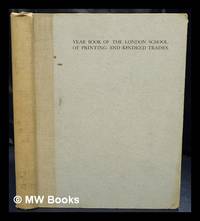
1932439688London : London school of printing and Kindred trades 1932. Hardcover. Very good copy in the original cloth-backed paper-covered boards. Spine bands and panel edges somewhat dulled and dust-toned as with age. Hinge starting. Remains quite well-preserved overall. Physical description: 129p. : ill. some col. London : London school of printing and Kindred trades hardcover
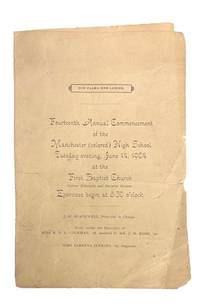
190495762Manchester VA 1904. Good. 1 sheet folded somewhat crookedly to make a four-page program. 22 cm. Somewhat soiled with some chips and tears as well as a partially split corner crease. James H. Blackwell an African American was for many years Principal of this school which opened in 1888. After Manchester merged with the city of Richmond in 1910 the school was renamed the Maury School. Rev. Dr. A. Binga Jr. an African American minister at Manchester's first Baptist Church and also the first African American public school teacher in Manchester gave the Invocation. Eight students read essays. We have laid in a cut signature "A. Binga Jr." from 1891. unknown
195273596Boston:: Wilson-Hill Company. Very Good. 1952. Paperback. Over 150 recipes simplified for young cooks. First edition paperback. Uniform age toning throughout text block else very good in oversize illustrated wraps. ; 128 pages . Wilson-Hill Company, paperback
195273596Boston:: Wilson-Hill Company. Very Good. 1952. Paperback. Over 150 recipes simplified for young cooks. First edition paperback. Uniform age toning throughout text block else very good in oversize illustrated wraps. ; 128 pages . Wilson-Hill Company, paperback books
1997299728PN. New. 1997. . Soft Cover. Date is original print. This is a reprint edition . PN paperback
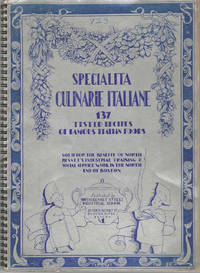
19366324Boston Mass: North Bennet Street Industrial School 1936. Wire-O metal coil binding 26 x 18.5 cm. 57 7 pages. Index is table of contents. Advertisements. Foreword printed on a separate sheet laid-in at front. Title author and publication data from cover. Date from information in second edition of 1937. FIRST EDITION. A community fundraising cookbook for the benefit of North Bennett Street Industrial School. There is no front matter title page intro etc. and the recipes are not attributed but are drawn from members of the surrounding community Boston's North End. Other fundraising efforts for the school are featured in the advertising section including The Perfection Bottle Rack "made by the unemployed" and an unnamed Spanish olive oil "sold exclusively by the North Bennet Street Industrial School". There is also a full page illustrated ad for Prince Superfine Macaroni. ~ Card stock boards printed in blue and silver; edge wear and pulls at a few wire coils. "123" written in ink at head of front wrapper panel otherwise very good. With the bookplate of cookery author and collector June Platt. OCLC locates five copies and four copies of the 1937 second edition. North Bennet Street Industrial School hardcover
197517OUT OF THE DARK IS VERY GOOD BUT MINING FOLK HAS TAPED SPINE NORTHERN CAMBRIA HIGH SCHOOL paperback
193713466New York Boston: Yamanaka & Co 1937. Second Edition. Hardcover. Good. Second Edition. Hardcover. 100 wood block colour illustrations plus hand-colored plates. A significant collection despite the foxing. Printed in Japan. The Rokkakudo Temple is said to have been founded by Prince Shotoku about 1400 years ago. Priests who made floral offerings at the Buddhist altar of this temple lived near a pond the Japanese word "ike" in a small hut called "bo". For this reason people began to call the priests by the name "Ikenobo.". Light to moderate shelf/edge wear sunned spine rubbing to boards small starting split but intact even toning throughout else tight and unmarred. 8vo. 21pp. Illus. b/w color plates. Accordion fold decorative blue cloth boards stamped title in blue in moderately worn paper slipcase with tape repair. In English with Japanese. Yamanaka & Co hardcover
1951734561951. Paperback. Good. All appear to be written in 1951 and all were sent to Rev. Campbell MacRae Lewistall who is identified on a slip laid in one of the envelopes as Founder-teacher Blyden-Lewistall Private School at 314 West 133rd Street in New York City. Some letters are worn; all appear to be complete. Most envelopes present some with stamps. Three of the letters were from Philip Nathaniel King headmaster or head teacher of this Methodist-supported elementary school; one is from his wife; two are from his son; and two are from Mr. King's niece who was also a teacher at the school. All of the letters seem designed to establish contact with Rev. Lewistall who is addressed as Uncle. Some including the letters from King's son thank the New York Uncle for gifts such as an air rifle. It is clear from the letters that conditions at the school were far from ideal and that the Kings were hoping that their uncle in America would provide some financial support. <br/><br/> paperback books
191849221Paris: A.E.F. 1918. fair to good. 293 v.2 only wraps stiff card covers figures tables some darkening to text covers worn/soiled sm chips at spine & edges. A.E.F. No. 1402 G-5. Subtitled: Ballistics and Dispersion Effects of Projectiles and Fuses Artillery Materiels Ammunition. A.E.F. paperback
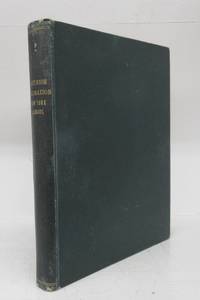
1921125319New York: The New York School of Interior Decoration 1921-1928 . Hardcover. Good. Various paginations. 29 cm. Numerous b&w illustrations. Also a page with 12 glued-on samples of typical upholstery fabrics in colour. Altogether 12 lessons on decoration each with separate title page example illustrations examination questions. Some pencil and ink marks along with thumbing in first two sections but less afterwards as though that's where a former student quit. Green cloth with worn corners and spine ends a few marks to boards and spine hinges cracking ink inscription on first page. <br/><br/>Lessons on: the theory of decoration; color harmony; decorative textiles; tapestries rugs and carpets; floor and wall treatments woodwork paint; furniture selection and arrangement; pre-Renaissance and Oriental art periods; Italian and Spanish Renaissance; French Renaissance; English Renaissance and American Colonial periods; lighting fixtures curtains and hangings; mantels and pictures. The New York School of Interior Decoration hardcover
1959025877Lubbock TX: Tom S. Lubbock High School 1959. Hardcover. Very Good/No Jacket. 4to - over 9¾" - 12" tall. 256pp.incl.index; HB blk.emboss; some rub w/usual sigs etc. Included: Ralna English featured performer on Lawrence Welk Show pgs.3547140.&145 <br/> <br/> Tom S. Lubbock High School hardcover
1958025876Lubbock TX: Tom S. Lubbock High School 1958. Hardcover. Very Good/No Jacket. 4to - over 9¾" - 12" tall. 288pp.incl.index; HB red w/white; some rub w/usual sigs etc. Includes: singer/songwriter/actor Mac Davis - senior picture pg.137 & featured performer on Lawrence Welk Show Ralna English pg.37 <br/> <br/> Tom S. Lubbock High School hardcover
1904269456Washington Barracks D.C.: Press of the Engineer School 1904. Second Edition. Very Good binding. Includes Piarron de Mondesir’s “Notes on Intrenching Toolsâ€; Colonel William Miller’s interesting “Water Supply of Washington D.C.†with black and white photographs; C. F. Porter’s “A Brief History of Works Erected for the Defense of Portland Maine†with large folding maps; Lieutenants Elliot Dent and George Spalding’s “Russian Provisional Fortifications†with many folding maps; and 9 other reports; Bound in buckram with new spine label; mylar custom cut to protect the binding. Very Good binding. Press of the Engineer School unknown
196779712Redstone Arsenal Alabama: U. S. Army Missile and Munitions Center and School 1967. Revised Edition. Wraps. Good. Staplebound at left side. 148 pages. Figures including photographs and drawings/diagrams and tables. Name in ink on front cover. Cover has some wear and soiling. This publication was provided for resident instruction at the U. S Army Missile and Munitions Center and School. It reflects the then current thought of the school and conformed to printed Department of the Army doctrine as closely as possible. The mission of the US Army Ordnance Missile and Munitions Center & School is to ensure the combat commander is supported during Army joint and combined operations by developing doctrine materiel CSS concepts requirements and organizational structure. The School is also tasked with producing mission focused motivated ordnance officers warrant officers soldiers and civilians who are technically competent in the munitions management explosive ordnance disposal electronic and missile maintenance and test measurement and diagnostic equipment arenas. Redstone Arsenal RSA is a United States Army post and a census-designated place CDP adjacent to Huntsville in Madison County Alabama United States and is part of the Huntsville-Decatur Combined Statistical Area. The Arsenal is a garrison for a number of tenants including the United States Army Materiel Command Army's Aviation and Missile Command the Missile Defense Agency of the Department of Defense and NASA's Marshall Space Flight Center. RSA has benefited from decisions by the Defense Base Realignment and Closure Commission. The Redstone Arsenal CDP had a population of 1946 as of the 2010 census. The base contains a government and contractor workforce that averages 36000 to 40000 personnel daily.<br /> <br /> Originally a chemical weapons manufacturing facility for World War II in the immediate post-war era it became home to the German rocket scientists that were brought to the US as part of Operation Paperclip. The team first worked on ballistic missiles starting with V-2 rocket derivatives before moving on to a series of ever larger designs. Many of their tests were carried out at White Sands Missile Range and flights between the two locations were common. In late 1956 the Army was relieved of most of its ballistic missiles in favor of similar weapons operated by the US Air Force. The German design team was then spun off to become part of the newly founded NASA. Redstone served as the primary site for space launch vehicle design into the 1960s.<br /> <br /> In March 1952 the commanding officer at Redstone Arsenal officially established the Provisional Redstone Ordnance School. In December the Ordnance Guided Missile School OGMS was established taking over the provisional operation. The OGMS greatly expanded through the years occupying a large land area with many buildings and providing a wide variety of missile and munitions courses for thousands of students from the U.S. as well as many foreign countries. The name was later changed to the Missile and Munitions Center & School in 1966 and then to the Ordnance Missile and Munitions Center and School in the mid-1980s. In 1994 the School Brigade disbanded and was replaced by the reformed 59th Ordnance Brigade which had previously disbanded in Europe in 1992. The school was then renamed the Ordnance Munitions and Electronic Maintenance School in 2002 and moved to Fort Lee in 2011. U. S. Army Missile and Munitions Center and School paperback
1904269456Washington Barracks D.C.: Press of the Engineer School 1904. Second Edition. Very Good binding. Includes Piarron de Mondesir's "Notes on Intrenching Tools"; Colonel William Miller's interesting "Water Supply of Washington D.C." with black and white photographs; C. F. Porter's "A Brief History of Works Erected for the Defense of Portland Maine" with large folding maps; Lieutenants Elliot Dent and George Spalding's "Russian Provisional Fortifications" with many folding maps; and 9 other reports; Bound in buckram with new spine label; mylar custom cut to protect the binding. Very Good binding. Press of the Engineer School unknown books
193290559Fort Sill OK: United States Army. Field Artillery School. Department of Tactics & Communication 1932. Presumed First Edition First printing thus. Single sheet printed on one side. Fair. The format is approximately 18 inches by 17 inches. RARE SURVIVING COPY. FRAGILE. Flimsy overlay paper. Tear in the lower right panel. Numerous pencil notations adjusting number printed on the overlay sheet. Several perforations noted. Short text notation at lower right corner. The United States Army Field Artillery School USAFAS trains Field Artillery Soldiers and Marines in tactics techniques and procedures for the employment of fire support systems in support of the maneuver commander. The school further develops leaders who are tactically and technically proficient develops and refines warfighting doctrine and designs units capable of winning on future battlefields. The school is currently located at Fort Sill Oklahoma. The mission of the Field Artillery is to destroy neutralize or suppress the enemy by cannon rocket or missile fire and to help integrate all fire support assets into combined arms operations. The U.S. Army Field Artillery School trains educates and develops agile adaptive and decisive Soldiers and leaders; engages collaborates and partners with other branches sister-services and other fires warfighting function proponents; and serves as the lead agent for the development of Field Artillery doctrine concepts and dissemination of that knowledge to the Field Artillery force in support of commanders operating across the full spectrum of conflict and in the joint inter-organizational and multinational JIM environment. The U.S. Army Field Artillery enables maneuver commanders to dominate in Unified Land Operations through effective targeting integration and delivery of fires. The vanguard sometimes abbreviated to van and also called the advance guard is the leading part of an advancing military formation. It has a number of functions including seeking out the enemy and securing ground in advance of the main force. The vanguard derives from the traditional division of a medieval army into three battles or wards; the Van the Main or Middle and the Rear. The term originated from the medieval French avant-garde i.e. "the advance guard". The vanguard would lead the line of march and would deploy first on the field of battle either in front of the other wards or to the right if they deployed in line. The origin of USAFAS can be traced back to the 1907 reorganization of the Artillery Corps and to the character of Fort Sill at that time. The 1907 reorganization created Coast and Field Artillery Branches. In the process of this reorganization the Field Artillery was deprived of its former home at Fort Monroe Virginia. Fort Sill was considered the best location for a Field Artillery school since its 15000-acre reservation allowed ample room for target practice and its great variety of terrain offered an excellent area for different types of tactical training. In addition the post had already assumed the character of the home of artillery with a large number of artillery units assigned. The first artillery school the US Army School of Fire was organized in 1911 by Captain Dan Tyler Moore. With the exception of a brief period in 1916 when school troops were used as frontier security guards during the Mexican Revolution the School has operated and expanded continuously. Hundreds of thousands of artillerymen have been trained at Fort Sill since the inception of the School. After the United States entered World War I the school reopened in 1917 with Col. William J. Snow as commandant. The Field Artillery School as it was now known added more courses. After the war school commandants began a long-range program to improve field artillery mobility gunnery and equipment. Budget cuts during the 1920s hampered their efforts but innovative directors of the Gunnery Department with support from school commandants helped modernize the field artillery in the 1930s. Maj. Carlos Brewer director of the Gunnery Department in the late 1920s and early 1930s introduced new fire direction techniques so fire support would be more responsive. Maj. Orlando Ward the next department director developed the fire direction center to centralize command and control and to facilitate massing fire. Brewer Ward and Lt. Col. H.L.C. Jones encouraged replacing horses with motor vehicles for moving field artillery guns. During World War II to best use new long-range guns and better response times the Field Artillery School championed the use of air observation to control artillery fires. The War Department approved organic field artillery air observation in 1942. The artillery air observers adjusted massed fire and performed liaison reconnaissance and other missions during the war. Following the war the school adapted to the atomic age and the Cold War. The War Department consolidated all artillery training and developments under the U.S. Army Artillery Center at Fort Sill in 1946. At that time the center included the Artillery School the Antiaircraft and Guided Missile School at Fort Bliss Texas and the Coast Artillery School at Fort Scott Calif. United States Army. Field Artillery School. Department of Tactics & Communication unknown
1915000876Davis CA: Associated Students of the University Farm School. 100 pages of Academic yearbook photos of students faculty activities sports clubs etc student writings and cartoons; 47 pages of period ads from local Davis businesses in support of this publication.Cover soiledpenciling edgewear 1st page has foxing and lower corner torn off. O/w good. University Farm School began in 1905 and eventually became University of California at Davis. Early rare yearbook. . good. Soft cover. 1915. Associated Students of the University Farm School paperback
194249130Fort Benning GA: The Infantry School 1942. good. 312 illus. maps text slightly darkened. Contents include: from flintlock to M-1; a raid to capture an enemy weapon of a new type; combat training of the rifle squad within the rifle platoon; the infantry battalion rifle in defense; troop movement by motor; the heavy weapons company in attack; motor vehicle maintenance in the field and on the march; artillery-infantry team in the triangular division; rifle company platoons in attack; a history of the Infantry School; and notes on infantry stream crossing expedients for 1/4-ton trucks. The Infantry School unknown
194218375<p>Very Good HC in Very Good DJ. Black paper over boards backed with black morocco-grain cloth; front cover with light blue building design and red titles. Bright clean covers and spine; few faint faded spots on cloth; tightly bound; owner name on front pastedown; bright clean interior. DJ is bright clean and complete; few light scuffs; tiny chip at front cover top fore corner. 8vo unpaged about 80 pp.</p> Simsbury, CT: Westminster School Year Book Board hardcover
19782110502151107862Shanghai Ancient Book Publishing House 1978. Soft Cover. Fine. Number of books: 4 Shanghai Ancient Book Publishing House paperback
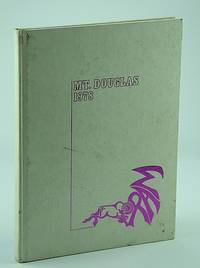
1978873G3895Saanich British Columbia: Mount Douglas Senior Secondary School Yearbook Committee 1978. Book. Good. Hardcover. First Edition. 4to - over 9¾" - 12" tall. 144 pages. Autographs and inscriptions. Average wear. Binding intact. A sound vintage copy. Mount Douglas Senior Secondary School Yearbook Committee Hardcover
1983873G3892Victoria B.C.: Royal Oak Middle School. Fair. 1983. First Edition. Hardcover. 96 pages. Lots of autographs. Above-average wear. Binding intact. A worthy vintage copy.; 4to - over 9¾" - 12" tall; 1982-1983 Yearbook of Royal Oak Middle School Victoria B.C. British Columbia . Royal Oak Middle School hardcover