852 résultats
18732090202122801542Ise Yamada Kato Chohei 1873. Soft Cover. Fine. Number of pages: 34 pages Size: 46 pages Ise Yamada Kato Chohei paperback
18992092902137600847Published by Hobunkan 1899. Soft Cover. Fine. Size: Japanese paper book upper and lower are slightly different Number of books: 2 Published by Hobunkan paperback
18772092902141401317Tsuda Genbe version 1877. Soft Cover. Fine. Volume: 1 Tsuda Genbe version paperback
18972111902160602815Nishimura Gohokan Collection Edition 1897. Soft Cover. Fine. The book is in fine condition. Nishimura Gohokan Collection Edition paperback
18792080502106910377Not Available 1879. Soft Cover. Fine. The book is in fine condition. Not Available paperback
18802111902160201225Kaichi School 1880. Soft Cover. Fine. Number of books: 1 Kaichi School paperback
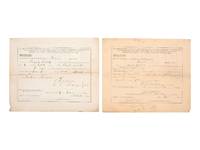
1888215331888. Rowan County Board of Education teacher pay vouchers 1888 and 1892 documenting African American education within the segregated public school system of post-Reconstruction North Carolina. The vouchers record segregated public education and its funding mechanisms through payments to Black teachers approved at the county level. These documents show how African American educators were paid through formally structured systems requiring countersignature by the county superintendent and approval by district committee members.<br /> <br /> Two manuscript teacher salary vouchers each approximately 8.5 x 7 inches and written on both sides. The first dated March 26 1888 authorizes payment of $30.00 to Maggie Locke for teaching in "School District No. 4 Rowan County for Colored Race" covering the period from January 3 to March 2 1888 in Atwell Township. The printed form specifies that payment is contingent upon countersignature by the county superintendent and approval by at least two district committee members establishing formal oversight procedures. The verso bears Locke's signed receipt dated March 27 1888 acknowledging payment from county treasurer J. M. McCubbins. The second voucher dated January 16 1892 records payment of $25.00 to Isaac Kerns for teaching in "School District No. 2 Salisbury & No. 2 Prov. Rowan County for Colored Race" with similar requirements for administrative approval prior to disbursement. The verso includes Kerns's signed acknowledgment of payment. Both documents explicitly designate the schools as serving the "Colored Race" indicating the formalized racial segregation embedded within the educational system.<br /> <br /> These vouchers document the operation of segregated schooling in the decades following the Civil War when African American education expanded under conditions of systemic underfunding and institutional control. The requirement for multiple authorizations before payment records the bureaucratic regulation of Black teachers' labor while the recorded wages provide quantitative evidence for comparative study of compensation disparities. Produced during a period when access to education for African Americans remained contested these documents contribute to research on Reconstruction-era legacies Jim Crow governance and the role of Black educators in sustaining community institutions. Light wear minor creasing and typical manuscript handling marks; overall very good condition. Documentary record of the administrative structure and lived realities of segregated education in the late nineteenth-century South. unknown
187810633ANMPhiladelphia PA: American Sunday-School Union 1878. 251 pp. Original green cloth covers w/ decoration on front cover and gilt title on spine. INSCRIBED AND SIGNED BY JOHN V. SEARS. Corners bumped. Normal shelf wear. Light foxing to pg. text block and endpapers. Illust. w/ b/w drawings. Contents nice. . Signed by Author. First Edition. Hard Cover. Very Good/No Dust Jacket. 12mo - over 6¾" - 7¾" tall. American Sunday-School Union Hardcover
18398953Edinburgh: Whyte & Co. 1839. 8vo. 11 1 blank 8 pp. <br><br><br>Â Â Â Â <br>Â Â Â Â Apparently not in NSTC CD version. Removed from a nonce volume. Lightly age-toned. Inked numeral on title-page. Whyte & Co. unknown books
1881467192Tübingen, Laupp, 1881. XXIV, 847; VIII, 498; XV, 575; VIII, 538 S. Halbleder d. Zeit (berieben, Ecken leicht bestoßen, Gelenke mit einigen Wurmstichen, Vordergelenk von Band 1 mit langem Einriß). [2 Warenabbildungen]
1867108898Tübingen, Laupp, 1867. XXXI, 583 S. Pappband d. Zeit (berieben u. bestoßen). [2 Warenabbildungen]
18853243056Tübingen, Laupp, 1885. 112 S. Kart.
18943369920Leipzig, Duncker & Humblot, 1894. VII, 450 S. Hlwd (Stempel auf Titel).
1873SBLB0264Wien, k.k. Schulbücher-Vlg. 1873. kl.-8°, XII, 228 S., mit 114 Abb. u. 1 Karte, HLn. d. Zt., stark berieb. u. bestoß., Name v. alter Hd. auf flieg. Vors., papierbed. gebr., Einbd. gelockert, Vorsatzfalz hinten aufgeriss.
1900SBLB0233Wien, k.k. Schulbücher-Vlg. 1900. kl.-8°, XII, 228 S., OHLn., Lichtspuren, berieb., bestoß., Kanten u. Ecken etw. aufgeplatzt, flieg. Vors. m. Stemp. u. hs. Nummerierung, Titelbild m. Buntstift bemalt. Dabei: Güttenberger, Heinrich. Die Einsiedler in Geschichte und Sage. Wien, Reinhold-Vlg. 1928. kl.-8°, 191 S., mit 13 Bildtaf. u. einem Plan, Ausstattung von Rose REINHOLD, OKart. m. ill. Papierüberzug, hint. Deckel stark geknickt, abgegriff., Textblock gebräunt.
187528226Stuttgart. Chr. Belser Verlagshandlung. 1874 und 1875. 2 Blätter, 300 Seiten u. 2 Blätter, 272 Seiten. HLdr.-Einband der Zeit. (Einband stärker berieben; Papier etwas fleckig) 21x13 cm
1899EEzz2681Mchn., Helbing 1899 (Auktion). 8 Bl., 50 Taf. u. erläut. Texts., 1 Titelportr. Folio. OLn. Mit leichten Anstr. im Text. Eines von 500 Ex. der "Prachtausgabe". - Gemälde der Holländischen, Vlämischen und Deutschen Schule.
18973192994Leipzig, Flisecher, 1897. XVI, 415 S. Hldr (mit eingebundener OBroschur, beschabt).
1867PAED0050Wien, Selbstvlg. d. Hrsgs. 1867. 112 S. HLn. d. Zt. Bestempelt, Text etw. gebräunt.
1900005877Battlecreek MI : School of Applied Art 1900. This is a bound volume of 18 issues of the School of Applied Art's journal with only light wear. The black cloth covers with gilt title "Commercial Art" very clean and unmarked. Inside very clean too. Each issue with a different title. All issues have illustrations in black & white. Some issues have tipped-in color plates fold-outs. One issue has an original photograph tipped-in. 8" high X 5.5" wide each issue 20 to 30 pages. All covers bound in. This book will be securely wrapped and packed in a sturdy box and shipped with tracking. Hard Cover. Very Good. School of Applied Art Hardcover
18893754Freeman Place Beacon Street Boston: The School 1889. FIFTH ANNUAL CATALOGUE OF THE SCHOOL OF EXPRESSION- School of Expression S. S. Samuel Silas Curry- The School- Freeman Place Beacon Street Boston- 1889- 1st Edition-1st Printing- Illustrated Softcover Wraps:-12mo- Fine/ no jacket as issued- original manilla illustrated softcover wraps tight clean and solid- 25pp 3pp ads are clean and crisp- SEE PHOTOS- A very scarce pamphlet from the School of Expression in Boston- Only one other example held in World Cat Libraries and that at Ohio State U-: Corp Author- School of Expression Boston Mass.- Title: Fifth annual catalogue of the School of Expression- Publish Info Boston : The School 1889- Local Note: OSU's copy 1 part of the Jerry Tarver Elocution Rhetoric and Oratory Collection-OSU's copy 1 gift of Jerry Tarver- OSU's c.1: Information relating to the provenance or history of the item available in Rare Books and Manuscripts Library. THO Special Collections Rare Books Stacks- From World Cat: Fifth annual catalogue of the School of Expression.-Author: . 1st Edition-1st Printing. Illustrated Softcover Wraps. Fine/No Jacket as Issued. 12mo - over 6¾" - 7¾" tall. The School Paperback
190043614Lincoln: Journal Co. Printers and Stationers. Good. circa 1900. 1st Edition. Softcover. Tan covers quite worn and pulling away from staples with staining and chipping to edges. Still quite easily read and complete. School treasurer's report with cash received and expenses detailing payments for teachers school supplies coal and hauling coal etc. Dates range from 1902 through 1912 with entries on 21 pages. A one of a kind Webster County Nebraska historical and genealogical item. ; MCN35950; 4to 11" - 13" tall; 59 pp . Journal Co., Printers and Stationers paperback
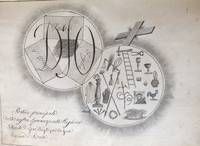
18242952Genoa 1824. <p>Manuscript on laid paper 4to 236 x 176 mm. 126 leaves foliated 3 1-3 1 4-42 1 43-51 1 52-61 1 62-103 1 104-118 complete. The numbered leaves containing one hundred and eighteen emblematic drawings all full-page explanations written on versos the unnumbered leaves containing the title 3 and 1/2-page introduction and section titles; most of the illustrations in landscape format. Calligraphic title text in brown ink in a neat cursive hand; the drawings in graphite pen-and-ink and gray wash a few with details in brown ink each within rule border with numbering at top gutter edge. Corner repairs to ff. 1-10 tears into ff. 9 and 104 a few other short marginal tears or fraying to edges ff. 100 and 101 with gutters reinforced on versos occasional minor offsetting or soiling. Late 19th-century half parchment and brown glazed paper manuscript title label on spine. <br /><br />An illustrated manuscript course of religious instruction for Deaf children by a pioneer of Deaf education in Italy using an original emblematic visual "language." <br /><br />By the early nineteenth century pre-modern misconceptions concerning the learning abilities of Deaf children had been largely exposed as false by such eighteenth-century pedagogues as the abbé Sicard and Charles-Michel de l'Epée in France each of whom founded schools for the Deaf and contributed to the development of a standardized sign language or Samuel Heinicke in Germany who implemented a different method of communication for the Deaf centered on oral speech. In Italy the most influential figure in the education of Deaf children was Ottavio Assarotti. As a young man Assarotti entered the order of the Piarists the Scuole pie. Founded in 1617 the Piarists' principal mission was and remains the provision of free education to poor and especially disabled children. After several years teaching theology and philosophy Assarotti set those disciplines aside to devote himself full-time to the development of an instructional program for Deaf children. Assarotti's method consisted in teaching the children not only reading writing and sign language but also a full range of humanist disciplines including science the arts and foreign languages. In 1805 he obtained financial support from Napoleon to found a school which after some delays was finally opened in 1811 in the former Bridgettine convent. After Napoleon's defeat the growing school received renewed support from King Vittorio Emmanuele I and its fame spread throughout Europe. <br /><br />"Assarotti made great use of sign language in his teaching . Directors of nearly all Italian institutes for deaf students flocked to learn from him and carried his method back with them. Pope Gregory XVI sent the new directors of the Rome Institute Padri Ralli and Gioazzini to study in Genoa with Assarotti. Upon their return to Rome they too used his techniques. How is it possible that a man so renowned and successful in his own time did not earn so much as one line of recognition in the historical accounts of other countries Perhaps the answer lies in the fact that Assarotti left no traces in written form of his philosophy and method. Had he done so not only would he have gained respect and notoriety outside Italy but perhaps the critical events soon to follow the subsequent dominance of "oralism" over sign language in Italy would have taken a different course ." Radutsky p. 245.<br /><br />In fact Assarotti wrote and may have published several texts for his pupils listed in DBI but not found in OCLC or ICCU. The present unpublished work was probably prepared for the use of instructors in the school. It contains a pictorial religious course of instruction using a complex but precise symbolic system to explain Christian doctrine and liturgy including the most abstract theological concepts. All the elements in the drawings are identified in captions of varying lengths and in various layouts. Names or words are often incorporated as visual elements of the emblems. While somewhat primitive the drawings' unique iconography is evocative and some have a powerful dreamlike quality.<br /><br />In the Middle Ages the Deaf were barred from the sacraments - and hence from marriage and any kind of normal life - because of the belief that they could not understand the word of God. While these strictures were loosened in 1571 thanks to Luther's influence prejudice against Deaf persons' abilities to achieve salvation subsisted partly because it was thought that they could not perform Confession. Hence the importance to early educators of the hearing-disabled of providing their pupils with comprehensive religious instruction as an essential foundation of their integration into society.<br /><br />The unnamed author of the introduction writing in the third person describes Assarotti's school and praises his religious zeal humanity and his understanding that Deaf people who had been previously "abandoned by society" are fully competent and indeed capable of the highest intellectual and spiritual attainment. The emblems the author explains will present to the Deaf student an easy transition from familiar material objects to those objects which are less material and from there to the most immaterial concepts of all. In doing so he or she will eventually absorb the entire Christian doctrine. The figures are described as Assarotti's own egli . ha inventato le figure che formano questo Libro . but whether the actual drawings are in his hand is uncertain. The introduction concludes with an explanation of the most frequently recurring emblematic figures. God is represented by a circle containing three rectangles which touch the circle and each other representing the Divine Trinity: flames emanate from the God the Father and Jesus rectangles toward the one representing the Holy Spirit a concept which is explained in the text as the reciprocal love between the two other Divine Persons. Jesus the man as opposed to his divine nature is shown by another circle helpfully inscribed "Uomo / Jesu' Cristo" and humans or human souls are represented by hearts although the meaning of the heart emblem varies throughout the manuscript. Further symbols introduced later are explained on the versos of the drawings.<br /><br />Contrasting with the approbation granted his pedagogical achievements Assarotti's religious views linked to the most mystical wing of the Ligurian Jansenists met with resistance from the church hierarchy and some of his theological writings were not approved for publication. The drawings of this manuscript provide a glimpse of an abstract mysticism which would certainly have been at odds with Catholic orthodoxy.<br /><br />The work is in five parts titled: Faith Fede ff. 4-42; Laws Legge 43-51; Prayer Preghiera 52-61; Sanctification Sanctificazione 62-103 and Virtue Vertù 104-118. The first part is a visual exposition of the Credo starting with God's attributes: his ubiquity is represented by the God and Jesus circles overlapping above a symbol of the world earth and heavens with the word DIO written repeatedly across the page; his omniscience by the God symbol at top sending down rays of light at center a man sitting under a tree and below that a well captioned "Abyss." Creation is a delightful drawing of fish in the seas flanking a mound representing the earth on top of which cavort animals under trees and within which are three large hearts linked to a central pole at the top and illustrating the three reasons that God created man: so that they might know love and enjoy him. The Church of Jesus Christ is an architectural drawing of a fortress. Heaven is a light emanating rays while Hell is a large vat whose opening is locked and barred. Virtuous souls are flaming hearts each with an open eye since they see God; sinful souls are spotted hearts with wilted stems instead of flames. These blemished hearts recur throughout the book for example behind bars in the vat of Hell; enchained by a similarly spotted Devil; in a genealogical tree descended from Adam and Eve; or clustered above Hell on Judgment Day opposite a crowd of pure haloed hearts trumpets sounding above and lightning striking the damned while divine light bathes the saved.<br /><br />The section on Laws contains various allegorical representations of the Ten Commandments. While some drawings amount to schematic tables demonstrating the relationships between theological concepts others are more pictorial. Reflecting no doubt Assarotti's personal mysticism all aspects of the divinity are abstract: there are no angels Madonnas or images of Christ. Crosses are shown but there are no Crucifixions and Christ's Passion appears as a circle containing the Arma Christi. The church hierarchy is represented by a papal tiara mitres and stoles. Human figures appear predominantly in the drawings of the sacraments and in representations of sin. In contrast with the invisibility of the divine Satin is personified as a grimacing devil and the seven deadly sins appear as animals and monsters poised above poisonous emissions from Hell's chimneys. <br /><br />That Assarotti's school used such manuscripts for teaching is supported by the existence of another manuscript very similar in content but lacking the title and two leaves offered by the Austrian antiquarian book firm Inlibris. Cf. Dizionario Biografico degli Italiani art. Antonella Dolci 4:433-4; E. Radutsky "The Education of Deaf People in Italy and the Use of Italian Sign Language" in Van Cleve ed. Deaf History Unveiled 1993 237-5; Rauthgundis Kurrer Gehörlose im Wandel der Zeit doctoral dissertation University of Munich 2013 available as a pdf online pp. 30-33.</p> unknown books
1834547Millgrove Buschkill Taunship Northampton County Pennsylvania: Gedruckt von Samuel and Solomon Siegfried's 1834. 12mo. 189 x 105 mm. 7 x 4 ¼ inches. 360 pp. . Illustrated with woodcut title-page vignette and a woodcut image of a thermometer. Contemporary leather backed marbled paper boards; scuffed and rubbed at joints; paper toned with age and some foxing; good copy. First edition text entirely in German. Scarce Millgrove imprint written by Samuel Siegfried and printed by his brother Solomon both of Northampton County. The content of the geography text is well conceived beginning with a section of geographical terms followed by a grammar of place names and vital statistics for every state territory and country in North and South America Europe Africa the Near East and the Far East. This is followed by a more detailed study of each of the place names and includes information on population manufacturing farm production major cities literary and cultural centers and religious denominations. The book is fully indexed. "Samuel Siegfried 1797-1879 started his career as a printer after his move from Easton to Millgrove in 1834. In this he published at least two books Deutsche Georgraphie and Bewährter Ratgeber and his first broadside baptismal certificate together with his brother Solomon. At the end of this year and during 1835 Samuel Siegfried printed and published three further baptismal certificates under his own name." Solomon Siegfried is best known for the printing and decorating of birth and baptismal certificates which he produced for German speaking families in Northampton County. Shoemaker Checklist of American Imprints 26774. Stopp The Printed BBC's III p. 176. Earnest Flying Leaves and One-Sheets pp. 41-42 264. Gedruckt von Samuel and Solomon Siegfried's unknown books
1883391251London : School Board 1883. 1st edition. Hardcover. Poor copy in the original half aniline calf over ribbed-cloth boards. Front board detached; back board lacking. Spine worn; spine bands and panel edges somewhat rubbed and bumped as with age. Text remains clear and without blemish. Physical description; 970 pp. Subjects; Great Britain. Parliament. House of Commons. London. School Board. Accounts. London : School Board hardcover