School, Zion LawBiblio.com
911 Ibaryath Rescue: Ancient Phoenician Paleo Hebrew
33472394like new. unknown
GreatBookPrices · États-Unis76,52 $US≈ 64,74 €
34 831 résultats
19702091202133105159Meizen School 90-Year History Publishing Association 1970. Soft Cover. Fine. Volume: 1 Meizen School 90-Year History Publishing Association paperback
2082402113507902Not Available N.A. Soft Cover. Fine. Number of books: books Not Available paperback
19882090202120410980Hiroshima Prefecture Miyoshi High School Alumni Association 1988. Soft Cover. Fine. Number of books: 1 Hiroshima Prefecture Miyoshi High School Alumni Association paperback
19952090202120411710Hiroshima University Junior and Senior High School 1995. Soft Cover. Fine. Number of books: 1 Hiroshima University Junior and Senior High School paperback
19862080502106501550Not Available 1986. Soft Cover. Fine. Number of books: 2 Not Available paperback
19752082402113510516Not Available 1975. Soft Cover. Fine. The book is in fine condition. Not Available paperback
33472394like new. unknown
0260323918.Ghardcover. Good. Access codes and supplements are not guaranteed with used items. May be an ex-library book. hardcover
0266111874.Gpaperback. Good. Access codes and supplements are not guaranteed with used items. May be an ex-library book. paperback
19892092902141200146Qilu Book Company 1989. Soft Cover. Fine. The book is in fine condition. Qilu Book Company paperback
19682212270374xbvkTokyo, Tokuma Shoten, Showa 43/5/10 (1968). 245 pages, 1 p. colophone. - Ornamental titlepage in slightly misspelled German 'Ästhetik des Knabenlibe', Text and colophone in Japanese. - Publisher's illustrated hardcover-binding with matching original dustjacket which again is protected by a halftransparent orig.? vellum-paper jacket; and again in a red plastic booksleeve by 'Hankyu Book Center'(Osaka, Inagaki's city of birth); 8vo.(ca. 22 x 17 cm).
1955904510BGUm 1955. Blattmaß: 50,5 x 65 cm. Bildmaß: 40 x 55 cm (quer).
Very Good Turkish, Ottoman (1500-1928) Collection includes six postcards by him sent to Mehmed RAsih Bey, Âli Türkgeldi (Sofia, Bulgaria), Satvet Lütfi Tozan, one newspaper clipping about Gerede, eight autograph letters signed 'Hüsrev' sent to Satvet Lütfi Tozan, (1889-1975), Âli Türkgeldi, 1867-1935) and beside ones which came from them to him. Some letters are more than one page. Full text. In Ottoman script. Items dated from 1920 to 1929/30 on letters and postcards. All in one envelope with Ottoman script autograph notes and name of Hüsrev Gerede on it. Letters and other material include mostly important diplomatic contents and early Republican Turkish historical info. These material is not published. Gerede was a Turkish career officer, who served in the Ottoman Army and the Turkish Army. He was also a politician and diplomat of the Republic of Turkey. He has Medal of Independence with Red-Green Ribbon.
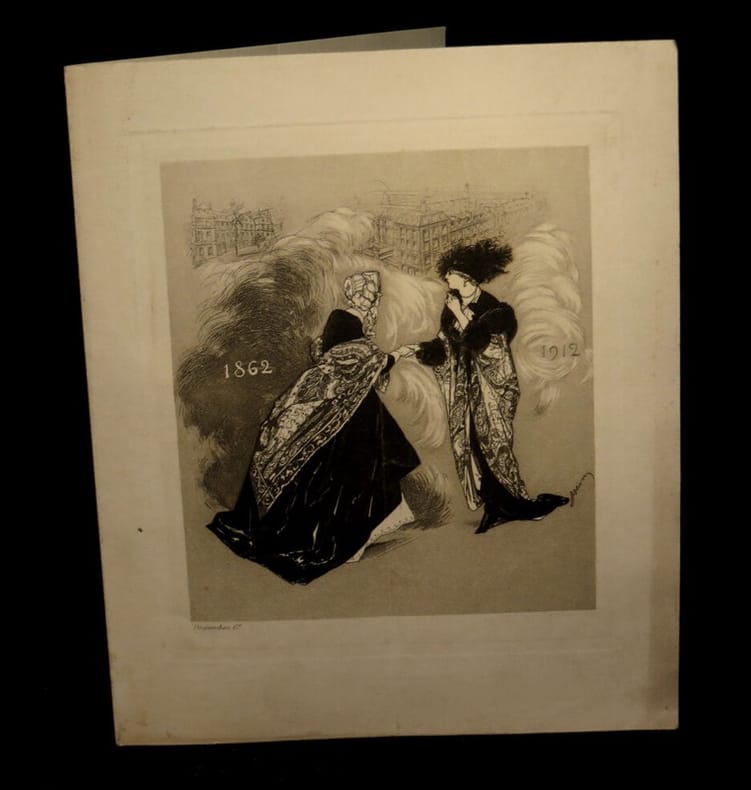
191216298[1912]. Dimensions : 223 x 183 mm.
Very Good Turkish, Ottoman (1500-1928) Original illustrated and decorative wrappers. Pages are untrimmed and not opened. 12mo. (16 x 12 cm). In Ottoman script. 104 p. Hejra-Hijri: 1311 = Gregorian: 1894. Early edition of this rare Turkish book with Arabic script about the Jesuits' society, the most influential community of the Catholic Church, their activities and formations from the 16th to the late 19th century. It was a translation from German, but it's not written original title in the book. Kaymakam Mehmed Tahir was a late Turkish martry who was a district governor of Yozgat city. He died in the War of Independence (1919-1922). Extremely rare. Özege 3085 / 2.; TBTK 7602. Second Edition.
Very Good Turkish, Ottoman (1500-1928) Original wrappers. 12mo. (16 x 12 cm). In Ottoman script. 44 p. Hejra-Hijri: 1304 = Gregorian: 1887. Extremely rare first edition of this Ottoman edition of 'history of the Jesuits'. This book has been abridged and translated from Taxil's work. Marie Joseph Gabriel Antoine Jogand-Pagès, better known by the pen name Léo Taxil was a French writer and journalist who became known for his strong anti-Catholic and anti-clerical views. He is also known for the Taxil hoax, a spurious expose of Freemasonry and the Roman Catholic Church's opposition to it. Marie Joseph Gabriel Antoine Jogand-Pagès was born in Marseille, and at the age of five, he was placed into a Jesuit seminary. After spending his childhood years in the seminary, he became disillusioned with the Catholic faith and began to see the religious ideology as socially harmful. Taxil first became known for writing anti-Clerical or anti-Catholic books, notably "La Bible amusante" (The Amusing Bible) and "La Vie de Jesus" (The Life of Jesus), in which Taxil satirically pointed out inconsistencies, errors, and false beliefs presented in these religious works. In his other books Les Debauches d'un confesseur (with Karl Milo), Les Pornographes sacrés: la confession et les confesseurs, and Les Maîtresses du Pape, Taxil portrays leaders of the Catholic Church as hedonistic creatures exploring their fetishes in the manner of the Marquis de Sade. In 1879, he was tried at the Seine Assizes for writing a pamphlet A Bas la Calotte ("Down with the Cloth"), which was accused of insulting a religion recognized by the state, but he was acquitted. In 1885, he professed conversion to Catholicism, was solemnly received into the church, and renounced his earlier works. In the 1890s, he wrote a series of pamphlets and books denouncing Freemasonry, charging their lodges with worshiping the devil and alleging that Diana Vaughan had written for him her confessions of the Satanic "Palladian" cult. The book had great sales among Catholics, although Diana Vaughan never appeared in public. In 1892, Taxil also began to publish a paper, La France chrétienne anti-maçonnique (Christian Antimasonic France), with his staunch anti-Masonic publishing friend, Abel Clarin de la Rive. In 1887, he had an audience with Pope Leo XIII, who rebuked the bishop of Charleston for denouncing the anti-Masonic confessions as a fraud and, in 1896, sent his blessing to an anti-Masonic Congress of Trent. Doubts about Vaughan's veracity and even her existence began to grow, and finally, Taxil promised to produce her at a lecture to be delivered by him on 19 April 1897. To the amazement of the audience (which included a number of priests), he announced that Diana was one of a series of hoaxes. He had begun, he said, by persuading the commandant of Marseille that the harbor was infested with sharks, and a ship was sent to destroy them. Next, he invented an underwater city in Lake Geneva, drawing tourists and archaeologists to the spot. He thanked the bishops and Catholic newspapers for facilitating his crowning hoax, namely his conversion, which had exposed the anti-Masonic fanaticism of many Catholics. Diana Vaughan was revealed to be a simple typist in his employ, who laughingly allowed her name to be used by him. The audience received these revelations with indignation and contempt. Afterward, Taxil left the hall, where policemen escorted him to a neighboring café. He then moved away from Paris. He died in Sceaux in 1907. An extremely rare first translation in Ottoman Turkish. Özege 9775. First Edition.
1372265Corbeil: Imprimerie Crété, 1936 in-4, 16 pages, illustrations, plan dépliant. Agrafé, couverture illustrée en couleurs. Programme de la fête du Point Gamma de l'Ecole Polytechnique.
1372264Corbeil: Imprimerie Crété, 1937 in-4, 16 pages, illustrations, 2 ff. libres de publicité, plan dépliant. Agrafé, couverture illustrée en couleurs. Programme de la fête du Point Gamma de l'Ecole Polytechnique.
1372266Corbeil: Imprimerie Crété, 1938 in-4, 48 pages, illustrations, plan dépliant. Agrafé, couv. illustré, un peu défr. Programme de la fête du Point Gamma de l'Ecole Polytechnique.
1372262Corbeil: Imprimerie Crété, 1936 in-4, 56 pages, illustrations, 2 ff. libre de publicité. Agrafé, couverture illustrée en couleurs. Programme de la fête de la Sainte-Barbe de l'Ecole Polytechnique.
1372263Corbeil: Imprimerie Crété, 1937 in-4, 64 pages, illustrations, 1 ff. libre de publicité. Agrafé, couverture illustrée en couleurs. Papier légèrement gondolé par l'humidité à la marge inférieure des pages. Programme de la fête de la Sainte-Barbe de l'Ecole Polytechnique.
1372261Corbeil: Imprimerie Crété, 1935 in-4, 64 pages, illustrations, 1 ff. libre de publicité. Agrafé, couverture illustrée en couleurs. Papier légèrement gondolé par l'humidité à la marge inférieure des pages. Programme de la fête de la Sainte-Barbe de l'Ecole Polytechnique.
Very Good Greek, Modern (post 1453) Contemporary fine leather bdg. Demy 8vo. (22 x 15 cm). In Greek. 1118 p., richly illustrated (b/w ills.). Period bindery label of E. Watson in London. Ex-library copy on fourth blank page. Otherwise a very good copy. First and extremely rare translation into Greek of Taxil's 'Myste`res de la Franc-Mac?onnerie'. Mysteries of Freemasonry. Marie Joseph Gabriel Antoine Jogand-Pagès, better known by the pen name Léo Taxil was a French writer and journalist who became known for his strong anti-Catholic and anti-clerical views. He is also known for the Taxil hoax, a spurious expose of Freemasonry and the Roman Catholic Church's opposition to it. Marie Joseph Gabriel Antoine Jogand-Pagès was born in Marseille, and at the age of five, he was placed into a Jesuit seminary. After spending his childhood years in the seminary, he became disillusioned with the Catholic faith and began to see the religious ideology as socially harmful. Taxil first became known for writing anti-Clerical or anti-Catholic books, notably "La Bible amusante" (The Amusing Bible) and "La Vie de Jesus" (The Life of Jesus), in which Taxil satirically pointed out inconsistencies, errors, and false beliefs presented in these religious works. In his other books Les Debauches d'un confesseur (with Karl Milo), Les Pornographes sacrés: la confession et les confesseurs, and Les Maîtresses du Pape, Taxil portrays leaders of the Catholic Church as hedonistic creatures exploring their fetishes in the manner of the Marquis de Sade. In 1879, he was tried at the Seine Assizes for writing a pamphlet A Bas la Calotte ("Down with the Cloth"), which was accused of insulting a religion recognized by the state, but he was acquitted. In 1885, he professed conversion to Catholicism, was solemnly received into the church, and renounced his earlier works. In the 1890s, he wrote a series of pamphlets and books denouncing Freemasonry, charging their lodges with worshiping the devil and alleging that Diana Vaughan had written for him her confessions of the Satanic "Palladist" cult. The book had great sales among Catholics, although Diana Vaughan never appeared in public. In 1892, Taxil also began to publish a paper, La France chrétienne anti-maçonnique (Christian Antimasonic France), with his staunch anti-Masonic publishing friend, Abel Clarin de la Rive. In 1887, he had an audience with Pope Leo XIII, who rebuked the bishop of Charleston for denouncing the anti-Masonic confessions as a fraud and, in 1896, sent his blessing to an anti-Masonic Congress of Trent. Doubts about Vaughan's veracity and even her existence began to grow, and finally, Taxil promised to produce her at a lecture to be delivered by him on 19 April 1897. To the amazement of the audience (which included a number of priests), he announced that Diana was one of a series of hoaxes. He had begun, he said, by persuading the commandant of Marseille that the harbor was infested with sharks, and a ship was sent to destroy them. Next, he invented an underwater city in Lake Geneva, drawing tourists and archaeologists to the spot. He thanked the bishops and Catholic newspapers for facilitating his crowning hoax, namely his conversion, which had exposed the anti-Masonic fanaticism of many Catholics. Diana Vaughan was revealed to be a simple typist in his employ, who laughingly allowed her name to be used by him.The audience received these revelations with indignation and contempt. Afterwards, Taxil left the hall, where policemen escorted him to a neighboring café. He then moved away from Paris. He died in Sceaux in 1907. First Greek Edition. Rare. Only one copy in OCLC: 758917323.
18991802260263xbvkParis, E. Bernard & Cie, 1897/1899. Overall 300 untrimmed pages of text on strong paper, CLX (160) singleside intaglio-printed colour-plates on thin white cardboard; loosely inserted: largesize 4-page publisher's advertisement for the present publication (''Vient de paraître. . .''). - Publisher's richly gilt half-morocco bindings with mainly red and green (incl. minimal black and yellow) marbled panels, endpapers marbled as well, topedges gilt; Folio (ca. 32,5 x 25,5 x 6 cm; ca. 5 kg.).
Very Good Italian Paperback. Roy. 8vo. (24 x 17 cm). In Italian. 33-93 pp. Signed and inscribed by Saban. Saban was a Turkish mathematician of Jewish origin. He's the nephew of Saban who is the chief rabbi of Turkey. He studied on quazi asymptotic varieties, differential geometry, space curves, and openable surfaces and integrals on the sphere surfaces.