852 résultats
183426035Italy 1834. Pen-and-ink watercolour and gouache painted black border titled and dated in white gouache in the lower margin within the border. Lovely 19th-century watercolour of Palermo.<br/> <br/>Catering to the foreigners flocking to the region on the Grand Tour this lovely watercolour shows the town of Palermo with its beautiful hills and mountains in the background with a large fort in the harbour with a British and French ship beside it. The sky is awash in pinks and blues displaying the incredible light of the region. unknown books
183426035Italy 1834. Pen-and-ink watercolour and gouache painted black border titled and dated in white gouache in the lower margin within the border. Lovely 19th-century watercolour of Palermo.<br/> <br/> Catering to the foreigners flocking to the region on the Grand Tour this lovely watercolour shows the town of Palermo with its beautiful hills and mountains in the background with a large fort in the harbour with a British and French ship beside it. The sky is awash in pinks and blues displaying the incredible light of the region. unknown
185711975Bourg, Imprimerie Dufour, 1857 ; in-16, broché ; 28 pp., couverture lilas imprimée.
1889ln791Paris, librairie de Firmin-Didot et Cie, imprimeurs de l'institut, rue Jacob, 56 Relié 1889 In-8 (15,5 x 22,5 cm), demi-chagrin, dos à cing nerfs orné de petites dorures, illustré de 28 gravures en noir dont 18 hors texte par Quesney de Beaurepaire, bel exemplaire ; petit choc sur le mors supérieur en queue, coiffe inférieure frottée, quelques rousseurs à l'intérieur, par ailleurs bon état général. Livraison a domicile (La Poste) ou en Mondial Relay sur simple demande.
18386370und Welche Gründe sprechen für die Errichtung von technischen Anstalten überhaupt, und insbesondere für die Errichtung einer Gewerbschule in Hamburg. Hamburg, gedruckt bei G. H. Voigt, 1838. Gr.-12mo. (18,6 x 11,5 cm). Titel, Widmungsblatt, VI, 115 S. Typographischer Orig.-Umschlag.
188713188Paris Gauthier-Villars 1887 in-4° Etroit XVII+139 pp, dos à 5 nerfs avec titre doré . Fortes épidermures au dos, mors fendus et manques de cuir ; plats frottés, coupes et coins émoussés.
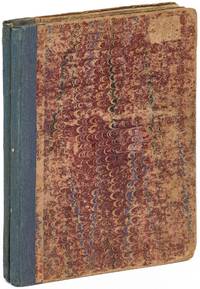
1890460264Fredonia New York 1890. Hardcover. Good. Two notebooks with printed title: Normal Rhetorical Exercise Correction Book. Fredonia N.Y.: F.C. Chatsey Publisher Copyright 1886. Small quartos. Bound in quarter cloth and marbled paper over boards. Covers are rubbed and worn one front cover has some staining good overall. Both notebooks contain several book reports and essays on special topics written by Walter Pettit when he was a teenage student at the Fredonia Normal School.<br /> <br /> Both notebooks date from the late 1890s. In addition to reports on The House of the Seven Gables Gulliver’s Travels The Merchant of Venice Oliver Twist and other books; the notebooks include both fictional essays such as “My Flying Machine†and “A Trip to the North Pole†and personal essays on special topics. Here for example is an excerpt from an essay titled: “Should Lynching be Suppressedâ€:<br /> <br /> “One of the greatest evils in existence is lynching. That it should be abolished is evident. Many innocent people have met their death by this means and it still is in existence in the Southern States. Perhaps some person … suspected of a crime is imprisoned. A crowd collects and is excited by somebody over the crime … the jailor gives up the suspected criminal to the mob who immediately carry the poor man to the nearest tree … This incident is kept from the newspapers and the suspected criminal dies unmourned unknown. With hanging by authorities … the criminal has a chance for his life; he may plead his case before unprejudiced men. His death is not embittered by the taunts of an unfeeling multitude of men women and children many of whom are as bad as the criminal. The wretches who are the leaders in such a mob are far worse than the victim …â€<br /> <br /> Also included is a travelogue from Sitka Alaska to Dawson City then at the height of the gold rush written in the form of a letter:<br /> <br /> “Feb. 18 1898: Dawson City Canada / Dear Friend … We started from San Francisco … arrived at Sitka … the town consists of a number of Indian huts a few Russian and American residences … we accompanied an excursion party to the Yukon. This river is one of the largest in the world … upon its banks are a few Indian villages … and here and there ‘Totem poles’. These totem poles … are made of wood grotesquely carved with figures of men beasts and birds. Upon them are kept the records of the Indian’s ancestors. These Indians are a half civilized sneaking dirty race short in stature with small eyes. They act as guides around the settlements … While at Sitka we bought a large stock of groceries … We carried these with us when we went to Dawson. Our party consisted of ten Indians my partner and I. Our journey took three weeks … we reached this city in October and immediately rented the only vacant building in town … I wish you where here to wait on some of our customers. They bring in a bag of gold dust and we weigh out enough to pay for the groceries they buy. This city is in the midst of the gold fields. It is composed principally of saloons dancing halls theaters and gambling houses. The miners sleep in tents … we have rows nearly every night and thieves are as thick as mosquitos …â€<br /> <br /> A graduate of the Class of 1901 Pettit had quickly shed such early external prejudices against indigenous peoples and gold miners. He taught high school in the Philippines 1901-09 attended Teacher’s College at Columbia and served as a U.S. Government Special Relief Assistant in Russia during World War I. As Director of the New York School of Social Work Pettit won international acclaim for his work on the “interdependence of peoples and the strengthening of international relationsâ€.<br /> <br /> A compelling pair of notebooks that sheds light on Pettit’s early education in upstate New York. American Sociological Review December 1961 pp. 959-60. hardcover
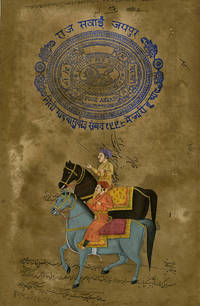
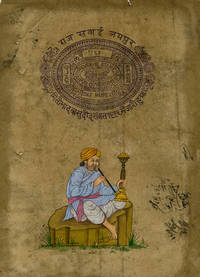
189013431890. Ink and gouache with gold heightening on fibrous brown laid paper with a Jaipur Court Fee tax stamp in blue ink on the recto as well as the Jaipur City Council blindstamp 13 1/4 x 8 1/2 inches 335 x 215 mm. Toning handling creases and minor scattered surface soiling throughout. There are scattered coeval inscriptions in ink on the recto and verso. The first revenue stamps in India were issued in the mid-nineteenth century during the Raj and they are still being issued to this day. Apart from issues for the whole of India many princely states provinces and other states also had or still have their own revenue stamp issues. Before independence Indian revenue stamps were closely modeled on similar designs from Great Britain as is the case with this carriage motif stamp from Jaipur. <br /> <br /> The stamps were issued to denote various denominations including rupees and annas. An anna or Änna was a currency unit formerly used in British India equal to 1â„16 of a rupee. It was subdivided into four old Paisa or twelve pies thus there were 192 pies in a rupee. When the rupee was decimalized and subdivided into 100 new paise one anna was therefore equivalent to 6.25 paise. This particular stamp was used as evidence of court taxes remitted for property dealings. unknown
18972111902160602815Nishimura Gohokan Collection Edition 1897. Soft Cover. Fine. The book is in fine condition. Nishimura Gohokan Collection Edition paperback
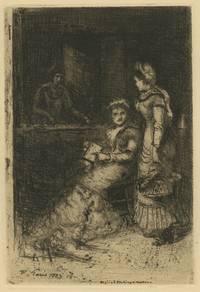
1883215London: English Printmakers 1883. Etching with aquatint and stipple on cream laid paper 7 x 4 3/4 inches 175 x 120 mm full margins. With a stamped signature including the date in the lower right image area and the English Pintmakers blind stamp lower left sheet margin. In very good condition with extremely small dog-ear shaped hard crease lower left sheet corner. A lovely 19th century Parisien interior scene. English Printmakers unknown
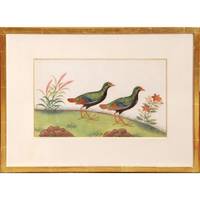
185072325ca 1850. Chinese rice paper. Size: 170 x 280 mm Framed size: 315 x 425 mm Good condition. unknown
189013391890. Ink and gouache with yellow heightening on fibrous brown laid paper with a Jaipur Court Fee tax stamp in purple ink on the recto and the Jaipur State Council Stamp dated June 5 1894 and the 1889 Jaipur State Council stamp in black ink on the verso 12 1/2 x 9 inches 318 x 230 mm. Toning handling creases and minor scattered surface soiling throughout. There are scattered coeval Hindi inscriptions in ink on the recto. The first revenue stamps in India were issued in the mid-nineteenth century during the Raj and they are still being issued to this day. Apart from issues for the whole of India many princely states provinces and other states also had or still have their own revenue stamp issues. Before independence Indian revenue stamps were closely modeled on similar designs from Great Britain as is the case with this carriage motif stamp from Jaipur. <br /> <br /> The stamps were issued to denote various denominations including rupees and annas. An anna or Änna was a currency unit formerly used in British India equal to 1â„16 of a rupee. It was subdivided into four old Paisa or twelve pies thus there were 192 pies in a rupee. When the rupee was decimalized and subdivided into 100 new paise one anna was therefore equivalent to 6.25 paise. This particular stamp was used as evidence of court taxes remitted for property dealings. unknown
1860218670東京. Tokyo. circa1860s. Three colour woodblock prints a triptych panels loose each approx 38.5 x 25.4cms Japanese text artist's signature publisher's seal and date in the outer margin of the centre and right-hand panels and in the inner margin of the left-hand panel slivers of paper tape strengthening the top margin to the verso of each print pin-holes to the corners from previous display with loss to the lower right corners and the inner corner of the left-hand panel paper a little dusty and soiled but overall in good condition. Wonderful satirical woodblocks with muted tonings possibly from the composition for "Sumo wrestling match of Seven Lucky Gods" replacing the gods with actors as aging sumo wrestlers surrounded by onlooking geisha and fellow actors in masks and costume. <br> <br>From the collection of the late John Caiger lecturer in Asian studies ANU. . unknown
1874MC6-594Trento (Trient), Stabilimento Tipografico di Giovanni Seiser Editore, 1874. original soft binding, 8vo, 16 p.; former library copy, therefore stamped, good copy
1846007435New York: Lane & Tippett 1846 180 pages. In the original binding. Early owner's signature and old damp stains to the margins of pages. Size: Small 8vo. Illus. by Illustrated with three engravings. First American Edition. Leather and Marbled Boards. Good. Lane & Tippett hardcover
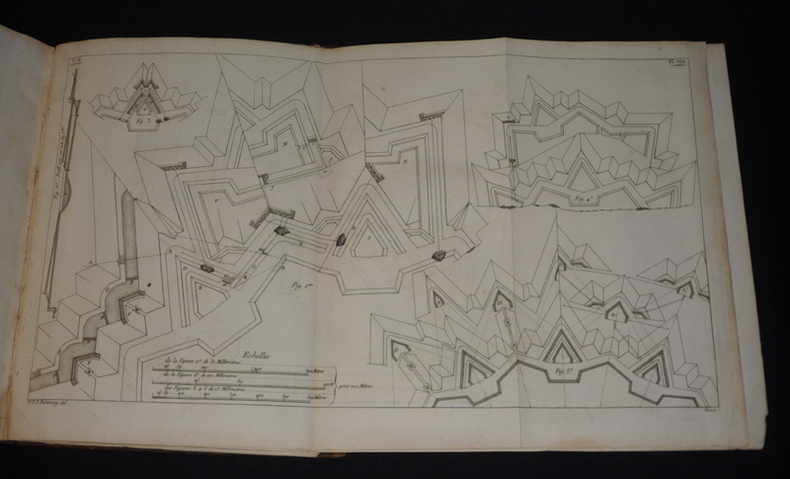
1805xs2314Paris, Allais, libraire, quai des Augustins, n°44 Relié 1805 Deux volumes in-4 (20,5 x 26,2 cm), reliure plein veau, dos lisse, 308 et 299 pages, complet des 20 planches dans le premier volume et des 13 planches dans le second ; coiffes et coupes usées, mors inférieur fendu aux coiffes au tome 2, mouillure sur le bord des planches au tome 1, par ailleurs bon état général. Livraison a domicile (La Poste) ou en Mondial Relay sur simple demande.
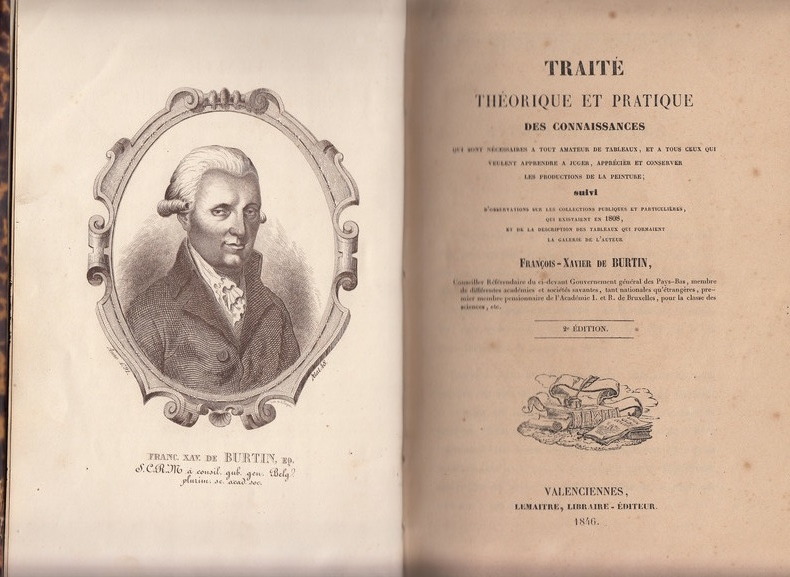
1846213561846 Valenciennes, Lemaitre, 1846, 2e edition (second edition), in-8°,demi basane,dos lisse usé, portrait lithographé frontispiece + viii pp + 569 pp, index,texte frais. L'auteur fut un des premiers à attirer l'attention sur l'importance de la peinture hollandaise du XVIIe siècle.
18782080502106501451Sairyu-sha 1878. Soft Cover. Fine. The book is in fine condition. Sairyu-sha paperback
18742081002108700741Not Available 1874. Soft Cover. Fine. Size: Small Japanese paper Number of books: 4 Not Available paperback
18742090502130300239Osaka Prefectural Office of Education 1874. Soft Cover. Fine. Number of books: 1 Osaka Prefectural Office of Education paperback
18802080202106300477Not Available 1880. Soft Cover. Fine. Number of books: 1 Not Available paperback
18782080502106601118Not Available 1878. Soft Cover. Fine. The book is in fine condition. Not Available paperback
18772082402113500964Monbusho 1877. Soft Cover. Fine. Volume: 1 Monbusho paperback
18902080502106908529Not Available 1890. Soft Cover. Fine. The book is in fine condition. Not Available paperback