EDUCATIONBiblio.com
95 940 résultats
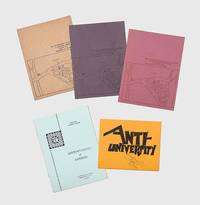
1968164806London: Trigram Press and Writers Forum 1968. Anti-establishment education for the masses A complete set of the catalogues issued by the Antiuniversity of London including all three colour variants of the first quarter's catalogue. For just £8 per term a fee later abolished entirely students could access an array of unconventional courses at 49 Rivington Street in Shoreditch London. The catalogues chart the expansion of this short-lived and radical experiment in anti-establishment education. The Antiuniversity was officially founded in February 1968 by a group including veterans of the Free University of New York Allen Krebs and Joe Berke the feminist psychoanalyst Juliet Mitchell the cultural theorist Stuart Hall and the anti-psychiatrists R. D. Laing and David Cooper. The catalogue for the first quarter introduces a permanent faculty and in lieu of a defined curriculum brief blurbs introduce each teacher. Cooper and Laing along with Jerome Liss and Leon Redler offered courses related to sociology and psychology; poets and sculptors such as Harold Norse John Latham and Barry Miles hosted workshops and talks; composer Cornelius Cardew offered a course in experimental music and Michael Kustow the director of the Institute of Contemporary Arts ran a "fortnightly talk-out" about the questions involved in running "a place that has the freedom of an underground research and fun-lab and yet radiates influence out into the system by virtue of its very position". The illustrious list of visiting faculty includes William Burroughs Richard Hamilton Allen Ginsberg and Carolee Schneemann. Slight differences in the faculty list occur in the pale brown variant of the first quarter catalogue which was published a little later. Notable additions include Robin Blackburn and Nicholas Krasso Noel Cobb and Axel Jensen David Caute Obi Egbuna Francis Huxley and Alex Trocchi. Around 300 students were enrolled when the second quarter catalogue was issued in April 1968 by which time the project had caught the attention of some of the biggest underground names in psychiatry art and politics. The "artist's artist" Gustav Metzger taught "Theory of Auto-destructive Art" C. R. L. James lectured on "Imperialism Leninism and the underdeveloped countries" Satish Kumar invited students to learn about Gandhi and the Gandhian movement and Yoko Ono offered a weekly Friday evening course called "The Connection" "an attempt to connect people to their own reality by means of 'brain sessions' and ritual". The catalogue for the third quarter adds among others the filmmaker Steve Dwoskin the Israeli journalist Shimon Tzabar and the American sculptor John Chamberlain. Loosely inserted is a flyer invitation which announces an Antiuniversity Course Creation Rally on 21 July which marked the beginning of the disintegration of the project; mounting bills forced the Antiuniversity out of Rivington Street by August 1968 though the dispersed community continued to host lectures across London as late as 1971. Together 5 items. Original wire-stitched wrappers in brown red purple yellow and blue printed in black. With 3 flyers loosely inserted: a registration form and printed list of supplementary courses Second Quarter and a flyer for a "Kip In" 12-14 July 1968 Third Quarter. Trivial splash mark to front wrapper of brown issue minor toning to edges nick to head of rear wrapper: a fine set. unknown
1784219177Leipzig, Crusius, 1784-92. M. 11 gest. Tit.-Vign., 30 (st. 33) Kpfr.-Taf. u. 43 (st. 44) gest. (teils gef.) Notenbeil. In 5 Hldr.- u. 4 Ppbdn. d. Zt. 1 Hldr.-Rücken abgeplatzt. Ppbde. stark beschabt. Bd. 7/8 Buchbl. gebrochen. Einige Taf. lose. Teils m. St. Gebräunt u. braunfl. Fehlen: Bd. 11 3 Taf. u. 1 Notenbeil.
1757213451Leipzig, Krauß, 1749-1757. M. 6 wiederh. gest. Front. v. A. Nunzer, 1 gest. Kte., 4 gest. Plänen, 74 gest. Taf. u. einigen gest. Kopfvign. Versch. geb. in Einbdn. d. Zt. (Ldr., Hldr, Hprgt., Prgt. u. Pp. 1 Einbd. m. leichtem Wasserschaden. 1 Rücken fleckig. 3 Rücken m. Sign. St. a. 4 Tit. Fehlen: Tl. 1 3 Taf.
1922213611Berlin, Weidmann, 1850-1922. Geb. u. in Heften. Einige Einbde. beschabt. Wenige Rücken anerissen. St. a. mehr. Tit. Fehlt: Jg. 20 4 S.
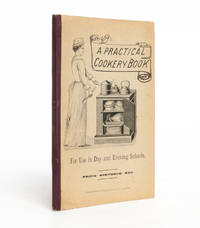
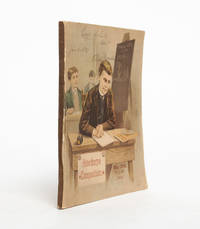
19033158London and Manchester: John Haywood 1903. First edition. Near Fine. Original pictorial boards with cloth to spine. 76 pages. Faint toning to edges of covers but surprisingly clean overall. Early ownership signature of "Sarah Askworth.1906" to the verso of the front cover and overlaid with tape. Lightly toned throughout but otherwise unmarked without the signs of kitchen use common in such books. Scarce in trade OCLC reports no copies of the present work at institutions. <br /> <br /> "Around the year 1900 there was a concern about the physical state of the people of Britain. Even though there had been tremendous efforts in the late 19th century to provide better public health housing and education many children were still no more healthy than they had been back in the 1840s. The new Liberal government elected in 1906 passed various measures to try to deal with this problem.and they gave permission for schools to offer meals to their pupils" National Archives. Efforts to consider the link between education and nutrition had begun in the lead-up to the laws however; and the present work is a scarce surviving example of such a cookery. Its compilers note in the preface "This collection of Recipes has been prepared specially for Day and Evening Schools. The instructions of the Education Department.have been embodied." Given the book's brevity it contains a multitude of basic nutritious and locally accessible foods that can be combined for a variety of different meals -- always with an eye to giving growing students the fuel they need to grow and thrive in their schooldays. There is even included a selection of recipes designed for the sickroom when students are ill and need extra care for their health. A research-rich compendium. Near Fine. John Haywood unknown
19033158London and Manchester: John Haywood 1903. First edition. Near Fine. Original pictorial boards with cloth to spine. 76 pages. Faint toning to edges of covers but surprisingly clean overall. Early ownership signature of "Sarah Askworth.1906" to the verso of the front cover and overlaid with tape. Lightly toned throughout but otherwise unmarked without the signs of kitchen use common in such books. Scarce in trade OCLC reports no copies of the present work at institutions. <br/><br/>"Around the year 1900 there was a concern about the physical state of the people of Britain. Even though there had been tremendous efforts in the late 19th century to provide better public health housing and education many children were still no more healthy than they had been back in the 1840s. The new Liberal government elected in 1906 passed various measures to try to deal with this problem.and they gave permission for schools to offer meals to their pupils" National Archives. Efforts to consider the link between education and nutrition had begun in the lead-up to the laws however; and the present work is a scarce surviving example of such a cookery. Its compilers note in the preface "This collection of Recipes has been prepared specially for Day and Evening Schools. The instructions of the Education Department.have been embodied." Given the book's brevity it contains a multitude of basic nutritious and locally accessible foods that can be combined for a variety of different meals -- always with an eye to giving growing students the fuel they need to grow and thrive in their schooldays. There is even included a selection of recipes designed for the sickroom when students are ill and need extra care for their health. A research-rich compendium. Near Fine. John Haywood unknown books
18933241Wisconsin 1893. Hawthorne Composition Notebook #774 measuring 8.25 x 6.75". Comprised of 70 densely written pages largely in pencil in a single hand with penmanship maturing as pages go on across three years. Lizzie's ownership signature to the front wrap designates her as 12 years old at the start of her composition in January 5 1891. Resulting genealogy research has identified her as Elizabeth Lizzie Schuh born in Milwaukee Wisconsin in 1879. Census records show that she remained in this area through the end of her life. The present composition book is an opportunity to examine how girls were being educated at the turn of the century in the midwest and how that compares to their counterparts to either coast.<br/><br/>It is telling how little of Lizzie Schuh's preteen lessons are overtly gendered. In many notebooks of this kind from the U.K. and East Coast lessons during this age work to indoctrinate girls into an acceptable femininity even in seemingly innocuous ways. Yet here the lessons seem nearly gender neutral -- a possible sign of coeducational classrooms in her school. Throughout the notebook she writes declarative sentences works on active and passive voice practices tenses and memorizes abbreviations. She composes short essays; in the beginning these tend to focus on some piece of nature such as bees or oranges and they incorporate natural science as well as geographical information. Later essays include original short stories and reports on American figures including Daniel Boone and Andrew Jackson. As she progresses her compositions and her hand move toward adulthood becoming more confident and complex. <br/><br/>Perhaps the largest content focus is on areas of etiquette and behavior -- again a space where one might expect more overt gendering. And yet a section on How to Be Polite for example includes common-sense behavior such as "Try to be kind and unselfish" and "When anyone is writing or reading do not stand behind him or look over his shoulder." Some of the advice seems to encourage a kind of working-class or regional modesty: "Do not talk about dress" and "Do not soil your tongue with slang." Correspondence and letter-writing take up the bulk of the rear of the book. Here Lizzie begins by copying out generic letters likely providing by an instructor so she can learn the formalities both of letters and of posting them; later she imagines letters or copies out letters she herself has written and sent out. These appear to train the children for a variety of relationships including personal and familial communications the management of household and businesses and the maintenance of new acquaintances. <br/><br/>A fascinating glimpse into the language and communication development of a young Midwestern girl as she approached adulthood with research potential including but not limited to English language teaching the intersection among disciplines in elementary and middle school the history of coeducation regional education penmanship and paleography gender studies etiquette and genealogy. unknown books
19952080502106401801Not Available 1995. Soft Cover. Fine. The book is in fine condition. Not Available paperback
19932080302106807810Oita Prefecture Board of Education 1993. Soft Cover. Fine. Number of books: 5 Oita Prefecture Board of Education paperback
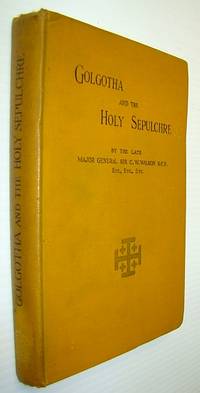
1906544G1652London: The Committee of the Palestine Exploration Fund 1906. Book. Good. Hardcover. First Edition. 8vo - over 7¾" - 9¾" tall. 209 pages. Index. Nine black and white plates. Twelve black and white figures. Fold-out two-colour plan of Jerusalem at back. Published posthumously. A detailed investigation of the question of the validity of the traditional sites of the Holy Sepulchre and of Golgotha. Average wear and soiling to dark yellow exterior. All lettering and gilt decorations clearly legible/visible upon backstrip and front board. Binding intact. Prior owner's signature atop title page otherwise unmarked. A sound copy. The Committee of the Palestine Exploration Fund Hardcover
1851545j0915Philadelphia: Daniels & Smith. Good. 1851. Third American Edition. Hardcover. "John Wilson 1799 - 1870 was a self educated man. In 1840 he published the first edition of this book in which he claimed the Ten Lost Tribes of Israel made their way from the Near East across the continent of Europe to the British Isles. He believed the Northern European people to be descended from the Ten Lost Tribes with the people of Britain being the Tribe of Ephraim. He relied upon philological 'evidence' of English Scottish and Irish words that were similar to Hebrew words." - Wikipedia. "If the view maintained in Mr. Wilson's Lectures be true it is a subject of deep interest to us all; for in that case the inhabitants of the United States are a part of the 'Lost Tribes of Israel' and the literal posterity of Jacob; and particularly are the Anglo-Saxons of the posterity of Ephraim the youngest son of Joseph." - Preface. iv 237 pp. Index. Prior owner's name upon front free endpaper. Former library copy with relatively few related markings. Binding intact. Average wear to elaborately embossed original chocolate brown cloth. Rubbed gilt lettering upon backstrip. A sound vintage example of this fascinating compilation.; Sm 8vo . Daniels & Smith hardcover
19012111902160305072Dobun-kan 1901. Soft Cover. Fine. Number of pages: 2160 pages Approximate size: A5 size Number of books: 4 Dobun-kan paperback
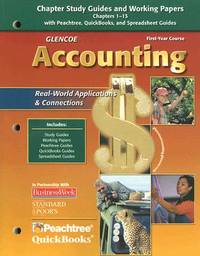
2006SONG007873987X2006-04-15. 1. paperback. Used: Good. 8.25x0.75x10.50. Buy with confidence. Excellent Customer Service & Return policy. paperback
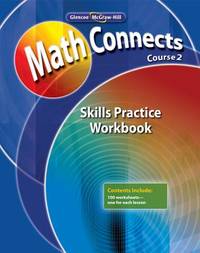
2008SONG0078810531McGraw-Hill Education 2008-02-29. 1. paperback. Used: Good. 8.40x0.30x10.80. Buy with confidence. Excellent Customer Service & Return policy. McGraw-Hill Education paperback
2008SONG0022045104McGraw-Hill Education 2008-04-02. 1. paperback. Used: Good. 8.30x0.60x10.90. Buy with confidence. Excellent Customer Service & Return policy. McGraw-Hill Education paperback
16718Women education Sports Album of female students at The Baldwin School for girls in Brywn Mawr PA from 1903-1905. Photo album with 111 cyanotype photographs of various sizes ranging from 2 in x 1 in. to 4 in x 2.5 in. Original paper boards. 40 pages. 5.5 x 7.25 in. Album records the life of young students at the all-female Baldwin School including their activities in sports such as basketball and field hockey time spent living in the dormitories and extracurricular diversions with school friends. <br/><br/>The school was founded in 1888 as "Miss Baldwin's School for Girls Preparatory for Bryn Mawr College" as there was an increasing movement to create formal education opportunities for young ladies across the country. Images of the social lives of students at the residential academy. Includes photos of a pastoral drive "View from my window 1903" and two photos of the interior with one clearly showing a banner for Harvard University. Photos of student life such as the 1904 "Freshman Cake-Walk" and a picture with a small dog the "4th class mascot". Many photos in which girls dress in overalls as if they were pioneers or farmers. "Yours-Truly" written under photo of figure in pants jacket and tie. Images from a trip to Newport Rhode Island to visit Fort Adams and a female friend called "Teddy."<br/><br/>Many photos document the sporting life and outdoor activities for students most notably of field hockey games and practices including team photoswith team members identified as "Hoot" and "Tat" among more conventional names. Photo captioned "At the 6th or 7th game" that shows a playing field which is being walked over by women in ankle-length dresses and there are other photos of hockey practice. Another photo shows a girl walking with field hockey stick in hand: "'Husky' Smith 1904". Photo of Basketball practice outside of a school building and girls holding rackets on on either side of a tennis net. Photos of the girls sledding down a snowy hill. Name of original owner handwritten in black ink on label on front cover "Mrs. Samuel J. Gummere 2 Regent Street Worcester Mass." Boards worn at extremities. Images very crisp. Very good condition. unknown books
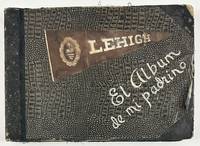
12844Various locations in Cuba and Pennsylvania: contents ca 1973. 25 leaves totaling 40pp. illustrated with thirty black-and-white and sepia-toned photographs with detailed manuscript captions plus seven large clippings from school publications and six additional ephemeral items. Oblong folio. Black cloth with alligator-patterned cloth on front board with manuscript title below a drawn representation of a small pennant for Lehigh University. Covers worn frayed and chipped alligator-style cloth curling a bit along fore edge. A few items loose from adhesive and a few with small tears scattered spotting and soiling. Overall very good condition with fascinating materiality. A lovingly-compiled photograph album and memorial book created by a young woman named Magdalena Sofia Guitart in tribute to her godfather Rafael Genó a Cuban engineer who studied at Lehigh University in Pennsylvania. Juan Rafael Genó Rizo was born in Santiago de Cuba in 1883. A doctoral thesis on Cuban architecture found online deems him one of the premiere Art Deco architects of Santiago and the only one to obtain a degree abroad. Genó graduated with a degree in Civil Engineering from Lehigh in 1909 and from the University of Havana in 1913. He died in Miami Florida in 1973.<br /> <br /> This doting scrapbook was compiled and heavily captioned in Spanish which we hereafter present in translation as a "Memorial which with love and pride I dedicate to my godfather and some of his works; a pale reflection of all the good he has done in his life" by Magdalena Sofia Guitart who was born in 1936 in Santiago and arrived in Miami in 1958. She includes photos of Genó as a baby and a boy of 11 "From a very young age as you can see here my godfather was a little gentleman" as well as in uniform alongside Mexican and Costa Rican comrades at Pennsylvania's Wayne Field. She lauds his "triumphs" and "genius" in "thousands of battles." Genó likely came to the United States following the Spanish-American War during the growth of Cuban immigration resulting from increased American attention of the island country. All of the content in the album is artfully presented within decorative rules or floral borders providing an unusual flair to the presentation. The book displays not only the hand-drawn Lehigh pennant on the cover but also large artistic renditions of the campus and an internal shot of its library clipped from school publications and comparing views from 1873 1909 and 1933 the relevance of Lehigh at the later date is unclear.<br /> <br /> Additional photographs and decorative designs share the story as "our engineer" returns to Cuba and "begins to demonstrate his knowledge" in the mines of Ponupo. Soon "his hard work integrity and honesty led him to be chosen" for other feats of engineering including "la Iglesia church Los Desamparados constructed by my godfather 1932" and a train terminal in Guantánamo. Images and a photographic clipping laud his renovations of "Colegio La Salle" in 1937. There are also six photos and a clipping showing Genó's work on the altar for the Eucharistic Congress held in Santiago in 1936 during which the original statue of Our Lady of Charity of El Cobre Patroness of Cuba was granted a canonical coronation by Pope Pius XI. The album also holds a clipping naming Genó as president of the Board of Directors of Santiago's Urban Property Center an inauguration ribbon and brochure for the Municipal Food Market in 1950 with which he was also involved and photos of the celebrated engineer later in life.<br /> <br /> A captivating and carefully-assembled homage created by a Cuban immigrant to the United States honoring a loved one who was educated in Pennsylvania and then returned to his home country to serve as a noted engineer during the first half of the 20th century. contents ca unknown
88664N.p. n.d. ca 1880s-1900. Cloth-bound leporello binding gilt-ruled gilt-titled "FOLDING." on front cover 8-3/4" "x 8". Opens to reveal 42 panels 21 on each side of the accordion fold of which 26 are used containing a total of approximately two hundred folded examples laid-down but otherwise fully openable by unfolding; each unique some arranged into complex compositions on the page. Occasional mild foxing but Near Fine overall with three or four pieces possibly lacking from the final pages. The album is presumably American based on its source a regional American auction house purchased 2025 though conceivably British in origin.<br /> <br /> A beautifully-preserved "papierfalten" album of the late nineteenth or early twentieth century likely the work of either an advanced elementary-school student or a kindergarten teacher in training. Paper-folding was first introduced in American schools in the 1890s an adaptation of Friedrich Fröbel's kindergarten curriculum developed to train children in both manual skills and geometrical and mathematical concepts. The apotheosis of Fröbel's papierfalten technique was the so-called "Froebel Star" a complex three-dimensional composition based on the traditional German folk-art "Moravian Star." Numerous examples of the technique are collected here along with many more basic folds and several wonderful full-page compositions comprised of multiple folded sheets arranged to resemble snowflakes and other objects. We've encountered other examples of the papierfalten genre usually in single sheets with a few examples; none nearly as comprehensive or complex as this one and certainly none as beautifully preserved. A unique and beautiful documentation both of American folk art and educational technique. unknown
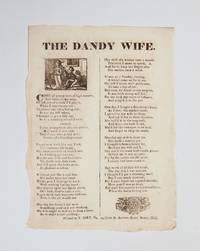
18285421London: T. Birt 1828. First edition. Single sheet measuring 250 x 185mm and printed in two columns to recto. Some edgewear to margins not affecting text; a bit of foxing and toning largely confined to margins. A scarce and delicate survivor OCLC documents only one example at the National Library of Scotland. The present is the only example on the market.<br /> <br /> The Dandy Wife is narrated by a man who aimed "to choose me out a loving wife" at the age of twenty-one but whose experience becomes a warning to "all young men of high renown": "If you want a tidy wife Beware of a boarding school." What unfolds is a satire of how the marriage economy is affected when women have access to knowledge -- intellectual and physical -- and how by meeting a man's superficial expectations a woman can fulfill her own more pressing needs.<br /> <br /> Thinking that a boarding school girl will have the innocence submissiveness and domestic skill he desires the narrator selects a wife from among their ranks. Thinking only of what he can obtain from such a bargain he is unprepared for what an educated woman brings into his house. The Dandy Wife he describes understands the commodity value of her own beauty and material adornment and that these are her key means for acquiring wealth of her own. "She takes one-half of what I earn In drinking gin and tea; Besides such frills and furbelows My Dandy Wife does wear.Her sleeves upon her dandy gown Oh! Lack they're such a size You'd think they were two balloons that in the air would rise." Aside from staying on par with fashion trends her clothing assists her in avoiding domestic tasks she abhors. She refuses to do laundry more than monthly and through ridiculous cooking failures she rapidly establishes that the kitchen is not a showcase for her skillset. Accustomed to a life of learning she is not trained to conduct domestic business. <br /> <br /> By the ballad's end it becomes clear that the Dandy Wife was savvier in managing a marriage than her husband was. For not only does her superior intellect help her carve out a more satisfying role but she also has physical knowledge that predates him: "The day that I was married I thought I'd got a charming maid But I was much deceived.For scarce five months we'd married been When she had a darling son. T. Birt unknown
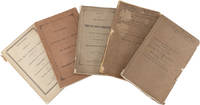
184456150Boston 1844-45. 1. MANN Horace Seventh Annual Report of the Board of Education; Together with the Seventh Annual Report of the Secretary of the Board. Boston: Dutton and Wentworth 1844. First edition. Octavo 25cm. Original brown paper wrappers with printed title on front untrimmed; 1991pp. Inscribed "J. F. Bumstead Esq. / with best regards from / Horace Mann" on front wrapper. With a few contemporary pencil annotations. A fresh copy edges gently rubbed one or two small stains to wraps: Very Good or better. <br /> <br /> This copy presented by Mann to J. F. Bumstead-plausibly Josiah Freeman Bumstead 1797-1868 who authored primary school primers readers and spellers published by Ticknor and other Boston firms in the 1840s.<br /> <br /> 2. MANN Horace. The Common School Journal vol. VI no. 5; March 1 1844. Containing the "Seventh Annual Report of the Secretary of the Board of Education to the Board of Education." PRESENTATION COPY FROM SAMUEL MAY TO ADIN BALLOU. Octavo 26cm. Original paper wrappers printed on front; 64-200pp. Inscribed to "Rev. Adin Ballou / with the best regards of / Sam J. May - / Let all that have eyes read / or all that have ears hear this / admirable document -" With one or two minor marginal pencil marks. Ex libris and discard stamp of Swarthmore College to final leaf. Textblock sound though rubbed but front cover detached rear cover lacking; some staining to outer leaves minor foxing: Good.<br /> <br /> Presentation copy from Samuel Joseph May 1797-1871 to Adin Ballou 1803-1890 founder of the Hopedale Community. May was one of Mann's allies in establishing the Massachusetts state school system and both he and Ballou were members of the New England Non-Resistance Society a peace organization founded by William Lloyd Garrison. <br /> <br /> 3. Association of Masters of the Boston Public Schools. Remarks on the Seventh Annual Report of the Hon. Horace Mann Secretary of the Massachusetts Board of Education. Boston: Charles C. Little and James Brown 1844. Octavo 23cm. In original brown paper wrappers printed in black on front; 144pp. Inscribed "B. A. Gould" to front upper cover--possibly pioneering Boston astronomer Benjamin Apthorp Gould 1824-1896. With occasional marginal pencil marks. A fresh copy with one or two tiny chips to spine: Very Good or better. <br /> <br /> 4. MANN Horace. Reply to the "Remarks" of Thirty-One Boston Schoolmasters on the Seventh Annual Report of the Secretary of the Massachusetts Board of Education. Boston: Wm B. Fowle and Nahum Capen 1844. Octavo 23cm. <br /> In original dark beige paper wrappers printed in black on front; 176pp. A sound copy with losses at head and tail of spine joints partly split but holding internally clean: Very Good. <br /> <br /> 5. ASSOCIATION OF THE MASTERS OF THE BOSTON PUBLIC SCHOOLS. Barnum Field; Wm A. Shepard; S. S. Greene; Joseph Hale. Rejoinder to the "Reply" of the Hon. Horace Mann Secretary of the Massachusetts Board of Education to the "Remarks" of the Association of Boston Masters Upon His Seventh Annual Report. Boston: Charles C. Little and James Brown 1845. First edition. Octavo 22cm. Original beige wrappers printed in black on front; 55 1 56 40 64pp. Inscribed "The Misses Adams / 1 May 1922" on verso of title page. A sound fresh copy with split at front upper joint chip at tail minor dirt to wraps but internally clean: Very Good. <br /> <br /> Five pamphlets on Horace Mann's 1844 annual report to the Board of Education including two presentation copies of different editions of the report itself and three responses. Mann had toured Europe with his new wife Mary Peabody and friend Samuel Gridley Howe and studied schools in eight countries with special interest in the Prussian school system. His 1844 annual report comparing American and European school systems was received with great offense by Boston schoolteachers. "A group of thirty-one schoolmasters. . . published a sharply worded critique of his seventh Annual Report" targeting "Mann's recommendations for teacher training as well as his opposition to corporal punishment." However this group "soon faced Mann's wrath in the form of written rejoinders" and were ultimately vanquished when "Mann's allies were elected to the Boston School Committee." <br /> <br /> Despite the controversy Mann's efforts to "merge the best that he found in European educational systems with the principles of the growing American common school movement" saw remarkable success. Under his direction the Board of Education spent over $2 million on improved school buildings increased teacher salaries by over 50% opened fifty new high schools commissioned uniform school textbooks from Boston publishers and alotted time for student exercise-shaping the public school system as we know it ANB. All the titles in this collection are uncommon in the book trade. unknown
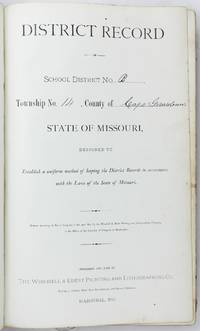
18924183Cape Girardeau Mo 1892. Very good. 138pp. of manuscript content. Folio. Contemporary preprinted record book with some pages partially-printed and completed in manuscript and some pages with wholly manuscript content bound in three-quarter calf and brown pebbled cloth gilt spine titles. Some abrasions and wear to spine and edges minor rubbing and soiling to boards. Occasional thumb-soiling and light spotting to text. A unique manuscript record book kept by the officials of the school district in Cape Girardeau Missouri in the late-19th century. Over the course of about fifteen years the various sections of the ledger book record the names of school directors a register of teachers a short list of authorized textbooks notes for annual school meetings notes of the proceedings of the school district's Board of Directors lists of parents or guardians and their school-age children taxpayer lists financial reports of the district clerk payments made from the teacher's and building funds lists of incidental charges paid by the school district treasurer's reports teacher's reports and with additional notes oaths the text of teacher's contracts book lists and more on blank pages at rear.<br /> <br /> Particularly interesting are the detailed notes for the school district's annual meeting and its regularly-held board of directors' proceedings each of which record regular district business but also contain important mentions regarding the segregated educational situation for the local African-American population. The annual meeting notes record the approval of funds for supplies and books summer school costs teacher hires the length of the school term and more as well as activities such as the election of school administrators the construction of new schools and approval of funding for said schools and so forth. Of particular interest is a motion approved at the 1887 annual meeting which reads: "Moved and seconded that the Board of Directors be authorized to sell the land known as school land near the swamp and buy a more suitable piece of land to build a school house for the colored population." Another interesting entry occurs in the notes for the 1889 annual meeting: "The colored foalks of the district ask permission to use their school house for church and sunday school which privilege was given."<br /> <br /> The notes from the board of directors' meetings contain much the same type of information as the annual school meeting notes but often in more detail. For example the details of the new schoolhouse being built in the late 1870s is described in more specific dimensions than was recorded in the annual meeting notes as is the land to be purchased for it. And as with the annual meeting notes the board of directors occasionally discussed the local African American population. For instance in November 1885 a note from the directors reads: "A resolution made and carried that District No.B Twnshp 14 Range 13 propose to pay their proportion of the tuition for colored children in said District.and that the Clerk.be authorized to issue a warrant.when the bill is presented for the tuition of colored children from District No.B Townshp 12." A similar notation is recorded on the next page during a board meeting in April 1886. At the May 28 1887 meeting of the board they authorized $124.75 "for the purpose of.building a school house for the colored population.to be finished on or before the first day of October 1887 according to contract." At their November 12 1887 meeting the board "examined the colored schoolhouse" and them approved payment for its contractor for the aforementioned $124.75. An entry for July 9 1887 records that a teacher was hired for five months at the white school at a rate of $35 per month; another teacher was hired for the same term but for a teaching position at the "colored school" for five dollars less per month. A similar entry in 1889 notes that the white school teacher would earn $40 per month while the man hired "to teach the colored school" would do so for $30 a month widening the disparity this would persist for the next two years as well. The record book also notes approvals by the board for separate purchases of stove wood for both the white and African-American schools. It is also interesting to observe that the names of African Americans on the enumeration lists listing parents or guardians and their school-age children and the taxpayers' list are noted as "Col." for "Colored." A fascinating record of segregated schooling in action in Jim Crow Missouri. unknown
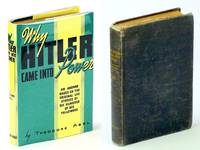
1938864H5065New York: Prentice-Hall Canada Inc. Fair. 1938. First Edition. Hardcover. "Professor Abel went directly to the source of Hitler's power - the German people - for the truth and by an ingeniously contrived literary contest secured this collection of simple and eloquent life histories. The direct testimony of eye witnesses and participants in the revolutions riots and coups ushering in the most powerful of modern dictatorships gives this book a stirring and realistic validity." - dust jacket not included. xi 3 322 pp. Index. Chronology of the Hitler movement. Statistical tables. Rebound former library copy with usual markings and above-average wear. Binding intact. Includes replica dust jacket preserved in archival-grade Brodart. A fascinating study all the more in view of what was soon to come. Stachura p.209 Laska 93 Kehr & Langmaid 129 Madden p.153 Wiener Library Cat. 2 - 905 Rees G-461.; 8vo - over 7¾" - 9¾" tall; Nazi Party - history Adolf Hitler Politics - Germany Germany - Interwar Period NDSAP . Prentice-Hall Canada Inc. hardcover
19422110502150908438Lower volume Owari Mikawa edition unpublished 1942. Soft Cover. Fine. Volume: 1 Lower volume (Owari Mikawa edition) unpublished paperback
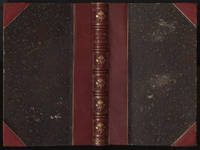
1823046784London: Benbow 1823. First Edition. Hardcover Half Leather. Very Good Condition. Early half red leather mild wear and rubbing to boards marbled endpaper loose some offsetting from frontis onto title page scattered very light foxing very clean overall bound with the half title. x 240 xvi 58pp.<br/><br/>Benbow was an interesting character a political reformer pamphleteer pirate publisher he published a well circulated edition of Queen Mab in 1812 he was in and out of trouble for most of his working career. Crimes of the Clergy is a collection of pamphlets he had written started in 1821- it was much condemned and no doubt destroyed as few copies seem to circulate. In it Benbow details a host of heinous crimes pederasty abuse drunkenness theft etc etc. Size: Octavo 8vo. Quantity Available: 1. Shipped Weight: Under 1 kilo. Category: Religion & Theology; History. Inventory No: 046784. Benbow hardcover
1823046784London: Benbow 1823. First Edition. Hardcover Half Leather. Very Good Condition. Early half red leather mild wear and rubbing to boards marbled endpaper loose some offsetting from frontis onto title page scattered very light foxing very clean overall bound with the half title. x 240 xvi 58pp.<br/><br/>Benbow was an interesting character a political reformer pamphleteer pirate publisher he published a well circulated edition of Queen Mab in 1812 he was in and out of trouble for most of his working career. Crimes of the Clergy is a collection of pamphlets he had written started in 1821- it was much condemned and no doubt destroyed as few copies seem to circulate. In it Benbow details a host of heinous crimes pederasty abuse drunkenness theft etc etc. Size: Octavo 8vo. Quantity Available: 1. Shipped Weight: Under 1 kilo. Category: Religion & Theology; History. Inventory No: 046784. Benbow hardcover books