Cicero, Marcus TulliusAntiquariat.de

13 résultats
176664130CBHalæ [Halle], Orphanotropheum [Verlag der Buchhandlung des Waisenhauses], 1766. 12°. 14,5 x 9 cm. [8] Blatt, 296 Seiten. Brauner Ganzlederband.
1789401658Jesi, Bonelli, 1789. IX, 218 S.; 280 S. Interimspappbände d. Zeit (etwas gebräunt u. fleckig, Bd. 2 gelockert, Rückdeckel wasserfleckig, Rückenbezug mit Fehlstellen). [2 Warenabbildungen]
1776401726Venedig, Pezzana Erben, 1776. 4to. XII, 735 S.; VIII, 756 S. Pergament d. Zeit (gebräunt u. fleckig, Rückenbezug von Bd. 1 unten mit Fehlstellen). [2 Warenabbildungen]
17630005877Glasgow: Aedibus Academicis / Robert & Andrew Foulis 1763. New edition. Hardcover. Fair. 16mo 237pp. contemporary full calf raised bands red morocco label front joint splitting; X-library with bookplate rubber-stamped on contents page & p. 25; also ex libris Hon. T. Fose Jr. and "the celebrated Dr. Archibald Cameron". Archibald Cameron of Lochiel 17077 June 1753 was a doctor and a prominent leader in the Jacobite rising of 1745. On 7 June 1753 at Tyburn he was the last Jacobite to be executed for high treason. <br/><br/>Attributed to Dionysius Halicarnassus and Cassius Longinus altho probably by neither man. It is a classical treatise on aesthetics and the effects of good writing written as a series of epistles. A bi-lingual edition with Greek and Latin. Also contains his FRAGMENTA with a two-page publisher's catalog at the end. Lowndes 1394 . Aedibus Academicis / Robert & Andrew Foulis hardcover
1749931651749. 234 S.; S. 235-266; (Index 34 nn. S.); S. 267-279. 13,5 cm. Ldr d. Zeit m. Rückenverg. u. Goldfileten auf den Deckeln.
1756108493Venedig, S. Occhi, 1756. 4to. VIII, 452 S. Mit Titelvignette in Holzschnitt. Halbpergament d. Zeit mit Kattunpapierbezug (Kanten stark bestoßen, Vorderdeckel mit Knick). [2 Warenabbildungen]
17249741London: Impensis Gulielmi & Johannis Innys 1724. Fourth edition. 8vo 8 299pp plus 5 publisher's ads. Contemporary paneled calf finely rebacked with red morocco spine label. Boards with some soiling and scuffing Berkeley Divinity School plate to front pastedown. Text clean and very good. <br /> <br /> Sharp copy of one of the most widely used ethics textbooks in the 17th and 18th centuries by the Oxford clergyman and Scholar Daniel Whitby. Whitby died 2 years after this fourth and final edition was published. An excellent example of early enlightenment curriculum in moral philosophy. Impensis Gulielmi & Johannis Innys unknown
177516701London: Nourse 1775. Fourth edition. Hardcover. Good . Five volume set of books with dates from 1775 to 1786. Each has a half-title page Miscellanies. Volume I has a contents page which shows the titles and contents of all five volumes. Title page of each volume shows the date. Vol. I 1783 Three Treatises;. Vol. II 1786 Hermes or a Philosophical Inquiry Concerning Universal Grammar; Vol. III 1775 Philosophical Arrangements; and Volumes IV and V 1781 contain Philological Inquiries in three parts. Uniformly rebound speckled leather boards with attractive newer smooth calf spines red and black leather spine labels with gold title "Harris' Works" and gold decoration. Frontis illustrations in Vols III& III. Volume I & II title pages state Fourth Edition Revised and Corrected; with dates 1783 and 1786. Indexes in 4 volumes vol.5 includes index to vol.4. Light foxing and offsetting and wrinkles and creases on some pages. and rubbing front and rear boards and corners of volumes I & II. No marks or writing in books. Not available for international shipping. <br/><br/> Nourse hardcover
17870005177Madrid: Imprenta de Benito Cano 1787. First edition thus. Hardcover. Very Good. Small quarto x 139pp. full contemporary sprinkled calf extra gilt spine inked initials on title-page which is clipped across the top with loss of an inch marbled endpapers. <br/><br/>This is a new version of one of two of Jesuit Fr. Rapin's major works on ascetical theology The Perfection of Christianity 1673: he was a major opponent of the Jansenists. WorldCat cites only 1 copy of this in Mexico; Sommervogel vol. 6 Rapin no. 24b . Imprenta de Benito Cano hardcover
17757Amsterdam 1775. Full Calf. Very Good. <p>Very good No dust jacket as issued 321 p Plein cuir veau moucheté d'époque in 12 dos orné 5 nerfs piéce de titre ocre gardes marbrées tranches rouges coins frottés avec léger manque sur un coin arrière et petite tache intérieur frais Voici ce l'auteur à écrit au sujet de notre édition en préface de celle de Paris en 1784 '' Les trois éditions de l'homme moral qui se sont succédée dans le cours des années 1775 qui portent toutes le nom d'Amsterdam & dont les exemplaires sont rares du moins en France ont étés faites loin des yeux de l'auteur qui était alors à St-Pétersbourg une seule avait été entreprise de son aveuPressé par un voyageur qui offrait de se charger du manuscrit engagé à saisir cette occasion parcequ'il n'espérait pas en trouver d'autreDe deux éditions furtives celle dont l'auteur a le plus à se plaindre a été annoncée comme une édition corrigée & considérablement augmentée C'était un leurre qu'on offrait au public & un exemple de brigandage des contrefacteurs ''</p> unknown
1744J73919Francfurti & Lipsiae [Frankfurt & Leipzig], Ex officina Knochiana 1744 vol 2 (out of 2): 500 + [27]pp., 26cm., full leather binding (gilt lettering and decorations on spine, gilt decorations on edges of cover, leather slightly rubbed, corners bit bumped, small pieces detached from spine), title page printed in black and red, vignette on title page, title-vignettes, few foxing, generally good, text in Latin, [this second volume contains "Liber sextus" - "Liber septimus" - "Liber octavus" - "Index auctorum" - "Index rerum"; Samuel von Pudendorf, 1632-1694, German jurist, political philosopher, statesman, economist and historian], J73919
1704biblio592London: A.&J. Churchil 1704. Fine. <p>12mo LVIII 10 392p 18x11cm Translated by Basil Kennet signed binding by Sydney Aiken Fine leather decorated binding and marbled boards ownwer's signature</p> A.&J. Churchil hardcover
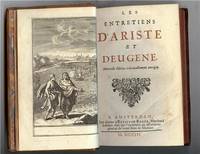
1703biblio45<p><b><i>Bouhours Dominique. 1628-1702 Les Entretiens D'Ariste Et E'Eugene. Nouvelle Edition très-exactement corrigée. A Amsterdam Aux depens D'Estienne Roger Marchand Libraire chez qui l'on trouve un assortiment general de toute sorte de Musique. M. DCCIII 1703</i></b> </p><p>Duodecimo. 3 blank 3 versoscene title page A12-I12 K12-R12 R12 includes 4 blank. Bookplate of Nicolai Joseph Foucault 'Comitis Consistoriani' Two Lions holding a crowned lion within the Crown. French Calf with marvelous gold filigree Emblem on the front and back of the same lion. Five raised spines in period gold gilt. Some edge and binding abrasion but otherwise tight. Internally clean but with fading print probably not washed but just running out of ink.</p> Title Page Printed in <b>Red and Black</b> by Roger in Amsterdam in 1703 the year after Dominque Bouhours death this elegantly bound book was once owned by <b>Nicolai Joseph Foucault and has his wonderful bookplate as well as his deeply embossed Seal on the front and back of the book.</b> Period blind stamp binding with 6 wonderful compartments. There is some minor separation of the leather along the spine but that is easily repaired. The book is tight crisp and is in overall very good condition. Dominique Bouhours 15 May 1628 - 27 May 1702 was a French Jesuit priest essayist and neo-classical critic. He was born and died in Paris. Bouhours entered the Society of Jesus at the age of sixteen and was appointed to read lectures on literature in the Collège de Clermont at Paris and on rhetoric at Tours and Rouen. He afterwards became private tutor to the two sons of Henri II d'Orléans duc de Longueville. First Amsterdam Edition. He was sent to Dunkirk to the Romanist refugees from the Commonwealth of England and in the midst of his missionary occupations published several books. In 1665 or 1666 he returned to Paris and published in 1671 Les Entretiens d'Ariste et d'Eugène which was reprinted four more times at Paris twice at Grenoble and afterwards at Lyon Brussels Amsterdam Leiden and other cities. The work consists of six conversations entretiens between two companionable friends whose Greek- and Latin-derived names both mean "well-born" in the agreeable discursive manner of the well-informed amateur as it had become established in the salons— "the free and familiar conversations that well-bred people have honnêtes gens a by-word of the précieuses of the salons when they are friends and which do not fail to be witty and even knowledgeable though one never dreams there of making wit show and study has no part in it."1 The subjects erudite but devoid of pedantry are the Sea considered as an object of contemplation the French language Secrets True Wit "Le Bel Esprit" The Ineffable "Le Je ne sais quoi" and Mottoes "Devises" all expressed in flawless idiom and effortless allusions to the Classics or Torquato Tasso. The popularity of Bouhours' discursive heuristic Entretiens extended to Poland where Stanislaw Herakliusz Lubomirski imitated them in Dialogues of Artakses and Ewander. His thoughts on the elusive je ne sais quoi that was in vogue in the seventeenth century expressed through his characters ends in assessing it a mystery that escapes a rational inquiry. It determined by its delicate presence its grace and invisible charm the sense of what pleases or displeases in Nature as well as Art and remained an essential part of the French critical vocabulary until the advent of Romanticism.2 His Doutes sur la langue française proposés aux Messieurs le l'Académie française Paris 1674; corrected second edition 1675 was called "the most important and best organized of his numerous commentaries on the literary language of his time"3 when it was edited in a critical edition. His doubts are collected under five headings: vocabulary phrases and collocations grammatical constructions clarity and stylistic consistency in each case setting literary quotations under scrutiny. His standards expressed in the suggestions he offered for improving each example showed the way out of ambiguities skirting incongruous juxtapositions and untidy constructions. The work was widely accepted and Bouhours standards are still the accepted norm among literate readers today. The chief of his other works are La Manière de bien penser sur les ouvrages d'esprit 1687 which appeared in London in 1705 under the title The Art of Criticism Vie de Saint Ignace de Loyola 1679 Vie de Saint François Xavier 16824 and a translation of the New Testament into French 1697. His letters against the Jansenists had a wide circulation. His practice of publishing secular books and works of devotion alternately led to the mot qu'il servait le monde et le ciel par semestre. Bouhours died at Paris in 1702. According to the book Mother Tongue by Bill Bryson Bouhours' dying words were "I am about to -- or I am going to -- die: either expression is used." D' Estienne Roger