Pascal, BlaiseBiblio.com

3 559 résultats
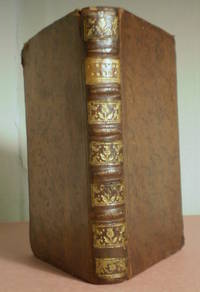
1704biblio592London: A.&J. Churchil 1704. Fine. <p>12mo LVIII 10 392p 18x11cm Translated by Basil Kennet signed binding by Sydney Aiken Fine leather decorated binding and marbled boards ownwer's signature</p> A.&J. Churchil hardcover
12mo, xii, 193 pages. 21 cm. 1st edition of Levinsohn's most important work. Levinsohn was one of the founders of the Haskalah in Russia. "He also was known as Ribal (initials of Rabbi Isaac Baer Levinsohn) From 1820-23 he spread the ideas of the Haskalah as a private tutor in wealthy homes in Berdichev and other towns ..Levinsohn's connections with the Russian government gave him authority in Haskalah circles and protected him against the fury of his fanatical opponents. In his memoranda he tried to persuade the Russian authorities to mitigate the persecution of the Jews (his memorandum against the kidnapping of children for military service) and to introduce reforms in the spirit of the Haskalah. He supported a plan for agricultural settlement of Jews, especially those who had lost their livelihood owing to expulsion from the countryside and border areas ..Levinsohn's literary work was mainly polemical and propagandistic. It dealt with the social, internal, and external position of the Jews in Eastern Europe. He started his public advocacy of the Haskalah by writing satires, mainly imitations of those by Perl and Erter .In 1823, Levinsohn completed his most influential work Te'udah be-Yisrael ("Testimony in Israel") which, because of Orthodox opposition, did not appear until 1828 (Vilna) .[In it h]e characterized the Hebrew language as "the bond of religion and national survival," uniting all the dispersions of Israel into one people. He severely criticized the traditional Hadarim ("Hebrew schools") which he dubbed "Hadrei mavet" ("rooms of death"). He denounced their talmudic-centered curriculum, their unsystematic method of instruction, and their employment of corporal punishment. He objected to the use of Yiddish and demanded its replacement by "pure" German or Russian. He demonstrated that great Jews of the past knew foreign languages and studied the sciences, and explained the advantages of such studies, both in business and in relations with the authorities. He devoted considerable space to the advocacy of manual labor, especially farming, and criticized Jewish fondness for petty trading. The book had a great impact on Russian Jewish life. Groups formed in many towns which undertook to carry out Levinsohn's proposals. Even a part of Orthodox Jewry received the book sympathetically; only the Hasidim regarded it as a dangerous work. They banned the book and labeled an adherent of the Haskalah with the pejorative epithet te'udke. The Russian government awarded him a prize of 1,000 rubles for Te'udah be-Yisrael. His contemporaries called him "The Russian Mendelssohn." For the modern reader, only his first book, Te'udah be-Yisrael, is of some historical value. By his personality and literary activity, Levinsohn undoubtedly did much to strengthen the moderate Haskalah. Certain ideas formulated in Te'udah be-Yisrael, such as educational reform and the transition to a life of labor and agriculture, later became a part of the programs of Hibbat Zion, Zionism, and other organizations and movements which preached "the productivization" of the Jewish masses and their adaptation to life in the modern world" (Yehuda Slutsky in EJ, 1972). Repair to title page, with some loss of text. Otherwise Very Good Condition in Good period binding. (HEB-1-22)
1st edition thus. Later paper wrappers, 12mo, 24 leaves, 155:90 mm. In Yiddish, with title also transliterated on title page ("Hanoges Odom"). Title translates as, The Book of Man's Leadership: ... How Every Jew Should Conduct Himself All His Days From Early to Evening ... and Many Laws. Proper daily behavior for Jews. Contains Kabbalistic customs and practices based on the teachings of the Ari. The text includes detailed descriptions of the halakhot and customs of the Ari for weekdays, Shabbat and festivals, and daily occasions.Although published anonymously, this appears to be similar to the work of Rabbi Meir ben Judah Leib Poppers (died 1662). He was a kabbalist of Ashkenazi descent who was active in Jerusalem after 1640. A pupil of Rabbi Jacob Zemah, he became the last editor of the Lurianic writings. He divided the mass of Rabbi Vital's different versions of Rabbi Luria's teachings into three parts, Derekh Ez Hayyim, Peri Ez Hayyim, and Nof Ez Hayyim. Rabbi Poppers' version became the one in most widespread use in Poland and Germany. After 1640 he composed a large number of his own kabbalistical writings in the vein of Lurianic Kabbalah. They are said to have comprised 39 books, each of which contained the word or ("light") in its title, the entire corpus being called Kokhevei Or. Several parts have been preserved (Ms. Jerusalem no. 101, Ms. Rabbi Alter of Gur no. 170). They included commentaries on Sefer Bahir, on Nahmanides' Torah commentary, on the Zohar, and on Luria's writings according to his own edition (Ms. Jerusalem no. 102). In the latter manuscript Poppers reports that he had studied Rabbi Luria's writings for 17 years. Only two of these books have been published, this work and Or Zaddikim (Hamburg, 1690), written in Jerusalem in 1643, and later incorporated in Rabbi Moses Katz's compilation, Or ha-Yashar (Amsterdam, 1709); and Me'orei Or, a dictionary of kabbalistic symbolism, published with copious notes by Jacob Vilna and Nathan Neta Mannheim under the title Me'orot Natan (Frankfurt, 1709). In addition, Mesillot Hokhmah, a booklet summarizing Lurianic metaphysics in 32 paragraphs, later published under Rabbi Poppers' name (Shklov, 1785), was first printed anonymously (Wandsbeck, c. 1700). Rabbi Poppers is credited with the authorship of a graphic description and summary of the Lurianic system, in the form of a scroll, published under the title Ilan ha-Gadol (1864). This tree, however, shows the distinct influence of Rabbi Israel Sarug's version of Lurianism, which is not to be found in Poppers' other writings. Part of his homilies on the Torah were published as Tal Orot (1911). He mentions as his teachers one Rabbi Israel Ashkenazi and his father-in-law, Azariah Ze'evi (probably from Hebron). During the 1650s Poppers spent about two years in Constantinople. He died in Jerusalem. (EJ, 2007). SUBJECT(S): Jewish ethics. OCLC: 233362307. OCLC lists only one copy (NLI), which, it is noted is missing the end, after 24 leavesexactly the same as our copy, so possibly as issued??? Some toning and stains. Good Condition, very rare. (YID-42-23)
Very Good Turkish, Ottoman (1500-1928) Original 1/3 leather bdg. in a traditional Ottoman style. Foolscap 8vo. (18 x 12 cm). In Ottoman script (Old Turkish with Arabic letters). 276 p. Third Edition. Very early edition of this first translation of Fenelon's "Telemaque"; made by Yusuf Kamil Pasha (1808-1876), under the influence of the leading French writers and thinkers like La Fontaine, Racine, Voltaire, Montesquieu, Rousseau; which introduced early Ottoman / Turkish literature to the utopian city called "Salante" for the first time. Özege 20335.; TBTK 10653.; This third edition cannot be found in OCLC. (Utopias from the Middle East 15).
Hardcover in good condition. No jacket. Ex-library. Xvii, 332 pages. Boards and spine are stained and faded. Title plate on spine is tanned and faded. Leading corners and spine ends are bumped and worn. Pen and stamp on front pastedown. Rough-cut pages are foxed. Light creases throughout pages. Penned marginalia and underlining on some pages. Volume is cocked but binding remains intact. Text remains legible throughout. HCW Used
1st edition. Period half leather binding over marbled boards, 12mo, [115] + [22] leaves. 17 cm. In Hebrew. Sefer Zikaron li-vene Yisra'el is by Avraham Mizrahi and Sefer Shohate ha-yeladim is by Israel ben Moses Najara. SUBJECT (S) : Shehitah. Jews -- Dietary laws. Judaism -- India -- Kolkata. OCLC: 49543377. Some wear to binding, especially at spine, a few pages trimmed close, paper remains bright and beautiful, an excellent copy. KH-8-53-BX
Period boards. 8vo. 72 pages; 18 cm. In Hebrew. Vinograd, Lissa #1. The title translates to Praise to the Righteous. A very early edition of this work and the first Hebrew publication in Lissa (Vinograd) . Rabbi Luzzatto (1706-1746) is often thought of as a great rabbinic scholar, kabbalist, and intellectual, though this work attests to his literary and poetic abilities. One of two pivotal literary works of the 19th century Haskalah, the other being Wessely's Shirei tif'eret. Luzzatto drew from secular Italian poetic dramas while mixing in his mastery of the Hebrew language. It was written on the occasion of the wedding of his friend and pupil Jacob di Gavis. (Abramson, Encyclopedia of Modern Jewish Culture) . SUBJECTS: Haskalah Hebrew poetry. OCLC lists 5 copies worldwide (Yale, Amsterdam, Kassel, HUC, JTS) . CD 000175365. Minor shelfwear. Very Good Condition. An outstanding copy. (HEB-50-18)
SIGNED BY MAX SIMON NORDAU (1849-1923), the renowned Zionist leader, physician, author, social critic, co-founder with Theodor Herzl of the Zionist Organization in Basel, and president of several Zionist congresses. This book is a rare French translation of his social and philosophical critique written in German in 1883 - Die conventionellen Lügen der Kulturmenschheit [The Conventional Lies of Our Civilization], in which he shows what he believes to be the essential falsity of some of the social, ethical and religious standards of modern civilization. Nordau's dedication is written in French and dated 1896, Paris. 230x150 mm. X+354 pages. Quarter-cloth marbled Hardcover with gilt spine [Contains original front and rear softcover]. Cover slightly rubbed. Cover and spine edges slightly worn. Small Ex-Libris on front inner cover. Pages yellowing. [SUMMARY]: This rare French edition of Max Nordau's critique, signed by author, is in good condition.
Very Good Turkish, Ottoman (1500-1928) Original cloth bdg. Foolscap 8vo. (18 x 12 cm). In Ottoman script (Old Turkish with Arabic letters). [16], 318 p. Lithographed Edition. Early edition of this first translation of Fenelon's "Telemaque"; made by Yusuf Kamil Pasha (1808-1876), under the influence of the leading French writers and thinkers like La Fontaine, Racine, Voltaire, Montesquieu, Rousseau; which introduced early Ottoman / Turkish literature to the utopian city called "Salante" for the first time. Özege 20335.; This edition cannot be found in OCLC. (Utopias from the Middle East 2).
Very Good Turkish Original wrappers. 12mo. (16 x 12 cm). In Turkish. 16 p. First and only edition of this extremely rare pamphlet written by Turkish Islamist-Nationalist journalist Eygi, who criticizes the understanding of Islam in the 1960s, through the symbol of the first fictional utopian land and vision in Turkish literature called "Darürrahat" [i.e. The Door of Peace] in Ismail Gaspirinskiy (1851-1914)'s book "Darürrahat Müslümanlari" [i.e. The Muslims of Darrürrahat] published in 1887, in Kazan. Mehmed Sevket Eygi was a Turkish journalist, writer, columnist, and Holocaust denier. He had Islamist-nationalist views. After graduating from university in 1956, he worked as a translator at the Directorate of Religious Affairs for two years. Eygi began publishing the daily Bugün newspaper and its publishing house in 1966, where this book will also be published as the third book of the publishing house. While making this criticism, he used the first utopia text of Turkish literature called "Darürrahat Muslims" by Gaspirinskiy as a symbol. Ismail Gaspirinskiy (or Gaspirali) was an ideologist, author, journalist, publisher, educator, and major. Gaspirali's work called Muslims of Darurrahat (Comfortable Country) was published in 1891 after the first issuance in Tercuman Newspaper as the continuation of Letters of Frengistan. Cannot be found in any data as well as OCLC. (Utopias from the Middle East 1).
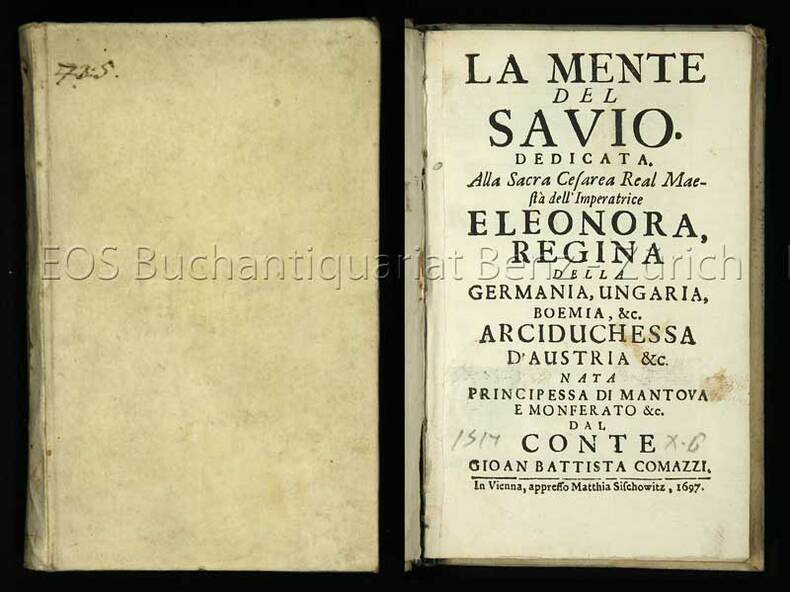
169730057ABWien, Matthia Sischowitz, 1697. 8°. (8), 170, (6) S. Pergamentband der Zeit mit handschr. Rückentitel. + Wichtig: Für unsere Kunden in der EU erfolgt der Versand alle 14 Tage verzollt ab Deutschland / Postbank-Konto in Deutschland vorhanden +, 30057A
Period full leather binding, 8vo, 370 + [1] Leaves [740 + 2 pages]. In Hebrew. Printed entirely on Blue paper. Red and black lettering on title page. me-et Yosef Karo ; ?im Hidushe dinim me-et Mosheh Iserles; ve-im Baer hetev. Yehudah Ashkenazi, dayan di-k. k. Tiktin. The Shulchan Aruch, sometimes dubbed in English as the Code of Jewish Law, is the most widely consulted of the various legal codes in Judaism. It was authored in Safed (today in Israel) by Joseph Karo in 1563 and published in Venice two years later. Together with its commentaries, it is the most widely accepted compilation of Jewish law ever written. The halachic rulings in the Shulchan Aruch generally follow Sephardic law and customs, whereas Ashkenazi Jews generally follow the halachic rulings of Moses Isserles, whose glosses to the Shulchan Aruch note where the Sephardic and Ashkenazi customs differ. These glosses are widely referred to as the mappah (literally: the tablecloth) to the Shulchan Aruch's Set Table. Almost all published editions of the Shulchan Aruch include this gloss, and the term Shulchan Aruch has come to denote both Karo's work as well as Isserles', with Karo usually referred to as the mechaber (author) and Isserles as the Rema (an acronym of Rabbi Moshe Isserles). Due to the increased availability of the printing press, the 16th century was an era of legal codification in Poland, the Ottoman Empire and other countries. Previously unwritten laws and customs were being compiled and recorded; the Shulchan Aruch was one of these. In the century after it was published by Karo (whose vision was a unified Judaism under the Sephardic traditions) it became the code of law for Ashkenazim, together with the later commentaries of Moses Isserles and the 17th century Polish rabbis (WIkipedia). OCLC: 39808032/233341596. OCLC lists 3 copies worldwide (NLI, NYPL, JTSA). Period inscriptions on blank endpapers, Very Good Condition. Attractive blue paper copy. (RAB-66-29)
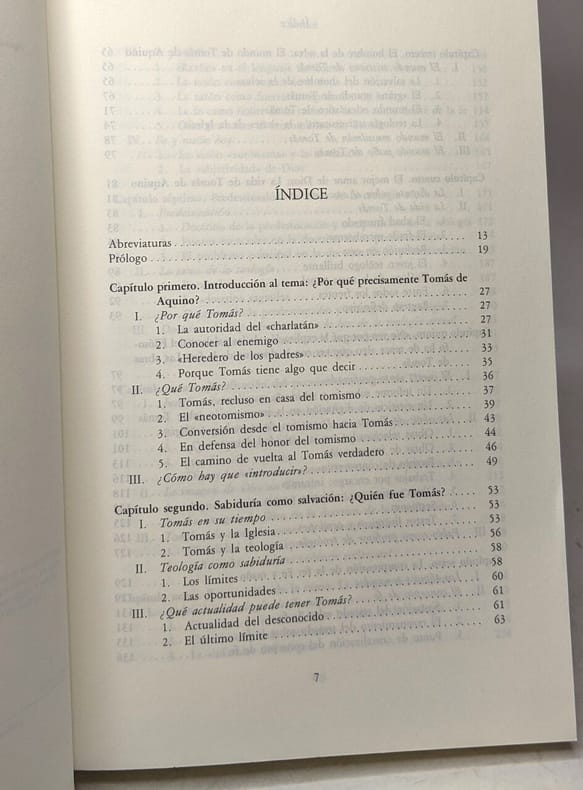
1992100133083Herder Editorial 1992 548 pages in8. 1992. Broché. 548 pages.
vol 2 (out of 2): 500 + [27]pp., 26cm., full leather binding (gilt lettering and decorations on spine, gilt decorations on edges of cover, leather slightly rubbed, corners bit bumped, small pieces detached from spine), title page printed in black and red, vignette on title page, title-vignettes, few foxing, generally good, text in Latin, [this second volume contains "Liber sextus" - "Liber septimus" - "Liber octavus" - "Index auctorum" - "Index rerum"; Samuel von Pudendorf, 1632-1694, German jurist, political philosopher, statesman, economist and historian], J73919
1744J73919Francfurti & Lipsiae [Frankfurt & Leipzig], Ex officina Knochiana 1744 vol 2 (out of 2): 500 + [27]pp., 26cm., full leather binding (gilt lettering and decorations on spine, gilt decorations on edges of cover, leather slightly rubbed, corners bit bumped, small pieces detached from spine), title page printed in black and red, vignette on title page, title-vignettes, few foxing, generally good, text in Latin, [this second volume contains "Liber sextus" - "Liber septimus" - "Liber octavus" - "Index auctorum" - "Index rerum"; Samuel von Pudendorf, 1632-1694, German jurist, political philosopher, statesman, economist and historian], J73919
17757Amsterdam 1775. Full Calf. Very Good. <p>Very good No dust jacket as issued 321 p Plein cuir veau moucheté d'époque in 12 dos orné 5 nerfs piéce de titre ocre gardes marbrées tranches rouges coins frottés avec léger manque sur un coin arrière et petite tache intérieur frais Voici ce l'auteur à écrit au sujet de notre édition en préface de celle de Paris en 1784 '' Les trois éditions de l'homme moral qui se sont succédée dans le cours des années 1775 qui portent toutes le nom d'Amsterdam & dont les exemplaires sont rares du moins en France ont étés faites loin des yeux de l'auteur qui était alors à St-Pétersbourg une seule avait été entreprise de son aveuPressé par un voyageur qui offrait de se charger du manuscrit engagé à saisir cette occasion parcequ'il n'espérait pas en trouver d'autreDe deux éditions furtives celle dont l'auteur a le plus à se plaindre a été annoncée comme une édition corrigée & considérablement augmentée C'était un leurre qu'on offrait au public & un exemple de brigandage des contrefacteurs ''</p> unknown
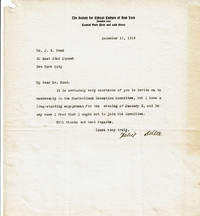
191936901New York December 12 1919. 1919. Very good. - Over 50 words typed on Adler's 9-1/4 inch high by 8-1/2 inch wide "The Society for Ethical Culture of New York" stationery. Responding to the American impresario and lecture agent James B. Pond's invitation to join as a member of the reception committee welcoming Maurice Maeterlinck to America Felix Adler thanks Major Pond for the invitation and apologizes as he has "a long-standing engagement for the evening of January 2 and in any case I fear that I ought not to join the Committee". Signed in full "Felix Adler". Folded for mailing the letter is slightly darkened along the right edge and there is a small piece out from the top left corner. Very good. <p>The German-American philosopher Felix Adler 1851-1933 was a professor of political and social ethics. A rationalist social reformer and religious leader he was an influential lecturer on the subject of euthanasia arguing as Robert Ingersoll did for the rights of individuals suffering from terminal illnesses to end their pain through suicide. Adler unlike Ingersoll did not reject religion and argued from an ethical perspective. Born in Germany the son of a rabbi he moved to New York with his family when he was 6 years old. After graduating from Columbia University Adler continued his studies at Heidelberg University with intent to become a rabbi. He was influenced by the neo-Kantian argument that as one can neither prove nor disprove the existence of a deity or an afterlife morality is independent of theology. Asked to give a sermon at New York's Temple Emmanu-El where his father was head rabbi he shocked the congregation with his sermon titled "The Judaism of the Future" which made no mention of God and made the case for a universal religion of morality. It is not surprising that this was not only the first but also the last time he was invited to lecture at the temple. He took a position as a Professor of Hebrew and Oriental literature at Cornell University where he was popular with the students but stirred controversy. He was later offered and accepted the chair of political and social ethics at Columbia University. With Joseph Seligman's assistance Adler founded the Society Of Ethical Culture. Adler argued for the importance of "deed not creed" and set up teams of visiting nurses to serve the homebound poor who were ill and also set up a Free Kindergarten for the children of the working poor. He was the founding chairman of the National Child Labor Committee and served on the Civil Liberties Bureau which later became the ACLU.<p>James B. Pond the American impresario and lecture agent who headed the J.B. Pond Lyceum Bureau brought the great Belgian poet Maurice Maeterlinck to America for a series of lectures. The first lecture took place at Carnegie hall on January 2nd 1920. Unfortunately Maeterlinck failed to carry out his intention to lecture in English because of his labored "phonetic" English. He declared his intention to continue his lectures in French and have the translation read by another person. As a result the lecture tour was a failure and lawsuits ensued on both sides.<p>An uncommon autograph. New York, December 12, 1919. unknown
Features: Great cover photo of men viewing Paris election news; What it is like to live in Warsaw - the daily struggle to achieve the ordinary wears a man out, physically and spiritually, but Poles have not yet quite lost their pride and hope, gaiety and individualtiy; France Chooses a new Assembly - with great photos; Big Three of Algeria's Rebels - Premier Ferhat Abbas, Foreign Minister Mohammed Lamine-Debaghine, and Belkacem Krim, Vice Premier; A 600 Billion Dollar Economy?; The Egghead vs. the Muttonhead - too few people dare to be themselves; Small Wonder Called the Gene - How will radioactive fallout affect human genetics?; Rodgers and Hammerstein Brand on a Musical; Real World in the Abstract - photos; He Calls the Signals for Pro Football - Article on NFL Commissioner Bert Bell; Fantastic two-page color-photo as for American Airlines promotes the first jet service in the U.S.A., 707 service scheduled to begin in January, New York to Los Angeles in 5.5 hours!; Impressionistic View of an Art Opening; When Cities Put Out the Welcome Mat to host conventions; Captains of the Subway - brief article on New York subway conductors, with photos; Two Movies - Two Audrey Hepburns; Stuffing recipes; Building the Child's Sense of Ethics; Fashion photos of two-piece swimwear for women; Photo-feature of new five-story Manhattan home designed by Felix Augenfeld and Jan H. Pokorny; Photos of "The Disenchanted" starring Jason Robarts; and more. 96 pages. Many fascinating black and white reproductions of photos plus sensational fashion ads, some of which are in color. Unmarked with average wear. A sound vintage copy. Book
169730057ABWien, Matthia Sischowitz, 1697. 8°. (8), 170, (6) S. Pergamentband der Zeit mit handschr. Rückentitel.
9789004104778 & 97890041047921st edition. Original publisher's cloth, 8vo, viii, 334 + viii, 292 pages. These two volumes collect some of the most influential and important scholarly essays by the late Morton Smith (1915-1991) , for many years Professor of Ancient History at Columbia University in New York City. Smith was admired and feared for his extraordinary ability to look at familiar texts in unfamiliar ways, to re-open old questions, to pose new questions, and to demolish received truths. He practiced the "hermeneutics of suspicion" to devastating effect. His answers are not always convincing but his questions cannot be ignored. The essays of Volume I center on the Hebrew Bible ("Old Testament") , Ancient Israel and Ancient Judaism, of Volume II on the Christian Bible ("New Testament") , Early Christianity and Ancient Magic. Volume II also contains an assessment of Smith's scholarly achievement and a complete list of his publications. Ex-library with minimal markings, Very Good Condition, very clean. (KH-4-2)
18033567FBBerlin, Verlag der Realschulbuchhandlung, 1803. 8°. 20,5 x 12,5 cm. X, 489 Seiten. Marmorierter Pappband der Zeit mit goldgeprägtem Titel auf Lederrückenschild und Rundum-Rotschnitt. [3 Warenabbildungen]
Very Good Turkish, Ottoman (1500-1928) In contemporary cloth bdg. Marbled boards. Serlevha colored in purple in its contemporary period. Roy. 8vo. (24 x 17 cm). In Ottoman script. [6], 360 p. Nevâdir-i Süheylî: Acaibü'l-meâsir ve garaibü'n-nevâdir. It is a widely read work and is a corpus of prose stories written in the period of Murad IV. In the work, which includes 204 stories under thirty-one chapters, Süheylî added stories from his own time to the corpus generally chosen from the Turkish-Islamic history as well. The stories, almost all of which were instructive and exemplary, were selected from various books in Arabic, Persian and Turkish, and the lessons to be learned at the end of each were written separately, and the adaptation path was followed in the translated stories. Hegira: 1276 = Gregorian: 1860. TBTK 774.; Özege 32. Second Edition. Five copies in OCLC: 163633062. Tahir, Bursali Mehmed, Ahlâk kitaplarimiz (Books on ethics) 46.
Hardcover (no jacket). The Complete Works of Friedrich Nietzsche, edited by Oscar Levy, volume fifteen. The Will to Power, v.2 (comprising books three and four). Second edition, limited to 1000 copies, this stamped #1550 (presumably erroneously). Embossed portrait on front board. xix, 432pp + ads. Boards are marked, sunned and bumped. Page block is rough cut (affecting very few page edges) and discoloured. Previous owner's name penned on FEP. Endpapers are tanned. Text is clear throughout. TS Used
226p., 8 engr. plates (frontis & 14 figures) 4 p. of ads. at beginning Hardcover Good condition, in worn leather, hinges cracked, backstrip chipped
167033392-ya8Lugdunum Batavorum (Brittenburg) & Amstflod: Gaasbekios 1670. 359 Seiten. Pergament mit durchgezogenen Bändern und handgestochenen Kapitalbändern (der Einband nachgedunkelt, etwas bestoßen, der Buchblock zwischen dem Frontispiz und dem Titelblatt leicht angebrochen, auf dem vorderen Vorsatzblatt kleine Annotationen von alter Hand, sonst sehr gutes und sauberes Exemplar) 10 x 5,5 cm. [3 Warenabbildungen]