4 488 résultats
15347No publication details. Oxford 1907. Dated in manuscript at head: 'G. E. M. 16. v. 1907'. 4pp. foolscap 8vo. Bifolium. Apparently printed at the Clarendon Press with the Fell types. Sections on 'New Buildings' 'University Professors Lecturers and Readers' 'Honour Schools' 'Courses of Study: Diplomas' 'The Professions' 'Post-graduate Study and Research' and 'Extra Academical Teaching'. In poor condition with ink stain at head of first page. No copies on COPAC or OCLC WorldCat. No publication details. [Oxford, 1907.] unknown
2251727 September no year. Oxford. The 1880 'Balliol Masque' indicates Jowett's standing and the pronunciation of his name: 'First come I. My name is Jowett. There's no knowledge but I know it. I am Master of this College What I don't know isn't knowledge.' 2pp 12mo. Bifolium. In good condition lightly aged with fold lines. Begins: 'My dear Jex Blake I am very glad to hear of the prosperity of Rugby in which I shall always take a great interest. In a year or two the past will be forgotten & you will again regain your old prestige.' He plans to answer his question in three weeks time 'or if I do not perhaps Mr Pearson will write & ask me again. We have not yet settled the question whether the certificates shall be received or not'. He continues on the subject with reference to a meeting before turning to his health: 'I am much better than I was this time last year & hope still to get some work done if my health holds up.' He ends in the hope of coming to see Jex-Blake 'at Rugby for a night' if he is able and that Jex-Blake and his wife 'will come & see us at Oxford in the course of the next few months'. 27 September [no year]. Oxford. unknown
20218Bodleian Library Oxford. 30 July 1857. 3pp. 12mo. Bifolium. In fair condition on lightly-aged paper with faint stain to first page. The letter is of interest for Bandinel's reference to his education with the recipient under Richard Valpy 1754-1836 at Reading School. The recipient is not named but the letter is addressed to Major Robert Guthrie Macgregor 1805-1869 and concerns his 'Translations from the Greek Anthology' which was published without date in London by Nissen and Parker. Bandinel returns Guthrie his 'very best thanks for the Honor you have done this Library and the humble individual who has the care of it in sending two copies of your translation from the Greek Anthology'. He anticipates 'great pleasure from the perusal of the Volumes which would be not a little encreased sic from the knowledge that the Author was educated at the same school and by the same celebrated individual as himself viz Dr Valpy.' Bodleian Library, Oxford. 30 July 1857. unknown
20505'Oxford & Cam Club' London . 16 July no year . 3pp 12mo. Bifolium with mourning border. In good condition lightly aged with reverse of second leaf laid down on leaf removed from album. Valentia's father had been like Neate a Member of Parliament for Oxford. The letter begins: 'Dear Lord Valentia. I am sorry it so happens that I was away and shall be till next Monday - when I return home <> to <> street for the next six Weeks'. He would have been 'very glad to meet even a Yankee at your <> - though I dont like those northerns especially those that stay in England just now.' If 'the Yankee' should be with Valentia or in the neighbourhood the following week he will be 'happy to show him Oxford'. 'Oxford & Cam Club' [ London ]. 16 July [ no year ]. unknown
2241428 August no year. On letterhead of Elderfield Otterbourne Winchester. 4pp 16mo. Bifolium of grey paper with letterhead printed in red. In good condition lightly aged. Folded three times. The recipient is undoubtedly Elizabeth Missing Sewell or a member of her family and the letter begins: 'My dear Miss Sewell I wish you could have accomplished giving us a day hoping you might have found me in more lively and sensible trim than when you were here when I had a headache just enough to make me stupid.' She is going to post her Roscoe's 'William I' which she got 'from the Lending Library'. She has not yet read the book 'but a glance made me think we might get a good extract'. She will send it before 6 September 'when we go to my uncle's in Devon a place that always brightens me beyond all others'. She will write again before departing and returns in October. Changing the subject she writes: 'I was much provoked with the Saturday Review it was such a specimen of people reading and misunderstanding things never meant for them. I am vexed not to have had the book yet Hookham's Library never send above half the books one asks for - and they say it is because people will read nothing but novels'. 28 August [no year]. On letterhead of Elderfield, Otterbourne, Winchester. unknown
26238No date. On cancelled embossed letterhead of Christ Church Oxford. See his entry in the Oxford DNB. 2pp on both sides of a 9 x 10.5 cm piece of paper. Aged and worn with a corner cut away but the text complete.Nineteen lines in a close and difficult hand. Addressed to 'My dear Mgnr i.e. Monsignor' and signed 'E B Pusey'. Interpretation of Pusey's execrable handwriting is challenging. He appears to be ‘lecturing on the Psalms’ and may be requesting ‘combined lectures’. Other phrases that stand out are ‘some other Hebrew subject’ ‘the original idea’ ‘supplement the Professors lectures’ ‘competition studies’ ‘it is difficult to obtain a class of any dimension’. One passage seems decipherable: ‘The Psalms have been one of my special studies before my Professorial years; and now too I review all the latest writings upon them’. See Image. No date. On cancelled embossed letterhead of Christ Church, Oxford. unknown
23993No place or date. Scrap of paper 9 x 9cm remnants of laying down on reverse clear text as follows: "I should be glad to have the Statuta Aularia if you have them to hand short line though this paragraph Line crossed out - indecipherable I shd be glad to know of any new German works or 'Jewish' prob. or any improved editions of the old ones." Note: Statuta Aularia: "statutes made by the University for the government of the Halls" presumably as opposed to 'Colleges'. "The Oxford University Act 1854 and the university statute De aulis privatis On private Halls of 1855 allowed any Master of Arts aged at least 28 years to open a private hall after obtaining a licence to do so.3 The longest lived of the thirteen private halls was Charsley's Hall 1862–1891" Wikipedia. SEE IMAGE. No place or date. unknown
24474Embossed "Christ Church Oxford". Docketed "Dr Pusey Nov.25. 1875". One page 16mo in narrow "frame" of stiffer paper good condition. "My dear Sir I am sorry but I did not know it was wanted so soon and have not written to Leipzig. I will write. . P.S. I suppose the Publisher who sell sic the Bodleian book will tell them I will wroite to them". Note: I have traced no publication of Tauchnitz's atributable to Pusey. And the only book in which he was involved associated with the Bodleian that I've traced is "Treasures of Oxford : containing poetical compositions by the ancient Jewish authors in Spain : and compiled from manuscripts in the Bodleian Library Oxford / Part I" published in 1851 by Groombridge. IMAGE. [Embossed] "Christ Church Oxford". Docketed "Dr Pusey | Nov.25. [18]75". unknown
22240'Cagliari Sardinia March 7th. 1814.'. The Earl's wife was a mistress of Lord Byron. Her infidelities let to her children being jokingly referred to as 'The Harleian Miscellany'. 1p 4to. Heavily aged and worn with spike hole at centre. Folded several times. 'Sir As Naples is now open for the English I beg you will send the Carriage to Naples for me by the first Ship that Sails from England for that Country. We are going there immediately. & shall therefore want it. I hope therefore you will lose no time in sending it. I will thank you to call on Wh. /// sic the Sadler in North Audley Street & inquire if he has sent the things I ordered & if he has not let them be sent with the Coach to Naples I am &c Oxford'. 'Cagliari [Sardinia] March 7th. 1814.' unknown
1374215 Ship Street Oxford. 18 November 1898. 4pp. 12mo. 65 lines of text. Bifolium. In fair condition: on aged paper with one dogeared corner. He begins by apologising for not returning her manuscript sooner: 'what with my Doctorate exam: and other things I have been specially busy'. Having been 'completely through the MSS' he lists those he likes best: 'the Rhapsodies especially No. 1 - also No. 5 and No. 3 - especially the opening subject of No. 5. I do like the G minor but somehow I hardly think the G major section goes well with it and it is scarcely so interesting to my mind.' He comments on his favourites among the 'other things'. He gives his opinion regarding some 'Themes and Variations' in which 'it seems to me that you have tied yourself down harmonically more strictly than is necessary in modern variations'. He concludes with the opinion that she does not 'quite grasp the structural organism of sonata style so to speak. I think your "métier" lies beyond any doubt more in the direction of detached pieces than of works which require sustained structural and organic interest and ideas different in atmosphere so to speak from those suitable for lyric music.' He will 'probably be in Anerley all the Christmas vacation' and would be 'very glad to call and talk over the things "viva voce"'. 15 Ship Street, Oxford. 18 November 1898. unknown
15222A. J. Cumming Government Printer Brisbane. Australia. 1926. 27pp. 12mo. With collotype frontispiece of memorial plaque to Sir James Francis Garrick 1836-1908. In grey printed wraps. In fair condition on lightly-aged paper in worn wraps with chipping to extremities and rusted staples. Stamp label and shelfmark of the Board of Education Reference Library London. Only three copies on COPAC and none at the British Library. A. J. Cumming, Government Printer, Brisbane. [Australia.] 1926. paperback
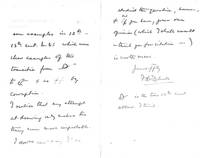
26904Headed 37 Norham Road Oxford 31 Jan. 1922. Two ALSs 12mo good condition. LETTER ONE: Three pages 12mo bifolium as follows: ". I have myself not the least doubt that Savigny Friedrich Carl von Savigny German jurist and historian presumably is right I am not good at diagrams nor have I a good memory for shape - but I have seen examples in 12th - 13th century MSS which have clear examples of the transition from symbols here - see Image by corruption. I realise that my attempt at drawing only makes the thing seem more improbable. I can't say I've studied the question however & as you have your own opinion which I shall consuly -thank you for citation - is worth more Signature and Postscript including symbolsymbol is the true 12th Century abbrev. I think."; LETTER TWO: Two pages 12mo 2 Feb. 1922 to presumably the same "Sir" responding to his reply. "You make myremarks seem very superficial. I confess that I am no palaeographer. & have not enough sense of form ever to become one. I admit that a corrupt D is not very satisfactory. Still it is not simply a D but D with a stroke throughit D with a stroke through it is the sort of thing; then; symbol it becomses & then ff. Again it isn't exactly a blunder but a conventional sign naturally developed. Is it really as early as 9th or 10th century Earliest I've seen is middle 13th. Cappelli marks it XV. I will ask Mr Madan at Bodley. Will you accept enclosed which is the most serious piece of palaeographical work I've dome .". Note: For what it's worth he published "Digest 41 1 & 2. Translation and commentary" Justinian in 1922. [Headed] 37 Norham Road, Oxford, 31 Jan. 1922. unknown
19548'Oxoniae Maii 5to Anno Domini 1818'. Printed form on one side of a 10.5 x 17 cm piece of laid paper. In fair condition aged and worn. Reads with autograph text by Hodson in square brackets: 'Oxoniae Maii 5to Anno Domini 1818. QUO die comparuit coram me Ricardus Harington ex AEde Christi Baronetti Fil. et subscripsit Articulis Fidei et Religionis; et juramentum suscepit de agnoscenda suprema Regiae Majestatis potestate; et de observandis Statutis Privilegiis et Consuetudinibus hujus Universitatis. F. Hodson P. V. Cancell:'. From the papers of the Harington baronets of Ridlington. 'Oxoniae [ Maii 5to ] Anno Domini 1818'. unknown
22732'7 Carey Street. Lincoln's Inn London Tuesday.' With postmark 3 December 1833. 4pp 4to. Bifolium. In good condition lightly aged. Addressed on reverse of second leaf with small seal in red wax and postmark to 'Revd. Charles Merivale St John's College Cambridge'. A long letter with the four pages of text followed by a long postscript at the head of the first page continuing to the last. An interesting intimate letter discussing his activities and writing and ending with aThe letter begins: 'My dear Charles I still direct from these unfortunate lodgings having been quite unable to find chambers to suit me in which I consider myself particularly unlucky: as all the world except myself appear to have found their way into decent habitations Neate in particular who has got a very pleasant little set of rooms in Lincolns Inn for almost no rent at all.' He turns to 'Other news' with reference to 'the revisorship' his 'Wiltshire operations' 'a stupid barbarian by name Taunton' 'Mrs. Spring Rice' and her husband who is 'feasting ministers in his house in Hertfordshire instead of making up & paying the accounts of us unhappy barristers who are desperately out of pocket by his delay'. He has his 'hands over full of writing' but does not find that he can 'do satisfactorily more than one thing at a time: consequently I undertake a great many jobs more than I am able to perform'. He has 'just finished or nearly so a long paper for Cochrane about the Italian Wars of Charles V.' and has 'also on the stocks one or two small matters for Blackwood: & ought to be in correspondence with Napier who wants me to select a subject & write for him but nothing has occurred to me worthy of my genius.' He continues with reference to the Edinburgh Review the 'Revue des 2 mondes a tolerable Paris journal' and again to his publisher Cochrane. As the letter continues there are references to 'Mrs. Mariott' 'De Morgan' and 'Mr. Frere'. He asks to know what his brother's 'proposals are with respect to Henry Drury'. The postscript gives a shrewd assessment of Dickens's future friend Edward Bulwer-Lytton: 'I have not read much of Bulwer & what I have I greatly despise. Not that I do not agree in many of his public ideas: but there is a mixture of affected philosophy & mortified vanity about him which would be amusing in one chapter but is detestable in 2 volumes - he seems to have aimed at being the most fashionable man in London - a leader in the House of Commons - and a first rate writer all at once: & to think it very hard that he has not succeeded - Had he addicted himself to one line only the composition of works requiring a mixture of passion & affection I think he would have come nearer Rousseau & de Stael than any English writer has done.' '7 Carey Street. [Lincoln's Inn, London] Tuesday.' With postmark 3 December 1833. unknown
2002OUP 4 & 11 Oct. 1929 26 May 1932 and 16 March 1943. Publisher Oxford University Press. One page each 8vo 2 and 4to 2 one grubby fold marks minor defects but texts clear and complete. Two are goodhumoured brief and concerning social trivia. The one sent in 1932 goes: "This is to introduce Sir Wallis Budge. I have told him you are the best bookseller in London and would be able to get him all he wanted." one ms. correction and one ms. addition. The letter dated 1943 discusses the works of Mark Rutherford: "I remember in very old days you were a devoted admirer of my late brother-in-law Mark Rutherofrd. The Oxford University Press editioln of the Novels is the only edition I think now in existence but our annual sales are miserable; most of them barely reach double figures." He asks if Wilson would give his opinion before he arranged for existing stocks to be pulped on whether Rutherford was likely to come back into fashion. "I should be very loath to let Mark Rutherford for whose works I still have a great admiration drop out of circulation but I cannot keep my congested warehouse groaning under six unsaleable books indefinitely." Frank Mumby describes Wilson as "one of the outstanding booksellers of the day" 1956 ed. p.235. Four items OUP, 4 & 11 Oct. 1929, 26 May 1932, and 16 March 1943. unknown
21940Wolfson College Oxford; 8 February 2001. 1p 8vo. In good condition. Folded twice. With secretarial note in blue pencil recording response by 'C.F.' The letter concerns Fry's screenplay for the 1966 film 'The Bible: In the Beginning.' produced by Dino De Laurentiis and directed by John Huston which recounts the first 22 chapters of the Book of Genesis. Stallworthy wonders whether Fry remembers 'that “in the dark backward and abyss of time†the OUP wanted to publish your screen-play for the film of Genesis but the film company's lawyers wouldn't allow it. John Bell 1922-2008 senior editor at the Oxford University Press and I were desolated and over the years I have so often remembered/half-remembered/mis-remembered your opening stage-direction description of the first days of creation that I'm writing to ask whether by any happy chance you have a copy of those pages that I could see and show to deserving friends' He ends by stating that his brother-in-law 'Jim Thompson Bishop of Bath and Wells for one would like to see it – almost as much as Yours ever Jon'. Wolfson College, Oxford; 8 February 2001. unknown
24098Without date or place. Circa 1935. See her entry in the Oxford DNB. 1p long 8vo. In good condition lightly aged. Headed ‘TORRINGTON SQUARE. / To the EDITOR of The TIMES’. Whether the letter was published or not and if so whether it appeared in its entirety is unclear. Clearly a carbon but with her characteristic signature at end in black ink ‘Margot Oxford’. The forty-seven-line text has four autograph emendations. Begins: ‘Sir / It has been officially announced that the building of the School of Oriental Studies London Institution in Finsbury Circus is to be sold and that in due course the School “will be accommodated in its own new building on the Bloomsbury siteâ€; and further that the Court of the University of London has presented a new site to Birkbeck College.’ In the light of this and as a Bloosmburyite the Asquiths had lived at 44 Bedford Square since the early 1920s she continues: ‘May we see in these announcements the gleam of a hope that the University proposes to preserve the garden of Torrington Square and to surround it with a group of beautiful buildings generously spaced and allowing glimpses of those wonderful trees’She quotes a ‘Resolution adopted by the Senate of the University in March 1928’ suggesting that ‘a group of beautiful buildings’ would give ‘greater scope to the genius of the Architect Mr. Charles Holden than a single patternised building’. In then emphasizing ‘the strenght of public opinion in favour of the preservation of London squares she quotes a statement by Lord Rothermere ‘in handing over the Geraldine Mary Harmsworth Park in Southwark’. The final paragraph outlines how ‘the garden of Torrington Square could be made a thing of beauty rivalling the garden of New Square in Lincoln’s Inn’ and could be used for purposes including ‘garden parties open air concerts and plays’. Construction delays and the war meant that what became SOAS did not move to its Bloomsbury site until 1941. Without date or place. [Circa 1935.] unknown
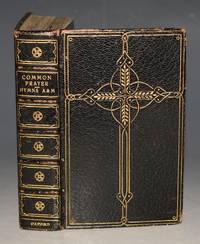
98405Oxford University Press Humphrey Milford / William Clowes n.d. ca1940 New Small Pica 24mo. Small pocket Hardback 5.75 x 3.5 inches. In polished black morocco leather fine binding with decorative gilt Cross design to boards boards raised banding and gilt decorations and lettering to spine gilt inner dentelles full gilt page edging blue marbled endpapers. In very good condition. Some rubbing to edges of cover and raised bands on spine corners slightly bumped. Some minor foxing spots to endpapers neat inscription to front “Bridget Carola Barnard from her Grandmother Christmas 1946.” Minor crease to title pages at front. A couple of minor handling marks and minor light foxing spots small bump/nick to edges of Index pages at rear of Hymns. Else a very good clean and tight copy. 2 vols in 1: 652 & 719pp. Book of Common Prayer AND Hymns Ancient and Modern. 2 vols in 1. Oxford University Press, Humphrey Milford / William Clowes, n.d. ca1940 (New Small Pica 24mo.) hardcover
24745‘Paper read by Mr. Percy Linaker Leamington at the Quarterly Meeting of the Birmingham and Midland Counties District of the Institute of Journalists held at Wolverhampton March 7th 1896.’. A scarce item no other copy discovered on ViaLibri WorldCat or JISC LHD. 4pp 12mo. Paginated bifolium in small print. Aged and worn with short closed tear in gutter. Folded twice. A discussion of the ‘image of an ideal newspaper’ and of the ‘ideals about professional training status work and reward’ in the journalistic profession with sideswipes at the ‘New Journalism’ and ‘those unwieldy amorphous weekly budgets which flourish in America and which contain everything from the instalment of a novel to a recipe for chipped potatoes and from a resume of last Sunday’s sermons to the portrait of the latest fashionable beauty’. From the papers of J. Cuming Walters editor of the Manchester City News who has indicated in pencil passages he finds significant. ‘Paper read by Mr. Percy Linaker (Leamington), at the Quarterly Meeting of the Birmingham and Midland Counties District of the unknown
13918Place not stated. December 1960. 2pp. foolscap 8vo. In fair condition on lightly aged and worn paper. A fair copy of a twenty-eight line poem arranged in seven four-line stanzas. Signed at end 'P. L. December 1960.' The first stanza reads 'Rain-threaded gull-wheeling bell-clamorous air by wind shifted by smoke lightly weighted in which sirens beautifully despair no monumnet crumbles uncelebrated'. The poem ends with a simile of 'Adam when he woke: stood for a moment as if he had been blind and bent suddenly over Eve and spoke.' There is no indication that the poem has been published. A regular of the Colony Room Henrietta Moraes was noted for her bohemian and hedonistic lifestyle in the Soho of the 1950s and 1960s. She met Dom Moraes in 1956 and the couple married in 1961 divorcing a few years later. Place not stated. December 1960. unknown
13917Card postmarked from Campion Hall Oxford and with postmarked date 21 November 1971. Three Poems: Sycamore Press 4 Benson Place Oxford; Spring 1970. 'To our friends': No. 33 April 1962; with note on letterhead of Heythrop College Chipping Norton. The three items in good condition with light age and wear. CARD: He has been told about Korn by 'Barbara <Ghilan> and Cyril Connolly': 'Maybe we might meet though I shall now be leaving England for a time. Do you ever have a catalogue If so please put me on your list. I chiefly want classics & archaeology & old travels in Greece & Central Asia but sometimes modern poetry. I am always at or c/o this address. Peter Levi.' THREE POEMS: Landscape 8vo folded twice to make three panels. Printed in blue. The first poem is titled 'Riddle' and the other two are untitled. TO OUR FRIENDS: 20pp. 12mo. Stapled pamphlet printed in green and black. Accompanying the pamphlet is a card with letterhead of Heythrop College Chipping Norton Oxon with the following in Levi's autograph: 'This underlined I did write & hideous as it is I thought you might underlined like a copy love Peter'. Card postmarked from Campion Hall, Oxford, and with postmarked date 21 November 1971. Three Poems: Sycamore Press, 4 Benson Plac unknown
20292One on letterhead of Christ Church Oxford 2 July 1920; the other from 'Ch. Ch. Oct 30 no year '. From the papers of William Scoresby Routledge 1859-1939 Australian-born British ethnographer anthropologist and adventurer. Both items in good condition on lightly-aged paper but the first with a vertical closed tear at the base of one leaf. ONE: On letterhead of Christ Church Oxford. 2 July 1920. 3pp. 16mo. Bifolium. Routledge's silence he begins by stating led him to think that he was 'somewhere on the High Seas' but he has realised that it was due to a mistaken address 'in the Steward's Office Address Book where 'Conservative Club' has been written for 'Carlton Club'. 'How the mistake arose I cant imagine: for 2 years ago though the usual Clerk was away at the Wars the Steward had the services of a most excellent & business-like woman clerk whom I never found to fail in doing anything that I as Secretary had to ask her to do.' A description of 'the Gaudy' follows: 'We tried to fill the Hall but though I sent out 561 invitations there were only 198 diners.' He proceeds to tell an amusing anecdote about Venizelos then reaching the end of a turbulent period as Greek Prime Minister: 'Venizalos sic was our principal guest & he had consented to address us for 5 minutes in French as his English is not of easy flow when most dramatically a tweed-clothed man entered the Hall by one entrance from Common Room handed him a slip of paper which seemed to cause him much surprise & made him hurriedly rise briefly apologize to the Dean & at once disappear – doubtless as Lord Sumner said in an immediately following speech to give the Turk “a lesson in compulsory Greekâ€.' He hopes the 'Sti' to which Routledge is 'off' 'will prove to be savoury as well as pleasant and interesting'. TWO: 'Ch. Ch. Oct 30'. 3pp. 16mo. Bifolium. He does not know why 'any London Lodge shd charge you an extra Fee on joining it because you are not a Subscribing Member of any other Lodge at the time of so joining it. I expect Buckmaster has made a mistake.' As a consequence he is returning Routledge's guinea and has taken his name 'off the Lodge Books'. If Routledge does find that there are fees for having 'ceased membership with us but this I cant for a moment believe' he will arrange the matter for him. The letter ends with further talk of joining fees. Postscript: 'Still at bones' One on letterhead of Christ Church, Oxford, 2 July 1920; the other from 'Ch. Ch. Oct 30 [ no year ]'. hardcover
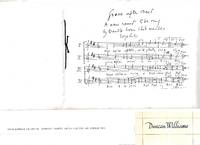
16783Pencil note stating that the item is for a dinner at the Café Royal 7 March 1934. 16 x 20 cm booklet consisting of a bifolium stitched with black green thread into covers of thicker paper. In fair condition aged and worn with remains of clear plastic front covering. On the front cover is a heavily-inked art photograph superimposing an image of a musical score over the edges of an fanned-out signature. On the inside of the back cover is a facsimile of a calligraphic inscription in Latin in Renaissance style. The inner contents consists of two facsimiles. The first on the recto of the first leaf consists of the 'Bill of Fare' written out in similar style as the inscription on the back cover. At foot: 'Chairman Dr John Johnson Mr James Guthrie will read a paper on "THE HAND PRINTER AND HIS WORK"'. On the recto of the second leaf is the score headed 'Grace after Meat A new round to be sung by Double Crown Club Members together'. Printed on strip of paper loosely inserted: 'THE WORDS OF THE ROUND BY DANIEL GEORGE . MUSIC BY HUBERT FOSS'. The name label of Duncan Williams written out calligraphically in black ink within red rules on a slip of paper is loosely inserted. Pencil note stating that the item is for a dinner at the Café Royal, 7 March 1934. unknown
13144Both letters on letterhead of 20 Bradmore Road Oxford. Letter to Sylvia Lynd: 16 December 1930. Letter to Sigle Lynd: 19 July 1930. Both items in very good condition on lightly-aged paper. Both letters are written in an excited gushing style and have the margins filled with extra text. Letter to Sylvia Lynd: 2pp. 4to. Addressed to 'Dear Mrs Lynd'. He conveys at great length his 'immense gratitude' at her 'hospitality': 'I have never really told you what very great happiness this succession of glorious meals has given me - This visit to London was splendid and neither Sweet-Escott nor the Kind Cabmennor my Kinder Aunt in Saint John's Wood are really at all the hosts whom I want to thank for it - But you.' He thanks her for 'Rock' which he is sure 'is best' and makes a couple of references to a recent rugby match 'my right shoulder aching . where a nasty heavy forward wilfully kicked it when no one was looking and the scrum had fallen down yesterday afternoon - A beautiful game and I kept swallowing mud and getting it into my eyes'. He urges her and her family to 'come to Bamburgh'. Letter to Sigle Lynd who studied chemistry and biology at Somerville 1929-1930 leaving after four terms as she was 'too busy dancing': 2pp. 12mo. With envelope docketed by Sigle Lynd: 'Lovely enthusiasm from T. It increases my regret even more.' The letter begins with a flight of fancy: 'As for the Byron and the poem I gave them to your charming maid who told me she remembered me and my name was Mr Barry wasn't it I said it wasn't - But it has occurred to me that she may have meant Barrie and not believing my denial she has probably stolen the MS and has been hawking it round to low Publishers hoping by persuading them that as Barrie writes few poems this must be a rarity to get a vast price for it. It will be fun if they bring out a pirated edition for it - But I'm afraid if they compare handwriting and style they may see through it - and she will get nothing poor creature.' He is sending her 'the Poets Progress because I met the young man who wrote it Walter D'Arcy Cresswell 1896-1960 - he's miserably poor and charming - and it's an excellent book - prose rather like Bridges and exciting metaphysical ideas - so your copy if I remember to get it will bring him one and threepence or so which he badly needs'. The letter contains another invitation to Bamburgh: 'Remember that I shall be working at least six hours a day and you will be able to do that and more if you like to miss dirty games like lobstering'. From the Lynd family papers. Both letters on letterhead of 20 Bradmore Road, Oxford. Letter to Sylvia Lynd: 16 December 1930. Letter to Sigle Lynd: 19 July 1 unknown
14686Spencer's two letters both from Grange House Shanklin Isle of Wight. 23 and 26 February 1931. Bois's letter to Sawyer: on letterhead of 32 Phillimore Walk Kensington London W8. 14 March 1966. Spencer was a sharp operator see Mandelbrote ed. 'Out of Print and into Profit' pp.285-287 and the present items give an hint of his methods. The two letters are addressed from the premises at which his staff were said to practice their 'sophistications'. His two letters both signed 'W. T. Spencer' are in good condition on lightly-aged and worn paper with the second dated by Bois to 1931. Bois's letter signed 'Winifred Bois' is in fair condition with a short closed tear along one edge. Letter One: Spencer to Bois 23 February 1931. The letter begins: 'I have just come across a vol of Flowers & Birds Drawings on Paper that I thought you might like I have never seen anything quite like them before and being in a double case thought they might be the work of a famous artist'. He offers it to her for £20 and also sends 'a Rice Paper Vol with some loose ones inside' priced at £12. Letter Two: Spencer to Bois 26 February 1931. He urges her 'to secure those Drawings even if only as an investment'. 'I feel somehow at the back of my head that they are very valuable; because I have never before seen anything in a double case and as you know I have seen a good many of these things'. He admits that 'they are oxydized but if you do not know how to take that off Miss Marie will tell you how to when next you are that way'. He concludes: 'Do please secure it.' Letter Three: Bois to 'Mr Sawyer' 14 March 1966. She thanks him for his cheque for £184 'in payment for the Books taken on Thursday. I was sorry to not to see you but your assistant seemed a very nice pleasant young man & very keen on the books.' She feels 'quite happy about the deal' and is 'glad the books have gone back to their original home'. She asks whether he still buys 'Chinese Drawings' having sold him some of hers in the past. 'I have a book which old Walter Spencer was certain was very valuable as he had never seen one like it before - I want to dispose of it some time but should like to ask your advice first.' She asks him to telephone as she finds it 'very difficult getting about in the crowded London streets'. Spencer's two letters both from Grange House, Shanklin, Isle of Wight. 23 and 26 February [1931]. Bois's letter to Sawyer: on le unknown