[PHOTOGRAPHY - ALGERIA - TUNISIA]Biblio.com
5 456 résultats
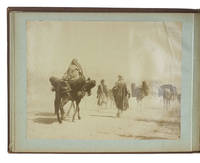
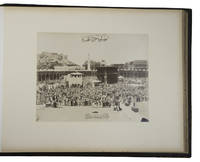
1890ABC_46444Tunis: Photographie Garrigues 1890. Half black leather red buckram sides blind-stamped boards and gold-stamped spine title in gold lettering on front board marbled endpapers. Oblong album 32 x 41 cm. Album with 50 photographic prints of various sizes 13.5 x 9.5 to 29 x 21.5 cm each pasted on thick paperboard. Album with 50 late-nineteenth-century photographic probably albumen prints of scenes in Algeria and Tunisia made by an unknown photographer. Most of the photographs have a caption naming the place photographed but only 5 indicate place of production or publication of the photos. These were all produced in Tunis at least some by the French photographer J. Garrigues printed and published at his studio. Notable photographs in this album are the first showing a veiled woman a barber at work in the streets riders on their horses camels with riders and luggage the Notre Dame d'Afrique in Algiers. Other subjects include city views fairly candid photos of people in the streets landscapes and the exterior and interior of a mosque.The most remarkable print in this album actually does not fit in with the other images of places in North Africa. It is a photograph of pilgrims before the Great Mosque and Kaaba in Mecca modern day Saudi Arabia with a caption in Arabic. This photograph was taken by the first Arab photographer Al-Sayyid Abd al-Gaffar ca. 1887 making it one of the first photographs of Mecca. The present album contains this picture in its original form including the Arabic caption. An edited version of the photograph in which remnants of the Arabic caption are visible can be found in Hurgronje's Bilder aus Mekka.With a small Antwerp booksellers ticket on the front paste-down". The binding shows some signs of wear slight foxing/browning of the outer edges of the paper boards not affecting the photographic prints some prints have slightly faded edges which does not interfere with the actual image. This album with photographic prints of Algeria Tunisia and remarkably 1 of the Great Mosque and Kaaba in Mecca is overall in good condition. Photographie Garrigues, hardcover
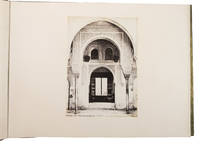
1870ABC_47963Madrid 1870. Contemporary gold- and blind-stamped green leather with the intials "M.L.B." blind-stamped on the front board gold-tooled turn-ins green watered silk endpapers gilt edges. Oblong folio 62 x 46.5 cm. With 72 large size albumen photographic prints with architectural views including numerous views of Spanish and Western Islamic architectural treasures ca. 33.5 x 24.5 cm 3 large composite photographic panoramas the Alhambra and Granada Cordoba and San Sebastian and 5 photographs of people 3 handcoloured photographs of Spanish costumes and 2 portraits of a woman. 58 of the 72 photographs contain the name of photographer title and number of the image in the negative. An exceptional album with fine views of Sevilla Granada Cordoba San Sebastian and many more. The photographer Jean Laurent was born in France but opened a photo studio in Madrid in 1856. In 1858 the Spanish government commissioned him to photograph the construction of the railroad line from Madrid to Alicante. The results were published and exhibited in many places which brought him considerable success. From 1861-68 Laurent held the title of "Fotógrafo de S. M. la Reina" and produced photos of members of the Spanish royal family. His photo studio in Madrid became one of the best-known from his time which allowed him to open gallery in Paris where he exhibited and sold premium-quality prints from his work in Spain. Although he was interested in industrialisation and intended to convey the image of a modern and economically flourishing country his photographs of the more picturesque aspects of Spain became more popular. The present album contains 34 views of Western Islamic architectural structures and a large 4-part folding panorama of the Alhambra and Granada. Furthermore it contains two examples of photographs on leptographic paper a collodio-chloride printing paper which was sold ready to use. Its manufacture was perfected by Laurent in collaboration with Martínez-Sánchez in 1866.With some slight signs of wear around the spine and the corners of the boards the panorama views are mounted on grey cloth which is somewhat foxed not affecting the actual photograph the album leaves are very slightly browned. Overall in very good condition.l Hannavy Encyclopedia of Nineteenth-Century Photography II 829/830. hardcover
188545686ABSt. Petersburg, (J. Dazario), um 1885. Bildgröße meist ca. 21:27 cm. Auf 20 Trägerkartons (62:42 cm) mit gedruckten Bildunterschriften. In reich verzierter, zeitgenössischer Holzkassette (77:57:15 cm), mit gusseisernen Beschlägen und Emaillearbeiten verziert, im Deckel eingelassen eine Glasplatte mit gefassten Kanten, darunter ein kalligraphiertes Widmungsblatt.
1900ABC_495491900. Contemporary gold- and blind-tooled burgundy buckram with the title and volume number lettered in gold on the front and spine a double fillet border on both boards blind-tooled turn-ins gold and burgundy floral end papers gilt edges. Folio. With 50 photographic reproductions in black and white mounted onto thick passe-partout leaves separated by thinner leaves onto which typed descriptions are mounted. 2 volumes. Remarkable photographic album beautifully reproducing the paintings from the Shah Jahan Album also known as the Kevorkian Album. The album compiled by the Mughal emperor Jahangir 1569-1627 and his son Shah Jahan 1592-1666 contains miniatures from the best painters of the Mughal era such as Govardhan Mansur Daulat Payag and Chitarman with calligraphic text by famous calligraphers such as Mir' Ali Haravi. The 50 exquisite photographs accurately reproduce the details of the original miniatures highlighting the iconographic and stylistic richness of Mughal art.Mughal albums also known as muraqqa usually included existing works in the patrons collection as well as works created specifically for the album such as paintings and drawings folios from preparatory pattern books and calligraphy specimens. They were not bought ready-made but compiled over a longer period of time by its owners. Emperor Jahangir commissioned the first folios for the Shah Jahan Album around 1620 and his son continued after his death. Shah Jahan's additions are stylistically different from Jahangir's with more portraits and illumination and the inclusion of calligraphy pages. After his death the muraqqa now with 39 miniatures passed onto his son Aurangzeb 1618-1707 who did not commission any more folios. The muraqqa left the royal library in the early 19th century and was likely acquired by an art dealer from Delhi who added 11 miniatures around 1820. These were made in the 19th century but imitated the 17th-century style of the others. In the 20th century the muraqqa was bought by the New York art dealer Hagop Kevorkian who sold 9 folios to the Freer Gallery of Art in Washington and the remaining 41 to the Metropolitan Museum of Art in New York where they still reside.The spectacular Shah Jahan Album is a collection of 50 single-page paintings which include intimate nature studies and portraits of the royal family and various dignitaries framed by a beautiful floral border. Each painting is faced by a single page of illuminated calligraphy made by renowned calligraphers. The photographs in the present work each mounted in a passepartout carefully reproduce the single-page paintings and three of the four calligraphic pages that open the collection. They are accompanied by a foreword and a short description of each painting which appear to be taken from an auction catalogue and were likely added later. A valuable testament to the interest in Mughal art in the 20th century this collection constitutes a seemingly unique iconographic resource as we have not been able to find another copy. There is no mention of a publisher or photographer but the quality of the prints suggests careful production intended for and commissioned by a scholar or collector specialising in Indian art. The present copy was part of the collection of Dr Ebadollah Bahari 1929-2018 noted historian of Persian art author of Bihzad master of Persian painting 1996 and benefactor of the Bahari Curatorship of Persian Collections at the Bodleian Libraries University of Oxford.The boards have been rubbed with minor loss of material on the back board of both volumes the joints are slightly weakened but the structural integrity of the bindings is still intact. Some of the mounted descriptions are lightly foxed. Otherwise in good condition. hardcover
185964885London, James S. Virtue, (1858-1859). Gr.-Fol. (45 x 33 cm). Mit zus. 76 auf Untersatzkartons mont. Orig.-Fotografien (Albumin) von Francis Frith u. 82 nn. Bll. Text. HLdr.-Bde. d. Zt. m. goldgepr. Rückentiteln u. marmor. Schnitt.
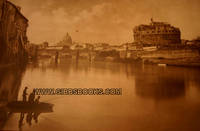
1870053004-KItaly 1870. Book. Illus. by Giacomo Brogi. Very Fine. No Binding. Albumen Mammoth Print c. 1870's By Giacomo Brogi 1822- 1881 Italian. Very rare photographic image by this artist in the original restored frame . This is not one of the standard tourist pictures that you find but a true work of art by this master photographer. Both Brogi and the Alinari Brothers worked as photographers and took the standard architecture ruins photos in Italy most being small 8"x10" Albumen prints but they did art photography also and to find one is a rare treat . This piece shows three men in a row boat on the Tiber River with Castel Saint`Angelo Mausoleum of Adrian on the right the Saint`Angelo bridge to the castle in the middle in the far distance you can see St. Peter's Dome . Looking around the photo the men in the boat you can see their reflection in the water. With sheep on the right shore and the clouds rolling by above it all this is a very importain photographic image by this artist . Please call for more information on this and other works of art. Size: 32 x 23. unknown
188641580Paris, , 1886-1932. 224 photographies glissées sous pochettes transparentes dans une boîte classeur grand in-4 (31 x 35 cm) de 65 feuilles, feuillets noirs intercalés, demi-maroquin brun, dos lisse orné et titré (Elbel libro).
187454520Paris: Arthus Bertrand 1874. First edition. Hardcover. Very good. Four volumes folio 36 by 27 cm text volumes 36.2 by 28.6 cm atlas. Complete with a total of 99 plates in various media. Text in French; copious transcriptions of Arabic inscriptions in the second volume. 4 IV 388 pp. in-text illustrations throughout; 6 222 6 pp; 4 VI 326 pp.14 plates numbered I-XIV: 2 double-suite chromolithographic maps 2 double-suite chromolithograpic arrays of geologic sections; 2 steel-engraved arrays of geologic sections; 8 full-page lithographic specimen plates; Atlas: 4 pp; 67 plates documenting the journey of the Duc de Luynes: 3 unnumbered steel-engraved plates - 1 large folding map colored 1 folding itinerary colored 1 double-suite plan of the iron sailing vessel; numbered I-LXIV - 64 hand-pulled b/w photogravures on steel 1 double-suite by Charles Nègre after photos by Jardin and Louis Vignes; 18 plates documenting the journey of Christophe Mauss numbered I-XVIII: 1 double-suite steel-engraved itinerary 3 steel engraved site plans 1 colored 14 tinted lithographs by Eugène Ciceri after photographs by Henri Sauvaire 8 mistakenly attributed to Louis Vignes.<br /> <br /> Later half light brown morocco over marbled boards gilt spine with raised bands; marbled endleaves; original blue printed wrappers preserved along with the backstrips the three text volumes. Text leaves intermittently foxed throughout often in light-moderately toned large blotches. Plates clean and fresh with only occasional touches of soiling or faint foxing almost exclusively confined to the margins; large folding map and folding itinerary in the Atlas with more notable light foxing. A very good set with fine plates.<br /> <br /> First edition of this comprehensive report on one of the most important scientific and archaeological missions of the nineteenth century the 1864 expedition to the Dead Sea undertaken by the visionary art collector archaeologist and scientist Honoré Paul Joseph d'Albert duc de Luynes 1802-1867. Along with an atlas containing 78 reproductions of photographs by Louis Vignes 1831-1896 Jardin fl. 1864 and Henri Joseph Sauvaire 1831-1896 this work documents "the first systematic attempt to survey and photograph the geological features and cities of the Dead Sea basin in present-day Jordan. In addition to mapping the Dead Sea area the expedition made significant contributions to the geological and paleontological knowledge of the region and also to an understanding of the chemical composition of the lake's waters" GRI. Louis Vignes a lieutenent-commander in the French navy and director since 1860 of the port in Beirut was chosen by de Luynes as photographer for the expedition because of his knowledge of the Levant. "Vignes began to photograph immediately upon arrival in Beirut and continued to do so during the ride south throughout Sidon Tyre Nablus and Jerusalem. From March 14 until May 29 the party sailed the entire Dead Sea on a special iron vessel designed by Vignes to be dismantled for easy trasportation" Perez.<br /> <br /> A preliminary account edited by Vignes appeared as Extrait des notes d'un voyage d'exploration à la mer Morte dans le Wady Arabah sur la rive gauche du Jourdain et dans le désert de Palmyre Paris: H. Plon 1865. This work essentially comprised a key to the two maps drawn by Vignes with assistance from Dr. Gustave Combe. The larger of the two maps charted the Jordan Rift Valley from the southern end of the Dead Sea to the Gulf of Akabah; the second map depicts the Dead Sea and its immediate vicinity. "In addition to tracing the expedition's routes place names elevations vegetation land conditions natural features and many other geomorphic and climatic details are recorded on the maps" GRI. In the Atlas volume of the Voyage these two maps have been combined into a single map printed surface: 69.7 by 28.8 cm. In 1866 de Luynes made a second expedition to the region accompanied by the archaeologist Christophe Edouard Mauss and Henri Sauvaire; their account was published the following year in the Bulletin de la Société de Géographie as "De Karak à Chaubak. Extrait d'un Journal de voyage."<br /> <br /> De Luynes' full account of the expedition is found in the first volume of the present report. The two parts of the second volume comprise Louis Vignes' account of the journey from Petra Jordan to Palmyra Syria along with the account of the 1866 journey from Jerusalem to the Crusader castles in Jordan at Kerak and Shoubak Montréal written by Mauss and Sauvaire. The third volume contains the report prepared by the noted geologist Louis Lartet 1840-1899 who would go on to discover the first Cro-Magnon skeletons. It is accompanied by chromolithographic maps and arrays of geological and paleontological elevations along with finely detailed lithographic specimen plates. The entire production was posthumously edited by Melchior marquis de Vogüé 1829-1916.<br /> <br /> A member of the Académie des inscriptions et belles-lettres de Luynes was a philanthropist with enormous inherited wealth and deep interdisciplinary interests many of which are on display in the present work: the study and collection of Greco-Roman antiquities notably from Phoenicia and Palestine and the pursuit of scientific interests in chemistry geology and photography. In 1856 de Luynes initiated a competitionin in conjunction with the Societé Française de Photographie to find the best method of photomechanical reproduction. Two people were short-listed for the prize: the chemist and photographer Alphonse Louis Poitevin for his method of photolithography; and the pioneering photographer Charles Nègre 1820-1880 whose photogravure method "produced beautiful prints but was even more complicated and unwieldy in practice the Poitevin's method" Parr & Badger. Although Poitevin was finally awared the prize in 1867 de Luynes chose Nègre to process the 64 reproductions which appear in the first suite of images in the Atlas. "The Duc's decision was clearly based on aesthetics" as Nègre's photogravure process actually improved upon the albumen prints by Vignes "which tended to be high in contrast and lacking shadow detail" Parr & Badger. These 64 photogravures are arranged according to the expedition itinerary starting at Beirut and concluding with a view of the source of the Hasbany River. These images along with views of Nablus the ruins of Araq el-Emir the fortified hilltop palace Machaerus the rock-cut architecture of Petra the Greco-Roman ruins of Gerasa and views of the tributaries and source of the Jordan River are "among the earliest photomechanical reproductions of photographs from the Holy Land" Nir. Along with John Thomson's Illustrations of China and its People 1874 Voyage d'exploration à la mer Morte 1868-1874 is a "key work" in the early development of the photobook. "Amongst the best early French photographers" Charles Nègre "was a leading figure in the development and employment of photomechanical processes. These early methods were still labour-intenseive and could be termed hand-craft processes but they represent another significant step in the industrialization of the photographic process -- a step towards the halftone block and the photobook as we know it today" Parr & Badger.<br /> <br /> A note on the dating of this work: Title-pages undated; the publisher's avertissement in the first volume dated "Constantinople août 1874." N.B.: Rohricht dates the work 1871-1876; the Bibliotèque national de France dates the Atlas 1871; The Getty Research institute dates the entire production 1875; several libraries date the geological survey volume 1877. References: P. Foliot "Louis Vignes and Henry Sauvaire Photographers of the Expedition of the Duc de Luynes" History of Photography 1990 vol. 14 no. 3 pp. 233-250; Getty Research Institute "Duc de Luynes Archive and Related Photographs by Henri Sauvaire" via website; Hannavy Encyclopedia of Nineteenth-Century Photography I pp. 982-5 Nègre; Y. Nir The Bible and the Image 1985 p. 89; Parr & Badger I pp. 19 33; N. Perez Focus East Early Photography in the Near East 1988 pp. 180 Jardin 229 Vignes; Rohricht 2824.<br /> <br /> Full title and imprint: Voyage d'Exploration a la mer Morte a Petra et sur la rive gauche du Jourdain par M. le Duc de Luynes. Oeuvre posthume publiée par ses petits-fils sous la direction de M. le Comte de Vogüé. Relation du Voyage. Paris: Arthus Bertrand Éditeur Libraire de la Société de Géographie 21 rue Hautefeuille 21 Tome deuxième De Petra a Palmyre par M. Vignes. Voyage de Jérusalem a Karak et a Chaubak par MM. Mauss et Sauvaire; Tome troisième Géologie par M. Louis Lartet; Atlas. Arthus Bertrand hardcover
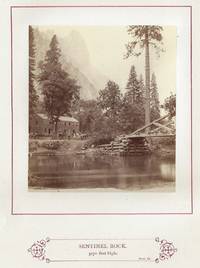
187224393Boston and New York: Alexander Moore and Lee Shepard & Dillingham 1872. Hardcover. Very good. Third edition revised and enlarged; second printing. Small quarto pp. v-x xi-xii 13-98 with two maps and 20 original mounted albumen photographs credited to Boston photographer John Soule. In publisher's green cloth with beveled edges; front board decorated in gilt black and rose; all edges gilt; each text page and each photograph bordered in red. A very good copy with rubbing and fraying to corners and spine ends bookplate of Canadian bookseller and collector G. Ducharme on front pastedown handwritten date of December 15 1872 on front free endpaper evidence of an erased ink stamp on title page. Lacks tissue guard over plate facing p. 35 all others present. Contents sound and clean. This is the rarest and most desirable edition of this work as it is the only one to contain 20 rather than 10 mounted photographs. Kneeland 1821-1888 was a physician naturalist and Professor of Zoology and Physiology at MIT. This book is based on his first visit to the Yosemite Valley in 1870 and includes a narrative of his trip from and return to Boston. "Kneeland made every effort to obtain current and accurate information and each of the later editions of the guide incorporates new material.Weston J. Naef in his book Era of Exploration the Rise of Landscape Photography in the American West 1860-1885.comments that the photographs 'are curious because there is no evidence that Soule a talented landscape photographer was ever in California.which suggests that he might have purchased the negatives from a California photographer not an uncommon transaction'" Currey & Kruska 225. Eadweard Muybridge and Martin Hazeltine are both considered strong candidates to have been the actual photographer. Farqhuar #10; Cowan p. 333. Only two copies of this edition have appeared at auction in the past 30 years and there are no others on the market as of September 2025. Alexander Moore [and] Lee, Shepard & Dillingham hardcover
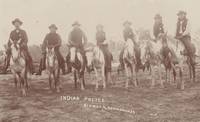
1900List1916Purcell 1900. Unmounted gelatin silver prints and one mounted boudoir card most images measuring 8 x 5 and 7 x 4 ½ inches. Varying levels of fading else about fine. With gallery stamps of Fenn Gallery Santa Fe verso. Near Fine. In the years following the Land Run of 1889 which opened land in Indian Territory to Euro-American settlement professional and amateur photographers alike moved to the region. Their motives varied with some attempting to document the vanishing indigenous culture and others trying to capitalize on the Euro-American demand for photographs of Native Americans in both traditional and western attire. Some studios would use single sets of props for different tribes. Despite these issues the images from the period do illuminate the period of acculturation and displacement in the history of the Southern Plains Indians tribes and also provide a record of the motives of the Euro-American photographers behind the camera. <br /> <br /> William J. Lenny and William L. Sawyers were photographers working out of Purcell in the years immediately following the land rush. They photographed the tribes on the Kiowa-Comanche-Apache and Wichita-Caddo reservations. Lenny was a field photographer and likely took most of the photographs while Sawyer managed the studio. Offered here are a very extensive group of photographs taken by the duo - twenty-seven in total - giving a visual record of the Kiowa and other tribes during this period. Some of these images - though not these copies - were included in the Museum of the Great Plains Exhibition In Citizen’s Garb and we have included their reference numbers where applicable. <br /> <br /> Overall an uncommonly large group in fine condition with some fading. From the collection of Forest Fenn the noted Santa Fe gallerist. <br /> <br /> 1. Indian Police / Kiowa and Comanches Supplied Title. The images shows seven mounted police officers with the one furthest to the left appearing to be Euro-American. <br /> <br /> 2. Arko Captain of the Indian Police Comanche. Supplied Title Indian police commonly earned $8-$10 per month to work on the reservation where their duties included expelling intruders bringing children to the schools curbing crime and preventing the sale of alcohol. He’s dressed traditionally including a single feather worn as a headdress. In Citizen’s Garb 32<br /> <br /> 3. Chief Tow-Wac-A-Ny and Wives. Wichitas. Supplied Title. A portrait of ‘Towacany Jim’ a famous military scout posed with a Navajo-style blanket along with his two wives. The women are wearing purchased shoes common in this period. He earned $10 per month as leader of the Indian Police and traveled to Washington D.C. on diplomatic missions. Fine contrast. <br /> <br /> 4. Big Tree’s Boy and Girl. Kiowas. Supplied Title A portrait of two children of the chief Big Tree. The pair wear traditional dress. Faded. <br /> Big Tree. <br /> <br /> 5. Kiowa Chief. Supplied Title A portrait of A’Do-Ette or Big Tree the Kiowa chief. Fine contrast. <br /> <br /> 6. Portrait of A’Do-Ette . He wears the same costume used by the photographers for various other tribal leaders including a large headdress. Faded. <br /> <br /> 7. Chief Big Tree’s Daughters. Kiowas. Supplied Title The image shows two girls identified as Alma left and Leena right. Alma wears a dress of dark buckskin. Both girls have beaded bags known as “Strike-a-Light†bags hanging from belts. <br /> <br /> 8. Lone Wolf. Kiowa Chief. Supplied Title A photograph of Mamay-day-te or Lone Wolf the Younger in the same costume used for O’Do-Ette’s portrait and others. Some fading.<br /> <br /> 9. Photograph of Laura Dunmore or Laura Pedrick. Dunmore was a graduate of Carlisle School and sister of Chief Aptone. She is pictured here with a parasol tartan cloth and tinkling cone earrings providing a striking study in fashion during this period. Fine contrast. <br /> <br /> 10. Photograph of a Camp Scene in Summer on a Reservation. This scene perhaps a Kiowa-apache camp contains a tipi made of canvas instead of hides. A man in an expensive set of purchased clothing sits in the foreground. Excellent contrast. In Citizens Garb 9<br /> <br /> 11. Photograph of a Camp Scene in Summer. A variant of our no. 10 showing the same scene from a different angle. Excellent contrast. <br /> <br /> 12. Chief Wild Horse Supplied Title Title written in ink on margin. A photograph of Kobay-O-Burra second chief of the Quahadi who took over principal chieftanship when Parra-o-Coom died in 1874. <br /> <br /> 13. Photograph of Mamay-Day-Te Lone Wolf. A variant pose as number 8 with the same dress. <br /> <br /> 14. Photograph of Five Comanche in Mixed Attire. They have been identified as Pah-do-pony top left To-pooh bottom right and Big Kiowa bottom left brother of Pah-do-pony and Perk-a-Quannard. In Citizens Garb 14<br /> <br /> 15. Apache Papoose Supplied Title. A photograph of a child in traditional dress. Faded. <br /> <br /> 16. Photograph of Four Indigenous Subjects in Mixed Attire. A portrait of a man and three women the man in a Euro-American style suit and the women in a mix of traditional dress using trade fabrics. Excellent contrast. <br /> <br /> 17. Portrait of an Unidentified Man. A portrait of a man in heavy fringe breechcloth and fringed leggings. This was marketed under the name “Big Tree’s Son†in the 1890s and the subject is identified as Kiowa in the In Citizens Garb catalog. In Citizens Garb 16<br /> <br /> 18. Kiowa Squaw and Papoose Supplied Title. A photograph of a woman and a child in a studio setting. Very good contrast. <br /> <br /> 19. Portrait of Zah-Tay or Lizzie Woodward. Zah-Tay appeared in other photographs with her niece and son. <br /> <br /> 20. Portrait of Cora Caruth. A portrait identified as Cora Caruth who graduated from an Indian School perhaps Carlisle and eventually worked as an interpreter for Wichita at Anadarko. Fine contrast. <br /> <br /> 21. Portrait of a Man in a Serape. A portrait of a seated man in a serape or striped Mexican blanket. A breechcloth legging and moccasins can be seen under the serape. In Citizens Garb 23<br /> <br /> 22. Chief Cat. Kiowa. Supplied Title A photograph of Ba’o Cat also Goon-Saudle-Te who wandered from camp in Colorado when he was twelve and was not recovered for five years. Comanches sheltered him. Fine contrast.<br /> <br /> 23. Kiowas. Supplied Title A portrait of Lizzy Woodward Oliver and her niece posed in Kiowa clothing. Oliver is in a beaded cradleboard Lizzy’s dress was tied with Tartan cloth and wears traditional Kiowa moccasins. In Citizen’s Garb 10<br /> <br /> 24. Portrait of Lizzy Woodward Her Niece and Oliver. A variant of our no. 23 with Oliver and Woodward in different dress. Fine contrast. <br /> <br /> 25. Portrait of Two Kiowa Girls. Two girls pose one in buckskin dress decorated in paint. Buckskin would become less frequent. Fading. In Citizen’s Garb 2<br /> <br /> 26. Big Tree’s Papoose. Kiowa. Supplied Title. A portrait of Alma later known as Mrs. Ahote. Fine contrast. <br /> <br /> 27. Kiowa Braves. Supplied Title A photograph of two young men on horseback. Very good contrast to foreground slight fading to background.<br /> <br /> 28. A Young Kiowa Warrior Supplied Title. A photograph of Enoch Smokey later known as Apenguadal who lived near Verden Oklahoma. His mother was noted as a beadworker and his horse is fitted with unusually decorative gear. His personal dress includes a hairpipe breastplate and a pelt around his arms. In Citizens Garb 36<br /> <br /> 29. Portrait of a Standing Kiowa Man. He wears the same headdress used in other studio photographs. Some fading. <br /> <br /> 30. Unidentified Man Possibly Euro-American Posed in a Headdress in Studio Setting. This is a mounted image unlike the others with the Lenny & Sawyers mount. The subject appears to be Euro-American and wears the same headdress used by the Indigenous subjects in several of the earlier photographs. He holds a prop bow and arrow. <br /> <br /> An uncommonly large group of images which in total provide an impressive visual record of this period of forced acculturation and transition in dress. unknown
1900H9GCKI5261RRZanzibar Madagascar Mayette 1900. Brown cloth album made by M. Andouard in Paris decorated endpapers. Oblong album 25 x 34 cm with 47 silver gelatin photographic prints many with handwritten captions in French. The photographs vary in size from 8 x 5.5 cm to 27 x 20.5 cm. The 30 panorama photographs measure 5.5 x 17.5 cm. 10 10 blank ll. A unique set of views from Zanzibar and Madagascar taken five years after the French military intervention of 1894/95 also called the Second Madagascar expedition. The unidentified photographer can be seen in three of the photographs wearing a white coat and white pith sun helmet being the French tropical style as used by white colonial troops since 1878 suggesting the photographers connection with the French colonial army. His travel partner is occasionally shown as well. Their visit took place during the final years of the notorious slave trading activities of Tippu Tip 1837-1905 in Zanzibar.The photo album opens with a portrait of a young Sakalavan woman in a beautiful dress. Three other photographs show other native women as well including one family with a baby. The majority of the photographs are panoramic views showing villages harbours coasts and landscapes the first dated 28 November 1900. The only full-page photograph in the album shows an Arab caravan marching along the beach. Rare are the few photographs taken in Mayotte giving some highly uncommon scenes of the island nation's pre-development era.Binding somewhat scratched spine slightly worn. The front endleaf clipped. Only a few photographs slightly faded: in very good condition. hardcover
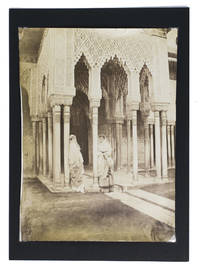
1865ABC_47974Granada 1865. All albumen photographic prints 18 x 24 cm are mounted on black card stock 29.5 x 21 cm. Collection of 19th-century albumen photographic prints of the Alhambra in Spain by Charles Mauzaisse ca. 1823-1885; fl. 1860s. The beautiful images show many different parts of the Alhambra especially of the court and palace of lions including the central fountain and the pavillion with the oriental dome that was added in 1859 and later removed. The Alhambra is a medieval palace and fort of Moorish or Muslim rulers of the Kingdom of Granada in Andalusia in the South of the Iberian Peninsula. Additionally the collection contains one photograph of the tomb of the Catholic monarchs which is located in the Royal Chapel of Granada.During the 19th century tourism was booming. Travellers wanted to take proof of their travels home and often did so in the form of photographs. Many photographers took the opportunity to sell their work to tourists. Charles Mauzaisse son of the painter Jean Baptiste Mauzaisse traveled to the south of Spain and fell in love with Granada where he would develop his professional activity alongside other renowned photographers such as Laurent Coutourier and Dubois. All of them - aware of the lucrative field of work that the image of the Alhambra offered - settled more or less definitively in the city just as Masson or Count Vigier did in Seville or Clifford and Laurent in Madrid.The prints are slightly yellowed and some images were possibly overexposed or have faded slightly all prints show clear signs of having previously been mounted on another surface. Some prints have small tears in the edges. The print of the 2 Moroccan women in the Alhambra is probably by a different photographer but the name has been cut off. The collection gives a beautiful insight into 19th-century photography in the Iberian Peninsula - showing off the beautiful Arabic- and Muslim-influences architecture in Granada. unknown
18697140Lille, Imprimerie L. Danel, 1869. In-4 (306 x 230 mm), (4)-61-(1 bl.) pp., 14 planches de procédés de reproduction de photographies. Reliure d'époque demi-percaline, rousseurs.
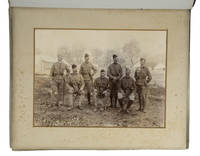
1898ABC_457021898. 2 PARK Superintendent. 1898. Catalogue of photographs by Sergeant A.J. Clarke R.E. taken during Tirah Expedition 1897-1898. Kirkee Pune India Sappers and Miners' Press 1898. Small folio 22 x 14.5 cm 4 pp. With a lithographed title-page. Loosely inserted in the album. Collection of photographs taken by a British Indian Army officer who served in the Peshawar Column during the Tirah Expedition in the Northwest Frontier of India from June 1897 to April 1898 including a manuscript Key that identifies seven British officers that are in the first photo of the album and a list of captions to 10 photos in the album.The Tirah Expedition was aimed against the Afridi and Orakzai tribes in British Indias Northwest Frontier modern-day Khyber Pashtunkhwa province of Pakistan. One of many Northwest Frontier campaigns of British India the Tirah campaign concentrated on the area west and south of Peshawar in the mountainous region between the valleys of the Bara and Kohat Rivers. The album primarily documents the actions of the Tirah field forces Peshawar Column under command of Brigadier-General Arthur George Hammond 1843-1919 which followed the route of the Bara Valley.The present photo album contains 8 large albumen photos documenting the movement of the Peshawar Column. The large photos were taken by W. Rahn according to the memoirs of Peshawar Column officer Richard Thomsett we had a photographer named Rahn with the column and he accompanied us until we arrived at Ali Masjid in December 1897 when an accident necessitated his returning to India. Rahn was a German who had come out to the East some twenty years before and seemed to be ubiquitous for wherever we were there he was with his camera ready and I must say he took some very excellent pictures.The present album also includes 43 smaller gelatin photos with manuscript captions for 10 of them on a small piece of paper perfectly describing the photos on leaves 5 and 9 of the album. The album is supplemented with a rare 4-page brochure no doubt produced in a small print-run that lists 99 photos. About 20 have been marked by hand in pencil probably by the albums compiler. The brochure indicates that the present photos could be purchased from the Bombay Sappers and Miners.8 of the large photos have contemporary manuscript captions in ink on the mounts. 2 marks on the front paste-down reading "photographs by British Royal Engineers. Tirah Expedition 1897-1898 North India. Binding slightly rubbed on extremities the original 5 cords replaced with 3 new black cords hinged to stubs . A few images mildly faded. The additional manuscript leaves foxed and worn. Otherwise in good condition.l The navy and army illustrated V no. 53 24 December 1897 pp. 150-152 4 of the 8 large photographs & no. 57 18 February 1898 p. 275; R.G. Thomsett With the Peshawar olumn. Tirah expeditionary force London 1899 pp. 103-104. unknown
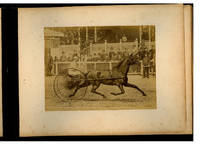
1879G84BDE85OGMKBerlin: H. Schnaebeli & Co 1879. Oblong 8vo 33 x 26.5 cm album with 16 original albumen prints ca. 20.5 x 15 cm mounted on paperboard. Original richly decorated cloth. Title on front cover: "Album des Trabrenn-Sport. H. Schnaebeli & Co. Hof-Photographen u. Kunstverlag. Berlin Unter den Linden 30". Fine album of original albumen prints depicting trotting. All horses and jockeys are identified in handwriting on the opposite page. 1 Cremien. 2. Lump. schw. H. v. Lump a. d. Nelly Parker. Züchter u. Bes. Gestüt Mariahall. 3. Mazeppa. Fahrer J. W. Raymer. 4. anon. 5. France's Alexander. Schwarzer Hengst v. Ben Patschen a. d. Jenny Martin. Besitzer Gestüt Mariahall. 6. Lynwood. Schimmel-Hengst v. Clinker a. d. Belton Maid. Besitzer. Berliner Trabrenn-Verein. 7. Sunol. Braune Stute v. Electioneer a. d. Wazana. Besitzer Rob. Bronner. 8. Djelowaja. Schimmel-Stute v. Atlasnuyi a. d. Delni. Besitzer und Fahrer Herr G. Barthels. 9. Blue belle. Fuchs-Stute v. Blue Bull. Besitzer: Gestüt Mariahall. Trainer u. Fahrer L. Raymer. 10. Polly. Braune Stute v. Hamdallah a. d. Belle. Besitzer: Herr Ehrich. Trainer u. Fahrer Joe Raymer. 11. Tiger. F. H. gez. in Russland 1873 v. Stroining a. d. Saszita. Besitzer: Albas Singer in Wien. 12. Lumpazius. br. H. v. Lump a. d. Addre E. C. Züchter u. Bes. Gestüt Mariahall. 13. Sametz. 14. Maud. S. Fuchs-Stute v. Harlod a. d. Miss Russell. 15. Ledenaja. Fahrer J. W. Raymer. 16. Jersey Thorne brauner Hengst v. Thorndale a. d. Martha Besitzer Mr. Wilson. - Most photographs signed in the negative "H. Schnaebeli"; one dated 1879. Very early example of an album illustrating horses horsemanship and trotting. Extremely scarce: we were unable to trace another copy in any public library according to OCLC-Worldcat and KVK; not in JAP or ABPC. Binding a bit discoloured otherwise very well preserved. Boards show some browning and foxing; albumen prints in very good condition. H. Schnaebeli & Co, hardcover
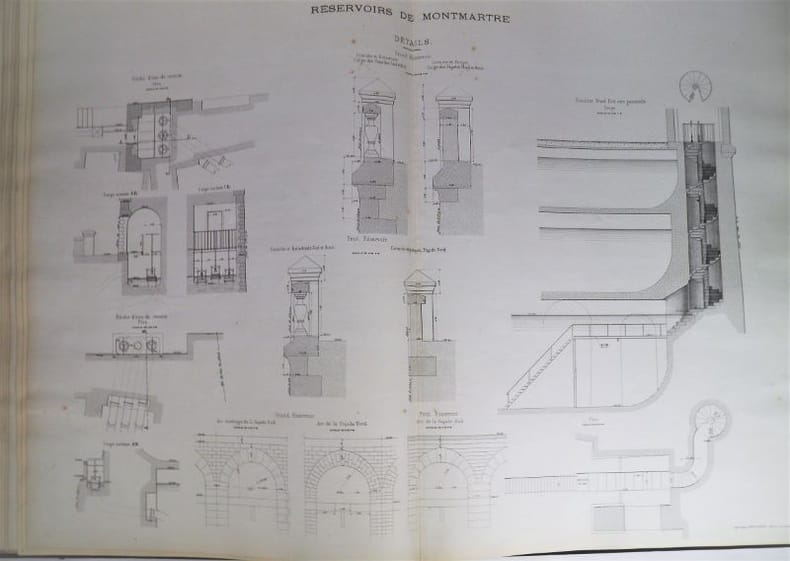
18892356Paris, Imprimerie Autog. Aost & Gentil, sans date [1889]. In-Plano – 49 x 65 cm. Reliure de l’époque en demi-chagrin bleu marine à coins, triples filets à froid en encadrement des plats de toile, titre, dates et blason parisien dorés sur le premier plat. Exemplaire entièrement monté sur onglets. 1 f. bl. ; 2 planches doubles + 4 planches (6 photographies originales), 1 p. (titre), 3 p. (texte autographié imprimé), 19 planches doubles (plans, coupes, façades et détails). ALPHAND ; HUET ; BECHMANN ; DIET ; JOURNET ; DUTOIT ; VILLE DE PARIS (auteurs). Entrepreneurs : LAZIES (maçonnerie). MATHELIN et GARNIER (Fontainerie). Rare et important ouvrage illustré de 6 photographies originales, dont 2 sur double page, et de 19 planches doubles, techniques et architecturales, témoignant de l’ampleur des travaux effectués à Montmartre à la fin du XIXe siècle, afin d’améliorer l’alimentation en eau d’un quartier en pleine croissance démographique. En effet, les sources naturelles présentes sur les flancs de la butte qui alimentèrent longtemps de nombreuses fontaines ne suffisaient plus : il fallait donc aller capter de l’eau de rivières (ce que permet dès 1834 une machine hydraulique édifiée à Saint-Ouen), la monter au sommet – au moyen d’une pompe à vapeur -, et enfin la stocker, d’où la construction en 1835 d’un château d’eau qui fonctionnera jusqu’en 1927. A partir de 1887, sous la houlette d’Adolphe Alphand, Directeur des Travaux de la Ville de Paris, sont entrepris deux chantiers de grande envergure. Le premier est la construction de deux réservoirs (un « grand » et un « petit »), dotés d’une capacité totale de 11 000 m3, dont la conception est confiée aux ingénieurs Bechmann et Journet et les plans sont dressés par l’architecte Diet (photographies 4 et 5). L’ouvrage occupe l’emplacement de l’ancien pressoir à raisins de l’abbaye des Dames de Montmartre, rue Azaïs, sur une colline sableuse à environ 128 m d’altitude. La nature du sol complexifie énormément les travaux, d'autant que l'usage du béton pour les fondations, d'un coût prohibitif, est exclu. Les deux concepteurs ont donc misé sur la pression de l'eau contenue dans les réservoirs pour stabiliser le banc de sable présent à cet endroit. Néanmoins, une partie de ce sable (avec les gravats) fut évacuée par des wagonnets tirés par une locomotive à vapeur (photographie 3), tandis que l'on imaginait d'ingénieux systèmes pour garantir l'étanchéité de l'édifice. Le sous-sol, les murs et le sol sont donc réalisés en meulière, les voûtes de la couverture en briquettes, et les piliers intérieurs en maçonnerie de brique de Bourgogne. Autre contrainte : la proximité du Sacré-Cœur (édifié à partir de 1886), qui requiert une harmonisation du style décoratif du bâtiment avec l’architecture néo-byzantine de la basilique (photographie 6), et là intervient le calcaire blanc des carrières de Souppes-sur-Loing et Château-Landon. Le second chantier de cette même année 1887 est celui de la nouvelle usine de relevage (ou élévatoire) Saint-Pierre, qui alimente à la fois le château d’eau et le réservoir. Ce dernier, définitivement opérationnel en 1889, pourvu de respectivement deux et trois étages, distribue l’eau dans les quartiers bas de Montmartre encore de nos jours. Les deux premières photographies, sur doubles pages, prises en 1886 et 1889, attestent de la transformation du paysage de la butte lorsque les réservoirs sont achevés.
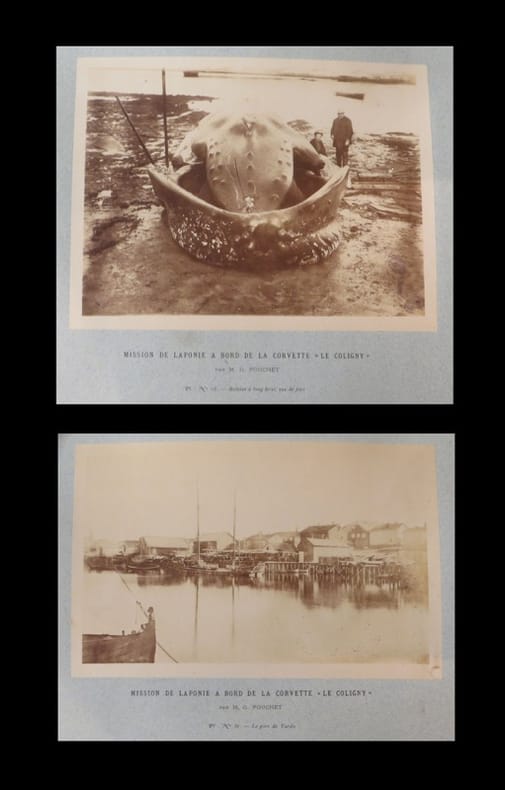
1881292681881. Paris G. Masson 1881. Un vol. au format in-folio 473 x 338 mm de 1 f. bl. 2 ff. n. fol. 34 photographies et 1 f. bl. Reliure moderne de demi-cartonnage gris-perle ˆ l'imitation de chagrin dos lisse ornÂŽ de triples filets dorÂŽs et en noir piÂce de titre de maroquin marine titre dorÂŽ. Edition originale d'une insigne raretÂŽ. Exemplaire revÂtu d'un envoi autographe signÂŽ de Georges Pouchet en tÂte de la page de titre. L'ouvrage est constituÂŽ de 34 sur 34 superbes photographies originales tirÂŽes sur papier albuminÂŽ contrecollÂŽes sur carton fort avec lÂŽgende imprimÂŽe en marge infÂŽrieure de chacune et montÂŽes sur onglet. ''Titulaire de la chaire d'anatomie comparÂŽe du MusÂŽum national d'histoire naturelle de Paris Georges Pouchet 1833-1894 se spÂŽcialise dans l'ÂŽtude des cÂŽtacÂŽs et l'ocÂŽanographie. De 1870 ˆ 1894 il passe plusieurs mois par an ˆ parcourir les mers du Nord ou encore ˆ ÂŽtudier les espÂces marines. Ë chacune de ses expÂŽditions il rapporte de nouveaux spÂŽcimens dont plusieurs cÂŽtacÂŽs mais aussi de nombreux tÂŽmoignages sur le paysage marin''. BÂŽnÂŽdicte Percheron. Table : Lodingen - Hammerfest - Vadsš - Klubben - Jarfjord - Kištfjord - Fjeldaal - Bugšfjord - Klosterfjord - Thorgatten - Bergen - etc. Ensemble en bel ÂŽtat. b42961 unknown
188129268Paris, G. Masson, 1881. Un vol. au format in-folio (473 x 338 mm) de 1 f. bl., 2 ff. n. fol., [34] photographies et 1 f. bl. Reliure moderne de demi-cartonnage gris-perle à l'imitation de chagrin, dos lisse orné de triples filets dorés et en noir, pièce de titre de maroquin marine, titre doré.
1894103248BBParis, Photo-Club de Paris, 1894. Folio (40 x 30 cm.). 3, (5) S., 56 Tafel in Héliogravure, [2] Bl. OKart. mit OU.
1874ABC_46925Calcutta 1874. Contemporary gold-tooled half red morocco brown cloth sides. Oblong 8vo. With 33 mounted sepia albumen prints ca. 15/15.5 x 10.5/11 cm all captioned. Manuscript title and captions of the pictures in English written in brown ink in a neat 19th-century cursive hand. Photograph album containing 33 albumen prints of buildings important places views and people in Calcutta in the 1870s. The album opens with some architectural photographs including the governor's house the new market the post office St. Paul's cathedral and the high court. Also included are views of roads and streets that are still important today such as Benting Street Chilpore Road Russell Street and Strand Road and 5 albumen prints of the B.Y. Docks. The album also contains views near Kalighat and Barnatore especially of the landscape but also of a Hindu temple. The album concludes with some photographs of people living in Calcutta showing beggars carpenters palki bearers a barber ending the album with a group of Rohillas.The album includes a photograph of the statue of Sir James Outram unveiled in Calcutta on 22 May 1874 an all photographs seem likely to have been made soon after that.Binding a little worn and scuffed endpapers a little dust-soiled some leaves marginally slightly dust-soiled some leaves slightly browned some occasional foxing paper of the last photograph slightly damaged not affecting the image some images a little faded but overall in good condition. A highly interesting album showing life in Calcutta in the 1870s.l For dating the statue of Sir James Outram: Catalogue of the sculpture of J.H. Foley in: Dublin Historical Record 32 3 1979 pp. 108-116. hardcover
189042492, , Ca 1870-1890. Album grand in-folio oblong, demi-chagrin à coins (reliure de l'époque).
185563738Paris, Au siège de la Société française de Photographie, 1855-1866, in-8, 12 tomes, , Les douze premières années, rares, du Bulletin de la Société française de photographie, dans une élégante reliure uniforme de la seconde moitié du XIXe siècle. LA SFP est la revue photographie la plus importante de la photographie ancienne. Ensemble complet de tous ses hors-textes : - 2 planches pour la première année, 1855 montrant le pied articulé de voyage et le chassis de Jules Clément ; - 1 planche pour l'année 1857 donnant une reproduction photolithographique (procédé Poitevin) ; - 1 photographie originale pour l'année 1863 : un spécimen des recherches de M. Blanquart-Evrard sur l'intervention de l'art dans la photographie. La première année reproduit les statuts du 15 novembre 1854, la liste des premiers fondateurs, et la Liste des membres titulaires, correspondants et amateurs au 31 décembre 1855. Précieux et bel exemplaire portant l'ex-libris imprimé des Ducs de Luynes, chateau de Dampierre. Rarissime dans une telle condition. Couverture rigide
182426711Paris: C. L. F. Panckoucke 1824. 1st. Hardcover. Good. 9.3x6.8x1.5in. first octavo edition in original 3/4 brown morocco leather and marbled boards spine with red title and volume labels and gilt decoration; leather rubbed at extremities with sections of leather missing at corners armorial bookplate on pastedown owner's signature and date on title page light toning to 25 plates spot of foxing to 9 plates heavier foxing to 8 plates 38 plates unaffected. <br>80 colored stipple-engraved plates with descriptions. Text in French. <br>2.17lb 9.3x6.8x1.5in C. L. F. Panckoucke hardcover
184429058Paris: J.-J. Dubochet et Ce. 1844. Very scarce first edition. 8vo in the publisher's original yellow paper wrappers printed in black. Now housed in an unusual and very attractive black protective box with Plexi protector the lid held in place by stiff panel decorated with an sepia photograph visible through a port. iv 248 pp. A rare first edition copy in fully original state and in the printer's delicate wrappers the text largely unopened and quite fine but for some very minor spotting or mellowing the wrappers with some soiling and wear but completely original and unsophisticated the spine largely worn. FIRST EDITION. VERY RARE IN THE ORIGINAL WRAPPERS THIS COPY IN FULLY ORIGINAL STATE AND LARGELY UNOPENED. ARGUABLY THE FIRST DEFINITIVE MANUAL OF PHOTOGRAPHY. Marc-Antoine Gaudin's full and complete treatise on the Daguerréotype process was at the time the definitive manual on photography and covered virtually every aspect of making both Daguerréotype and the Calotype developed by Talbot. Includes the preparation of plates and their exposure processing printing on paper procedures for reproducing plates techniques for portraiture etc. etc. Marc-Antoine with his brother Alexis were important early pioneers in the business of photography and were responsible for numerous refinements. He held patents in both optics and chemistry and had one of the first photography shops in Paris. Marc-Antoine engaged in research while Alexis was in charge of commercial affairs. In 1851 he purchased the photo-newspaper La Lumiere which he ran until 1867. The Gaudin brothers also set up a stereoscopy company in the United States. J.-J. Dubochet et Ce. unknown
186018778circa 1860. Un volume oblong (24 x 32 cm.), demi-chagrin vert, dos à nerfs orné de caissons doré et muet, titre doré sur le premier plat, tranches dorées.