[Anonyme] [REVOLUTION FRANCAISE].Livre Rare Book
66 618 résultats
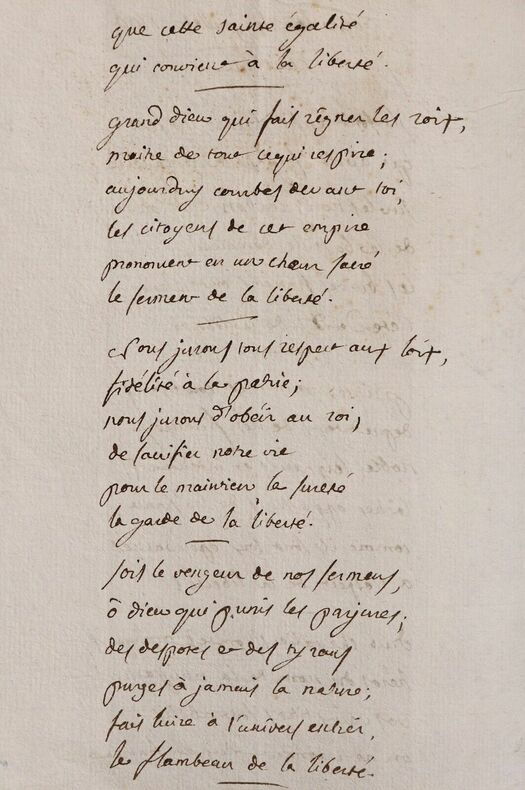
1790AMO-4529S.n., [14 juillet] 1790 Manuscrit autographe anonyme. 2 pages. 36 vers (6 strophes de 6 vers) 1 bi-feuillet 21,7 x 16,8 cm. parfait état. Belle écriture parfaitement lisible. Pièce autographe inédite non encore attribuée.
6521Paris, Éditions M.D., sans date. 4 fascicules in-folio sous couvertures parcheminées Un peu frottées, avec quelques taches). Quelques petites taches aussi ça et là dans le texte.
Small folio (ca 24 x 30 cm). Ca. 170 letters in Algerian Arabic, pasted to 100 numbered leaves. Contemporary papered boards (severely rubbed and bumped) with remnants of a green calfskin spine. A vast ensemble of handwritten letters in Arabic, assembled by the Franco-Algerian typesetter A. Duchâteau who used the collection both to perfect his command of practical Arabic in various local dialects and as a typographical style guide. Most of the letters were written by local dignitaries, including Beys, Kaïds, Sheikhs, provincial leaders and village chiefs. To obtain them, Duchâteau must have drawn upon various sources such as his own relations and other Algerian families, the French community, and the military. About a third of the letters include Duchâteau's French translations or at least notes about their origin, giving dates or details of their content or identifying the recipient. - Duchâteau worked as typesetter for the Algiers-based "Bastide" printing house in the early 1850s. Specializing in Arabic typography, he was especially close to Louis-Jacques Bresnier (1814-69), the first professor of Arabic in Algiers. It was Duchâteau who attended to the printing of the Arabic parts of Bresnier's chrestomathies and language guides, and it is apparent that the album also served as documentation for the professor's own publications, such as his "Chrestomathie arabe: lettres, actes, et pièces diverses" (1857). In the preface to his "Cours pratique et théorique de langue arabe", published by Bastide in 1855, Bresnier explains that his work could only be realized thanks to the talent of Duchâteau: "Two modest and excellent artists, Messrs. Ch. Portmann, lithographer, and A. Duchateau, an Arabic typesetter, understood and supported the author's work with remarkable intelligence and skill." - Some of these letters are of great historical interest, enabling us to trace in them the frequently poorly-documented history of Algeria between the late 18th and mid 19th century. The ensemble includes, inter alia, a letter from the Bey of Constantine, Hussein Bey (1807); letters addressed to Napoleon III, who is referred to as "Sultan" and "Lord Prefet"; a letter from a brotherhood leader asking permission to bring a number of faithful into his Zaouira; a document regarding the prisoners of Constantine; a letter from Mufti Hanefi of Constantine requesting the replacement of the hezzab of the mosque; letters from the interpreter Ismael Ben El Had Mohammed Amin El Sekkat, from Kaïd Belkaum Ben Minia, from Messrs. El Hadj Merouan & El Hadj ben Fouka, from Sid Said EI Hadj, a regional chief (1817), several letters to and from physicians, letters related to invitations, festivities and gatherings, requests to the authorities for intervention, commercial letters, and letters of thanks. A single letter in Hebrew is also included. Inserted at the beginning are 6 lithographed leaves of letter specimens as used by Bresnier in his courses, annotated by hand (likely that of Bresnier himself) with extensive remarks in French and Arabic on the vocabulary and phrasing. - An important source for the history of French Algeria and the history of Arabic typography in the mid-19th century.
194613740Genève, Imprimerie Excoffier, [1946]. Plaquette in-8 brochée de [16] pages, couverture imprimée.
Zusammen 15 Bll. Verschiedene Formate. Beiliegend drei weitere, nicht näher bezeichnete Pläne derselben Villa und 7 wohl vom selben Architekten, jedoch für ein anderes Objekt gezeichnete Pläne. Bezeichnet sind die sehr sauber ausgeführten Fassaden- und Detailansichten dieser von uns nicht identifizierten Villa mit 1. Stock (3mal), Erdgeschoß, Querschnitt AB, Querschnitt CD, Fassade gegen die Kaltenbachstraße (3mal), Fassade gegen die Esplanade (2mal), Dachboden, Parterre, Souterrain, Detail der Nischen auf der Vorder- und Seitenfassade sowie Schnitt durch den Bogen bei aa natürl. Größe. Einer der Fassadenaufrisse mit der eigenh. Signatur des Bauherrn Neymeister sowie des Stadtbaumeisters Josef Zeller. - Teils etwas angestaubt bzw. wasserrandig, die dekorativen Gesamtansichten der imposanten Villa jedoch wohlerhalten.
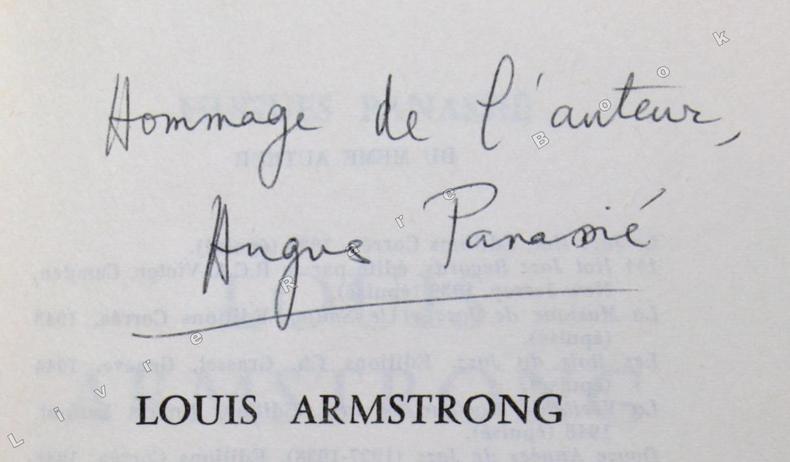
19698984Paris, Nouvelles Editions Latines, coll. Jazz-panorama, 1969. In-12 broché de 220-[4] pages, couverture ornée d'une photographie.
Small folio (235 x 290 mm). 20th century calf. A fine collection of sketch leaves by Carl Artaria, often dashed off on the reverse of old letters or forms, later cut out (likely by a 20th century member of the family) and thus assembled in the present album. Some of the sketches are dated (1827, 1828, 1833, 1836 etc.), others signed with the artist's "CA" monogram. The dominant theme is that of equestrianism and horsemanship (including many drawings of horses without riders, in landscapes or in military contexts, etc.), but there are also occasional hunting scenes, a caricature of a Turk firing a blunderbuss, etc. - Carl Artaria was a son of the long-established art seller and publisher Domenico Artaria from Mainz who in 1793 moved the business premises to Mannheim. Carl took over the company in 1816; it flourished until 1867. In the course of his business, Carl Artaria met many of Germany's great writers and illustrators, including Goethe. "In his youth he created etchings after W. Kobell und Boissieu [...] In his old age he began to draw the beauties of Mannheim's environs in meticulous watercolours" (cf. Thieme/Becker). - Occasional insignificant traces of handling, but in excellent state of preservation. Cf. Thieme/Becker I, 159.
198631744Paris, Gallimard, 1986. Un volume in-4, ((29,6 x 23,5 cm) 264 pp. Relié en pleine percaline safran, bien complet de sa jaquette illustrée et coffret cartonné de lŽéditeur.
338271 page in8 - très bon état - On joint un dossier de coupures de presse concernant sa pièce "Verlaine" jouée en novembre 1938 au Théatre Charles de Rochefort et ou Gilbert Gil a le rôle de Rimbaud -
194712735[Lausanne], [Association des écrivains vaudois - AEV], [1947]. In-4 de [106] pages, plein parchemin muet, orné au premier plat d'une composition originale du peintre Jean-Jacques Mennet. Sous emboîtage avec dos toilé muet. La maison Mayer & Soutter à Lausanne a soigné la reliure de ces pages autographes.
1953GF236251953 Manuscrit autographe par Francis de Miomandre de la traduction (parue chez Gallimard en 1953) du premier ouvrage de Miguel Angel Asturias - Le manuscrit est monté sur onglets et reliè en demi-chagrin rouge à coins - dos à deux fois trois nerfs joints - étui - (relié avec une lettre autographe de l'éditeur Georges Crès à Jacques Péricard) - On joint un exemplaire de l'ouvrage dédicacé par Miomandre et Asturias en 1963 -
4 SS. auf Doppelblatt. Gr.-8vo. Mit 5zeiliger Nachschrift und U. Berthold Auerbachs. An eine Frau Meyer: "[...] Nun zur Erledigung des Hauptgegenstandes. Als ich gestern Frl. Clara die factische Kündigung mittheilte, hat sie mir unter Thränen ihr heftiges Benehmen abgebeten, und ich ließ mich hierdurch wie durch das Versprechen sich meinen Wünschen zu fügen und auch durch die Anhänglichkeit meiner Kinder nach einem langen Gespräche mit ihr zur Wiederaufnahme bewegen [...]". - Nachdem Auerbachs erste Gattin Auguste im März 1848 an Kindbettfieber verstorben war, ehelichte der Dichter im Jahr darauf die Schwester des Schriftstellers Heinrich Landesmann, mit der er drei Kinder - Ottilie, Eugen und Rudolf - haben sollte. - Auf Briefpapier mit gepr. Briefkopf. - Die Recto-Seite von Bl. 1 mit einem kl. Registraturetikett und der hs. Numerierung "114".
Oblong 12mo. 1 page. With enclosure (see below). Signature stamped in green ink. - Enclosed is a hand-copied letter by d'Aurevilly to the poetess Harriet Mary Carey (1824-66). The year in which the letter was written also saw Carey's translation of a poem by d'Aurevilly ("Laocoon. A Forgotten Rhyme").
2 Faltbögen und ein vorgedr. Formular (Halbbogen). Folio. Entlassungstabellen für Mathias Wimmer aus Eitzing (7. VII. 1823) und Franz Pointner aus Albertstedt (12. VIII. 1823), beide vom kaiserlichen Infanterieregiment Nr. 14, ausgestellt vom Gräfl. Taufkirchenschen Patrimonialgericht Aurolzmünster. Beiliegend Zahlungs-Bogen für das Militärjahr 1822 über die Abführung der Urbarial- und Zehentsteuer (Sept.-Nov. 1822) durch die Pfarrkirche und Stiftsadministration Aurolzmünster.
19302212541930-1940s. Two concertina-bound autograph books. <br> <br>Fan-shaped concertina-bound autograph book 13 x 20cm widest point 30 thick cream leaves with approx 160 manuscript autographs gilt-flecked endpapers gold-patterned brocade cover with a linen label all edges gilt enclosed in a linen fan-shaped sleeve with toggle closures and paper label binder's stamp to the inside cover; the linen worn and faded and the album split at two openings but in very good condition. <br> <br>Small concertina-bound autograph book 12 x 9cm approx 25 thick paper leaves 5 red temple stamps and 4 pencilled autographs sable silk-covered boards chipped paper label in very good condition. Two autograph books dating from 1933-1940 which belonged to the Australian Japan expert author and broadcaster George Caiger 1903-1991. In 1930 after teaching in England and Australia Caiger moved to Japan where he taught English at Musashi Koto Gakko a private school in Tokyo and later also lectured at the Peers' School in Tokyo. Caiger wrote numerous essays and books on Japan and developed friendships with some leading figures in Japanese society and politics. He returned to Australia in 1940 and later became an intelligence officer and translator for the Australian military during World War II before joining the Australian Broadcasting Corporation. <br> <br>His beautiful fan-shaped Japanese autograph book contains a collection of signatures messages and some ink sketches. The earliest of these date to 1933-1934 and include farewell messages from friends written in May 1934 when Caiger and his wife Margaret returned for a short period to Australia. Others date from 1939-1940 and include farewells from the time when the Caigers left Japan for good in late 1939. An interesting set of signatures on the last page includes the annotation "SS Atuta Maru 00.01am 1st January 1940 Arafura Sea" clearly written as passengers celebrated a rather uncertain New Year on their voyage home from Japan. There are also two charming ink sketches - one of Mt. Fuji - drawn by a friend named Y. Nakatsuka shortly before the Caigers' departure from Japan. Autographs include those of Australian diplomat H. R. Sawbridge and Christian missionary Clarence Gillett who later worked with Japanese internees in the US during WWII. <br> <br>A second smaller concertina-folded autograph book is mostly blank but contains a few pencilled-in names on the first page and some souvenir ink-stamps including one labelled "Daibustu Nara 1.1.33" in the rear. <br> <br>Fascinating autograph realia from the Imperial Japanese period collected by a well-known Australian broadcaster. . hardcover
193078314New York: ca. 1930s. purchased illustrated autograph album in printed wrappers. Wrappers quite worn and front wrapper detached. 12mo. Designed by Elisa E. Edwards. Herbert Hoover was present in the form of a clipped signature which is absent. Also pasted in is a beverage check from the Players bar signed by W. Spencer Wright "the first autograph after the Great Volsteadian Drought" unknown
190268100New York and Paris 1902-1950. original elegant full inlaid and onlaid gilt morocco; a.e.g.; green moire silk doublures. Fine. 4to. Among the drawings are a small cartoon by Tony Sarg of a dog chasing a rat; a full page drawing by Edmond Anam-Jean of a lady; a watercolor of a small dog by Maud Earl; and a drawing of penguins by Leland Curtis of the U.S. Antacttic Expedition 1939-40. Many of the musical artists have added brief scores to their autograph sentiments. Contributors include: Marcella Sembrich 1858-1935; coloratura soprano; Edouard de Reszke 1853-1917; Polish bass; Edmond Anam-Jean 1858-1936; French symbolist painter; Clyde Fitch 1865-1909; playwright; Walter Damrosch 1862-1950; German-American conductor and composer; Lillian Nordica 1857-1914; dramatic soprano; T. J. Cobden-Sanderson fine printer; actress Sarah Cowell Lemoyne; William John Locke 1864-1930 British novelist; Olive Fremstad 1871-1951 Swedish-American opera diva; novelist Ian Hay; Kte Douglas Wiggin; Maud Alice Earl; Tony Sarg; Julia Arthur Cheney; Theodore Roosevely; Don Blanding and others. unknown
193325103Private Post Card. 9x 14cm Photograph by G.H. Saunders. These cards maybe obtained from G.H. Saunders 62 Glengowan Road Toronto. Mar. 28 1933 1933. 11 manuscript lines initialed and signed on the verso under the portrait fine condtion. N12. - Margaret Marshall Saunders 1861-1947 born at Milton Nova Scotia. She became a successful author of fiction mostly stories for children about animals. These differed from the animal stories of Seton and Roberts in that they were about tame rather than wild animals. She published about twenty-five books the most famous was Beautiful Joe an autobiography of a dog a classic ran into many editions and was translated in several languages. Beautiful Joe & Black Beauty lead the way for a more human treatment of domestic animals. Private Post Card. 9x 14cm, Photograph by G.H. Saunders. (These cards maybe obtained from G.H. Saunders, 62 Glengowan Road, Toro unknown
1857409672New York: Barker & Godwin 1857. From the Bart Auerbach Collection. Slight split at ends of spine a few small stains on front cover. 8vo. 16 pages. Original buff printed wrappers. An early and rare autograph catalogue. Includes items from the collection of Aaron Burr relating to the Revolutionary War principally by officer and others encamped on the Hudson. Barker & Godwin unknown
194128255Croton-on-Hudson 1941. Brief 1-pp TLS on Eastman's personal Croton-On-Hudson letterhead addressed to a "Mr. Simon" dated November 14 1941. Single holograph correction in Eastman's hand. Mailing folds; slightly toned at margins; Very Good. Regarding the recipient's letter to the Reader's Digest of September 24 Eastman had been hired as an editor for the conservative publication earlier in the same year. The subject appears to be the institution of the death penalty in the Soviet Union: ".Nobody questions the fact that the death penalty was decreed for theft of 'socialist property' and the extension of all penalties to children twelve years old automatically extends that one. I am sorry to say I can not tell you offhand when the previous decree was issued but I think it was the Spring of 1934. unknown
194128256Croton-on-Hudson 1941. Brief 1-pp TNS on Eastman's personal Croton-On-Hudson notepaper addressed to a "Miss Mendham" dated March 30 1938. Old folds; holograph additions in Eastman's hand; Very Good. "I shall be delighted to have you use some of my poems in your Verse Speaking Festival.perhaps the poem called "Battle Fields" in my volume "Kinds of Love" would be appropriate." Adds three further suggestions in holograph beneath signature: "The Sing Sing Alarm" "Isadora Duncan" "To Live in Summer" unknown
194528254New York 1945. Brief TNS on Eastman's personal W. 13th St. letterhead addressed to "Josephine" dated November 25 1945. Old folds else Fine with bright clear autograph: "Dear Josephine: Thanks so much for the news -- sad as it all was -- in your letter. It was nice to hear from you. I hope the autobiography may live up to your expectations." The recipient is likely the American proletarian novelist and essayist Josephine Herbst 1892-1969; the "sad news" to which Eastman refers may well have been Herbst's ongoing battles with her former husband and fellow novelist John Herrmann. unknown
4to (196 x 244 mm). 40 ff. (some blank) containing ca. 90 entries by writers, musicians, and actors, as well as by family members, teachers, and classmates. Original navy leather with gilt cover borders. All edges gilt. A fine document of a young autograph collector's passion for the world of the stage, and of the Viennese "World of Yesterday" described by Stefan Zweig, remarkable for its surprising number of eminent contributors. - Alice Wagner, born in Zadar, Croatia (then under Austrian rule) eight days before the assassination of Archduke Franz Ferdinand in Sarajevo, was the daughter of the mechanical engineer Rudolf Wagner and his wife Anna; she spent her childhood in Vienna's middle-class 9th district. The earliest contributors to her album - apparently a gift for her 11th birthday - are her teachers, school friends, and relatives, and after gathering a dozen of such entries between 1925 and 1929, her interest in her collection appears to have waned. Yet after a hiatus of a year, now aged nearly seventeen, Alice finds a new use for the navy-blue volume: clearly a devotee of the theatre and opera, she turns to pursuing the signatures of the great performers and writers of the stage. In 1931 she obtains the signatures of singers Käthe Dorsch and Hans-Heinz Bollmann, as well as of playwrights Anton Wildgans and of Christa Winsloe, who recommends to her young admirer the movie version of her play, "Mädchen in Uniform" (ignoring the age restriction passed on the then-notorious film). - In the year 1932 alone Alice gathers no fewer than 37 dated contributions, which include internationally prominent writers such as Thomas Mann, Ernst Toller, Erich Kästner, and Jakob Wassermann, but also Viennese celebrities such as Stefan Zweig, Felix Braun, Felix Salten, Richard Beer-Hofmann, Max Mell, Franz Theodor Csokor, Ernst Lothar, Franz Lehár, Robert Stolz, Hans Moser, Otto Tressler, and even the physician Julius Wagner-Jauregg. The most peculiar entry is that by the satirist Alexander Roda Roda, who - long a happily married man, first by common-law and then legally - signs himself as the 18-year-old Alice's "fiancé" on August 4th, at 7:27 p.m. precisely. Underneath this tongue-in-cheek inscription the cabaret artist Fritz Grünbaum adds his own name on 28 April 1933, whimsically appointing himself "best man"; and underneath his entry, the actor Paul Morgan adds his own name on 10 October 1933. Further contributors of the years 1933/34 include Max Brod, Arnold Zweig, Attila Hörbiger, Tilla Durieux, Oskar Maria Graf, and Paula Wessely; undated entries include Ernst Deutsch and Max Pallenberg, Bruno Walter, Karl Schönherr, and Ferdinand Bruckner. - Contributions dry up after 1934, possibly reflecting as much the now 21-year-old Alice's changing interests as the increasing political constraints on Viennese culture, first under Austro-fascism and then following the National Socialist "Anschluss". On 9 March 1939 the Wagners, who were Jewish, were evicted from their home in the well-to-do Ayrenhoffgasse and were forced to move into a "Jew house" in the third district, where Jewish tenants were concentrated before deportation. At their address at Untere Weißgerberstrasse 5, apartment 7, the Austrian Holocaust victims' database records six known victims aged between 7 and 71 years, all deported to Minsk in November 1941 and to Auschwitz in November 1942. Alice Wagner escaped the fate of her housemates (which was also that of several of the contributors to her album, such as her "best men" Fritz Grünbaum and Paul Morgan): in July 1941 she married a 40-year-old Romanian, left Vienna, and in March 1942 gave birth to a daughter. It is not known how the family survived the remaining war years, but they returned to Vienna in early 1947 and moved into a house in Berggasse, not far from Sigmund Freud's old office. Her parents, too, survived the Holocaust. Her album gives poignant evidence of the last flaring up of the old Viennese and German cultural scene before its collapse. - A detailed list of contributors is available upon request.
1826223051826 un document Original Authentique de 4 pages (une grande pliée en deux), préimprimée [à l'en-tête de l'Armée du Rhin et les emblèmes de l'Empire Français (à l'aigle) gravés en noir] et manuscrite à l'encre brune sur papier crème, format : 34 centimètres de HAUT par 22 centimètres de LARGE, fait au Ban Saint Martin, le 13 Septembre 1870, signature autographe de BAZAINE (Maréchal de France, Commandant en Chef de l'Armée du Rhin), petites fentes de papier en marge et léger manque de papier en marge (moins de 1 cm2) sinon Bel Exemplaire....