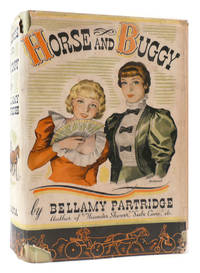
Artist: Bernard PartridgeBiblio.com
2 062 résultats
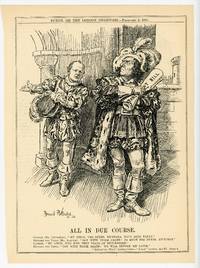
1911007095London: Punch 1911. This original printed appearance of a Punch cartoon featuring Winston S. Churchill comes from the personal collection of Gary L. Stiles author of Churchill in Punch Unicorn Publishing Group 2022. His book is the first ever effort to definitively catalog describe and contextualize all of the many Punch cartoons featuring Churchill. <br /> <br />This cartoon titled "'All in Due Course. appeared thus on p.101 of the 8 February 1911 issue of Punch. The artist is Bernard Partridge. The cartoon is captioned "Catesby Mr. Churchill. 'My liege The Dukes etcetera have been taken.' Richard the Third Mr. Asquith. 'Off with their heads! So much for Dukes etcetera.' Catesby. 'My liege e'en now they prate of self-reform.' Richard the Third. 'Off with their heads! We will reform 'em later.' "Richard The Third" Colley Cibber - "French" version Act IV. Scene 4." <br /> <br />Prime Minister Herbert Asquith's Liberal government introduced the Parliament Act to curb the powers of the House of Lords following the clash between the Commons and Lords over the 1909 People's Budget. Churchill was at 'point' for much of the attack on the Lords. Here the message is: show them no mercy. In Shakespeare's Richard III Catesby is one of the King's ardent supporters. <br /> <br />Punch or The London Charivari began featuring Churchill cartoons in 1900 when his political career was just beginning. That political career would last two thirds of a century see him occupy Cabinet office during each of the first six decades of the twentieth century carry him twice to the premiership and further still into the annals of history as a preeminent statesman. And throughout that time Punch satirized Churchill in cartoons more than 600 of them the work of more than 50 different artists. <br /> <br />It was a near-perfect relationship between satirists and subject. That Churchill was distinctive in both persona and physical appearance helped make him easy to caricature. To his persona and appearance he added myriad additional satirical temptations not just props like his cigars siren suits V-sign and hats but also a variety of ancillary avocations and vocations like polo painting brick-laying and writing. All these were skewered as well. <br /> <br />Some Punch cartoons were laudatory some critical and many humorous like the man himself. Nearly always Churchill was distinctly recognizable a larger-than-life character whose presence caricature served only to magnify. <br/><br/> Punch unknown
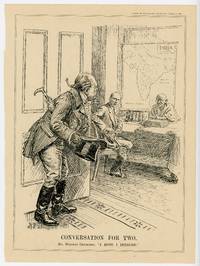
1931007155London: Punch 1931. This original printed appearance of a Punch cartoon featuring Winston S. Churchill comes from the personal collection of Gary L. Stiles author of Churchill in Punch Unicorn Publishing Group 2022. His book is the first ever effort to definitively catalog describe and contextualize all of the many Punch cartoons featuring Churchill. <br /> <br />This cartoon titled "CONVERSATION FOR TWO." appeared thus on p.239 of the 4 March 1931 issue of Punch. The artist is Bernard Partridge. The cartoon is captioned "Mr. Winston Churchill. 'I HOPE I INTRUDE.'" <br /> <br />The First Round Table Conference November 1930-January 1931 convened to consider government reform in India included Mohandas Gandhi and Secretary of State for India William Wedgwood Benn both depicted in this cartoon. Churchill is the only one not in contemporary garb dressed instead in old-fashioned riding clothes perhaps suggesting antiquated views. Clearly he is not an invited or welcome guest to the conversation. <br /> <br /> In 1931 Churchill had begun what would become a decade spent out of power and out of favor frequently at odds with both his own Conservative Party and prevailing public sentiment. In early 1931 Churchill broke with his Party over the India Bill. Churchill spent formative time as a young 19th century cavalry officer fighting on the northwest Indian frontier about which he would write his first published book. He certainly did not adopt an early progressive attitude toward relinquishing control over the crown jewel of Britain's colonial empire. Nonetheless it is instructive to remember that many of Churchill's dire warnings about Indian independence proved prophetic. Churchill had warned that too swift a British withdrawal from India would lead to bloody civil war and sectarian strife between Hindus and Muslims Hindu domination and destabilizing political balkanization of the subcontinent. All these predictions came to pass and to a considerable extent persist today. <br /> <br />Punch or The London Charivari began featuring Churchill cartoons in 1900 when his political career was just beginning. That political career would last two thirds of a century see him occupy Cabinet office during each of the first six decades of the twentieth century carry him twice to the premiership and further still into the annals of history as a preeminent statesman. And throughout that time Punch satirized Churchill in cartoons more than 600 of them the work of more than 50 different artists. <br /> <br />It was a near-perfect relationship between satirists and subject. That Churchill was distinctive in both persona and physical appearance helped make him easy to caricature. To his persona and appearance he added myriad additional satirical temptations not just props like his cigars siren suits V-sign and hats but also a variety of ancillary avocations and vocations like polo painting brick-laying and writing. All these were skewered as well. <br /> <br />Some Punch cartoons were laudatory some critical and many humorous like the man himself. Nearly always Churchill was distinctly recognizable a larger-than-life character whose presence caricature served only to magnify. <br/><br/> Punch hardcover
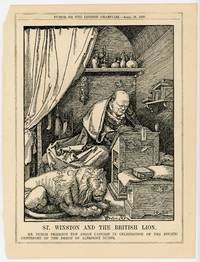
1928007150London: Punch 1928. This original printed appearance of a Punch cartoon featuring Winston S. Churchill comes from the personal collection of Gary L. Stiles author of Churchill in Punch Unicorn Publishing Group 2022. His book is the first ever effort to definitively catalog describe and contextualize all of the many Punch cartoons featuring Churchill. <br /> <br />This cartoon titled "ST. WINSTON AND THE BRITISH LION." appeared thus on p.435 of the 18 April 1928 issue of Punch. The artist is Bernard Partridge. The cartoon is captioned "MR. PUNCH PRESENTS THE ABOVE CARTOON IN CELEBRATION OF THE FOURTH CENTENARY OF THE DEATH OF ALBRECHT DURER." In the cartoon as the British Lion rests watchfully at Churchill's feet Churchill - then Chancellor of the Exchequer - works diligently on the budget. Of note are the knives and scissors and the hour glass showing time running out. Albrecht Durer 1471-1548 like Churchill a Renaissance man was a German printer and printmaker known to da Vinci and Raphael. <br /> <br />When this cartoon was published Churchill was a dozen years and an unrecognizable world away from his wartime premiership - a premiership that saw him become indelibly associated with the British Lion ubiquitous in British heraldry for the better part of a thousand years. The association with Churchills rumbling oratory and implacably steadfast wartime leadership was perhaps inevitable. The iconic photographic portrait of Churchill taken on 30 December 1941 by Yousef Karsh among the most famous photographic images of the twentieth century - came to be known as The Roaring Lion. Years later in remarks on his 80th birthday in 1954 Churchill would remark on his legacy: It was the nation and the race dwelling all round the globe that had the lions heart. I had the luck to be called upon to give the roar. <br /> <br />Punch or The London Charivari began featuring Churchill cartoons in 1900 when his political career was just beginning. That political career would last two thirds of a century see him occupy Cabinet office during each of the first six decades of the twentieth century carry him twice to the premiership and further still into the annals of history as a preeminent statesman. And throughout that time Punch satirized Churchill in cartoons more than 600 of them the work of more than 50 different artists. <br /> <br />It was a near-perfect relationship between satirists and subject. That Churchill was distinctive in both persona and physical appearance helped make him easy to caricature. To his persona and appearance he added myriad additional satirical temptations not just props like his cigars siren suits V-sign and hats but also a variety of ancillary avocations and vocations like polo painting brick-laying and writing. All these were skewered as well. <br /> <br />Some Punch cartoons were laudatory some critical and many humorous like the man himself. Nearly always Churchill was distinctly recognizable a larger-than-life character whose presence caricature served only to magnify. <br/><br/> Punch unknown
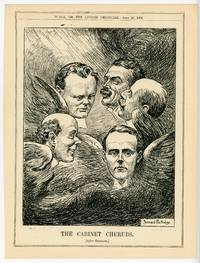
1908007074London: Punch 1908. This original printed appearance of a Punch cartoon featuring Winston S. Churchill comes from the personal collection of Gary L. Stiles author of Churchill in Punch Unicorn Publishing Group 2022. His book is the first ever effort to definitively catalog describe and contextualize all of the many Punch cartoons featuring Churchill. <br /> <br />This cartoon titled "THE CABINET CHERUBS appeared thus on p.134 of the 22 April 1908 issue of Punch. The artist is Bernard Partridge. The cartoon is captioned "After Reynolds". The cartoon depicts the young members of the new Asquith Cabinet - the first of many Cabinets to which Churchill would be appointed. The image is modeled after Joshua Reynolds's painting "A Cherub Head in Different Views" currently at the Tate Britain Acc. No. N00182. The figures are clockwise from lower left Reginald McKenna Winston Churchill Lloyd George Viscount Morley and Sir Edward Grey. <br /> <br />Punch or The London Charivari began featuring Churchill cartoons in 1900 when his political career was just beginning. That political career would last two thirds of a century see him occupy Cabinet office during each of the first six decades of the twentieth century carry him twice to the premiership and further still into the annals of history as a preeminent statesman. And throughout that time Punch satirized Churchill in cartoons more than 600 of them the work of more than 50 different artists. <br /> <br />It was a near-perfect relationship between satirists and subject. That Churchill was distinctive in both persona and physical appearance helped make him easy to caricature. To his persona and appearance he added myriad additional satirical temptations not just props like his cigars siren suits V-sign and hats but also a variety of ancillary avocations and vocations like polo painting brick-laying and writing. All these were skewered as well. <br /> <br />Some Punch cartoons were laudatory some critical and many humorous like the man himself. Nearly always Churchill was distinctly recognizable a larger-than-life character whose presence caricature served only to magnify. <br/><br/> Punch unknown
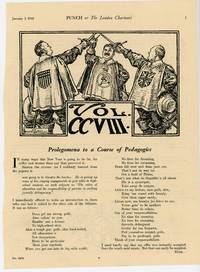
1945007168London: Punch 1945. This original printed appearance of a Punch cartoon featuring Winston S. Churchill comes from the personal collection of Gary L. Stiles author of Churchill in Punch Unicorn Publishing Group 2022. His book is the first ever effort to definitively catalog describe and contextualize all of the many Punch cartoons featuring Churchill. <br /> <br />This cartoon titled "THE CAVALIERS." appeared thus at the top of page 1 of the 3 January 1945 issue of Punch - the first issue of 1945. The artist is Bernard Partridge. The cartoon rather sunnily features the wartime Allied triumvirate of Franklin D. Roosevelt Joseph Stalin and Winston S. Churchill as three musketeers. By the end of the year the war would be won Roosevelt dead and Churchill voted out of office and the victory already fracturing into what would become the Cold War with only Stalin remaining at the helm of his nation. <br /> <br />Punch or The London Charivari began featuring Churchill cartoons in 1900 when his political career was just beginning. That political career would last two thirds of a century see him occupy Cabinet office during each of the first six decades of the twentieth century carry him twice to the premiership and further still into the annals of history as a preeminent statesman. And throughout that time Punch satirized Churchill in cartoons more than 600 of them the work of more than 50 different artists. <br /> <br />It was a near-perfect relationship between satirists and subject. That Churchill was distinctive in both persona and physical appearance helped make him easy to caricature. To his persona and appearance he added myriad additional satirical temptations not just props like his cigars siren suits V-sign and hats but also a variety of ancillary avocations and vocations like polo painting brick-laying and writing. All these were skewered as well. <br /> <br />Some Punch cartoons were laudatory some critical and many humorous like the man himself. Nearly always Churchill was distinctly recognizable a larger-than-life character whose presence caricature served only to magnify. <br/><br/> Punch unknown
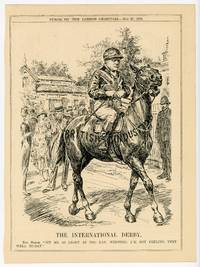
1925007140London: Punch 1925. This original printed appearance of a Punch cartoon featuring Winston S. Churchill comes from the personal collection of Gary L. Stiles author of Churchill in Punch Unicorn Publishing Group 2022. His book is the first ever effort to definitively catalog describe and contextualize all of the many Punch cartoons featuring Churchill. <br /> <br />This cartoon titled "THE INTERNATIONAL DERBY." appeared thus on p.575 of the 27 May 1925 issue of Punch. The artist is Bernard Partridge. The cartoon is captioned "The Horse. 'SIT ME AS LIGHT AS YOU CAN WINSTON; I'M NOT FEELING VERY WELL TO-DAY.'" Churchill then Chancellor of the Exchequer is portrayed as a jockey wearing the Union Jack astride an agitated mount labeled "BRITISH INDUSTRY". Churchill was weighing the tax and financial burdens of industry and the British taxpayer. <br /> <br />Punch or The London Charivari began featuring Churchill cartoons in 1900 when his political career was just beginning. That political career would last two thirds of a century see him occupy Cabinet office during each of the first six decades of the twentieth century carry him twice to the premiership and further still into the annals of history as a preeminent statesman. And throughout that time Punch satirized Churchill in cartoons more than 600 of them the work of more than 50 different artists. <br /> <br />It was a near-perfect relationship between satirists and subject. That Churchill was distinctive in both persona and physical appearance helped make him easy to caricature. To his persona and appearance he added myriad additional satirical temptations not just props like his cigars siren suits V-sign and hats but also a variety of ancillary avocations and vocations like polo painting brick-laying and writing. All these were skewered as well. <br /> <br />Some Punch cartoons were laudatory some critical and many humorous like the man himself. Nearly always Churchill was distinctly recognizable a larger-than-life character whose presence caricature served only to magnify. <br/><br/> Punch unknown
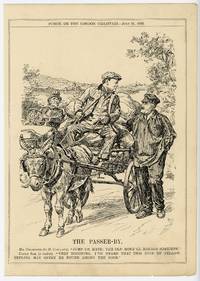
1926007145London: Punch 1926. This original printed appearance of a Punch cartoon featuring Winston S. Churchill comes from the personal collection of Gary L. Stiles author of Churchill in Punch Unicorn Publishing Group 2022. His book is the first ever effort to definitively catalog describe and contextualize all of the many Punch cartoons featuring Churchill. <br /> <br />This cartoon titled "THE PASSER-BY." appeared thus on p.71 of the 21 July 1926 issue of Punch. The artist is Bernard Partridge. The cartoon is captioned "Mr. Churchill to M. Caillaux. 'JUMP UP MATE; THE OLD MOKE'LL MANAGE SOMEHOW.' Uncle Sam a realist. 'VERY TOUCHING. I'VE HEARD THAT THIS KIND OF FELLOW-FEELING MAY OFTEN BE FOUND AMONG THE POOR.'" Joseph Caillaux was a French politician who led the Free Radical Party and in this cartoon represents his countrymen traveling on foot. Churchill - then Britain's Chancellor of the Exchequer - is riding a cart pulled by a beleaguered donkey "Old Moke" labeled "BRITISH TAXPAYER. In he background representing the United States Uncle Sam whizzes by in a motor car puffing on a cigar supercilious and making a snide comment. <br /> <br />Punch or The London Charivari began featuring Churchill cartoons in 1900 when his political career was just beginning. That political career would last two thirds of a century see him occupy Cabinet office during each of the first six decades of the twentieth century carry him twice to the premiership and further still into the annals of history as a preeminent statesman. And throughout that time Punch satirized Churchill in cartoons more than 600 of them the work of more than 50 different artists. <br /> <br />It was a near-perfect relationship between satirists and subject. That Churchill was distinctive in both persona and physical appearance helped make him easy to caricature. To his persona and appearance he added myriad additional satirical temptations not just props like his cigars siren suits V-sign and hats but also a variety of ancillary avocations and vocations like polo painting brick-laying and writing. All these were skewered as well. <br /> <br />Some Punch cartoons were laudatory some critical and many humorous like the man himself. Nearly always Churchill was distinctly recognizable a larger-than-life character whose presence caricature served only to magnify. <br/><br/> Punch unknown
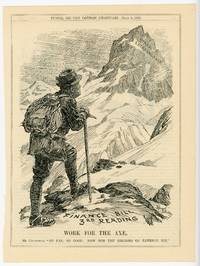
1925007141London: Punch 1925. This original printed appearance of a Punch cartoon featuring Winston S. Churchill comes from the personal collection of Gary L. Stiles author of Churchill in Punch Unicorn Publishing Group 2022. His book is the first ever effort to definitively catalog describe and contextualize all of the many Punch cartoons featuring Churchill. <br /> <br />This cartoon titled "WORK FOR THE AXE." appeared thus on p.703 of the 1 July 1925 issue of Punch. The artist is Bernard Partridge. The cartoon is captioned "Mr. Churchill. 'SO FAR SO GOOD. NOW FOR THE REGIONS OF ETERNAL ICE.'" In the image Winston dressed as a circa 1920s mountaineer stands leaning on a pickaxe labeled "FINANCE BILL 3RD READING" while regarding a distant high peak labeled "STATE EXTRAVAGANCE". Churchill as Chancellor of the Exchequer was seeing his first budget through Parliament. Issues being hotly debated ranged from war debt payments to the U.S. the cost of social programs such as unemployment insurance health care payments new taxes and on whom industry versus individual consumer and the recent reintroduction of the Gold Standard. <br /> <br />Punch or The London Charivari began featuring Churchill cartoons in 1900 when his political career was just beginning. That political career would last two thirds of a century see him occupy Cabinet office during each of the first six decades of the twentieth century carry him twice to the premiership and further still into the annals of history as a preeminent statesman. And throughout that time Punch satirized Churchill in cartoons more than 600 of them the work of more than 50 different artists. <br /> <br />It was a near-perfect relationship between satirists and subject. That Churchill was distinctive in both persona and physical appearance helped make him easy to caricature. To his persona and appearance he added myriad additional satirical temptations not just props like his cigars siren suits V-sign and hats but also a variety of ancillary avocations and vocations like polo painting brick-laying and writing. All these were skewered as well. <br /> <br />Some Punch cartoons were laudatory some critical and many humorous like the man himself. Nearly always Churchill was distinctly recognizable a larger-than-life character whose presence caricature served only to magnify. <br/><br/> Punch unknown
1905287118London: Kegan Paul Trench Trübner & Co 1905. Hard Cover. Very Good binding. Signed. Austin Dobson's Proverbs in Porcelain to which is added "Au Revoir;" a collection of short dramatic works with numerous illustrations by Bernard Patridge. Signed by Dobson on a paper slip pasted onto to the front endpaper. With a personal inscription on the recto of the frontispiece for a previous owner from her mother. Olive cloth with white lettering and illustration. Very Good. Very Good binding. Kegan Paul, Trench, Trübner & Co unknown books
1991Q-0851863337Royal Society of Chemistry 1991-12-31. Paperback. New. New. In shrink wrap. Looks like an interesting title! Royal Society of Chemistry paperback
Light wear and blemishes from tag removal on front and back covers. Age toned pages. 128 pages.
45465395like new. unknown
1015812538.Ghardcover. Good. Access codes and supplements are not guaranteed with used items. May be an ex-library book. hardcover
1981222077United Kingdom: Perdix Press 1981. Book. Near Fine. hardback. hardback slim octavo issued in a limitation of 100 copies of which this is numbered 67 signed by Mark Franklin and Walter Partridge recently rebound in half green morocco and grey woven cloth covered boards lettered gilt to spine a near fine tightly bound copy text unmarked and clean wood-engraved frontis and decorations by Richard Tilleard 34pp. Perdix Press Hardcover
196758605p10Detroit: Gale Research Company 1967. Book. Very Good. Hardcover. 8vo - over 7¾ - 9¾" tall. A facsimile reprint of the original 1889 edition. Two voumes. Original cloth hard covers with gilt titles to spines. Ex libris non-lending library with typical marks. Light bumping to covers. Otherwise clean tight and unmarked. Very neat -- a sound and handsome set. . Gale Research Company Hardcover
190064108New York: Charles Scribner's Sons 1900. First Edition; First Printing. Hardcover. Good in boards. Hinge is starting. ; 8vo 8" - 9" tall. Charles Scribner's Sons hardcover
5034161like new. unknown
2010Q-1592579809Alpha 2010-02-02. Paperback. New. In shrink wrap. Looks like an interesting title! Alpha paperback
1993x-0415088666Routledge 1993. Paperback. New. 1st edition. 241 pages. 8.75x5.50x0.75 inches. Routledge paperback
2017x-1138164798Taylor & Francis 2017. Hardcover. New. 256 pages. 8.50x5.43x0.63 inches. Taylor & Francis hardcover
2022__1789241561Cab Intl 2022. Hardcover. New. 3rd edition. 280 pages. 9.50x6.50x1.00 inches. Cab Intl hardcover
2010Star-9781845936747Cabi 2010. Hardcover. New. Cabi hardcover
2010Star-9781845936747Cabi 2010. Hardcover. New. Cabi hardcover
1941186879New York: Whittlesey House 1941. First Edition; Sixth Printing. Hardcover. Very Good in a Very Good price clipped dust jacket. All 4 flap corners clipped. Top of rear flap hole punched. Whittlesey House hardcover
1937174511New York: Arcadia 1937. First Edition; First Printing. Hardcover. Very Good in a Very Good dust jacket. Owner name bookplate on FEP. Few small open tears along pnael edges. Arcadia hardcover