[Persia].MareMagnum
Persia. N. p., Menzies, ca. 1820.
Hand-coloured engraved map (531 x 480 mm).
4 134 résultats
11 pp. Re-stapled paper. A detailed war-time newsletter from the Middle East, relaying through the soldier's wives at home the regiment's movements at the front for family members back in the UK. Covering August 1942 to March 1943, it focuses on general updates of the regiment's position and provides lists of soldiers, facts which would give some comfort to their families. Whilst there are humorous bits on the trivialities of warfare, the confidential nature and redacted passages remind the reader that this was an internal communication with the bare minimum of information allowed. - The letter starts with addresses which a reader would need to write to for inquiries as to whether family members had been wounded or captured as prisoners. It then proceeds into "regimental letter number 1", which describes the regiment boarding a steamer and at sea; the typical routine is portrayed as a "wild rush to get the mess deck clean, hammocks and mattress stacked, blankets rolled and so on before breakfast" (p. 3). - The 2nd letter commences with 8 Dec. 1942, making reference to landing in Egypt and preparations for fighting Germany. In the same format as the first letter, it is followed by a battery notes section, listing ill or other soldiers who had to remain at HQ, promotions, soldiers injured and casualties sustained from the fighting. - A humorous note concerns an incident involving poisonous creatures of the desert, where "Battery Commander was dragged from his bed to take L/Bdr. Tait to the M.O. for treatment for scorpion sting. The scorpion, later in the night, was captured alive [...] and severely dealt with. Bdr. Hood G's scorpion sting turned out to be a piece of sardine tin, and it's thought that the piece of hand grenade alleged to have fallen on Gnr. Elliot's truck may have been the remainder of the tin" (p. 10). As discussed at the end of the letter, the paper rationing introduced in the UK meant that "it will be impossible to make the future circulation of these letters as wide as it has been" and that in the future a lady in each area of the UK would pass a single letter around for the families eager to find out about the loved ones on distant shores. - Some spotting and staining with a 3 cm tear along the central hold line to some pages. In good condition for a fragile letter.
8vo. (2), 17 pp., final blank page. With 2 half-tone photographs in the text and a folding map of the area between Baghdad and Beirut. Staple-bound. In original printed wrappers. Exceedingly rare pocket-booklet of leave instructions issued to members of the Persia and Iraq Force during the Second World War, "in the hope that it will help [them] to understand the type of country and the places [they] will see on [their] journey" (first page). Subdivided into three sections, the first part of the booklet describes the route taken by the leave convoy from Baghdad via Fallujah, Habbaniyah, Ar-Rutba, Mafraq and Damascus to Beirut, deeming the last portion from Damascus "by far the most picturesque part of the route" (p. 4), and finishing off with a photograph of people relaxing on the beach. The second section comprises a history of Damascus and the Syrian desert by Seton Lloyd (1902-96), who had been appointed archaeology adviser to the Directorate of Antiquities, Baghdad, in 1939, and during the war "was able to conduct some notable research, principally the excavation of the painted temple at Uqair and later of Tell Hassuna, where he identified a new culture - and the earliest known - in Iraq" (obituary, Independent, 13 Jan. 1996). The third and last section discusses the construction of the Baghdad to Haifa road by the British between 1938 and 1943. - General Edward Quinan's Iraq Command (originally Iraq Force) was renamed Persia and Iraq Force (Paiforce) shortly after the successful Anglo-Soviet invasion of Persia in August 1941. The main responsibilities of Paiforce were to protect the Iraqi and South Persian oil fields and to maintain the lines of communication from British-controlled ports on the Persian Gulf to the Soviet ports on the Caspian. A dedicated Persia and Iraq Command was established under Sir Maitland Wilson in August 1942, though victory in the Western Desert Campaign combined with series of Soviet victories in southern Russia meant that Paiforce activities began to be wound down from mid-1943. The folding map to the rear of this booklet provides a detailed overview of the vital infrastructure roads and oil pipelines which they were tasked with defending. - Mended tear to upper cover; traces of folds and a little soiled. Handwritten numbers in orange crayon to lower cover. The interior with traces of a vertical fold throughout, resulting from the pages resting on the rim of the folding map; margins slightly creased. Map somewhat foxed. An uncommon survival, with only the Imperial War Museum copy traceable in institutions. Not in OCLC.
12mo. 46, (2) pp. (ads). With full-page maps of Iraq and Baghdad and map of Baghdad amenities area on back cover. Original illustrated wrappers, stapled. First edition. An extremely rare guide to Iraq, produced for members of Paiforce (Persia and Iraq Force). It covers the expected subjects of health, hostels, clubs, sports and tours but also aims to instill a degree of cultural and historical awareness, principally with Seton Lloyd's short history of the country. Lloyd was the curator of the Baghdad Museum at the time, an institution mentioned in the guide as home to "astonishingly beautiful specimens of early Sumerian art, and the whole of Iraq's history ... within well laid out rooms" (p. 23). - Less routine sections highlight Trunk Call (the Paiforce paper) and list Christian churches in Iraq and Bahrain. The advertisements, acting as front and rear endpapers, give a sense of the establishments catering to the troops, including an advert for a shopping centre belonging to the Hasso Brothers, who issued many fascinating photographic postcards of Iraq. - A few small stains to wrappers, a little dusty, otherwise very good. Rare, with no copies in Copac/Jisc or OCLC. We have only been able to trace one example, located at the Imperial War Museum.
Hand-coloured engraved map, 440 x 315 mm. Constant ratio linear horizontal scale, ca 1:8,122,000. Includes the entire Gulf coast of the Arabian Peninsula, showing Kuwait, El Katif, Bahrain, Qatar, and the Musandam Peninsula, including the territory of today's United Arab Emirates (here still labeled the "Pirate Coast"). "Debai", Sharja", "Ras-el-Khaimah", "Khorfakan" and "Fejerah" are identified. - Well preserved. Issued as plate XXXVIII in Sidney Hall's General Atlas of the World. OCLC 781690561.
Ca. 66 x 54 cms. Printed outline colour. Constant ratio linear horizontal scale 1:4,200,000 (1 inch = 66 miles). Folded and bound in original yellow cloth boards. 8vo. Includes Afghanistan and the Balochistan province of Pakistan, as well as the Arabian Gulf with the coastline of the Gulf Emirates to Oman. - Ownership stamps of the German botanist Prof. Dr. Arnold Scheibe (1901-89; cf. NDB XXII, 619f.). OCLC 37732501.
Hand-coloured engraved map (531 x 480 mm).
25 stamps (42 x 50 to 52 x 65 mm) mounted on 6 printed album sheets (250 x 170 mm). Loosely inserted within an envelope in a full cloth album with the name and insignia of the Persian Gulf Command. Jubilee stamps issued on the occasion of the celebration of the Persian Empire's 2,500-year anniversary, from a collector's album. Including portraits of Mohammad Reza Pahlavi and his father, Shah Reza Pahlavi, they also feature architectural landmarks and artefacts such as the Pahlavi crown, the Cyrus Cylinder, and a section of the Bishapur mosaic, as well as the coronation of Shahinshah Aria Mehr of the Kingdom of Yemen. The festivities were to celebrate Iran's ancient civilization and history and to showcase the country's contemporary progress under Mohammad Reza Pahlavi. - Album slightly rubbed at extremities. Vertical tear to 4 sheets, not touching stamps. A few stamps with traces of postmarks; one stamp loose. An appealing set.
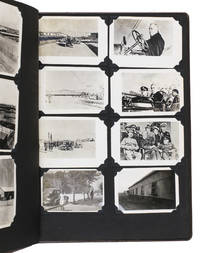
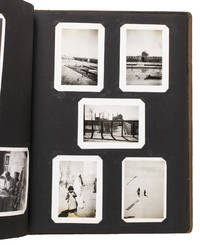
1943ABC_484281943. Contemporary embossed brown cloth with the title embossed in silver on the front board and the green shoulder sleeve insignia of the Persian Gulf Command embedded in the front board. Ca. 32.5 x 26 cm. With 150 gelatin silver photographs various sizes. Unusual military photo album with 150 photographs of the activities of the Persian Gulf Command PGC at the base in Andimeshk Iran. The PGC was a branch of the United States Army established to facilitate the supply of material from the U.S. Lend-Lease programme through the Persian Corridor. This material was sent to the Soviet Union to strengthen it so it could help defeat Nazi Germany. The photographs in this album which cannot be found anywhere else offer a visual documentation of this time. However they show the simple soldiers; the men tasked with driving trucks maintaining oil supply lines or working alongside Iranians at the two factories producing trucks for the war effort. The work therefore offers a fascinating insight into daily life of PCG members in Persia in the Second World War.This album was compiled by John Stefano dates unknown a technician fourth grade in the PGC. It includes photographs of the Tehran conference in 1943 the first World War II conference between the Soviet Union the United States and the United Kingdom where it was decided to open a second front against Germany. Other than this there are photographs of the barracks the men lived in the military vehicles they used the marches and excercises they partook in but also the surrounding landscape and the local people.Inserted in the album is a booklet with images and information about Persia with a letter by PCG commander Donald Prentice Booth 1902-1993 which was sent to PCG members after the war to congratulate them on a job well done. He hoped the booklet would serve as a memento. Together with the album it continues to do so until this day.With the shoulder sleeve insignia of the Persian Gulf command mounted on the inside of the frfont board some of the photographs are captioned on the back. The eyelets for the string on the front board have come loose. The corners of the leaves are slightly creased. Overall in very good condition. hardcover
1943ABC_484291943. Contemporary embossed brown cloth with the title embossed in silver on the front board the name of the owner painted in silver and the green shoulder sleeve insignia of the Persian Gulf Command embedded in the front board. Ca. 32.5 x 26 cm. With 76 gelatin silver photographs various sizes. Remarkable military photo album with 76 photographs of the activities of the Persian Gulf Command PGC at various locations in Iran. The PGC was a branch of the United States Army established in 1941 to assure the supply of U.S. Lend-Lease war material to the Soviet Union through the Persian Corridor. After the war members of the PCG received an empty album to fill with personal memories of their time in Iran. These albums are now relatively rare. The present one was compiled by Colonel S. Morgan Thomas dates unknown a PGC member who carried out inspections of the railroads. It includes various photographs of him at work.This album also contains photographs of PCG commander Donald Prentice Booth 1902-1993 a visit by Soviet soldiers and a young child military activity in Teheran locals and soldiers sending telegrams. Loosely inserted in the album are maps of Iran the lands surrounding Hamadan and the Trans Iranian Railroad which would have been important to carry for someone who inspected the railroads. The work offers a rare insight into life of a PGC member stationed in Iran.The corners of the boards are somewhat scuffed. One of the inserted maps is somewhat foxed and another has a tear that has been repaired with tape in the lower margin not affecting the image some leaves are missing one of the corner mounts the photographs are mounted on possibly missing a photograph on the verso of leaf 4. Otherwise in very good condition. hardcover
Folio (230 x 368 mm). Title, (6) pp., single column, lithographed throughout, with large Persian coat of arms on the title page (by Abu’l-Hasan Gaffari). Early issue of Persia's official government newspaper. Traces of folds; some edge chipping and tears to folds. Removed from the City Library Association, Springfield, MA, with their stamp to the title an handwritten note "The 'Persian Gazette", one of the only two in Persia - printed at Teheran - The Persian Coat of Arms".
4to. 70 pp. Contemporary Italian boards with papered spine. Only issue of this Persian grammar for the use of the Padua seminary, ascribed to Lodewijk de Dieu (1590-1642) by the State and University Library of Göttingen. Without a title page as issued. - Old monastic library stamp at bottom of final page; 19th c. note of donation (a gift of Cardinal Barberini) on front flyleaf. OCLC 461040960.
Small folio (190 x 268 mm). Eight issues and eight supplements (1 October 1957 to 1 August 1959), bound in one. Vol. 5 (nos. 1-4 & supplements 18-21): 234 pp.; vol. 6 (nos. 1-4 & supplements 22-25): 256 pp. Contemporary sand buckram; red and black labels with gilt lettering to spine, 'Foreign Office' stamped in black to upper cover. Two early volumes from the highly important "Persian Gulf Gazette", which ran from 1953 to 1972. Published in the final decades before the independence of the Gulf States, it is a fascinating record of the waning of direct British involvement in the governments of Kuwait, Bahrain, Qatar and the Trucial States (now the United Arab Emirates). - The Gazette was a quarterly publication containing notices of anything relevant to Britain's jurisdiction in the aforementioned States, from political appointments to new Orders and Regulations. It was sold at H.M. Political Agencies in Bahrain, Kuwait, Qatar and Dubai, as well as at H.M. Consulate, Muscat. Supplements were published with each issue, printing the Orders and Regulations in full. These include all manner of regulations - often created in response to rapidly developing infrastructure - covering, inter alia, employment, shipping, patents and the penal system. - Provenance: withdrawn from the Foreign and Commonwealth Office Library with stamps to endpapers. Some very minor dampstaining to the top edge of textblock, handwritten ink reference numbers to some title-pages, rest of interior clean and fresh. Very well preserved. Though fairly well-held institutionally, original issues (not to mention volumes and runs) are rare in commerce.
Folio (322 x 212 mm). 50 watercolour miniatures on paper, ca. 9 x 14 cm, pasted on coloured cardboard within multiple gilt and pen-ruled frames, bound as a fan-fold book with cloth hinges. Near-contemporary black leather covers, stored in blind-stamped black slipcase with top flap. An exceptional series of 50 meticulously executed miniatures, compiled and painted by an anonymous artist. 41 of the delicate watercolours represent famous calligraphers, 5 (1 in grisaille) presumably represent sufis, and one more (not coloured) shows a seated prince, while 3 miniatures (2 in grisaille) depict flowers. - The main series of calligraphers begins with Yaqut al-Musta'simi, who lived in Baghdad under the Abbasid dynasty in the 13th century, and reaches so far as to include artists from the first half of the 19th century (the most recent date of death being that of Aqa Fath-'Ali Sirazi, 1852/53). Their names are captioned under the image, all in the same hand in nasta'liq script (with a single exception in sikasta). Most calligraphers are shown kneeling, with one knee raised on which they rest their paper - the typical posture of a scribe. One is shown writing at a desk, another seated on a low stool; yet another is busy sharpening his pen. The poet Wisal Sirazi is seen writing on his knee, but has a small table with an inkwell and paper in front of him. Nearly all are depicted holding their reed pen in hand, with various writing implements next to or in front of them, such as inkwells, pen cases, extra pens and paper, pen-knife, and sometimes a hookah (indeed, two scribes are shown smoking). Others have in front of them a candle and teapot, flowers or a bowl of fruit. They are shown wearing different kinds of turbans or a black astrakhan "kulah", the Qajar headdress. All the miniatures bear numbers between 1 and 50 on the reverse of the mounting boards, though they are not bound in order. - Provenance: apparently from the collection of Paul Manteau, a French (or Belgian?) official in Iran, with a press-copied salary receipt loosely inserted: "Je reconnais avoir reçu de Son Altesse Impériale Djellal-e-Daulet la somme de Soixante Tomans représentant le montant de mes appointements du mois de Châval année 1310. Téhéran le 11 avril 1893. Paul Manteau". As Shawwal 1310 began on 18 April 1893 AD, Manteau would have received his salary in advance, proving that the capacity in which he served could not have been altogether minor. Sultan Husayn Mirza Jalal al-Dawlih (b. 1868/69), his employer, was the eldest son of prince Mas'ud Mirza Zill al-Sultan (1850-1918) and grandson of the Qajar ruler Nasir al-Din Shah (r. 1848-96). In the later 19th century, numerous French and particularly Belgian officials worked in Iran: especially from 1898 onwards, Belgium posted to Persia a large number of officials whose task was to organize or reorganize various administrative departments. However, Manteau does not appear in Annette Destrée's standard account of "Les fonctionnaires belges au service de la Perse, 1898-1915" (Téhéran/Liège 1976): he clearly arrived before the great Belgian influx and may have left the country before 1898. - Some of the cloth concertina hinges professionally repaired, but finely preserved altogether.
8vo. XIV, 673, (1) pp. With wood-engraved title vignette, folding map of the Middle East, 3 maps, 4 wood-engraved plates, 1 steel-engraved portrait, and numerous wood-engraved text illustrations. Contemporary half calf with giltstamped spine title. Marbled edges and endpapers. Fascinating account of the work on the submarine telegraph lines from British India to Turkish Arabia, the so-called "Persian Gulf Cable" laid in the 1860s. An extensive section is devoted to the laying of cables in the Arabian Gulf south of Persia, with a separate diagram of the diversion of the "Persian Gulf Cable" from Elphinstone Island off the northern tip of Arabia to Henjam and Jask. The telegraph lines ultimately reached from London via Munich, Vienna, Constantinople, Diarbekr, and Baghdad to Basrah, then continued by the Indian Government to Bushehr, Henjam, Gwdar and Karachi as well as to Tehran. Other cables connected Cairo with Aden and thence with Bombay. - Some brownstaining and edge flaws, otherwise an excellent copy. Inscribed "Thomas Kirk Johnson Dec. 1876 From R. B. Hull". Howgego III, G31. OCLC 1283945.
Manuscript letter in Italian, opening with a duplicate of an earlier letter, in a different hand, dated 26 September 1732, written in ink on one page of a bifolium originally folded 4 more times for sending (to 8.5 x 14 cm) with the address on one side and traces of a red wax on the other. Letter in Italian concerning the cloth trade in the capital of Egypt during the last months of 1732. The letter is addressed to the Italian merchant Nicolò Caragiani in Venice, who actively traded with the Levant and correspondence with several other merchants survives. The present letter informs Caragiani on the demand in certain types of cloth, which prizes are expected to rise during the approach of Ramadan. It mentions various fabrics including silks, damask and wools and also includes the prices of coffee and pepper. The letter opens with a copy of an earlier letter, followed by the actual letter in a different hand, signed by one Michiel whose last name is unclear, but could read something like Petea or Retea. - With some faint foxing, and a tiny hole and a tear along a fold on the address side, otherwise in very good condition.
Oblong 8vo. Captioned in English, French and Arabic. Rare, early black and white photographic views of two important petroleum refineries in Africa: Suez and Fedala. The latter is featured in a photograph by the French military photographer Marcel Flandrin (1889-1957), a pioneer of aerial photography in Morocco. Taken from an aeroplane and published by the Syndicat d'Inititative, the image shows the bonding warehouses at Fedala refinery amidst a rough Atlantic. - The second postcard, published by Vitta & Cie., shows a general view of the Suez refinery against the backdrop of the Ataka Mountains. - In addition to the printed captions, the postcard of Suez bears handwritten captions in German and English on recto and verso in ink and pencil. - The postcard of Suez pierced in two places. A very well preserved set.
4to. 40 pp. Original printed wrappers. Stapled. Arabic edition of the leading English newspaper on oil matters. Founded in 1934, the Petroleum Press Service was one of the first reliable sources of information on all aspects of the petroleum industry and trade. The Arabic version, first issued in 1953, was published up to the 1970s. - Front cover slightly dampstained.
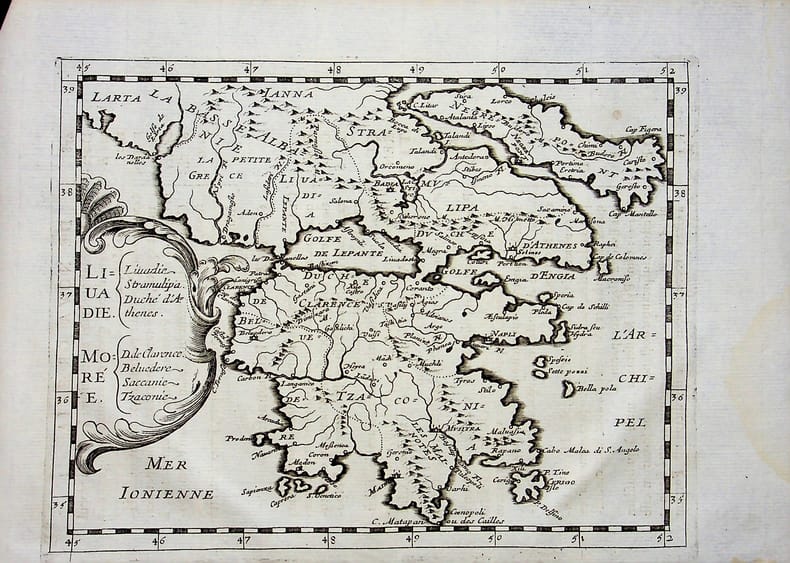
018798[Philippe Briet, Parallela geographiae veteris et novae] Liuadie Morée - Grèce, Golfe de Lépante. Gravure originale, 1649, environ 240*170mm. Gravure tirée de l'ouvrage du savant jésuite Philippe Briet (1601-1668) publié en 1648-1649. Texte au dos. [436]
Folio (257 x 344 mm). (104) pp. More than 200 photo prints. Original giltstamped green cloth. Intriguing photo publication of both Iraq and Central Arabia during the Great War, brought out by St John Philby at the end of the year 1918, after he had served with the British administration in Baghdad from 1915 to 1917 and then travelled through the interior of the Arabian Peninsula as head of a mission to Ibn Saud. Philby completed a great tour of the Nejd in nine months, covering some 4000 kilometres. "Over 600 photographs were taken, some of which were later published in 1918 in 'Iraq in War Time', the first photographic book to appear on Najd" (Badr El-Hage, p. 95f.). The book, captioned throughout in English and Arabic (in which Philby was fluent), is divided into four sections: "Groups and Portraits" (43 illustrations); "Local Events" (55 illustrations); "Views" (112 illustrations, including "In Basrah City", "Amarah", "Nasiriyah", "Baghdad", "Najaf", "Mosul", "Suq al Shuyukh", "In Persia"), and "A Tour through Central Arabia" (24 illustrations). Among these are numerous equestrian images ("The best Arab horse 'Winchester' owned by Fahud el Nasar", "Well-known Basrah Race Horses", "Arabs competing for a prize offered for the best Arab mare", "Judging the Arab mares", "Winner of the Prize for Arab Mares" etc.), and the portrait section contains a veritable gallery of the sheikhs and political officers of the Arabian scene during the Great War. - The tour of the Nejd shows fascinating images of Jeddah, Nafudh, Sakha, Madhiq, Riyadh, Al-Hafar, Saqtah Gorge, the Shamsiyah Garden, etc., as well as Arab chiefs and a group portrait with the anonymous tourist Philby himself, surrounded by his Bedouin escort. "Although Philby was an amateur photographer, and the quality of his photographs fails at times to be up to standard, his achievements were remarkable, and his photographs documented many towns and villages for the first time" (Badr El-Hage, p. 114). - Near-indecipherable ownership inscription of Sheikh Abdulkareem bin Khaz’al, or possibly of the Sheikh of Muhammerah, Khaz’al bin Jabir bin Merdaw al-Ka’bi (1863-1936), to the verso of the rear free endpaper. A photograph of the Sheikh of Muhammerah appears in Part II. A few small scuffs and stains, corners bumped. A good copy of this rare and important work usually encountered only in poor condition. Badr El-Hage, Saudi Arabia: Caught in Time, 1861-1939, p. 95. Imperial War Museum 29(567)/3-5. OCLC 757755425. Not in Macro or Wilson.
Seven photos and a mimeo letter mounted on four pages of a tied homemade album with paper covers. Photos approximately 160 x 110 mm. Inked caption beneath each photo. The rest of the album pages are blank. Oblong folio. A mimeo letter from Headquarters, 169 (Lon) Inf Bde states that members of their brigade scaled Mount Camino and routed the Germans from an old Benedictine monastery located on the summit in November 1943. When the Moroccan Goums arrived in the area in the Spring of 1944 they were so impressed with the mountain warfare of the British troops that they subscribed for a plaque to be placed on top of the mountain honouring the British soldiers. These seven professional quality photos which the mimeo letters says are "enclosed" were taken at the dedication of the plaque. The photos show Moroccan troops, the 8th Army commander, and the plaque.
Approximately 120 mounted (usually 2-4 to a page) snap shots ranging in size from 60 x 40 mm to 120 x 100 mm. Brief captions in black ink under almost all the photos. 1/4 leather album. 4to. The first half of the photos show middle class life in Edwardian England. The second, and more interesting half of the photos are snap shots that appear to have been taken by a British officer and include military subjects, scenes of Baghdad and the Euphrates, and views of the Bosporus. - Some photos are faded or have minor spots or light streaks. Wretched-looking lacking backstrip, with covers worn, discolored, and detached.
Ca. 620 original photographs (ca. 460 in black-and-white and ca. 160 in colour), 1 portrait reproduced from a painting, and 2 small portrait drawings. Various sizes (ca. 39 x 40 to 202 x 300 mm). Most photographs with handwritten Arabic captions in ballpoint on versos, some of which with official stamps, some with pasted mimeograph typescript captions in English. Stored in 11 display books. A handsome trove of photographs, apparently assembled by a Middle Eastern political scientist or journalist, illustrating the evolving history of various countries of the Arabian Peninsula and their political leaders during the second half of 20th century, with an emphasis on the Sheikhs of Saudi Arabia, Kuwait, Oman, and Bahrain. - Some volumes focus on one or two politicians, with their portrait photographs and their various official appearances while welcoming foreign dignitaries, attending summits, military parades, celebrations, and competitions or award ceremonies. A large section of the archive shows King Fahd bin Abdul-Aziz Al Saud, including a photograph of him with his brother Turki Bin Abdul-Aziz (vol. 1), depicting him in London on the occasion of a lunch given by Margaret Thatcher, at a diplomatic meeting with Ronald Reagan, and at the "10th Arabian summit" in Tunis (vol. 6). Nayef bin Abdul-Aziz is seen meeting political leaders and ministers (among them Yasuhiro Nakasone and François Mitterrand, vol. 3), and the diplomat and Ambassador to the U.S. Prince Bandar bin Sultan Al Saud meeting Bill Clinton, then Gouverneur of Arkansas, and Vice President George Bush Sr. (Oval Office) for the AWACS plane contract (vol. 10). Another part is dedicated to the OPEC summits under Saudi oil minister Sheikh Ahmed Zaki Yamani, meeting Bruno Kreisky in Vienna, as well as at venues in Algiers, Kuwait, Yugoslavia, Caracas, Geneva, Oslo, and other places (vol. 4). King Abdullah Bin Abdul-Aziz Al Saud is given a splendid state visit in Britain, where he is welcomed by Prince Charles and shares a carriage with Queen Elisabeth (vol. 5). Other photos show Prince Mashour bin Saud bin Abdul-Aziz Al Saud, King Fahd's nephew, in London after being freed on bail for smuggling cocaine, and King Faisal during a stay in Khartoum (vol. 8). Another part of the collection shows Kuwaiti leader Jaber al-Ahmad al-Sabah receiving Yemeni representatives, as well as his successor Saad Al-Abdullah Al-Salim Al-Sabah and his predecessor Sabah III Al-Salim Al-Sabah (vols. 2, 5, 8). Furthermore, Bahrain's royal family is shown: Isa bin Salman Al Khalifa is depicted at a young age practising riding and falconry, and Sheikh Hamad Bin Isa Al Khlaifa (vols. 7, 10, 11) meeting Oman's royals, such as Sultan Qaboos bin Said, the Saudi minister Ghazi al-Gosaibi, and the Libyan ruler Muammar Gaddafi. Dubai's ruler Sheikh Rashid bin Saeed Al Maktoum is depicted at the opening of "Asry dry dock", pouring holy water (vol. 11). - Two original photographs of well-known views of Mecca's Masjid al-Haram with the Kaaba from ca. 1885 and 1920 are added. The photographs are partly stamped and mostly annotated in Arabic (some in English and French), often with mounted labels on the versos for possible use by the press, some with small labels bearing Arabic captions. One photograph has a portion whited out for reproduction, a few photographs with studio imprint ("Zamani"), others with more detailed information, such as the name of the photographer ("Alain Nogue") or agency ("Sygma") on versos. - A wide-ranging, hitherto untapped archive which allows for various perspectives toward an analysis of international, global political diplomacy by Middle Eastern rulers and members of the Arab League, including numerous candid, personal images of the actors involved.
8vo. (2), 348, (6), 44 pp. Contemporary full mottled calf with gilt spine (hinges weakened, binding professionally restored and lacquered). All edges sprinkled red. Rare news journal containing the lengthiest entry on pirates known in any contemporary periodical, spanning eleven closely printed pages (pp. 246-256) that went on to be cited in numerous piracy studies. The relevant section begins with a report from Jamaica that the pirates have been so active that they now number about 1500. There is a letter from Andrew Kingston detailing the loss of his ship to John Roberts (also known as Bartholomew Roberts, and later "Black Bart") about four miles from Antigua, followed by proclamations and speeches of Nicholas Lawes, Governor of Jamaica, and an attempt by him to collect recompense from the alcaldes of Trinidad in Cuba ("I find the Port of Trinidado a Receptacle to Villains of all Nations"). The English governor also demanded that the two pirates Nicholas Brown and Christopher Winter be handed over, which was refused - on the grounds that they had been baptized in the Catholic faith. Pages 253-256 contain an account by Captain Mackra who lost his ship Cassandra to pirates in the East Indies "between the coasts of Arabia and Malabar", and the unfortunate seaman's negotiations with the pirates' "chief Captain", the notorious Edward England. - The "Historical Register" was a quarterly news periodical originally issued to the clients of London's Sun Fire insurance. First printed in 1716, it ceased publication with no. 92 in 1738. This is the complete 1721 volume, comprising numbers 21 through 24 of the Register as well as the Chronological Diary for 1721. Complete year-volumes are rare: Bonhams NY (11 April 2016, lot 30) estimated a disbound copy of issue no. 23 only at $2500-$3500. ESTC T154297. OCLC 642461330.
Large 4to (206 x 275 mm). XXVI pp., final blank leaf. With engraved armorial vignette to title-page and a woodcut tailpiece. Contemporary bronze-varnished wrappers. Report from the Papal consistory for the Syrian Catholic Church in Aleppo, printed in Latin and Arabic throughout, confirming the newly-elected Archbishop Basilius of the Catholic Armenian rite. With the engraved arms of Pope Pius VI on the title-page. - Some light foxing, otherwise an excellent copy. Very rare; no copy in OCLC. Canon Law Collection of the Library of Congress, p. 17, no. 189. Zenker, BO I, p. 72 ("Jan." in error for "Jun.").
Folio. With two folding lithographed maps, one centered on the Middle East and the other detailing the seats of the plague in Mesopotamia and south-west Persia. Original publisher’s blue printed paper wrappers. Compilation of observational governmental reports on various outbreaks of the bubonic plague in the Middle East, Persia and Egypt between 1853 and 1877. As stated in the introduction, this publication was compiled to study the epidemic in detail, in hopes that such knowledge might benefit Great Britain in the event of an outbreak of the plague in its own territories. The information in these reports proved to be of value during the intensive study of the plague in the 1890s, which led to the identification of the origin of the disease in 1894. - The compilation comprises three parts: the first contains extracts from reports of the medical officers of the local government board, the second is a memorandum by Mr. Netten Radcliffe, and the last contains a few papers considering the medical aspects of quarantine. - Binding worn at the edges and the paper spine damaged at the head and foot. Upper corner of the first few pages slightly soiled, but still in good condition. Creighton, A history of epidemics in Britain (1965) I, 162. Ethnographic Plague: Configuring Disease on the Chinese-Russian Frontier, p. 166. Histories of Post-Mortem Contagion: Infectious Corpses and Contested Burials, p. 25.