4 134 résultats
8vo. (4), 135, (3) pp. With 3 folding tables and 1 engraved plate. Later blue wrappers. Only edition of this introduction to Arabic, written by the Comte de Volney (1757-1820) as history professor at the newly-founded École normale, immediately after the end of the Terreur and his release from prison following the fall of Robespierre. In spite of its wide-ranging title, the book comprises essentially an Arabic grammar and a collection of Arabic proverbs; the long introductory chapter has been hailed a model of style. Volney had learned Arabic in 1782 in preparation of a long journey through Egypt and Syria. The work displays his ingenious method of simplifying the study of Arabic, Persian and Turkish by transliterating the alphabets into European characters. The tables give the Arabic alphabet, the conjugation of regular verbs, and instructions on how to write Arabic letters by hand, as well as the Arabic alphabet in European characters intended for merchants travelling to Asia and Africa. With a section of Arabian proverbs included as samples. - Pages 30-31 unopened. A good copy of this important work, untrimmed as issued. Gay 3429. Brunet V, 1351. Cioranescu 663767. Monglond III, 481. OCLC 21978700.
8vo. (2), 135, (3) pp. With 3 folding tables and 1 engraved plate. Contemporary wrappers with printed spine-label. Only edition of this introduction to Arabic, written by the Comte de Volney (1757-1820) as history professor at the newly-founded École normale, immediately after the end of the Terreur and his release from prison following the fall of Robespierre. In spite of its wide-ranging title, the book comprises essentially an Arabic grammar and a collection of Arabic proverbs; the long introductory chapter has been hailed a model of style. Volney had learned Arabic in 1782 in preparation of a long journey through Egypt and Syria. The work displays his ingenious method of simplifying the study of Arabic, Persian and Turkish by transliterating the alphabets into European characters. The tables give the Arabic alphabet, the conjugation of regular verbs, and instructions on how to write Arabic letters by hand, as well as the Arabic alphabet in European characters intended for merchants travelling to Asia and Africa. With a section of Arabian proverbs included as samples. - Untrimmed in the original grey temporary wrappers as issued; a few pages uncut. A good copy of this important work. Provenance: from the collection of the psychoanalyst and bibliophile Jacques Lacan (1901-81). Gay 3429. Brunet V, 1351. Cioranescu 663767. Monglond III, 481. OCLC 21978700.
80 x 27 cm. Ink and gold dust on paper. With large Tughra. Concerns an order of horses. The document was given to a British sailor whose family preserved it until recently.
Ink on paper. With large gilt Tughra. Ca. 55 x 28 cm. In original, addressed envelope. Pretty Ottoman document from the last months before the beginning of the Balkan Wars, concerning an arms factors. Includes the rare envelope. - Berat certificates were official documents presented as appointments for office, exemption certificates from a tax or duty, or accompanying the award of a medal or other honour. This example is meticulously calligraphed in black and gold ink.
33 x 44 cm (neat line). Pencil on paper. Charming dressage scene between an Arab in back view and two bridled Arabian horses with luxurious saddles and a backdrop of tents. The stallion on the left is carrying a round shield and a bow. The signing artist Charles Paris was probably an amateur and is not otherwise known. - Professionally restored. The upper and right margins show traces of tears and brittleness, probably due to old water damage. Browning and minor foxing overall. Some light spotting to the lower margin. The drawing is little affected by the paper flaws.
4to. 188 [i.e. 192] pp. Title printed in red and black. Modern moirée boards. First edition of "the first Sanskrit grammar to be published in Europe" (Smitskamp), produced by the Propaganda Press. The Sanskrit words are printed in Malayalam characters. With excerpts from the Bhagavad Gita ("Textus originalis libri Bhagavadam", 171-186). Paulinus à S. Bartholomaeo (J. P. Wesdin or Werdin, 1748-1806), a Discalced Carmelite from Lower Austria but active in India between 1776 and 1789, was "one of the inaugurators of Indian studies in the 18th century" (ibid.). "His many scholarly works earned him a reputation as an outstanding orientalist" (cf. Streit). "Ces différents ouvrages du P. Paulin étant recherchés, ont quelquefois été payés assez cher dans les ventes" (Brunet). - Slightly browned throughout with occasional professional repairs. A good copy in a modern, somewhat uncommonly coloured binding. Smitskamp, PO 214a (note). Vater/Jülg 332. Brunet IV, 446. Streit VI, 188. Zenker 2832. Wurzbach I, 170. OCLC 17209846.
197440470Pine Valley Clemton New Jersey 1974. Third printing. Illustrated. 1 vols. 4to. Green cloth. Fine in fine aqua paper slipcase. Third printing. Illustrated. 1 vols. 4to. unknown books
189482721X.Gspiral_bound. Good. Access codes and supplements are not guaranteed with used items. May be an ex-library book. unknown
19412082702114605728Iwanami Shoten fixed 650 yen 1941. Soft Cover. Fine. Number of books: 1 Iwanami Shoten fixed 650 yen paperback
19402092902137306519Shinkenchikusha 1940. Soft Cover. Fine. The book is in fine condition. Shinkenchikusha paperback
8vo. XI, (1), 233, (1) pp. With a lithogr. frontispiece in original hand colour. Contemporary auburn calf with giltstamped rules to boards; leading edges gilt; spine rebacked. All edges gilt. First edition of this account of a Middle Eastern civil servant's visit to Britain in 1765, translated from the original Persian manuscript by James Edward Alexander. Born in India, Itesa Modeen learned Persian and entered the service of the British. When Shah Alam wanted to send letters and gifts to King George III in England it was decided that these would be taken by a British army officer, accompanied by Modeen as his translator and secretary. Modeen wrote a record of his journey recording the sights he saw and the excited reactions of Londoners to the unusual sight of a high class "Hindoostanee" (as he called himself) visitor. It was not until some 60 years later that his manuscript account was translated and published. The Mirza spent about almost three years on his trip to Europe, staying mostly in London but also visiting Scotland and Oxford, before returning to his native India. - Insignificant foxing to title and final leaf. From the library of Sir Richard Strachey (1817-1908), the Indian administrator and father of Lytton Strachey (his engr. armorial bookplate to pastedown); later in the collection of Christopher Jower (bookplate to flyleaf). OCLC 8868736.
2 stereoscopic images, c. 80 x 80 mm each, mounted on cardboard (177 x 88 mm) with printed captions. The portrait shows the seventy-odd-year-old Sheikh, wearing numerous medals on his burnous, before a door. Significantly superior specimen compared to the only other known set, that in the Keystone-Mast Collection of stereoscopic views in the California Museum of Photography.
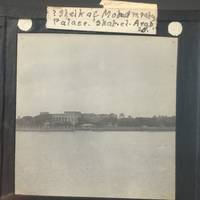
17118Vintage Optical Lantern images of the Persian Gulf circa late 19 cent Glass size is about 3.25" x 3.25" . Vintage Image of the Persian gulf and The Sheik of Mohammerah Palace at Shah-et-Arab. A boat is docked in calm water along the bridge while a spray of palm leaves waves at the edge of a palace. The handwritten label reads "Sheik of Mohammerah Palace. Shah-et-Arab." The Shatt al-Arab also known as Arvand Rud River is a river formed by the confluence of the Euphrates and the Tigris. Mohammerah is city and port presently known as Khorramshahr a city in southwestern Iran. It lies on the right bank of the KÄrÅ«n River where it enters the Shatt al-Arab. The city occupies the site of the old Ê¿AbbÄsid port of Mohammerah but it was already in existence at the time of Alexander the Great. Since In 1847 it was ruled by a sheik known as the Emir of Mohammerah who was chief of the local Banu Ka'b tribe and built a large Palace known as Qasr al-Failiyah in Mohammera with very large arches that can be seen on the image. Very few historical artifacts exist from the times of Shaikh Khaz'al bin JÄbir bin MirdÄw al-Ka'bÄ« 1861-1936. After oil was discovered by the Anglo-Iranian Oil Company BP today in Khuzestan in 1908 Britain at first strengthened its ties to Shaikh Khaz'al. But after W.W.I The British stopped supporting him and in 1924 Mohammerah came under the control of the central government of Iran and was renamed Khorramshahr by Rez Shah of Iran. The cheikh was taken to Tehran and stayed in house arrest until his death in 1936. Out of all the sheikdoms around the gulf Abu Dhabi Dubai Sharjah Ajman Umm Al Quwain and Fujairah he is the only Emir to have lost his sheikdom. The southern end of the river constitutes the border between Iraq and Iran and discharges into the Gulf and has been the cause of multiple wars due to its huge oil reserves including the Iran-Iraq war. Scarce and in very good condition. unknown books
17118Vintage Optical Lantern images of the Persian Gulf circa late 19 cent Glass size is about 3.25" x 3.25" . Vintage Image of the Persian gulf and The Sheik of Mohammerah Palace at Shah-et-Arab. A boat is docked in calm water along the bridge while a spray of palm leaves waves at the edge of a palace. The handwritten label reads "Sheik of Mohammerah Palace. Shah-et-Arab." The Shatt al-Arab also known as Arvand Rud River is a river formed by the confluence of the Euphrates and the Tigris. Mohammerah is city and port presently known as Khorramshahr a city in southwestern Iran. It lies on the right bank of the KÄrÅ«n River where it enters the Shatt al-Arab. The city occupies the site of the old Ê¿AbbÄsid port of Mohammerah but it was already in existence at the time of Alexander the Great. Since In 1847 it was ruled by a sheik known as the Emir of Mohammerah who was chief of the local Banu Ka'b tribe and built a large Palace known as Qasr al-Failiyah in Mohammera with very large arches that can be seen on the image. Very few historical artifacts exist from the times of Shaikh Khaz'al bin JÄbir bin MirdÄw al-Ka'bÄ« 1861-1936. After oil was discovered by the Anglo-Iranian Oil Company BP today in Khuzestan in 1908 Britain at first strengthened its ties to Shaikh Khaz'al. But after WWI The British stopped supporting him and in 1924 Mohammerah came under the control of the central government of Iran and was renamed Khorramshahr by Rez Shah of Iran. The cheikh was taken to Tehran and stayed in house arrest until his death in 1936. Out of all the sheikdoms around the gulf Abu Dhabi Dubai Sharjah Ajman Umm Al Quwain and Fujairah he is the only Emir to have lost his sheikdom. The southern end of the river constitutes the border between Iraq and Iran and discharges into the Gulf and has been the cause of multiple wars due to its huge oil reserves including the Iran-Iraq war. Scarce and in very good condition. unknown
4to. XIX pp., one blank page, 485, (1) pp. With photographic frontispiece, 46 photographic plates (1 of which double-page), 1 folding map of southern Arabia, and several photographic illustrations in the text. Publisher's full cloth with giltstamped title and ornament to spine. First edition. Travel account by the first European to cross the Rub' al-Khali (Empty Quarter) of Arabia from east to west, the Arabist, explorer, writer, and British colonial office intelligence officer St. John Philby (1885-1960), also known by his Arabian name "Sheikh Abdullah". Educated at Trinity College, Cambridge, he studied oriental languages and was a friend and classmate of Jawaharlal Nehru, later prime Minister of India. Philby settled in Jeddah and became famous as an international writer and explorer. He personally mapped on camelback what is now the Saudi-Yemeni border on the Rub' al Khali; in 1932, while searching for the lost city of Ubar, he was the first Westerner to visit and describe the Wabar craters. At this time, Philby also became Ibn Saud's chief adviser in dealing with the British Empire and Western powers. He converted to Islam in 1930. The personal contacts between the United States and Saudi Arabia were largely channeled through the person of Philby. - From the collection of the Dutch traveller and collector Ruud Verkerk. With 2 inserted colour photographs mounted on the plates facing p. 314 and 318, showing Verkerk standing beside rock inscriptions on the old fort at 'Uqla - south face, as well as standing before the Rock fort of 'Uqla, both dated in pencil 18 December 1997. Light damage to head of spine. Paper occasionally foxed and a slightly creased. Overall a good copy. Macro 1801. OCLC 4836861.
Diazoprint map, 111.5 x 75.4 cm. Scale 1:1,000,000. Folded. Highly detailed map of the Arabian Peninsula's coast from Abu Dhabi (Abu Al Abyad island) and Ras al-Khaimah in today's United Arab Emirates to Ras al-Hadd and south to Salala in Dhofar, Oman. The legend identifies wells, towns and villages, wadis, scarps, edges of sand, quicksand, and tracks. Political boundaries are omitted. The latest surveys incorporated are those undertaken by Nick Fallon, Douglas Michael Morton and René Wetzel in the mid- and later 1950s, suggesting that the present map - identified as "TP_773 (Revised)" in the lower left corner but not traced in any institutional collection worldwide - was one of a very small number produced for the internal use of a geological exploration team in the 1960s, when the first discoveries of oil in commercial quantities intensified exploration efforts both in the soon-to-be-independent Trucial States and in Oman. - Light staining and wear; a few minor tears professionally repaired.
8vo (127 x 214 mm). Arabic manuscript on polished paper. 80 ff. Part 2 (of 2). Black and occasional red ink, with catchwords and a few marginal notes in a contemporary hand. 19th century limp red morocco. Rare and important 17th century manuscript of the most famous work of Ibn al-Nafis (1210-88), written at only twenty-nine years of age. Unlike the author's two other commentaries on Ibn Sina's Canon of Medicine, the "Sharh Qurashi" is extremely uncommon. The present part includes his most important contributions to medicine and anatomy: in describing the pulmonary blood circulation, he anticipated by many centuries the works of the 17th century scientists Marcello Malpighi and William Harvey. - Ibn al-Nafis "was the first person to challenge the long-held contention of the Galen School that blood could pass through the cardiac interventricular septum, and in keeping with this he believed that all the blood that reached the left ventricle passed through the lung. He also stated that there must be small communications or pores ('manafidh' in Arabic) between the pulmonary artery and vein" (West, 1877). In his commentary, "pulmonary circulation was described, for the first time, in much detail [...] this circulation was not described by Galen, and only Al-Akhawayni had provided some accurate details about it. He contradicted Galen's reports on the presence of a pathway of 'invisible pores' or a visible hole between the right and left cavities, and stated that blood moves to the lung through vena arteriosa (pulmonary arteries). There, it mixes with air and is filtered, then it moves back to the left cavity via the arteria venosa (pulmonary vein)" (Alghamdi, 1001). Many of al-Nafis's statements remain accurate to medical science today, making this work one of the most groundbreaking of its era. - Morocco binding somewhat rubbed and lightly soiled, with a few small closed tears to extremities. A tiny paper flaw in margin of f. 19 and old paper repair to edge of f. 53. Exterior leaves slightly browned and brittle, with some wear and soiling to edges. A well-preserved and highly unusual survival of a major text in the history of medicine during the Islamic Golden Age. GAL I 493, 37, 7. M. Alghamdi et al., "An Untold Story: The Important Contributions of Muslim Scholars for the Understanding of Human Anatomy", The Anatomical Record 300 (2017), pp. 986-1008. J. B. West, "Ibn al-Nafis, the Pulmonary Circulation, and the Islamic Golden Age", in: Journal of Applied Physiology 105 (2008), pp. 1877-1880.
4to (156 x 225 mm). Arabic manuscript on strong laid paper. 154 pp, 24 lines per extensum, calligraphy in beautiful and fine Maghribi in brown ink, titles in yellow, emphases words are in yellow, red, or green. Bound in late 19th century marbled boards with cloth spine. Uncommon commentary by Ibn Miqlash al-Wahrani on a versification of the "Ajurrumiya", the famously popular outline of Arabic grammar written by Abu 'Abdallah Muhammad ibn Da'ud as-Sanhaji Ibn Ajurrum (d. 723 H / 1323 CE in Safar). A Northern African manuscript from the early 18th century CE, colophon signed by the scribe Muhammad ibn 'Ali ibn Ramadan ibn Isma'il al-Hariri and dated 16 Rajab 1141 AH, "at the time of the noon prayer". - Numerous marginal annotations; modern pencil pagination. Binding rubbed, old stamp to front endpaper, otherwise well preserved. Cf. GAL II, 237ff.
4to (175 x 244 mm). Arabic manuscript on paper. 2 volumes. 117 pp. 68 pp. 27 lines to the page, written in dark brown ink on buff paper, catchwords in red, some diagrams, dated at the end of each book. Modern brown morocco bindings with fore-edge flap. Rare and early manuscript of Ibn Kammuna's principal work, this copy written less than fifty years after the commentary, which made its author famous, was completed in 1268. - Ibn Kammuna, who lived in Baghdad in the 13th century, is considered one of the most important Jewish philosophers after his Andalusian colleague Moses ibn Maimon (Maimonides, d. 1204) and is known to have corresponded with the illustrious polymath Nasir al-Din Tusi (d. 1274). Ibn Kammuna experienced the overthrow of Abbasid power by Mongol troops in 1258. Following this event, many faiths cohabited in Baghdad until the new power converted to Islam. It is at the heart of this multi-confessional society that Ibn Kammûna wrote most of his work. - The "Sharh al-Talwiyyat" constitutes one of the major contributions to the work of Sohrawardi (d. 1191), who had died in Aleppo less than eighty years before the commentary was written. Several texts suggest that Ibn Kammuna would have stayed in Aleppo, around 1250, to collect direct sources from Sohrawardi's students. Thus, Ibn Kammuna played a key role in the dissemination of the thought of Sohrawardi and the illuminative philosophy ("Ishrâq" in Arabic) that he initiated (cf. Henri Corbin, 1945). - Since Corbin's work, the "Sharh al-Talwiyyat" has been the subject of numerous studies seeking to establish a reference edition. Three relevant editions exist: those of S. Mûsawî (2003), H. Ziai and A. Alwishah (2002, dealing only with parts I and II), and of N. Habibi (2009). The three parts of this work are devoted respectively to logic, the natural sciences, and theology. According to the census established by John Lameer, there are only about fifty copies of "Sharh al-Talwihat" by Ibn Kammuna, taking into account the complete and incomplete copies. Our manuscript, dating from 716 H (1316 CE), is said to be the tenth oldest known copy of Ibn Kammuna's Commentary on the work of Suhrawardi. This set of two volumes comprises parts 2 and 3, while the volume on logic is not present. - Ibn Kammuna wrote extensively on theology, philosophy and psychology. His work is based on the knowledge of ancient Greek philosophers, on the study of the writings of Avicenna and Sohrawardi, as well as on the works of Judah Halevi and Maimonides. He is notably the author of "Tanqih al-abhath lil-milal al-thalath" (Critical Study on the Three Monotheistic Religions), and of "al-Jadid fi'l-hikma" (The New Wisdom), a discussion of the philosophy and science of the 13th century. His most significant contribution to the history of philosophy remains his present detailed commentary on Sohrawardi's "Al-Talwihat". Reza Pourjavadi & Sabine Schmidtke, A Jewish Philosopher of Baghdad. 'Izz al-Dawla Ibn Kammuna (d. 683/1284) and His Writings. Leiden and Boston, 2006 (= Islamic Philosophy, Theology and Science. Texts and Studies, vol. 65). Joep Lameer, "Ibn Kammuna's Commentary on Suhrawardi's Talwihat. Three Editions", Journal of Islamic Manuscripts 3 (2012), pp. 154-184.
Large 8vo (146 x 238 mm). Arabic manuscript on polished oriental paper. 865 pp. (paginated in a later hand), 25 lines, per extensum. Black ink with red underlinings and emphases. With numerous diagrams in the text. Contemporary blindstamped full calf, restored and spine rebacked. A rare, complete, and well-preserved late 16th century manuscript of Al-Birjandi's "Sharh al-Tadhkirah", a commentary on the "Tadhkira", the memoir of the Persian polymath at-Tusi (1201-74). As consistent with the Islamic tradition of commentary, Al-Birjandi provides explanations for the reader and provides alternative views while assessing the viewpoints of predecessors. - Abd Ali ibn Muhammad ibn Husayn Birjandi (d. 1528) was a prominent Persian astronomer, mathematician and physicist from Birjand. A pupil of Mansur ibn Muin al-Din al-Kashi, of the Ulugh Beg Observatory, he anticipated notions later developed by Galileo Galilei in the West. - Copied by the scribe Abd al-Wahhab bin Mawlana Baha al-Din. Somewhat browned throughout; some waterstaining to lower half, more pronounced near the end of the volume. The text illustrations show sections, celestial spheres and other astronomical and mathematical diagrams. Old waqf stamp to first leaf. Restored binding uses original cover material.
Large 8vo (170 x 274 mm). Arabic manuscript on polished Indian laid paper. 328 leaves, 19 lines per extensum. Naskh script in black and occasional red ink; a few leaves of commentary loosely inserted. Contemporary full leather, spine rebacked, with oriental medaillon stamps to both covers. Expansive Arabic commentary on the "Qanunchah" ("Qanunceh", "Small Canon") of Mahmud al-Jaghmini, the important Persian medical compendium based on Ibn Sina's famous Arabic "Qanun". Al-Jaghmini's handbook of medicine was widely used at Eastern Persian schools as an introductory medical instruction manual for at least three centuries, but also found favour in India early. "One of the first works of medicine compiled in the Indian subcontinent was 'Sharh ul Qanunchah'. It was authored by Syed Abul Fath bin Syed Ismail al-Husaini al-Lahori during the sixteenth century and was a commentary of the well-known 'Qanunchah' of Chaghmini" (Alam, p. 369). The present manuscript was copied by Muhammad Kayyal (?) in Dhul-Qidah 1198 H. - Frequent, early remarginings to edges; some brownstaining and a few waterstains. Binding rubbed and rather bumped at extremeties. 19th century waqf stamps. A prettily written 18th century manuscript specimen of this important 16th century Indian commentary on a principal medical text. Cf. Mumtaz Alam, "Shift to Arabic? Medical Literature and Writing During Medieval India", in: Proceedings of the Indian History Congress 71 (2010/11), pp. 365-376.
8vo (124 x 192 mm). Arabic manuscript on paper in black (and occasional red) Naskh script. 322 pp., frequently interleaved with extensive comments on later paper, prefixed with 6 ff. (some blank). 13 lines, text enclosed within black and gilt rules, gilt headpiece to first page. Numerous coloured diagrams throughout. Contemporary black calf with fore-edge flap, gilt cover borders and central stamped ornaments. Marbled pastedowns. Illustrated commentary by Qadizade al-Rumi on Al-Jaghmini's famous astronomical treatise "Mulakhas" ("Summary on the Science of the Authority"), completed in 808 AH. Al-Rumi (1364-1436), known under the name of Salah al-Din Musa Pasha, was one of the principal astronomers at the famous Samarkand observatory. - Binding rubbed and chipped along extremeties. A paper flaw to the colophon, repaired with some loss. Some leaves loosed, a few edge defects (more prominent to first leaf) and occasional duststains and fingerstains, but on the whole very well preserved. A valuable copy owned and annotated by Mustafa bin Khalil. Cf. GAL I, 473.
4to (165 x 213 mm). Arabic manuscript on polished oriental paper. 53 pp. on 28 ff. 19 lines, per extensum, written in a Naskhi script in black ink, some words in red, some marginal notes. Contemporary half leather binding over marbled boards with fore-edge flap. A manuscript on Arabic prosody and metrics, forming a commentary on the well-known prosodic manual "Kitab al-'Arud al-Andalusi" by Abu al-Jaysh al-Ansari al-Qisti al-Andalusi (d. 626 H / 1229 CE). - The commentator Al-Qaysari, who flourished in Anatolia in the 14th century CE, both condensed and expanded on the work of Al-Jaysh, with the aim of providing a summary for students as well as adding his own perspective on the study of poetic metre and verse. He dedicated his effort to Emir Süleyman bin Tashun, an important political figure in Anatolia, who had commissioned the book. After a traditional introduction and long foreword, Al-Qaysari's work contains quotations from the original text, which he then juxtaposes with his own opinions. For his commentary, Al-Qaysari also drawn upon the standard works of Al-Khalil ibn Ahmad al-Farahidi (who first systematized the art of Arabic prosody) and Al-Khalil's student Al-Akhfash al-Avsat. - By tradition, Arabic prosody ('Arud) scans poetry not in terms of syllables (as in most Western languages), but in terms of vowelled and unvowelled letters, which are combined into larger units, which in turn make up feet. Sixteen types of metre are distinguished, some very common, others exceedingly rare. - The present copy was written in the early 18th century CE by a scribe who names himself as Ali ibn Muhammad ibn Ali ez-Zuhri es-Shirvani al Madani, a scholar who is known to have resided in Medina all his life. On the recto of the first leaf are a few later pencil notes which erroneously attribute the work's authorship to Al-Madani himself, though the copyist did indeed add several notes of his own supercommentary in the margins. - Binding a little rubbed; hinges chipped and weakened in places, interior very well preserved with minimal staining or smudging. A fine example. GAL I 310, 8 & S I 544, 9. Cf. Joan Maling, The Theory of Classical Arabic Metrics (1973). Ernest N. McCarus, "Identifying the Meters of Arabic Poetry", in: Al-’Arabiyya 16.1/2 (1983), pp. 57-83.
Large 8vo. 2 vols. (2), II, (2), 386 pp. (2), IV, 393, (1) pp. With a folding genealogical plate. Giltstamped half leather over marbled boards; original printed wrappers bound within. Marbled endpapers. Each volume stored in a cloth-covered slipcase. Editio princeps of the text of the "Shajare-i Türk", the principal historical work by Abu al-Ghazi Bahadur (1603-63), Khan of the Uzbek state of Khiva from 1643 until his death. The title is variously translated as "Genealogy of the Turks" and "Genealogy of the Tatars". The book was published in a French translation at Leiden as early as 1726, with additional translations appearing in the later 18th century. The first critical translation was published in Kazan in 1825; a Turkish version (by Vefik Ahmed Pasha) was published at Kazan in 1864. Edited by Jean Jacques Pierre Desmaisons (1807-73), oriental scholar and diplomat in Russian services. Desmaisons studied oriental languages at Kazan and St Petersburg and taught Persian and Arabic at Russian military academies before entering the diplomatic service and being posted to Tehran repeatedly in the 1840s. His present edition includes the text, annotations, and a French translation (the latter of which appeared shortly after his death). - A well-preserved, prettily bound set from the library of the Piedmont collector and self-taught Arabic linguist Luigi Cora (1871-1947) with his bookplate to pastedowns. OCLC 85058877.
8vo. (1), 81, (1) pp. Ottoman Turkish in Arabic type. Modern blindstamped full calf with the Turkish crescent and star to upper cover, and giltstamped spine. Marbled endpapers. First and only early edition. - An exceedingly rare travelogue of the first ever voyage of the Ottoman navy to the American continent, albeit accidental. Thrown off their course to Basra by a storm on the Atlantic near Cape Verde, the two Ottoman warships Bursa and Izmir were dragged in the opposite direction, to Rio de Janeiro. This lively account by the Turkish engineer and naval officer Faik Bey describes all the stages of the corvettes' 13-month journey, their voyage from Istanbul across the Mediterranean Sea to Cadiz, on to the Canary Islands and the Cape Verde Islands, and the fierce storm that brought them to the shores of Brazil, where they laid anchor at the port of Rio de Janeiro before setting sail again two months later. They visited many ports and countries including the Cape of Good Hope, Mauritius, Muscat, Bombay, and Iran, before finally reaching Basra in November 1866. Faik Bey gives a personal account of what must have been an exciting but strenuous journey, while also reflecting on the economic conditions in the Ottoman state and the Islamic world at the time. - Extremely rare; we were not able to trace a single library copy. A second edition was not published until 138 years after the first, in 2006 (Istanbul, Kitabevi). - A second account of this voyage, written by Imam Abdurrahman Efendi, who remained in Brazil for a while before returning to Istanbul, was published in 1871. It only briefly mentions the voyage to South America, instead focussing on the author's time in Brazil and his return journey. - Flaws to upper margins of several pages, rarely touching the text. - An intriguing documentation of an unplanned visit to the New World. TBTK 10454. Özege 17908. Cf. Snowden, Accidental Turks in Brazil and Beyond. Kabacali, Gezi edebiyati seçkisi (2004). Not in OCLC, Weber, or Cox.