4 134 résultats
Large 8vo. V, (1), 308 pp., final blank leaf. Publisher's dark blue cloth with original dustjacket. First edition. - An intriguing account of the misunderstandings and fantasies that persisted between northwestern Europeans and Arabs about the prevailing sexual mores and attitudes toward gender in each other's societies in the 18th, 19th and 20th centuries, discussing, inter alia, Montesquieu, Lady Mary Wortley Montagu, and Voltaire. - In near-mint condition with author's signed presentation inscription: "With all best wishes, Derek". OCLC 42043272.
Double-page woodcut map, fine original hand-colour, with near-contemporary manuscript vignette illustrations of an Ababeel bird, Makkah and Kaaba in pen and wash heightened in gold. 414 x 572 mm. Framed (78 x 56 cm). The first-ever printed woodcut map of the Arabian peninsula, here in original hand colour and adorned with unique, hand-drawn illumination added by a contemporary artist. The map was published in the first atlas printed outside Italy; it was the first atlas to be illustrated with woodcut maps. Remarkably, the hand-drawn vignette illustrations include a depiction of the relief of Makkah, besieged by Abrahah, through the Ababeel birds, who pelted the attacking army of war elephants with burning stones from the pits of the fires of hell. The image shows a gigantic blue-and-gilt Ababeel bird above the city, engulfed in flames - not only one of the earliest depictions of Makkah but also an amazing example of cross-cultural exchange of narratives during the early Renaissance, proving a Western illustrator's familiarity with a Middle Eastern tradition famously referenced in the Qur'an (sura 105, known as al-Fil, The Elephant): "Wa 'arsala 'Aalayhim tayran 'Ababeel, Tarmeehim bihijaratin min sijjeel" ("And He sent against them birds in flocks, Striking them with stones of burning clay"). No other example with these illustrations of Makkah is known, nor are they contained in any printed edition of Ptolemy. Campbell, Earliest Printed Maps, p. 179-210. Schreiber 5032. Tibbetts 8 (p. 37). The Heritage Library, Islamic Treasures, s. v. "Maps". Cf. Heritage Library, Qatar, p. 8f (illustration). Carter, Robert A. Sea of Pearls, p. 21.
Engraved map of the Arabian peninsula, printed (as usual) on two joined folio leaves (together 563 x 396 mm). Framed (79:63 cm). Highly important early map of the Arabian Peninsula and adjoining regions, from the extraordinary 1478 Rome edition of Ptolemy's "Geography", created under the direction of Conrad Swenheym (who apprenticed with Gutenberg). The second map of the Peninsula ever published, in its first state, this is the earliest obtainable printed map of Arabia, preceded only by the less detailed and crudely engraved specimen in the Bologna edition of Ptolemy, which is generally regarded as unobtainable. - The present map is an excellent example of Swenheym's finely engraved map of Arabia, based upon Ptolemy. Among the towns shown are Medina (Lathrippa) and the archaeological sites of Zubarah (Catara) and Al-Dur (Domana). The association of Macoraba with Mecca is disputed. Shirley notes that "[t]he new copper plates engraved at Rome for the 1478 edition of Ptolemy's 'Geography' are much superior in clarity and craftsmanship to those of the Bologna edition. There is evidence that work on the Rome edition had been started in 1473 or 1474, and several of the plates may well have been engraved before those printed [by Taddeo Crivelli] at Bologna in 1477. The printing was carried out by two skilled printers of German origin: Conrad Sweynheym and his successor Arnold Buckinck; the publisher was Domitius Calderinus. Many consider the Rome plates to be the finest Ptolemaic plates produced until Gerard Mercator engraved his classical world atlas of 1578" (p. 3). - Until the 1477 edition was definitively dated, the 1478 edition was believed to be the first printed atlas. Buckinck completed the work started by Sweynheym, whose method of using a printing press for the copperplate maps, together with the fine engraving, produced excellent results. Christopher Colombus owned a copy of this edition, which he annotated. The plates for the 1478 Rome Ptolemy were later purchased by Petrus de Turre in 1490, who published the second, unchanged edition of the map; it was again reprinted in 1507. The editions are identical, although there are different watermarks in the paper (though there is some debate as to whether the watermarks are in fact completely reliable in determining the editions). - Some faint stains along the edges of the paper and in the gutter. In very good condition. Al Ankary 3. Nordenskiöld 201.21. Tibbetts 4. Campbell, Letter Punches: a Little-Known Feature of Early Engraved Maps. Print Quarterly, Volume IV, No. 2, June 1987, pp. 151-154. For the atlas: Shirley, Mapping of the world 4.
5 original black and white photographs. 68 x 44 mm to 104 x 74 mm. On Velox photographic paper. Rare original photos of five aircraft on the runway. Includes one of the few surviving images of the G-ALYU de Havilland Comet - the plane that in May 1952 completed the world's first passenger jet service from London to Johannesburg. Less than two years later G-ALYU was scrapped and its fuselage used for metal fatigue research following the crash of another B.O.A.C. Comet in January 1954. All Comet 1 aircraft were grounded in April 1954. - Among the other depicted aircraft is a Handley Page Hermes IV, registered G-ALDM. The Hermes IV model entered service with B.O.A.C. in 1950, taking over from the Avro York on the West Africa service from London to Accra via Tripoli, Kano and Lagos, with services to Kenya and South Africa commencing before the end of the year. - Pencil annotations to versos. Somewhat warped; slightly toned. Some notable specimens of aviation photography.
Altogether 12 items, various formats. Set of posters and programmes for horse races at Saintes, Marmande, Castillonnès (Lot-et-Garonne), Jonzac, Gémozac, Mirambeau, Mansle (Charente), Valence-d'Agen (Tarn-et-Garonne), Pons et Saujon. - Occasional damage to edges.
4to and oblong 8vo. 4 brochures and a folder, the latter comprising (55) ff. Prospectuses for Aramco benefit plans, briefing the employees on terms and conditions of life insurance, retirement income, social security benefits, a medical payment plan, a savings plan, disability plans, and the compensation plan for expats. The latter includes the photocopy of a typed letter signed by Aramco official W. E. Whitley, inviting an employee to attend a meeting on the compensation plan at the Dhahran training center. - Some margins slightly worn.
8vo. (2), 217, (16) pp., final blank page. With engraved title vignette, 1 folding map of the Arabian Peninsula and 7 engraved folding plates. Later marbled boards. First edition. Scarce Dutch translation of the journals of Henry Middleton (d. 1613) and his lieutenant Nicholas Downton (1561-1615) documenting the sixth voyage undertaken by the East India Company, in 1610-12. The ships landed in Aden before continuing to Al-Mukha (Mocha) in Yemen, where Middleton's ship ran aground and had to be refloated. "After an initially friendly reception, the local ruler changed his tune and imprisoned Middleton and his crew on the pretext of their breaking an embargo against Christian shipping. After spending three weeks as prisoners at Mocha, they were taken inland to Ta'iz and then San'a, where the Pasha explained that the arrival of English ships had been resented by the local Muslim traders. Released in February 1611, Middleton and his crew returned to Mocha and sailed on 9 Aug. 1611 for Surat in India" (Howgego). The illustrations include depictions of an English ship exploding in the harbour, as well Middleton in chains in a Mocha jail. - Published as part of Van der Aa's collection "Naaukeeurige versameling der gedenkwaardigste Zee- en Land-Reysen". Somewhat browned and brownstained throughout; folding map slightly frayed; 2 tears to first plate and 2nd plate respectively; small tear to title-page repaired with old tape. Only 3 copies traceable in auction records since 1931. Howgego I, 719; cf. also p. 320. Catalogue of Printed Books in the British Museum I, 95. Tiele 5. Cat. NHSM I, 107. OCLC 14998184.
12mo. 46, (2) pp. (ads). With full-page maps of Iraq and Baghdad and map of Baghdad amenities area on back cover. Original illustrated wrappers, stapled. First edition. An extremely rare guide to Iraq, produced for members of Paiforce (Persia and Iraq Force). It covers the expected subjects of health, hostels, clubs, sports and tours but also aims to instill a degree of cultural and historical awareness, principally with Seton Lloyd's short history of the country. Lloyd was the curator of the Baghdad Museum at the time, an institution mentioned in the guide as home to "astonishingly beautiful specimens of early Sumerian art, and the whole of Iraq's history ... within well laid out rooms" (p. 23). - Less routine sections highlight Trunk Call (the Paiforce paper) and list Christian churches in Iraq and Bahrain. The advertisements, acting as front and rear endpapers, give a sense of the establishments catering to the troops, including an advert for a shopping centre belonging to the Hasso Brothers, who issued many fascinating photographic postcards of Iraq. - A few small stains to wrappers, a little dusty, otherwise very good. Rare, with no copies in Copac/Jisc or OCLC. We have only been able to trace one example, located at the Imperial War Museum.
Folio (240 x 334 mm). 16 pp.: (193)-208. With 6 halftone photographic and wood-engraved illustrations (one on the upper cover). Well-preserved issue of the Ottoman weekly "Servet-i Fünun" ("Wealth of Knowledge"), an avantgardistic literary weekly that informed readers about European, particularly French, cultural and intellectual movements. The present issue, published in the year work began on the famous Hejaz Railway, is illustrated with two photographs showing the Ottoman construction team at work and posing for the camera. They are depicted celebrating "the ceremony of starting the ground works of the railway lines built towards Hejaz with the support of the Caliph [Sultan Abdülhamid II] under the auspices of Islam in the Muzayrib area" on the Jordanian-Syrian border ("Saye-i Diyanet-Sermaye-i Hazret-i Hilafet-penahi'de canib-i Hicaz magfiret-tiraza fers ve temdid olunan simendüfer hatlarinin Müzeyreb mevki'inde ameliyyat-i turabiyyesine resm-i mübaseret", title-page) and undertaking "the First Excavation Process of the Hejaz Railway" ("Hicaz Demir Yollarinin Ilk Ameliyat-i Türabiyesi", p. 196). - A rare survival that gives evidence of how the greatest building project of the era found space even among the pages of an intellectual magazine largely devoted to elegant fashion and the theory of poetry. OCLC 745305308.
Large 12mo. 106 pp. With woodcut device on title-page. Contemporary wrappers. Arabic edition of Catholic indulgences for penitence, eucharist, and extreme unction. Some worming. OCLC 302419328.
199830686ABZürich, Conzett Verlag, 1998. 4° (quadratisch). (40) Blatt mit zahlreichen Abb. nach Fotografien von Brian Morgan und Barbara Stucki. Aufklappbarer Orig.-Lederband. + Wichtig: Für unsere Kunden in der EU erfolgt der Versand alle 14 Tage verzollt ab Deutschland / Postbank-Konto in Deutschland vorhanden +, A|B [2 Warenabbildungen]
199830686ABZürich, Conzett Verlag, 1998. 4° (quadratisch). (40) Blatt mit zahlreichen Abb. nach Fotografien von Brian Morgan und Barbara Stucki. Aufklappbarer Orig.-Lederband.
199830686AB1998. Zürich Conzett Verlag 1998. 4° quadratisch. 40 Blatt mit zahlreichen Abb. nach Fotografien von Brian Morgan und Barbara Stucki. Aufklappbarer Orig.-Lederband. Serendipity oder einen zufällige Beobachtung. Mit Geschichten und Anekdoten von Golfern. Die Fotografien wurden auf und vom Golf & Country Club Zürich in Zumikon gemacht. unknown
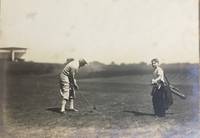
192658065Youngstown OH: n.p. 1926. Oblong folio. 17 x 9.5 in. 13 leaves unnumbered. on thick gray-green textured boards all mounted on linen hinges at gutter margin with 35 tipped-in silver gelatin photographs sized from 4.5 x 9.5 in. up to 6.75 x 14 in. Full green morocco gilt lettering stamped on front cover decorative Italian patterned endpapers minor scuffing & wear to fore-edges very light sunning to front cover still a VG exemplar. This excellent souvenir photo album depicts the golf tourney hosted by the Youngstown Country Club in honor of Campbell’s 1854-1933 72nd birthday in 1926. The opening photo depicts all the participants and dignitaries at the Country Club followed by images of players on the greens. The 18-hole course was built on the 131-acre Holland Farm and designed by Walter Travis featuring a $ 60000 Clubhouse which was noted for elegance and model comfort. These images depict the quintessential 1920’s golfing excursion including those of players the greens the roughs caddies and even an image of what appears to be Walter Travis himself taking a turn on the links. The year before in 1925 the Youngstown Country Club had hosted the 25th Open Championship of the Western Golf Assoc. and legends of the game including Walter Hagen Gene Sarazen and Tommy Armour III all played the course. Campbell was an enthusiastic golfer until his death holding a similar tourney in 1929 on his 75th birthday. He had begun his business career by forming the Youngstown Ice Co. in the summer of 1884 and by 1890 was hired as manager of the Trumbull Iron Co. later consolidated into Union Iron & Steel Co. In 1901 he founded Youngstown Steel and Tube Co. but after a failed merger at the beginning of the Great Depression his health declined. See: Ted Heineman James A. Campbell Riverside Cemetery Journal 2009; History & Golf Outings Youngstown Country Club 2021; James A. Campbell’s 75th Birthday Celebration Youngstown Sheet & Tube Audiovisual Archives YHC MSS 0140 Box 10 Folder 186 n.p., hardcover
187 x 276 mm. With a rosette gilt and in gouache colour. Diacritical marks added later in black ink, vocalization marks in red (as well as one in green and one in blue). 5 lines. Well-preserved leaf in monumental Kufic script (line height c. 30 mm), written in dark brown ink. The text is from the middle part of verse 109 of the second Quran sura. The script style belongs to group D (according to Déroche's classification, subtype D.III). Similar examples are usually dated to the 9th century C.E. (cf. François Déroche, The Abbasid Tradition, London 1992. The Nasser D. Khalili Collection of Islamic Art, Vol. I, nos. 25 [p. 76] and 34/35 [p. 84]). The polychromatic rosette shows an inscribed number: The red dots are vocalisation marks; the diacritics (in the form of small slashes) were added later in black ink. - Some browning and staining. Brittle in places due to ink corrosion (minor defects to vellum). Verso rubbed, but still legible. Cf. Fingernagel (ÖNB 2010), p. 33.
170 x 263 mm. With gilt rosette and numerous gilt floral ornaments between the letters and in the margins. Vocalisation marks (dots) in red. 5 lines. Illuminated leaf from a once-magnificent Quran manuscript with fine gilt flower and leaf illustrations as space fillers and ornamental border around the large Kufic script written in black ink (line height ca. 25-30 mm). The ornamentation mainly consists in leaf designs with the occasional blossom. Illumination of this type is exceedingly rarely encountered among the preserved Abbasid Kufic manuscripts pre-dating the year 1000. The script style belongs to subgroup D.I, according to Déroche's classification. Manuscripts in this style are normally dated to the 9th century CE (cf. François Déroche, The Abbasid Tradition, London 1992. The Nasser D. Khalili Collection of Islamic Art, Vol. I, nos. 19-23, pp. 67-71). The red dots are vocalisation marks: diacritic marks were not used until later. - Some browning and staining. Brittle in places due to ink corrosion (slight loss to individual letters). Verso rubbed, but still legible. Cf. Fingernagel (ÖNB 2010), p. 33.
Large 8vo. XXII, (2), 500, (folding leaf of appendix) pp. With 27 (of 32) plates, mostly folded and coloured. Modern half calf with marbled paper boards. Red morocco label to gilt spine. First edition, very rare. The volume includes seven important historical, archaeological and geographical essays covering Baghdad, the Nahrwan canal and large parts of Kurdistan, the topography of Nineveh and the old course of the River Tigris. Also included are some 30 maps and plates, many in colour, most notably the ground-plan of Baghdad. Felix Jones first saw service on the Palinurus, surveying the northern part of the Red Sea, whilst a later commission found him engaged on the Arabian survey under Haines. In 1839 he surveyed the harbour of Graine (Kuwait) and this led to an almost continuous period of service in Mesopotamia and the Gulf, ending in 1862 as Political Agent in the Persian Gulf, in which capacity he planned the British invasion of Persia. - Lacks the large maps of the Katul es Kesrawi and River Tigris. Labels to spine chipped, spine faded, occasional blue pencil markings between pages 259 & 288, and between pages 364 & 368. Generally text and plates very clean and fresh, map at page 136 torn at fold with no loss. - No pocket is present in the rebinding nor are the 3 maps which the pocket should contain. Paper slightly browned, otherwise in good condition.
8vo. 240 pp. Red-brown cloth with title information in gilt on spine. Red upper edge. First edition of a collection of ten quite rare and otherwise inaccessible articles by the British explorer, scholar and soldier Richard Francis Burton (1821-90), compiled and edited by N. M. Penzer, the author of "An Annotated Bibliography of Sir Richard Burton" (1923). - After the publication of Burton's bibliography, Penzer received numerous requests to publish some of the articles he had mentioned but were hard to find by members of the general public. Norman Mosley Penzer (1892-1960) was a scholar who specialised in Oriental studies and a fellow of the Royal Geographical Society. He wrote several original works, for example on cotton in British West Africa (1920) or the mineral resources of Burma (1922), but he was possibly more famous for the works he edited. According to the Royal Geographical Society, Penzer was an eminent authority on Sir Richard Francis Burton but failed to write the definitive biography, though "it was well within his power to do". Apart from his works on Burton, Penzer also edited other anthropological works and even translated the tale of Nala and Damayanti from Sanskrit in 1926. - Penzer consciously made a small selection of Burton's more obscure papers, in order to give an insight into the varied activities and achievements of the explorer's life. Thus, the contents of the present work vary in subject. Burton's travels in India, Ethiopia, Gabon, Syria, and to Mecca are represented in separate articles. The subjects of other articles are more anthropological in nature, as expected regarding the title, such as the history and significance of scalping in different cultures around the world or spiritualism and religion in Africa and the Middle East. Other than the introduction, in which he explains his reasoning for including certain articles, Penzer only included short preliminary and explanatory remarks at the beginning of each paper and the occasional footnote, while Burton's work remained the focal point of the book. - Slight browning and foxing throughout, with an autograph in blue ink on the first flyleaf. Overall in good condition. Howgego IV, B98. Cf. Shapero, The Islamic World (2003), 158 (another edition).
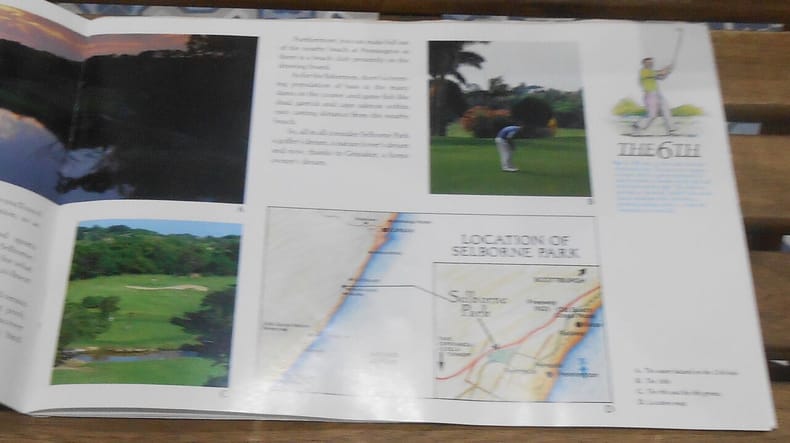
1991100074766Pennington Province de Natal Afrique du Sud. 21 cm x 30 cm. 1991. Agrafé. 12 pages. Pennington Province de Natal Afrique du Sud Grinlaker Construction 1991. Agrafé 21 cm x 30 cm 12 pages photos couleur. Plaquette publicitaire présentant le golf et les pavillons de Selborne Park bien complet de la brochure avec les tarifs et du plain hors-texte. très bon état
4to. XXIII, (1 blank), 199, (1 blank) pp. With the title-page in red and black, 1 map of the Hadhramaut titled: "Seen in the Hadhramaut", and 50 double sided plates. The plates are included in the pagination. Blue cloth with black lettering on front cover and spine. With dust jacket. First edition. A perspective on the Hadhramaut region in Southern Arabia and its people through the eyes and camera lens of traveller, writer, and photographer Freya Stark (1893-1993). Of Italian and British descent, Stark was born in Paris and grew up in several places throughout Europe. Her present account tells the story of Southern Arabia in 130 photographs with corresponding descriptions. - Dust jacket is slightly soiled and very slightly damaged (mostly around head and foot of spine), binding and edges with some slight discoloration and foxing, endleaves partially browned. Blackmer 1470. Howgego IV, S 61. Smith, The Yemens, 98. Sotheby's, Burrell sale, lot 889. Cf. article "Freya Stark" in Encyclopaedia Britannica; Macro 2118 (1939 ed.); Shapero, The Islamic World (2003), 468.
Sm. folio, First Edition, with numerous photographs and facsimiles throughout; maroon cloth, upper board and backstrip lettered in black, marbled endpapers, a very good, bright, clean copy in unclipped dustwrapper, the latter with two or three short closed tears.
20 x 13 inches. Hand-coloured. Fine example of De Jode's modern map of the Middle East, from his Speculum Orbis Terrae, published in Antwerp in 1578 and engraved by Joannes & Lucas van Deutecum. The complete title reads: "Secundae partis Asiae: typus qua oculis subijciuntur itinera nautarum qui Calecutium Indiae mercandorum aromatum caufa fre quentant, ac eorum quoqz qui terrestri itinere ade unt Suacham, Laccam, in domino Praeto Iani, nec non eorum qui Aden et ormum inuifunt, et Balsaram quoque castrum, supra Euphratem fluuium situm, omnia suis gradibus subiecta, cum longitudinis tum latitudinis / Iacobo Castaldo pedemontano authore; Gerhardus de Iode excudebat". As noted in the title, the map was prepared by Gerard De Jode's and is largely identical to Giacomo Gastaldi's highly influential map of 1559. De Jode's delineation of Arabia is vastly superior to the contemporary maps of Ortelius, showing far more accuracy and detail. Extending from the Nile to Afghanistan and centered on the Arabian Peninsula and the Gulf, the map depicts what was then still among the most important trading centers of the commercial world. The present example is from the first edition of De Jode's work, which can be distinguished from the second edition by the pagination on the verso (VII for the 1578 edition; 9 for the 1593 edition). The map is drawn from the rare first edition of De Jode's Speculum Orbis Terrarum. At least one commentator has opined that as few as 11 known examples of the first edition are known to have survived, making separate maps from this first edition very rare on the market. - Giacomo Gastaldi (fl. 1542-1565) is widely considered to be the most important and influential of all of the Lafreri School mapmakers. Born in Piedmont, Gastaldi worked in Venice, where he become Cosmographer to the Venetian Republic. Karrow described him as "one of the most important cartographers of the sixteenth century. He was certainly the greatest Italian mapmaker of his age..." While his achievement is obvious, it is hard to quantify. A large number of maps were published throughout this period with the geography credited to Gastaldi, but it is often difficult to know what role Gastaldi played in their creation. As a practice, he did not sign himself as publisher, although his name may be found in the title, dedication, or text to the reader. Frequently where there is no imprint one may assume that Gastaldi was the publisher. A further clue may be that many of the maps attributable to Gastaldi as publisher seem to have been engraved by Fabius Licinius. In other cases, where publication is credited to another, it is not always certain whether Gastaldi was commissioned by the publisher to compile the map, whether another less-enterprising publisher merely copied his work and attribution, or simply added Gastaldi's name in the title to add authority to the delineation. His name clearly commanded the same sort of respect that the Sanson name had in the last years of the seventeenth century, and as Guillaume de L'Isle's had in the first half of the eighteenth century. Gastaldi's first published map was of Spain, engraved on four sheets, and issued in 1544. The following year he published a map of Sicily, among the most widely copied of all his maps. In the course of a prolific career, Gastaldi subsequently produced a number of maps of Italy, and individual parts of the peninsula, with his general map of Italy, and the map of Piedmont also being very influential. Among the most important of his maps, however, were of areas outside Italy. Principal among these was his map of the World, published in 1546, a four sheet map of the countries of south-eastern Europe, published in 1559, and his series of three maps of the Middle East, Southern Asia, and South-East Asia with the Far East, issued between 1559 and 1561. In 1562, Gastaldi issued a two-sheet map of the Kingdom of Poland, and in 1564, a magnificent eight-sheet map of Africa. Karrow, Mapmakers of the Sixteenth Century, 30/91.2. Tibbetts, Arabia in Early Maps 38.
Ilustraciones.
Large folio (ca. 37 x 57 cm). 1 p. Traces of folds; some slight paper flaws. Austrian revenue stamp (50 kreuzers), dated 1888, affixed to upper left corner. Calligraphic notes in Ottoman Turkish on reverse (ink somewhat oxydized).
Engraved map of the Indian Ocean, Indian subcontinent and most of the Gulf region (28 x 39 cm; margins extended to 50 x 66.5 cm), at a scale of about 1:13,500,000 with north at the foot, with the equator reticulated with longitudes based on a prime meridian through Cape Verde, reticulated scales of latitude in the left and right borders, the Tropic of Cancer not reticulated; 3 sea monsters, a spouting whale and 3 ships in the ocean; and on the land elephants, lions and 2 people on horseback carrying spears. Rare very early engraved map showing the Indian subcontinent, the Strait of Hormuz, the eastern half of the Gulf, and the Indian Ocean, including the islands of Ceylon (Sri Lanka), the Maldives, Seychelles, the western tip of Sumatra and what must be the eastern tip of Somalia. The island Diego Garcia (7° S), labelled "Isole de Don Garzia", touches the southern edge of the map image. The map's own scales indicate that it covers 35°N to 9°S and 60 to 120°E (labelled 85 to 145°E following the Cape Verde prime meridian), but in fact it covers about 60 to 96°E. It is double trapezoidal projection, but tapers only slightly from its widest point at the equator. Many topographic names appear in forms used in early Portuguese accounts of voyages, but most can be identified. In India and Ceylon we find Goa, Mangalor (Mangalore), Cochin (Kochi), Calinapata (Calcutta?), Besinagar (Bangalore), Colmucho (Colombo) and many others; in the Gulf region Cor. Dulfar (Dhofar), the island Macira (Masirah), C. Resalgate (Ras el Had?), Galatia (the ancient site Qalhat), Mazcate (Muscat), the island Quexumo (Qeshm) and Ormus (Hormuz). There is even an unlabelled city close to present-day Abu Dhabi. Two of the ships are labelled with their destinations: Calicut (Kozhikode) on the Malabar Coast and Molucche (the Moluccas) in the East Indies. - Gastaldi first published a similar map as one of a set of three woodcut maps in the first volume of the second edition of Giovanni Battista Ramusio,Navagationi et viaggi, Venice, 1554: the "Prima tavola" shows Africa, the "Seconda tavola" shows the regions in the present map and the "Terza tavola" shows Southeast Asia and the East Indies. These were a great advance on earlier maps, including even Gastaldi's own, taking account of new information from Portuguese explorers. - The woodblocks and whatever copies of the printed edition had not yet been sold were destroyed by a fire in 1557, so for the 1563 edition the publisher had the three maps engraved on copperplates by Niccolo Nelli. Bertelli published the three maps without Ramusio's text, and his maps are usually supposed to have been printed from the 1563 plates, but Karrow describes them as close copies, with his name and the date 1565 added in each map, and Bertelli was an engraver as well as a publisher. Although the first map also has a longer note referring to all three maps, they were probably issued separately as well. Although printed from a single copper plate, the present map image is divided into two parts, with a 7 mm gap between the right and left halves, so that nothing would be lost if the map were bound as a double-page plate. No later state is noted in the literature, so there may have been multiple printings with the unrevised plate. - The present copy is printed on a whole sheet of paper, watermarked: coat of arms (77 x 44 mm) bearing a tree on the central and highest of three hills = --, with about 38.5 mm between chainlines except that the mark is centred on a chainline only 25 mm from the adjacent ones. The tree clearly matches the style of the oak tree in the arms of the family Delle Rovère, including the Popes Sixtus IV and Julius II (who served 1471-1484 and 1503-1513), but their arms does not include the hills. The present mark is very close to Briquet 969 (Lucca 1573-1582) and Zonghi 1737 (Fabriano 1571). Likhachev 3636 (an Italian manuscript f ca. 1570) is not as close. All similar marks noted in the literature date from the period 1569 to 1582, so the present map seems unlikely to have been printed in 1565, but very likely to have been printed ca. 1570 (Bertelli remained active to ca. 1580 or perhaps even later). Bifolco & Ronca lists copies of the 1563 (84a) and the present 1565 (84b) state or edition together, but their separate lists of references suggest the present 1565 version is much rarer. - The margins have been cut down close to the plate edge and in places to the outer edge of the border, and the margins then greatly extended (10-14 cm) with blank paper, but this paper is also contemporary, watermarked: coat of arms bearing a ladder and topped with a 6-point star (90 x 27 mm) = --, similar to Likachev 3524 (Loreto 1564). The map is very slightly browned at the edges (where the pieces of paper used to extend the margins were pasted together) and in the gap between the right and left halves (where the old fold has been reinforced on the back), but the map is otherwise in fine condition. A milestone in the cartography of India and the Gulf States, remarkably well preserved. Bifolco & Ronca, Cartografia topografia Italiana, 84b. Gole, Early printed maps of India, 2. Karrow 30/74.2.