67 résultats
18762080502106504344Shosei shoin 1876. Soft Cover. Fine. Number of books: 3 Shosei shoin paperback
18852090502128300123Not Available 1885. Soft Cover. Fine. The book is in fine condition. Not Available paperback
19162080202102705284Foreign sugar industry 1916. Soft Cover. Fine. Page size: 267 pages Size: A5 size Foreign sugar industry paperback
18842090502128300007Not Available 1884. Soft Cover. Fine. The book is in fine condition. Not Available paperback
19912110502151102797Not Available 1991. Soft Cover. Fine. Number of books: 1 Not Available paperback
19422110502150412071Kijokai Tokyo City 1942. Soft Cover. Fine. Volume: 1 Kijokai (Tokyo City) paperback
19892091502135408424Shanghai Dictionary Publishing House 1989. Soft Cover. Fine. Number of books: 1 Shanghai Dictionary Publishing House paperback
19632090202118205095Kadokawashoten 1963. Soft Cover. Fine. The book is in fine condition. Kadokawashoten paperback
19772081502112100155Not Available 1977. Soft Cover. Fine. The book is in fine condition. Not Available paperback
19762092902137302662Nichido Gallery 1976. Soft Cover. Fine. The book is in fine condition. Nichido Gallery paperback
20122082702114910584Kanagawa Prefectural Museum of History 2012. Soft Cover. Fine. Number of pages: 303 pages Size: 30cm Kanagawa Prefectural Museum of History paperback
19322090502126903495Nobara-sha 1932. Soft Cover. Fine. Size: paperback Nobara-sha paperback
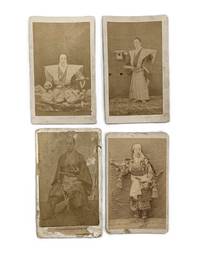
1860231401860. Meiji JapanSamuraiKabuki Theatre Samurai identity in the late 19th century photo archive documenting kabuki depictions of warrior masculinity in Japan during the early Meiji period made after the abolition of the samurai class when images of warriors continued to shape popular understandings of military tradition and masculinity in Japan. These four photographs preserve samurai imagery as presented in popular theatre at a time when Japan's military identity was changing under rapid political transformation. The archive is especially strong for showing how kabuki performance sustained martial ideals in visual form after the social foundations of hereditary warrior status had been dismantled.<br /> Photo archive of 4 albumen carte-de-visite photographs approximately 2.5 x 3.5 inches Japan circa 1860s-1880s. The images show male sitters posed in studio interiors against plain backdrops and atop patterned floor coverings each dressed as a samurai or warrior character. One figure stands in full armor with a sword at his side and a striped staff or bow-like prop in hand his costume built from lamellar armor tassels shin guards and layered protective dress that stress the ceremonial weight of warrior costume. A second sitter tentatively identified as kabuki actor Jitsukawa Enjaku appears seated frontally in voluminous robes with sharply extended shoulder forms flanked by swords and posed on a textile-covered platform in a deliberately formal composition. A third stands holding a small prop structure in one hand with a sword tucked at the waist while a fourth in a more lightly defined but heavily worn image sits in traditional dress with topknot hairstyle and blades visible at the sash. Across the group the repeated use of swords stylized posture and exaggerated makeup grounds the archive in theatrical samurai iconography rather than ordinary portraiture.<br /> These photographs belong to the decades in which photography popular prints and theater recoded samurai visuals as a national historical image rather than a living class identity. Kabuki played a central role in that process preserving warrior narratives and masculine ideals for mass audiences while early commercial photography made those images widely distributable and accessible. For institutions building Japanese photography theater or military history holdings the archive offers direct evidence of how samurai identity was presented popularized and circulated in the first generation of Japanese photography. Heavy fading staining edge wear and mount losses to several cards most notably one with substantial abrasion and corner loss; overall fair to good condition. A group exemplifying the presentation of samurai imagery in popular theatre and photography in Meiji Japan. unknown
TE-57WM-2XXEFine. Fine book & jacket. unknown
18832090502126803273Hakumon Head Office Ginza Tokyo 1883. Soft Cover. Fine. Number of books: 2 Hakumon Head Office (Ginza, Tokyo) paperback
19342091502135415490Dai bun kanshoten 1934. Soft Cover. Fine. Number of books: 1 Dai bun kanshoten paperback
Haugaard, Erik ChristianIn Pristine Condition. unknown
19462091502135410244Shinsei-sha 1946. Soft Cover. Fine. Number of books: 1 Shinsei-sha paperback
18812082402113510423Rairakudo 1881. Soft Cover. Fine. Volume: 1 Rairakudo paperback
20062090502113717829Not Available 2006. Soft Cover. Fine. The book is in fine condition. Not Available paperback
99069701Tokyo 1870 Tohsendoh. Stitched orange wrs. very good 8.5 x 12 cm. 19 double folded leaves 50 pages of steel or copper engraved illustrations two large fold-outs opens to be a double set with 4 illustrations on both sides 8 in all. This work shows the courage & heroism Yamanaka Shikanosuke one of the bravest who served his Shogun Amago in the Sannin district. It was during the 16th century that Yamanaka became a wellknown legend for his bravery. This work outlines his deeds & escapades as a warrior. It shows various scenes in the life and actions of Yamanaka a women who threw off male attackers young people listening to the tales of recited by Yamanaka. Views of his early childhood as he rode a deer while his mother was protected by a monkey. Suppressing the Inoshishi wild boar how he protected his Lord Amago from attackers while traveling in a palanquin as he fends off attackers. His sword duels in full armor protection of unarmed Buddhist priests suppression of animal monsters capture of enemies &c. Fascinating graphic representations of true stories from Japan's rich Samurai past. The theme of courage loyalty and honor is clearly delivered and has become legendary. Expertly executed etchings drawn by Bai-Doh Kunimasa. FORMAT: The book is a very small size easily put in the pocket. The kind of a book people carried around and read. Nicely done profusely illustrated work capturing the imagination of the reader. BIBLIOGRAPHY: Not in Kerlen. . unknown
19362080502106511289Toyama bo 1936. Soft Cover. Fine. Volume: 1 Toyama bo paperback
19372080502106511583Toyama bo 1937. Soft Cover. Fine. Volume: 1 Toyama bo paperback
20032080202102500812Shinkosho Co. Ltd. Campus 2003. Soft Cover. Fine. The book is in fine condition. Shinkosho Co., Ltd. Campus paperback
18782090502128301145Not Available 1878. Soft Cover. Fine. The book is in fine condition. Not Available paperback