67 résultats
18842080302106807452Chichizando 1884. Soft Cover. Fine. The book is in fine condition. Chichizando paperback
19842110502150201280Mimiya Bookstore 1984. Soft Cover. Fine. Volume: 1 Mimiya Bookstore paperback
19832091202133001681Fortress Society 1983. Soft Cover. Fine. Number of books: 1 Fortress Society paperback
19822092902138303423Kashiwashobo 1982. Soft Cover. Fine. Number of pages: 135p Size: 22cm Kashiwashobo paperback
18822090502128300069Not Available 1882. Soft Cover. Fine. The book is in fine condition. Not Available paperback
19672090502113714443Not Available 1967. Soft Cover. Fine. The book is in fine condition. Not Available paperback
19952090202118102930Kashiwashobo 1995. Soft Cover. Fine. The book is in fine condition. Kashiwashobo paperback
19632091502135419403Not Available 1963. Soft Cover. Fine. Number of books: 1 Not Available paperback
2110502150414125Not Available N.A. Soft Cover. Fine. Volume: 1 Not Available paperback
18822080302106807364Ryuundo Temple Osaka Prefecture 1882. Soft Cover. Fine. Number of books: 4 Ryuundo Temple, Osaka Prefecture paperback
19292110502150414177Japan Broadcasting Corporation Tokai Branch Nagoya City 1929. Soft Cover. Fine. Volume: 1 Japan Broadcasting Corporation Tokai Branch (Nagoya City) paperback
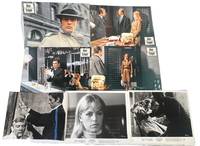
1967197201967. Film Alain Delon in Le Samourai aka The Godson in the US directed by Jean-Pierre Melville. Archive of 7 original vintage lobby cards. Artists International 1967 and 1972. All are about 8" x 11". Three are silver gelatin photogaphs in black and white four are in color. Le Samourai is a noir crime film about the intersecting paths of a professional hitman trying to find out who hired him for a job and then tried to have him killed and the Parisian commissaire trying to catch him. It was a massive success in France selling 1.9 million tickets which led to an English dubbed version released in the US in 1972. With aesthetic emphasis placed on being "cool" the film is seen as a direct ancestor to films like No Country for Old Men Road to Perdition and Pulp Fiction. Photos feature action sequences and close ups of stars Delon Nathalie Delon and Francois Perier. Two have the US title as well as production information in lower white margin. Four color images have the German title with actor and directors names in corners. Roger Ebert gave the film four out of four stars writing: "Like a painter or a musician a filmmaker can suggest complete mastery with just a few strokes. Jean-Pierre Melville involves us in the spell of Le Samourai 1967 before a word is spoken. He does it with light: a cold light like dawn on an ugly day. And color: grays and blues. And actions that speak in place of words." Scarce and in very good condition. unknown
18892110502150412978Not Available 1889. Soft Cover. Fine. Number of books: 3 copies Not Available paperback
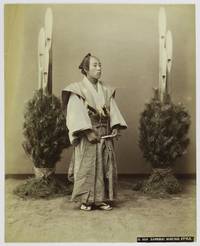
73414Japan ca. 1890. Albumen print 26.5 x 21.2 cm with additional colouring. = A nice large photo captioned B 1159 Samurai Waking Style. This photograph shows a studio portrait of a samurai full-length standing between two potted conifers and bamboo. Samurai were the hereditary military nobility and officer caste of medieval and early-modern Japan from the 12th century to their abolition in the 1870s. They were the well-paid retainers of the daimyo the great feudal landholders. They had high prestige and special privileges such as wearing two swords. They cultivated the bushido codes of martial virtues indifference to pain and unflinching loyalty engaging in many local battles. During the peaceful Edo era 1603 to 1868 they became the stewards and chamberlains of the daimyo estates gaining managerial experience and education. In the 1870s they were 5% of the population. The Meiji Revolution ended their feudal roles and they moved into professional and entrepreneurial roles. Their memory and weaponry remain prominent in Japanese popular culture. Wikipedia. The word waking is peculiar perhaps watching or warding is meant. The same photo framed is according to their website present in the Library of Congress. Weak pencilled annotation on verso. Mildly creased more so towards the margins; print strong. A very attractive item. unknown
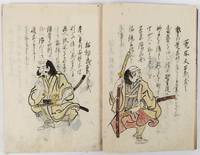
218340Japan. No date. Late Edo. Seven attractive colour manuscript ink and watercolour images 23.5 x 17cm 55 double-folded leaves 4-hole string binding paper title label upper cover. A little occasional worming contents paper on card covers insect damaged particularly on lower cover. This manuscript likely made in the late Edo period is a collection of samurai tales of revenge loyalty and self-sacrifice. The first story features Watanabe Kazuma 渡邊数馬 who avenged his brother Gentaro's death by pursuing and killing Kawai Matagorō. The book includes manuscript colour illustrations of the seven main figures involved in this vendetta—a story widely revered as a testament to loyalty and tenacity often portrayed in stage performances for the public. <br><br>Another account in the collection details Ikeda Tsuneoki also known as Shōnyū and his son who perished in the Battle of Nagakute near Nagoya. . unknown
1820305224Edo 1820. 200 woodblock illustrations of crests some light soiling to margins. 208 pp. small oblong 8vo 110 x 155 mm. blue paper wrappers worn stitched. 200 woodblock illustrations of crests some light soiling to margins. 208 pp. small oblong 8vo 110 x 155 mm. Japanese woodcut book on the crests and symbols of the Samurai families.<br /> <br /> WITH: <br /> A series of 99 small manuscript information cards on for ceremonial use for Samurai families denoting their crests and banners pen ink and colors. First half of 19th century each card 70 x 55 mm some affected by worm tracks. unknown
1800305220Nara 1800. 152 woodcut illustrations some double-page across several bifolia on mulberry paper. Folio 380 x260 mm. With a small stain on the opening pages thicker paper covers slightly soiled the upper cover with a few worm holes not affecting illustrations. upper cover title label not present. Stitched. Ownership chop of Sato Takekicho. 152 woodcut illustrations some double-page across several bifolia on mulberry paper. Folio 380 x260 mm. Woodcut book of the samurai armor at the Kasaga Shrine Nara Prefecture <br /> <br /> "A fine illustrated text on an important collection of ancient samurai armor. The Kasaga shrine in Nara was the shrine of the Fujiwara family first built in 768 and rebuilt several times over the centuries and is now one of the more important in Japan and a Unesco World Heritage Site. The family armor which came to be placed in the Shrine includes pieces dating from the 12th century such as a special helmet with a sparrow motif said to have been dedicated by Minamoto no Yokishitsune dating form the Kamakura period 1185. The shrine is famous for its bronze lanterns. unknown