234 résultats
18603052211860. 37 pen and ink illustrations of techniques of horse breaking. On rice paper. 8vo 240 x 170 mm. Wrappers in thicker paper with title labels covers slightly soiled and occasionally affected by worm holes some spreading through the text. 37 pen and ink illustrations of techniques of horse breaking. On rice paper. 8vo 240 x 170 mm. A fine mid 19th century Samurai text on horse-riding by Hiko. The Otsubo school of samurai training originated in the 7th century and was popularized in the 12th century when the elite Samurai warriors rode into battle. By 1600 under the comparitive peace of the Toguwara Era the military practice of Military equestrianism was discouraged and often became more of a ceremonial practice amongst the Samurai clans. This late manuscript text just predates the final extinguishing of the Samurai clans by the Meiji Emperor. unknown books
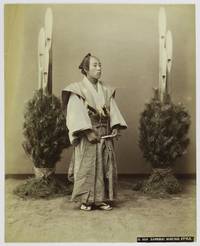
73414Japan ca. 1890. Albumen print 26.5 x 21.2 cm with additional colouring. = A nice large photo captioned B 1159 Samurai Waking Style. This photograph shows a studio portrait of a samurai full-length standing between two potted conifers and bamboo. Samurai were the hereditary military nobility and officer caste of medieval and early-modern Japan from the 12th century to their abolition in the 1870s. They were the well-paid retainers of the daimyo the great feudal landholders. They had high prestige and special privileges such as wearing two swords. They cultivated the bushido codes of martial virtues indifference to pain and unflinching loyalty engaging in many local battles. During the peaceful Edo era 1603 to 1868 they became the stewards and chamberlains of the daimyo estates gaining managerial experience and education. In the 1870s they were 5% of the population. The Meiji Revolution ended their feudal roles and they moved into professional and entrepreneurial roles. Their memory and weaponry remain prominent in Japanese popular culture. Wikipedia. The word waking is peculiar perhaps watching or warding is meant. The same photo framed is according to their website present in the Library of Congress. Weak pencilled annotation on verso. Mildly creased more so towards the margins; print strong. A very attractive item. unknown
19162080202102705284Foreign sugar industry 1916. Soft Cover. Fine. Page size: 267 pages Size: A5 size Foreign sugar industry paperback
20032080202102500812Shinkosho Co. Ltd. Campus 2003. Soft Cover. Fine. The book is in fine condition. Shinkosho Co., Ltd. Campus paperback
19912110502151102797Not Available 1991. Soft Cover. Fine. Number of books: 1 Not Available paperback
Features: Treasures Unearthed; Joe Turner; John Mackiewicz; Creating the Toymaker's personal space; A Mexican Fiesta and a Samurai Surprise; Show Report; Lingerie Shop; Carnival of Fun; Medieval Chest; English Cottage IV; Adding Built-ins - luxurious bath; The 3 Little Pigs; and more. Clean and unmarked with light wear. A sound copy. Magazine
2003259654Sankt Augustin, Brandenburgisches Verlagshaus, 2003.
2003262129Sankt Augustin, Brandenburgisches Verlagshaus, 2003.
2003209204Sankt Augustin, Brandenburgisches Verlagshaus, 2003.
18812082402113510423Rairakudo 1881. Soft Cover. Fine. Volume: 1 Rairakudo paperback
18822111902160200608Hiro-rei-sha 1882. Soft Cover. Fine. Number of pages: 114 pages Size: 18.5cmx12.5cm Number of books: 1 Hiro-rei-sha paperback
19462091502135410244Shinsei-sha 1946. Soft Cover. Fine. Number of books: 1 Shinsei-sha paperback
19962091502135405582Chinese Medicine Publishing House 1996. Soft Cover. Fine. Number of books: 1 Chinese Medicine Publishing House paperback
178 pages including bibliography and colour plates. A series of picaresque adventures set against the backdrop of a Japan still closed off from the rest of the world. "...Opens a wonderful window into the real-life conditions of a down-at-the-heels lower-middle level samurai." - Susan Matisoff. Average wear. Moderate lean to spine. Decent copy with usual library markings. Book
198447975ABMünchen, Droemer Knaur, 1984. 23 cm, 1181 Seiten, schwarzes Leinen, geprägter Rückentitel und Deckelvignette, Original-Schutzumschlag. 1. - 100. Tsd. leichtw Gebrauchsspuren, gut erhalten.
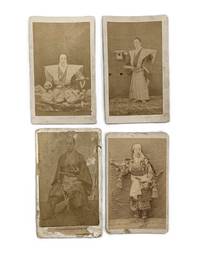
1860231401860. Meiji JapanSamuraiKabuki Theatre Samurai identity in the late 19th century photo archive documenting kabuki depictions of warrior masculinity in Japan during the early Meiji period made after the abolition of the samurai class when images of warriors continued to shape popular understandings of military tradition and masculinity in Japan. These four photographs preserve samurai imagery as presented in popular theatre at a time when Japan's military identity was changing under rapid political transformation. The archive is especially strong for showing how kabuki performance sustained martial ideals in visual form after the social foundations of hereditary warrior status had been dismantled.<br /> Photo archive of 4 albumen carte-de-visite photographs approximately 2.5 x 3.5 inches Japan circa 1860s-1880s. The images show male sitters posed in studio interiors against plain backdrops and atop patterned floor coverings each dressed as a samurai or warrior character. One figure stands in full armor with a sword at his side and a striped staff or bow-like prop in hand his costume built from lamellar armor tassels shin guards and layered protective dress that stress the ceremonial weight of warrior costume. A second sitter tentatively identified as kabuki actor Jitsukawa Enjaku appears seated frontally in voluminous robes with sharply extended shoulder forms flanked by swords and posed on a textile-covered platform in a deliberately formal composition. A third stands holding a small prop structure in one hand with a sword tucked at the waist while a fourth in a more lightly defined but heavily worn image sits in traditional dress with topknot hairstyle and blades visible at the sash. Across the group the repeated use of swords stylized posture and exaggerated makeup grounds the archive in theatrical samurai iconography rather than ordinary portraiture.<br /> These photographs belong to the decades in which photography popular prints and theater recoded samurai visuals as a national historical image rather than a living class identity. Kabuki played a central role in that process preserving warrior narratives and masculine ideals for mass audiences while early commercial photography made those images widely distributable and accessible. For institutions building Japanese photography theater or military history holdings the archive offers direct evidence of how samurai identity was presented popularized and circulated in the first generation of Japanese photography. Heavy fading staining edge wear and mount losses to several cards most notably one with substantial abrasion and corner loss; overall fair to good condition. A group exemplifying the presentation of samurai imagery in popular theatre and photography in Meiji Japan. unknown
19712090502113717998Not Available 1971. Soft Cover. Fine. The book is in fine condition. Not Available paperback
br. Lo zen, il ramo del buddhismo che sottolinea maggiormente la disciplina meditativa, fu anche la filosofia di vita scelta dai samurai, la classe militare giapponese che assunse il potere nel 1600, mantenendo pieno controllo del paese fino alla restaurazione (1867). In che modo una filosofia serena e contemplativa poté rispondere alle esigenze del samurai aiutandolo a perfezionare le capacità marziali e schermando la sua mente dalla naturale paura della morte? L'autore esamina in dettaglio la disciplina e l'esperienza zen, soffusa di elementi taoisti, e la sua diffusione in Giappone, dapprima come scuola minore e poi come religione appropriata al guerriero. Quindi passa ad analizzare la figura del guerriero giapponese, il bushi, spiegandone in dettaglio condizione sociale, costumi, principi morali e loro evoluzione nel corso della storia giapponese. Un'attenzione particolare è dedicata agli stili di combattimento e alle armi, soprattutto la spada, 'anima del samurai'. Riallacciandosi alla storia moderna, King prende in esame l'eredità dei samurai e il risorgere dei loro valori durante l'espansione del Giappone in Asia e la seconda guerra mondiale. Gli stessi valori sono alla base della struttura stessa della società giapponese odierna, e ben evidenti negli ambienti di lavoro, nella scuola e nella famiglia.
2080202103705079Kashiwashobo N.A. Soft Cover. Fine. Page size: 128p Size: 22cm A5 Kashiwashobo paperback
ASIE512M2009, Budo Editions. In-8, relié, cartonnage sous jaquette illustrée, 191 pages. Riche iconographie couleurs. Très bon exemplaire
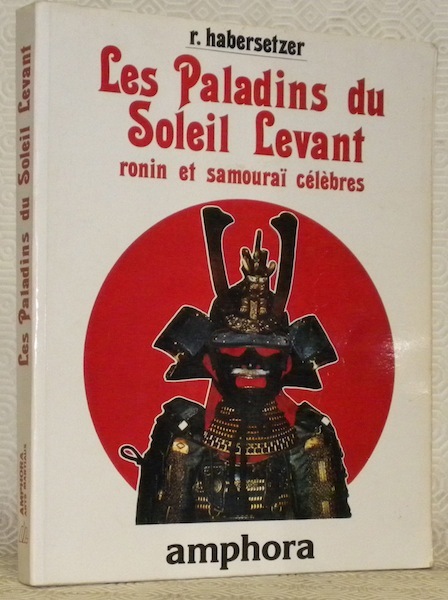
1988GITc324Paris Editions amphora 1988. Grand in-8 broché couverture illustrée 263pp imprimées sur 2 colonnes. Nombreuses illustrations dans le texte, à pleine page, hors texte, en noir et en couleurs. Bel exemplaire.
71015Paris, Editions Amphora s.a. 1988, 270x210mm, 263pages, broché. Bon état.
200811362Gremese Editore 2008 208 pages 23 8x2 2x15 8cm. 2008. Relié. 208 pages. Cet ouvrage étudie l'histoire et la culture des samouraïs guerriers d'élite japonais en analysant leur entraînement leur armement leurs stratégies militaires et leur philosophie du Bushido. Il couvre leur évolution depuis les premiers colons jusqu'à leur abolition au XIXe siècle décrivant tous les aspects de leur vie et de leur code d'honneur exigeant une loyauté absolue envers leur maître
2002110449Dreamland éditeur, coll. « CinéPulp », n° 2 2002 In-8 broché 21 cm sur 15,5. 135 pages. Bon état d’occasion.
197220254Balland, 1972, in-8°, 387 pp, 56 pl. de gravures et photos hors texte, annexe (périodes historiques du Japon), biblio, reliure skivertex éditeur