Collectif.Livre Rare Book
24 439 résultats
110776Lausanne, Edita 1953, 320x240mm, 225pages, broché. Bords de la couverture inférieure ainssi que les 4 derniers feuillets endomagés, autrement bon état.
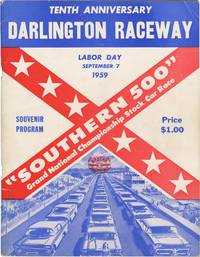
1959167807N.p.: N.p. 1959. Vintage program and archive of assorted ephemera from the 1959 Southern 500 held at the Darlington Raceway in Darlington South Carolina on September 7 1959. An enthusiastic spectator's archive of the marquee NASCAR event held at NASCAR's "oldest superspeedway race" during its Tenth Anniversary which has since become a Labor Day institution in the South.<br /> <br /> The substantial archive of ephemera from the 1959 Southern 500 includes: The 88 page Souvenir Program. A tri-fold ticket order form mailer for the Rebel 300 and the Southern 500 with grandstand map. A ticket stub from the event. A flyer of the "Race Qualifiers" on the recto with the "Starting Order Of Cars" on the verso with an attached newspaper clipping of the event's winners. A souvenir Confederate flag with "Southern 500" printed on one side. A jumbo color post-card of the then-named Darlington International Raceway viewed from above. A color post-card and four 3.5 inch vernacular black and white photographs of the Bennettsville Motel and Brandin' Iron Restaurant where the compiler of the material appears to have stayed for the event. And a dozen contemporary newspaper clippings from before and after the event.<br /> <br /> The 1959 Southern 500 was the tenth running of the race held at the then-named Darlington International Raceway on September 7. A legendary NASCAR racetrack and one of NASCAR's Crown Jewels Darlington has been nicknamed as "The Lady in Black" and "The Track Too Tough To Tame" by NASCAR enthusiasts because of it's long unique somewhat egg-shaped course with uniquely different banks at the track's first two turns from the track's last two turns giving the track a storied reputation for being unforgiving and unpredictable.<br /> <br /> The race lasted for four hours and twenty-eight minutes with Jim Reed defeating Bob Burdick by more than two laps in a 1959 Chevrolet Impala and featured Richard Petty who finished fourth and Buddy Baker's first superspeedway experience. Scenes from the race were used in the 1960 film "Thunder in Carolina" directed by Paul Helmick and starring Rory Calhoun and Alan Hale Jr.<br /> <br /> Program. 8.5 x 11 inches side-stapled. Near Fine overall.<br /> <br /> Additional materials Very Good plus to Near Fine overall. N.p. unknown
195562224Salem OR: Traffic Engineering Division Planning Survey Section Oregon State Highway Commission June 1955. Oblong folio. 15.5 x 11 in. 151 1 pp. With maps colour maps diagrams 5 colour mylar overlays civil highway engineering elevation drawings tables charts. Original tan softcovers plastic-comb binding as issued wear bumping creasing to text block some soiling & tidemark to back cover edgewear front cover retained and affixed w/ paper tape repair still a good reference copy from the library of A. Rodney Eckerson 1930-2024 former purchasing agent for the Port of Portland. First edition of this groundbreaking highway engineering urban planning and “blight†redevelopment plan released the year before funding began flowing to underwrite 90% of the eventual 42500 mile interstate freeway “Expressway†system. Oregon leaders had contracted with New York urban planner Robert Moses†in 1943 to develop a public works program and highway building plan for the state which included a series of core recommendations reflected in this later 1955 Traffic Engineering Technical Report prepared by Baldock & Williams who pitched in the report that Portland be carved up by a series of freeways and cleared of blighted urban neighborhoods. The Banfield Freeway which later became I-84 through East Portland was completed first in 1958 and largely was built over the remnants of a vast shanty town in Sullivan Gulch but the construction of I-5 through North Portland began in earnest in 1962 directly demolishing 300 homes and bisecting the African-American Lower Albina neighborhood which at the time was the heart of the city’s only majority black neighborhood. The original colour mylar overlays depict the projected growth of the city and the increasing demand for roads as the interurban and electric railway system was either decommissioned or condemned and automobiles were the focus of transport into and around the city. Also included here is the proposed route for the Mount Hood Freeway which was to run through East Portland all the way to Mt. Hood and by 1969 had received the necessary funding but by then considerable residential backlash had built primarily due to the fact that the proposed Stadium Freeway I-405 ended up bisecting and leveling the former neighborhoods North & West of downtown Portland near Goose Hollow increasing removal of houses in North Portland along the I-5 construction was particularly bitter and the introduction of the early plans for I-205 set off a revolt in Lake Oswego that would have as planned divided the community separating the schools from their community. Eventually after the election of Mayor Neil Goldschmidt the Mount Hood Freeway project would finally be canceled and the Federal money poured into mass transit projects. Although 11 copies are located in Worldcat privately owned copies for sale in the trade are quite scarce; See: Val Ballestrem “In the Shadow of a Concrete Forest:†Transportation Politics in Portland Oregon and the Revolt Against the Mount Hood Freeway 1955-1976 2009; Cortright How a Freeway Destroyed a Neighborhood and May Again 2019; Raymond Mohl The Interstates and the Cities: Highways Housing and the Freeway Revolt 2002. Traffic Engineering Division, Planning Survey Section, Oregon State Highway Commission, paperback
192862600Ottawa ONT: Natural Resources Intelligence Service 1928-1929. Four large folding colour maps. atlas folio w/ largest sized 45 x 35 in. w/ each sheet including an index map indicating there are 4 in total with outlines fold creases as issued minor age toning to fore-edges a few minor closed tears at fold creases still a VG set of maps. Early printing of this four sheet map depicting the automobile roads connecting Canada and the United States during the 1920’s as the Good Roads Movement rapidly expanded through the Northern Country following World War I. These maps depict the burgeoning highway and national road system which had been fostered by urban centers attempting to convince rural municipalities to replace their seasonal dirt roads with those of gravel or crushed stone and facilitate much greater movement of agricultural and manufacturing products across the continent and with the U.S. The Atlantic map stretches from the maritime provinces down to Washington D.C. and over to Niagara Falls and Buffalo NY; The Middle West map documents the main automobile roads and highways from Port Albert to Port Arthur and South from Denver to St. Louis indicating provincial federal and state roads and highways; The Great Lakes section tracks the extensive network of roads and highways surrounding the Great Lakes including those in Iowa Kentucky Wisconsin New York and the Canadian provinces of Quebec and Ontario; while the Pacific Map records the highways from San Francisco to Denver and up through Alberta and over to British Columbia. Uncommon with all four maps present. See: J.I. Little Confronting Rural Localism: The Good Roads Movement in Quebec’s Eastern Townships 1897-1920 Social History/Histoire sociale Vol. 57 No. 117 May 2024. Natural Resources Intelligence Service, unknown
193961858Saugatuck CT: The Eno Foundation for Highway Traffic Control Inc. Yale University 1939. 4to. 7.5 x 9.4 in. xi 1 293 1 pp. With several diagrams street plans colour facsimiles of driving rules and street regulations designed by the author. Black publisher’s cloth white lettering red sigil front cover for the Eno Foundation white lettering on spine minor shelfwear very minor rubbing w/ d.j. title & Eno Foundation sigil repeated on front cover Roundabout street plan for the Champs Elysees drawn 1912 approved 1913 and installed later after World War I in 1927 minor chipping & tears small tear upper fore-edge back cover darkening to spine still a VG/VG- copy. First edition 1 of 2500 copies printed of this seminal work detailing the author’s pioneering efforts of introducing traffic controls and street flow regulations beginning during the Progressive Era in 1899. Although Eno 1858-1945 had personally experienced his first New York traffic jam in 1867 it was missing the opening of the New York Metropolitan in 1899 that turned him to devote all his efforts to Good Roads engineering and traffic regulation and away from real estate. This volume includes his pioneering “Rules of the Road†which suggested speed limits right-of-way laws slowing and stopping signals and that vehicles should stay to one side and in 1902 New York adopted the rules creating their “Apollo Squad†traffic police. As the Progressive Era “Good Roads†movement launched largely by bicyclists and further propelled by automobiles in the Brass Era traffic flow planning patterns and regulations were also considered and adopted by governments in London Paris Berlin Rome and others consulted from as far as Australia and Japan. In addition during both World Wars he developed the military traffic control codes used overseas and in 1901 incorporated the Eno Foundation for Highway Traffic Control along with inventing the stop sign marked pedestrian crosswalks taxi stands and pedestrian safety islands. Of interest is that Eno never learned to drive. See: William Phelps Eno Institute of Transportation Engineers 2024; Karen Karabell William Phelps Eno My Hero Cycling Savvy Feb. 14 2018; The Life of Eno Eno Center for Transportation 2024. The Eno Foundation for Highway Traffic Control, Inc., [Yale University] hardcover
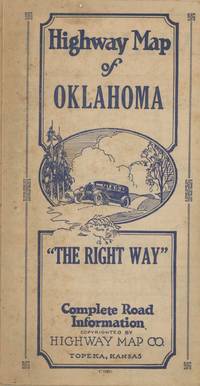
1930List2430Topeka 1930. Folded map measuring 28 x 17 inches. Some small tears at folds very good. Very Good. A scarce depression-era map of Oklahoma with graphic advertisements to the verso showing the range of automobile-centric establishments in the state at the time. The map shows all the automobile routes of the time with text along the borders listing the towns and the telephone numbers of various services and lodging options. The instructions on the the top read “Put Out Your Fires / Leave a Clean Camp / Keep the Streams Pure / Don’t Be a Road Hog.†According to the single copy in OCLC at the Denver Public Library the map was printed in 1930 though we see no date on the map itself. The depression hit Oklahoma following the drought in 1930 which also coincided with the opening of the East Texas oil field. This map is a relic of the period just before the state’s economic downturn with the early automobile infrastructure still intact and vibrant. unknown
195714447np ca. 1957-1958. Hardcover. Very good. 4to. Black three-ring binder with illustrated title label to front containing 17 loosely plastic covered paper leaves profusely filled both recto and verso with black and white photographs and materials on the English Ford line of automobiles. More than 35 various scrap and ephemera elements in all. Front cover moderately worn discolored. Some wrinkling and warping internally. Overall very good. <br/><br/>Fascinating salesman's catalogue produced by British Ford marketing their cars to American dealerships. Struggling financially Post-WWII Britain enacted an "Export or Die" mandate for its domestic carmakers in hopes of injecting more stable currencies into its economy. This act mandated aggressive sales in foreign markets and especially in The United States. Ford of Britain had operated as a subsidiary of the Ford Motor Company since 1909 producing an entirely different line from its American division. Since it was indeed a British car manufacturer Ford was forced compete with itself. These materials date from a 1957-1958 push aimed at getting existing U.S. Ford dealerships to sell and service the cars of their English counterpart. Included are specification sheets and sample advertisements for the various models: 10 approximately 8" x 10" black and white promotional photographs a body color chart with paint samples dealer pricing and cost sheets with option breakdowns and import costs analysis charts comparing the Anglia and Prefect that's right the Ford Prefect with comparable and competing European imports blank sales forms a service policy paint mixing formulas and a list of the financial spatial and service requirements of potential dealers. The modest sales of English Ford passenger cars in the U.S. peaked in 1958-1959 at approximately 75000 compared with an estimated 1.5 million units sold by Ford USA in 1957 alone. Numbers limped along through the 1960's with the last model The Cortina discontinued in 1971. A rare surviving source from an unusual chapter in American and British automotive history as well as a uncommon example of marketing and trade automobiliana. hardcover books
1988151333N.p.: N.p. 1988. Archive of 120 vernacular borderless color snapshot photographs of the Detroit Grand Prix taken in 1986 1987 and 1988.<br/><br/>In the summer of 1982 the US became the first country to host three World Championship Grands Prix in one season with the older Grand Prix West races in Long Beach and Las Vegas joined by the newly established Detroit Grand Prix in Michigan near the General Motors headquarters. The Detroit race continued to be held annually for the next six years in spite of its growing reputation for its narrow bumpy track a result of the race taking place on a closed street course in downtown Detroit and typically hot humid weather. These factors would ultimately push FISA to declare the track unsafe ending the circuit's affiliation with Formula One in 1988 to be replaced by the CART-sanctioned Detroit Indy Grand Prix the following year. <br/><br/>The photographs in the archive document an attendee's perspective of the races from 1986-1988 won all three years by Brazilian champion driver Ayrton Senna. The photographs are taken from both the main grandstand and the garages with views of the vibrant car designs downtown cityscape and track layout on full display. An uncommonly thorough look at three successive years in the race's history more broadly capturing the end result of Formula One's attempts to expand internationally throughout the decade.<br/><br/>Photographs 5.25 x 3.5 inches housed in three separate envelopes grouping the photographs by year 1986 1987 and 1988. Photographs and envelopes generally Near Fine. N.p. unknown books
1950151268N.p.: N.p. 1950. Archive of 13 vintage single-weight vernacular photographs and 1 vintage double-weight vernacular photograph of open-wheel racing events held at the Iowa State Fair in Des Moines circa 1950s. <br/><br/>The photographs in the archive show close-ups shots of races at the Iowa State Fairgrounds' original half-mile dirt track with the idiosyncratic vehicle designs and paint schemes of the era on full display. Also included in the archive are several photographs of the Bardahl Special #2 "The Black Deuce" a champion racing car owned by noted car collector Hector Honore Jr. with the car's second driver Bobby Grim behind the wheel. <br/><br/>Open-wheel racing was first sanctioned in the US by the AAA Contest Board who introduced the first track season national championship in 1905. The sport grew in popularity after World War II attributable in large part to the rapid innovations in auto engineering and design throughout the 1950s. In the ensuing decade the rise of the Chevy V8 would quickly render prewar four-cylinder and flathead engines obsolete making the photographs in the archive a valuable record of early race car construction and use. <br/><br/>Photographs generally Very Good plus lightly and evenly faded. N.p. unknown books
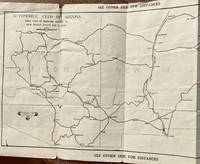
1916499Phoenix: Automobile Club of Arizona 1916. 12 1/2 x 7 3/4 inches. The map is in good used condition not lacking any printed surface. Very nice early map for traveling the roads of Arizona to El Paso. Mileage charts included on the backside. There is a reference to using the Bankhead Highway founded in 1916 for one of the suggested routes. The map includes a road that EVENTUALLY WAS LABELED ROUTE 66. Overall this is a simple but adequate composition that would get the driver from here to there on less than perfect roads.This is quite rare. Automobile Club of Arizona unknown
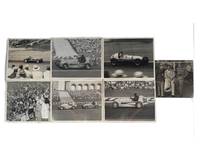
1940215481940. Archive of original photographs documenting midget auto racing at the Los Angeles Memorial Coliseum during the postwar expansion of American motorsports culture in the 1940s and 1950s. The material captures competitive race action spectator culture and driver camaraderie at one of Southern California's most recognizable sports venues during a formative period in American automobile racing. The photographs provide visual evidence of the growing popularity of midget racing in the decades following World War II when compact open-wheel race cars became central attractions at urban speedways and stadium tracks across the United States. The archive also preserves details of racing technology protective gear crowd demographics and public spectacle associated with mid-century American motorsports entertainment.<br /> Collection consists of seven vintage black-and-white silver gelatin photographs measuring approximately 10 x 8 inches. The images depict open-wheel midget race cars with exposed suspensions streamlined bodies and oversized racing numerals characteristic of late 1940s designs associated with manufacturers such as Kurtis Kraft. Several photographs capture high-speed racing sequences with drivers leaning into turns gripping steering wheels tightly as cars accelerate around the Coliseum track. Cars numbered "81" and "60" appear repeatedly throughout the archive in both individual and competitive scenes. One photograph prominently features a driver wearing a dark leather racing helmet and protective goggles typical of the period. Additional race images show vehicles crossing near the checkered start-finish line while spectators densely fill the Coliseum grandstands in period attire including brimmed hats jackets and collared shirts. One particularly striking image frames speeding race cars against the Los Angeles Memorial Coliseum's monumental archways in the background. Beyond race action the archive includes candid social scenes associated with the event including a photograph of a driver addressing a crowd from an elevated platform while spectators gather below and another image showing three men in racing attire and plaid shirts standing beside a race car in a relaxed pit-side setting.<br /> The archive documents the culture of early postwar American motorsports at a time when Southern California emerged as a major center for automobile racing innovation promotion and spectatorship. Midget racing attracted large urban audiences during the mid-twentieth century and served as an important developmental arena for drivers mechanics and racing technologies that later shaped broader American auto racing culture. Particularly notable are the photographs balancing high-speed competition with informal social interactions preserving both the spectacle of racing and the community surrounding the sport. Minor handling wear scattered creasing and light edge wear; photographs otherwise remain in very good condition overall. A strong visual archive of mid-century American midget racing and postwar Los Angeles sports culture. unknown
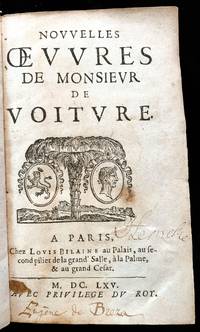
166510340Paris: chez Louis Bilaine au Palais 1665. Complete as issued with the Nouvelles lettres and the Metamorphoses. Interesting title device. French sprinkled calf joints starting; some minor foxing and stains a tear on page 3 affecting text. Early note on flyleaf plus a contemporary signature of Eugène de Breza on title and a bookplate Karl Spitzweg's The Bookworm signed by Robert J. O'Toole. This edition of the author's works of prose is sometimes found bound with his Les Oeuvres. Our copy which is complete has the tables of the first and second works here bound together along with the privilege du Roy .<br /> <br /> Voiture 1597-1648 was an eminent French writer. His letters were translated by John Dryden and others in the Familiar and Courtly Letters to Persons of Honour and Quality by Mons. Voiture London 1701. chez Louis Bilaine au Palais unknown
AAA1Ensemble de 4 catalogues.
20182-1980618208Independently published 2018. Paperback. New. 105 pages. Spanish language. 9.00x6.00x0.27 inches. Independently published paperback
2013DADAX1450876625Publications International Ltd 2013-07-24. hardcover. New. 11.25x0.81x8.50. Buy with confidence. Excellent Customer Service & Return policy. Publications International, Ltd hardcover
1971111900Paris, Librairie du Compagnonnage, coll. « Encyclopédie des Métiers » 1971 3 volumes sur 4. In-folio 36 x 24,5 cm. En feuillets, sous coffrets rigides toile bleu-marine, titre en jaune sur les dos, 1088 ff. en foliotage continu, abondament illustré de phtotographies, plans et schémas divers. Dos passés sinon ensemble en très bon état.
191320174Paris Panhard & Levassor 1913 -in-4 cartonné un catalogue Publicitaire, reliure cartonnée souple gauffrée in-quarto carré Cartonnage Editeur (30,8 x 28 cm), dos muet, 1ère de couverture ornée en première de couverture du titre "SI" gauffré et doré dans un cercle central gauffré et doré au centre de trois lignes verticales or et avec à droite 4 rond (points) gauffrés et dorés sur fond de papier peigné marron, cahier intérieur avec reliure à cordonnet doré, orné de huit hors-texte en couleurs déclinant les différents modèles de la marque en 1913 + 15 dessins hors-texte en noir et bicolores, couverture trés légèrement frottée, 32 pages, 1913 Paris Panhard & Levassor Editeur,
20161166022016 Edité à compte d'auteur - 2016 - Edition limitée à 500 exemplaires - Fort in-folio, format à l'italienne, cartonnage illustré de l'éditeur sous emboîtage de l'éditeur - 328 p. - Très riche iconographie en couleurs et en N&B - Inclut un CD audio - Inclut un envoi d'André Etancelin en page de garde - Ouvrage volumineux, prévoir une augmentation de frais de port en cas d'envoi
1935211901935-1960 17 tirages photographiques, négatifs dont 16 sur plaques de verre et une sur transparent, édition publicitaire des Studios René Ravo , (1935-1960), 5,5 x 7 cm.
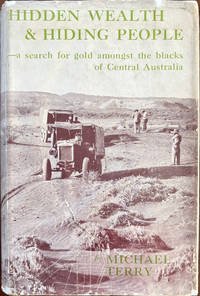
193162087London & New York: Putnam 1931. Thick 8vo. xv 1 350 pp. Photo frontisp. numerous photo plates 3 folding maps 1 large 1 colour 1 large folding chart. Brown publisher’s cloth gilt lettering on spine minor foxing to upper fore-edges of textblock very slight bumping to couple corners w/ d.j. wraparound photo cover art of 2 6-wheel Morris trucks minor closed tears closed tear & creasing front cover w/ repair on verso minor edgewear still VG/G copy. First edition of this uncommon third automobile/truck expedition which equipped with two 6-wheel Morris trucks started in Port Hedland May 1928 and then drving via De Grey Pardoo and Wallal homesteads north to Broome. After Broome they pushed onto Fitzroy Crossing and Hall Creek hunting gold and then reached the Tanami goldfields and then prospected along the Lander River visiting Brooks’ Soak a traditional Warlpiri Soak which Fred Brook was illegally appropriating. Their mining expedition overlapped the subsequent tragic Conniston Massacres of Australian Warlpiri Anmatyerre and Kaytetye Indigenous Peoples in retribution for the killing of Fred Brooks. Terry’s party quickly moved on and headed to Alice Springs followed the Finke River to Horseshoe Bend Oodnadatta Hawker Adelaide and later Melbourne. Terry was quite taken with the Morris trucks which averaged 5-18 mpg every 250 miles and the lead truck only suffered 41 flat tires in their Dunlop tires. See: Ron Moon The Last Explorer: Michael Terry WhichCar July 20 2015. Putnam, hardcover
189740478Boston: The Barta Press 1897. 1st printing. Presumed to be the first printed brochure issued by Whitney for his recently formed "Motor Wagon Company.". Printed card-stock folded once vertically. Light signs of use. A bit of age-toning. VG. Unpaginated though 4 pages. Pages 1 & 4 with specs & performance date. Pages 2 & 3 each with a b/w photographic image depicting the Whitney 'motor wagon'. Oblong format: 3-1/4" x 5-3/8" <br/><br/>"George Eli Whitney an early pioneer in automotive history 'was tinkering with steam cars before the turn of the 20th century. While others turned their attention to the new-fangled gasoline engine he stayed with steam founding the Whitney Motor Wagon Company. He designed and built a succession of steam-driven carriages starting with he believed the first steam-driven car ever built. Many of the ideas that found their way into the steam automobile are attributable to him. The Stanley Brothers famous founders of the Stanley Steamer sought advice from him and used some of his ideas in their first cars.'" Whitney Research Group. According to Britain's Society of Automotive Historians Whitney "completed his first automobile in 1896 and founded the Whitney Motor Wagon Company the following year. Five cars had been built by the end of 1897 and although all his steamers had the common feature of a vertical two-cylinder engine attached to the boiler because Whitney was an 'inveterate tinkerer' no two were exactly the same. He devoted more of his energy to patenting his inventions and pursuing others over alleged infringement of his ideas than he did to actually making automobiles and he left the industry soon after the turn of the century." No "Whitney Motor Wagon" listings found on OCLC. No George Whitney literature found in Romaine. A rare item documenting early American automotive history. The Barta Press unknown books
192645860ABO.O.V.u.J. (Berlin, Elsnerdruck, 1926). 31,5 x 27 cm. 52 S. (unaufgeschnittene Doppelblätter) mit zahlr. Abb. Goldgepr. OLn. mit blindgeprätem Titel; Schmuckkordel, 45860A.jpg (etwas braunfleckig; Goldgrund etwas zerkratzt).
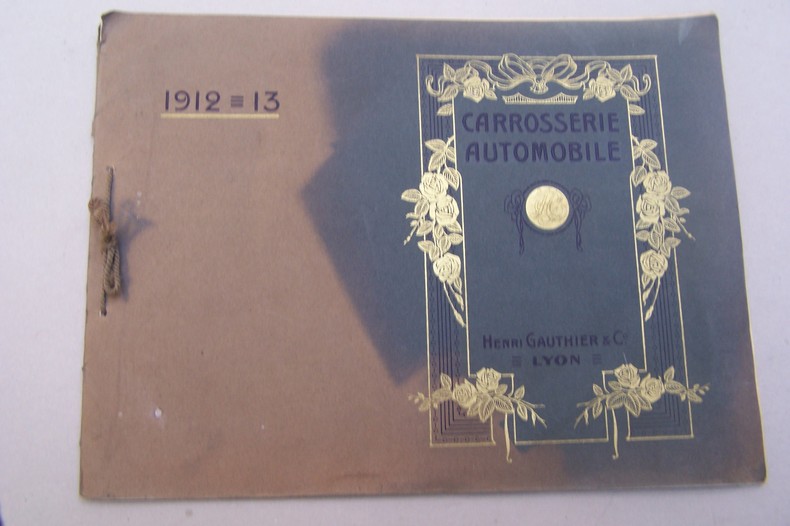
CARRO10Paris, Lyon, Imprimeries A. Ramboz, 1912. In-4 oblong, 7 pp., 13 planches, br.
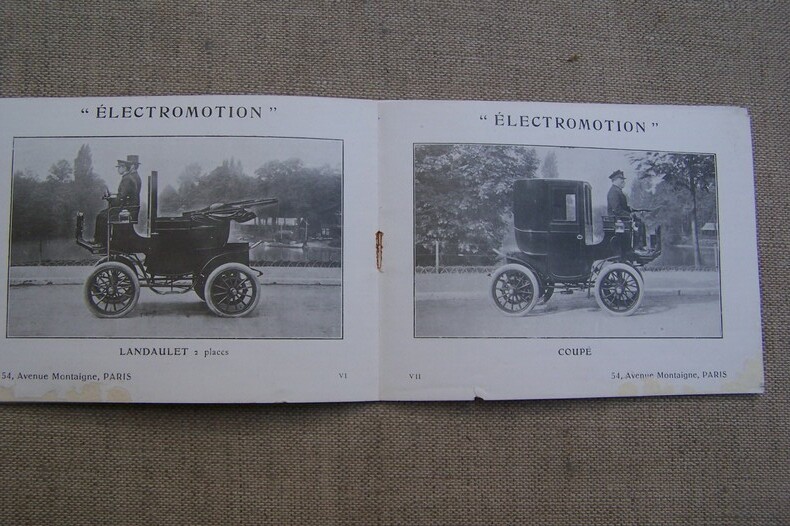
EL6Catalogue 21x13 cm, 3 pages (notice et conditions de vente), 6 pages présentant les photos du chassis et des carrosseries, broché, cordelière. On joint un livret 13x10 cm. de XII pages contenant 10 photos (vers 1906).
20094Antony, ETAI, 2012. 2 vol. in -4, 303 pp. + 399 pp., cartonnage éditeur illustré, jaquette originale illustrée, étui éditeur illustré.