24 438 résultats
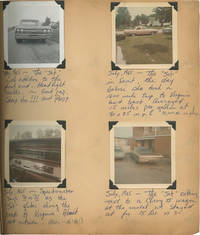
1967154897Peru Indiana: N.p. 1967. Vintage stringbound vernacular photograph album documenting the vehicular obsessions of one Greg Wildrick of Peru Indiana who would ultimately kill four people in a motor vehicle accident and later die himself in the same manner while speeding. Approximately 150 black-and-white photographs and 50 color photographs with manuscript ink annotations captioning most of the images. <br /> <br /> Manuscript ink annotations on the front board provide the album's title: "#1 / Our new cars etc. / Family Too." Additional annotations on the inside rear board note: "The bullshit contained in this so called albumn sic belongs to Greg E. Wildrick / 4 Holiday Drive / Peru Indiana is where I live if you don't know me. Call 472-2550 / If you don't call me forget it!!! / Book Finished March 5 1967 at 4:45 A.M."<br /> <br /> The photographs in the album span roughly 1955 to 1966 compiled by Greg at the age of 19. In addition to many images of the family's muscle cars and trucks the album also contains quite a few shots of bicycles go-karts quarter midgets and speedboats often with family members posing happily nearby. Several images also capture vehicles in use.<br /> <br /> Patently obsessed with cars and speed from a young age Wildrick would go on to work as a used car salesman in nearby Kokomo Indiana throughout the 1960s and 1970s. Wildrick's fanaticism also evidently extended to his leisure hours as the Kokomo Tribune notes Wildrick's involvement in multiple speeding violations during the same period. <br /> <br /> One of the album's more striking photographs taken on December 19 1965 is a blurry color Polaroid of the speedometer of a 1966 Oldsmobile 442 going 110 miles per hour down US Highway 31. This same stretch of 31 would see Wildrick gravely injured and four others dead in a grisly two-car accident five years later in January of 1971. Sadly this would not be Wildrick's last serious accident as a similar collision on US Highway 35 would precipitate his own demise in 1986 at the age of 39.<br /> <br /> A fascinating and thorough album capturing a young man's coming-of-age in a car-centric family and more broadly allowing a personal glimpse into the golden age of the automobile in postwar America. <br /> <br /> 12.75 x 12.25 inches. Photographs ranging from Near Fine to Very Good plus with approximately 18 photographs lightly scuffed cracked toned and edgeworn. Album Very Good plus with light edgewear and scuffing on the boards. N.p. unknown
AUTO290Album in-8 oblong, 1 carte du circuit, 58 planches montées sur onglets comportant chacune deux photos originales du voyage,demi-chagrin à coins.
1900P12P., Huguet & Minart, 1900. In-folio, 128pp., nombr. publicités in-t. et h.t. (dont deux en couleurs), cartonnage éditeur.
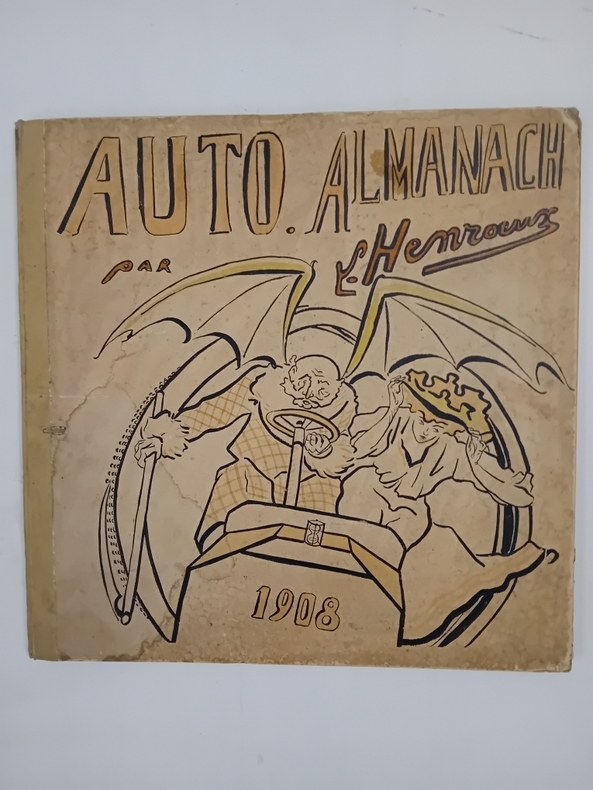
1908P79Paris, A. Eyméoud Imprimeur, 1908. In-4 carré (30x30 cm.), 24 pages, dont 12 illustrées de pleine page, cartonnage illustré. ENVOI.
188059310Portland OR & Seattle WA: Walter Angus MacKay Julia Rose Eder MacKay Cross & Dimmitt ca. 1880-1958. Two vols. 1st - Thick oblong 4to. 11.5 x 8.75 x 2.25 in. 128 pp unpaginated. on thick black paper. With 461 photographs sized 1.75 x 2.75 in. up to 4.5 x 5.5 in. including 2 CDV’s 1 cyanotype several albumen and range of silver gelatin snapshots on matted and glossy paper stock many w/ annotations either on verso below images or w/in the margins at lower fore-edge or in pencil some w/ white ink alongside the images. Contemporary flexible polished calf post-binder punch-sewn at gutter margin in gold silk braid RPPC of Tillamook Bay OR by Gregg mounted on front cover chipping & wear to front cover wear to corners wear & rubbing to some fore-edges occasional chipping minor closed tears still VG exemplar; 2nd vol. -- Oblong 8vo. 8 x 5.75 in. 78 pp unpaginated. on thick tan paper stock. With 101 silver gelatin photographs mounted sized from 1.75 x 2.75 in. up to 4 x 6 in. some w/ sepia effect either mounted directly on the pages or many affixed with small strips of black paper or old paper corners affixing the images to the leaves a few w/ annotations on verso or below. Contemporary flexible diced calf “Housh†photo album chipping & wear to spine wear & bumping to corners some pages reworked by compilers at some point still a G exemplar both albums’ photos with bright strong contrast. These photo albums faithfully follow the sporting and leisure activities of two gearheads from Chicago -- Walter MacKay and his brother Carrol MacKay who together with their extended families and friends drive and auto-camp across the West. The large first album opens with many photos following a trip to Yosemite National Park as well as scenes along the route and upon the return of Walter & Julia. Their follow-up automobile trip in 1928 takes them to Yellowstone National Park via Spokane Idaho and Montana with photos included of Old Faithful a photo by Haynes of the Grand Geyser as well as auto camping at “Mammoth Hot Springs.†Subsequent photos trace their travels through the Columbia River Gorge the Snake River Mount Rainier National Park Ariel Dam near Ariel WA Hoods Canal WA and Newport OR. Their speed boat launch the Carmen is featured in some photos along with several views of pumps hoisting engines giant diesel and gas engines under repair. Other trips include those to Snoqualmie Falls Trout Lake WA near Mt. Adams working a hoist at logging camp partying with friends in Renton WA and even views of Walter MacKay advertising his Automobile Repair Shop with a cover on his rear tire. Other outings include auto camping and picnicking along the Mt. Hood Loop Grant’s Park on the Clackamas River Mt. Hood the Rogue River Table Mountain and views of Grants Pass. Walter and his gearhead friends were known for their stripped-down roadster racing cars and were also early participants in the Seattle Motorcycle Club and Motorcycle races. A couple photos within the two albums show early motorcycles and even gallivanting on some stripped down chassis without engines or tires. The second album includes a series of photos featuring Walter and his car beneath a towering Cedar Stump with arch cut into the base and him holding gun as well as standing on the fenders of the car. The second also includes automobile camping photos with tent and cots folded out of the rear of the automobile driving into Vancouver B.C. as well as driving to Mount Rainier and more along the Columbia River Highway and Mount Hood. Also featured are hunting shots in Eastern Oregon construction of a summer log cabin and much more. Mackay 1883-1959 was a mechanical engineer machinist gearhead racecar builder who came West working for the railroad as a machinist before working for Paragon Co. in Seattle as parts manager. He owned and operated the MacKay Automotive Repair at 165 E. 39th in Portland OR on the SW corner of 39th Cesar Chavez and Belmont for years before working at Albina Engine & Machine Works at the end of the Great Depression. One of the photos in the 2nd album shows MacKay with his camera shooting a photo and several show Julia MacKay’s 1880-1958 sisters and family. Should be noted we unknowingly catalogued an album on Seattle Auto Racing and Motorcycle Clubs from before World War I without having had access to these unknown albums. See: The Origins and Growth of the Club Scene in Western Washington 1910-1941 Jolly Rogers Motorcycle Club Feb. 7 2009; Seattle Motorcycle Races Pantages Theater Program Early Advertising in the West 1867-1918 Univ. of Washington Spec. Collections. Walter Angus MacKay, Julia Rose Eder MacKay, Cross & Dimmitt, unknown
198458040BBMilano, Automobilia, 1984-1996. 29x25,5 cm. Originalleinwandbànde mit Schutzumschlägen. Band 7, 8, 11-13, 16-19, 21-25 mit Bauchbinde.
198458040BBMilano, Automobilia, 1984-1996. 29x25,5 cm. Originalleinwandbànde mit Schutzumschlägen. Band 7, 8, 11-13, 16-19, 21-25 mit Bauchbinde.
194554550Seattle & Tacoma WA: Leo Dobry; Del Fanning ca. 1945-1955. 4to. 29 leaves unnumbered. composed of mylar sleeves. With 122 original photos printed on glossy photo paper 5 Kodachrome colour photos sized from 2.5 x 3.5 in. up to 3.5 x 5 in. some w/ annotations in lower fore-edge of image or on verso a few dated some soiling to one image & edgewear to a few. Recent cloth 3-ring binder lettering stamped on front cover excellent exemplar. This sensational group of original photographs records open wheel midget car racing just after World War II in and around Seattle Tacoma & Puyallup WA Victoria BC Portland OR California and Nevada including photos of many of the midget racers and their drivers at the Portland Raceway Aurora Speedway in Seattle the San Mateo Fairgrounds Reno Fairgrounds and the historic Langford Speedway in Victoria British Columbia. The hunger for speed the presence of large numbers of skilled mechanics & machinists a booming midget car racing scene nurtured by Ballard’s Gasoline Alley nurtured incredibly popular midget car racing circuits on the West Coast during the 1940s and 1950s. These photos open with shots of Geer McRae Motors Mercury # 75 the AA Plating Works No. 2 Leo Dobry’s No. 64 Kurtis Kraft midget racer driven by Del Fanning a jalopy racer No. 26 sponsored by Nix Auto Wrecker owned by Edward Prestek and the center of Ballard’s old Gasoline Alley in Seattle Swede Lindskog’s No. 3 midget racer and more. There are many photos of races wrecked midget racers midget open wheel racers on trailers and many action shots of them hurtling down the tracks. A number of the photos depict iconic Seattle driver Del Fanning in front of and sitting in his midget race cars including the “Seattle Special†No. 7 for Dick’s Auto Repair on 3817 Gilman Ave. in Seattle as well as No. 63 owned by Leo Dobry which was a Kurtis Midget with Offenhauser Engine and ran a number of races in the Northwest set track records at Langford and also raced the San Jose 100. There are photos annotated for the Portland Auto Show in 1954 when No. 44 wins 1st place as well as a series of images showing a pristine Midget Racer under construction in a garage. Leo Dobry was a racing car owner out of Tacoma who was a moderately successful car owner on the AAA and ASPAR circuits in the 1940s and 1950s as well as operated a successful speed shop which built and ran Kurtis Kraft racers on the Indy circuit and the Pike’s Peak Hill Climb. See: Don Radbruch Dirt Track Auto Racing 1919-1941: A Pictorial History pp. 302-303 100-124; Golden Wheels Fraternity Auto Racing Pathfinders Del Fanning History; Racin’ Thru the Raindrops: A Virtual Motorsport Scrapbook Lanford Speedway Victoria BC 2017; Brian Pratt Big Car Racing at Lanford Speedway Canadian Racer 2018; A Look Bat at Nix Auto Wrecking & Ballard’s Gasoline Alley Vintage West Woodland August 29 2016. Leo Dobry; Del Fanning, hardcover
191252555New York: Privately Printed University Press 1912. Tall 8vo. xiii 1 333 1 pp. Numerous photo plates photo text illustrations maps. Red ribbed embossed pictorial cloth cover art illustration of Vanderbilt in his Mercedes which set the 1904 land speed record of 92.3 mph at Daytona Beach FL gilt lettering & gilt ruling t.e.g. minor rubbing bumping to corners head & foot of spine couple very small holes at upper front hinge in cloth slightly shaken still G copy w/ faint ownership and gift inscription of the book being given to Peter C. Taylor from Peter Breymeier in 1941. Breymeier 1911-1991 was the son of Fred Breymeier b. 1876 noted Montclair NJ banker and auto racing enthusiast who had received the book originally from Vanderbilt. First edition of the second of these privately printed logs documenting the travels through Europe by the famed automobile racing enthusiast -- founder of the Vanderbilt Cup the first major trophy in American auto racing and avid supporter of the America’s Cup yacht races. This motoring memoir begins with the Vanderbilt’s travels in his one of his famed 1907 35-45 HP Renaults which Willie K had talked the company into producing after their 1906 French Grand Prix race win with the 13-liter racing car driven by Ferenc Szisz. One of these won the Morris Park 24-Hour race in October 1907 and subsequently one was used by Vanderbilt to trek over Europe from Liverpool to London then onto Paris over to Germany through the Austrian Tyrols then into Switzerland over to Monte Carlo and returned to Lyons. These are followed by accounts of his travels through Spain in a 1909 55-HP Mercedes witnessing the bull fights in Madrid through the Spanish Countryside and down to Seville followed by a trip through Northern Europe which lasted until 1910. The final trip from southern France around the entire countries of Spain & Portugal in 1911 were driven in a 1911 60-HP Mercedes fitted with a tonneau body and Michelin tires and hood and extra trunk rack in the back. Willie K. Vanderbilt 1878-1944 was a Vanderbilt scion served in World War I on the USS Tarantula on patrol off New York and New Jersey and was a skilled automobile and yacht racer. About 200 copies were printed of these “Log of my Motor†for friends and fellow motoring enthusiasts during the Brass Era carefully documenting mileage road conditions places visited as well as the performance of the various cars. See: The Owls Head Transportation Museum 1907 35-45 HP Renault The Old Motor 2015; Messer-Kruse Speed Demons American History Gear July 31 2013; Art Evans History of Sports Cars -- Speed Records at Daytona Beach Sports Car Digest 2011. Privately Printed, [University Press], hardcover
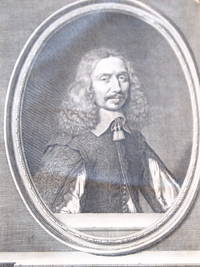
165640071à Paris: Chez Augustin Courbé 1656. Fine. Chez Augustin Courbé à Paris 1656 - 1658 16.50 x 24 cm relié Fifth edition of Voiture's uvres the first of which appeared in 1648; and first edition of the Nouvelles uvres de Voiture. A frontispiece by Mellan for the first volume a headpiece and an initial in the epistle and a fine portrait of the author by Champaigne engraved by Nanteuil. Contemporary full brown sheep binding. Raised spine richly decorated. Red morocco title label. One missing headcap. Tear with loss to upper joint at foot. Rubbing. Good copy. Voiture 1597-1648 was throughout his life a gallant and a courtier brilliant in salons and playing games. His epistolary talent earned him long popularity in France for fashionable prose and his poetry excels in the mannered and precious tone even though he knew how to be trivial when necessary. He is an essential figure of the literary scene of the early 17th century a true Molière character. Voiture is first and foremost a style not only in his letters Lettres amoureuses and his poetry but also in his prose see for example the delightful Métamorphoses. His works were in the image of the man gallant teaching beautiful language and fine manners to the habitués of the hôtel de Rambouillet. His fame was very great during his century and he remains an emblem for the 17th century. Chez Augustin Courbé unknown
0785317775New. Brand new and still unused unknown
1450815472New. Brand new and still unused unknown
047090447XNew. Brand new and still unused unknown
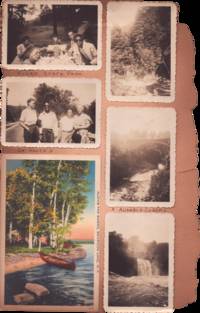
1947List2905United States and Canada 1947. Eleven double-sided scrapbook pages measuring 7 x 11 inches containing forty-five 2 ½ x 3 ½ inch photographs six postcards four maps four guides and nine typed pages. Scrapbook pages fragile with significant marginal damage; scrapbook contents generally excellent. A scrapbook documenting an African-American family’s road trip during July and August of 1947 which took them from Dutchess County New York through Quebec and New Brunswick and then Maine and Cape Cod. The scrapbook contains photographs of the family and scenery on the trip starting at Norrie State Park in Dutchess County then Quebec Gaspé Moncton’s Magnetic Hill in New Brunswick down the coast of Maine and finally a friend’s house in Marstons Mills on Cape Cod. It also includes postcards from various locations; maps of New York Quebec Canada’s Maritimes and Eastern Quebec and New England; tourist guides to Quebec Gaspé Moncton and the Cape; several retyped articles from the Toronto Globe and Mail; and a list of hotels in the Gaspé.<br /> <br /> For an African-American family traveling during the Jim Crow era this trip would have taken significant planning. Canada was not exempt from anti-Black discrimination at both legal and social levels; the car had solved the problem of segregated inferior public transportation but not the problem of finding a restaurant or hotel along one’s route that would actually serve Black patrons or even a safe place to stop and use the restroom. Victor Hugo Green’s Negro Motorist Green Book—a guidebook for food lodging and services that were friendly to African-Americans—did not include Canada until its 1949 edition. The family likely used it for the US leg of their trip but would have had to rely on other tactics for the Canadian leg. unknown
195053076Oakland CA & Hollywood CA: Lee’s Speed Shop; Hot Rod Magazine; Louis Hochman 3303 Cahuenga Blvd. Photographer 1950-1955. Oblong 4to. 24 leaves w/ 24 silver gelatin photos sized 7 x 10 in. up to 8 x 10 in. 4 w/ photographer’s stamps on versos 6 w/ red grease pencil markings & a couple with whiteout preparing camera-ready copy a few w/ annotations on versos still VG photos preserved in archival mylar sleeves. Recent limp black cloth post-binder gilt lettering stamped on front cover an excellent exemplar. This historic photo album records the construction and racing of Lee Chapel’s “Tornado Special†in 1952 at the Bonneville Salt Flats. Lee’s Speed Shop was one of the original members of the Dry Lakes Racers Bonneville 200 MPH Club who held their first meeting in September 1953 at the Bonneville Nationals. The “Tornado Special†was a Class C Streamliner which driven by John “Sonny†Rogers achieved a two-way average speed of 224.144 mph at Bonneville in 1952 featuring an unsprung front end torsion bars at the rear with a novel trunnion arrangement for pivoting the engine fitted with a 295 cubic in. Mercury engine equipped with a Lee’s Speed Shop “Tornado†overhead valve conversion. The front end was built from a 36 Ford and had split radius rods mounted to a tubular frame and the rear end was a reworked 1932 Ford Model A. The Tornado Special crashed in 1953 and the body was left at Bonneville while many of the parts were salvaged. Chapel 1905-1966 opened his first speed shop while sharing space with a junkyard in 1928 at 3263 San Fernando Road in LA which he later moved to 4557 Alhambra Ave. from 1933 to 1937. In 1937 he closed the shop to tour the country racing open wheel midget cars until he reopened his Lee’s Speed Shop at 1143 East 14th St. in Oakland CA. He served during World War II as a TEC4 until discharge in 1945 whereupon he resumed his Speed Shop in Oakland. Lee’s Speed Shop was a pioneer in the southern California Hot Rod scene who along with George Wight blazed the used hot rod parts trail. See: Hot Rod of the Month Man Made Tornado Hot Rod Magazine Sept. 1953 pp. 34-38; Daniel Strohl Lost Speed Shops: Bell Chapel Orr Hemmings Daily Nov. 23 2009; David Lucsko Junkyards Gearheads and Rust: Salvaging the Automotive Past p. 37; Lee Chapel Origin of a Speed Shop In: Hot Rod Magazine June 1928 p. 13; Kinne & Warner Bonneville 200 MPH Club History -- Links in a Chain 2010. Lee’s Speed Shop; Hot Rod Magazine; Louis Hochman, 3303 Cahuenga Blvd. (Photographer), hardcover
P56Paris, Naudin, 1903. In-folio (30x39 cm.), 121 pages, nombreuses photos, cartonnage éditeur.
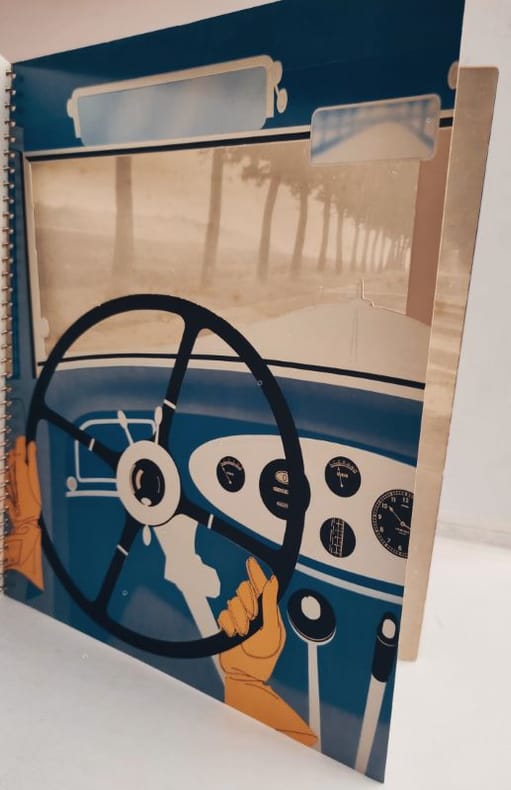
19958P., Draeger, 1931, In-4, 26 X 30 cm., reliure à spirale, 40 pp.
1st edition. Original paper wrappers, 16mo (small), 7 pages ; 25 cm (folded to 14 cm in wrappers). "Correspondence between Henry Ford, Louis Marshall and Herman Bernstein. Settlement of Aaron Sapiro's and Herman Bernstein's libel suits" (From the front cover). During the 1920s, Henry Ford gained as much fame for his antisemitic views as for his cars. His newspaper, the Dearborn Independent, published dozens of articles between 1920 and 1925 naming prominent Jewish Americans as conspirators in a plot to overthrow governments all over the world. Though hardly the first of their kind, the accusations in the Dearborn Independent represented the broadest, most sustained published attack on individual Jews and Jews as a group in the nations history. The articles created clear grounds for defamation and libel actions against Ford and the newspaper, and several were filed. In 1927 one lawsuit, Sapiro v. Ford, made it into court, generating international headlines, only to end in mistrial. Ford then disposed of the distasteful affair by signing a statement in which he apologized for the wrongs he had 'unintentionally' done to Jews. Ford's campaign against the Jews, as historians have recognized, reflected the renewed racial tribalism that characterized post-World War I American society (Woeste, Insecure Equality: Louis Marshall, Henry Ford, and the Problem of Defamatory Antisemitism, 1920-1929 in Journal of American History, Dec. 2004). The importance of the end result, here spelled out in this rare period publication, was summarized by Robert Rifkind in his 2008 examination Confronting Antisemitism in America: Louis Marshall and Henry Ford: Putting aside historical revisionism, it becomes clear that the Ford apology achieved a number of things no libel suit could have achieved. First, in broad and unambiguous strokes, Ford repudiated the defamation of Jews in general and not merely the particular claims asserted in the lawsuits. Second, the apology did so with dispatch rather than after further protracted delay. Third, Ford undertook to withdraw The International Jew from circulation both in the United States and abroad, and at least while Marshall remained alive, he seems to have done so. A jury sitting in an action for monetary damages could not have compelled such a result. And finally, a confession, retraction, and apology appearing in Fords name and over Fords signature carried the impressive force of a world-famous mana force that twelve anonymous jurors, easily dismissed as misled by lawyers wiles, could never have had (American Jewish History, Vol. 94, No. 1/2, March/June 2008, pp. 71-90). SUBJECT(S): Antisemitism -- Michigan -- Dearborn. Jews -- Trials (Libel) -- Antise´mitisme -- Juifs -- Proce`s (Diffamation) -- Dearborn independent. OCLC: 264355930. OCLC lists only 3 copies worldwide (Harvard, YIVO, Yale Law), none outside the Northeast. Light wear to wrappers, number penned on cover, no other markings, folded text pages inside extremely clean, an exceptional copy of this rare and very important imprint. Very Good Condition (holo2-148-4).
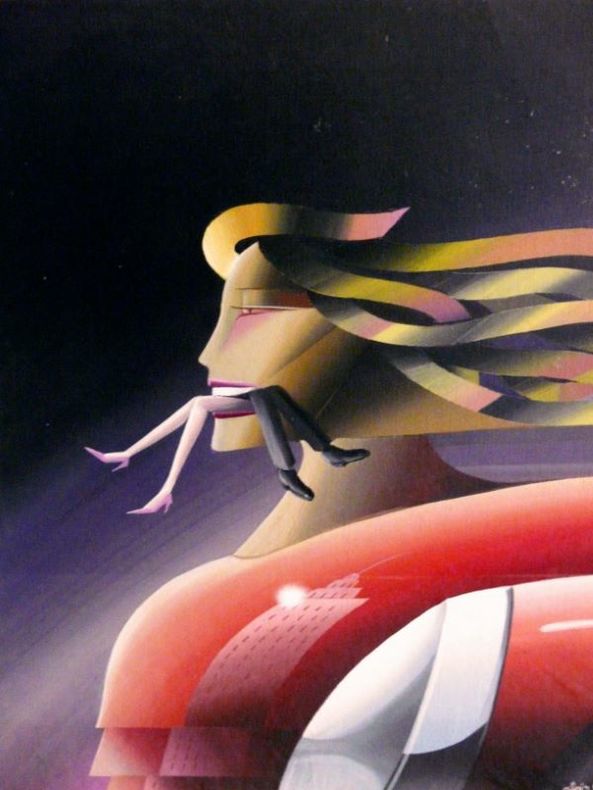
1989195111989 Acrylique sur toile, titrée au dos, 1989, 44.5 x 36.5 cm, encadrée, signée sur le verre du cadre.
165040071Chez Augustin Courbé | à Paris 1650 | 16.50 x 24 cm | relié
165050197à Paris: Chez Augustin Courbé 1650. Fine. Chez Augustin Courbé à Paris 1650 - 1658 16.50 x 23 cm relié Second edition of the Oeuvres and first by Courbe who had just acquired the privilege by Voiture and first edition of the Nouvelles oeuvres. Two title vignettes by Picart. A fine portrait by Champaigne. Binding in full eighteenth-century mottled calf. Spine with raised bands handsomely decorated with fleurons and stars fillet at tail. Red morocco title-label. Triple gilt fillet frame on boards. Decorative gilt board-edges. Marbled edges. Fine restorations to corners and headcaps. Rubbing. First leaves yellowed with small marginal dampstains. Extensive yellowing on the preliminary leaves of the Nouvelles oeuvres. Voiture 1597-1648 was throughout his life a gallant and courtier brilliant in the salons and playing at games. His epistolary talent earned him the distinction of making prose fashionable in France for a long time and his poetry excels in the mannered and precious tone even though he knows how to be trivial in turn when necessary. He is an essential figure of the literary scene of the early seventeenth century a true Molière character. Voiture is above all a style not only in his letters Lettres amoureuses and his poetry but also in his prose see for example the delightful Métamorphoses. His works were in the image of the man gallant teaching fine language and beautiful manners to the regulars of the hôtel de Rambouillet. His fame was very great during his century and he remains an emblem of the seventeenth century. Chez Augustin Courbé hardcover
1966155116N.p.: N.p. 1966. Archive of photographs newspaper clippings and various ephemera belonging to a Kenny Aumont Brown 1943-2016 of Burlington North Carolina largely relating to automobiles and automobile accidents 1963-1966.<br /> <br /> The archive assembled by Brown when in his early twenties documents his preoccupation with automobiles automobile accidents and racing at a time when Brown was first employed as a tow truck driver for Cobb Motor Company and later as part of a rescue unit as seen in one of the newspaper clippings. In his later years Brown would serve as an Alamance County Deputy Sheriff for 34 years. A copious and insightful vernacular documentation of the relationship of southern culture and automobiles in the early to mid 1960s.<br /> <br /> The archive contains 37 standard size black and white photographs one 8 x 10 inch black and white photograph four color photographs 25 newspaper clippings two newspaper issues and twelve various documents all housed in a photo album. The archive contains annotations throughout in white marker on the black leaves of the photo album and frequently in pen or pencil on the margins of articles and photographs.<br /> <br /> The photographs in the archive include shots of Cobb Motor Company vehicles and shop including a circa 1930s photograph of a 1930s Cobb vehicle laid in various crashed vehicles with annotations including location and fatalities wrecked NASCAR vehicles one page including the annotations of "Petty Plymouth's 1962" and "Car witch sic almost killed Lee Perry" three of local drag races and several of friends and family vehicles including Brown's own cherished 1949 Plymouth which he identifies as "My Own True Love KAB." Many of the photographs include developer dates stamped into the margin which range from 1958 1960 1962 and 1965.<br /> <br /> The newspaper clippings in the archive date from 1963 to 1966 with the majority about local automobile accidents but also feature articles on NASCAR accidents and fatalities Joe Weatherly illegal racing a transportation shop fire a murder suicide and an Alamance plane crash which killed three which is included in two clippings as well as a full issue of the Daily Times News.<br /> <br /> As well as the photographs and newspaper clippings the archive includes various personal effects which include Brown's driver's license two car registrations belonging to his mother Cathera Garner Brown a 1962 Dion and Sam Cook concert ticket and a letter from the North Carolina Department of Motor Vehicles warning Brown his license is in danger of suspension from speeding violations with an adjacent "Nasty Letter" annotation. Also included are much older family artifacts including a 1914 postcard receipt from Burlington Coffin Company a 1917 postcard receipt from Piedmont Railway and Electric and a 1919 receipt from Souther Bell Telephone and Telegraph Company all belonging to a presumed grandfather W.L. Burke of Burlington.<br /> <br /> On the first leaf of the album is Brown's name dated "Dec. 1963" and his initials in bold Gothic calligraphy in white. On the verso of the first leaf is a Sunday May 19 1963 newspaper clipping of an accident featuring a strikingly disturbing photograph of a man hanging from a telephone pole upon which his body was thrown his car burning below him with the adjacent annotation "Will They Ever Learn." The photograph in the clipping is of note as it was the image appropriated by Andy Warhol for his 1963 painting "Green Car Crash Green Burning Car I" one of the most celebrated paintings of his early "Death and Disaster" series.<br /> <br /> Photo album with string binding 12.5 x 8.75 inches. Very Good plus. Photographs Newspaper clippings and ephemera Very Good overall with a few clippings laid in and ten of the photographs loose from the original tape mounting many with faint soil tape shadows and light creasing. N.p. unknown
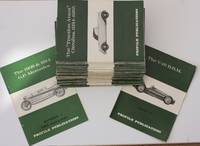
196645733Profile Publications Windsor 1966-1967. 96 vols. 8vo. First Edition with coloured and monochrome illustrations and monochrome photographs; pictorial wrappers wire-stitched as issued a few covers lightly age-soiled else all very good clean copies. The run comprises Nos. 1 - 96. RUNS OF THIS CALIBRE ARE EXTREMELY SCARCE. Profile Publications, [Windsor], unknown
96 vols., 8vo., First Edition, with coloured and monochrome illustrations, and monochrome photographs; pictorial wrappers, wire-stitched as issued, a few covers lightly age-soiled else all very good, clean copies. The run comprises Nos. 1 - 96. RUNS OF THIS CALIBRE ARE EXTREMELY SCARCE.
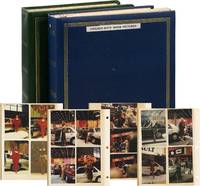
167954N.p.: N.p. 1990. Archive of approximately 570 vernacular color photographs of the Chicago Auto Show housed in two generic photograph albums with plastic overlays covering every year from 1979 through 1990 lacking 1981.<br /> <br /> The first photograph album a blue 3-ring binder of 58 leaves with a "Chicago Auto Show Pictures" label on the front board contains approximately 320 photographs housed on the rectos and versos of the leaves and has ink annotations on the verso of the front board noting the years 1979 1980 1982 1983 1984 and "David Hasslehoff" a guest at the 1983 Chicago Auto Show. The vast majority of photographs in this album are 5 x 3.5 inch photographs with approximately 40 3.5 x 3.5 inch photographs.<br /> <br /> The second photograph album a green 3-ring binder of approximately 53 leaves with a "Chicago Auto Show Pictures" label on the front board contains approximately 250 photographs housed on the rectos and versos of the leaves and has ink annotations on the verso of the front board noting the years 1985 1986 1987 1988 1989 1990 and "William Perry The Refrigerator" a guest at the 1986 Chicago Auto Show. The vast majority of photographs in this album are 5 x 3.5 inches with eleven 4.25 x 3.5 inch photographs.<br /> <br /> A sizable photographic archive documenting eleven years of a devoted fan's annual trips to the Chicago Auto Show throughout the 1980s. The majority of the photographs depict the displayed vehicles with their attending female models and performers as well as the lavish booths and fashions of the 1980s. A documentation of a transitional decade for the US automobile as the behemoths of the late 1970s evolved into the more compact and fuel-efficient Japanese-influenced models emergent by 1990.<br /> <br /> The Chicago Auto Show was begun in 1901 by bicycle show promoter Samuel Miles and quickly rose to prominence often regarded as the "National Auto Show" by the early 1930s. World War II curtailed the production of motor vehicles for consumers and as a result the Chicago Auto Show was not held between 1941 and 1949. In 1961 the Chicago Auto Show was moved from the International Amphitheatre to its current location at McCormick Place. It is currently the largest auto show in the United States.<br /> <br /> Photograph Albums 11.5 x 11 inches. Albums and photographs all Near Fine. N.p. unknown