FIAT 124 ..MareMagnum
GIULIA 1600 TI - ALFA ROMEO.MareMagnum
Uso e manutenzione.
In-8°, legatura in brossura editoriale, pp. 79, con illustrazioni a due colori anche su tavole ripiegate. Marginali tracce d'uso.

Daris s.r.l. · Lucca, IT45,00 €
24 430 résultats
In-8°, legatura in brossura editoriale, pp. 48, con figure e spaccati.
In-8°, legatura in brossura editoriale, pp. 79, con illustrazioni a due colori anche su tavole ripiegate. Marginali tracce d'uso.
In-8°, legatura in brossura editoriale, pp. 52, con illustrazioni.
In-8°, legatura in brossura editoriale, pp. 67-(2), con illustrazioni.
FIAT Uso e manutenzione Fiat 126. , FIAT 1977, Copertina cartonata lucida con segni d'uso. Tagli e pagine ingialliti in modo lievissimo. Brossura oblunga. Buono (Good) . <br> <br> <br> <br>
AUTO376Prospectus 21x26 cm., deux illustrations. Imprimerie Valence, Paris.
198839993Pfäffikon, SERAG AG, Verlagsunternehmen, ca. 1988. Original-Pappband, 4°; 127 Seiten.
1979139290Berlin: Transpress Verlag. 1979. 208 S., Abb. 21*14 cm. OBroschur.
198410954ABLeipzig, Jena, Berlin, Urania-Verlag, (1984). Gross-8°. 248 S. mit zahlr. (teils farbigen) Abbildungen. Original-Leinwand mit Schutzumschlag (dieser teils bestossen u. beschabt). Vorderdeckel fleckig, Schnitt gebräunt.
195743286Düsseldorf, VDI-Verlag, 1957.
1910VERK1086Berlin, o. Vlg. 1910. 4°. 68 S. m. 26 Fig., neuerer HLnbd., ausgeschied. Bibl.-Expl. mit den üblichen Kennzeichnungen.
1910VERK1087Berlin, o. Vlg. 1910. 4°. 68 S. m. 26 Fig., OBrosch., ausgeschied. Bibl.-Expl. mit den üblichen Kennzeichnungen, Einband etwas abgegriffen.
192882537(Hamburg, Carl Holler-Verlag, 1928). 31 S. 18,5 cm. Schwarzes HLn.
198357108Bayreuth : Hestia-Verlag 1983. 247 S. : Ill. ; 22 cm, mit Schutzumschlag, Umschlag mit Randblessuren gebundene Ausgabe, Hardcover/Pappeinband, sonst Exemplar in gutem Erhaltungszustand
1940V39498Berlin-Grunewald (Krafthand Verlag Walter Schulz) 1940 (= 3., verbesserte und erweiterte Auflage). 8°, illustrierter Originalkarton (Hardcover) 239 S., 211 Bilder und Zeichnungen, 3
1958V40675Hamburg (Spiegel Verlag) 1958 (= Erste Ausgabe). 4°, illustirerter Originalumschlag (Klammerheftung), 82 S., Abbildungen, Werbung 1
198716945Honos, Zug, 1987. VII, (4), 558 Seiten. Gr-8vo. Leinen.
1966106066Dingolfing. 1966. Beidseitig bedrucktes Blatt mit zahlr. farbigen Abbildungen (Gefaltet). 41x30 cm
2006054126Gudensberg-Gleichen., Wartberg Verlag., 2006. 63(1) Seiten mit zahlreichen Abbildungen. Guter Zustand. 4°. OPappband.
43158Ostfildern, Verlag Baedeker,, 2016. 2. Auflage 100 Seiten , 17 cm, Hardcover/Pappeinband
193658355Santa Barbara CA: United Motor Courts Inc. 3230 Hollister Ave. 1936. 4to. 8 x 9 in. 15 1 pp. Printed in red & black photo- illustrated throughout w/ strip maps printed in red & black in landscape double-page formated self-printed colour illustrated softcovers cover art of scenic Spanish Revival style bungalows w/ 1930’s style sedans pulling into a California motor court minor dustsoiling shelfwear small tear to upper right corner still VG- copy w/ stamp of Beechwood Auto-o-Tel on back cover. Fourth revised edition of this well-illustrated motel guide for Western automobile travelers as the country slowly emerged from the Great Depression. This association based in Santa Barbara California was one of the earliest motel referral services in the U.S. and managed to garner independent motel and motor inn operators across the country to subscribe and maintain their standards of comfort and courteous service. These illustrated guides prove invaluable in charting roadside architecture across the West amenities to be found by travelers and the variety of signage. This guide combines elements of the earlier Photo-mobile Western travel guides with mileage information phone numbers and images of the well-appointed motels. Scattered across the West these include the Utah Motor Park Sunset Cottage Court in Pocatello ID the Home Motel in Las Vegas NV the Craftsman inspired Wa-Wona Court in Corvallis OR the Jones Autel in Merced CA featuring a service station & cottages Bear Creek Lodge on the Yosemite Highway and many more. No copies located in Worldcat; See: Andrew Wood The Rise and Fall of the Great American Motel: Mom and Pop Motels once dominated American Highways Smithsonian Magazine June 30 2017. United Motor Courts, Inc., 3230 Hollister Ave., paperback
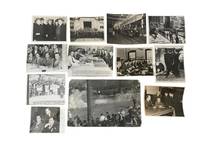
1938234231938. Labor Organizing United Auto Workers and CIO labor photograph archive documenting strike action union leadership and collective bargaining negotiations during the expansion of organized labor in the American automobile industry 1938-1949. The archive traces the period immediately following the 1935 Wagner Act when unions gained federal legal protection for collective bargaining but still faced violent resistance from corporations police departments and municipal governments. Several scenes connect directly to the years surrounding the 1937 Battle of the Overpass in Dearborn when Ford security men beat UAW organizers attempting to distribute union literature outside the River Rouge complex and to the broader wave of sit-down strikes and factory shutdowns that forced General Motors Chrysler and eventually Ford into formal negotiations with the UAW. The captions identify senior labor figures including Walter Reuther R. J. Thomas George Addes and Richard T. Leonard establishing the archive as documentation not merely of rank-and-file unrest but of the institutional consolidation of the UAW-CIO into one of the most powerful industrial unions in the United States. The material also records how labor disputes extended beyond factory gates into courts city halls state legislatures and police jurisdictions revealing the political dimensions of industrial unionism during the New Deal and early Cold War years.<br /> <br /> Photo archive of 12 Large silver gelatin press photographs one large panorama measuring 9.5 x 16.5 inches 11 press photos ranging from 6 x 8 inches to 8 x 10 inches primarily Detroit Dearborn South Gate and Atlantic City circa 1938-1949. A large-format scene dated 1939 records tear gas and street violence during a UAW strike at the Fisher Body plant with clouds of gas spreading across trolley tracks as helmeted police advance toward crowds of fleeing workers and spectators. Another image shows hundreds of demonstrators carrying a massive American flag through downtown Detroit toward City Hall during protests following clashes between union pickets and police at Federal Screw Works; the verso caption notes approximately forty injuries and references accusations of "police brutality" raised before city council. Additional photographs show UAW-CIO officials seated at conference tables negotiating contracts and appearing in municipal hearing rooms beneath desk microphones and courthouse lighting. Captions identify figures including Walter Reuther George Addes and R. J. Thomas while a 1940 Dearborn caption records the arrest of union leaders for distributing handbills asserting workers' rights under the National Labor Relations Act. South Gate strike scenes outside a General Motors facility show workers carrying placards demanding a thirty percent wage increase while Rev. Louis R. Loe conducts prayer services along the picket line. Convention and leadership photographs from Atlantic City and Washington document labor leaders gathered under the authority of Samuel Gompers and later CIO leadership structures linking local strike activity to national labor organization.<br /> <br /> The archive illustrates the transformation of the automobile industry from one of the nation's most violently anti-union industrial sectors into the center of postwar collective bargaining power. Ford Motor Company resisted union recognition longer than General Motors or Chrysler relying on private security forces local police cooperation labor espionage and anti-handbill ordinances to suppress organizing inside and outside its plants. Several captions directly reference these legal confrontations including arrests tied to leaflet distribution and disputes over municipal authority to restrict labor organizing in public space. By the late 1940s many of the same figures shown here were negotiating contracts that established wage standards pensions grievance procedures and health benefits that reshaped industrial employment across the United States. Creasing edge wear scattered minor losses adhesive residue and newsroom markings to versos; images remain clear and intact overall. Overall good condition. unknown
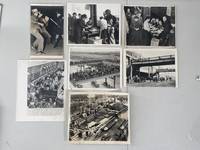
1941234341941. Labor Organizing Ford River Rouge plant labor photo archive documenting the struggle over union recognition strike enforcement and industrial bargaining at Ford Motor Company between 1941 and 1953. River Rouge was Ford's massive Dearborn complex where raw materials blast furnaces rail lines ships assembly shops and tens of thousands of workers were concentrated at one site. Ford resisted the United Auto Workers longer than General Motors and Chrysler and the 1941 strike forced the company into an NLRB-supervised vote that led to UAW representation at Rouge. The later 1949 strike over speed-up conditions demonstrates the continued role of the union in protecting workers from unreasonable production paces giving bargaining authority and strengthening worker control inside the plant.<br /> <br /> Photo archive of 7 Large silver gelatin press photographs measuring between 7 x 8 and 8 x 10 inches Dearborn and Detroit Michigan 1941-1953. Workers stream across elevated pedestrian bridges into the Rouge gates crowd plant entrances receive ballots under the supervision of officials and a Michigan State Police officer and stand in picket lines outside Ford buildings. A Black worker charges toward a picket while a state policeman advances with club raised with the Acme caption identifying the incident as "Vengeance at River Rouge" on April 4 1941. Other captions identify Sunday dinner served to pickets on April 6 1941; thousands returning to work after settlement of the UAW-CIO strike on April 14 1941; workers voting in the NLRB election on May 21 1941; pickets entertained from a truck during the May 1949 walkout; and Ford's River Rouge plant in 1953 described by the Ford News Department as employing more than 60000 and able to turn raw materials into a finished car in 28 hours.<br /> <br /> The archive records both the scale of River Rouge and the mechanics of labor conflict: police interference union voting picketing crowds and shop workers moving between strike and production. It connects the 1941 recognition fight to the postwar UAW's continuing battles over working conditions at one of the most closely watched industrial sites in the United States. Creasing handling wear surface marks and caption wear; images remain intact and legible. Overall in good condition. unknown
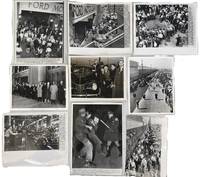
1941234311941. Labor Organizing Ford River Rouge plant press photographs documenting labor conflict picketing and union organization at the largest industrial complex in the United States from the early UAW recognition battles of 1941 through the major Ford walkouts of 1949 and 1967. The River Rouge plant in Dearborn employed tens of thousands of workers and was the center of Ford's anti-union resistance during the rise of the Congress of Industrial Organizations CIO. Ford Motor Company remained the last major Detroit automaker to recognize the United Auto Workers after General Motors and Chrysler signed contracts following the 1936-1937 sit-down strikes. Several scenes here connect directly to the April 1941 strike that finally forced Ford to negotiate with the UAW after years of union busting and company sanctioned violence against organizers. Later scenes document the 1949 strike involving roughly 65000 workers and the 1967 Rouge walkout documenting three decades of union activity in the American auto labor history.<br /> <br /> Photo archive of 9 black-and-white press photographs silver gelatin prints ranging from 7 x 9" to 8 x 11" Dearborn and Detroit Michigan 1941-1967. Photographs show UAW members at Rouge plant gates carrying placards reading "Ford Is On Strike" while reporters and cameramen surround circular picket formations outside the factory entrances. One scene records women from the Women's Auxiliary of UAW Local 600 marching in orderly formation with American flags during an April 1941 demonstration outside the Rouge complex. Another captures a state policeman advancing with baton raised as two men recoil during violence near a plant gate; the attached caption identifies one figure as an unidentified Black man striking a UAW picket captain. Additional scenes show workers waiting in line for pay envelopes during the strike men gathered outside plant entrances under heavy guard and a largely idle assembly floor where a lone foreman sits beside silent production lines after tens of thousands of workers walked out. Typed press captions affixed to versos on image margins including references to the May 1949 strike and September 1967 Rouge picketing.<br /> <br /> The Ford strikes were some of the most consequential labor battles in twentieth-century American industry. Ford's Service Department under Harry Bennett built an extensive anti-union apparatus that used labor spies intimidation and physical violence against organizers culminating in nationally publicized confrontations such as the 1937 "Battle of the Overpass." The April 1941 strike represented the decisive collapse of Ford's resistance to industrial unionism and secured UAW recognition at the Rouge plant fundamentally changing labor relations in the American automobile industry. These scenes preserve not only the mechanics of organized strike action but also the scale of industrial labor mobilization in midcentury Detroit where mass demonstrations were central in the struggle between organized labor and corporate management. Light creasing scattered surface wear and minor handling marks consistent with newsroom use; captions and editorial markings largely intact and legible. Overall good to very good condition. unknown
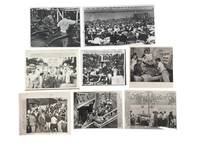
1961234081961. Labor Organizing United Auto Workers strike and labor photographs documenting national contract disputes factory shutdowns collective bargaining and picket line action across the American auto industry during the 1960s and 1970s. The group records major UAW conflicts involving General Motors Ford and Chrysler including the 1961 General Motors bargaining deadline the 1967 Ford strike in Los Angeles and the 1973 Chrysler contract dispute led by Leonard Woodcock and Douglas Fraser. These conflicts grew from fights over wages speedup compulsory overtime pensions medical coverage retirement eligibility and plant safety inside the nation's largest manufacturing sector. By the early 1970s the UAW represented more than one million workers and could halt production across dozens of plants through coordinated bargaining local picketing convention mobilization and public demonstrations.<br /> <br /> Photo archive of 8 Large silver gelatin press photographs one large panorama measuring approximately 8 x 14 inches and the remaining ranging from 8 x 8.5 to 8 x 10 inches primarily Detroit and Los Angeles 1961-1973. Workers paint strike placards inside a Local 15 UAW-CIO shop space with slogans including "Improve Working Conditions" "Free Paid Medical and Insurance" and "Stop Speed Up." Leonard Woodcock and Douglas Fraser march beside white-collar Chrysler employees carrying a sign reading "30 and Out No Age Limit." Ford workers gather beneath the "Ford Motor Co." sign at the Los Angeles assembly plant while signs reading "UAW on Strike for Justice" and "UAW Local 148" rise above the crowd. At Ford's Rouge plant hundreds of UAW members picket outside the entrance after a contract settlement while the attached caption notes that the plant employed roughly 33000 workers and that pickets remained after the "lonely guard" opened the gate. Factory interiors show chassis assembly lines rear axle installation and suspension components while a crowded convention hall displays banners reading "Get America Back to Work" and "Improve Working Conditions."<br /> <br /> The group demonstrates the UAW operations in the labor strife of the 60s and 70s: national officers negotiated with automakers local members prepared signs and walked gates convention delegates debated priorities and production workers controlled the pace of automobile output by withholding labor. Kennedy publicly intervened during the 1961 GM dispute to prevent a shutdown of the auto industry while the 1973 Chrysler negotiations centered on retirement working conditions and contract protections during a decade of inflation and labor unrest. Creasing edge wear scattered minor losses and occasional handling wear; captions editorial markings stamps and verso annotations retained throughout; images overall intact and clear. Overall in good condition. unknown