Abraham LincolnBiblio.com
568 résultats
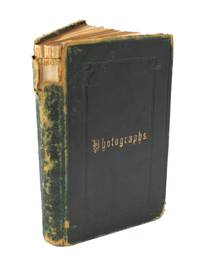
1864175101864. Abraham Lincoln and Civil War Figures Album of pasted oval portraits with signatures underneath each image. 1861. Features most notably Abraham Lincoln with a pasted signature below his image. This mid-nineteenth-century photographic album assembles oval portraits of political and military figures during the Civil War era including a pasted signature beneath an engraved portrait of Abraham Lincoln on the 15th page. Dated inscriptions from 1861 situate the compilation at the outset of national conflict. The inclusion of Lincoln Henry Clay and numerous uniformed figures reflects contemporary practices of collecting and memorializing political leadership through photographic reproduction and autograph acquisition.<br /> <br /> Photographic album measuring approximately 4.5 x 7 inches. Dark green morocco boards with gilt "Photographs" title. Contains 93 black-and-white and sepia portraits most approximately 2.5 x 2.25 inches mounted on pages. Lincoln portrait with separate pasted signature "A. Lincoln"; Henry Clay portrait with pasted signature; additional signatures written directly on album leaves. Spine chipped at head with separation; rubbing along margins; binding intact; photographs generally clear with minor age toning. Overall condition very good. he album reflects nineteenth-century commemorative culture preserving images and autographs of national figures during a transformative political moment. unknown
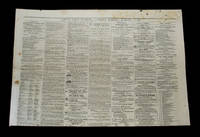
186369186Boston: Boston Daily Courier 1863. Full Description:<br> <br> LINCOLN Abraham. Emancipation Proclamation."President's Proclamation. Emancipation of Slaves in Rebellious States." Boston. Published in: Boston Daily Courier Volume LXXVIII no. 2. Friday Morning January 2 1863.<br> <br> The publication of Lincoln's Emancipation Proclamation in the Boston Daily Courier and one of if not the first official public announcements of the Final Emancipation Proclamation once it was signed and in effect as of January 1 1863. The Proclamation is featured at the top of the center column of page 3.<br> <br> We could find no other copies of this or any other January 2nd edition at auction and it is not mentioned in Eberstadt. Eberstadt's entry for the second edition of the "Final Proclamation" Eberstadt 9 states "Second edition. Apparently the only separate newspaper edition of the final proclamation and the earliest non-official edition. Printed on Friday evening January 2 1863 this Extra in point of chronological sequence was preceded only by the first official edition." Our present copy although not a separate newspaper edition was rushed to press and published in the Friday Morning edition of the Courier placing it's publication prior to Eberstadt 9.<br> <br> According to Eberstadt "A number of newspapers did not issue on January 2nd because of the previous day's holiday but most of those that did carried the final proclamation. Many of the others printed it on January 3rd." pg. 17.<br> <br> Broadsheet folio one large leaf folded along side to make four pages two leaves printed on recto and verso. Seven-column format. 26 x 19 inches; 655 x 490 mm. Light creases down the middle in both directions. A few minor closed tears. A large old ink signature along top margin of front page causing some bleed-through and foxing but not affecting text. Still a very good copy of this important declaration.<br> <br> Abraham Lincoln issued the preliminary Emancipation Proclamation on September 22 1862 stating that if the rebelling states did not cease fighting and rejoin the Union by January 1 1863 the slaves in those states would be set free. Once January 1st 1863 arrived President Lincoln signs and issues the final Emancipation Proclamation freeing the slaves in the Confederate states. The Boston Courier issued this early printing of Lincoln's Proclamation the very next morning January 2 1863. "<br> <br> HBS 69186.<br> <br> $8500. Boston Daily Courier unknown
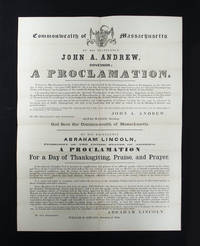
186368373Massachusetts 1863. LINCOLN Abraham. Massachusetts: 1863.<br> <br> Letterpress broadside 27 3/4 x 20 in.; 708 x 508 mm on paper incorporating several display and ornamental fonts as well as the seal of Massachusetts docketed on the verso "Post Office Hanover.' Some light offsetting. Nearly invisible professional repairs to the verso along the folds. A very nice example of this rare and important broadside<br> <br> This original broadside produced in Massachusetts is formatted in two halves with the top half being Governor John A. Andrew's announcement of Lincoln's Proclamation endorsing the observation of this day of Thanksgiving in his state dated July 27 1863 and the bottom half being Lincoln's actual proclamation dated July 15th 1863 and announcing that August 6th shall be set aside as a National Day of Thanksgiving. Though the exact printing date is unknown it can be assumed that it was printed within the week following July 27th.<br> <br> Thanksgiving was observed as a Holiday since colonial times and each state would set aside its own day for celebration. This proclamation was the first time that the Holiday would be celebrated on a set day nation wide making it the first observed Thanksgiving as a National Holiday.<br> <br> Though later the same year on October 3rd 1863 Lincoln made a second proclamation again announcing Thanksgiving as a Holiday but this time in November a date closer to the time most states had been celebrating it in the past. This earlier proclamation is actually the first time Thanksgiving was given national status but because the second proclamation was widely accepted the knowledge of this earlier one has been somewhat forgotten making this piece a rare and important document in the annals of American history.<br> <br> Though this broadside is for the State of Massachusetts no other broadsides from any other states that announce this date are known to exist and only three other copies of this rare document are located through OCLC.<br> <br> HBS 68373.<br> <br> $8500. Massachusetts unknown
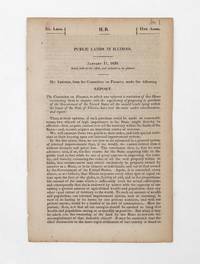
1839373003Vandalia Illinois 1839. First edition. 3 1pp. 8vo. Disbound. Housed in a morocco backed slipcase. First edition. 3 1pp. 8vo. Abraham Lincoln had yet to join the bar when he began his first stint in politics in the Illinois legislature in 1834 serving four consecutive terms in the Assembly through 1841. "This rare printing has the prestige of being the first occurrence of Lincoln's name as the sole author of a work. As a Whig lawmaker he was devoted to his party's program of public works through government financing. After the Panic of 18376 the spending he had advocated for had resulted in massive state debts. To relieve the budgetary burden Lincoln proposed that Illinois acquire land within its borders which the federal government still possessed and then sell the land at a fourfold profit to settlers and speculators resulting in both increased revenues and self-determined land ownership" Boroujerdi. Very rarethoma. Monaghan 1; Boroujerdi et. al. Abraham Lincoln: His Life in Print p. 29 unknown
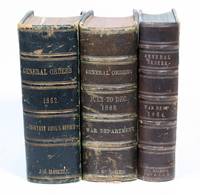
18622923Washington D.C.: War Department 1862. Calf marbled boards. Very Good. FIRST OBTAINABLE PRINTING OF THE PRELIMINARY EMANCIPATION PROCLAMATION setting a date for the freedom of more than three million enslaved in the United States and reframing the Civil War as a fight against slavery. Issued by the War Department to regimental commanders in the field during the Civil War in the week after the completion of President Lincoln’s official manuscript version. Contained is a set of three volumes of General Orders covering the full year 1862 July-Dec 1863 and the full year 1864. History of the Emancipation Proclamation:<br /> <br /> “The proclamation has been called by responsible persons one of the three great<br /> documents of world history ranking with Magna Carta and the Declaration of<br /> Independence†– Eberstadt<br /> <br /> “From the first days of the Civil War slaves had acted to secure their own liberty. The Emancipation Proclamation confirmed their insistence that the war for the Union must become a war for freedom. It added moral force to the Union cause and strengthened the Union both militarily and politically. As a milestone along the road to slavery’s final destruction the Emancipation Proclamation has assumed a place among the great documents of human freedom†– National Archives<br /> <br /> Following the Seven Days Battle and General McClellan’s retreat from the Peninsula at the end of June 1862 President Lincoln realized that there would be no early end to the war and found himself “as inconsolable as it was possible for a human to be and yet live.†Anxious for news from the army and needing to escape the constant interruptions at the White House he frequently visited the telegraph office in the War Department building to await dispatches. It was during one such visit early in July that he asked the chief of the telegraph staff Major Thomas Thompson Eckert for some paper to “write something special†and began the first draft of the Emancipation Proclamation completing it in a few weeks. Lincoln had long hoped to resolve the slavery issue through a congressional act of emancipation compensating slave owners for their loss of “property†but that approach was roundly rejected by representatives from the border states leaving the President who had decided upon the necessity of emancipation with a presidential proclamation as the only option. The extraordinary document he conceived would announce the liberation on January 1 1863 of all slaves in those states still in rebellion against the Union and promised compensation to slave owners in those states that returned to the fold before that time if they adopted “immediate or gradual abolishment of slavery.†This proclamation would be followed by a final proclamation issued on the 1st of January identifying those states still in rebellion and confirming the liberation of all slaves therein.<br /> <br /> On Tuesday July 22 Lincoln presented his draft to the Cabinet telling them that he had resolved firmly upon the course of action it specified and asking them not for advice but suggestions. The only observation he had not anticipated came from Secretary of State Seward who proposed that it might be best to wait for a military victory before issuing the Proclamation as it could otherwise seem like “the last measure of an exhausted government.†Immediately recognizing the wisdom of the suggestion Lincoln held back. On September 17 after an anxious wait of nearly two months he received the victory he needed at the bloody Battle of Antietam. Completing his final draft Lincoln presented it to his cabinet for refinement on September 22. Following the meeting Seward took the amended draft with him to the State Department where a formal manuscript copy was made then signed by Lincoln and Seward. The formal official “Emancipation Proclamation†was of course issued on January 1 1863 the day it became the law of the land.<br /> <br /> Printing History:<br /> <br /> This printing in the War Department’s official “General Orders†is the fourth printing overall but realistically the first obtainable printing. It is preceded by:<br /> <br /> -The first printing Eberstadt #1 a small three-page circular intended for distribution within the government and to the local press likely printed on September 22. At the time that Charles Eberstadt published his study of the Proclamation 1950 he was able to locate only one copy which he himself owned and as nearly as we have been able to determine no other copies have come to light since then.<br /> <br /> -The second printing Eberstadt #2 may be a phantom printing. Charles Eberstadt was not able to locate a copy but he inferred its existence from the standard State Department practice of printing a folio edition consisting solely of the text of the proclamation followed by another printing consisting of the text of a letter of transmittal from the Secretary of State as well as the text of the proclamation. While there may be a copy of Eberstadt #2 in the National Archives as he speculated it is not recorded in their online catalogue nor have we been able to find a copy in any other online catalogue including OCLC the Library of Congress and the Abraham Lincoln Library.<br /> <br /> -Eberstadt’s third printing is of legendary rarity. It consists of Secretary of State Seward’s one-page letter of transmittal addressed “To the Diplomatic and Consular Officers of the United States in foreign countries†and the text of the proclamation. Eberstadt located a total of only five copies in institutions at the Library of Congress the National Archives Yale the Clements Library and Brown. OCLC does not record any additional copies nor is it recorded in Monaghan. There has been one copy at auction $400000 in 2021 and that was described as the only copy in private hands. <br /> <br /> -The present copy General Orders No. 139 is Eberstadt’s fourth printing of the Preliminary Emancipation Proclamation dated in print on September 24. Eberstadt surmises that this field order printing could have been accomplished as late as September 29 or 30. Although it may have been printed in as many as 15000 copies it is very rare in commerce likely due to the ephemeral nature of the printing and distribution.<br /> <br /> Additional General Orders and Provenance:
<br /> <br /> The three volumes once belonged to John G. Haskell A.Q.M. Chief Quartermaster and contain the General Orders for the year 1862 July-December only for the year 1863 and for the full year 1864. John Gideon Haskell 1832-1907 was a resident of Kansas and joined the Union Army when the war broke out. He enlisted with the 14th Kansas Volunteer Cavalry Regiment and later served as Assistant Quartermaster General of Kansas as quartermaster of the Third Kansas and the Tenth Kansas Volunteers as Captain and Assistant Quartermaster on the staff of General James G. Blunt and as Chief Quartermaster of the Army of the Frontier. After the war Haskell was named official state architect and worked on the state house the capitol the State University and more.<br /> <br /> In addition to the preliminary Emancipation Proclamation the three volumes also contain the Acts of Congress on many other subjects including pay discharge recruitment handling of troops etc.<br /> <br /> Washington D.C.: War Department Adjutant General’s Office 1862-64. Three volumes. Small octavo contemporary three-quarter brown morocco two volumes with cloth boards one with marbled boards. Some rubbing and wear to bindings pencil notations on endpapers with collation and highlighting certain orders and some internal pages. Dampstaining to general title of 1862 volume; internal text and Emancipation Proclamation generally fine. RARE AND IMPORTANT.<br /> <br /> References:<br /> <br /> Charles Eberstadt. “Lincoln’s Emancipation Proclamation.†New York: 1950. War Department unknown
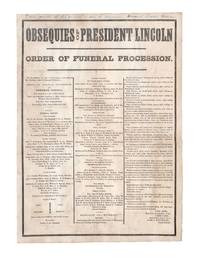
1865353589Springfield IL 1865. Broadside text in three columns mourning borders. Early manuscript note signed by Harriet Louise Greene in the upper margin "I was present at the funeral & saw the remains". 10-3/4 x 7-3/4 inches. Paper-backed at an early date with early newspaper clippings mounted on verso. Broadside text in three columns mourning borders. Early manuscript note signed by Harriet Louise Greene in the upper margin "I was present at the funeral & saw the remains". 10-3/4 x 7-3/4 inches. President Lincoln was assassinated on April 15 1865. His body lay in state in the White House on April 18 and a ceremonial funeral service took place in Washington D.C. around noon on April 19. Two days later President Lincoln's casket was loaded on a funeral train headed for Springfield Illinois stopping at Baltimore Harrisburg Philadelphia New York City Albany Buffalo Cleveland Columbus Indianapolis Michigan City and Chicago before arriving in Lincoln's adopted hometown early on the morning of May 3. <br /> <br /> Immediately upon arrival in Springfield Lincoln's coffin was transferred by hearse to Representatives' Hall inside the Illinois Old State Capitol. For the next twenty-four hours about 75000 mourners were allowed to pass by the open coffin of the slain president to pay last respects.<br /> <br /> According to the present broadside President Lincoln's funeral procession left the Old State Capitol "on Thursday the 4th Inst. at 10 o'clock a.m. precisely." The funeral party of over 10000 people then turned right on 7th Street to pass by the Lincoln family home and then right up Cook Street to proceed past the Governor's Mansion before heading north to Oak Ridge Cemetery.<br /> <br /> Surrounded by a heavy black band it lists all the persons and units involved their place in the procession and rules for the day. The entire procession was divided into eight divisions with Gen. Joseph Hooker acting as Marshal in Chief. The first three divisions were the military escort representing all the elements of the Army and Navy. After them came the attending clergy and Lincoln's attending physicians. Next was the casket itself the only wheeled vehicle in the procession with the pall bearers to each side followed by Lincoln's horse with reversed boots and then the immediate family. Next came government officials ambassadors and state officials followed by delegations from Springfield and other Illinois towns. Next were representatives of various organizations delegations from colleges lawyers doctors and the press. After this came Masons Odd Fellows and firemen. The final division was designated "Citizens at large. Colored Persons." Directions were given for the locations of each group forming up. Only marshals were allowed to be on horseback; all others walked. Bands were under the direction of the Committee on Music. Other particular directions complete the document.<br /> <br /> This broadside must have been widely distributed to assist the mourners but like all such ephemeral pieces few copies have survived. OCLC locates only six; at Indiana University the Abraham Lincoln Memorial Library the Boston Athenaeum the Chapin Library at Williams College the John Hay Library at Brown University and a copy formerly in the James S. Copley Library. There is also a copy at the Library of Congress. Two variants are recorded the other with a variant headline omitting "Order of" from title as well as a proof without the letters FUN of Funeral in the title. unknown
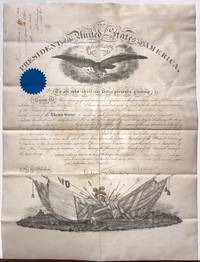
18638703<p>One partly-printed military commisssion on vellum signed by Lincoln as president and countersigned by Edwin M. Stanton as Secretary of War dated May 16th 1863. The document commissions Benjamin H. Geary as Second Lieutenant to the 13th Infantry Regiment on August 13th 1862. Accession note to top left.</p><p>The document measures 14.75 x 19.5 in</p>
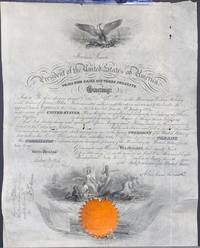
18638667<p>One partially printed vellum leaf dated February 21 1863 of the appointment of James Alden Jr. as a Captain in the Navy. Signed by President Abraham Lincoln and the Secretary of the Navy Gideon Welles. Orange embossed seal of the Department of the Navy to bottom. Previous owner's repair to upper right corner see image. Loses at folds see image. James Alden Jr. had an impressive career in the United States Navy having been appointed by Lincoln in aiding to split the Confederacy apart along the Mississippi River ultimately helping in the Battle of Vicksburg. Alden whose direct descendant came to America on the Mayflower assisted in the Mexican-American War before joining the Union during the Civil War.</p><p>The paper measures approximately 14.5 x 17.75 in 37 x 45 cm.</p>
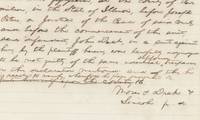
18573563230/10/1857. <p>John V. Drake and John C. Moses practiced law in Danville Illinois. They worked on cases appearing before the Vermilion County Circuit Court. When Abraham Lincoln had a case appearing in that court he would sometimes affiliate himself with Drake and Moses. Lincoln was before that court in October and November 1857.</p><p>Hezekiah Ballah sued John Deck and Zachariah Deck in a case heard in the Vermilion County Circuit Court. This was an action of trespass for castrating seventeen buck sheep and cutting up eight other ewes wethers and lambs. The Decks retained Lincoln who worked together with Drake and Moses in the case in October 1857. The Decks pleaded not guilty. Moreover John Deck also pleaded that he had been acquitted of the charge in Justice of the Peace court. The jury found the Decks not guilty. Hearing the case was Judge David Davis who Lincoln would one day name to the U.S. Supreme Court.</p><p><strong>Autograph document signed</strong> a draft pleading completely in Lincoln’s hand Vermilion County Circuit Court October 1857 being the pleading informing the Court that Deck had previously been acquitted of the same offense. The name of the case was John Deck impleaded with Zachariah Deck ads vs Hezekiah Ballah and it was filed In Trespass. <em>“And the said defendant John Deck comes and defends the force and injury…and says plaintiff actio non fails to act when there is a duty to act because he defendant says he is not guilty in manner and form as is in the declaration alleged; and of this he puts himself upon the country etc. citizens in a court or jury. Moses & Drake & Lincoln p.d.â€</em></p><p>Lincoln adds below: <em>“And for further plea in this behalf defendant John Deck says plaintiff actio non because he says that heretofore to wit on the __ day of __ in the year of our Lord one thousand eight hundred and fifty seven at the county of Vermillion in the state of Illinois before Joseph Peters a Justice of the Peace of said county and before commencement of this suit said defendant John Deck in a suit against him by the plaintiff herein was lawfully judged to be not guilty of the same identical supposed trespass in this declaration mentioned and this he is ready to verify therefore he prays judgment etc. Moses & Drake & Lincoln p.d.â€</em> The case is listed at lawofficeofabrahamlincoln.org.</p><p>An interesting pleading where Lincoln’s client has already been acquitted of the same offense.</p><p><img class=""alignnone wp-image-25018 size-post-window"" src=""https://cdn.raabcollection.com/wp-content/uploads/20231204144051/Folder-site-11-1600x1327.jpg"" alt="""" width=""1600"" height=""1327"" /></p> unknown
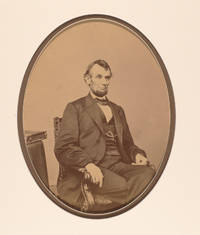
186442820809<p>Oval albumen print 8 x 6 in. original printed mount trimmed at bottom removing caption signed "BRADY & CO. PHOTOGRAPHERS." Browning and offsetting to mount light toning to image. Very good. Matted and framed.</p><p><strong>The classic Brady $5 bill photograph.</strong> This celebrated portrait the basis for the five-dollar bill engraving used for most of the 20th century is one of seven poses taken by Anthony Berger at Mathew Brady's Washington D. C. studio on February 9 1864. The most prolific photographer of Lincoln Brady himself did not actually operate his cameras during the war years instead training and employing men like Alexander Gardner and his successor Anthony Berger who took this picture to operate the camera.</p><p><strong>Lincoln's son Robert Todd Lincoln declared this famous portrait to be "the most satisfactory likeness" of Abraham Lincoln.</strong></p> Mathew Brady Gallery
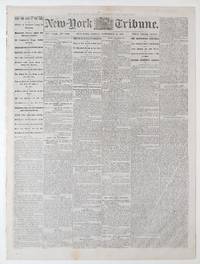
1863372898New York 1863. 8pp. printed in six columns on a single folded sheet. Large folio. Disbound. Natural paper flaw to first leaf not affecting text of the Gettysburg Address. Cloth portfolio. 8pp. printed in six columns on a single folded sheet. Large folio. The complete issue of the New-York Tribune printing the Gettysburg Address on the morning of Nov. 20 1863 the first possible date of the speech's printing. The previous day Lincoln delivered his great address at the dedication of a cemetery on the Gettysburg battlefield four months after the bloody and pivotal battle that turned the tide of the Civil War in favor of the Union. Lincoln's speech was preceded by an address from Edward Everett the most famous orator of his day. Everett's speech took between ninety minutes and two hours to deliver and today is largely forgotten. Lincoln's speech delivered in only a few minutes stands as a supreme distillation of American values and of the sacrifices necessary for the survival of liberty and freedom.<br /> <br /> Much controversy surrounds the circumstances and content of the address as it was actually delivered at Gettysburg. The words spoken in the speech differ in the versions appearing in newspapers and the text which appeared in Washington several days later published as The Gettysburg Solemnities and known in only four copies which is now taken as the closest version to Lincoln's final intent because of its correspondence to the known manuscript versions. Interestingly and according to Carbonell the text of the first appearance of the speech in book form published a few days later as An Oration Delivered on the Battlefield of Gettysburg is taken largely from this New York Tribune printing.<br /> <br /> As it appears here the address corresponds closely to the transcription printed in the same day's edition of the New York Times with slight variations in punctuation and capitalization "Four score and seven years ago our fathers brought forth on this continent a new Nation." in the Tribune versus "Fourscore and seven years ago our Fathers brought forth on this Continent a new nation." in the Times e.g. The address is printed on the first page at the bottom of the fifth column running to the top of the sixth. Significantly it notes the five places during Lincoln's speech where applause broke out thereby providing an important historical record of the reception of the speech as it was delivered by Lincoln. It is noted that the conclusion of the speech was met with "long continued applause" and that "three cheers were here given for the President and the Governors of the States." Lincoln's speech is preceded by the opening prayer of the Rev. Thomas H. Stockton and followed by Everett's speech which occupies the rest of the sixth column and the vast majority of space on page two. War news occupies the other column space on the front page.<br /> <br /> Together with examples from other newspapers of Nov. 20 1863 this issue of the New-York Tribune represents the first appearance of any version of the Gettysburg Address in print although at some variance with the version Lincoln eventually disseminated. The exact order in which the morning editions of November 20 were printed is practically impossible to determine at this point and as Carbonell states "will almost certainly never be known." Rightfully so Carbonell includes all November 20 morning newspaper printings of the Gettysburg Address as his first entry with no priority. Suffice to say this is as early a printing of one of the foundational documents of American life as one can ever encounter.<br /> <br /> "Lincoln's speech composed on the train on the way to Gettysburg and written down according to tradition on scratch-paper and the backs of envelopes comprised ten sentences and took only a few minutes to deliver. From the first words - 'Four score and seven years ago' - to the last - 'that government of the people by the people and for the people shall not perish from the earth' - it is immortal one of the supreme utterances of the principles of democratic freedom" PMM. Carbonell 1. Grolier American 100 72 ref. Streeter Sale 1748 ref. PMM 351 ref. Howes E233 ref. Monaghan 192 ref. Paul M. Angle "Four Lincoln Firsts" in Papers of the Bibliographical Society 36 Spring 1942 pp.13-17 unknown
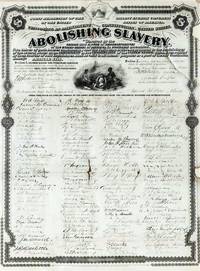
1868019219Chicago: Western Bank Note & Engraving Co. 1868. First Edition. Document. Recently backed with thin paper with several professional repairs of chips and tears. Very Good . Large folio 16-1/4" x 21-3/4" finely engraved and printed on good quality paper with elaborate decorative borders with a "US" monogram to upper corners a bold calligraphic heading with "ABOLISHING SLAVERY" in prominent decorated letters; at top center is a small vignette of the pyramid and all-seeing eye above an oval vignette of a slave family with child mourning over a cameo portrait of Lincoln. This is followed by the engraved signatures of President Lincoln Vice President Hamlin Schuyler Colfax and J. W. Forney Speaker and Secretary of the Senate and 164 Senators and Congressmen. An exceedingly rare and beautiful printing of the Thirteenth Amendment abolishing slavery: "Neither slavery nor involuntary servitude . Shall exist within the United States." This elaborately engraved Reconstruction-era broadside is based on the special "souvenir" copies on parchment signed by Lincoln and the others of which only a handful are known to have been made. The Thirteenth Amendment represents the first substantive change to how America interpreted those liberties guaranteed by the Bill of Rights since its ratification in 1791. The Emancipation Proclamation only freed the slaves in the openly rebellious states. The Amendment effectively put an end to slavery once and for all upon its passage on 1 February 1865. <br/><br/> Western Bank Note & Engraving Co. unknown
18623568928/02/1862. <blockquote><p>He was later promoted to Lt. Colonel for gallantry in action at the Battle of Groveton</p></blockquote><p><strong>Document signed</strong> with fine engravings of an eagle flags and cannons Washington February 28 1862 naming Percy B. Spear a Commissary of Subsistence of Volunteers with the rank of Captain effective November 30 1861. The document is countersigned by Secretary of War Edwin M. Stanton. The appointment is listed in the U.S. Army Register.</p><p>The Civil War Commissary Department was responsible for procuring storing and distributing food to soldiers. The rations managed by the department included such things as pork beef bread coffee and soap.</p><p>But Spear did not serve solely as a Commissary for the entire war. He would soon serve an aide-de-camp in the Fifth Corps in the Gettysburg campaign with Gen. James Barnes mentioning him with distinction in dispatches. Spear ended the war as a Brevet Major. In July 1865 he was appointed Lt. Colonel of Volunteers for meritorious service and for gallantry in action at the Battle of Groveton in 1862. After the war he was again named Commissary of Subsistence this time at the recommendation of Gen. George G. Meade.</p><p><img class=""alignnone wp-image-25018 size-post-window"" src=""https://cdn.raabcollection.com/wp-content/uploads/20231204144051/Folder-site-11-1600x1327.jpg"" alt="""" width=""1600"" height=""1327"" /></p> unknown
18533514603/11/1853. <blockquote><p>The case is well known and illustrates Lincoln’s penchant for aiding women who had been unjustly treated</p></blockquote><blockquote><p>""Said answers are untrue uncertain and insufficient that her Bill is true certain and sufficient and he Lincoln will so prove it to be""</p><p> </p></blockquote><p>During his 25-year legal career in Illinois Abraham Lincoln was involved in a substantial number of cases involving women as litigants. He was known for seeking to represent women and working to get justice for them in an era when women’s cases were often shunned by lawyers or not taken seriously.</p><p>Lincoln handled some 147 divorce cases about 40% of all divorce cases in his home county of Sangamon. Importantly more than half of the litigants he represented were women. He handled these cases with ""tender consideration"" learning from experience that the law could be a dangerous place for women who had few rights under the legal doctrines of the time. Lincoln also represented women in cases involving land disputes and in slander lawsuits which often involved accusations of adultery and were important for maintaining a woman's community reputation.</p><p>Lincoln was known for taking cases for women where he felt justice was on his client's side. Notable examples include: Nance Legins-Costley - In 1841 Lincoln successfully represented this African American woman to prevent her from being sold into slavery arguing that slavery was illegal in Illinois; Melissa Goings - He defended Mrs. Goings an elderly woman charged with her abusive husband's murder in a case based on self-defense; Doshia Wyatt - In 1853 Lincoln took on the case of Mrs. Wyatt a widow whose claim was that she was being cheated out of her inheritance.</p><p>A petition for dower is a legal request filed by a surviving spouse typically a widow to claim a portion of their deceased spouse's estate such as in real property based on common law dower rights. This is a formal process that requires the surviving spouse to file a petition in court describing the property and naming the heir or person with the next immediate estate of inheritance. The court then holds a hearing to determine the rights to dower and the property.</p><p>Doshia Wyatt widow of Robert Wyatt retained Lincoln and sued for her dower. Thomas Wyatt died in 1847 and left all of his property to his son Robert. Robert Wyatt lost part of the land the Mill Farm to satisfy a judgment against him in the U.S. District Court of Illinois. Robert Wyatt sold another property the Prue Farm to George Brewner. After Robert Wyatt's death in 1852 Doshia Wyatt sued Leonard and Brewner's heirs. Leonard contested the petition claiming that he did not believe Doshia and Robert Wyatt had been legally married. Leonard also claimed that Robert Wyatt had already left Doshia Wyatt land in his will which Leonard claimed was recorded.</p><p>Hearing the case was Judge David Davis a friend of Lincoln whom as President he would appoint to the U.S. Supreme Court. Ward Hill Lamon Lincoln’s co-attorney on the case began his professional association with Lincoln in 1852 when they became law partners. Though they had different styles they remained close personal and professional friends. After the partnership dissolved in 1857 their friendship continued and Lamon would later become Lincoln's bodyguard and U.S. Marshal for the District of Columbia during Lincoln's presidency. As the bodyguard Lamon was not in Washington on the night of Lincoln’s assassination being on assignment in Richmond at Lincoln’s request. In his Recollections of Abraham Lincoln Lamon reveals that before he left for Richmond he implored the President not to ""go out at night after he was gone particularly to the theatre.""</p><p>This document relates to the case of Doshia Wyatt. In a petition to the Court filed by Lincoln Wyatt stated her case: “Your petitioner would further represent to your honor that she your petitioner is the widow of the said Robert Wyatt — that she has never relinquished her dower to the said aforesaid land or any part thereof - nor has her dower ever been set off - or assigned her in said premises - that said Robert Wyatt on or about the 28th of July AD 1852 departed this life leaving her the said Doshia widow as aforesaid…Your petitioner would further pray that this honorable court appoints commissioners to assign her dower in & to all of the above described tracts or parcels of land according to the statue in such cases made and approved. And your petitioner would pray for such & gather relief as may be according to equity and good conscience and as in duly abound your petitioner will ever pray.â€</p><p>This is a pleading in Lincoln’s hand which contains the answer of Wyatt to the defendants’ responses to her allegations. <strong>Autograph document signed</strong> Vermillion County Illinois Circuit Court November 3 1853. <em>“The replication response of Doshia Wyatt to the defendants’ answers filed in the case for her Petition for Dower in the Vermillion Circuit Court against Peter R. Leonard and others. This repliant respondent says that said answers are untrue uncertain and insufficient that her Bill is true certain and sufficient and he Lincoln will so prove it to be as this Honorable Court shall direct. Lincoln & Lamon for Repliant respondent.â€</em> On the verso Lincoln has docketed the document <em>“Dosha Wyatt vs Peter R. Leonard Replication.â€</em> The clerk of court Samuel Craig then notes that the plea was filed on November 3 1853.</p><p>An uncommon document in Lincoln’s hand concerning his representation of women. As for the case the parties likely reached a settlement as Wyatt ended up dismissing the case while Leonard paid the costs.</p><p><img class=""alignnone wp-image-25018 size-post-window"" src=""https://cdn.raabcollection.com/wp-content/uploads/20231204144051/Folder-site-11-1600x1327.jpg"" alt="""" width=""1600"" height=""1327"" /></p> unknown