LINCOLN, AbrahamBiblio.com
575 résultats
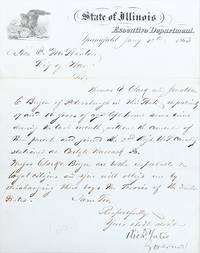
1863192290Springfield Illinois: 22 January 1863. Lincoln intercedes for two runaway boys On the verso of a letter to Stanton from Illinois Governor Richard Yates 1815-1873 the president writes "The families to which these boys belong are among my old acquaintances. A. Lincoln. Jan. 22 1863". Yates 1815-1873 was a longtime friend of Lincoln's. His letter dated 12 January 1863 states that "Thomas E. Clark and Jonathan C. Bergen of Petersburg in this state respectively 17 and 16 years of age left home some time during the last month without the consent of their parents and joined the 2nd Reg't U.S Cavalry stationed at Carlyle Barrack Pa". Yates requests to Stanton that "Messrs Clark & Bergen are both respectable & loyal citizens and you will oblige me by discharging these boys from the service of the United States". Petersburg Illinois is near New Salem where Lincoln lived from 1831 to 1837. Lincoln also received letters from the fathers George S. Bergen and David Clark which he referred to the Adjutant General of the Army Lorenzo Thomas on 21 January Collected Works of Abraham Lincoln Vol. 8 1953 p. 509. Although no one under 18 could legally enlist without the written consent of a parent or guardian many did so. By one recent estimate underage enlistees accounted for roughly a tenth of the Union forces Clarke & Plant. Parents filed thousands of petitions with Union authorities and state courts to secure their children's discharge. Here the families were sufficiently well-connected to appeal at the highest level; Lincoln's endorsement implies that the request was granted. Provenance: Elsie O. and Philip D. Sang their sale at Sotheby Parke Bernet 1978 lot 484; Louise Taper Beverly Hills California; acquired by the Abraham Lincoln Presidential Foundation as part of the Taper Collection 2007; sold by the Foundation at Freeman's Hindman in their Lincoln's Legacy sale 2025 lot 78. Single sheet on State of Illinois Executive Department letterhead 253 x 197 mm handwritten by Yates on recto endorsed by Lincoln on verso alongside a note it was forwarded to Stanton. Central folds repaired still in very good condition. The endorsement is published in Roy P. Basler The Collected Works of Abraham Lincoln First Supplement 1974 page 175. Frances M. Clarke & Rebecca Jo Plant Of Age: Boy Soldiers and Military Power in the Civil War Era 2022. unknown
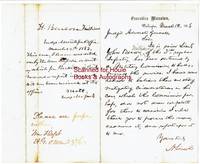
1863604602"A. Lincoln" in black ink on Executive Mansion Washington letterhead March 18 1863. 5" x 8" 1 page with integral leaf. Very good. Integral blank with an autograph endorsement signed by Holt and clerical endorsement from the Adjutant General's office. To Judge Advocate General Joseph Holt: Lincoln requests his Judge Advocate General to investigate the "Strong Mitigating Circumstances" surrounding the court-martial of a member of the West Point Class of 1861. "It is said Lieut. John Benson Williams of the 3rd regular infantry as been sentenced by a Military Commission to be dismissed the service. I have some reason to believe there are strong mitigating circumstances in his case which the Commission perhaps did not deem competent for them to consider I will thank you to procure the record examine it and report it to me. . ." Holt forwarded Lincoln's letter to the Adjutant General noting that "No record or report in regard to the Williams case has been received at this office." The letter was returned to Holt accompanied by the record of William's court-martial and docketed "Please see papers within." After studying the record Holt made a lengthy report to Secretary of War Stanton March 30 1863 which survives in the Abraham Lincoln Presidential Library. Holt dismissed the "mitigating circumstances" referenced by Lincoln - Williams's supposedly "severe sickness" - and concluded that "It is evident that Lieut. Williams left his command on the battlefield and returned to Washington without leave and in known violation of orders and of his duty. . . .He has shown himself disqualified for the profession of arms." On April 8th Stanton in turn forwarded Holt's deposition to the President "as requested by his note on the 18th Ulto" that is the present letter. Lincoln ended the matter with his own terse endorsement on April 11th: "I decline to interfere in Behalf of Lieut. Williams" Basler 4:169. Although referred to in Basler's note regarding Lincoln's endorsement the present letter does not appear in "The Collected Works of Abraham Lincoln".<br /><br />Extra shipping required.<br /><br />
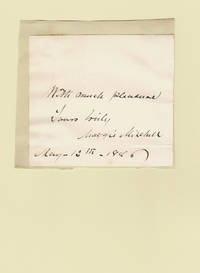
1886101012<p>New York May 12th and July 26th 1886. 1886. Very good. - Two autograph sentiments alternately penned on 4 inch high by 4-3/8 inch wide and 4-7/8 inch high by 4-3/8 inch wide paper mounted with glue from the verso onto both sides of sheet clipped from an autograph album. The first penned by the famous American actress reads "With much pleasure / Yours truly / Maggie Mitchell / May 12th - 1886". The second penned by the American character actor reads "Very Truly Yours / W.S. Daboll / N.Y. City / July 26th 1886". Both were once folded and are in very good condition.</p><p>Born in New York the American actress Maggie Mitchell 1832-1918 made her debut in 1851 as Julia in "The Soldier's Daughter". She earned much fame for her roles in Jane Eyre Mignon Little Barefoot and Fanchon the Cricket. Once a supporter of the Confederacy she was a close friend of John Wilkes Booth but she later moderated her views and was admired by Abraham Lincoln who enjoyed her performances at Ford's Theatre and had her over for tea in the Executive Mansion.</p><p>The prominent American actor W.S. Dobell d 1892 was known for his role as Ravennes in a popular comic opera "Erminie". At the age of 35 Daboll committed suicide by poison on August 23 1892 while in Boston engaged to appear in "Puritania" at the Tremont Theatre.</p> New York, May 12th and July 26th, 1886.
1863601017in black ink as President Washington D.C. December 23 1863. Six lines plus signature and date on verso of the integral blank of an Autograph Letter Signed from General John M. Schofield Washington D.C. December 23 1863. Octavo. 2 pages. Fine fresh example dark and clean. In his letter Schofield addresses his commander in chief deferentially: "Mr. President I desire simply to ask you if I may be absent from Washington a few days pending the settlement of my affairs I wish to spend Christmas day with my relatives at West Point. If there is any reason for my remaining here of course I do not wish to go." On verso Lincoln writes: "Not the slightest objection to Gen. Schofield's visiting West Point so that he be in call by Telegraph." This letter serves as an interesting footnote to the long-simmering problem in Missouri where Schofield had been in command. A slave state Missouri had seethed with pro and anti-slavery conflicts and was terrorized by armed bands of southern sympathizers. Schofield and the provisional governor had engaged in bitter jurisdictional quarrels until all factions finally united to criticize Schofield for his "high-handed" administration and demand his removal. In early December 1863 a congressman who had visited Missouri told Lincoln first hand of Schofield's increasing difficulties prompting the President on December 11 to telegraph a simple order to Schofield: "Please come see me at once." After his White House interview Lincoln recommended that Schofield be promoted to major general transferred and Rosecrans appointed to take his place. Lincoln's recommendation was quickly approved by the Senate. Schofield 1831-1906 Graduated West Point 1853. In Missouri at the outbreak of the Civil War he became chief of staff to Gen. Nathaniel Lyon and served until Lyon’s death at the battle of Wilson's Creek August 1861. Promoted brigadier-general of volunteers in November he was engaged in field operations in Missouri and later commanded the Department of the Missouri as major-general. Assuming command of XXIII Corps in February 1864 he took part in Sherman's Atlanta campaign as one of the three army commanders and badly shattered Hool's confederate force at the fierce battle of Franlklin Tenn. Moving the XXIII Corps to the mouth of the Cape Fear river He occupied Wilmington N.C. and effected a junction with Sherman at Goldsboro March 23 1865 for the final moves against Gen. J.E. Johnston. In the spring of 1868 served briefly as U.S. secretary of war. Promoted major-general regular army 1869 he commanded several departments successively and made the recommendations that led to the acquisition of Pearl Harbor Hawaii as a naval base. Superintendent at West Point 1876-81. Lincoln 1809-65 16th President of the United States 1861-65 and one of the most important figures in American history. Signed by Authors. F. Soft cover. unknown books
18636046011863. "A. Lincoln" in black ink Washington DC May 12 1863 being 7 lines on the verso of the second leaf of an autograph letter to Lincoln from Robert Chester Buffalo May 9 1863 2 pages; 7 7/8" x 12 3/4" on a bifolium of blue-ruled paper neatly reinforced at folds. Lincoln deals with an officer seeking "An Honorable Discharge & to Avoid a Dishonorable One." Robert Chester who identifies himself as "late Capt. 17th Infantry US Army" petitions the President: "I would most respectfully request a suspension of Special Orders No. 201 Extract 4 by which I am dismissed the service of the United States. The reasons for such request are that my case has not been properly submitted to Your Excellency. I would respectfully ask that the order my be suspended until a Court of Inquiry or Court Martial; can be convened when I may have the opportunity to defend myself." Chester's appeal is joined by ten other prominent citizens of Buffalo including her postmaster one the justices of the city's Superior Court and three Union officers hailing from the Bison City. Lincoln forwarded Chester's petition to Judge Advocate General Joseph Holt directing him to "please examine & report on this case. The officer only seeks an honorable discharge & to avoid a dishonorable one." Nothing further on the case is recorded and Holt - influenced perhaps by the President's none-too-subtle insinuation - evidently found no merit to Chester's claim. See "The Collected Works of Abraham Lincoln" ed. Basler Supplement: 187. Signed by Authors. No Binding. Very Good/No Jacket. unknown books
1864WRCLIT85064Baltimore: Cushings & Bailey 1864. xi2001pp. Quarto. Polished plum-colored cloth stamped in gilt and blind. Lithographed manuscript facsimiles and illustrations. Spine a shade sunned with shallow chips at crown and toe slight edge-wear a bit of foxing early and late old French bookseller's description in corner of verso of front free endsheet offset through tissue to upper blank portion of title old offset from an ancient and absent floral specimen in gutters of pages 42-3 generally a very good copy. First edition of this considerable undertaking to raise funds contemporary with the Baltimore Sanitary Fair to support relief for the aid of soldiers and their families. Includes faithful facsimiles of the contributors' works and includes the first facsimile of Lincoln's handwritten Address Delivered at the Dedication of the Cemetery at Gettysburg. Other facsimiles of works by other important 19th Century authors include: Francis Scott Key Edward Everett Washington Irving Harriet Beecher Stowe Nathaniel Hawthorne John Audubon Oliver Wendell Holmes Henry Wadsworth Longfellow Herman Melville Ralph Waldo Emerson Henry David Thoreau William G. Simms J.J. Audubon and many many others. Melville's "Inscription to the Slain at Fredericksburg" was not collected in book form until 1947. BAL 2418 13672 etc. Cushings & Bailey hardcover books
1864D16155Baltimore: Cushings & Bailey 1864. First Edition. First and only edition extra-illustrated with approximately 65 inserted portraits. Full red pebbled morocco gilt dated 1882 on the spine rebacked with the original spine laid down the covers panelled in gilt the spine tooled and lettered in gilt with the initials "W.H.W." at the foot. 10 x 8 inches 25.5 x 21 cm; with lithographed title and approximately 65 mostly engraved or lithographed portraits inserted three are original drawings including one of Julia Ward Howe xi lithographed contents 200 pp. lithographed fascsimiles of the handwriting of the authors. Intermittent foxing the inserted portraits have offset to the text leaves opposite rebacked as noted and lightly rubbed. <br/><br/>This volume produced at the time of the 1864 Baltimore Sanitary Fair contains what is considered the first reproduction of the Gettysburg Address in Lincoln's hand. The facsimile was made from what is now known as the "Bliss Copy" of the address the fifth and final manuscript copy of the address that Lincoln executed at the request of the editors of this volume. Other authors represented here include Emerson Poe Melville Hawthorne and many other notables of the period. Cushings & Bailey unknown books
18636046021863. "A. Lincoln" in black ink on Executive Mansion Washington letterhead March 18 1863. 5" x 8" 1 page with integral leaf. Very good. Integral blank with an autograph endorsement signed by Holt and clerical endorsement from the Adjutant General's office. To Judge Advocate General Joseph Holt: Lincoln requests his Judge Advocate General to investigate the "Strong Mitigating Circumstances" surrounding the court-martial of a member of the West Point Class of 1861. "It is said Lieut. John Benson Williams of the 3rd regular infantry as been sentenced by a Military Commission to be dismissed the service. I have some reason to believe there are strong mitigating circumstances in his case which the Commission perhaps did not deem competent for them to consider I will thank you to procure the record examine it and report it to me. . ." Holt forwarded Lincoln's letter to the Adjutant General noting that "No record or report in regard to the Williams case has been received at this office." The letter was returned to Holt accompanied by the record of William's court-martial and docketed "Please see papers within." After studying the record Holt made a lengthy report to Secretary of War Stanton March 30 1863 which survives in the Abraham Lincoln Presidential Library. Holt dismissed the "mitigating circumstances" referenced by Lincoln - Williams's supposedly "severe sickness" - and concluded that "It is evident that Lieut. Williams left his command on the battlefield and returned to Washington without leave and in known violation of orders and of his duty. . . .He has shown himself disqualified for the profession of arms." On April 8th Stanton in turn forwarded Holt's deposition to the President "as requested by his note on the 18th Ulto" that is the present letter. Lincoln ended the matter with his own terse endorsement on April 11th: "I decline to interfere in Behalf of Lieut. Williams" Basler 4:169. Although referred to in Basler's note regarding Lincoln's endorsement the present letter does not appear in "The Collected Works of Abraham Lincoln". Signed by Authors. No Binding. Very Good/No Jacket. unknown books
1865100185Montauk" Montauk Navy Yard Wash D.C. 34 1865. 4 pp. 8vo. Slight soiling and minor tears along old folds otherwise in very good condition. 4 pp. 8vo. The Surgeon of the 'Montauk' Gives an Eye-Witnesses Account. ".About 10:25 P.M. a man came in and walked slowly along the side ." A remarkably clear and dramatic eyewitness account of the assassination of Abraham Lincoln from a naval surgeon who was close to the President's box at Ford's theater on that fateful night of April 14 1865. In this letter to his brother written the night after the assassination while the details were still fresh in his memory Dr. George B. Todd surgeon aboard the U.S. "Montauk" at anchor in the Navy Yard that day recounts the terrible event with a clarity of observation one might expect of his profession - a rarity among confused eyewitness accounts. The text of Todd's letter - one of only 7 eyewitness accounts written within 24 hours of the assassination - reads: "The few hours that have intervened since that most terrible tragedy of last night have served to give me a little clearer brain and I believe I am now able to give you a clear account up to this hour. Yesterday about 3 P.M. the President and wife drove down to the navy yard and paid our ship a visit going all over her accompanied by us all. Both seemed very happy and so expressed themselves - glad that this war was over or so near its end and then drove back to the White House. In the evening nearly all of us went to the Ford's Theatre. I was very early and got a seat near the President's private box as we heard he was to be there. About half past nine he came in with his wife a Miss Harris and Major Rathburn and was cheered by every one. As soon as there was a silence the play went on and I could see that the "pres." seemed to enjoy it very much. About 10:25 P.M. a man came in and walked slowly along the side on which the 'pres.' box was and I heard a man say "there's Booth" and I turned my head to look at him. He was still walking very slow and was near the box door when he stopped took a card from his pocket wrote something on it and gave it to the usher who took it to the box. In a minute the door was opened and he walked in. No sooner had the door closed then I heard the report of a pistol and on the instant Booth jumped out of the box onto the stage holding in his hand a large knife and shouted so as to be heard all over the house - 'Sic Semper Tyrannis' "so always with tyrants" and fled behind the scenes-I attempted to get to the box but I could not and in an instant the cry was raised 'The President is Assassinated.' "Such a scene I never saw before. The cry spread to the street only to be met by another 'So is Mr. Seward.' Soldiers had gone. Some General handed me a note and bid me go to the nearest telegraph office and arouse the nation. I ran with all my speed and in ten minutes the sad news was all over the country. Today all the city is in mourning nearly every house being in black and I have not seen a smile. No business and many a strong man I have seen in tears. "Some reports say Booth is a prisoner others that he has made his escape but from orders received here I believe he is taken as a mob once raised now would know no end. I will not seal this until morning and I may have some more news. "April 24th. "I have had no time to write until now as I have been a detective. We have now 7 that are implicated. Why don't you write Love to all George" Several important facts regarding the movements of both the President and John Wilkes Booth are recorded here: 1 This appears to be the only eyewitness account of the President's inspection of the "Montauk" earlier that afternoon. 2 Todd's account of Booth's interaction with the "usher" sitting outside the President's box "took a card from his pocket wrote something on it and gave it to the usher" is especially intriguing and reveals not only something of Todd's powers of observations but also his proximity to the assassin immediately before the shooting. Todd alone among eyewitnesses notes that the "usher" first took the card from Booth then went into the box and that a short time later the door opened and Booth went in. In fact Good finds only 7 other eye-witness accounts of the Lincoln assassination as early as April 15 -- most of these witnesses record little or nothing regarding the events before hearing the shot itself and none of them noticed Booth's interchange with the usher who was in fact Lincoln's valet Charles Forbes. There are three other accounts by eyewitnesses which partially corroborate Todd's observation of the Forbes and Booth interchange -- but they were written much later than Todd's. 3 Todd's observation of the time he spotted Booth moving toward the box "about 10:25" corresponds to Good's own conclusion that Booth fired the fatal shot close to 10:30 PM. According to James Swanson MANHUNT p. 419 "the exact time of Booth's shot cannot be fixed . Booth may have shot Lincoln as early as 10:13 or as late as 10:30" Todd's account - again one of the freshest and most reliable weighs heavily in favor of Good. 4 Todd by his own account played a role in alerting the nation by telegraph. 5 Although he doesn't mention it as a surgeon of the ironclad Montauk Todd was also probably present at the autopsy of John Wilkes Booth on Thursday April 27 in the gun room of his ship. Indeed in an article in the February issue of the Baltimore and Ohio Magazine 1926 where the letter was first published and reproduced Todd is reported to have been "one of the surgeons who performed the autopsy." That as well as the fact that the other prisoners were being held on board the ironclad "Montauk" and "Saugus" may explain his cryptic remark near the end ". I have been a detective .". Todd actually mailed the letter on April 30 3 days after the autopsy and may very have participated in the actual investigation of the captives aboard the "Montauk." AN EXTRAORDINARY AND UNIQUE RECORD OF ONE THE NATION'S GREAT TRAGEDIES. Published from a copy in the State Historical Library of Wisconsin in Timothy S. Good WE SAW LINCOLN SHOT U. of Miss. 1995; with the mistaken date of April 30 1865 unknown books
1878A151-1737Wien, Kaiserlich-K?nigliches Milit?r-Geographisches Institut, 1878. Heliogravure in Kupfer vervielf?ltigt durch Umdruck vom Steine., Blatt ca. 51x 45 cm, Kartenbild; ca. 48 x 42 zu 6 Segmenten auf Leinen aufgezogen; Zustand: sehr gut
1878A151-1415Wien, Kaiserlich und K?nigliches Milit?r-Geographisches Institut, 1878. Heliogravure in Kupfer vervielf?ltigt durch Umdruck vom Steine., Blatt ca. 51x 45 cm, Kartenbild; ca. 48 x 42 zu 6 Segmenten auf Leinen aufgezogen; Zustand: sehr gut
1878A151-2168Wien, Kaiserlich und K?nigliches Milit?r-Geographisches Institut, 1878. Heliogravure in Kupfer vervielf?ltigt durch Umdruck vom Steine., Blatt ca. 51x 45 cm, Kartenbild; ca. 48 x 42 zu 6 Segmenten auf Leinen aufgezogen; Zustand: sehr gut
188655411Boston: Roberts Brothers 1886. Second edn. 8vo pp. 536 plus advertisements. Index. Marbled paper 3/4 brown calf little rubbed a very good copy. Inscribed on the end paper: "Maud C. Eastman Granby Mass Compliments of The Author Mary J Lincoln" See Bitting page 288 for the 1896 edition. Grolier Club One Hundred Influential American Books Printed in Before 1900 page 116-117; Cagle 478 the first edition. According to the preface the work was "undertaken at the urgent request of the pupils of the Boston Cooking School who have desired that the receipts and lessons given during the last four years in that institution should be arranged in a permanent form. Roberts Brothers unknown books
1865106234<p>Newspaper folio 21" x 28" eight columns 4 pp. Chips and folds in margins center page crease folded a couple of holes at folds with some loss some soiling aging and darkening; otherwise fair to good. Dated May 31 1865 this local Boston paper carries two stories about the Lincoln assassination. Both articles start on front page. The first discusses the trial of the conspirators and the second deals with the trial also but presents information about the individuals involved. Back page has the usual ads. </p>
1865106234<p>Newspaper folio 21" x 28" eight columns 4 pp. Chips and folds in margins center page crease folded a couple of holes at folds with some loss some soiling aging and darkening; otherwise fair to good. Dated May 31 1865 this local Boston paper carries two stories about the Lincoln assassination. Both articles start on front page. The first discusses the trial of the conspirators and the second deals with the trial also but presents information about the individuals involved. Back page has the usual ads. </p> books
1865834751865. PRESIDENTS - LINCOLN. BOSTON EVENING COURIER MAY 8 1865: LINCOLN ASSASSINATION INVESTIGATION. Four page newspaper folded twice. Edgewear a few closed tears at edges not affecting text. Excellent condition otherwise. Contains letter from W. C. Cleary contesting his involvement in the assassination European reactions short articles concerning the investigation. unknown books
1890CAT000008Boston: Roberts Brothers Publishers 1890. Hardcover. Very Good/No Dust Jacket. Publishers boards with an illustrated version of the title printed in brown and a brown cloth spine moderate wear to boards illustrated with a woodcut butchering guide. 237pp plus advertisements. Signed by owner E.P Flagg 1890 and contains two manuscript letters regarding the owner one a letter of recommendation from the Blake Manual Training School later UC Santa Barbara regarding her work in cookery and dated September 17th 1898. Cagle/Stafford 479 Size: 8vo. Quantity Available: 1. Shipped Weight: Under 1 kilo. Category: Antiquarian & Rare; Cooking Wine & Dining. Inventory No: CAT000008. Roberts Brothers Publishers hardcover
1890CORV-BBC-OK92774Roberts Brothers Publishers Boston 1890. First Edition. Hardcover. Acceptable. Binding firm. Boards soiled have edge/heavy corner wear half inch strip of illustrated paper on front cover torn off. Interior lightly tanned clean and unmarked except for penciled notes on the lfep. Two pages of recipes have been pasted into the section called Standard Library Books. 237 pp. 16 additional pages. First Edition. Roberts Brothers Publishers, Boston hardcover
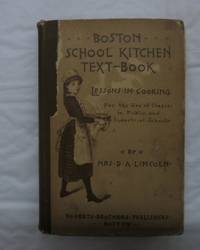
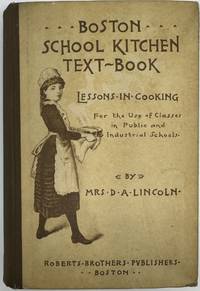
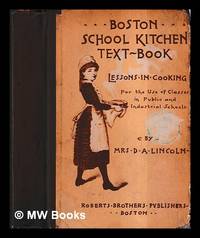
18871928Boston: Roberts Brothers 1887. Cloth. Very good . COOKERY JUVENILE HOME ARTS. First edition. 12mo; 237pp 5 16 1pp publisher's ads; tan pictorial boards front printed in sepia featuring a girl dressed in an apron holding a cake on the front brown cloth shelf back; gray endpapers ownership in neat ink on ffep; light wear to boards scuffing to corners a few areas browned where clippings were laid in; binding tight; very good plus. A girls' instructional book for use in schools on the management of households and food preparation with an introductory blurb from the Superintendent of Boston Public Schools. The text begins with basic household management including "Rules for Housekeepers" "Rules for Cleaning Dishes" two charts show "Average Composition of Some Common Foods" and "Food Materials Obtained for 25 cents." Included is a chapter of "Suggestions for Teachers." Twenty chapters follow these introductory sections and provide both food recipes and basic kitchen instructions. Following the text the publisher's ads give the reader a good idea of what was of interest in the late 19th century.<br /> <br /> The author Mrs. Mary Johnson Bailey Lincoln 1844-1921 was a leader in Domestic Science who wrote using her married name during her husband's lifetime. After his death she authored using the name Mary J. Lincoln. She was a teacher author and pioneer in nutrition. Further interesting information on her work and life can be found in her Wikipedia page. Roberts Brothers unknown
1891433757Boston : Roberts Brothers 1891. Edition Unstated. Hardcover. Very good copy in the original illustrated paper-covered boards. Spine bands and panel edges slightly dulled and dust-toned as with age. Bumped corners. Remains overall tight bright and clean. Physical description; xxvii 237 pages. Subjects; Cooking. Boston : Roberts Brothers hardcover
1887038466Boston: Roberts Brothers 1887. First edition title page dated 1887. Worn but sound fair condition overall. Pictorial hardcover with brown cloth spine about 7.25 inches tall 237 pages plus testimonials and 16 page publisher's catalog one additional page ad. Covers heavily worn with chip to upper front cover considerable edgewear hinges good free endpapers roughly removed text block sound 2 leaves loosened and near detached but present pages age-yellowed with some spotting and soil but completely and readily legible throughout some margin chips not affecting printed areas no names or other markings. First Edition. Hard Cover. Fair. 12mo - over 6¾" - 7¾" tall. Roberts Brothers Hardcover
188793913Roberts Brothers 1887-01-01. Hardcover. Good. Roberts Brothers with 1888 date title page soiled but intact covers pencil to flyleaf hinges tender but intact. Small clothe over illustrated paper boards no title to spine. A61 Please email for photos. Roberts Brothers hardcover
1887081827Roberts Brothers 1887. Book. Very Good. Hardcover. Brown cloth spine. Wear to paper over boards at corners. Browning to top page edges. Hinges are sound. Roberts Brothers Hardcover
1890CAT000008Boston: Roberts Brothers Publishers 1890. Hardcover. Very Good/No Dust Jacket. Publishers boards with an illustrated version of the title printed in brown and a brown cloth spine moderate wear to boards illustrated with a woodcut butchering guide. 237pp plus advertisements. Signed by owner E.P Flagg 1890 and contains two manuscript letters regarding the owner one a letter of recommendation from the Blake Manual Training School later UC Santa Barbara regarding her work in cookery and dated September 17th 1898. Cagle/Stafford 479 Size: 8vo. Quantity Available: 1. Shipped Weight: Under 1 kilo. Category: Antiquarian & Rare; Cooking Wine & Dining. Inventory No: CAT000008. Roberts Brothers Publishers hardcover books
18875831Boston: Roberts Brothers 1887. Octavo 19 x 13 cm. xxvii 237 5 16 1 pages. Index. Evident FIRST EDITION. Not a cookbook per se but rather an instruction manual "for the use of classes in public and industrial schools" based on the work being done by the Boston School Kitchen. The Boston School Kitchen was initiated and funded by Mrs. Mary Hemenway in summer of 1885 and was the introduction of cooking schools into the Boston Public School system and the first public school kitchen in the United States. Students from various schools in the system would choose to attend as an addition to their regular studies. Mrs. Hemenway supported the school for three years and for the first year instruction was given by Miss Amabel Hope. School Kitchen No. 2 was established in January 1886 in South Boston. Ten years later Miss Hope issued a report on the Cooking Schools indicating that the number of schools had grown to fourteen. Documents of the School Committee of the City of Boston for the Year 1895. Boston: Rockwell & Churchill City Printers 1895 page 281 ff. ~ Mrs. D. A. Lincoln was the first teacher at the Boston Cooking School though she recognized her inadequacy as a culinary instructor and replaced herself with Miss Joanna Sweeney. While at the school she wrote Mrs. Lincoln's Boston Cook Book 1884 the fore-runner to Fannie Merritt Farmer's Boston Cooking School Cook Book 1896. The Boston Cook Book included a section on operating a cooking school titled "An Outline of Study for Teachers". With the publication of the Boston School Kitchen Text-Book Lincoln had written the two works that became the foundation of cooking education for decades. ~ A school prize copy with the presentation inscription of the book's dedicatee Mrs. Mary Hemenway. The inscription reads "May Storey from Mrs. Mary Hemenway June added later in pencil 1885/6." And following in pencil in what appears to be the same hand "aged 12 years 1st Prize for highest percentage Diploma 98 and proficiency." Mary Porter Tileson Hemenway 1820-1894 was a remarkable American philanthropist. Born in New York she moved to Boston after marrying Augustus Hemenway a successful merchant. Quick to recognize significant needs she dedicated herself to a variety of educational causes helping to fund the both white and black colleges including Hampton and Tuskeegee in the south following the Civil War; she recognized that many soldier's wives did not know how to sew and so she provided training and materials for introduction of a sewing course within the Boston Public Schools. This led to her opening "an industrial-vocation school in Boston and two years later in 1885 she opened a kitchen in a public school the first venture of its kind in the United States. After three years the city assumed the cost of the kitchen and cooking as well as sewing became part of the program of education. Meanwhile in 1887 Mrs. Hemenway had started the Boston Normal School of Cooking which after her death in 1894 became the Mary H. Hemenway Department of Household Arts in the State Normal School of Framingham." HarvardSquareLibrary 09/18. Moderately edgeworn in illustrated paper boards over brown cloth. Professional repair to hinges and to one torn leaf. With the bookplate of Carl Sontheimer founder of Cuisinart and culinary collector. Cagle 479. Roberts Brothers hardcover books