Lincoln, Abraham; Leidner, GordonBiblio.com
11 347 résultats
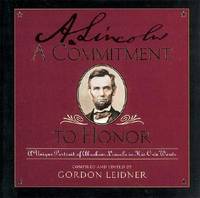
2000Q-1558537864Rutledge Hill Pr 2000-04-01. Hardcover. New. In shrink wrap. Looks like an interesting title! Rutledge Hill Pr hardcover
1991244084PN. New. 1991. Soft Cover. Date is original print. This is a reprint edition . PN paperback
186230007.01<p>On the front page under <i>"News from the North" </i>is the text of Abraham Lincoln's reply to <i>New York Tribune</i>editor Horace Greeley. Greeley's letter urging Lincoln to emancipate all slaves in Union-held territory was known as "The Prayer of Twenty Millions." It was first published on August 20 1862. Lincoln responded on August 22 declaring that his paramount goal is to save the Union regardless of its effect on slavery as well as his personal views that all men should be free.</p> <b>ABRAHAM LINCOLN.</b>Newspaper. <i>Richmond Whig</i> Richmond Va. August 30 1862. 2 pp. 17 x 24 in.<p><b><br /></b></p><p><b>Excerpt:</b></p><p><i>"…As to the policy I 'seem to be pursuing' as you say I have not meant to leave any one in doubt. </i></p><p><i> I would save the Union. I would save it the shortest way under the Constitution. The sooner the national authority can be restored the nearer the Union will be 'the Union as it was.' If there be those who would not save the Union unless they could at the same time </i>save<i> slavery I do not agree with them. If there be those who would not save the Union unless they could at the same time </i>destroy<i> slavery I do not agree with them—My paramount object in this struggle </i>is <i>to save the Union and is </i>not<i> either to save or to destroy slavery. If I could save the Union without freeing </i>any<i> slave I would do it and if I could save it by freeing </i>all<i>the slaves I would do it; and if I could save it by freeing some and leaving others alone I would also do that.—What I do about slavery and the colored race I do because I believe it helps to save this Union and what I forbear I forbear because I do not believe it would help to save the Union. I shall do </i>less<i> whenever I shall believe what I am doing hurts the cause and I shall do </i>more<i>whenever I shall believe doing more will help the cause. I shall try to correct errors when shown to be errors; and I shall adopt new views so fast as they shall appear to be true views. </i></p><p><i> I have here stated my purpose according to my view of </i>official<i> duty; and I intend no modification of my oft-expressed </i>personal<i> wish that all men every where could be free." </i></p><p><b>Historical Background</b></p><p>Though this letter is often as proof that Lincoln did not intend to abolish slavery unknown to Greeley and most Americans Lincoln had already drafted the preliminary Emancipation Proclamation and was only waiting for a Union military victory to deliver it. Moreover Lincoln makes a "divide and conquer" rhetorical move: he splits the issue by stating that his constitutional duty as president is to keep the Union together while simultaneously expressing his personal view of universal freedom at the end.</p><p>Additional content in this issue includes a front page editorial <i>"European Recognition" "The Indian Atrocities in Minnesota" "Yankee Finances" "An Order From Gen. Burnside" "The Peninsular Campaign—Gen. </i><b><i>J. Bankhead </i></b><i>Magruder's Official Report"</i> which takes over two columns with considerable detail.<br /><br />The back page has additional content with: <i>"A Brilliant Cavalry Exploit" "The Impressment of Slaves In Georgia" "Outrages in Arkansas" "From Kentucky"</i> and more. Additionally there are various reports from the <i>"Confederate Congress"</i> and numerous advertisements including a <i>"$100 Reward"</i> for a runaway slave.</p><p>The <i>Richmond Whig</i> is one of the less common—but still important—newspapers from the capital of the Confederacy.</p><p>In <i>Four Years in Rebel Capitals: An Inside View of Life in the Southern Confederacy from Birth to Death</i> journalist T. C. DeLeon wrote that the <i>Richmond</i> <i>Whig</i>was among the South's best wartime newspapers. Their pages "recorded the real and true history of public opinion during the war. In their columns is to be found the only really correct and indicative 'map of busy life its fluctuations and its vast concerns' in the South during her days of darkness and of trial."</p><p>One of the more interesting episodes in the history of the <i>Whig</i> is its alleged involvement in a terror plot against New York City during the Civil War. The <i>Whig</i>was reputed to have worked with the Confederate government to use advertisements and editorials to convey secret messages to Southern sympathizers in the North. In October 1864 the <i>Whig</i> was alleged to have run an editorial that signaled Southern supporters to embark on a terror campaign that called for widespread fires to be set in New York city and federal offices to be taken over and the capture of the city's military commander Maj. Gen. John Adams Dix.</p><p><b>Condition</b></p><p>Good. Never bound several folds with minor wear at the folds.</p> books
1934HR-JBU0-NFEG1934. Hardcover. Very Good. National Travel Club 1934. Jacket is Good with some wear fading small tears. Book is VG with light wear clean yellowed pages firm binding. Owner bookplate to front endpaper and article about Hedin pasted to rear endpaper. hardcover
1934RHEDCON00mfE. P. Dutton 1934. Very Good. Hedin Sven. A Conquest of Tibet. Lincoln translator Julius. NY: E. P. Dutton 1934. National Travel Club edition. 400pp. Illustrated. 8vo. Black cloth with gilt lettering. Book condition: Very good. Gently bumped spine ends. Color map laid in; folded in original envelope. E. P. Dutton hardcover
1935835B35London : Macmillan and Co. 1935. First edition. Cloth. Very Good. 9" by 6". Sven Hedin. A smart first English edition of A Conquest of Tibet with illustrations throughout. A first English translated edition of A Conquest of Tibet by Sven Hedin. Translated into English from the original Swedish. Sven Hedin was a Swedish geographer explorer and travel writer who illustrated his own works and this volume describes his exploration of Tibet.With illustrations throughout the text by Sven Heldin. Re-bound in full cloth. Externally lovely. Internally firmly bound with bright and generally clean pages with some light scattered spots to the first and last few pages. Very Good Macmillan and Co. hardcover
ria9780271094380_inpPaperback. New. New Book; Fast Shipping from UK; Not signed; Not First Edition; N/A paperback
2023x-0271094370Pennsylvania State Univ Pr 2023. Hardcover. New. sew edition. 230 pages. 9.00x6.00x0.89 inches. Pennsylvania State Univ Pr hardcover
2025x-0271094389Pennsylvania State Univ Pr 2025. Paperback. New. 230 pages. 9.00x6.00x0.64 inches. Pennsylvania State Univ Pr paperback
0271094370.Ghardcover. Good. Access codes and supplements are not guaranteed with used items. May be an ex-library book. hardcover
4951BENJAMIN LINCOLN 1733-1810. Lincoln was a Revolutionary War general and the Secretary of War from 1781 to 1783. SURRENDER OF CHARLESTON SOUTH CAROLINA. On April 2 1780 10000 British soldiers under the command of General Henry Clinton sieged 3000 Continental Army soldiers at Charleston. On May 12 the over-matched forces surrendered marking the largest Continental Army capitulation of the American Revolution. General Cornwallis was left in charge of British forces and Lincoln was eventually traded for a British general. After the Charleston surrender a guerilla war broke out in South Carolina. When the British surrendered at Yorktown Benjamin Lincoln was there to accept Cornwallis’s sword. D. 2pg. 8†x 10â€. 1780. Charleston South Carolina. A contemporary draft of General Lincoln’s articles of capitulation for Charleston: “Article of Capitulation proposed by Major General Lincoln – Art. 1 that all acts of hostilities and Work…Between the Besiegers and Besieged Until…of Capitulation shall be Agreed on signed…Executed or be collectively Rejected. Art. 2. The town and fortifications shall…be surrendered to the Commander in Chief of the…Forces such as they now stand. Art. 3. The Continental Troops and Sailors – with their baggage shall be Conducted to a Place to be Agreed on – where they will Remain Prisoners of War – until Exchanged – White Prisoners they shall be supplied with Good and Wholesome Provisions in such quantity as is Served out to the Troops of his Britanic sic Majesty. Art. 4. The militia now in garrison shall be permitted to return to their respectives homes and…be secured in their persons and property. Art. 5. The sick and Wounded shall…be continued under the care…Art. 6. The Garrison shall at an hour appointed march out with shouldered arms Drums beating and Colours Flying to a place to be agreed on where they will pile their arms. Art 7. That the French Consul his house papers and other movable property shall be protected and untouched and a proper time granted to him for retiring to…that may afterwards be agreed upon between…Commander in Chief of the British forces. Art. 8. That the citizens shall be protected in their persons and Property. Art. 10. That a twelve months time be allowed all such as do not choose to continue under the British Government to dispose of their Effects real and personal in the State with out any molestation or to remove such part thereof as they choose as well as themselves and families and that during that time they or any of them may have it as their option to reside occasionally in town or country. Art 11. That the same protection to their persons and properties and the same time for the removal of their Effects be given to the subjects of France and Spain as required for the citizens in the previous articles. Art 12. That a vessel be permitted to go to Philadelphia with the General’s dispatches which are not to be opened. Signed May 8th 1780 B Lincolnâ€. This likely is an early draft since Article 6 is not included; that stated “The officers of the army and navy shall keep their horses swords pistols and baggage which shall not be searched and retain their servants.†It is in an unknown hand and is not in the writing of Lincoln’s aide-de-camp Hodijah Baylies. The document just underwent a professional restoration to remove silking and improve the overall condition although I would still rate the document’s state as fair. There are paper losses that affect some words but the legibility has improved considerably. unknown books
186322448.01New York N.Y. 1863. No binding. Fine. New York Journal of Commerce. Newspaper. New York Journal of Commerce. New York N.Y. January 3 1863. 4 pp. 24 x 32 1/2 in. An early report of the Emancipation Proclamation where the editors describe Lincoln's bold move as ""a farce coming in after a long tragedy.Most of the people regard it as a very foolish piece of business."" Historical BackgroundThe Emancipation Proclamation was the single most important act of Lincoln's presidency. Its text reveals the major themes of the Civil War: the importance of slavery to the war effort on both sides; the courting of border states; Lincoln's hopes that the rebellious states could somehow be convinced to reenter the Union; the role of black soldiers; Constitutional and popular constraints on emancipation; the place of African Americans in the United States and America's place in a worldwide movement toward the abolition of slavery. In sounding the death knell for slavery and the ""Slave power"" the President took a decisive stand on the most contentious issue in American history and the United States joined other western nations in embracing a future of free labor.In addition to the moral impact of this ""sincerely believed.act of justice"" the Proclamation aided the Union cause tangibly and decisively. Because it focused on territory still held by the Confederacy only small numbers of slaves compared to the total slave population were immediately freed. However the Proclamation deprived the South of essential labor by giving all slaves a reason to escape to Union lines. Failing that it freed slaves immediately upon the Union Army's occupation of Confederate territory. The Proclamation also encouraged the enlistment of black soldiers who made a crucial contribution to the Union war effort. Moreover England and France who had already abolished slavery were restrained from supporting the Confederacy which would have been in their own economic interests. Lincoln summed up the Proclamation's importance in 1864: ""no human power can subdue this rebellion without using the Emancipation lever as I have done.""Nonetheless the editors of the Journal of Commerce disagreed and their opinion reflects the truly controversial nature of the act for many contemporary Americans.
186322448.01New York N.Y. 1863. No binding. Fine. New York Journal of Commerce. Newspaper. New York Journal of Commerce. New York N.Y. January 3 1863. 4 pp. 24 x 32 1/2 in. An early report of the Emancipation Proclamation where the editors describe Lincoln's bold move as ""a farce coming in after a long tragedy.Most of the people regard it as a very foolish piece of business."" Historical BackgroundThe Emancipation Proclamation was the single most important act of Lincoln's presidency. Its text reveals the major themes of the Civil War: the importance of slavery to the war effort on both sides; the courting of border states; Lincoln's hopes that the rebellious states could somehow be convinced to reenter the Union; the role of black soldiers; Constitutional and popular constraints on emancipation; the place of African Americans in the United States and America's place in a worldwide movement toward the abolition of slavery. In sounding the death knell for slavery and the ""Slave power"" the President took a decisive stand on the most contentious issue in American history and the United States joined other western nations in embracing a future of free labor.In addition to the moral impact of this ""sincerely believed.act of justice"" the Proclamation aided the Union cause tangibly and decisively. Because it focused on territory still held by the Confederacy only small numbers of slaves compared to the total slave population were immediately freed. However the Proclamation deprived the South of essential labor by giving all slaves a reason to escape to Union lines. Failing that it freed slaves immediately upon the Union Army's occupation of Confederate territory. The Proclamation also encouraged the enlistment of black soldiers who made a crucial contribution to the Union war effort. Moreover England and France who had already abolished slavery were restrained from supporting the Confederacy which would have been in their own economic interests. Lincoln summed up the Proclamation's importance in 1864: ""no human power can subdue this rebellion without using the Emancipation lever as I have done.""Nonetheless the editors of the Journal of Commerce disagreed and their opinion reflects the truly controversial nature of the act for many contemporary Americans. books
1018379126.Gpaperback. Good. Access codes and supplements are not guaranteed with used items. May be an ex-library book. paperback
1332757715.Gpaperback. Good. Access codes and supplements are not guaranteed with used items. May be an ex-library book. paperback
065604098X.Ghardcover. Good. Access codes and supplements are not guaranteed with used items. May be an ex-library book. hardcover
1330104196.Gpaperback. Good. Access codes and supplements are not guaranteed with used items. May be an ex-library book. paperback
1528250192.Ghardcover. Good. Access codes and supplements are not guaranteed with used items. May be an ex-library book. hardcover
0483002097.Ghardcover. Good. Access codes and supplements are not guaranteed with used items. May be an ex-library book. hardcover
1330798317.Gpaperback. Good. Access codes and supplements are not guaranteed with used items. May be an ex-library book. paperback
6248812Cambridge University Press CUP pp. ix 361 Maps 2nd Edition . Papeback. New. Cambridge University Press CUP unknown
0521591392New. Brand new and still unused unknown