WESENBECK, MatthaeusAntiquariat.de

88 résultats
1612603532Frankfurt, E. Kempffer für A. Hierat (in Köln), 1612. 4to. 4 Bl., 1032 Sp., 12 Bl.; 2 Bl., 218 Sp., 4 Bl. Blindgeprägter Schweinsleder d. Zeit (gebräunt u. leicht berieben, wenige Wurmstiche, Spiegel mit späterem Marmorpapier überklebt). [3 Warenabbildungen]
1688486331Köln, Widenfeldt Erben u. Berges (Band 3/II-IV Frankfurt, Societas), 1688-95. Folio. Mit 5 wiederholten gestochenen Titelvignetten. Leder d. Zeit (berieben u. mit großen Schabstellen, Gelenke u. Kapitale teils mit kurzen Einrissen oder Fehlstellen, Band 3/II wasserfleckig, 7 Rückenschilder fehlen). [3 Warenabbildungen]
1620257033Lutetiae Parisiorum i.e. Paris: E Typographia Renati Giffart 1620. Title-page printed in red and black with large engraved vignette by Jaspar issac. Printed in red and black throughout illustrated with full-page engravings engraved borders woodcut initial capitals in red and printed music. 1 vols. Folio. Early calf nineteenth century marbled endpapers. Covers much worn joints cracked spine perished. Defective copy lacking numerous leaves but with 17 iinserted leave printed on velllum including the entire "Canon Missae" 8 leaves. Title-page printed in red and black with large engraved vignette by Jaspar issac. Printed in red and black throughout illustrated with full-page engravings engraved borders woodcut initial capitals in red and printed music. 1 vols. Folio. Bbl-7CcDD7-EE6 &HH7-II2 are printed on parchment. OCLC: 633338957 1 copy E Typographia Renati Giffart unknown
1643475680Nürnberg, Endter, 1643. 2 Bll., 970, 51, 36, 7 Bll. Pergament der Zeit. 4to
16202446Vienna 1620. In very good condition. unknown
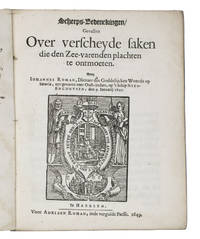
1649ABC_49304Haarlem: Adriaen Roman 1649. Later black and orange painted paper wrappers showing a floral design. 4to. With a large woodcut printers device on the title page depicting a printing press surrounded by the Latin motto Labore et Diligentia and a Dutch quote from Genesis 3:19 with a small view of a school class below. Further with a large woodcut portrait of Laurens Janszoon Coster printer's device of A. Roman dated 1630 in the block on the final page 3 decorated woodcut initials and a woodcut tailpiece. Very rare first and only edition of a pamphlet containing reflections related to seafaring written by the Dutch minister Johannes Roman d. 1689. He had left his birthplace of Haarlem for Batavia in January 1647. On his journey to the Dutch East Indies on board the East Indiaman Nieu-Enchuysen built in 1636 also known under all spelling variations of Nieuw Enkhuisen he probably wrote the present pamphlet - comprising 15 short texts in which he reflects on topics relevant to those embarking on sea voyages. The present work is dedicated by the publisher Adriaen Roman to the directors of the Enkhuizen chamber of the VOC. A long poem in Dutch has been included at the end of the work on pp. 19-23 titled Ziel-verheffing over de verlossinghe die ons de Heere heeft ghedaen uyt verscheyde stormen ende nood-weder ons op de Spaensche zee over-ghekomen. Midtsgaders dat Hy ons heeft laten ontmoeten een Engelsch schip van de Barbades .The author born in Haarlem as son of the Dutch bookseller and publisher Adriaen Roman 1590-1649 went to Batavia in 1647 where he became a minister of a Malaysian church. He was active as a translator and in 1653 he wrote a manual of the Malay language titled Grondt ofte kort bericht van de Maleysche tale . which was published posthumously in Amsterdam in 1674 and again in 1689.With an extensive manuscript annotation in brown ink on the front pastedown containing biographical details on the author a quote from S. Gille Heringa "Naamlijst van Nederlandsche Dichters" in: Konst en letterbode 1848 part II p. 166. The pastedowns and first and last few leaves are very slightly water stained in the gutters and pp. 9-16 show a small water stain in the outer blank margin not affecting the text. Otherwise in very good condition.l Knuttel 6496; Landwehr VOC 767; Petit 2538; STCN 830231420 4 copies; USTC 1026292 4 copies same as STCN; Van der Wulp 9172; WorldCat 69050990 5 copies. Adriaen Roman, unknown
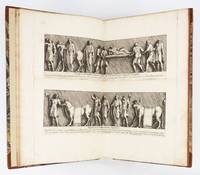
1690ST17496-016Rome: Buagni 1690. 492 x 310 mm. 19 1/4 x 12 1/4". 6 leaves of text numbered in sequence with the plates; i.e. title page frontispiece To the Reader plates 3-15 text leaves 16-19 plates 20-52. <br/> Modern quarter calf over marbled boards raised bands spine panels with gilt starburst centerpiece. With allegorical frontispiece featuring a portrait of the dedicatee Cardinal Otthobono and 46 FINELY ENGRAVED COPPERPLATES OF ROMAN ARCHES half of these double-page all mounted on stubs. Cicognara 3608; Brunet I 758 and VI 29473. Slight signs of use to the covers first and last three leaves faintly foxed one- to two-inch light dampstain to bottom corners far from images or text other trivial imperfections but A FINE COPY--internally clean fresh and bright with excellent impressions of the engravings and in a pleasing binding showing virtually no wear.<br/> <br/> This work depicting the triumphal arches of imperial Rome is considered by Cicognara to be "the most beautiful of this genre and classic especially for the magnificence and elegance of the prints which are the masterpiece of Pietro Bartoli." Bartoli 1635-1700 was an antiquary as well as an engraver; he produced engravings of many Roman antiquities and helped to excavate Nero's Domus Aurea the sprawling complex built by the emperor in the middle of Rome after the fire in 64 A.D. had destroyed much of the city. Bellori 1613-96 was an author and antiquarian who served as curator of antiquities for Pope Clement X. He was later librarian and antiquary to Queen Christina of Sweden who also employed Bartoli. Bartoli's illustrations show the Arch of Constantine the Arch of Titus and the Arch of Septimus Severus examining the details of each. J. M. Suarez wrote the text discussing the Arch of Septimus Severus. The vastness of the present volume the very considerable detail of the plates and the richness of the engravings make this a very impressive book. Buagni unknown
162353483Rouen: apud Societatis Typographicam / David du Petit Val 1623. Disbound. Very good. Two parts folio. 72; 37 1: blank pp; 1 full page copperplate engraving; woodcut initials and ornaments. Printed in red and black throughout. Text in Latin generally in two columns with double ruled borders in black. All edges gilt. Boards perished text block very solid with binding cords intact. Occasional light soiling. A very good copy housed in a beautiful new clamshell box of maroon silk moire.<br /> <br /> Concluding sections ONLY of this uncommon local missal for the Archdiocese of Rouen printed on vellum by David du Petit Val. Along with general information about the calendar and the celebration of the Mass this portion of the Missale Ecclesiae Rothomagensis contains tables of the Movable Feasts and Easter Sunday followed by a complete liturgical calendar. The second section contains musical scores with text for Palm Sunday Dominica in Ramispalmarum finito tractu diaconus dicat and Good Friday In die Veneris sancta tractu finito diaconus.<br /> <br /> The beautiful full page engraving of the Annunciation which opens the musical section is signed by Jean Messager. The following verses in praise of the Virgin Mary appear as a caption:<br /> <br /> Virgo tibi plenis exundat gratia rivis<br /> Pone metum: proh quanta refundes gaudia terris<br /> Femineos inter tu praestantissima coetus<br /> Cum Patris aeterni paries virgo integra Natum.<br /> <br /> Virgin you overflow with full streams of grace<br /> Put aside your fear: Oh! How many joys you will bring back to the earth<br /> You preeminent among women<br /> A virgin will bear with the Eternal Father a Perfect Son. References: OCLC 1063115827 one of only two copies located both at the British Library.<br /> Date printer and location taken from colophon; title and publisher information from British Library. Collation: e6 i6 o6 u6 aa6 ee4 ii2; asterisk-3asterisk6 4asterisk1 = 55 leaves. [apud Societatis Typographicam] / David du Petit Val unknown
169038016PRIMERA Y UNICA EDICION.- S.l.: s.n. s.a. ca. 1690 o 1691.- 4 h. 528 p. 4 h.; 4º menor 205 x 16 cm: Con 2 viñetas xilográficas de fin de capítulo; Buena impresión sobre papel verjurado fuerte y limpio; Cinta separadora de lectura; Enc. en Plena Piel pasta época lomo liso con dorados y tejuelo rojo con el título cortes jaspeados. Según Salvá en su Catálogo ficha Nº 3595 este libro debió imprimiese para ser regalado o distribuirlo privadamente pues no consta por ninguna parte ni el nombre del librero que lo publicó ni aún el del pueblo donde salió a luz. Por todo esto la rareza de este libro se debe a su escasísima difusión y corta tirada. Catalina asevera que la impresión debe ser de Madrid."y casi tengo la seguridad de que no se imprimió en Alcalá". No obstante es de señalar que al principio del libro justo al final de la carta impresa en que se dedica el libro al Excmo. Sr. Marqués de Mondejar el autor escribe: Mondejar y Julio 20 de 1690. Por esto deduzco que debió de imprimirse en ese año o a más tardar al siguiente de 1691.- RARISIMA OBRA. Palau nº 276605 Salva nº 3595. Las 14 hojas comprendidas entre las pags. 133 a 161 tienen en la esquina superior externa una máncha de óxido que toca un poco al texto y va disminuyendo hasta desaparecer pero no afecta ni a su lectura ni a la textura del papel. También falta un trocito de papel en la esquina inferior externa de la hoja que corresponde a las pags. 275-76 que toca mínimamente al texto de una apostilla marginal impresa. Con 7 notitas de la época manuscritas a tinta en los márgenes externos. El plano posterior restaurado de dos pequeñas faltas de piel que apenas se notan. A PESAR DE LO DICHO QUE ES PRECEPTIVO EL LIBRO SE ENCUENTRA EN MUY BUEN ESTADO. CASTILLA-LEÓN Libro en español Sin editorial hardcover
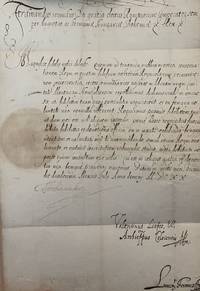
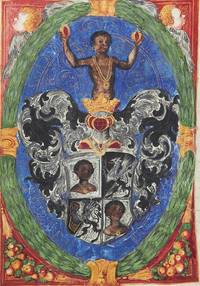
166935491669. Manuscript on vellum folio c. 240 × 300 mm. Sewn in contemporary limp vellum. Final leaf with contemporary notarial certification signature stamp and remnant of wax seal. Some wear and light soiling but a well-preserved and striking copy. With a large finely illuminated coat of arms in vivid colours and burnished gold framed by green palm fronds and flanked by angels incorporating distinctive Moor's head motifs. With a large finely illuminated coat of arms in vivid colours and burnished gold framed by green palm fronds and flanked by angels incorporating distinctive Moor's head motifs. Manuscript on vellum folio c. 240 × 300 mm. Sewn in contemporary limp vellum. 8 leaves. <p><br /> Imperial ennoblement diploma featuring depictions of Black African figures-an unusual and well-documented example of African representation in early modern European aristocratic identity.<br /> <p><p><br /> This lavishly illuminated imperial diploma issued by Emperor Leopold I on 6 May 1668 confirms the noble status of Georg Adam Christoph and Jakob Moren as members of the knightly nobility rittermäßiger Reichs- und erbländischer Adel of the Holy Roman Empire and its Hereditary Lands. It reaffirms earlier ennoblements of the family in 1514 and 1557 and grants the recipients revised arms and the right to use the territorial predicates von oder zu Sunnegg und Morberg following the extinction of the line of their cousin Hieronymus Moren. The present manuscript is an authenticated official copy certified on 4 April 1669.<br /> <p><p><br /> Of particular interest is the large full-page coat of arms likely painted by a professional court illuminator. Richly coloured and heightened with gold the quartered shield includes two fields with black imperial eagles and two with bust-length portraits of dark-skinned men in three-quarter profile adorned with gold earrings and chain necklaces. Above the shield rises a bare-chested crowned Black man holding a red orb in each hand and emerging from a coronet. The rendering is highly individualized and unambiguously emphasizes African phenotypic features. The composition is framed by a laurel cartouche flanked by angels and fruit.<br /> <p><p><br /> The surname Moren or Mor and the heraldic iconography leave little doubt that the family was of Moorish origin-or at least claimed such ancestry as part of its noble identity. While Moor's heads appear elsewhere in European heraldry they are typically stylized emblems representing conquest exoticism or religious symbolism. The Moren arms are distinct: they include multiple prominently placed depictions of Black African men-not as abstract symbols but as individualized and repeated figures in both crest and escutcheon. Their dignified and central presence-together with the family name-suggests an intentional genealogical claim rather than a purely symbolic motif. The route by which the Moren ancestor entered Habsburg service is uncertain but likely occurred via Spain or Italy in the late 15th or early 16th century.<br /> <p><p><br /> The Moren family retained noble status over successive generations with branches in Tyrol Styria Carinthia and Upper Austria and remained listed in official registers of the Austrian nobility into the 20th century. Among their later descendants was Therese von Mor zu Sunnegg und Morberg 1871-1945 a painter trained in Vienna Munich and Paris and active in several artists' associations. The family's heraldic identity-with its explicit visual reference to African ancestry-remained remarkably consistent making this diploma not only a legal instrument of nobility but a rare and compelling record of Black lineage within the early modern European aristocracy.<br /> <p><p><br /> Reference: Genealogisches Taschenbuch der adeligen Häuser Österreichs. 1907. Zweiter Jahrgang 1906/07 pp. 278-310. Wien: Otto Maass' Söhne.<br /> <p>. unknown