151 résultats
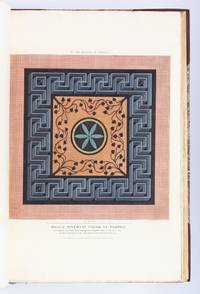
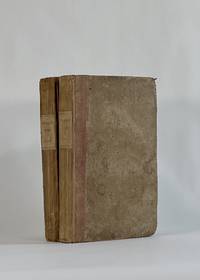
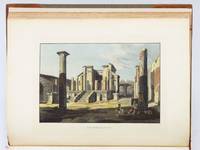
1824ST17496-014Zurich: by the author and Henry Fuessli and Comp 1824-25. FIRST EDITION. 445 x 325 mm. 17 1/2 x 12 3/4". 26 leaves of descriptive text. Lacking title page and dedication.Commentary by art historian Johann Jacob Horner. <br/> Modern tan half morocco over olive green buckram raised bands spine panels with gilt ornament red morocco label. 24 FINE AQUATINT VIEWS COLORED BY A CONTEMPORARY HAND. Brunet III 357. Text pages variably foxed from a little to very but somehow THE LOVELY PLATES IN FINE CLEAN CONDITION--fresh and bright with pleasing coloring in an unworn sympathetic binding.<br/> <br/> This is a rare complete colored set of Hüber's famed views of Pompeii much sought-after by armchair travellers after excavations uncovered that urban time capsule in the late 18th century. The German-born Hüber 1787-1871 settled in Naples in his early 20s studying landscape painting with Dutch émigré painter Jacob Philipp Hackert 1737-1807 who was known for his lush scenes often featuring ruins. His arrival in the region coincided with the occupation of Naples by the French who accelerated the excavations underway at Pomepii which had been buried by the eruption of Vesuvius in 79 A.D. The rapid burial of the city in volcanic ash had captured a moment in time and the opportunity to see a well-preserved example of life in the ancient Roman Empire caught in medias res drew eager travellers on the Grand Tour of the Continent. Hüber's well-executed views often picture these tourists and their contemporary dress contrasts sharply with the classical ruins. Lord Napier in his "Notes on Modern Painting at Naples" 1855 credits Hüber for introducing the use of watercolors to the meticulously drawn landscapes then being produced. This innovation is displayed in the hand-colored plates here which were also issued in uncolored state. Napier was correct to appreciate the value of adding colors which increases both the drama of the views and the pleasure of the viewer. Because the attractive sets with color were often broken up complete volumes of the colored plates are rarely seen for sale: we could trace just three such copies sold at auction as listed in RBH and ABPC the two best ones were the Feltrinelli copy which sold for $14330 in 2001 and the Donaueschingen copy fetching $13750 in 2014. Ours does not have the distinguished provenance attached to those copies and it lacks two preliminary leaves but the text is present and most important the lovely colored plates are in fine condition. by the author and Henry Fuessli and Comp unknown
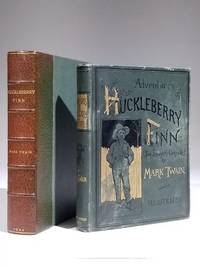
188511520New York: Charles L. Webster and Company 1885. 1st Edition. Original cloth. Octavo. 366 pages. Very Good. Bound in original dark green cloth over boards with spine and upper board stamped in black and gilt. Some rubs and minor fading to cloth covers a few shallow bumps to board fore corners and spine ends. Hinges not cracked. Housed custom cloth and board folder in half morocco slipcase. A very nice first edition of one of the most important books in American literature. Hemingway believed that "American writing comes from that. There was nothing before. There has been nothing as good since." This copy has the important issue points at pages 13 57 and 143. A very handsome copy. Charles L. Webster and Company unknown
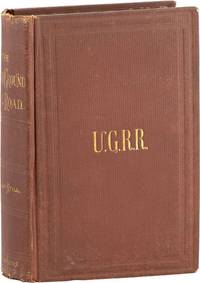
187284883Philadelphia: Porter & Coates Publishers 1872. First Edition. Thick octavo 24.5cm; variant in the publisher's terracotta fine English cloth binding with titles stamped in gilt on spine and front cover; dark brown clay-coated endpapers; 4pp.ads iv7802pp with an engraved frontispiece portrait of Still and 43 plates of illustrations. Gently spine-sunned spine ends pushed and a bit worn minute board exposure to corners some light surface wear and dust-soil to cloth with some partial cracks to front hinge and a small one to lower rear hinge; some light foxing and occasional finger-soil to margins of plates with some staining to lower third of pp.50-51 and the plate in between; a solidly Very Good unrepaired copy.<br /> <br /> A historically significant document by Still a free-born Black man who became an author and abolitionist movement leader in Philadelphia PA. The volume documented the stories of escaped slaves and remains "the only first-person account of Black activities on the Underground Railroad written and self-published by an African-American.William Still was a major contributor to the success of the Underground Railroad activities in Philadelphia and a part of Philadelphia's free Black community that played an essential role in the Underground Railroad. He personally provided room and board for many African Americans who escaped slavery and stopped in Philadelphia on their way to Canada. Through his work with the Pennsylvania Society for the Abolition of Slavery's Vigilance Committee he raised funds to assist runaways and arrange their passage to the North. He was instrumental in financing several of Harriet Tubman's trips to the South to liberate enslaved Africans" Turner Diane D. "William Still's National Significance." Web blog post. William Still: African American Abolitionist. Temple University n.d. 18 August 2016. <br /> <br /> Still kept meticulous notes concerning the many escaped slaves who passed through the Philadelphia "station;" he took pains to record names brief biographies and the destination for each individual along with any adopted aliases in hopes of reuniting family members who were separated by slavery. He kept his notes secret hidden in diaries he kept during those years and published them after the Civil War. The Underground Rail Road went through three editions and was displayed at the Philadelphia Centennial Exhibition in 1876. SCHOMBURG p.7 394; WORK p.338. Porter & Coates, Publishers unknown
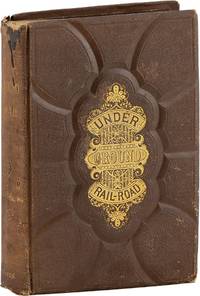
187284792Philadelphia: Porter & Coates Publishers 1872. First Edition. Thick octavo 24.5cm; variant bound in the publisher's paneled-style brown pebbled cloth with titling and decorations stamped in gilt on spine and covers; dark brown clay-coated endpapers; all edges gilt; 4pp.ads iv7802pp with an engraved frontispiece portrait of Still and 43 plates of illustrations. Modest rubbing to the binding wear and shallow loss to heel with gentle sunning and biopredation to spine resulting in some erosion to the cloth; a few thin partial cracks to hinges two of them showing evidence of being re-glued with textblock starting to sag very slightly; early owner's small label and neatly rubber-stamped name John D. Harrison on preliminary blank and pp.101 400 and 780 with a small loss to margin at pp.45-46 and two pages with small marginal tears; Very Good.<br /> <br /> A historically significant document by Still a free-born Black man who became an author and abolitionist movement leader in Philadelphia PA. The volume documented the stories of escaped slaves and remains "the only first-person account of Black activities on the Underground Railroad written and self-published by an African-American.William Still was a major contributor to the success of the Underground Railroad activities in Philadelphia and a part of Philadelphia's free Black community that played an essential role in the Underground Railroad. He personally provided room and board for many African Americans who escaped slavery and stopped in Philadelphia on their way to Canada. Through his work with the Pennsylvania Society for the Abolition of Slavery's Vigilance Committee he raised funds to assist runaways and arrange their passage to the North. He was instrumental in financing several of Harriet Tubman's trips to the South to liberate enslaved Africans" Turner Diane D. "William Still's National Significance." Web blog post. William Still: African American Abolitionist. Temple University n.d. 18 August 2016. <br /> <br /> Still kept meticulous notes concerning the many escaped slaves who passed through the Philadelphia "station;" he took pains to record names brief biographies and the destination for each individual along with any adopted aliases in hopes of reuniting family members who were separated by slavery. He kept his notes secret hidden in diaries he kept during those years and published them after the Civil War. The Underground Rail Road went through three editions and was displayed at the Philadelphia Centennial Exhibition in 1876. SCHOMBURG p.7 394; WORK p.338. Porter & Coates, Publishers unknown
18904628Paris 1890 1890. A beautiful late nineteenth-century illuminated manuscript with the text of the Ordinary of the Mass. 178x125mm. Title page and thirty-two pages. Signed at foot of final page "Germaine Mimey 1890" with the initials "G.M." at the foot of each page. Bound by Emile Rousselle signed at foot of front doublure in tan morocco with a single fillet border framing a wide gilt tooled border inside which is a smaller gilt tooled border which frames a shield with three fleur de lys surmounted by a crown. Below the shield is a dragon. Either side of the shield is stamped four times the letter "F" surmounted by a crown. This is repeated on the lower cover. The spine has five raised bands with four compartments decorated with a fleur de lys the second compartment being blank. The front and rear doublures are of blue morocco with gilt decoration and a brown calf diamond. Turn-ins decorated in gilt. Front and rear free endpapers are in brown silk. The illuminations are gorgeously delicate with the occasional block of colour. The spirit is genuinely medieval with a light sinuousness in contrast to the rather heavier Gothic Revival manner which is often in evidence in this type of late nineteenth century illumination. We have been unable to identify "F" unless of course it simply stands for "France" but with the crowns shield and fleur de lys this beautiful little Missal was clearly done for an aristocratic and perhaps even a royal patron although of course by 1890 he or she would have been a mere Pretender taking solace in this sumptuous devotional book. [Paris] 1890 hardcover
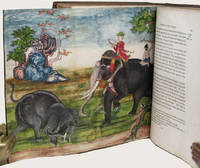
182634747London: Published for the Author 1826. First Edition. THE AUTHOR'S COPY SPECIALLY BOUND. A Highly Important and Unique Copy with 25 Extra Illustrations tipped or pasted in 6 coloured 5 full page. SIGNED BY RANKING with the Inscription - "To remain in the family this correted copy with new notes and Illustrations." The Notes appear on several pages and are rendered in pencil. Folding lithograph frontispiece folding map 1 folding engraved map 6 lithograph and 3 engraved plates plus the 25 extra illustations and engravongs. A large folding handcoloured plate of elephants Quarto conemporary red straight-grained morocco the spine exquisitely designed with wide raised bands gilt rolled the compartments decorated with in both gilt and blind two compartments lettered one being the declaration that this is the author's copy covers bordered with triple gilt rules surrounding an inner panel gilt decorated and ruled the corners with elaborately tooled decorations in gilt an inner diamond and roll tooled border in blind inner gilt dentelles original dark green endleaves all edges gilt a superb binding accomplished for the author. xiv 516 pp. A very handsome copy in a beautifully designed and unique contemporary binding the binding tight and strong and beautifully preserved there is a very faint old stain from damp affecting the lower portion of the pages but this remains a quite extraordinary copy nevertheless. UNIQUE FIRST EDITION SPECIALLY BOUND THE AUTHOR'S OWN COPY WITH HIS INSCRIPTIONS AS TO OWNERSHIP AND FAMILY ASSOCIATION. Ranking's wide-ranging work generally returns to the author's interest in Asiatic and African elephants and his "endeavor to trace the historical proofs that the fossil bones of elephants and wild beasts which have been found throughout Europe are the remains of those animals which have been employed in the wars religious ceremonies and amphitheatrical sports of the Romans and the Mongols" Preface. The book examines the historical roots of fossil remains found in Siberia and other countries arguing that these remains belong to elephants and other animals used in the wars religious ceremonies and amphitheatrical sports of the Romans and Mongols. The author traces the evidence from historical sources including accounts from Marco Polo and other travelers to prove that the number of elephants employed by these empires far exceeded previous estimates. <br> The book also explores the broader context of elephant usage in ancient times from their role in warfare to their significance in cultural and religious practices. Ultimately this book sheds light on the interconnectedness of human history and the natural world providing insights into the complex relationships between humans animals and the environment. <br> The volume full of "much amusing and instructive matter industriously accumulated and detailed with conciseness and perspicuity" American Quarterly Review March 1827 includes chapters on the lives of the Grand Khans and of Tamerlane the "Employment of Elephants from the earliest times" "Fossil Remains of Elephants" "Of Roman and Greek Wars in which Elephants were employed" "Sports and Combats in the Circus and Amphitheatre". Illustrated with a large folding map measuring approximately 17-1/2 by 21 inches unfolded "The Continent of Asia as conquered and governed by Genghis Kahn… and to the Death of Tamerlane" and with ten engraved plates: these include "The Emperor Kublai" a spectacular depiction of "The Emperor Kublai" going to war in a pavilion borne atop four elephants.; three numismatic plates depicting coins and medals from Roman Britain; the "Defeat of Hannibal by Scripio at Zama" portraying a battle with armies cavalry and elephants; views of the "Amphitheatre of Claudius" and a "Circus" with numerous elephants giraffes and lions; and a folding map of Hannibal's storied campaign over the Alps "with large armies and numerous Elephants". Presentation Inscription and Ownership signification to the title-page. Published for the Author hardcover
189544165New York December 8th 1895. Autograph letter signed on recto and verso of single cream laid sheet 22x14.5cm.; approx. 85 words; dated 26 West 61st N.Y. Dec 8th and simply addressed to "Parker" presumably Stanton's friend and fellow-suffragist Parker Pillsbury 1809-1898 who with Stanton had co-edited the women's rights newsletter "The Revolution" twenty years earlier. Faint mail folds small unobtrusive archival paper remnants to two corners from having been previously mounted else Near Fine and still quite fresh. Brief contemporary 1897 pencil note at bottom edge "Mrs. Stanton - born Nov. 12 1815 Now past 82 - C.E.R." though based on contents we would place this letter as having been written around 1895. Brief but significant missive addressed to Parker Pillsbury the American minister and women's suffrage advocate regarding a copy of Stanton's "Woman's Bible" she had just sent him. "I wonder if I could interest them a "Mrs. White" and one other sufficiently in the Woman's Bible to sell ten or twenty copies in there sic respective woman's clubs It is published at my expense hence I am trying to push its circulation." The controversial "Woman's Bible" a series of commentaries pertaining to the portions of the Bible relating to women was published in two parts in 1895 and 1898 and composed almost entirely by Stanton alone her committee of Bible revisors finding the project too controversial and harmful to the cause of women's suffrage. Clearly at the time of writing this letter the book was still meeting with resistance thus our placing the date at around 1895 Stanton turning to Pillsbury as a potential source of influential and wealthy patrons she inquires "Is Mrs. White still living & working Is that rich woman that Mr. illegible used to visit in Maine living". But by 1897 the book had become a best seller though many of the members of the women's suffrage movement would continue to distance themselves from it. This letter quite significant as a testimony to the aging Stanton organizer of the historical 1848 Seneca Falls Convention and her continuing indefatigable efforts and initial lack of support in getting this work circulated. See Tracy A. Thomas "Elizabeth Cady Stanton and the Feminist Foundation of Family Law" 2016 pp. 15 & 223. unknown
1827ST17496-012London: W. B. Cooke 1827. FIRST EDITION. 566 x 385 mm. 22 3/8 x 15 1/8". Two volumes. <br/> Attractive modern brown half morocco over marbled boards raised bands with gilt design gilt lettering. With six engraved vignettes and 80 ENGRAVED PLATES AND PLANS five hand-colored one double-page some with more than one illustration on each plate original tissue guards. A Large Paper Copy. Brunet II 116 "This beautiful work is in the same format at Stuart's 'Antiquities of Athens'"; Graesse II 207. See also: Benezit III 1167. Bindings with negligible imperfections essentially as new. Light stain to top corner of title in volume I contents with light scattered and mostly marginal foxing fore edge margins occasionally lightly toned or with light thumb smudges but on the whole an excellent copy the foxing never severe the plates overall very clean the margins notably wide and in handsome newer bindings.<br/> <br/> Coinciding with a renewed fascination in the West regarding the ancient world this vast profusely illustrated set details the architectural delights of Pompeii "as the eye of the traveller will now behold them in 1827" inviting viewers to experience the fabled city at a time when it was still half buried and its mysteries only partially unearthed. Based on drawings by watercolorist James P. Cockburn 1779-1847 a well-known artist specializing in travel books the plates show a variety of civic and residential architecture that had previously been excavated including the great Amphitheatre the Temple of Isis and the Grand Forum. Travellers in 19th century dress can often be seen mingling in the foreground of these scenic views highlighting Pompeii's relatively new status as a tourist spot while the smoldering Mount Vesuvius occasionally looms in the distance--a sobering reminder of Pompeii's calamitous past and the volcano's ever-present danger. The plates also depict important cultural and artistic artifacts as well as charming details that offer a glimpse into daily life before the city's annihilation such as stone inscriptions the contents of private homes and even the arrangement of stepping stones on one of the streets. Of particular note are the five lovely hand-colored illustrations that bring to life Pompeii's famous mosaic work painted murals and bath house interiors as well as plans showing the progress of excavations in Pompeii which had begun in earnest during the mid-18th century. The text here was provided by the highly regarded architect Thomas Leverton Donaldson 1795-1885 who is best known as the founder of the Institute of British Architects. DNB calls him "a pioneer in the academic study of architecture" and notes that "in 1879 the prince of Wales had called him 'the father of the institute and of the profession.'" This work is not common: RBH lists just four copies at auction in this century. W. B. Cooke unknown
187184475New York: Woodhull Claflin & Co 1871. First Edition. First printing. Octavo 23cm. Original terracotta cloth titled in gilt on spine and front cover; portrait frontispiece; 247pp. Shallow chips to cloth at head and tail of spine; corners and board edges tapped; spine gilt very slightly dulled else a tight straight Very Good copy free of restoration and with joints external and hinges internal tight and strong. <br /> <br /> Woodhull's important first book in which she analyzes the evolution of human rights through history - with special regard to the landmark civil liberties granted by the U.S. Constitution - to advocate for equality of income opportunity and suffrage for women. The book was published in conjunction with and to bolster her 1872 candidacy for U.S. President for which she campaigned under the banner of the Equal Rights Party; it was the first bona-fide Presidential campaign by an American woman. Though the run was doomed from the start - most obviously by Woodhull's gender but hindered also by her advocacy of such radical notions as free love socialism and spiritualism to say nothing of her age not yet 35 making her constitutionally ineligible for the presidency - it cemented Woodhull's place in American history. Often lost in the discussion is the significance of the current work; which though unquestionably eccentric in spots nonetheless attempted to build a clear logical and historical basis for women's equality thus establishing Woodhull as an important intellectual advocate not only for feminism but for other once-radical causes as well. <br /> <br /> The book was issued by the publishing firm which Woodhull ran in partnership with her sister Tennessee Claflin through which the sisters also issued their weekly newspaper Woodhull & Claflin's Weekly in which preliminary versions of some chapters of the present text first appeared. Though not scarce institutionally the book has become truly infrequent in commerce especially in unrestored condition; we can trace only a single copy at auction in the past two decades. FRANKLIN The Case for Woman Suffrage: A Bibliography p.45. Somehow missed by Krichmar. Woodhull, Claflin & Co unknown
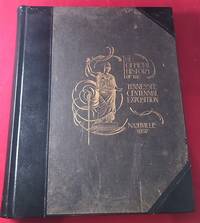
18983800Nashville TN: Brandon Printing Company 1898. First Edition First Printing. Hardcover. Good. 10 1/2 X 13 3/4 Inches. 494 PP Index. Official photographic album created to celebrate the near six-month Centennial celebration of Tennessee statehood. Published under the direction of Dr. W.L. Dudley and G.H. Baskette of the Committee on Publication. An impressive history of the state of Tennessee as well as a veritable who's who of Tennessee history. Illustrated with hundreds of engravings and photographs of historical buildings and citizens as well as the actual Centennial Celebration activities and locations. A notoriously scarce book. <br /> <br /> This copy is rebacked in recent black leather spine and rear board with tips. Retains original front board with gilt illustration and title work. First twenty or so pages quite damaged at edges with primitive tape repairs. While several pages are creased and taped the text is complete. Original color frontis illustration of The Parthenon intact with tape repair to edges. A lower grade example of this book that is rarely seen in commerce. Brandon Printing Company hardcover
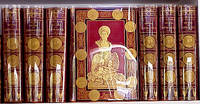
18794026Paris. Librairie Hachette. 1879. Bound in extravagantly ornate gilt pictorial red Morocco depicting gilt tooled Roman emblematic seals and large embellishment of armour eagles and statuary to front and rear covers. Gilt tooled spine compartments embellished with seals and laurel leaves. Raised bands. White silk moire endsheets. a.e.g. Thick 4to. New Edition. Illustrated with 50 brilliantly illuminated full page tissue-guarded chromolithographic plates. Further illustrated with over 3400 gravure engravings and 30 colour maps. A monumental work in a most impressive Hachette gilt binding - truly one of the most stunning bindings we've encountered. Sumptuously illustrated with eye-boggling iridescent Chromolithographs this extremely rare set is a true work of design art. Some chipping to head and tailpieces to various volumes with some small bits lacking hinges rubbed on various volumes some corners bumped through front cover of Vol. 1 starting mild scattered foxing throughout else Very Good. A bright crisp gleaming gilt gem.Featured Sets. Librairie Hachette. hardcover
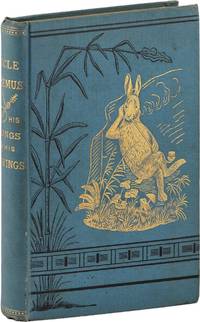
188189007New York: D. Appleton and Company 1881. First Edition. Blanck's first state with "presumptive" on last line of p.9 and ads on p.233 beginning with New Books: A Treatise on the Practice of Medicine. Octavo 19.75cm; publisher's powder blue cloth with titling and decorations stamped in gilt and black on spine and front cover; butterfly-patterned endpapers; 34-2311 8pp ads. Armorial bookplate of real estate magnate and art collector Edward Hubbard Litchfield 1845-1930 mounted to front pastedown. Spine ends gently nudged some softening to corners though still sharp with a hint of sunning to spine and some light dust-soil to extremities; contents clean with hinges sound; Very Good with bright gilt and the pictorial elements unrubbed. Housed in a custom slipcase and chemise. <br /> <br /> Uncle Remus was among the most significant collections of African American folklore recorded by Harris 1848-1908 a white Georgia-born author and journalist. "Harris was not the first to record the stories of Brer Rabbit Brer Fox and Brer Bear which he heard in the cabins of slaves on Georgia plantations but his retellings made them a favorite with American children.The book contains thirty-four "Legends of the Old Plantation" as well as "Plantation Proverbs" songs and chants under the title "His Songs" and a series of sketches about Uncle Remus the African American narrator entitled "His Sayings" Grolier One Hundred Books Famous in Children's Literature 42. BLOCKSON 42; BAL 7100; JOHNSON p.36. D. Appleton and Company unknown
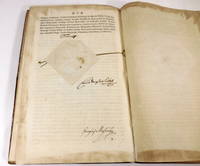
1807041061Hungary: N.P. 1807. In Latin. Laws passed by the Hungarian Assembly of 1807 a tumultous time in this region with the Imperial Seal of Francis II of the Holy Roman Empire later Francis I of Austria. Although the transition was made in 1806 this is still signed as Franciscus II. There is an additional signature below the seal Comes Josephus Erdody . Title page includes an additional inscription by Reverendo Petro Klobuviczky. Full brown leather with decorative borders 13.5 inches tall 2 32 pages. Covers worn with some worming to the covers hinges good but lower of the two binder's cords has separated endpapers age-toned with a modern note about the identity of Franz II neatly written at the bottom of the rear endpaper pages very clean. . Hard Cover. Good. Folio - 12" - 15" Tall. N.P. Hardcover
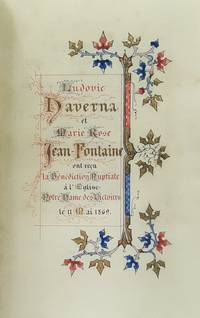
18603957<p>Paris: Morizot Libraire-Editeur.� n.d. 1860s 1860. Small 8vo. 140x90mm. pp. iv 668. Chromolithography frontispiece and twelve engraved plates. Beautifully bound by Charles Francois Capé in blue morocco lavishly decorated in gilt with the monogram "A.M." at each corner of the covers spine with five raised bands compartments richly decorated and second compartment lettered in gilt cream silk endpapers all edges gilt. On front free endpaper is stamped in gilt "M.J.F. 27 Juin 1861". The following leaf has the inscription "A Madlle i.e. mademoiselle. Marie Fontaine Souvenir de relieur Capé 31 December 1859". Bound in before the title page is an exquisite Gothic Revival illuminated manuscript on vellum recording the marriage of Marie Rose Jean-Fontaine to Ludovic Haverna on 11 May 1869. This is written in red and black with decoration drawn in blue and red highlights in thickly applied gold leaf. A gorgeous little prayer book and missal in immaculate condition. Capé 1806-1867 began his working life as a porter at the Louvre while learning the art of bookbinding in the museum library. In 1848 he established his bindery in Rue Dauphine where he carried out for work for distinguished clients as well as building his own fine book collection. This charming work was clearly done for friends given the warm inscription. And the insertion of the beautiful illuminated leaf shows that the book was unsurprisingly much treasured by Marie Fontaine throughout her life.</p> Paris: Morizot, Libraire-Editeur.� n.d. [1860s] hardcover
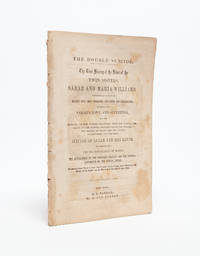
18555437New York: H.H. Randall 1855. First edition. Printed self wraps stitched at spine. Measuring 220 x 140mm and complete in 64 pages. Some rubbing along spine and scattered foxing to preliminary and terminal leaves; toned throughout else clean. A scarce piece sensationalizing the tragic affairs and subsequent suicides of Sarah and Maria Williams OCLC reports fewer than twenty copies with libraries with this being the only example on the market.<br /> <br /> We've been unable to determine whether the tragic story of the Williams twins is in fact historically true. What is clear whether the narrative is fiction or non-fiction is that the damage caused to women and their lives as a result of their social positions and sex had a wide audience and attracted a variety of readers -- some who hoped to judge the parties involved some who sought the experience of empathy and catharsis some with prurient fantasies and some who simply wanted a thrill. According to this story Sarah and Maria Williams were firstborn daughters to a loving and prosperous middle-class New York family and that like any "perfect victims" they combined "sincerity kindness and judgement" with "the bloom of loveliness grace and innocence." Chaste and well behaved in their boarding-school days their lives took a turn at twenty. During their father's extended absence on business Maria began receiving visits from Mr. Knight an insidious but well-recommended brother of an old schoolmate. Seduced by him into a fraudulent marriage Maria is ultimately separated from her family and forced into sex work for his profit.<br /> <br /> Rising eventually to "a high position among those of her kind.as a prostitute of superior grade" Maria operated on her own and refused to return to the Williams household despite Sarah's urgining; being degraded by her old neighbors and parents when she could be respected by her own was too much to bear. Sarah's insistence on maintaining a relationship with her twin and visiting her disreputable home led to her own reputation being cast into doubt. And when Sarah's intended eventually fell for engaged in keeping and ultimately got pregnant Maria all participants in the affair ended their own lives. <br /> <br /> In many ways the sensationalized stories of these twins reveal how no woman is safe and how no woman can rely on her chastity to protect her socially. Though Maria and Sarah were identical and took opposite paths their violent ends wind up being identical and equally scandalous. H.H. Randall unknown
189982637St. Petersburg: Ekspeditsii Zagotovienya Gosudarstvennykh Bumag 1899. First Edition. First printing with the Vasnetsov illustrations. Quarto 33cm x 23cm ca.; accordion-style binding opening to an eight-page panorama; printed in black and red throughout with chromolithographed head- and tail-pieces and four chromolithographed text illustrations. Slight soil and wear; brief splits at folds; internally fresh and unmarked with the illustrations still fresh and vividly colored; Very Good or better overall. <br /> <br /> A lavishly-illustrated work published to celebrate the centenary of Pushkin's birth. Vasnetsov 1848-1926 was a key figure among Russian Silver Age illustrators a strong influence on such successors as Ivan Bilibin Boris Zvorikin and Mikhail Vrubel. The illustrations for this work ".are exemplary for Vasnetsov's intense national style that soon would become visible in the works of Ivan Bilibin and other artist-illustrators.it would be difficult in this period of nationalistic revival to find a more talented and committed artist" Lemmens p.48. The illustrations printed at the State Dispatch Office in St. Petersburg are rendered here in brilliant chromolithography as are the ornamental initials and head- and tail-pieces by Viktor Zamiraĭlo. A large-paper reissue appeared later ca. 1914 under the Moscow imprint of A.A. Levenson; all editions are uncommon especially in such nice condition. LEMMENS pp.47-48 pictured. Ekspeditsii Zagotovienya Gosudarstvennykh Bumag unknown
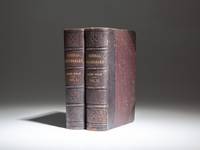
188415513New York: Harper & Brothers 1884. Second Edition. Quarter Leather. Near fine. The Military Operations of General Beauregard in the War between the States by Alfred Roman in the publisher's deluxe three quarter morocco. Octavo two volumes xvii 3 594pp; xvi 691pp. Publisher's three-quarter brown morocco title in gilt on spines raised bands. All edges gilt. Marbled endpapers. Errata slip at the end of Volume I. Note and postcard affixed to rear endpaper of Volume I. Complete with frontispiece portraits in both volumes a map of Charleston and plate depicting Fort Sumter in Volume II. Dornbusch II: 2605 Nevins II: 86 A scarce example in the publisher's morocco binding a near fine example. The author of this work Colonel Alfred Roman was the aide-de-camp and inspector general for Confederate General P.G.T. Beauregard. This biography was largely written by Beauregard himself with the rest compiled by Roman using the general's journals and battlefield notes. According to Eicher "this is a valuable source on the first victor of the Confederacy." Eicher 186 The first edition of this work was released in 1883. This second printing was sold by subscription in 1884 in full cloth half morocco sheepskin or full morocco. Harper & Brothers unknown
18902111902153000006Not Available 1890. Soft Cover. Fine. Number of pages: 91 pages Size: about 18.7 x width about 12.7 cm Number of books: 1 Not Available paperback
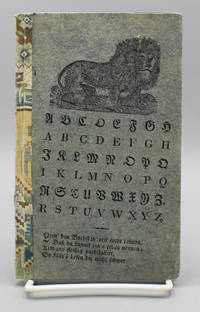
182014631<p>New-Market Shenandoah County Virginia: Salomon Henkel and J.H. Lawton 1820 Second edition of a book that first appeared in 1817. The first edition apparently did not have the four pages of additional material at the end. OCLC reports other copies of the second edition without the final four pages but only one the copy at Princeton which as them. Original patterned cloth over pictorial printed boards. New endpapers with presentation inscription from Elan O. Henkel a descendant of the compiler and printer dated October 29 1925. Twelvemo. Woodcut frontispiece depicting the letters of the alphabet and animals whose names start with each one woodcut title-page vignette woodcut alphabets and vignettes in text. Our copy has two final unnumbered leaves with eight woodcuts of different animals which is quite uncommon. A remarkably fine bright copy. The Henkels started the first Lutheran printing house in the U.S. in 1806. Ambrosius Henkel who wrote the primer also cut the woodblocks for the illustrations.</p> Salomon Henkel and J.H. Lawton, hardcover
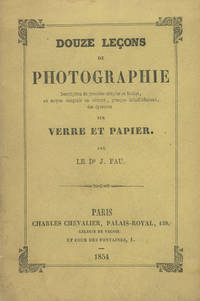
1854List01203Paris: Charles Chevalier 1854. First Edition. 12mo wraps 88 pp. A near fine copy with some wear to extremities of wraps and fine contents. Near Fine. A scarce early photographic manual by the anatomist Julien Fau who was best known for his lithographic works on human anatomy. This is an early manual of the collodion process. Quite uncommon with eleven copies held institutionally five in North America. Little is known about Fau’s involvement with photography though given his interest in the human form it would be fair to assume he may have employed it for the process of anatomical studies. An exceptionally clean copy from the library of the noted collector Otto Oren Fisher. Roosens and Salu 6522. Charles Chevalier unknown
18551530Sevilla: Imp-Libr. Española y Extrangera el tomo 1º y Francisco Alvarez y Cia. tomos 2º 3º y 4º 1855-57.- 4 TOMOS VII768; 798; 790; 780 pp.; 4º 24 x 155 cm; Media Piel época ligeramente gastada.- COLABORAN: Juan Nicolas Böhl de Faber ; Fernando de Gabriel y Ruiz de Apodaca; Aureliano Fernandez-Guerra; Fernán Caballero; Ramón de Campoamór; Eduardo Mier; Juan Eugenio de Hartzenbusch; José Amador de los RÃos; Juan de Ariza; José Bermudez de Castro; Alberto Lista y Aragón; Juan Valera; Antonio Alcalá Galiano y Trujillo. etc. MUY RARA. Solo ofrecemos los 4 primeros tomos. Palau 263737 indica 6 tomos. Las encuadernaciones se encuentran algo rozadas en los bordes pero restauradas y la cabeza del lomo del tomo III está reparada de pequeñas faltas. El interior en perfecto estado. LITERATURA Y FILOSOFÃA ESPAÑOLAS DE LOS SIGLOS XIX-XXI Y SU HISTORIA EN GENERAL Libro en español Imp-Libr. Española y Extrangera [el tomo 1º] y Francisco Alvare hardcover
186654689Edinburgh: William Blackwood and Sons 1866. First Edition. First printing with the second state of the advertisements. Octavo 20cm in three vols. In brick-red publisher's cloth stamped in blind on boards and titled in gilt on spines variant of Baker & Ross binding B; yellow coated endpapers; 4pp of ad leaves at rear of vol. III; vol. I: iv 303pp; vol II: iv 290pp; iv 283 1 1-4pp. With the embossed ownership mark of "W. H Smith & Son Library" on front free endpaper of vol. I. An appealing copy mildly cocked and rubbed at edges with two or three small stains to cloth; internally clean gathering K in vol. III pulled but holding overall: Very Good. <br /> <br /> The binding largely corresponds to Baker & Ross binding B but with a different cloth color and with "W BLACKWOOD" instead of "BLACKWOOD" in the imprint; for a description of a similar copy see Baker & Ross p. 232. BAKER & ROSS A8.1. SADLEIR 814. William Blackwood and Sons unknown
18101071601810. CHILDREN'S LITERATURE ANONYMOUS. London Cries for Children. With Twenty Elegant Wood Cuts. Philadelphia: Johnson & Warner 1810. 12mo later stiff paper wrappers. $950.First American edition following the London printing of the same year with woodcut frontispiece vignette woodcut on the title page and a half-page woodcut illustration for each of the 18 cries in the text.Dr. Rosenbach notes ""This edition of the London Cries resembles the Cries of Philadelphia and of New York in that each Cry is accompanied by a verse and a long explanatory passage in prose And although the book is intended for children the propaganda introduced into it is at times obviously intended for their parents"" Rosenbach Children's 421. Welch American Children's Books 249.12. Shaw & Shoemaker 19892 & 20586. Minor expected embrowning to text. One leaf with short tear from lower margin just touching text. An extremely good copy of this early children's book. unknown
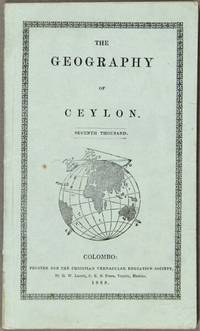
186845516Colombo: printed for the Christian Vernacular Education Society 1868. 12mo pp. 30; engraved title page; original stiff blue pictorial wrappers; spined ends cracked else very good. Despite the title this small pamphlet covers not only the geography of the island of what is now the country of Sir Lanka but also the people commerce and government. Only the NYPL copy in OCLC which locates no other editions. printed for the Christian Vernacular Education Society unknown
183210951Philadelphia: Carey & Lea 1832. Hard Cover. Very Good binding. 12mo. x 312; vi 320 36 publisher catalog pp. First edition. In publisher plum muslin spines and paper over boards; printed paper title labels on the spines. Spines are sunned; expected wear and some soiling to the boards; contents with varying degrees of foxing throughout ranging from moderate to quite light; one leaf in Volume II with loss to the top margin that touches the running header and page number; contemporary owner name John J. Moore dated 1832 in pencil on the bottom margin of p. 40; both volumes have later 19th century armorial bookplates of Charles A. Woolley on the front pastedown. <br /> <br /> While this is Kennedy's best known literary work he was also a United States Congressman and the United States Secretary of the Navy in the Fillmore administration. Uncommon novel in any form but particularly in publisher's boards. Despite the expected wear from age this is a pleasing set. BAL 11040; Wright I 1569; Haynes 9961. Carey & Lea unknown