12 256 résultats
89022unknown
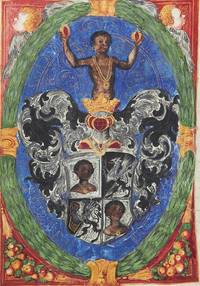
166935491669. Manuscript on vellum folio c. 240 × 300 mm. Sewn in contemporary limp vellum. Final leaf with contemporary notarial certification signature stamp and remnant of wax seal. Some wear and light soiling but a well-preserved and striking copy. With a large finely illuminated coat of arms in vivid colours and burnished gold framed by green palm fronds and flanked by angels incorporating distinctive Moor's head motifs. With a large finely illuminated coat of arms in vivid colours and burnished gold framed by green palm fronds and flanked by angels incorporating distinctive Moor's head motifs. Manuscript on vellum folio c. 240 × 300 mm. Sewn in contemporary limp vellum. 8 leaves. <p><br /> Imperial ennoblement diploma featuring depictions of Black African figures-an unusual and well-documented example of African representation in early modern European aristocratic identity.<br /> <p><p><br /> This lavishly illuminated imperial diploma issued by Emperor Leopold I on 6 May 1668 confirms the noble status of Georg Adam Christoph and Jakob Moren as members of the knightly nobility rittermäßiger Reichs- und erbländischer Adel of the Holy Roman Empire and its Hereditary Lands. It reaffirms earlier ennoblements of the family in 1514 and 1557 and grants the recipients revised arms and the right to use the territorial predicates von oder zu Sunnegg und Morberg following the extinction of the line of their cousin Hieronymus Moren. The present manuscript is an authenticated official copy certified on 4 April 1669.<br /> <p><p><br /> Of particular interest is the large full-page coat of arms likely painted by a professional court illuminator. Richly coloured and heightened with gold the quartered shield includes two fields with black imperial eagles and two with bust-length portraits of dark-skinned men in three-quarter profile adorned with gold earrings and chain necklaces. Above the shield rises a bare-chested crowned Black man holding a red orb in each hand and emerging from a coronet. The rendering is highly individualized and unambiguously emphasizes African phenotypic features. The composition is framed by a laurel cartouche flanked by angels and fruit.<br /> <p><p><br /> The surname Moren or Mor and the heraldic iconography leave little doubt that the family was of Moorish origin-or at least claimed such ancestry as part of its noble identity. While Moor's heads appear elsewhere in European heraldry they are typically stylized emblems representing conquest exoticism or religious symbolism. The Moren arms are distinct: they include multiple prominently placed depictions of Black African men-not as abstract symbols but as individualized and repeated figures in both crest and escutcheon. Their dignified and central presence-together with the family name-suggests an intentional genealogical claim rather than a purely symbolic motif. The route by which the Moren ancestor entered Habsburg service is uncertain but likely occurred via Spain or Italy in the late 15th or early 16th century.<br /> <p><p><br /> The Moren family retained noble status over successive generations with branches in Tyrol Styria Carinthia and Upper Austria and remained listed in official registers of the Austrian nobility into the 20th century. Among their later descendants was Therese von Mor zu Sunnegg und Morberg 1871-1945 a painter trained in Vienna Munich and Paris and active in several artists' associations. The family's heraldic identity-with its explicit visual reference to African ancestry-remained remarkably consistent making this diploma not only a legal instrument of nobility but a rare and compelling record of Black lineage within the early modern European aristocracy.<br /> <p><p><br /> Reference: Genealogisches Taschenbuch der adeligen Häuser Österreichs. 1907. Zweiter Jahrgang 1906/07 pp. 278-310. Wien: Otto Maass' Söhne.<br /> <p>. unknown
19802611New York: np 1980. First edition. Clamshell box. Fine. EXTREMELY RARE COMPLETE SUITE OF SEVEN LARGE SILVER PRINTS FROM EINSTEIN'S FAMOUS PHOTO SHOOT AT PRINCETON WITH ROMAN VISHNIAC. Each print is signed by Vishniac and dated "At Princeton 1942" in his hand below the image and numbered on the back. "One day Vishniac decided to visit Albert Einstein at Princeton to offer greetings from mutual friends in Berlin. Uninvited he hoped Einstein would pose for a portrait but Einstein had little interest. Vishniac recalled:<br /> <br /> It was a singular experience. An idea had suddenly come to him and the room was filled with the movement of the great man's thought. I waited several minutes and then when I saw that he did not intend to say anything more to me and that he was off in a world of his own I started taking pictures.<br /> <br /> Einstein later admitted that a Vishniac photograph taken that day was his favorite portrait" Encyclopedia of Twentieth-Century Photography. <br /> <br /> Vishniac provided details about this portolfio in a letter to an original recipient the letter is not included here explaining:<br /> <br /> The size of the edition's limitation is uncertain due to my age and only spare time to make them. The most expensive portfolios - Ansel Adams Kertesz - are limited in large numbers I can never measure up - 999 1001 and similar. <br /> <br /> The originality of Portfolio "Einstein" consists of its special character. It is made not to get images but the feeling that you are present during the creativity by the Great Man. All pictures are made with "hidden camera" method.<br /> <br /> The value of this portfolio is great and can hardly be estimated today. <br /> <br /> Princeton/New York: 1942 negatives; 1980 silver prints. Elephant folio clamshell box approx. 17x21 in. housing seven silver prints. Image size: approx. 10.25 x 13.25 in.; with matte 16x20 in. A few minor blemishes to box. Photos in fine condition. RARE. np unknown
257481350. <blockquote><p>This work takes its place on the lineage of great early works along with the Arthurian tales</p><p> </p><p>These are exceptionally early witnesses to this most important literary text the most popular secular work of the entire Middle Ages</p><p> </p><p>Appearances of this seminal text are uncommon only a handful having reached the market in decades</p><p> </p><p>Linguistic variations suggest a non-Parisian scribe; evidence of re-use in the 17th century from manuscript markings</p></blockquote><p>video width=""1920"" height=""1080"" mp4=""https://cdn.raabcollection.com/wp-content/uploads/20231204130246/Roman-de-la-Rose.mp4""/video</p><p> </p><p>The influence of the Old French allegorical poem the Roman de la Rose ripples through the Middle Ages into the Renaissance even into Modernity attracting the attention and inspiring the works of Chaucer Dante and C. S. Lewis. Lewis even stated that in cultural importance it ranks second to none except the Bible and the Consolation of Philosophy Allegory of Love 1936 p. 157.</p><p>The Roman de la Rose according to Lewis was an important step in the development of Western literature and thought. He wrote in the above work “We have seen how… in the hands of a great poet the Arthurian story treated in terms of courtly love produced the first notable examples of psychological or sentimental’ fiction… The radical defect in Chrétien’s poetry is that these two kinds of interest lie side by side in it without being really fused. The emotions of Lancelot and Guinevere are not really illustrated save in a very shallow sense by their adventures; their adventures are not really explained by their emotions.â€</p><p><img class=""alignnone wp-image-25764 size-post-window"" src=""https://cdn.raabcollection.com/wp-content/uploads/20231204140340/Roman-B-1-e1667227860712-1600x744.jpg"" alt="""" width=""1600"" height=""744"" /></p><p>This defect of emotional appeal of the primacy of love is rectified per Lewis in Roman de la Rose. “But the whole truth about Guillaume author of the Roman is missed until we see that he is more of a realist than Chrétien Chretien de Troyes fl. c. 1160–1191 was the author of some of the fundamental texts of Arthurian lore. Of the two things that he found in Chrétien it was the fantastic that he rejected and the natural that he used.â€</p><p>The great success then of the Roman de la Rose was fairly novel use of allegory to highlight the emotional journey of love as it would have appeared to someone at that time and in a courtly setting.</p><p><img class=""alignnone wp-image-25765 size-post-window"" src=""https://cdn.raabcollection.com/wp-content/uploads/20231204140328/Roman-A-1-e1667227983201-1600x752.jpg"" alt="""" width=""1600"" height=""752"" /></p><p><strong>Summary of the Romance of the Rose:</strong></p><p>In 1230 Guillaume de Lorris began the dream-vision poem a first-person narrative describing the efforts of a young man stricken by the arrows of the God of Love to obtain his beloved the Rose. Guillaume’s Amant Lover wished to tell the reader all that he knew of love and the poem describes a dream in which Amant is taken by Oiseuse Leisure into a pleasure garden where he meets the allegorical figures of Deduiz Pleasure Deliz Delight Cupid and others finally catching sight of and falling in love with the Rose. He is held back by the figures of Dangier Danger Honte Shame Mal Bouche Scandal and Jalousie Jealousy who imprison the Rose in a castle after Amant attains a kiss from the Rose.</p><p>Death claimed Guillaume before he was able to conclude his work. He is only remembered to us through a mention by the poem’s successive author Jean de Meun a friend of Dante who resumed the poem around 1275 adding around 17700 more lines to the approximately 4000 extant lines. There are therefore 2 authors for this same work separately themselves by a relatively great span of time each with his own milieu and sensibilities.</p><p>Both authors use the allegory to examine philosophical cruces emerging in the 13th century through scholasticism such as free will and determinism optics and the adjusting social orders which put mendicant friars in positions of increasing power. However Jean’s vision for how the Lover relates to his beloved— what he is prepared to do— diverges from Guillaume’s.</p><p>Jean provides a mirror for the turn from chivalric romances and courtly love which guided Guillaume. Jean’s social and political commentary sees the Lover deceiving and achieving the Rose in a way that that shifts away from the idealized and innocent sensuality of the first part of the poem to a biting satire on contemporary society blended with an overt realization of sexuality. Jean’s Amant makes war on the castle debates with Reson Reason Nature and Genius and finally enters the inner chamber of the Rose. His advice to the lover includes sections on how a man should keep his mistress study the arts ignore any infidelities offer flattery but never advice and how a lady might keep her male lover use false hair make up and perfume avoid getting so drunk you fall asleep at dinner only have intercourse in the dark to hide imperfections of the body and avoid poor men and foreigners - except very rich ones.</p><p>caption id=""attachment_25767"" align=""alignnone"" width=""1600""<img class=""wp-image-25767 size-post-window"" src=""https://cdn.raabcollection.com/wp-content/uploads/20231204140309/Roman-D-1-e1667228165675-1600x828.jpg"" alt="""" width=""1600"" height=""828"" /> Notes from use in the 17th century/caption</p><p><strong>The Manuscript & the Manuscript Tradition:</strong></p><p>Manuscript scholars have attempted to calculate the survival rate of medieval texts. Usually this calculation is done by comparing the catalogues of library books with known copies. Earlier in 2022 a team at the University of Antwerp has applied statistical principals usually used for tracking wildlife to estimate that approximately 9% of medieval manuscripts have survived to present day.</p><p>Johns Hopkins University and the Bibliotheque nationale de France have listed 324 known manuscript copies of the Roman de la Rose from the 13th 14th and 15th centuries exceeding the number of manuscripts of the works of Dante and Chaucer. With the suggestion of an original 3600 copies of the Roman de la Rose based on the 9% survival rate we are looking at what remains of a medieval best-seller. Yet few of these reach the market.</p><p><strong>Medieval manuscript poem</strong> 14th century France consisting of 2 double-sided folia from the Roman de la Rose from key sections of this great manuscript see “further details†below for a detailed entry and the Johns Hopkins system of categorization. There are manuscripts notations from use in the 17th century likely as binding.</p><p>This fragment opens with Friend’s advice to the lover to guard that Scandal doesn’t see him approach the castle where the Rose is kept. If the lover is spotted by Scandal he should not show hatred or rancor towards him ‘de hayne ne de racune’ because “a wise man covers his bad humour… those who deceive deceivers do a good deed and all lovers at least the wise ones should do so†‘sages hommes son maul talent ceuvre. cil fet bone euvre qi les decheveeurs decoivent…faire le doivent tretuit amans au mains li sage.†The scribe of this text has stricken through a line of his text “si sachies que cil fet bone euvre†which he was a repeat of two lines above. Jean de Meun’s jaded narrative has Friend giving the lover the advice to “serve and honor†Scandal and all his lineage ’tout son lignage’ because it is “no sin to trick those who are tainted by trickery†‘De ceus bouler nes pas pechies qi de bouler sont entechies’. And Scandal is indeed a boulierre a trickster. Friend goes on to explain the shameful tricks that Scandal’s bad mouth plays on men to steal— money and reputation. Friend warns that Old Woman and Jealousy also guard Bel Acueil Warm Welcome the lover’s companion who has also been taken into the castle. Through false courtesy bribes and weeping— even false weeping— will be needed for Amans to make his way through the castle.</p><p><img class=""alignnone wp-image-25768 size-post-window"" src=""https://cdn.raabcollection.com/wp-content/uploads/20231204140257/Roman-E-1-e1667228257297-1600x856.jpg"" alt="""" width=""1600"" height=""856"" /></p><p>At this point the fragment breaks off and resumes nearly a thousand lines later. The break in lines from one folio to the next from lines 7301-7379 to 8415-8575 occurs because of the way the book was put together. Large leaves of vellum were folded in half to create bifolia which were in turn nested into one another to create gathering of folios or pages in a modern sense. Since the folded bifolia were still attached a loose bifolia will contain text that jumps from one folio to the next. This is to say that the text on a bifolium will not follow sequentially unless it is the very center of the quire.</p><p>We reenter the narrative as Friend is telling of an idyllic time which slides slowly towards Jean de Meun’s cynicism but also with a great statement of the primary of love over earthly physical power and domination — “No king or prince had yet committed any crime by robbing and seizing from another. All were accustom to being equal and no one wanted any possessions of his own. They knew well the saying neither lying nor foolish that love and lordship never kept each other company nor dwelth together. The one that dominates separates them†“N’encor n’avoit fet roy ne price Meifet qui lautrui tout et pinche Testuit pareil estre souloient Ne riens propre avoir ne vouloient. Bien savoient ceste parole Qui nest mencongiere ne fole Conques amour et seignourie Ne sentrefirent compaignie Ne ne demourerent pas ensemble: Cil qui mestrie les dessemble’. Immediately following this the relationships between a jealous husband and frivolous wife is examined. Jealousy laments his own marriage and the bygone days of women like the Grecian Penelope of Homer’s Odysseya who waited loyally on Odysseus’s return.</p><p><strong>A Note on the Rarity:</strong></p><p>The text is far from common on the market with the vast Schoenberg database listing only ten codices appearing at auction since the 1970s and only three of those of the fourteenth century: Christies' 7 June 2006 lots 23 and 31 once Phillipps MS. 2838 and 4185 now both Senshu University Japan; and another in the same rooms 9 July 2001 lot 12; Sotheby's 17 June 1997 lot 6 once Phillipps MS. 129; Drouot 16 December 1994 lot 1; another in the same rooms 9 December 1992 lot 371; Ader Picard Tajan in Paris 16 September 1988 lot 152 this previously in Sotheby's New York sale of Carleton Richmond's library in 1981; the Astor copy sold in Sotheby's 21 June 1988 then Beck collection and stolen; Christie's 25 June 1980 lot 232 once Phillipps MS. 4357 now in the Ferrell collection; another sold in Ader Picard Tajan in Paris 20 May 1980 lot 60; and that sold in Sotheby's 13 July 1977 lot 48 to Peter Ludwig and thence to the Getty Museum. Fragments seem to come to the market even less frequently with the last examples in Christie's 30 May 1984 lot 200 a small miniature trimmed to its edges from a manuscript of the second half of the fourteenth century; Alde Libraire Giraud Badin 8 June 2012 a fourteenth-century leaf most probably the missing first leaf of Columbia University Plimpton MS. 284; and two fifteenth-century bifolia recovered from bindings sold through Dreweatt’s 6 July 2017 lots 34 and 35.</p><p><img class=""alignnone wp-image-25769 size-post-window"" src=""https://cdn.raabcollection.com/wp-content/uploads/20231204140244/Roman-F-1-e1667228424857-1600x828.jpg"" alt="""" width=""1600"" height=""828"" /></p><p><strong>The Scribe and His France:</strong></p><p>While the parent manuscript of the present leaves was probably a Parisian product and made for an aristocratic audience in the early 14th century the scribe of the manuscript probably came from farther afield than the ÃŽle-de-France.</p><p>Comparing the paleographic style the manuscript is similar to a manuscript at Oxford Bodleian MS Selden Supra 57 composed in 1348 in Paris arriving in the Bodleian Library in 1659. However a comparison of a sampling of 10 lines from both manuscripts reveals an interesting linguistic difference between the Parisian manuscript and the fragments here.</p><p>Lines 7307-7316 Selden Sura 57 on left fragment on right with differences in bold.</p><p><strong>Nene fetes chiere neisune/ ne faites chiere neysune</strong></p><p>De <strong>haine</strong> ne de rancune;/ de <strong>hayne</strong> ne de rancune ;</p><p>Et se vous ailleurs l'<strong>encontrez</strong>/et se vous ailleurs <strong>lencontres</strong></p><p>Nul mautalent ne li <strong>montrez</strong>:/nul mautalent ne li <strong>monstres</strong> :</p><p>Sages hons son mautalent <strong>cueure</strong>/ sages hommes son mautalent <strong>ceuvre</strong></p><p>Si <strong>sachiez</strong> que cil<strong> font bonne eur</strong>e/ si <strong>sachies</strong> que cil <strong>fet bone euvre</strong></p><p><strong>Qui</strong> les <strong>deceveours</strong> decovient;/ <strong>qi</strong> les <strong>decheveeurs</strong> decoivent;</p><p><strong>Sachiez ainsi fere</strong> le doivent/ <strong>sachies</strong> <strong>qu’ainssi</strong> faire le doivent</p><p><strong>Trestuit</strong> <strong>amant</strong> au <strong>mainz</strong> li sage./ <strong>tretuit amans</strong> au <strong>mains</strong> li sage.</p><p>Male Bouche et tout son linage/ Male Bouche et tout son lignage</p><p>We can examine another stylistically manuscript from Central France likely Paris in the 4th quarter of the 14th century London British Library MS Add. 42133.</p><p>Lines 7307-7316: Add. 4233 left Selden Sura 57 middle fragment right with differences in bold.</p><p>Nene fetes chiere <strong>nisune</strong>/ Nene fetes chiere <strong>neisune</strong>/<strong> ne faites</strong> chiere <strong>neysune</strong></p><p>De hayne ne de racune/ De <strong>haine</strong> ne de rancune;/ de hayne ne de rancune ;</p><p>Et se vous ailleurs lencontrez/Et se vous ailleurs l'encontrez/et se vous ailleurs <strong>lencontres</strong></p><p>Nul <strong>maltalent</strong> ne li monstrez/ Nul mautalent ne li montrez:/nul mautalent ne li <strong>monstres</strong> :</p><p>Sages hommes son <strong>maltalent</strong> cueure/ Sages hons son mautalent cueure/ sages hommes son mautalent <strong>ceuvre</strong></p><p>Si sachiez que cil font bonne <strong>oeure</strong>/Si sachiez que cil font bonne <strong>eure</strong>/ si sachies que cil fet bone <strong>euvre</strong></p><p>Qi les <strong>deceveurs</strong> decoivent/ <strong>Qui</strong> les <strong>deceveours</strong> decovient;/ qi les <strong>decheveeurs</strong> decoivent;</p><p>Sachiez quainsi fere le doivent/ Sachiez ainsi fere le doivent/ sachies qu’ainssi faire le doivent</p><p><strong>Tretuit</strong> amant au mains lo sage/ <strong>Trestuit</strong> amant au <strong>mainz</strong> li sage./ tretuit <strong>amans</strong> au mains li sage.</p><p>Male Bouche et tout son <strong>linguage</strong>/ Male Bouche et tout son <strong>linage</strong>/ Male Bouche et tout son <strong>lignage</strong></p><p><img class=""alignnone wp-image-25770 size-post-window"" src=""https://cdn.raabcollection.com/wp-content/uploads/20231204140228/Roman-G-1-e1667228920615-1600x832.jpg"" alt="""" width=""1600"" height=""832"" /></p><p>Comparing the fragment of the Rose with the other dated and located copies of the same text invites out the linguistic diversity of Old French the pre-Modern French in use from the 8th to 14th centuries. “Old French†is somewhat of an umbrella term housing the attested dialects that comprised the linguistic landscape of the Francophone region. The French spoken in the Paris region at this time is known as Francien in Champagne it is Champeniose Picard is Picardie Normans spoke Normand and the French of England is often called Anglo-Normand. These are only a sampling from the five linguistically distinct regions in the overarching region of langue d’oil France roughly the distinction between Northern France where they say oui for yes and Southern France where they say oc for yes. A simplified map of the langues de oil are represented below:</p><p>While some differences in the orthography of the Rose texts can be due to the lack of standardization in spelling in this period the differences can help us better understand the most likely profile of the scribe and can likely rule out a Parisian scribe who would have been native in the Francien-dialect. We begin to suspect that the scribe of these fragments was more likely to have come from a region outside of Paris. The data suggests Hainaut Orleans Indre-et-Loire or Ardennes as likely regions with overlap of the linguistic features. Two of these areas Hainaut and Ardennes are geographically close north and northeast of Paris while Indre-et-Loire and Orleans are further southwest from Paris.</p><p>Though inconclusive we can begin to paint a picture of our writer: a talented scribe arriving in Paris and adapting the Parisian style of writing but never losing his regional flare or maybe he was commissioned by a family of one of these areas and was delighted for the opportunity to produce a manuscript in his own dialect rather than Francien.</p><p><strong>Further details:</strong></p><p>Jean de Meun section of Roman de la Rose in Old French with regional features from outside of Paris <strong>illuminated manuscript on parchmen</strong>t northern France mid-fourteenth century Two large leaves each with double column of 40 lines of an early gothic French vernacular hand with lines 7301-7379 and 8415-8575 of the poem with one-line initials offset in margins 2-line initials in gold on blue and dark-pink grounds heightened with white penwork but with an apparent quire signature ""VII'"" at foot of verso of second leaf recovered from an account book binding that dated ""1622"" and ""1623"" and so with some stains cockled areas later scrawls discoloration to outer surfaces of that binding and holes but overall in good and presentable condition each leaf approximately 330 by 225mm. written space 226 by 167mm. These are exceptionally early witnesses to this most important literary text the most popular secular work of the entire Middle Ages. Manuscript notations from use in the 17th century likely as binding.</p><p>Provenance: Recently discovered in an American collection.</p><p><strong>Johns Hopkins Standardized Section Headings:</strong></p><p>Folio 1</p><p>1. Amans Lover and Amis Friend discuss the situation Amis assuring Amans that the situation is not desperate; no prison can hold Bel Acueil Warm Welcome once he has awarded Amans a kiss J3b 1-99 Lines 7204-7302</p><p>2. Amis counsels Amans to play nice with Male Bouche Slander J3c 1-66 7303-7368</p><p>3. Amis counsels Amans to be sweet to Vielle Old Woman and Jalousie J3d 1-32 7369-7400</p><p>Folio 2:</p><p>1. Amis Friend observes that things have not always been so; during the golden age love was sincere and loyal not rapacious J3o 1-96 lines 8323-8418</p><p>2. Amis interrupts himself to note that love is incompatible with domination beginning an account of a jealous husband Jalous Jealousy J3p 1-18 8419-8436</p><p>3. Amis in the voice of the husband berates his wife for carrying on when he goes off on business and for paying attention to young men J3q 1-94 8437-8530</p><p>4. Jalous laments that he should have followed the advice of Theofrastus and never married: whether a women is ugly or beautiful she will betray her husband J3r 1-42 8531-8572</p><p>5. All women can be seduced; women like Penelope or Lucrece no longer exist J3s 1-72 8573-8656<br />See Also:</p><p>Price Michael “‘Lost’ Medieval Literature Uncovered by Techniques Used to Track Wildlife†Science Feb. 17. 2022</p><p>Solly Meilan “How Much Medieval Literature Has Been Lost Over the Centuries†The Smithsonian March 8 2022</p><p><img class=""alignnone wp-image-24867 size-post-window"" src=""https://cdn.raabcollection.com/wp-content/uploads/20231204144901/Folder-site-10-1600x1327.jpg"" alt="""" width=""1600"" height=""1327"" /></p> hardcover
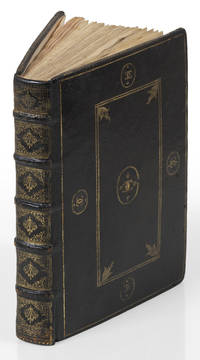
1518102<p>THE UNIQUE PROOF COPY OF AN EXTREMELY RARE BOOK OF HOURS BY THE ATELIER OF GERMAIN HARDOUIN PRINTED ON VELLUM WITH THE ILLUSTRATIONS FROM JEAN PICHOIRE AND THE MASTER OF THE APOCALYPSE OF THE ROSE'S ATELIER AND FINELY ILLUMINATED IN PARIS BY THE MASTER OF NICOLAS DE LA FONS<br />.</p><p>FROM THE COLLECTIONS OF ULRICO HOEPLI & HANS PETER KRAUS BOOK OF HOURS USE OF ROMAN CHURCH.</p><p>Hore divine virginis Marie secundum usum Romanum cum aliis multis folio sequenti notatis una cum figuris Apocalipsis et destructio sic Hierusalem et multis figuris Biblie insertis. Ad colophon: Parisius noviter impressum opera Germani Hardouyn commorantis ante Palatium regis ad intersinium sic dive Margarete ca. 1518. Paris Germain Hardouin 1518</p><p>8vo 170 x 110 mm 17th century brown calf gilt fillets and floral tools a central piece on which is stamped the monogram TCC a similar monogram with the only CC interlaced is gilt on the sides of the gilt frame ff. 84 signature a-k8 l4 not printed in this copy almanac for date 1518-1532 printed on 31 lines text in Latin Germain Hardouin printer device #1 the same device used by Guillaume Eustace from the MASTER OF THE APOCALYPSE ROSE Renouard 434 with the "E" of the crest and the name in the cartouche except the "G" deleted PRINTED ON VELLUM.</p><p>18 FULL-PAGE AND 22 SMALLER WOODCUTS ILLUSTRATING THE GOSPELS AND THE PRAYERS TO SAINTS ALL ILLUMINATED. HEAD-LETTERS ILLUMINATED IN BLUE RED AND GOLD.</p><p>UNIQUE COPY of an illuminated book of hours. Only 2 complete copies of this edition are recorded at BIBLIOTHÈQUE NATIONAL DE FRANCE and NEWBERRY LIBRARY and three uncomplete copies recorded HARVARD UNIVERSITY UNIVERSITY OF VERMONT HOWE LIBRARY COLLEGE OF SAINT BENEDICT/SAINT JOHN'S UNIVERSITY AND CLEMENS LIBRARY/ALCUIN LIBRARY but none of them belongs to this unique variant.</p><p>"RARISSIMUS" Tenschert op. cit.</p><p>The uniqueness of this copy is marked by different features as:</p><p>• lack of signature marks printed on the leaves</p><p>• a different set-up of metalcuts; in some cases different miniatures in others a different positioning within the printed text as well as with a different text in the cartouche under the illustration which is occasionally cropped and replaced by hand by a new version.</p><p>The cartouche under some miniatures has been erased and handwritten with a different text ILLUSTRATIONS: 18 Full page illuminated illustrations on a written cartouche: • Germain Hardouin Device From Guillaume Eustace from the Master of the Apocalypse Rose • Planetary man in the form of a Skeleton after Vostre's bloodletting man from Pichores Workshop • St. John the Evangelist on Patmos German style for Hardouin in -8° allongé ca. 1516 • Jesus Healing the ear of the servant • The Original Sin of Adam and Eve Master of the Apocalypse Rose style for Hardouin 1503 • Annunciation German style for Hardouin in -8° allongé ca. 1516 • Visitation German style for Hardouin in -8° allongé ca. 1516 • Nativity German style for Hardouin in -8° allongé ca. 1516 • Annunciation to the Shepherds German style for Hardouin in -8° allongé ca. 1516 • Adoration of the Magi Master of the Apocalypse Rose style for Hardouins 1503 • Presentation in the Temple Master of the Apocalypse Rose style for Hardouins 1503 • Flight into Egypt Master of the Apocalypse Rose style for Hardouins 1503 • Coronation of the Virgin Master of the Apocalypse Rose style for Hardouins 1503 • Job and his tormentors for Hardouin ca. 1515 • Crucifixion for Hardouin ca. 1515 • Pentecost Master of the Apocalypse Rose style for Hardouins 1503 • King David and Bathsheba bathing for Hardouin ca. 1515 • Assumption of Mary Immaculate with death watching for the opposite border German style for Hardouin in -8° allongé ca. 1516</p><p>22 small metalcuts illustrating the Gospels and the Prayers: • Luke the Evangelist room small pictures Pichore style for Hardouin ca. 1505 • Matthew the Evangelist small images Pichore style for Hardouin ca. 1505 • Mark the Evangelist small pictures Master of the Apocalypse Rose style for Hardouin ca. 1503 • Holy Mary small pictures Master of the Apocalypse Rose style for Hardouin ca. 1503 • Saint Barbara beheaded small pictures Master of the Apocalypse Rose style for Hardouin ca. 1503 • Holy Trinity three miniatures Apocalypse Cycle – Pichore workshop • Annunciation small pictures Master of the Apocalypse Rose style for Hardouin ca. 1503 • San Micheal small pictures Master of the Apocalypse Rose style for Hardouin ca. 1503 • Saint John the Evangelist • Saints Peter and Paul • St. James small pictures Master of the Apocalypse Rose style for Hardouin ca. 1503 • Saint Lawrence small pictures Master of the Apocalypse Rose style for Hardouin ca. 1503 • St. Sebastian small pictures Master of the Apocalypse Rose style for Hardouin ca. 1503 • St. Nicholas small pictures Master of the Apocalypse Rose style for Hardouin ca. 1503 • Saint Agatha of Sicily • St. Mary Magdalene • Saint Margaret • Santa Barbara repeated • Jesus • San Claudius small pictures Master of the Apocalypse Rose style for Hardouin ca. 1503</p><p>TEXT: • Front Page with Hardouin printer device • Tabula • Gospel Lesson and St John Passion • Hours of the Virgin HV o Matin Lauds Prime Third Sixth Ninth Vesper Compline • Hours of the Holy Cross • Hours of the Holy Spirit • Hours of the conception of Holy Mary • Penitential Psalms and Litany • Eve of the dead • Mass of Holy Mary • Prayers</p><p>CONDITION: occasional vellum flaws restored never affecting text or illuminations the corner of two pages strengthened inconsequential spotting or stains in margins overall a fine copy remarkably well-preserved.</p><p>PROVENANCE: I. TCC & CC monograms 17th-century on the covers attributable to the original client of the binding.</p><p>II. URLICO HOEPLI 1847-1935 one of the dominant figures in the European old books trade across the last two centuries paper ex-libris "H" pasted at inside front board</p><p>III. 1940's ex-libris not identified with the initials S.B. pasted on front flyleaf</p><p>IV. HANS PETER KRAUS 1907-1988 without doubt the most successful and dominant rare book dealer in the world in the second half of the 20th-century paper ex-libris "H.P.K" pasted at inside front board</p><p>V. LIBRAIRIE PINAULT Paris cutting taken from their sale catalogue 38 1971 The volume is housed in a very attractive 18th-century red velvet binding embroidered with silver thread and emblazoned. REFERENCES: Renouard ICP II 1848; Van Praet I p. 112 n°135; Bohatta 1027; Lacombe 290; Brunet Heures V 1638 n°251 ; Philippe Renouard Les marques typographiques parisiennes des XVe et XVIe siècles 1828 #434 ; HERIBERT TENSCHERT Herausgegeben von Heribert Tenschert 2015 vol VII 124.2 including plates provenances but not this unique proof ; Isabelle Delaunay Artistic exchanges between handwritten and printed books of hours produced in Paris doctoral thesis ss. The direction of F. Joubert Pairs IV 2000 p. 98 fig. 130 254 fig. 327 296 380.</p><p>HEURES DE GERMAIN HARDOUYN ILLUMINATED BY THE MASTER OF NICOLAS DE LA FONS</p><p>The style of the illuminator of this BOOK OF HOURS can be recognized in the edition of the Loups Ravissans printed for ANTOINE VÉRARD around 1504 Paris BnF. Rés. Vélins 2258. We recognize the expressionless looks of the illuminated figures with large black pupils lot of white in the eyes and heavy eyelids. On mainly flat illuminations the folds are highlighted by a thicker line often black. WE notice as our artist is very respectful and faithful to the engravings. His style can be seen in several BOOKS OF HOURS. In Paris Hours BnF. lat. 1387-1376 in the Announcement to the shepherds and the Presentation in the Temple he was inspired by engravings from the Thielman Kerver series printed from 1497. Two iconographic themes are peculiar: Saint Gemme and the Virgin handing over to Canon Arnoul the text of the prayer "Missus est Gabriel" themes represented by the MASTER OF ETIENNE PONCHER in the hours Paris BnF. lat. 18017. The two artists collaborate in the HEURES DE LYON Bm. Ms. 5997. In this last manuscript our artist is again inspired by engravings for the Presentation in the Temple Simon Vostre from 1496 and for the Betrayal of Judas Kerver from 1497. Here too he demonstrates originality by representing the Meal at Emmaüs Isabelle Delaunay Artistic exchanges between handwritten and printed books of hours produced in Paris doctoral thesis ss. The direction of F. Joubert Pairs IV 2000 p. 98 fig. 130 254 fig. 327 296 380. His activity as an illuminator of engravings continued into the 16th century. He was responsible for illuminating the HOURS FOR THE USE OF ROME Nicolas Higman for Simon Vostre around 1512 for the same use those of Gillet Hardouin around 1516 and again for the use of Rome those of Guillaume Le Rouge around 1510 H. Tenschert I. Neetekoven Horae BMV 158 Stundenbuckdrucke der Sammlung Bibermühle 1490-1550 Tenschert 2003 vol. 1 cat. 49 and vol. 2 cat. 77 86. We recognize its light gray walls dotted with small darker gray lines. He also illuminates the HOURS OF BRUSSELS Bibl. royal ms. 15079 F. Lyna The main painting manuscripts of the Royal Library of Belgium t. III 2nd part expanded reed. Brussels 1989 notice 341 pl. CXI a prayer book composed at the beginning of the 16th century Paris Bibl. Mazarine Far. 8 the HOURS FOR PARIS use Ms. Lat. 10562 and those of the same use Lat. 18032. Very interesting is the BOOK OF HOURS FOR THE USE OF ROME in Milan Biblioteca Nazionale Braidense AC. VIII 28 illuminated in Paris around 1507 for NICOLAS DE LA FONS. The name of the owner is designated by an inscription in capital letters on five lines alternately in blue and gold ink under the miniature of Saint Nicholas. NICOLAS DE LA FONS originally from Saint-Quentin in Aisne presented himself as "Esleu du Vermandois" a position he held from 1507. He was a wealthy officer who was entrusted with the distribution of the collection of aid in his site in Vermondois and the recruitment of war personnel. IT IS AFTER THIS MANUSCRIPT THAT WE CAN NAME THE ILLUMINATOR OF THE PRESENT "MASTER OF NICOLAS DE LA FONS". A skilful and firm hand compositions stripped of all details a reduced and dull palette and painting mainly in flat areas characterize his style. In the list of his sponsors we include ANNE LA ROUTYE who entered the Hôtel-Dieu in Paris at the age of 14 in 1505 who approached our artist for the addition of two miniatures in a BOOK OF HOURS PARISIAN from the mid-15th century Sydney University Library Ms. Additional 58 see P.R. Monks Patrons and Devotion. The University of Sidney's Hours of Anne de la Routye Sydney 1995 pl. XXIII XXIV.</p><p>Dr. Isabelle Delaunay</p> Germain Hardouin hardcover
51-4213Frankfurt : Theordoro de Bry 1596 1617. 2 volumes in one. Folio. 24 x 34.4 cm. Old vellum binding spotted. Part V: Engraved title and frontispiece map of New Spain portrait of Christopher Columbus and 22 half-page engravings. Collation: Engraved title page 92pp. repeated title page XXII plates double page folding map of Hispaniae Novae. blank. Part VI: Engraved title and frontispiece folding plan of Cusco Peru and 28 half-page engravings; lacking the map in the 6th part . Collation: 108pp. incl. engraved title page engraved double page bird's eye view of Cusco repeated title page with change to cartouche 28 engraved plates. Waterstaining to the upper corner of most text pages in Part V but not affecting the plates; light waterstaining to the plates in the top margin of Part VI not affecting the text pages.Engraved heraldic bookplate with lions dragon and metal helmuts.Title within engraved ornamental border; initials; headpieces and tailpieces.Roman numeral date on t.p. contains apostrophi.Engraved title page repeated before plates: verso blank: "Praefatio" contains portrait of Columbus with 11 lines of text p. 1: "Secvndi libri svmma et argvmentvm" p. 3: "Novae novi orbis historiae liber secundvs" p. 5-72.Map has title: Hispaniae novae sive Magnae recens et vora descriptio 1595.Signatures: a-hⴠiⶠA-Fⴠ-E1 and F2; F4 is blank.V. Benzoni's History continued. Americae pars quinta nobilis & admiratione plena Hieronymi Benzoni . secundae sectionis Historiae Hispanorum tum in Nigrittas servos suos tum in Indos crudelitatem Gallorumque piratarum de Hispanis toties reportata spolia. Frankfurt: Theodore de Bry "1595" but c. 1617. Blank leaves i6 and F4 . 2 engraved titles engraved portrait of Columbus with thirteen lines of text beneath engraved folding map of New Spain 22 engraved plates.Bry records and illustrates the events surrounding Columbus's discoveries subsequent relations with the natives and the atrocities committed by the Spanish and the native populations. Many of the illustrations have assumed iconic status and the three maps one in each part are also important as landmarks in the mapping of the Americas. Church 157.VI. Benzoni's History concluded. Americae pars sexta sive historiae ab Hieronymo Benzono . scriptae sectio tertia. Frankfurt: Theodore de Bry 1596. Engraved titles LACKING the double-page engraved map of Western Hemisphere with double-page engraved view of Cusco. FIRST EDITION. Church 158.Réunion des rares cinquième et sixième tomes des « grands voyages » consacrés à l'Amérique en seconde édition publiée vers 1617. Le texte est celui de l'Historia del Mondo Nuovo par Girolamo Benzoni d'abord paru à Venise en 1565. Magnifique illustration gravée sur cuivre par Theodor de Bry comprenant un titre-frontispice répété une carte de la Nouvelle Espagne à double page un portrait de Christophe Colomb et 22 gravures à mi-page dans la cinquième partie ; un titre-frontispice répété un plan de Cuzco replié et 28 gravures à mi-page dans la sixième partie.Manque la carte dépliante comprise dans la sixième partie. Mouillures et légères rousseurs ; quelques restaurations de papier toutes marginales hormis sur la carte de la cinquième partie restaurée avec légers manques dans le pli vertical ; titre-frontispice initial doublé.OCLC Numbers: 823867817 and 823868224 digital only.Expertise by Expert Jean Lequoy Librairie Giraud-Badin Paris Frankfurt : Theordoro de Bry, 1596 [1617] hardcover
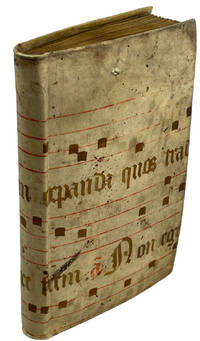
1504100<p>EXTREMELY RARE BOOK OF HOURS PRINTED ON VELLUM<br />ILLUSTRATION FROM MASTER OF THE APOCALYPSE OF THE ROSE'S ATELIER.<br />THE ONLY KNOWN COMPLETE COPY!</p><p>BOOK OF HOURS USE OF ROMAN CHURCH. A la louenge de dieu et de sa tres saincte et glorieuse mere et a ledification de tous bons catholiques furent commences ces presentes heures A lusaige de Romme. Colophone: " …achevez lan mil. ccccc. et iiii. le. xxii. iour de aoust pour Gillet Hardouyn libraire marchant demourant a Paris sur le pont au change a l'enseigne de la Rose Imprimeez par Anthoine Chappiel imprimeur demourant a Paris en la rue de beau vois a lenseigne des Connins " Paris: Antoine Chappiel for Gilles Hardouyn 22 August 1504. </p><p>8vo 17 x 10 cm binding from a reused middle age handwritten vellum page with Gregorian music notations gilt edges ff. 80 signature A-K8. Gothic type 32 lines. Text in Latin except for the prayer opening the volume and the title A1r the almanac A1v some prayers appearing at the end of the volume and the colophon K8r in French almanac for years 1497-1520.<br />13 FULL-PAGE WOODCUTS 28 SMALLER WOODCUTS ILLUSTRATING THE GOSPELS AND THE VARIOUS PRAYERS; HEAD-LETTERS ILLUMINATED IN BLUE RED AND GOLD. <br />EXTREMELY RARE BOOK OF HOURS PRINTED ON VELLUM BY ANDRE' CHAPPIEL FOR GILLES HARDOUIN: ACCORDING TO WORLDCAT AND USTC THERE ARE ONLY TWO OTHER RECORDED COPIES AT BIBLIOTHEQUE MUNICIPALE DE LYON INCOMPLETE MISSING THE LAST MINIATURE RICH MAN AND LAZARUS AND VERSAILLES MISSING DIFFERENT QUIRES. <br />TEXT: f. A1r: versified prayer: " Jesus soit en ma teste et en mon entendement Jesus soit en mes yeulx et en mon regardement … "; f. A1v: almanac giving the dates of the " Dimanche des Brandons" first Sunday of Lent or Quadragesima Sunday Easter and Advent for the years 1497 to 1520; f. A2r-A4v: calendar; f. A5r-B1v: abstracts from the Gospels of the four Evangelists; f. B2r-F2v: Hours of the Virgin use of Rome f. B3r: Matins; f. B8v Lauds; f. C4v: Matins of the Holy Cross; f. C5v: Matins of the Holy Spirit; f. C6v: Prime; f. D1r: Terce; f. D3v: Sext; f. D6r: None; f. D8v: Vesper; f. D1r: Compline; f. F3r-G1v: seven Penitential Psalms followed by litanies and other prayers; f. G3r-H6r: Office of the Dead; f. H6r-K8r: various prayers; f. K8r: colophon.</p><p>ILLUSTRATIONS:<br />• Tree of Jesse f B2v<br />• Annunciation f B3r<br />• Visitation f B8v<br />• Crucifixion f C4v <br />• Pentecost f C5v<br />• Nativity C6v<br />• Adoration of the Shepherds D1r<br />• Adoration of the Magi D3v<br />• Presentation in the Temple D6r<br />• Flight into Egypt D8v<br />• Coronation of the Virgin E4r<br />• Anointing of King David by Samuel F3r<br />• Rich man and Lazarus G2r</p><p>28 small figures illustrating the Gospels and the various prayers at the end of the book John the Apostle; Luke the Evangelist; Matthew the Apostle; Mark the Evangelist; the Crucifixion; Christ and the Angel; the Holy Shroud; the Flight into Egypt; the Archangel Michael; St. Johan the Baptist; John the Apostle; Saints Peter and Paul; Saint James; Saint Stephen; Saint Lawrence; Saint Christopher; Saint Sebastian; Saint Nicholas; Saint Anthony; Saint Anne; Saint Mary Magdalene; Saint Catherine; Saint Margaret; Saint Barbara; Saint Apollonia; Christ Pantocrator; Holy Mary; Saint Barbara.</p><p>The metalcuts used in this book were part of a series that both ANTHOINE CHAPPIEL and GUILLAUME ANABAT used for the Hardouin brothers. The series comes from the MASTER OF THE APOCALYPSE OF THE ROSE'S ATELIER.</p><p><br />ANTOINE CHAPPIEL printer in Paris 1500-1504 succeeded by Guillaume Anabat 1505–1510. <br />Chappiel's earliest dated book is from 1500. The Inventaire chronlogique records dated books in 1502 1503 and 1504. From 1502 to August 1504 he printed under the sign: "Au college de Triguet en la rue Sainct Jean de Latran; - In collegio Tregorensi or: --nuncupato de Triguet juxta sanctum 1ohannem Lateranensem ".</p><p>In August 1504 and on a Book of Hours without date we read: " Rue de Beauvois a lenseigne des Connins; Rue de rue sainct Jehan de Beauvais a lenseigne des Congnis. "</p><p>CONDITION: Very good copy of an extremely rare book of hours printed on vellum.</p><p>REFERENCES: Bohatta 790; Lacombe Books of Hours Printed in the 15th and the 16th Century p. 87-88 No. 143bis the Versailles copy incomplete; Moreau Inventaire Chronologique des Éditions Parisiennes du XVIe siècle I p. 128: 1504 No. 48; USTC 6689; Andrew Pettegree Malcolm Walsby and Alexander Wilkinson French Vernacular Books Books published in the French language before 1601 Leiden Brill 2007 REF. 29496; Philippe Renouard Répertoire des imprimeurs parisiens Minard 1965; Heribert Tenschert Horae b.m.v. 365 gedruckte Stundenbücher der Sammlung Bibermühle 1487–1586 2015.</p> Anthoine Chappiel for Gilles Hardouyn
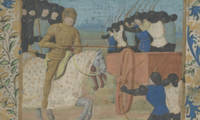
1450258541450. <blockquote><p>The sole known surviving piece of a once vast and grand 15th century ""Faits des Romans"" doubtless for a noble patron of enormous wealth.</p><p> </p><p>The artist is a follower of the Coëtivy Master</p></blockquote><p><strong>The twin nostalgias of Europe— one for the powerful all-encompassing Roman Empire the other for connecting with the mysterious pre-Roman peoples— combine in this 15th century French illumination of Caesar’s final and questionably successful encounter with the Britons led by Cassivellaunus. While Caesar won this battle his dream of a conquered and Roman Britain would not be realized within his lifetime. His legacy however was studied admired and immortalized far after his fatal betrayal by Brutus. This illustration captures this historic moment of Caesar’s triumph the beginning of the end for the Britons and the cultural legacy as viewed during the waning of the Middle Ages.</strong></p><p><a href=""https://cdn.raabcollection.com/wp-content/uploads/20231204135204/A-2.jpg""><img class=""alignnone size-post-window wp-image-25868"" src=""https://cdn.raabcollection.com/wp-content/uploads/20231204135204/A-2-1600x632.jpg"" alt="""" width=""1600"" height=""632"" /></a></p><p>In the nineteenth century European medievalists began shoring up their nations’ relationships with medieval literature to try to create firm claims of their peoples’ innate heroic attributes their noble histories their glorious pasts. This led for example to the French identifying themselves with the Chanson de Roland and the English lionizing King Arthur. But the desire to have these medieval roots overshadowed the more complicated histories: the Chanson de Roland though composed in French is about an emperor best known by his French name Charlemagne but who was born in Aachen Germany and is buried there. The first legends of King Arthur from the 9th century reflecting a much earlier time came from Wales a nation suppressed by the English and the major inventions in the narrative like the love story of Guinevere and Lancelot and the Round Table were invented in France. Though English storytellers engaged with Arthur and his knights it wasn’t until Thomas Malory in the 15th century that Arthur became English.</p><p>During the Middle Ages Rome was the empire to draw connections to for auctoritas. This is why the empire established by Charlemagne became known as the Holy Roman Empire. Though the term was not in use until the 13th century the Emperors were instilled with translation imperii-- a transfer of rule directly inherited from the historic emperors of Rome.</p><p>One aspect of Rome that was particularly admired in the Middle Ages was the conquering and bringing into Civilization of the barbarians north of the Alps and west of the Rhine that includes Caesar's foray into England and his confrontation with Cassivellanus. Cassivellaunus was likely the chief of the Catuvellauni of Hertfordshire whose tribal name translates to ‘war-chiefs’. In British accounts he appears in Welsh literature ranging from Geoffrey of Monmouth’s chronicle about the history of the Kings of Britain in both Latin Historia regum Britanniae and Welsh Brut y Brenhinedd to the more folkloric-based Trioedd Ynys Prydein The Triads the second branch of the Mabinogi and Cyfranc Lludd a Llefelys The Adventure of Lludd and Llefelys. The British chieftain even appears briefly in the Greek Stratagemata by Polyaenus. The Latin literature of course written by the winners includes Julius Caesar’s own Commentary de Bello Gallico Commentary on the Gallic War.</p><p>During the account of his second campaign in Britain from Gaul in 54 BCE after a failed first a year earlier Caesar writes that Cassivellaunus was a rabble-rouser conquering the Trinovantes the most powerful British tribe perhaps how the tribe received their appellation of ‘war-chiefs’. Though his location was betrayed by the Cenimagni Segontiaci Ancalites Bibroci and Cassi who had surrendered to Caesar Cassivellaunus gathered the forces of the Kentish kings Cinetorix Varvilius Taximagulus and Segovax. The tribes retreated to higher ground when they saw the sheer masses of Romans that Caesar had brought to avert the same failure of preparedness he suffered the year before. The legions established their military camp on the beaches and sought out the Britons. As they searched their party was harassed by Britons on chariots; it was chariots which had given the edge to the British during Caesar’s first invasion. About 12 miles away he encountered Cassivellaunus’ forces at a hillfort at the River Stour. A storm destroyed Caesar’s fleet of ships and the repair gave the Britons time to regroup and rally behind Cassivellaunus.</p><p>Previously the Britons operated as independent tribes; under Cassivellaunus these tribes became an army growing with more tribes coming to support Cassivellaunus. Their knowledge of the land and their use of chariots created a powerful enemy against Caesar’s army which was not used to fighting such a chaotic force. Had the Britons continued this strategy history might have played out differently; however they appeared to try to meet the Romans head-on in large-scale battle a tactic at which the Romans were well-practiced and deadly.</p><p>Cassivellaunus’s attempt to attack a foraging party as had been done to the Briton’s success in 55 BCE was the beginning of the end for the Britons now. Though he had unified some of the tribes the Trinovantes remained staunchly against Cassivellaunus since he murdered their king. The murdered king’s son bargained with Caesar— his tribe would support Rome and Rome would defend the tribe from any retribution. This gave the Romans a newfound understanding of the land and the warfare tactics of the Britons. Once again the tribes were divided which inclined them to making alliances with Rome. The final two-fronted battle between the Romans and Britons saw British defeat. It is this routing of the British charioteers that the French illuminator included in this illustration of the Faits de Romains some 1500 years later.</p><p>The Britons essentially defeated Caesar sent Commius the King of the conquered Atrebates to negotiate peace. Cassivellaunus agreed to paying tribute. In writing up the terms Caesar used specific legal terms which would eventually make Britain a province of Rome. But this would not come to pass before Caesar’s untimely death on the Roman Senate floor nearly a decade later. It would be another century before Britain came truly under Roman rule.</p><p>In 13th century medieval writers began to compile works by Caesar Lucan Suetonius and Sallust retelling Caesar’s life in the format of a chanson des geste a song of deeds— the same genre as the Chanson de Roland. The text which is listed under many names but most commonly Faits des Romans grew very popular from 14th century onwards with over 50 manuscripts now recorded – these usually grand commissions for noble reading with many miniatures set into the text columns opening significant chapters of which this extract serves as an example.</p><p>This miniature depicts the great scene introduced above: Caesar's confrontation with the Cassivellanus during the former's great invasion of Britain.</p><p><strong>Caesar routing the chariot-mounted forces of the British cheiftain Cassivellanus miniature on a cutting from an illuminated manuscript of the Faits des Romains</strong></p><p>France most probably Paris mid-15th century. The illuminator represented the two armies in armor contemporary with his own time— the armor of chivalric knights— rather than the Roman legion outfits of Caesar’s time and blue-painted leather-clad attire of the Britons. Differentiation between the Britons and the Romans is made by the Britons wearing blue and white tunics over their armor and using bows while the Romans have pikes and silver armor without tunics with the exception of a figure who may be Commius a Celt-turned-Roman-ally.</p><p>An historic cutting of an illumination on verso and 16 lines of one of two original columns of text on recto. 128x98mm in total. Text column of 102mm on verso. Written in Middle French in a Gothic bâtarde script with minimal abbreviations for legibility. Some oxidation from the silver-gilt on the illustration have bled through to the text side but still legible. Illumination is flanked on both sides by blue and gold acanthus leaves and green-leaved penwork-foliage. Illuminator applied silver to highlight the armour of the armies and gold touches to illuminate Caesar himself.</p><p>The artist is a follower of the Coëtivy Master worked in Paris c. 1450-85 and shares that artist’s simple but delicate facial modelling as well as his love of finely depicted drapery.</p><p>What remains of the text here allows us to see that this miniature came from a very grand manuscript almost certainly produced at vast expense for an important noble patron. Its text was clearly in two columns like many grand copies of the text with column-wide miniatures set at the head of crucial chapters. Examination of other copies of the text shows that about 3700 characters of text are missing between the foot of the miniature on the recto and the first partial line of text on the verso here. With an approximate average line length of 41 characters here this allows us to predict that the miniature here most probably sat in the inner column of the recto and thus some 90 lines of text are missing between its foot and the first line of text on the other side. Allowing for two columns this indicates that each column had 45 lines plus the 12 lines on the verso of this fragment allowing us to predict that the text on each page of the parent manuscript was approximately 57 lines in height. This is more than the 50 lines in some of the grandest surviving manuscripts such as BnF Fr. 64 made in the fifteenth century for an unknown noble patron. In addition as the cutting here gives us measurements for the column width 95mm. and the line height 5mm. we can further calculate that the parent codex of this cutting had a text block of approximately 285 by 220mm. the last 9595mm. plus 30mm. for an approximate gutter measurement. BnF Fr. 64 has a text block that measures 278 by 200mm. and a complete size including borders of 430 by 315mm - comparable to the copy from the library of the Comte d'Angouleme Fr. 250: 420 by 317mm. but far smaller than that made for a member of the De Fou family and later taken into the fine library of Cardinal Richelieu Fr. 23084: 345 by 245mm. and with only one miniature. The parent codex of the present miniature must have been on the same scale as Fr. 64 and 250 if not slightly larger. It was a vast codex produced on a scale to impress through its sheer opulence doubtless for a noble patron of enormous wealth.</p><p><img class=""alignnone wp-image-25018 size-post-window"" src=""https://cdn.raabcollection.com/wp-content/uploads/20231204144051/Folder-site-11-1600x1327.jpg"" alt="""" width=""1600"" height=""1327"" /></p> hardcover
193488436London: Nancy Cunard at Wishart & Co 1934. First Edition. One of 1000 copies. Large quarto 31.5cm; publisher's dark brown buckram with titles stamped in red on spine and front cover and a map of "The Black Belt of America" on rear cover; dark brown topstain; viii23-855pp; with numerous half-tone and other illustrations throughout including the color fold-out map of Africa tipped in between p.584-585. Modest external wear particularly to base of spine and upper and lower front joint gently spine-sunned light wear to topstain with a touch of dust-soil to covers and faint foxing to endpapers and text edges occasionally extending into the margins; small closed tear to lower edge of title page with a tiny puncture to one lower fold on the map; hinges sound; a solidly Very Good copy. <br /> <br /> A monumental work compiling some 250 contributions by more than 150 authors two-thirds of whom were Black privately published and financed by Cunard a direct descendant of Benjamin Franklin and heiress to the Cunard shipping fortune. Blockson notes Cunard's "bohemian spirit" and "unbending devotion to ending racial prejudice" and calls Negro "a landmark in African-American literature see BLOCKSON 71 p.53-5. Cunard stated her purpose in publishing Negro was to show "that there was no superior race merely cultural differences that racism has no basis whatsoever." Among the impressive list of contributors were Langston Hughes W.E.B. Du Bois Zora Neale Hurston Jomo Kenyatta Samuel Beckett Ezra Pound Theodore Dreiser Countee Cullen Sterling Brown Claude McKay and many other key figures in the Harlem Renaissance. Of the 1000 copies printed many hundreds were destroyed during the blitz of London -- an assertion that was long offered by dealers without documentation but which is indeed supported by an annotation in Cunard's own copy held by the Ransom Center dated October 1941: ".what remained of the whole edition has been destroyed by bombs and fire last years Sept. save 10 copies saved by E.E. Wishart as if in prevision." This fact along with the book's unwieldy size and fragile binding accounts for the scarcity of attractive copies in the marketplace; the present example being among the nicer copies we have handled. BLOCKSON 71; PERRY 761 The Harlem Renaissance: An Annotated Bibliography and Commentary. 88436. Nancy Cunard at Wishart & Co unknown
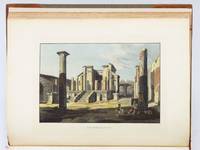
1824ST17496-014Zurich: by the author and Henry Fuessli and Comp 1824-25. FIRST EDITION. 445 x 325 mm. 17 1/2 x 12 3/4". 26 leaves of descriptive text. Lacking title page and dedication.Commentary by art historian Johann Jacob Horner. <br/> Modern tan half morocco over olive green buckram raised bands spine panels with gilt ornament red morocco label. 24 FINE AQUATINT VIEWS COLORED BY A CONTEMPORARY HAND. Brunet III 357. Text pages variably foxed from a little to very but somehow THE LOVELY PLATES IN FINE CLEAN CONDITION--fresh and bright with pleasing coloring in an unworn sympathetic binding.<br/> <br/> This is a rare complete colored set of Hüber's famed views of Pompeii much sought-after by armchair travellers after excavations uncovered that urban time capsule in the late 18th century. The German-born Hüber 1787-1871 settled in Naples in his early 20s studying landscape painting with Dutch émigré painter Jacob Philipp Hackert 1737-1807 who was known for his lush scenes often featuring ruins. His arrival in the region coincided with the occupation of Naples by the French who accelerated the excavations underway at Pomepii which had been buried by the eruption of Vesuvius in 79 A.D. The rapid burial of the city in volcanic ash had captured a moment in time and the opportunity to see a well-preserved example of life in the ancient Roman Empire caught in medias res drew eager travellers on the Grand Tour of the Continent. Hüber's well-executed views often picture these tourists and their contemporary dress contrasts sharply with the classical ruins. Lord Napier in his "Notes on Modern Painting at Naples" 1855 credits Hüber for introducing the use of watercolors to the meticulously drawn landscapes then being produced. This innovation is displayed in the hand-colored plates here which were also issued in uncolored state. Napier was correct to appreciate the value of adding colors which increases both the drama of the views and the pleasure of the viewer. Because the attractive sets with color were often broken up complete volumes of the colored plates are rarely seen for sale: we could trace just three such copies sold at auction as listed in RBH and ABPC the two best ones were the Feltrinelli copy which sold for $14330 in 2001 and the Donaueschingen copy fetching $13750 in 2014. Ours does not have the distinguished provenance attached to those copies and it lacks two preliminary leaves but the text is present and most important the lovely colored plates are in fine condition. by the author and Henry Fuessli and Comp unknown
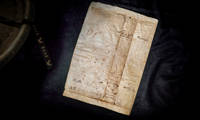
1450261961450. <blockquote><p>Uberti's father had been referenced by Dante</p></blockquote><p>The City State of Florence:</p><p>In the 1300s the Italian city-states were embroiled in complex political machinations between each other—chiefly Milan Florence Pisa Siena Genoa Ferrara Mantua Verona and Venice— and the overarching powers of the Papacy and the Holy Roman Empire. Even within factions that seemed to support the same objectives: the Guelphs who battled the Ghibellines split in to the White Guelphs and Black Guelphs and ultimately the Black Guelphs exiled Dante Alighieri 1265-1321 from his beloved city state of Florence in 1302. During this exile Dante wrote the Commedia his love-song to Beatrice to his pagan and Christian poet-idols to a reimagined theology incorporating courtly love and Greek philosophy and to the city and people of Florence. He wrote his three canticles in a style called terza rima rhyming stanzas of three lines which was frequently imitated by later poets.</p><p>The Power and Poetry of Florence:<br />Despite the political turmoil Florence rose in power not only in Italy but throughout Europe in part because of the strength of its gold based economy. Florence stepped out of the Middle Ages into the Renaissance with a flourish of distinct and memorable art and poetry but the mid-1300s offered another tragedy for the dazzling city state. In 1348 the Black Plague ravaged the Italian peninsula. Poets turned their pens towards chronicling this devastation with perhaps the most-well known being the Decameron of Florentine poet Giovanni Boccaccio 1313-1375. The Decameron likely begun shortly after 1348 and completed in 1353 follows ten young people as they leave Florence to flee the plague. On the way they entertain themselves through a series of stories to take their minds off of the horrors around them.</p><p>Fazio degli Uberti and Dante:<br />Fazio degli Uberti 1305/9- ca.1367 is not as well-known as Dante or Boccaccio who are two of the “Tre Corone†of Italy with Petrarch as the third crown. Fazio was born in 1305 or 1309 to a family of some importance who identified politically as Ghibellines who supported the Holy Roman Emperor rather than the Pope. The family’s Ghibelline alignment accorded Fazio’s ancestor Farinata degli Uberti a place in Dante’s Inferno. In Canto 6 Farinata is listed among the Florentines who have done more bad than good for the city. Though in Canto 6 Dante asks where the great Florentines are who had “minds bent towards good†including Farinata he is told that in fact these Florentines are those with the blackest souls and the fact that Dante thinks of them with esteem shows how warped Florence has become. Later in Canto 10 Dante will meet with Farinata himself among the heretics and in Canto 28 he will understand how Florence suffers because of men such as Farinata in part because of the schism between the Guelfs and Ghibellines.</p><p>Despite this condemnation of his family in 1345 Fazio wrote his most noted poem the Dittamondo an emulation of Dante’s Commedia. The title Dittamondo is an vernacularization of the Latin dicta mundi indicating that it is an encyclopaedic text of what is known and said of the world. Like Dante’s journey under the guidance of Virgil Statius and finally Beatrice Fazio’s narrator meets with the allegorical figure of Virtue he and the Roman geographer Solinus travelled the whole world Italy Greece Germany France Spain northern Europe Africa and parts of Asia with Solinus giving the narrator descriptions of the cities visited. In addition numerous other snippets of information are added from the works of Pliny the Elder Isidore of Seville and Pomponius Mela. Even the style of poetry Fazio employed for his didactic poem was modelled after Dante’s own terza rima. However unlike Dante’s poem Fazio’s is far more encyclopaedic rather than a tour de force of allegorical and contemporary political satire clothed in Dante’s masterful command of language. Like Dante Fazio was exiled from Florence and like Dante Fazio wrote of his exile from the city. The Dittamondo remained incomplete upon Fazio’s death around 1367.</p><p>History of the Manuscript Tradition of Dittamondo:<br />While no comprehensive survey of manuscripts exists it is clear that the text is rare in manuscript with the Arlima database listing only BnF. italien 81 and Venice Biblioteca Nazionale Marciana Cl. IX c. XI. To these should be added Turin Biblioteca Nazionale Universitaria cod N 1 5; Milan Biblioteca Nazionale AC.X.30; and other single volumes in the Biblioteca Riccardiana in Florence the Biblioteca Angelica in Rome and the university library of Bologna as well as a fourteenth-century fragment in the Biblioteca Archiginnasio in the same city.</p><p>The Schoenberg database lists no copy offered for sale since that from the Joseph Martini library by Hoepli on 27 August 1934 lot 177 there with that previously appearing as Sotheby's 10 June 1918 lot 504.</p><p>The document:</p><p><strong>Bifolium from a large humanist manuscript</strong> of Fazio degli Uberti Dittamondo in Italian on parchment Italy mid-fifteenth century within a century of Fazio’s death. Each leaf approximately 330 by 240mm. Two conjoined leaves each with single column of 33 lines of an accomplished humanist hand with parts of chapters X-XI and XIII-XIV of Book 6 one large simple initial in pale blue the text set within an extensive gloss in Italian in smaller script recovered from the binding of a seventeenth-century book and hence with scuffs spots small holes one corner torn away with loss to gloss there scrawls and areas of text on outerside abraded and illegible.</p><p>This bifolium would be one of the center leaves in the gathering or quire sandwiched between other successive leaves folded and sewn in the gutter the crease in the center of the bifolium separating the earlier part of the text from the later to create the legible linear text.</p><p>The content deals with Old Testament and Hebrew Bible figures.</p><p>Chapter X gives a précis of Old Testament stories in terza rima mentioning Jacob Laban Rachel and Lia Reuben Gad Asher and Potiphar.</p><p>Chapter XI continues with the genealogy of the tribe of Levi which includes and touches on Aaron and Moses who is the main focus of this section.</p><p>The text on the bifolium jumps forward to Chapter XIII where holy lives are described including that of Mary of Egypt. From the Book of Kings in the Hebrew Bible Fazio weaves in mention of Elisha’s punishment of Ghazi who stole robes and treasure from his Naaman the Syrian. Elisha transferred Naaman’s leprosy to Ghazi. Fazio demonstrating his wide knowledge of this material says that “io non ti canto apertamente qui come Eliseo reuscitò un morto col Santo prego…†I won’t tell you openly how Elisha resurrected a dead man with holy prater and follows with another secret: “io non ti canto poi che li fu scorto fuel pargoletto…†I won’t tell you that a little baby was seen there that gave light and brightness….</p><p>Beginning with Ahaziah the sixth King of Judah Chapter XIV follows this line through Ezechias and castigates Sennacherib the king of the Neo-Assyrian Empire who did not accept God. Fazio finds and points to “Olda d’Ain†a female prophet heard by the world.</p><p>The text of the Dittamondo is surrounded by annotations in a contemporary hand employing more frequent abbreviations. These notes provide further details about the events described in the poem with a patte-de-mouche flourish at the end of each section.</p><p><img class=""alignnone wp-image-25018 size-post-window"" src=""https://cdn.raabcollection.com/wp-content/uploads/20231204144051/Folder-site-11-1600x1327.jpg"" alt="""" width=""1600"" height=""1327"" /></p> hardcover
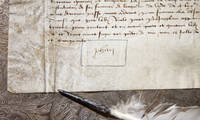
14502275018/10/1450. <blockquote><p>We can recall nothing similar having reached the market</p><p> </p><p>From the collection of Dr. Otto O. Fisher who bought primarily in the 1930s and 1940s so this not been offered for sale in nearly a century</p></blockquote><p>The Hundred Years’ War was one of the most notable conflicts of the Middle Ages. For 116 years interrupted by several truces five generations of kings from two rival dynasties - the English House of Plantagenet and the French House of Valois - fought for the throne of the largest kingdom in Western Europe - France. The war’s effect on European history was lasting. Both sides produced innovations in military technology and tactics such as professional standing armies and artillery that permanently changed warfare in Europe; chivalry which had reached its height during the conflict subsequently declined. Stronger national identities took root in both countries which became more centralized and gradually rose as global powers that expanded into the New World.</p><p>In the 1430s-50s the English clung to their dwindling possessions while French King Charles VII of the Valois dynasty slowly chipped away at them one piece at a time. By 1440 the French had driven the English completely from the valley of the Loire and the English retained only Normandy in the north and Gascony in the south. The Truce of Tours in 1444 gave the French a much-needed respite during which time Charles completed some necessary military reforms and prepared for the final grinding campaigns in a conflict that had begun more than a century earlier—well before anyone’s living memory.</p><p>Soon the war started up again. Under the weak kingship of Henry VI England seemed powerless to stop the French offensive of 1449 to recapture Normandy. The last major battle occurred in April 1450. With no other significant English forces in Normandy the whole region quickly fell to the victorious French. Caen was captured in June and Cherbourg the last English-held fortress in Normandy fell in August.</p><p>Among the commanders on the French side were the Count of Armagnac and his son the Viscount both named John.</p><p><strong>Autograph document signed</strong><em> ""Jehan John D'Armagnac""</em> October 18 1450 receiving 2000 livres a significant sum originally bestowed by the French King to Estienne Petit the treasurer to King Charles VII in the region the <em>""last march""</em> as the document notes for the purpose of attacking the English in April 1450 and after. <em>""I Jehan d'Armagnac Vicomte de Lomagne swear that I have received from Mr. Etienne Petit treasurer and collector of Languedoc the sum of 2000 livres that Mons. the King by distribution of his finances for Languedoc of 170000 livres awarded to the said Seigneur a Montpelier in the month of March last gave to furnish for us our expenses and to compensate for our efforts done in the surveying and conquest of Normandy.""</em></p><p>Jehan V was the last in the line of powerful Armagnac rulers. He fell out of favor with Charles who dispatched ""John the Bourbon"" to capture him but John fled to Spain. He was granted a return by Louis XI but soon revolted against him as well. Armagnac was part of the league that called itself ""Bien public"" or ""public good"" and threatened Paris at the head of 6000 mounted men. In 1469 Louis responded under the pretense that John was treating with ambassadors from England and sent an army under Antoine de Chabannes to rout him. John fled to Spain only to reappear in 1471 in the train of the king's rebellious brother the duc de Guyenne. John was stabbed to death in the 1470s without eligible male heir.</p> unknown
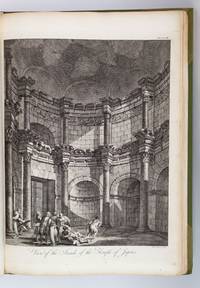
1764ST17496-042London: Printed for the Author 1764. FIRST EDITION. 520 x 365 mm. 20 3/4 x 14 1/4". iv 8 subscribers list 33 pp. <br/> Attractive modern light green half morocco gilt by J. F. Newman of Dublin his ticket on front pastedown raised bands spine panels with central patera ornament two darker green morocco labels reinforced hinges edges untrimmed. WITH 61 SPLENDID ENGRAVINGS 14 plans and elevations 47 views ON 54 PLATES eight double-page six folding by Bartolozzi and others. Front flyleaf with ink signature of Francis D. Bedford dated October 1886. Cicognara 3567; Fowler 2. Spine sunned to a light olive shade one corner bumped one plate with a little browning along the fold occasional mild marginal foxing or trivial smudges but A FINE COPY--fresh bright and clean internally with deep impressions of the type rich impressions of the plates and generous margins in a binding with few signs of wear.<br/> <br/> This is an extremely appealing copy of one of the great architectural books of the 18th century described by Cicognara as a "magnificent and grandiose work." Scottish architect Robert Adam 1728-92 was a product of the Scottish Enlightenment and moved in intellectual circles that included historian William Robertson who wrote the introduction here David Hume and Adam Smith. His interest in architectural drawing was stimulated by books in his father's extensive library which DNB tells us contained "a working collection of illustrated architectural books in English French and Italian and a series of manuals on architectural draughtsmanship." This curiosity developed into a passion during his 1755-57 tour of Italy which "was in every way a period of intense professional training during which the skills learned in Scotland were tested and given an international gloss by the Roman circle in which he now moved." DNB At the center of this circle was French architect antiquarian and artist Charles-Louis Clérisseau 1721-1820 the leading authority on Roman antiquities and architecture who introduced Adams to among others the great Piranesi. With Clérisseau as guide and tutor he explored and sketched various sites before arriving at the un-surveyed fortress palace built by the former emperor Diocletian at Spalatro the modern-day Croatian city of Split. Adam undertook a survey of the building and drew the architectural plans and elevations for this work while Clérisseau sketched views of the ruins. Adam planned this book as a way of promoting his career as an architect and worked with Clérisseau to have engravings made for it. According to Thom "while the traditional plans elevations and sections--what Robert Adam called the 'Geometricals'--were generally supplied by English engravers like Rooker Patton and Walker the all-important picturesque views and perspectives which Adam thought were essential to convey the emotional impact of the remains of Diocletian's Palace were engraved in Italy mostly by Bartolozzi Paolo Santini and Zucchi." Adams also wrote the architectural commentary. The publication was a success praised by the "Critical Review" in October 1864 as possessing "a taste and execution that has never been equalled in England." As DNB observes "during these two Roman years Adam succeeded in transforming himself from a provincial and rather green Scottish architect into a cosmopolitan figure ready indeed to put into effect 'the Antique the Noble & Stupendous.'" Now based in London he embarked on a distinguished career specializing in country houses and townhomes that reflected the deep influence classical architecture and his Italian sojourn had on his work. Our copy was once owned by another artist Francis Donkin Bedford 1864-1954 who exhibited landscapes at the Royal Academy and illustrated books during the Golden Age of children's book illustration in the late 19th and early 20th century. Printed for the Author unknown
196086348Havana: Departamento de Instrucción del MINFAR 1960. First Edition. First printing. Warmly inscribed to the American economist and author Leo Huberman who was responsible for introducing the work to a North American audience: "A Leo Huberman exponente del verdado pensamiento del pueblo Americano esto que quiere ser un cantico guerrero a este lado del Río Bravo con un revolucionario saludo de / Che" To Leo Huberman exponent of the true thought of the American people this that would wish to be a war chant this side of the Rio Bravo with revolutionary greeting.; dated Habana April 6 1960. Small octavo; staple-bound pictorial paper wrappers; 1875pp. Text illustrations. Mild edgewear and some gentle rubbing at bound edge still Very Good or better. <br /> <br /> Terrific association copy of the true first edition of Che's classic treatise on people's war later published in English by Huberman's own Monthly Review Press 1961. Though unquestionably the work with which Guevara is most associated it is the hardest of his books to obtain in the first printing. It was issued presumably simultaneously in two formats - a 12mo edition measuring 15cm in height and with a price of 50cts on the rear wrapper; and as here in octavo measuring 20cm and with the wrapper unpriced. We have been unable to determine priority but would conjecture that the two issues reflect separate intent: a people's edition for slipping into a jacket pocket; and a more expensively-produced edition for libraries. Of the two the octavo edition is somewhat scarcer in institutional collections with about twenty examples noted in OCLC.<br /> <br /> Guevara's signature is not strictly speaking rare; however inscriptions with personal content are truly scarce and signed or inscribed copies of the present title are almost never seen. A copy inscribed to Argentinian dictator Juan Perón was offered by Sotheby's in 2016; a copy with Che's ownership signature appeared at Bonham's in 2014 but no further signed or inscribed copies appear in the auction record. Our copy is inscribed to Leo Huberman 1903-1968 Che's American publisher and a key figure of the American left during the Great Depression and into the decade of the Fifties. Huberman founded the important independent Marxist journal The Monthly Review in 1949 and it was as its editor that Huberman became closely involved with the revolution in Cuba - as well as more directly with Guevara himself. Along with his co-editor economist Paul Sweezy Huberman spent three weeks in Cuba in the months following the revolution much of that time in the company of Guevara who appears to have been among the authors' principal informants. Out of that visit came the book Cuba: Anatomy of a Revolution Monthly Review Press: 1960 a sympathetic account and one of the earliest for an American audience. Guevara is mentioned frequently in the book always in glowing terms - as for example: ". as we can testify from personal observation Che Guevara President of the National Bank has as brilliant quick and receptive a mind as is likely to be found in anyone occupying a comparable position in the government of any country in the world." p.92. It must have been during this visit that Huberman secured American publishing rights to Guerrilla Warfare and clearly this is when the present copy was inscribed to him an inscription that is truly effusive by Che standards giving every indication that Guevara held Huberman in mutually high respect.<br /> <br /> PROVENANCE: From the collection of a direct Huberman descendant 2025. Departamento de Instrucción del MINFAR unknown
20162081502111904574Tianjin ancient books 2016. Soft Cover. Fine. The book is in fine condition. Tianjin ancient books paperback
188511520New York: Charles L. Webster and Company 1885. 1st Edition. Original cloth. Octavo. 366 pages. Very Good. Bound in original dark green cloth over boards with spine and upper board stamped in black and gilt. Some rubs and minor fading to cloth covers a few shallow bumps to board fore corners and spine ends. Hinges not cracked. Housed custom cloth and board folder in half morocco slipcase. A very nice first edition of one of the most important books in American literature. Hemingway believed that "American writing comes from that. There was nothing before. There has been nothing as good since." This copy has the important issue points at pages 13 57 and 143. A very handsome copy. Charles L. Webster and Company unknown
20212081502111901549Nishi Shirei Imprint Publishing Company 2021. Soft Cover. Fine. The book is in fine condition. Nishi [Shirei] Imprint Publishing Company paperback
87950New York 1986 Forward by Elie Wiesel. Paperback. Sl. Scuffed. Inscriptions to verso cover. Good New York, 1986 paperback
1920140553Munich: Dreilander Verlag 1920. Collection of 38 issues of the landmark Weimar-era periodical highlighting fantasy horror and early science fiction stories. Text in German. <br /> <br /> One of the world's first fantasy periodicals alongside the Swedish "Hugin" "Der Orchideengarten" featured a mix of new German stories alongside translations of foreign literature largely French including works by Victor Hugo Guy de Maupassant Voltaire Charles Dickens Edgar Allan Poe Joseph Capek H.G. Wells and many others. The magazine also made forays into the proto-science fiction genre as seen in Vol. 2 No. 4 entitled "Phantastik der Technik." <br /> <br /> A true product of the Weimar era's cultural blossoming the magazine also features stunning illustrations both with its two- and three-color cover art and its woodcut reproductions throughout: sinister yet elegant visions of anthropomorphic flowers religious idols Grim Reapers and gory deaths. "Der Orchideengarten" featured the work of Gustave Dore Otto Linnekogel Karl Ritter Alfred Kubim Carl Rabus Otto Nuckel and many more. <br /> <br /> This archive contains the following largely sequential issues: Vol.1 Nos.1-18 16 and 17 published as a combined issue; Vol.2 Nos.1-6 8 10-16 18-24. <br /> <br /> 9 x 12 inches saddle stapled. Very Good to Near Fine condition. In a custom quarter leather clamshell box. Dreilander Verlag unknown
1575648K20Medina : Francisco del Canto 1575. First edition. Leather. Good. 12" by 8.5". None. An extremely scarce first edition volume of this early and extremely influential work of world history penned by the highly controversial Jesuit Friar and pseudo-historian Fray Hieronymo Roman. Very scarce. The work is only held within four institutional libraries. The first edition of the work in the original Spanish. Volume one only. A second volume was published simultaneously with a third volume first published in 1595. The work has been rebound and is lacking the first two blank leaves otherwise complete. Pagination is irregular as called for. The work offers a wide ranging comparative history of the world's civilisations and their institutions. The work has a particular focus upon political legal and moral issues and includes reference to the Indies Far East and pre-Columbian America. The author Fray Hieronymo Roman was a clergyman librarian and Spanish historian known to be a close friend of Alonso de la Vera Cruz; considered to be the most important figure in philosophy in the sixteenth century. The work is the author's Magnum Opus and offers a very early example of anti-colonial writing. The comprehensive work was not without its controversy; indeed it faced censorship owing to its implications regarding the first conquistadors including casting doubt on the legitimacy of the Spanish rule in the New World. In 1583 the work was included upon the Spanish Inquisition's list of prohibited books after being denounced by the Council of the Indies. The following year the work was also included upon their index of books to be destroyed. The author managed to avoid further censorship by correcting the most controversial passages in the later 1595 edition. As such first edition copies such as this one are extremely scarce to come across and are considered of greater historical significance in part due to their inclusion of the more controversial anti colonial standpoint particularly in reference to Spanish colonisation in America. A very scarce example of this early anti-colonial writing written by a noted Spanish friar and historian. Rebound in half crushed morocco with marbled boards and gilt detail to the spine. Externally very smart with slight rubbing heavier to the joints and head and tail of the spine resulting in some minor loss to the leather. Hinges strained with cords visible. Bookseller's stamp to rear pastedown. Lacking first two blank leaves. Internally firmly bound. The occasional sympathetic repair particularly to the title page. Decorative contemporary banner has been adhered under title where previously would have read "diuididas en XXVII libros". The occasional tidemark throughout heavier to the first twenty leaves. The occasional contemporary ink annotation including to title page and fore edge. Scattered spotting. Good Francisco del Canto hardcover
193258248New York: Charles Scribner's Sons 1932. First Edition. First Printing. Octavo 20cm; publisher's folded and gathered signatures sewn together across the spines with unprinted jade green laid paper wrappers glued onto preliminary and terminal leaves; x2415pp. Light wear and dust-soil to wrappers though contents are fresh and clean; Near Fine. Caldwell's first novel and second book produced by a commercial publisher a searing fictional depiction of poor white life in the deep South. "The story of a Georgia sharecropper shelved by the plantation owner allowed to live in a tumble-down shack but not allowed to raise a crop. Pictures a family unbelievably degraded and destitute - the end result of a bad system" COAN p.56. While the novel infuriated Southern readers it was nevertheless an enormous success basis for John Ford's 1941 film starring Charley Grapewin Gene Tierney and Dana Andrews. A Modern Library 100 book and one of the defining works of the 1930's rare in this pre-publication format with none found in the auction record. HANNA 570; FLYNT & FLYNT 73. Charles Scribner's Sons unknown
193558667New York: Alfred A. Knopf 1935. First Edition. First Printing. Octavo 19.25cm; orange cloth with titling and decorations stamped in black on spine and front cover; black topstain; dustjacket; x1873pp. Contemporary bookplate of Brigadier General Philip R. Faymonville on front pastedown hint of sunning to spine else a fresh Fine copy. Dustjacket is unclipped priced $2.00 with light wear to extremities hint of sunning to the red portions on the spine and a faint diagonal crease to upper front flap; Near Fine. Offered together with a copy of the Advance Issue. Octavo 19cm; publisher's taupe cloth with titles stamped in burgundy on front and rear covers; burgundy topstain; dustjacket; 48pp. Light wear to extremities with a touch of dust-soil to lower board edges; contents clean; Near Fine. <br /> <br /> Laid into the first edition is a brief one-page TLS from Sinclair Lewis to Blanche Knopf dated October 2 1936: "Dear Blanche: Tom Kromer has asked me to read his novel "Waiting for Nothing" to see if I want to recommend him for the Guggenheim Fellowship. Would you like to send me a copy of it here at the Essex House Yours sincerely Sinclair Lewis." Typed letter on white bond measuring 8 5/8" x 11"; 17 lines 66 words with a few old folds a small tear to right edge and staple holes at upper left corner. A quintessential novel of the Great Depression and a masterpiece of understated desperation written by a West Virginia drifter who famously scribbled his story down on scrap paper scrounged on the streets in boxcars and in hobo jungles. The novel was highly praised upon publication but Kromer never mustered another book-length work; he died tubercular and forgotten in a West Virginia sanatorium. The novel was essentially "lost" until its republication by the University of Georgia Press in the 1980s. <br /> <br /> In 1936 Kromer prepared his application for a Guggenheim Fellowship the basis for which was six completed chapters of his working class novel Michael Kohler and a discussion of the industrial scene and proletarian character he explored in Waiting For Nothing. It would have been a logical leap for him to have solicited an recommendation from Lewis who by then was nationally recognized as an author in the proletarian vein and whose novel It Can't Happen Here was published the same year as Kromer's debut. Kromer was unsuccessful at securing a Fellowship though the letter is evidence that Lewis at the very least made an effort to acquire a copy of his novel from Knopf in an attempt to help him in his efforts. HANNA 2059; RIDEOUT p.297. Alfred A. Knopf unknown
62097Rome minted in 82 BC. 18mm. A magnificent specimen with very clear sharp imprint and sharp edges. Near mint - the finest copy we have seen. Obverse: Draped bust of Mercury right wearing winged petasos; caduceus and control letter behind. Reverse: Ulysses standing right holding staff in left hand and extending right hand to Argus; C•MAMIL to left LIMETAN to right. Crawford 362/1; BMCRR Rome 2725; RSC Mamilia 6. <br/><br/><em>A denarius of the Roman Republic featuring one of the very few references to Homer's Odyssey in ancient coinage. On the obverse is Mercury a god very much propitious to Odysseus easily recognizable by the winged petasos and the caduceus. The reverse depicts one of the most moving passages in literature hardly matched to this day. In book XVII 290-327 Odysseus returns to Ithaca disguised as a beggar. His faithful dog Argos has been waiting for his return for 20 years. Ignored abandoned by everyone the dog is ridden with ticks and fleas lying in a pile of manure. Odysseus is accompanied to the palace by Eumaeus the shepherd who is unaware of the beggar's true identity. Odysseus recognizes his dog and is forced to hide a single tear that rolls down his cheek. He cannot greet the dog as that would give away his identidy. Argos after all those years recognizes his master as well but if he were to run to him it would most certainly cause his death by the suitors. Here Homer cannot do anything other than to end the life of Argos otherwise the entire Odyssey would have been for naught. So Argos dies upon the vision of his master having fulfilled his life purpose: to await his return. It is also the moment that marks the end of the twenty year cycle since Odysseus left for the Trojan War thus announcing the imminent closing of the Trojan Cycle itself. The denarius' reverse depicts the idealized moment of the scene where master and dog would be just about to meet and greet each other but as we have seen the reunion cannot happen. "There lay the hound Argos full of vermin; yet even now when he marked Odysseus standing near he wagged his tail and dropped both his ears but nearer to his master he had no longer strength to move. Then Odysseus looked aside and wiped away a tear. . But as for Argos the fate of black death seized him straightway when he had seen Odysseus in the twentieth year." Mamilius Limetanus is one of the three moneyers for the year 82 BC. The moneyers selected every year were magistrates in charge of the production of coinage and they were at liberty to determine the design of the coins which were often deities and characters associated with their personal family history. Like most Roman Patricians Limetanus claimed to be a descendant of a Homeric character in this case Odysseus—Julius Caesar's family for example thought themselves to be descendants of Aeneas. A spendid specimen of this magnificent Roman denarius. </em> unknown
177253544Frankfurt/Main: Burgerlicher Ausschuss und Burgerl. Neuner 1772. First edition. Hardcover. Good to very good condition. Small Folio. 168pp. Rebound in decorative paper-covered boards with manuscript title on tan spine protected by modern mylar. Red edges. Marginalia. Decorative headpiece and historiated initial. <br /> <br /> ".latam nec non concedendo facultatem concipiendae vovae originariae Judaeorum Francosurtensium conditioni praefentique eorum statui accommodatae ordinationis & c. Anwälde beeder Kayserlichen verordnet und bestättigter Collegien des Burgerlichen Ausschusses und Burger. Neuner in Frankfurt Intervenientenby der Sache Gemeiner Judenschaft zu Frankfurt contra den Magistrat daselbst die Cramläden und Gewölber außer der Judengasse betreffend. Mit beylagen." continuation of title page<br /> <br /> Holy Roman Emperor Leopold II King of Hungary Croatia and Bohemia's 1771 ordinance regarding Jewish storefronts and houses in Frankfurt with reviews by officials of the city and attachments. The address to the emperor includes passages showing uninhibited disdain for the Jews: ". that the Jews in Frankfurt since their first admission and up until now have been detrimental and onerous for the Christian Frankfurt merchants." <br /> <br /> The extensive report respectfully requests confirmation of the ordinance providing several attachments making their case. The attachments include A B C1 C2 C3 and C4 plus D and the text of previous ordinances providing a historical outline and details regarding the treatment of Jews historically with secondary attachments concluding with an ordinance from 1616. Contains a list of houses and occupants for both sides of the Judengasse at rear closing with the emperor's confirmation. Signed in print by Hans Ludwig von Ulm for the emperor and Johann Rudolph Bucher for the city.<br /> <br /> Text in German Gothic script. Some light wear along edges of binding with spine showing several small to medium chips at head middle including label and tail of spine. A couple of small chips at front joint of spine. Printed label "Ex bibliotheca Johannis Augusti Speltz J.U.D etc. with manuscript number 113 on inside front cover. Block in very good condition. Burgerlicher Ausschuss und Burgerl. Neuner hardcover
81169Edinburgh: Payback Press 1996. First U.K. Edition. First Impression a trade paperback original. Octavo 19.5cm; original pictorial card wrappers; xii2377pp. Inscribed by the author on the half-title page to Pulitzer Prize-winning poet Gwendolyn Brooks: "Miss Brooks - Forgive the N. word this was written a long time ago. But I'd say it again / Gil Scott-Heron A Chicago Native 4/97." Trivial wear to extremities hint of foxing to text edges; very Near Fine.<br /> <br /> UK edition of Scott-Heron's second novel originally published by Dial Press in 1972. Inspired largely by his own experiences as a student during the late 1960s-early 1970s the book is a satirical look at campus life during that turbulent era. "Earl Thomas student body president at Sutton University is in a difficult position: struggling with the fact that even a historically black college could be part of a system that still priviliges whites he's also threatened by his fellow students members of the radical activist group MJUMBE. Claiming the time has come for revolution not reform the leaders of MJUMBE are poised not only to bring Earl down personally but also to instigate large scale acts of violence" from the Grove/Atlantic reissue. This copy bears a particularly poignant inscription to fellow Chicago poet Gwendolyn Brooks whose involvement in the Black Arts Movement was a key influence on Scott-Heron's work. Brooks's regard for Scott-Heron is evident in her poem titled "Gil Scott-Heron":<br /> <br /> "Chance-taker<br /> Emotion voyager<br /> Street-strutter<br /> Contemporary Spirit<br /> Untamed Proud Poet<br /> Rough Healer<br /> He is His"<br /> <br /> An exceedingly good association copy of a key title. Scott-Heron's autograph material has always been uncommon; this is only the third inscribed book we have seen over many years with no signed or inscribed books appearing in the auction record. BLOCKSON 5986 for the Dial Press edition. Payback Press unknown