23 265 résultats
20212081502111902788national library 2021. Soft Cover. Fine. The book is in fine condition. national library paperback
20212081502111904661National Library Publishing Company 2021. Soft Cover. Fine. The book is in fine condition. National Library Publishing Company paperback
173248603PRIMERA EDICION COMPLETA EN 6 TOMOS.- Con Privilegio. En Madrid: los tomos 1º a 5º En La Imprenta de Francisco del Hierro Impresor de la R. Academia Española 1726 - 1729 - 1732 - 1734 - 1737 y el tomo 6º en la Imp. de la Real Academia Española por los Herederos de Francisco de el del Hierro 1739.- En conjunto 6 VOLS. con: Tomo 1º. 4 h. sigue grabado alegórico al cobre LXXXXVI 723 p / Tomo 2º. 6 h. 714 p. / Tomo 3º. 6 h. 816 p. / Tomo 4º. 6 h. 696 p. / Tomo 5º. 6 h. 656 p. / Tomo 6º. 18 h. 578 p.: Tras la portada del Tomo 1º tal y como se ha indicado lleva un bello grabado a pleno folio dibujado por Antonio Palomino y grabado al cobre por Joan á Palomino; Magnífica impresión a dos columnas sobre gran papel de hilo verjurado; Con bonitas letras capitales grabadas en madera y cul-de-lampe al final de cada letra; Gran Folio 343 x 25 cm; Enc. en Plena Piel Pasta de la época lomo cuajado en oro tejuelo rojo cortes jaspeados en tonos rojo y azul incluyendo en cada tomo un precioso escudo nobiliario grabado a modo de ex-libris perteneciente al Marqués de Grimaldo Ministro de Felipe V.- PALAU N.º 1286. En excelente estado general. Tan solo algunas esquinas y bordes de la encuadernación han sido reparados de los normales desgastes del tiempo apreciándose pequeñas faltas en las cejillas de las cabezas de los lomos en los tomos 1 y 6. Interior en perfecto estado con el papel firme blanco sin manchas ni otros defectos. Publicado entre 1726 y 1739 el Diccionario de la lengua castellana de la Real Academia Española conocido como Diccionario de Autoridades representa la primera gran empresa lexicográfica del español. Concebido con fines normativos reunió definiciones apoyadas en ejemplos de autores canónicos sentando así las bases de la tradición académica. Su método basado en el uso ilustrado buscaba fijar la lengua sin desligarla de su riqueza histórica y literaria. Fue una obra clave en la consolidación de una lengua culta unificada para el mundo hispánico. Se estima que la tirada total fue de aproximadamente 1.500 ejemplares distribuidos en seis tomos. Hoy en día resulta una obra dificilísima de conseguir. LENGUA ESPAÑOLA Libro en español Real Academia Española hardcover

28174Paris, 1699-1760 [1720-1766]. 62 volumes in-4°, veau fauve marbré, dos à nerfs ornés de fleurons dorés, pièces de titre en maroquin rouge, roulette dorée sur les coupes, tranches jaspées de rouge. Reliure de l'époque, qq. épidermures et petits manques de cuir sur les plats, qq. défauts au niveau de la tomaison aux dos. Plaisant exemplaire en reliure uniforme. On joint 6 volumes de tables couvrant les années 1699-1760. Nombreuses figures gravées sur bois dans le texte et 1178 planches hors-texte gravées en taille-douce dont 459 repliées. Il manque 3 planches (aux volumes de 1723 et 1741).
19972091202133213256Walter de Gruyter 1997. Soft Cover. Fine. Number of books: 37 Walter de Gruyter paperback
H93Hamburg und Leipzig Grund; Leipzig Adam Heinrich Hollens Witwe bzw. Holle bzw. Heinrius 1768-1778 Bd.1-4 in 2.Aufl. und 1751-1783 ab Bd.5 in 1.Auflage. Mit zahlreichen Tafeln. Beinahe einheitliche Lederb‰nde der Zeit mit R¸ckenvergoldung und R¸ckenschilder nur vereinzelt und leicht berieben Bibl.-Scild am R¸cken St.einer Schloflbibl. am flieg.Vorsatz. Eine dekorative saubere Reihe. unknown
176420218Paris: Chez P. Alex. Le Prieur tomos 1 al 12 M. DCC.LXIV 1764 y 1771 y Chez P. Fr. Didot le jeune tomos 13 al 15 M.DCC.LXXIV 1774.- EN TOTAL SON 15 VOLS.: 1º con 2 h. 391 p. / 2º con 2 h. 439 p. y 6 láminas plegadas / 3º con 1 h. 479 p. y 12 láminas plegadas / 4º con CLXXIV232 p. y 4 láminas plegadas / 5º con 1 h 489 p. y 16 láminas plegadas / 6º con 1 h. 406 p. y 2 láminas plegadas / 7º con 1 h. 432 p. y 3 láminas plegadas / 8º con 1 h. 456 p. y 5 nláminas plegadas / 9º con 2 h. 516 p. y 11 láminas plegadas / 10º con 213 p. y 4 láminas plegadas / 11º con 2 h. 516 p. y 2 láminas plegadas / 12º con 2 h.388 p. y 2 láminas plegadas / 13º con XLVIII 431 p. y 9 láminas plegadas / 14º con 2 h. 534 p. 1 h. y 4 láminas plegadas / 15º con VIII 544 p. y 6 láminas plegadas Todas suman un conjunto de 89 láminas plegadas de anatomía e instrumental quirúrgico finamente grabadas al cobre; 8º menor 17 x 104 cm; Buena impresión sobre fuerte papel verjurado; Texto en francés; Plena Piel Epoca lomo cuajado en oro cortes pintados en rojo.- RARO. Las encuadernaciónes con ligeros roces en bordes y esquinasque han sido restaurados. Pequeñas faltas en las cabezas de las lomeras y los tejuelos de algunos tomos. Pero en conjunto la obra presenta un buen aspecto con el interior en excelente estado. Aunque los libros son de dos imprentas presentan un aspecto perfectamente uniforme. Según datos de la actual Académie Nationale de Chirurgie de Francia estas primeras Mémoires de l'Académie Royale de Chirurgie fueron publicadas entre los años 1743-1774. DESCRIPCION EXACTA DE FECHAS POR TOMOS: Paris Chez Le Prieur Tome I partie I 1764; Tome I partie II 1765; Tome I partie III 1743; Tomes IV V y VI 1768; Tomes VII VIII y IX 1771; Tomes X XI y XII 1768; Y Paris Chez P. Fr. Didot le jeune Tomes XIII XIV y XV 1774. CIRUGIA EN GENERAL Y TRAUMATOLOGIA Livre en français P. Alex Le Prieur y Fr. Didot le jeune hardcover
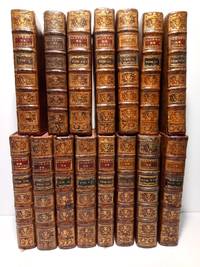
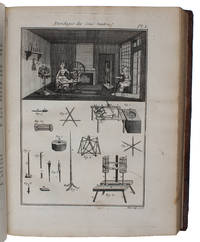
177156289Neuchatel, L'Imprimerie de la Société Typographique), 1771-83. 4to. Bound in 19 contemp. uniform full mottled calf. Raised bands. Gilt spines. Title-and tomelabels with gilt lettering. Spine-ends on nearly all volumes strenghtened. Stamp on title-pages. Each volume around 650 pp. With 508 fine engraved plates.
177156289Neuchatel L'Imprimerie de la Société Typographique 1771-83. 4to. Bound in 19 contemp. uniform full mottled calf. Raised bands. Gilt spines. Title-and tomelabels with gilt lettering. Spine-ends on nearly all volumes strenghtened. Stamp on title-pages. Each volume around 650 pp. With 508 fine engraved plates. <br/><br/><em>Second edition and the first 4to-edition was published in 19 volumes plus an additional volume by Jean Elie Bertrand where vol. 20 is an additional volume published much later 1799 - not present here - dealing with the art of printing. This importent collection of books on crafts was published by between 1761 and 1788. The full series comprises 113 parts cahiers in 27 folio volumes along with three supplements and "provide detailed accounts of a wide range of handcraft and manufacturing processes carried out in France at that time. The volumes are well-illustrated with precise engravings by Jean Elie Bertrand 1737-1779 a noted typographer from Neuchâtel where the printing was done. Many of them provide the background for shorter articles in Diderot's Encyclopedia which was appearing at much the same time. The project had its origin in request from Colbert in 1675 to the Academy Royal des Sciences for detailed accounts of various mechanic arts to be prepared and for new machines to be reported upon. This led to the formation of the Bignon Commission under Abbé Bignon. René-Antoine Ferchault de Réaumur 1683-1757 became editor soon after he joined the Academy. He inherited number of drawings the earliest prepared in 1693 and an illustrated manuscript on printing type and book binding which had been prepared in 1704. It was left to Réaumur's successor Duhamel du Monceau to bring about the publication of the series probably as the result of the competition from the Encyclopedia." Wikipedia.Brunet II618 ff. - Graesse II 367. </em> hardcover
16934565Paris: L'Imprimerie Royale 1693. First edition. <p>First edition a fine copy in its Royal presentation binding of this remarkable union of major texts on mathematics and physics by the leading scientists of seventeenth-century France. Especially important are nine treatises by Roberval comprising the principal corpus of his published works. They include his independent discovery of the geometry of indivisibles his foundation work on kinematic geometry and his treatise on the composition of movements. </p>. Hardcover. A ROYAL PRESENTATION BINDING. <p>First edition of this superb collection of thirty-one treatises by the leading scientists of seventeenth-century France almost all of which are published here for the first time. This is one of the earliest important publications of the Académie des Sciences and one of the most magnificent and the present copy was probably intended for presentation: it is bound in contemporary calf with the arms of Louis XIV on each cover. Founded on 22 December 1666 one of the principal functions of the Académie was to facilitate publication of the works of its members. Frenicle and Roberval were founding members as was Huygens and without the assistance of the Académie it is likely that many of their works would have remained unpublished only two works by Frenicle and two by Roberval were published in their lifetimes. After the death of Frenicle and Roberval in 1675 their books and manuscripts were entrusted to the astronomer Jean Picard; eight treatises by Huygens were also sent to Picard for publication in this collection. After Picard's death in 1682 publication of the works was brought to fruition by Philippe de la Hire. La Hire also included in the Divers ouvrages five treatises by Picard himself including an unusual 37-page work on dioptrics one by Mariotte and two each by Auzout and Rømer. The most important work in the volume is probably Roberval's Traité des indivisibles composed around the same time as Cavalieri's Geometria indivisibilibus 1635 but independent of it and published here for the first time. The treatises by Frenicle a close correspondent of Fermat treat topics in number theory and related fields. See below for a full list of contents.</p> <br /> <p>Gilles Personne de Roberval 1602-75 arrived in Paris in 1628 and put himself in contact with the Mersenne circle. "Mersenne especially always held Roberval in the highest esteem. In 1632 Roberval became professor of philosophy at the Collège de Maître Gervais. On 24 June 1634 he was proclaimed the winner in the triennial competition for the Ramus chair a position that he kept for the rest of his life at the Collège Royal in Paris where at the end of 1655 he also succeeded to Gassendi's chair of mathematics. In 1666 Roberval was one of the charter members of the Académie des Sciences in Paris . He himself published only two works: Traité de méchanique 1636 and Aristarchi Samii de mundi systemate 1644. A rather full collection of his treatises and letters was published in the Divers ouvrages de mathématique et de physique par messieurs de I'Académie royale des sciences 1693 but since few of his other writings were published in the following period Roberval was for long eclipsed by Fermat Pascal and above all by Descartes his irreconcilable adversary.</p> <br /> <p>"Roberval was one of the leading proponents of the geometry of infinitesimals which he claimed to have taken directly from Archimedes without having known the work of Cavalieri. Moreover in supposing that the constituent elements of a figure possess the same dimensions as the figure itself Roberval came closer to the integral calculus than did Cavalieri although Roberval's reasoning in this matter was not free from imprecision. The numerous results that he obtained in this area are collected in the Divers ouvrages under the title of Traité des indivisibles. One of the first important findings was in modern terms the definite integration of the rational power which he most probably completed around 1636 although by what manner we are not certain. The other important result was the integration of the sine . the most famous of his works in this domain concerns the cycloid. Roberval introduced the "compagne" "partner" of the original cycloidal curve and appears to have succeeded before the end of 1636 in the quadrature of the latter and in the cubature of the solid that it generates in turning around its base .</p> <br /> <p>"On account of his method of the "composition of Movements" Roberval may be called the founder of kinematic geometry. This procedure had three applications-the fundamental and most famous being the construction of tangents. "By means of the specific properties of the curved line" he stated "examine the various movements made by the point which describes it at the location where you wish to draw the tangent: from all these movements compose a single one; draw the line of direction of the composed movement and you will have the tangent of the curved line." Roberval conceived this remarkably intuitive method during his earliest research on the cycloid before 1636. At first he kept the invention secret but he finally taught it between 1639 and 1644; his disciple François du Verdus recorded his lessons in Observations sur la composition des mouvemens et sur le moyen de trouver les touchantes des lignes courbes . In the second place he also applied this procedure to comparison of the lengths of curves a subject almost untouched since antiquity . The third application consisted in determining extrema .</p> <br /> <p>"Roberval composed a treatise on algebra De recognitione aequationum and another on analytic geometry De geometrica planarum et cubicarum aequationum resolutione. Before 1632 he had studied the "logistica speciosa" of Viète; but the first treatise which probably preceded Descartes's Géométrie contains only the rudiments of the theory of equations. On the other hand in 1636 he had already resorted to algebra in search of a tangent. By revealing the details of such works he would have assured himself a more prominent place in the history of analytic geometry and even in that of differential calculus .</p> <br /> <p>"In 1647 Roberval wrote to Torricelli: "We have constructed a mechanics which is new from its foundations to its roof having rejected save for a small number the ancient stones with which it had been built" p. 301 . around 1669 Roberval wrote Projet d'un livre de mechanique traitant des mouvemens composez . Roberval dreamed certainly with too great temerity of a vast physical theory based uniquely on the composition of motions" DSB.</p> <br /> <p>Bernard Frenicle de Bessy 1605-75 was an accomplished amateur mathematician who corresponded with Descartes Huygens Mersenne and perhaps most importantly Fermat. "Frenicle de Bessy is best known for his contributions to number theory. In fact Fermat in a letter to Roberval writes: 'For some time M Frenicle has given me the desire to discover the mysteries of numbers an area in which he is highly versed' . He solved many of the problems posed by Fermat but he did more than find numerical solutions for he also put forward new ideas and posed further questions" Mactutor. </p> <br /> <p>In "Méthode pour trouver la solution des problèmes par les exclusions Frenicle says that in his opinion arithmetic has as its object the finding of solutions in integers of indeterminate problems. He applied his method of exclusion to problems concerning rational right triangles e.g. he discussed right triangles the difference or sum of whose legs is given . The most important of these works by Frenicle is the treatise Des quarrez ou tables magiques. These squares which are of Chinese origin and to which the Arabs were so partial reached the Occident not later than the fifteenth century. Frenicle pointed out that the number of magic squares increased enormously with the order by writing down 880 magic squares of the fourth order and gave a process for writing down magic squares of even order" DSB. </p> <br /> <p>In 1666 Jean Picard 1620-82 "was named a founding member of the Académie Royale des Sciences and even before its opening participated in several astronomical observations. In collaboration with Adrien Auzout he perfected the movable-wire micrometer and utilized it to measure the diameters of the sun the moon and the planets. During the summer of 1667 he applied the astronomical telescope to the instruments used in making angular measurements-quadrants and sectors-and was aware that this innovation greatly expanded the possibilities of astronomical observation. The making of meridian observations by the method of corresponding heights which he suggested in 1669 was not put into practice until after his death. Yet when the Academy decided to remeasure an arc of meridian in order to obtain a more accurate figure for the earth's radius Picard was placed in charge of the operation . it was primarily through the use of instruments fitted with telescopes quadrants and sectors for angular measurements that Picard attained a precision thirty to forty times greater than that achieved previously . This increased precision made possible a great advance in the determination of geographical coordinates and in cartography and enabled Newton in 1684 to arrive at a striking confirmation of the accuracy of his principle of gravitation .</p> <br /> <p>"In 1673 Picard moved into the Paris observatory and collaborated with Cassini Romer and later Philippe de La Hire on the institution's regular program of observations. He also joined many missions away from the observatory. The first of these enabled him to provide more precise data on the coordinates of various French cities 1672-1674; others conducted from 1679 to 1681 with La Hire had the purpose of establishing the bases of the principal triangulation of a new map of France. The results of these geodesic observations were published in 1693 by La Hire pp. 368-370 of the present work" DSB. "In 1692 William Molyneux who was familiar with Isaac Barrow's Lectiones XVIII published his Dioptrica nova which was a practical treatise on lenses and telescopes. He independently arrived at Huygens's rule for images in thin lenses though in a slightly different form and stated less generally. In the following year Jean Picard's posthumous writings on dioptrics pp. 375-412 also contained a similar rule for thin lenses as well as a series of equations for thick lenses. Picard had read and admired the Lectiones XVIII shortly after it had appeared" Feingold Before Newton: The Life and Times of Isaac Barrow 1990 p. 151.</p> <br /> <p>Adrien Auzout 1622-91 made a significant contribution to the final development of the micrometer and to the replacement of open sights by telescopic sights . By the summer of 1666 Auzout and Picard were making systematic observations with fully developed micrometers. In a letter sent on 28 December 1666 to Henry Oldenburg the first secretary of the Royal Society of London Auzout explained how his new micrometer with two parallel wires either of silk of silver one of which could be moved by a screw could be used to calculate the diameters of the planets and the parallax of the moon. His treatise Du micrometre pp. 413-422 appears to be the first published account of Auzout's work.</p> <br /> <p>Of the eight works by Christiaan Huygens 1629-95 in the present volume all appear here for the first time except for his treatise on gravity De la cause de la pesanteur which was first published three years earlier as an appendix to the Traitéde la lumière. </p> <br /> <p>Most of these works were reprinted at The Hague in 1731 in quarto format in three separate volumes. </p> <br /> <p>CONTENTS</p> <br /> <p>FRENICLE: Méthode pour trouver la solution des Problèmes par les exclusions 1-44; Abregé des Combinaisons 45-64; Des Quarrez magiques 423-483; Table générale des Quarrez magiques de quatre de coste 484-507</p> <br /> <p>ROBERVAL: Observations sur la composition des mouvements & sur le moyen de trouver les touchantes des lignes courbes 69-111; Projet d'un livre de Méchanique traitant des mouvements composez 112-113; De Recognitione aequationum 114-135; De Geometrica planarum & cubicarum equationum resolutio 136-189</p> <br /> <p>Traité des Indivisbles 190-245; De Trochoide ejusque spatio 246-278; Epistola Aegedii Personerii de Roberval ad R. P. Mersennum 278-282; Epistola Evangelista Torricellii ad Robervallium 283-284; Epistola Aegedii Personerii de Roberval ad Evangelistam Torricellium 284-302</p> <br /> <p>HUYGENS: De la cause de la pesanteur 305-312; Démonstration de l'equilibre de la balance 313-316; De potentiis fila funesque trahentibus 317-319; Nouvelle force mouvante par le moyen de la poudre a canon & de l'air 320-321; Constructio loci ad Hyperbolam per Asymptotos 322-325; Demonstratio regula de maximis et minimis 326-330; Regula ad inveniendas Tangentes curvarum 330-335; Construction d'un problème d'Optique 336</p> <br /> <p>PICARD: De la pratique des grands Cadrans par le calcul 341-365; De mensuris 366-368; Mésures prises sur les originaux & comparés avec le pied du Chastelet de Paris 368-370; De mensura liquidorum & aridorum 370-374; Fragments de Dioptrique 375-412</p> <br /> <p>AUZOUT: Du micromètre 413-422</p> <br /> <p>MARIOTTE: Règles pour les jets d'eau & de la depense qui se fait par différens ajustages selon les diverses élévations des reservoirs 508-516</p> <br /> <p>RØMER: De crassitie & viribus tuborum in aqua-ductibus secundum diversae fontium altitudines diversaequae tuborum diametros 516-517; Experimenta circa altitudines & amplitudeines projectionis corporum gravium institute cum argento vivo 517-518.</p> <br/> <br/> Folio 365 x 240 mm pp. viii last leaf blank 518 2 colophon with numerous woodcut diagrams and illustrations in text. Contemporary mottled calf with the arms of Louis XIV in the centre of each cover Olivier 2494 fer 10 and with his monogram in each spine compartment hinges with some wear and top capital chipped an entirely unrestored copy in its original state. / Hardcover. L'Imprimerie Royale unknown
19962091502135700647Chinese Book Bureau Touhou Bookstore 1996. Soft Cover. Fine. The book is in fine condition. Chinese Book Bureau Touhou Bookstore paperback
19912091202133213041Hanayama Bungei Publishing Company 1991. Soft Cover. Fine. Number of books: 40 books in total Hanayama Bungei Publishing Company paperback
12Petropoli, Typis academiae scientiarum, 1778; petit in 4, (5), 142pp., plein veau (reliure e l'époque), (coiffes et coins émoussés)
187992531879 Paris/ Bruxelles, V. Palmé, 1879 - In 8 - Broché - 2ème édition augmentée de nouveaux documents inédits - XXIV-541 pages - rousseurs éparses aux 20 premières pages - Bel exemplaire
H3966München Straub u.a. 1871-1972. 8vo. 77 Bände in Halbleinen 3 Bände in original-Broschur. Jeder Band zwischen 250 und 600 S.mit zahlreichen Tafeln. Halbleinenbände der Zeit leicht berieben Bibl.-Schild am Rücken St.a.Titel teils braunfleckig insgesamt ein gutes Set. unknown
19932081502111907122Hanayama bungei 1993. Soft Cover. Fine. Size: A4 hardcover book Hanayama bungei paperback
2081502111904681social science literature N.A. Soft Cover. Fine. The book is in fine condition. social science literature paperback
176256316Königsberg und Leipzig, Kanter (Berlin, Stettin, Leipzig, Rüdigern), 1762-75. 4to. Bound in 13 uniform contemp. full calf. Raised bands. Richly gilt spines. Titlelabels with gilt lettering. On all boards the gilt monogram on red background of King Christian VII. A stamp on title-pages. Around 6000 pp., 4 folded tables and 366 folded engraved plates (1 plate in xerox-copy). Occassionally a few minor brownspots, but fine and clean.
176256316Königsberg und Leipzig Kanter Berlin Stettin Leipzig Rüdigern 1762-75. 4to. Bound in 13 uniform contemp. full calf. Raised bands. Richly gilt spines. Titlelabels with gilt lettering. On all boards the gilt monogram on red background of King Christian VII. A stamp on title-pages. Around 6000 pp. 4 folded tables and 366 folded engraved plates 1 plate in xerox-copy. Occassionally a few minor brownspots but fine and clean. <br/><br/><em>First German edition of this importent collection of books on crafts which is a translation of "Descriptions des Arts et Métiers." published in French between 1761 and 1788. The full French series comprises 113 parts cahiers in 27 folio volumes along with three supplements and "provide detailed accounts of a wide range of handcraft and manufacturing processes carried out in France at that time. The volumes are well-illustrated with precise engravings by Jean Elie Bertrand 1737-1779 a noted typographer from Neuchâtel where the printing was done. Many of them provide the background for shorter articles in Diderot's Encyclopedia which was appearing at much the same time. The project had its origin in request from Colbert in 1675 to the Academy Royal des Sciences for detailed accounts of various mechanic arts to be prepared and for new machines to be reported upon. This led to the formation of the Bignon Commission under Abbé Bignon. René-Antoine Ferchault de Réaumur 1683-1757 became editor soon after he joined the Academy. He inherited number of drawings the earliest prepared in 1693 and an illustrated manuscript on printing type and book binding which had been prepared in 1704. It was left to Réaumur's successor Duhamel du Monceau to bring about the publication of the series probably as the result of the competition from the Encyclopedia." Wikipedia.Brunet II618 ff. only French editions - Graesse II 367 only the French editions. - Fromm 7040. </em> hardcover
174929077Hamburg und Leipzig Grund Grunds Witwe und A.H. Holle 1749-62. 8vo. Bound in 22 cont. uniform hcalf. Titlelabels in leather on backs gilt. Small paperlabel pasted on lower compartment. A few spine ends worn. Light wear to backs. Stamp on titles and verso. Light occasional browning but a good sound copy. Having numerous engraved folded plates. With Kätners: Zwiefaches Universalregister über die ersten XXV Bände von den Abhandlungen.der Königl. Schwed. Akademie der Wissensch. nach der deutschen Uebersetzung des Herrn Kästners gefertiget. Lpz. Holle 1771. Cont. hcalf. 6302 pp. <br/><br/><em>A long importent run of the first Series of the Transactions from the Royal Swedish Academy of Sciences in the German translation of Kongl. Svenska Vetenskaps Academiens Handlingar. It includes many importent contributions by Torben Bergman Georg Brandt Anders Celsius A.F. Cronstedt Pehr Elvius Carl Linnaeus Linné Sven Rinman H.T. Scheffer Mårten Triewald J.G. Wallerius and many others. - Bernhard Lundstedt: Sveriges Periodiska Litteratur No. 40. </em> hardcover
174929077Hamburg und Leipzig, Grund, Grunds Witwe und A.H. Holle, 1749-62. 8vo. Bound in 22 cont. uniform hcalf. Titlelabels in leather on backs, gilt. Small paperlabel pasted on lower compartment. A few spine ends worn. Light wear to backs. Stamp on titles and verso. Light occasional browning, but a good, sound copy. Having numerous engraved folded plates. With Kätners: Zwiefaches Universalregister über die ersten XXV Bände von den Abhandlungen...der Königl. Schwed. Akademie der Wissensch. nach der deutschen Uebersetzung des Herrn Kästners gefertiget. Lpz., Holle, 1771. Cont. hcalf. (6),302 pp.
H4013Berlin Akademie der Wissenschaften 1857-1858 1860-1867 und 1869-1882. 8vo. Jeder Band mit ca. 500 bis 800 S.mit zahlreichen Tafeln. Halbleinenbände und Pappbände der Zeit teils berieben manche Rücken etwas beschädigt St.a.T. Bibl.-Schild leicht berieben gutes Exemplar. Mit Beiträgen von Kirchhoff Grimm Ehrenberg Abich Helmholtz Poggendorff Curtius Hofmann Hammer-Purgstall Encke Petermann Peters Kiepert Mommsen Rose u.v.a. unknown
19742083002115804196Institute of Modern Chinese History Academia Sinica 1974. Soft Cover. Fine. Number of books: 21 Institute of Modern Chinese History, Academia Sinica paperback
2025CBS-9781681048734American Academy Of Ophthalmology Ex 35 2025. New. American Academy Of Ophthalmology (Ex) 35 unknown