REAL ACADEMIA ESPANOLABiblio.com
136 résultats
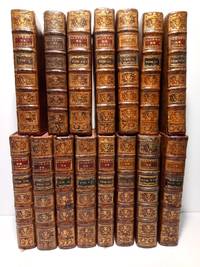
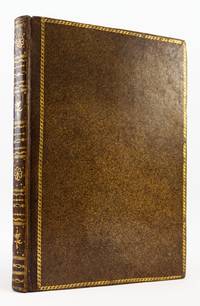
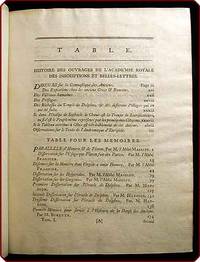
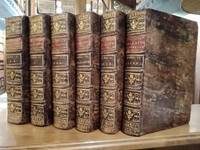
173248603PRIMERA EDICION COMPLETA EN 6 TOMOS.- Con Privilegio. En Madrid: los tomos 1º a 5º En La Imprenta de Francisco del Hierro Impresor de la R. Academia Española 1726 - 1729 - 1732 - 1734 - 1737 y el tomo 6º en la Imp. de la Real Academia Española por los Herederos de Francisco de el del Hierro 1739.- En conjunto 6 VOLS. con: Tomo 1º. 4 h. sigue grabado alegórico al cobre LXXXXVI 723 p / Tomo 2º. 6 h. 714 p. / Tomo 3º. 6 h. 816 p. / Tomo 4º. 6 h. 696 p. / Tomo 5º. 6 h. 656 p. / Tomo 6º. 18 h. 578 p.: Tras la portada del Tomo 1º tal y como se ha indicado lleva un bello grabado a pleno folio dibujado por Antonio Palomino y grabado al cobre por Joan á Palomino; Magnífica impresión a dos columnas sobre gran papel de hilo verjurado; Con bonitas letras capitales grabadas en madera y cul-de-lampe al final de cada letra; Gran Folio 343 x 25 cm; Enc. en Plena Piel Pasta de la época lomo cuajado en oro tejuelo rojo cortes jaspeados en tonos rojo y azul incluyendo en cada tomo un precioso escudo nobiliario grabado a modo de ex-libris perteneciente al Marqués de Grimaldo Ministro de Felipe V.- PALAU N.º 1286. En excelente estado general. Tan solo algunas esquinas y bordes de la encuadernación han sido reparados de los normales desgastes del tiempo apreciándose pequeñas faltas en las cejillas de las cabezas de los lomos en los tomos 1 y 6. Interior en perfecto estado con el papel firme blanco sin manchas ni otros defectos. Publicado entre 1726 y 1739 el Diccionario de la lengua castellana de la Real Academia Española conocido como Diccionario de Autoridades representa la primera gran empresa lexicográfica del español. Concebido con fines normativos reunió definiciones apoyadas en ejemplos de autores canónicos sentando así las bases de la tradición académica. Su método basado en el uso ilustrado buscaba fijar la lengua sin desligarla de su riqueza histórica y literaria. Fue una obra clave en la consolidación de una lengua culta unificada para el mundo hispánico. Se estima que la tirada total fue de aproximadamente 1.500 ejemplares distribuidos en seis tomos. Hoy en día resulta una obra dificilísima de conseguir. LENGUA ESPAÑOLA Libro en español Real Academia Española hardcover
176420218Paris: Chez P. Alex. Le Prieur tomos 1 al 12 M. DCC.LXIV 1764 y 1771 y Chez P. Fr. Didot le jeune tomos 13 al 15 M.DCC.LXXIV 1774.- EN TOTAL SON 15 VOLS.: 1º con 2 h. 391 p. / 2º con 2 h. 439 p. y 6 láminas plegadas / 3º con 1 h. 479 p. y 12 láminas plegadas / 4º con CLXXIV232 p. y 4 láminas plegadas / 5º con 1 h 489 p. y 16 láminas plegadas / 6º con 1 h. 406 p. y 2 láminas plegadas / 7º con 1 h. 432 p. y 3 láminas plegadas / 8º con 1 h. 456 p. y 5 nláminas plegadas / 9º con 2 h. 516 p. y 11 láminas plegadas / 10º con 213 p. y 4 láminas plegadas / 11º con 2 h. 516 p. y 2 láminas plegadas / 12º con 2 h.388 p. y 2 láminas plegadas / 13º con XLVIII 431 p. y 9 láminas plegadas / 14º con 2 h. 534 p. 1 h. y 4 láminas plegadas / 15º con VIII 544 p. y 6 láminas plegadas Todas suman un conjunto de 89 láminas plegadas de anatomía e instrumental quirúrgico finamente grabadas al cobre; 8º menor 17 x 104 cm; Buena impresión sobre fuerte papel verjurado; Texto en francés; Plena Piel Epoca lomo cuajado en oro cortes pintados en rojo.- RARO. Las encuadernaciónes con ligeros roces en bordes y esquinasque han sido restaurados. Pequeñas faltas en las cabezas de las lomeras y los tejuelos de algunos tomos. Pero en conjunto la obra presenta un buen aspecto con el interior en excelente estado. Aunque los libros son de dos imprentas presentan un aspecto perfectamente uniforme. Según datos de la actual Académie Nationale de Chirurgie de Francia estas primeras Mémoires de l'Académie Royale de Chirurgie fueron publicadas entre los años 1743-1774. DESCRIPCION EXACTA DE FECHAS POR TOMOS: Paris Chez Le Prieur Tome I partie I 1764; Tome I partie II 1765; Tome I partie III 1743; Tomes IV V y VI 1768; Tomes VII VIII y IX 1771; Tomes X XI y XII 1768; Y Paris Chez P. Fr. Didot le jeune Tomes XIII XIV y XV 1774. CIRUGIA EN GENERAL Y TRAUMATOLOGIA Livre en français P. Alex Le Prieur y Fr. Didot le jeune hardcover
177156289Neuchatel, L'Imprimerie de la Société Typographique), 1771-83. 4to. Bound in 19 contemp. uniform full mottled calf. Raised bands. Gilt spines. Title-and tomelabels with gilt lettering. Spine-ends on nearly all volumes strenghtened. Stamp on title-pages. Each volume around 650 pp. With 508 fine engraved plates.
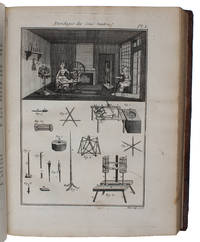
177156289Neuchatel L'Imprimerie de la Société Typographique 1771-83. 4to. Bound in 19 contemp. uniform full mottled calf. Raised bands. Gilt spines. Title-and tomelabels with gilt lettering. Spine-ends on nearly all volumes strenghtened. Stamp on title-pages. Each volume around 650 pp. With 508 fine engraved plates. <br/><br/><em>Second edition and the first 4to-edition was published in 19 volumes plus an additional volume by Jean Elie Bertrand where vol. 20 is an additional volume published much later 1799 - not present here - dealing with the art of printing. This importent collection of books on crafts was published by between 1761 and 1788. The full series comprises 113 parts cahiers in 27 folio volumes along with three supplements and "provide detailed accounts of a wide range of handcraft and manufacturing processes carried out in France at that time. The volumes are well-illustrated with precise engravings by Jean Elie Bertrand 1737-1779 a noted typographer from Neuchâtel where the printing was done. Many of them provide the background for shorter articles in Diderot's Encyclopedia which was appearing at much the same time. The project had its origin in request from Colbert in 1675 to the Academy Royal des Sciences for detailed accounts of various mechanic arts to be prepared and for new machines to be reported upon. This led to the formation of the Bignon Commission under Abbé Bignon. René-Antoine Ferchault de Réaumur 1683-1757 became editor soon after he joined the Academy. He inherited number of drawings the earliest prepared in 1693 and an illustrated manuscript on printing type and book binding which had been prepared in 1704. It was left to Réaumur's successor Duhamel du Monceau to bring about the publication of the series probably as the result of the competition from the Encyclopedia." Wikipedia.Brunet II618 ff. - Graesse II 367. </em> hardcover
176256316Königsberg und Leipzig, Kanter (Berlin, Stettin, Leipzig, Rüdigern), 1762-75. 4to. Bound in 13 uniform contemp. full calf. Raised bands. Richly gilt spines. Titlelabels with gilt lettering. On all boards the gilt monogram on red background of King Christian VII. A stamp on title-pages. Around 6000 pp., 4 folded tables and 366 folded engraved plates (1 plate in xerox-copy). Occassionally a few minor brownspots, but fine and clean.
176256316Königsberg und Leipzig Kanter Berlin Stettin Leipzig Rüdigern 1762-75. 4to. Bound in 13 uniform contemp. full calf. Raised bands. Richly gilt spines. Titlelabels with gilt lettering. On all boards the gilt monogram on red background of King Christian VII. A stamp on title-pages. Around 6000 pp. 4 folded tables and 366 folded engraved plates 1 plate in xerox-copy. Occassionally a few minor brownspots but fine and clean. <br/><br/><em>First German edition of this importent collection of books on crafts which is a translation of "Descriptions des Arts et Métiers." published in French between 1761 and 1788. The full French series comprises 113 parts cahiers in 27 folio volumes along with three supplements and "provide detailed accounts of a wide range of handcraft and manufacturing processes carried out in France at that time. The volumes are well-illustrated with precise engravings by Jean Elie Bertrand 1737-1779 a noted typographer from Neuchâtel where the printing was done. Many of them provide the background for shorter articles in Diderot's Encyclopedia which was appearing at much the same time. The project had its origin in request from Colbert in 1675 to the Academy Royal des Sciences for detailed accounts of various mechanic arts to be prepared and for new machines to be reported upon. This led to the formation of the Bignon Commission under Abbé Bignon. René-Antoine Ferchault de Réaumur 1683-1757 became editor soon after he joined the Academy. He inherited number of drawings the earliest prepared in 1693 and an illustrated manuscript on printing type and book binding which had been prepared in 1704. It was left to Réaumur's successor Duhamel du Monceau to bring about the publication of the series probably as the result of the competition from the Encyclopedia." Wikipedia.Brunet II618 ff. only French editions - Graesse II 367 only the French editions. - Fromm 7040. </em> hardcover
174929077Hamburg und Leipzig Grund Grunds Witwe und A.H. Holle 1749-62. 8vo. Bound in 22 cont. uniform hcalf. Titlelabels in leather on backs gilt. Small paperlabel pasted on lower compartment. A few spine ends worn. Light wear to backs. Stamp on titles and verso. Light occasional browning but a good sound copy. Having numerous engraved folded plates. With Kätners: Zwiefaches Universalregister über die ersten XXV Bände von den Abhandlungen.der Königl. Schwed. Akademie der Wissensch. nach der deutschen Uebersetzung des Herrn Kästners gefertiget. Lpz. Holle 1771. Cont. hcalf. 6302 pp. <br/><br/><em>A long importent run of the first Series of the Transactions from the Royal Swedish Academy of Sciences in the German translation of Kongl. Svenska Vetenskaps Academiens Handlingar. It includes many importent contributions by Torben Bergman Georg Brandt Anders Celsius A.F. Cronstedt Pehr Elvius Carl Linnaeus Linné Sven Rinman H.T. Scheffer Mårten Triewald J.G. Wallerius and many others. - Bernhard Lundstedt: Sveriges Periodiska Litteratur No. 40. </em> hardcover
174929077Hamburg und Leipzig, Grund, Grunds Witwe und A.H. Holle, 1749-62. 8vo. Bound in 22 cont. uniform hcalf. Titlelabels in leather on backs, gilt. Small paperlabel pasted on lower compartment. A few spine ends worn. Light wear to backs. Stamp on titles and verso. Light occasional browning, but a good, sound copy. Having numerous engraved folded plates. With Kätners: Zwiefaches Universalregister über die ersten XXV Bände von den Abhandlungen...der Königl. Schwed. Akademie der Wissensch. nach der deutschen Uebersetzung des Herrn Kästners gefertiget. Lpz., Holle, 1771. Cont. hcalf. (6),302 pp.
176226629Berlin, Stettin und Leipzig, Johann Heinrich Rüdigern, 1762-75. 4to. Bound in 13 fine uniform full calf, raised bands, gilt backs. Remains of paperlabels on backs. Top of spine on one volume frayed. Small rubber stamp on titles. A few brownspots. A good copy. Having in all 374 (of 585) fine engraved plates (1 plate supplied in xerox-copy). Plates measure around 37x24cm.
176226629Berlin Stettin und Leipzig Johann Heinrich Rüdigern 1762-75. 4to. Bound in 13 fine uniform full calf raised bands gilt backs. Remains of paperlabels on backs. Top of spine on one volume frayed. Small rubber stamp on titles. A few brownspots. A good copy. Having in all 374 of 585 fine engraved plates 1 plate supplied in xerox-copy. Plates measure around 37x24cm. <br/><br/><em>First German edition of one of the main works of the 18th century in the fields of crafts and technology as it is a translation of the famous series "Description des Arts et Metiers" issued by Academie Royale des Sciences 1760-75. The French edition was published in folio. Band 1: Kohlenbrennen Lichtziehen Ankerschmieden Nadler Papiermacher. 31 plates and 1 table;Band 2: Eisenhämmer. Teil 1-2 Wachsziehen Pergamentmachen Leder-Vergoldung Schieferbrüche. 22 plates; Band 3: Eisenhämmer. Teil 3-4 Spielkartenherstellung Seidenfärberei Pappenmacher. 29 plates 1 plate supplied in xerox-copy; Band 4: Böttcherkunst Weißgerber Ziegelstreichen Zuckersieden Silber affinieren. 30 plates; Band 5: Messingherstellung Tuchmacherkunst Lohgerberei. 33 plates. Band 6: Tuchfrisierkunst Saffianleder-Herstellung Leder auf ungarische Art Weißgerber Hutmacher Dachdecker. 19 plates; Band Band 7: Tapetenweberei Kalkbrennerkunst Ziegelstreichen in Holland Ziegelhütten Ball- und Raquettenmacher. 30 plates and 1 table; Band 8: Perückenmacherkunst Müller Nudelmacher und Bäcker. 15 plates; Band 9: Schuster Schlösserkunst. 48 plates; Band 10: Steinkohlenbergbau Indigobereiter. 22 plates; Band 11: Eisenbergwerke und Hüttenwerke in der Steiermark Leimsiederei Fischerei Teil 1. 25 plates and 1 table; Band 12: Fischerei Teil 2. 50 plates; Band 13: Fischerei Teil 3 Porzellanherstellung. 23 plates and 1 engr. frontisp.; Band 14: Glasmalerei und Glasarbeiten. Mit 13 von 14 Tafeln; Band 15: Wollenzeugfabrikant. 17 plates; Band 16: Seifensider Leinwandhandel Schneiderhandwerk Leinenmanufaktur Tabaksmanufaktur. 27 plates; Band 17: Bleiarbeiter mathematische und astronomische Instrumente Baumwoll-Samtfabrikation. 38 plates; Band 18: Stickerkunst Siebmacher Riemer und Sattler mit Kutschenbau Drahtzieherei Stahlblattmacher. 51 plates Band 19: Schiffbaukunst. 18 plates and 1 engr. frontisp.;Band 20: Zinngießerkunst. 32 plates; Band 21: der Strumpfwirkerstuhl und sein Gebrauch. 14 plates. </em> hardcover
174014160Paris: de L’Imprimerie Royale 1740. Complete with errata’s and original blank leaves two of three finely engraved frontispieces chapter vignettes ornamental head and tail pieces and 82 folding plates. Full mottled calf rebacked the corners a bit worn. Interior is lightly toned with some browning on the preliminaries and last leaves. Generally this is an excellent set. First editions of these three volumes from a series published by the Academy of Sciences. It is a summary of the activities and inventions that have been made and contains the most important discoveries of the time. These periodicals which were at the forefront of scientific development during the Enlightenment contain works produced by an elite class of French scientist for the years 1722 1731 and 1740. Each volume provided an overview of advancements in math and science for each year and the writings therein shaped the world’s understanding of physics mathematics astronomy anatomy and other fields of science. They further provide invaluable historical data such as meteorological and astrological records for each year. <br /> <br /> The memoirs for 1722 include data recorded on both a lunar and solar eclipse as well as other astronomical observations by Jacques Cassini 1677-1756 best know for completing his fathers work on determining the meridian of Paris. The distinguished astronomer provided further research on lunar eclipses in the memoirs of 1731 where he is in great company alongside distinguished mathematicians Alexis-Claude Clairaut 1713-1765 Pierre Bouguer 1698-1758 known for his work in physics photometry and hydrography and the foremost proponent of the Newtonian movement in France Pierre de Maupertuis 1698-1759. Of special note in the 1731 memoirs is Maupertuis’s ballistic arithmetic which was used to try to better understand the movement of the earth and its gravity. Too an article by Clairaut on new formulas for finding the center of gravity. These articles contributed greatly to a better understanding of the earth’s shape and the mechanics of its rotation particularly Bouguer’s essay on the tendency of objects set in motion to move in a curvilinear fashion. The 1740 edition contains Cassini De Thury’s De la Maridienne de Paris. which was an important step in the process of mapping the shape of the earth. Cassini 1714-1784 representing the third generation of the distinguished family of astronomers was the first to question <br /> <br /> <br /> Picard’s measurements which had been used to map the Maridian of Paris. Clairaut’s essay on integral calculus in the same volume which established the existence of an integrating factor for linear differential equations was an important step in the history of mathematics and Mairan’s treatise on reflection and refraction of light and the human eye was essential to the advancement of optics. Mairan 1678-1771 would set the foundation for optical theory with this treatise. de L’Imprimerie Royale unknown
1785876331785. American Academy of Arts and Sciences. MEMOIRS OF THE AMERICAN ACADEMY OF ARTS AND SCIENCES: TO THE END OF THE YEAR MDCCLXXXIII. Vol. 1: Boston: Adams and Nourse 1785. i-iii - xxxii 568pp. 1 f.errata. 4to 10 1/2" x 8 1/2". Six folding plates. Contemporary calf binding. Front and rear hinges cracked but attached. Vol. 2: pt.1 Isaiah Thomas & Ebenezer T. Andrews 1793. i-v- 200. pt.2 Charlestown: Samuel Etheridge 1804. i-iii - 24. 1- -168. Bound as one in contemporary calf. Contains 3 plates including one folding plate of a reproduction of James Winthrop's sketch of the Deighton Rock petroglyphs.Front board detached; rear hinge cracked. Ex-library copy previously owned by noted Boston physician Buckminster Brown. Text is mostly clean with some mild foxing and ink staining . First two volumes of the series published by one of the oldest and most prestigious honorary societies in the country. Created during the Revolution it included John Adams Thomas Jefferson and John Hancock among other luminaries. Volume 2 which includes an obituary of George Washington published in 1804 is quite scarce. $3250.00. unknown books
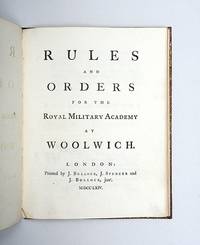
1764159337London: Printed by J. Bullock J. Spencer and J. Bullock junr. 1764. Good officers of Artillery and perfect Engineers Presented in a handsome period morocco a pair of notably scarce editions of regulations pertaining to the Royal Military Academy Woolwich; comprising the second recorded edition of the rules for the institution as a whole following that of 1741 together with the seemingly sole edition of the statutes relevant to officer-cadets specifically. We have traced no copy of either on auction records. The Academy - or "The Shop" as it was known colloquially - was established by Royal Warrant in 1741 for the training of "good officers of Artillery and perfect Engineers" its "gentlemen cadets" initially ranging in age between ten and thirty. The curriculum focused on mathematical theory and the scientific principles of gunnery and fortification employed to a practical end. It closed in 1939 and reopened in 1947 as the Royal Military Academy Sandhurst. The present regulations were drawn up under the eye of John Manners marquess of Granby 1721-1770 who in 1763 became master-general of the ordnance; another edition was put out in 1776. Quarto 225 x 173 mm. Contemporary red morocco decorative gilt spine sides with gilt border comprising a dog-tooth roll enclosing a broad panel formed of multiple tools including stars and circlets gilt edge roll and turn-ins Nonpareil pattern marbled endpapers gilt edges. Binding a trifle rubbed and marked gilt at head of front board dulled and a little wormed loss to lower compartment of spine boards just slightly splayed internally clean and crisp; withal an attractive copy. ESTC T93638 & T93392; an online search shows copies of the first mentioned work at 13 institutional libraries: BL Scotland St Andrews Strathclyde Wellcome Yale Society of the Cincinnati Auburn Temple Dalhousie Mount Saint Vincent Czartoryski Krakow and Queensland; the second at 10 libraries: BL Scotland St Andrews Strathclyde Society of the Cincinnati Auburn Temple Dalhousie Mount Saint Vincent and Queensland. hardcover
174397036Paris, Alex Le Prieur et Veuve Delaguette, 1743-1768, in-12, 12 vol, 4 front. et 70 pl. depl, Plein veau brun marbré, dos à nerfs fleuronné, pièces de titre grenat, tomaisons brunes; étuis toilés modernes, Édition au format in-12 des Mémoires de l'Académie Royale de chirurgie. Cette réunion composite de 12 volumes (sur 15) comporte des tomes parus en 1743, 1757, 1764-1765 et 1768, chez Le Prieur ou chez la veuve Delaguette. Elle contient quatre fois le même frontispice, gravé et réduit d'après l'original de Cochin fils par Robert. Le tome I est de 1764 [Le Prieur]; le II de 1765 [Le Prieur]; le III de 1743 [Le Prieur]; les tomes IV à VI et X à XII sont de 1768 [Le Prieur]; les tomes VII à IX, 1757 [veuve Delaguette]. Les Mémoires sont parus au format in-4 en cinq volumes, de 1743 à 1774. Bel ensemble, présenté dans deux étuis modernes. Galerie de vers traversant les 2 tiers du T. III, les pp. 137-182 plus touchées, et avec une légère atteinte au planches. Quelques coiffes arasées. Couverture rigide
17461500581746. In der Kartusche bezeichnet und datiert "Dieser Plan ist aufgetragen und projectiret worden in der Classe des Herrn Ingenieur Lieutenant von Tschernzoff seiner Classe durch den Cadetten Johan Franciscus von Kochen. St. Petersburg.d. 3. May 1746.". 36 x 51,5 cm (Blattgröße).
177554559Paris, Ruault, 1775, in-4, 4 vol. de I. CXXVIII, 491pp. (+ VIII*). - II. (4), II, 473pp. - III. (4), 651pp. - IV. (4), 232, 363pp, demi-basane marbrée à coins, dos à nerfs orné, tranches rouges (reliure de l'époque), L'Académie des sciences de Paris fut créée en 1666 par Colbert, qui réunit un petit groupe de savants deux fois par semaine, dans la bibliothèque du roi. L'Académie reçut ses statuts en 1699, avec le titre d'Académie royale, et fut installée au Louvre. Elle contribua au mouvement scientifique de son temps par ses publications et joua un rôle de conseil auprès du pouvoir. La série des volumes annuels "Histoire de l'Académie royale des sciences", tirés des registres de l'Académie, a été créée par le règlement de 1699. Les années 1666 à 1698 furent compilées plus tardivement, à la fin du 18° siècle. Ces précieux volumes de table, composés par l'abbé Rozier (1734-93), permettent d'effectuer des recherches dans les publications de 1666 à 1770. Qqs restaurations Couverture rigide
178914255En Valencia: En la Oficina de D. Benito Monfort Impresor de la Real Academia. Año 1789.- 2 h. 53 p.; en Folio; Gran papel de hilo verjurado; Cuidada impresión con un fino grabado al cobre el la portada diseñado por J. Camarón y grabado por M. Brú; Plena Piel Valenciana Epoca con rueda dorada en tapas y cantos lomera con filetes dorados.- MAGISTRAL EDICION DEL FAMOSO IMPRESOR VALENCIANO "BENITO MONFORT". MUY RARO. EN IMPECABLE ESTADO CON EL PAPEL BLANCO Y TERSO. Solamente la cabeza del lomo tiene un ligero deterioro que ha sido restaurado. Tiene repetidas 2 hojas correspondientes a las páginas 33-34 y 35-36. ARTE ESPAÑOL EN GENERAL E HISTORIA DEL ARTE ESPAÑOL Libro en español En la Oficina de D. Benito Monfort hardcover
17744067Paris: Imprimerie Royale 1774. 8vo 163 x 91 mm. 18 3 3 528 30 3 3 pages. Partly double column. Woodcut and type-ornament head- and tailpieces. Faint marginal discoloration. Contemporary red morocco sides with triple thick and thin ruled border spine in six gold-tooled compartments title lettered in second compartment gilt medallion with monogram of the Ecole Royale Militaire in lower compartment gilt edges Brokatpapier endleaves with semis of gold stars and dots corners bumped. Provenance: modern etched bookplate with initials AK. Only Edition of a complete course of religious instruction for the pupils of the Ecole Royale Militaire founded in 1751 by Louis XV as a military academy for the sons of noble families including those who had sunk into poverty. The book of which only one other copy is recorded was printed and bound for the school. At first two hundred and eventually five hundred teenagers from all over France were admitted on the basis of an exam taken at the end of primary school. The huge expenses entailed by the construction of a magnificent palace to house the school designed by the architext Ange-Jacques Gabriel were covered by a national lottery and by taxes on playing cards. A single cohort graduated before the project ran out of money and although the buildings had been completed in 1787 the academy closed its doors. Pillaged during the Revolution it would not open again for the same purpose for another century. The first part of the book which was approved by and possibly written by Christophe de Beaumont the Archbishop of Paris consists of a primer of the Christian religion. It opens with the Archbishop's rules for the administration of religion in the school. From 6 am masses to near-daily catechisms and energetic prayer sessions to prepare for confession the young future officers were reminded regularly that their duties to God were as important as those to the King. The meticulous scheduling of each day and other casual details testify to the complete control of their lives by the authorities of the academy whose premises they seem never to have left not even on Christmas. An allusion to visits by the religious Directors to students in prison and in the infirmary are further reminders to the modern reader of the harsh conditions of young people's lives when children were viewed as small-sized adults. Including a table of moveable feasts from 1775 to 1793 and a calendar of Saints' days this section provides the basics of religion from the Ten Commandments to instructions on communion on how to conduct oneself at Mass and the ritual itself on examining one's conscience and preparing for confession and so on. While most could apply equally to any student including the repeated exhortations to contemplate one's sins clearly a central concern to these teachers of adolescents a few paragraphs address the special circumstances of soldiers. These include prayers to be recited before battle or after victory instructions on providing absolution to the dying in the absence of an available priest requiring memorization of a rather long passage and finally a prayer for a good death. The second and longer part printed in two columns contains the Offices for Sundays and feast days throughout the year partly in Latin. OCLC locates a single copy at the BnF. Imprimerie Royale unknown books
174851397Breslau, Johann Jacob Korn, 1748-51. Large 8vo. Uncut in mounted orig. marbled wrappers, all 6 volumes later clotbacked. Wear to wrappers. Stamps on titlepages. Ca. 5000 pp. (each vol. separately paginated). Textillustrations and 104 engraved plates, some folding.Title-pages browned and brownspotted. Some browning and brownspots throughout.
174851397Breslau Johann Jacob Korn 1748-51. Large 8vo. Uncut in mounted orig. marbled wrappers all 6 volumes later clotbacked. Wear to wrappers. Stamps on titlepages. Ca. 5000 pp. each vol. separately paginated. Textillustrations and 104 engraved plates some folding.Title-pages browned and brownspotted. Some browning and brownspots throughout. <br/><br/><em>Scarce first German translation of the pysical memoirs from the "Mémoires de l'Academie des Sciences" containing many importent papers by the leading French scientists: Amontons Cassini Bernoulli Homberg Lemery la Hire Reaumur Tournefort Maraldi Delisle etc. etc.Of special importence are GOTTFRIED WILHELM LEIBNIZ: "Erklärung der Arithmetica binaria die sich nur der Charakteren 0 und I bedienet nebst Anmerkungen von ihrem Nutzen und dem verstande den sie den alten chinesischen Figuren des Fohi giebt." pp. 88-93 Bd. II. Leibniz' BINARY NUMBER SYSTEM first published 1703. And JACOB JACQUES CASSINI "Abhandlung von der Grösse und Figur der Erde" pp. 431-756 and 14 engraved plates and maps.Poggendorff II 1000 </em> unknown
1742SS13441London:: Printed for John and Paul Knapton. . . 1742-53. 1742. 5 volumes. 8vo. Vol.1: 4 x 11-456 16; Vol.2: 2 407 15 10; Vol.3: 2 422 16; Vol.4: 2 410 14 11-26; Vol.5: 2 426 14 pp. The first 10 pages of the "Addenda" are bound at the end of vol.2 pp.11-26 are bound at the end of vol.4. 44 of 45 engraved plates mostly folding I: 17; II: 6; III: 6; IV: 6; V: 9 of 10 plates pl. 10 supplied in facs. see p. 422 TOTAL: 44 2 folding tables vol. I tables some folding addenda indexes; 2nd wasp plate vol. V with small scrape effecting some of the image. Original speckled calf; rebacked and with later endleaves vols. I III & V with joints gently mended with kozo. PROVENANCE: Bookplates of Henry and Carol Faul mounted on top of the following engraved bookplate for the American Academy of Arts & Sciences: "Sub libertate Florent" dated 1780 "The Gift of . . ." -- also with their gilt-stamp applied to the foot of the later spines "American Academy"; Rubber stamps discarded of the Linda Hall Library Kansas City MO. Very good. HENRY FAUL'S COPY -- WORKED FOR ENRICO FERMI & BIKINI ATOLL TEST. A collection of early scientific papers from leading figures all belonging to the Royal Academy of Sciences at Paris the French equivalent to the Royal Society of London. The abridged papers all appeared between 1699 and 1720 and include diverse topics such as anatomy apiculture astronomy incl. Moon chemistry electricity entomology gases geography geology herpetology invertebrates magnetism medicine meteorology mineralogy monsters music mollusks natural history optics physics scientific instruments including the barometer microscope zoology and more. / AMONG THE NUMEROUS CONTRIBUTORS OR NOTABLES MENTIONED: Agricola Amontons Baert Juan de Barros Bernoulli Bignon Borelli Bouvet Robert Boyle Carre Cassini Chazelles Chevalier Coronelli Dampier Descartes Dodart Fermat Fontenay Fontenelle Galileo Gandolphe Gassendi Gesner Gouye Halley Van Helmont de la Hire du Hamel Huygens Jeaugeon Kepler Kircher Leibnitz Lemery Leuwenhoek Malpighi de Marca Mariotte Mollard Gregory Nazianzen Isaac Newton de Nointel Ortelius Parent Picard Renau Riccioli Sanctorius Strabo Tournefort Varignon etc. PROVENANCE: 1 American Academy of Arts & Sciences bookplate: The Academy seal features Minerva the goddess of wisdom science and trade and the arts. Her temple on the Aventine Hill was a meeting place for skilled craftsman writers and actors. She is also depicted as a warrior a symbol appropriate for an organization created in the midst of the American Revolution. Around Minerva are representations of the new country—on her right a field of Indian corn a stand of oaks and the outline of a town; at her feet a hoe a plow and a sickle; on her left a quadrant and a telescope a ship heading for shore and the sun completely risen above the cloud. Over the whole is the motto SUB LIBERTATE FLORENT which suggests that arts and sciences flourish best in. -- 2 Rubber stamps discarded of the Linda Hall Library Kansas City MO. -- 3 Henry and Carol Faul. Henry Faul was a geologist working on Enrico Fermi's team at the University of Chicago. He was responsible for prospecting uranium ore in Colorado and Utah. He also travelled to Manhattan Project sites at Los Alamos and in Washington DC. Following the war Faul continued to work on nuclear projects and participated in the Bikini Atoll test. He received his M.S. from the University of Chicago during the war and went on to get his Ph.D. from the Massachusetts Institute of Technology. ESTC T131275. Printed for John and Paul Knapton. . . , 1742-53. unknown
1742SS13441London:: Printed for John and Paul Knapton. . . 1742-53. 1742. 5 volumes. 8vo. Vol.1: 4 x 11-456 16; Vol.2: 2 407 15 10; Vol.3: 2 422 16; Vol.4: 2 410 14 11-26; Vol.5: 2 426 14 pp. The first 10 pages of the "Addenda" are bound at the end of vol.2 pp.11-26 are bound at the end of vol.4. 44 of 45 engraved plates mostly folding I: 17; II: 6; III: 6; IV: 6; V: 9 of 10 plates pl. 10 supplied in facs. see p. 422 TOTAL: 44 2 folding tables vol. I tables some folding addenda indexes; 2nd wasp plate vol. V with small scrape effecting some of the image. Original speckled calf; rebacked and with later endleaves vols. I III & V with joints gently mended with kozo. PROVENANCE: Bookplates of Henry and Carol Faul mounted on top of the following engraved bookplate for the American Academy of Arts & Sciences: "Sub libertate Florent" dated 1780 "The Gift of . . ." -- also with their gilt-stamp applied to the foot of the later spines "American Academy"; Rubber stamps discarded of the Linda Hall Library Kansas City MO. Very good. HENRY FAUL'S COPY -- WORKED FOR ENRICO FERMI & BIKINI ATOLL TEST. A collection of early scientific papers from leading figures all belonging to the Royal Academy of Sciences at Paris the French equivalent to the Royal Society of London. The abridged papers all appeared between 1699 and 1720 and include diverse topics such as anatomy apiculture astronomy incl. Moon chemistry electricity entomology gases geography geology herpetology invertebrates magnetism medicine meteorology mineralogy monsters music mollusks natural history optics physics scientific instruments including the barometer microscope zoology and more. / AMONG THE NUMEROUS CONTRIBUTORS OR NOTABLES MENTIONED: Agricola Amontons Baert Juan de Barros Bernoulli Bignon Borelli Bouvet Robert Boyle Carre Cassini Chazelles Chevalier Coronelli Dampier Descartes Dodart Fermat Fontenay Fontenelle Galileo Gandolphe Gassendi Gesner Gouye Halley Van Helmont de la Hire du Hamel Huygens Jeaugeon Kepler Kircher Leibnitz Lemery Leuwenhoek Malpighi de Marca Mariotte Mollard Gregory Nazianzen Isaac Newton de Nointel Ortelius Parent Picard Renau Riccioli Sanctorius Strabo Tournefort Varignon etc. PROVENANCE: 1 American Academy of Arts & Sciences bookplate: The Academy seal features Minerva the goddess of wisdom science and trade and the arts. Her temple on the Aventine Hill was a meeting place for skilled craftsman writers and actors. She is also depicted as a warrior a symbol appropriate for an organization created in the midst of the American Revolution. Around Minerva are representations of the new country—on her right a field of Indian corn a stand of oaks and the outline of a town; at her feet a hoe a plow and a sickle; on her left a quadrant and a telescope a ship heading for shore and the sun completely risen above the cloud. Over the whole is the motto SUB LIBERTATE FLORENT which suggests that arts and sciences flourish best in. -- 2 Rubber stamps discarded of the Linda Hall Library Kansas City MO. -- 3 Henry and Carol Faul. Henry Faul was a geologist working on Enrico Fermi's team at the University of Chicago. He was responsible for prospecting uranium ore in Colorado and Utah. He also travelled to Manhattan Project sites at Los Alamos and in Washington DC. Following the war Faul continued to work on nuclear projects and participated in the Bikini Atoll test. He received his M.S. from the University of Chicago during the war and went on to get his Ph.D. from the Massachusetts Institute of Technology. ESTC T131275. Printed for John and Paul Knapton. . . , 1742-53. unknown books
17628659S.l. s.e. 1762 Un volume in-folio plein veau raciné de l'époque, dos à nerfs orné, pièce de titre en maroquin rouge, double-filet doré sur les coupes, réunissant: - M. de Réaumur, Nouvel Art d'adoucir le fer fondu et de faire des ouvrages de fer fondu aussi finis que de fer forgé. 1762. viii+124pp., 7pl.- M. le Marquis de Courtivron et M. Bouchu, De la forge des enclumes. 1762. 11pp., 1pl. - M. Duhamel du Monceau, Art des forges et fourneaux à fer. 1762. 198pp., 9pl.- M. de Réaumur et M. Duhamel du Monceau, Fabrique des ancres. 54pp., 6pl.Épidermures, manque à la coiffe supérieure, léger travail de vers sur les plats et premiers feuillets, mouillure claire en marge supérieure à la fin de l'ouvrage.
1799ST19468Madrid: Viuda de Widow of Joaquín Ibarra 1799. 310 x 210 mm. 12 1/4 x 8 1/4". 2p.l. 144 pp. <br/> Extremely nice sprinkled calf covers with gilt chain roll border smooth spine divided by plain rules and decorative rolls into compartments with floral ornament at center marbled endpapers edges sprinkled red. A Large Paper Copy. Front pastedown with evidence of bookplate removal the ex-libris of Brian Stilwell pasted over it. ◆Rear joint with thin crack corners somewhat rubbed a couple small abrasions but the binding solid and still lustrous. Internally A BEAUTIFUL COPY--EXCEPTIONALLY CLEAN FRESH AND BRIGHT and with vast margins.<br/> <br/> This is an almost astonishingly well-preserved example of the press work that made Joaquin Ibarra the most renowned Spanish printer of all time and along with Baskerville Bodoni and Didot one of the great European printers of the 18th century. His large paper copies like the present item were especially beautiful printed on linen paper with margins that occupy a good deal more space than the text. Ibarra 1725-85 trained at the Pontifical and Royal Printing Press managed by his brother Manuel before moving to Madrid to establish his own workshop. He created a secret formula for ink that was famed for its quality and brilliance producing an especially dark crisp text on the paper. The effect was enhanced by the technique he developed for "satinizing" the paper to remove any traces of the printing plate. After Ibarra's death the firm was carried on by his widow and heirs until 1836 maintaining the high standards he had set. The text here reports on the transactions of the Royal Academy of Fine Art between July 1796 and July 1799 and the prizes distributed by the king to academicians in the fields of painting sculpture and architecture. Previous owner Brian Stilwell is an active collector of a range of material focusing on printing as an art from incunabula to private press books. A member of the Philobiblon Club he donated 500 limited editions of fine press books to Rutgers University. Viuda de [Widow of] Joaquín Ibarra unknown
177713107Londres: T. Becket & P. Elmsly 1777. 4to 27 cm 10.6". 3 vols. I: 2 iii 1 lx 656 pp. pagination skips 1732 text uninterrupted. II: 2 iii 1 ccviii 495 1 blank pp. III: 2 iii lxviii 1 696 pp.; 1 fold. plt. 2 plts. <br><br>Sole edition thus: Three-volume set of selected pieces from the Histoire et mémoires de l'Académie a massive collection of French-language commentary and criticism on Greek and Latin classics. The printing of the Histoire et mémoires commenced in 1717 and ran through 1809 with the total number of volumes coming to 51; the present compilation offers especially noteworthy treatises from the beginning of the series through 1763.<br>Â Â Â Â The third volume includes two plates and one oversized folding plate reproducing two inscriptions and a frieze engraved by E. Malpas.<br>Â Â Â Â ~> Uncommon outside of Great Britain's libraries. <br>Â Â Â Â <br>Â Â Â Â ESTC T113913; Brunet I 26; Lowndes I 5. Contemporary treed calf spines gilt extra with gilt-stamped leather title and volume labels; leather worn at edges and moderately rubbed with joints cracking. Front pastedowns with private bookplates and signs that a plate was removed on front free endpaper one vol. endpaper holed; impressions of old pencilled shelf numbers on title-pages and one lightly inked old date. First two leaves of vol. III with upper margins stained and final leaf browned; some pages with a few spots of faint foxing most clean and crisp. T. Becket & P. Elmsly hardcover books