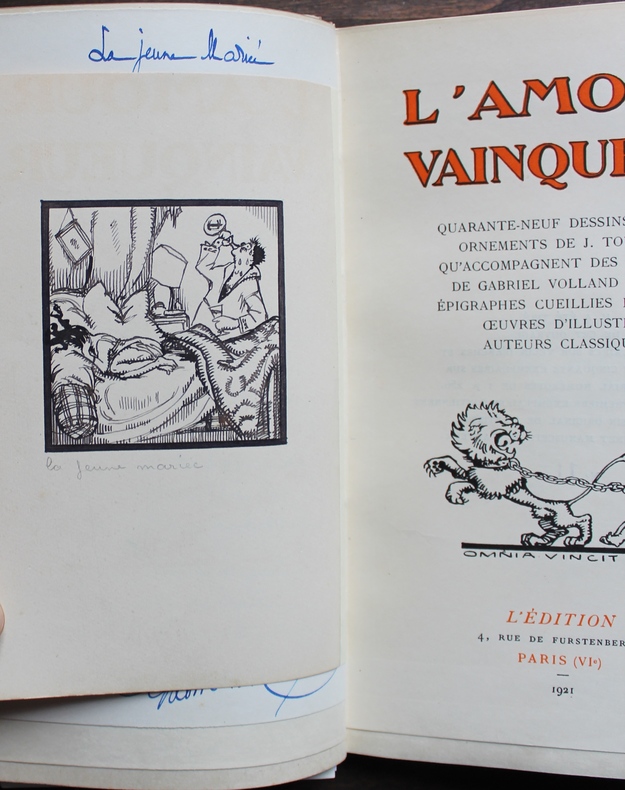
--Exemplaire de tête avec encre originale et poème manuscrit--[TOUCHET (Jacques)] - VOLLAND (Gabriel).Livre Rare Book
19 878 résultats
11151P., L'Edition, 1921, 1 vol. in-8° (226 x 140) relié 1/2 vélin à la bradel, auteur, titre et date dorés au dos, tête dorée, couverture et dos conservés, non paginé.Très bel exemplaire.
14044Neuilly-sur-Seine, rue Soyez, 28 avril - 12 août 1872, 1 vol. in-4° oblong (195 x 235 mm) reliure de lépoque 1/2 chagrin marron à coins, dos à 4 nerfs, auteur, titre, et fleurons dorés, double filet à froid bordant les plats de papier marbré, de (3) ff. (dédicace, faux-titre, titre) - 446 ff. Petites griffures et frottements sans gravité sur les plats, très bel exemplaire par ailleurs.
Very Good Turkish, Ottoman (1500-1928) Original manuscript copy of 1593 numbered Medical and Health Law of Turkish Republic, adopted in April, 24, 1930. No author. 32x22 cm. In Ottoman script. [37] p. Including full 309 articles of law. Written with a fine Riq'a script. "The Ministry of Health was founded on 3 May 1920 with the law no. 3 following the opening of the Grand National Assembly of Turkey. The first minister of health in Turkey is Dr. Adnan Adivar (Husband of famous Turkish female writer Halidde Edip Adivar). In this period, the issues of reconstruction after the war, the healing of the war wounds and formation of the key legislation in oder to found the country's health system were focused on. The foundations of the current public health system in Turkey were laid between the years of 1923 and 1946. In this period, a number of acts were put into effect to clearly and definitely specify the duties and functions of the Ministry of Health which was responsible for planning, arranging and applying the health programs. Such law as the General Health Law (Umumi Hifzissihha Kanunu) (1930/1593) which are still in effect today were enforced...". (Source: Legal, Ethical, Social Aspects of Public Health Care in Europe and Beyond: Croatia, Japan, Portugal and Turkey, Vol. 2).
1332332420.Gpaperback. Good. Access codes and supplements are not guaranteed with used items. May be an ex-library book. paperback
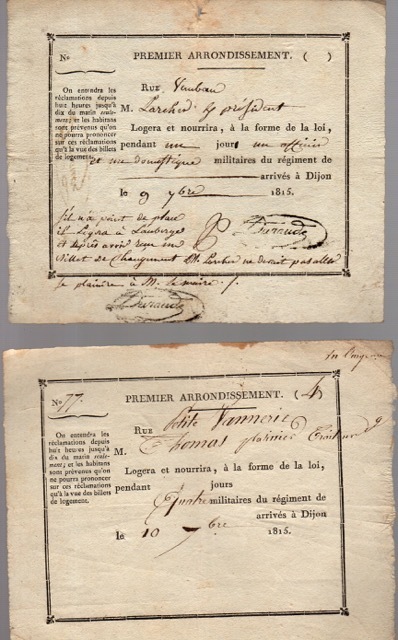
181594082 billets de logement: l'un pour 4 militaires "arrivés à Dijon le 10 septembre 1815"; l'autre pour un officier et son domestique daté du 9 septembre 1815 , avec griffe du maire de Dijon Durande. Très bon Dijon 1815
18159407pour la subsistance du cheval du soussigné pour la journée du 5 juillet 1815. Cambrai le 5 juillet 1815. Cachet du commissaire des guerres "Jacques". Très bon Cambrai 1815
Manuscript notes made by a nineteenth century student of medicine, possibly intent on becoming an apothecary, who examines and records the earlier works of German physician and professor Andreas Elias Buechner (1701-1769), including numerous medicinal recipes and commentary on physiological effects. 8vo. 56 pages in manuscript. Text is in German. Marbled paper boards with blank label to front. Volume measures approximately 17 x 21 cm. Very slight wear to boards, otherwise in very good condition, internally crisp and bright. The 18th century was the 'Golden Age' of scientific academies and learned societies. This work provides valuable information on the historic application of natural ingredients with medicinal qualities, as well as a somewhat early history of the experimentation and progress in the field of medicine, by drawing from the methodology and recipes of a notable eighteenth century German physician and educator in the field - Andreas Elias Büchner. Following a five-point outline, the writer compiles a lengthy and well organized list of medical ailments or discomforts and the simple remedies for them, over 24 pages, a very small sampling of these being parageusia (a distortion of the sense of taste), digestive issues for which are listed various laxatives, skin sensitivities and emollients, "alterantia" or hormonal alterants, and diaphoretics. A section headed "Special Formulas," comprising 23 pages of more complex medicinal recipes, provides ingredients and measurements for various emulsions, syrups, pills and much more. Andreas Elias Büchner (1701-1769) was a German physician, naturalist, Professor of Medicine at some of Germany's leading institutions, president of the German National Academy of Sciences Leopoldina from 1735 to 1769, and one of Friedrich Hoffmann's most zealous followers. Manuscript
19002111902160201130Book Moon Lake 1900. Soft Cover. Fine. Number of books: 2 Book Moon Lake paperback
Very Good Turkish Original b/w advertisement of Turkish Rock Band Üç Hürel, signed and inscribed by Feridun Hürel as 'Atilla'ya sevgiler'. Oblong: 11x16,5 cm. In Turkish. Photograph on the advertisement shows three members and brothers of Üç Hürel. Üç Hürel was a Turkish rock band, formed in 1970 by brothers Onur, Haldun and Feridun Hürel. Considered as among Turkey's most popular Anatolian rock bands, the band performed folk-driven pop and rock music and occasionally also paraphrased classic folk songs with considerable ingenuity. Their lyrics generally featured themes such as peace and freedom. Hürel brothers were born in Trabzon and later moved to Istanbul due to family business. In 1966, the brothers formed their first band, Yankilar, which was later renamed to Istanbul Dörtlüsü. The band performed in small music halls and tried to synthesize Turkish music and traditional rock formats. After forming a number of other bands, including Trio Istanbul, Oguzlar, and Biraderler, Feridun became a member of the Selcuk Alagöz Orchestra. Haldun and Onur later joined him to gain experience and earn money for new equipment. In 1970, they left the orchestra to form 3 Hur-El. Following the release of their debut single in 1970, "Ve Ölum/Seytan Bunun Neresinde," the band released two LPs and more than ten singles in six years. In 1977, Haldun and Feridun left the band for mandatory military service. Coping with the loss of their mother to a traffic accident, the brothers quit music. Feridun moved to England but returned without any significant accomplishments, subsequently returning and specializing in advertising. Onur took a job as an instructor and Haldun started a ceramics and textiles business. 3 Hür-El reunited in 1996, releasing two records in 1996 and 1999, respectively. The band's 1970 song, "Ve Ölüm", was featured in the 2013 Serge Bozon film, Tip Top. (Source: Wikipedia).
Very Good Turkish, Ottoman (1500-1928) Original manuscript autograph letter / correspondence signed 'Üçüncü Kafkas Firkasi Kumandan Vekili Avni'. 18x11,5 cm. In Ottoman script. 1 p. Full. It starts with 'Huve'. Dated 8/6/[13]35 AH = [1919 AD]. Written from Trabzon to Mühimme? Mintikasi levâzim reisi Yüzbasi Rafet Efendi. "1) 27 Tabur Kumandan Vekâleti'nde bulunan Yüzbasi Mehmed efendi ile mezunen terhisi kolordudan emir verilmistir. Mezkûr tabur kumandanligina vekâleten mühimme? mintika levâzim reisi Rafet Efendi tabi'kilinmistir. 2) 12. Alay Kumandanligina ve Yüzbasi Rafet Efendi'ye teblig kilinmistir. / Reply to Yaver Mustafa Efendi. An Ottoman army auttograph of Kafkas Army.
2080502106501082Not Available N.A. Soft Cover. Fine. Volume: 1 Not Available paperback
115024Vers 1863, 1 volume in-4 de 200x290 mm environ, demi-chagrin bleu marine, dos à 5 nerfs portant titres dorés, gardes marbrées. Copie manuscrite d'après le manuscrit original de M. de Valous (87 p.) suivie de la copie manuscrite des notes de M. de Valous sur son ouvrage (19 p.). Bon état.
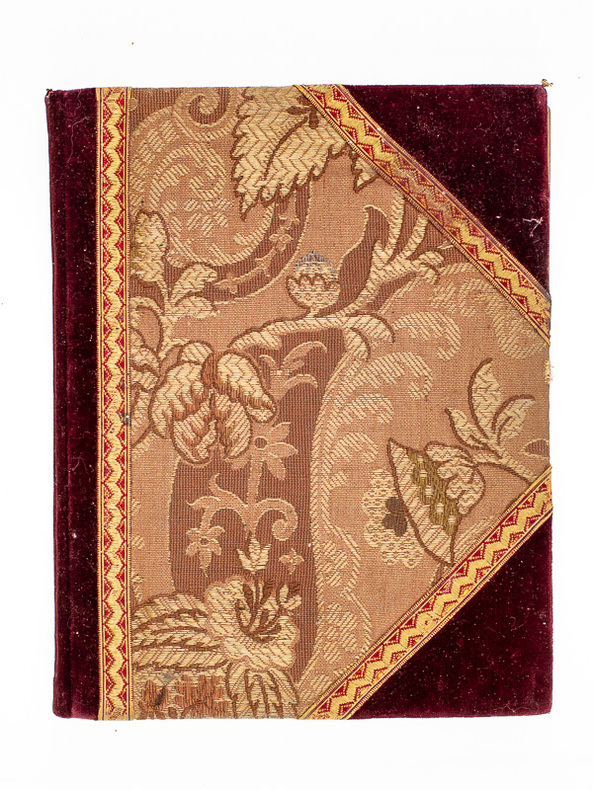
1898592991 cahier manuscrit recouvert de velours et tissu brodé, environ 90 feuillets et 5 faire-parts joints, s.d. [ circa 1890-1900 ]. Rappel du titre complet : Manuscrit [ Recueil de poésies et pièces diverses, dont copies de poèmes de Sully Prudhomme au verso de 5 faire-parts de mariage de Jeanne Geruzez, fille de Victor Geruzez, ami de Sully Prudhomme plus connu sous sous pseudonyme d'illustrateur : Crafty ]
1 cahier manuscrit recouvert de velours et tissu brodé, environ 90 feuillets et 5 faire-parts joints, s.d. [ circa 1890-1900 ]. Rappel du titre complet : Manuscrit [ Recueil de poésies et pièces diverses, dont copies de poèmes de Sully Prudhomme au verso de 5 faire-parts de mariage de Jeanne Geruzez, fille de Victor Geruzez, ami de Sully Prudhomme plus connu sous sous pseudonyme d'illustrateur : Crafty ] Le document est rendu très intéressant par la présence de 5 faire-parts du mariage de Jeanne Geruzez, fille de Victor Geruzez dit "Crafty" et Joseph Andlauer, chacun de ces faire-parts joints portant au verso la copie de poèmes de Sully Prudhomme, dont certains connus et publiés (ainsi "Hazards" ou "Songe d'Enfants" dédié à Mme G. [ Gabrielle ] Geruzez) mais il propose notamment un poème non intitulé et probablement inédit, dédié "A Jeanne Geruzez pour ses fiançailles", daté du 2 avril 1898 : "Jeanne, vois le printemps doucement radieux / Pas à pas revenir, réparateur fidèle / Il redresse le lys penché sur l'asphodèle / Il même la rosée à celle de tes yeux [ ... ]". Le cahier manuscrit recueille de nombreuses copies de poèmes (de Victor Hugo, Théodore de Banville, Musset, Casimir Delavigne, José Marie de Heredia, etc...), de textes historiques ou parfois scientifiques. Anonyme, le document peut-être très probablement attribué à un membre de la famille Géruzez. Eugène Geruzez, père de Crafty, était docteur es lettres et critique littéraire. Bon état Français
GF236231471 1 page et demi in-4 - Extrait daté du 7 février 1898 -
23749Petit In-8 Oblong 32 ff environ avec des cachets des différents états et duchés italiens avant l'unité italienne, et un tableau imprimé du Duché de Parme, une lettre à en tête de Théobald Rowland Garvey Bourke, gentilhomme de la chambre de sa majesté Danoise et chargé d'affaire de sa Majesté Britannique, une carte de séjour imprimée et signée du Préfet de Naples et enfin une vignette contrecollée médicale de la province de Milan ( Aucun signe de Choléra- Morbus )
179517327La Ciotat 1795 une page, format : 28 x 19 cm, écriture manuscrite à l'encre brune, sur papier velin ligné , orné du cachet de cire rouge du 1er bataillon de la charente "republique Française Indivisible" avec une représentation allégorique de la république au centre , 10 signatures manuscrite dont celles des Capitaines DUCOURET, et GREAU , La Ciotat, LE 11 PLUVIOSE AN 3 (30 Janvier 1795),
596847Décharges pour Jacques-René Acquet d'Hauteporte pour rentrer au Collège de la Flèche [produit contrat de mariage de Pierre Acquet, 1er janv. 1663 et transaction en date du 17 juil. 1679]. Signé Richemont, capitaine de dragons au régiment de Damas et chev. de St Louis. P., 8 mars 1771 et 2 avril 1773.
4to. Spanish manuscript on paper. 189 written pages on 97 ff. within black ink rules. Contemporary full leather binding over bevelled wooden boards, title and lyre design giltstamped to upper cover, Chilean arms to lower cover, floral ornamentation and title "Poesias" to spine. Gilt dentelle along bevelled outer as well as inner edges. All edges goffered and gilt. Dedication manuscript for Miss Teresa (Therese) Adametz, director of Santiago's pioneering teacher training college "Escuela Normal de Preceptoras" between 1885 and 1890. In 1910, the writer, educator and later Nobel laureate Gabriela Mistrál would receive her long-sought degree from this institution. - The volume constitutes an anthology of Chilean poetry, each section introduced by a brief outline of the life of the respective writer, including such poets as Eusebio Lillo, Isidoro Errázuriz, or Luis Rodriguez Velasco. Penned in fine and regular cursive calligraphy, with blackletter headlines decorated with ornamental penwork flourishes, this sumptuously bound volume was produced by the college's third class as a gift for the Silesian-born educator Adametz, formerly in charge of an Austrian girls' boarding school for the daughters of military officers (cf. Actividades femeninas en Chile [Santiago 1928], pp. 145f.). The dedicatory poem is signed "Rita Gomez Oviedo", while the final entry ("[L]a escuela qué goces") is signed "Pilar Montecinos C.". - An old stamped shelfmark "5.164" to the lower edge of the title-page. Beautifully preserved.
Deutsche Handschrift auf Papier. 23 SS. auf 14 Bll., halbbrüchig beschrieben. In originalem Papierumschlag mit kalligr. Titel. Lose Bögen. Kl.-Folio (225 x 286 mm). Interessante Kompilation von Erlassen und Dekreten, im wesentlichen betreffend den 1757 in den österreichischen Erblanden eingeführten "systemmäßigen Adel", ein Standesvorrecht, das bürgerlichen Offizieren unter bestimmten Bedingungen einen Rechtsanspruch auf Erhebung in den erblichen einfachen Adelsstand garantierte. - Das Dokument eröffnet mit einem "Vortrag des Directorii in Publicis et Cameralibus an Kais. Mar. Ther. v. 23. Okt. 1752": eine Vorlage zu der von Maria Theresia geforderten Beseitigung aller Unterschiede bei Nobilitationen und Standeserhöhungen zwischen den böhmischen und österreichischen Hofkanzleien, gegenseitiger Anerkennung ohne "der ehmals üblich gewesten neuerlichen Ansuch und Erlangung des selben respectu Standes" und Vereinheitlichung der dazu gebräuchlichen Siegel. Damit war eine wichtige Voraussetzung für die Einführung des systemmäßigen Adels geschaffen. Präsident des 1749 geschaffenen "Directorium in publicis et cameralibus", der Verwaltungsbehörde, die den erwähnten Hofkanzleien vorstand, war Friedrich Wilhelm von Haugwitz. Am 12. Jänner 1757 wurde der systemmäßige Adel per Allerhöchster Entschließung der Kaiserin eingeführt: "Laut Publikazion vom Jän 1757 hat M. Theresia aus allermildester Neigung für das Militär zu entschließen geruht, daß jede, Offiziere so auch von der Fortuna sein Aufkommen hat, nachdem er 30 Jahre gedient und seines Wohlverhaltens wegen von seinem vorgesetzten Kommandanten ein gutes Zeugnis beizubringen beizubringen vermag, auf Ansuchen das Ritterschaftsdiplom gratis ertheilt werden solle". - Bereits im April des Jahres erfolgten auf Anweisung des Hofkriegsrats erste Einschränkungen des Privilegs: "Im April 1757 wurde dieß dahin modifiziert, daß der erbländische Adel mit Nachsicht der Haupttaxe ertheilt werde, die Nebengebühren aber bezahlt werden sollen." Bis 1845 sind weitere Verschärfungen dokumentiert, aber auch Entscheidungen zur Form von Stammbäumen oder etwa die Festellung, dass "den Chefs der 2 Linien der fürstl. Familien Schönburg [...] und der 5 Linien der fürstl. Familien Salm" die Titulatur "Durchlaucht" gebührt (Hofkanzleidekret vom 4. Februar 1845). - Der Umschlag mit Einrissen, zwei Ausschnitten am Hinterdeckel und fleckig. Die Textseiten leicht gebräunt und minimal fleckig.
596844Décharge pour Mlle de Lantagnac pour rentrer à St Cyr. Signé Chabrol, Monaco, 29 août 1764, 3 pp. Autre décharge, signé Adhémar de Lantagnac, P., 14 février 1781 [contient la généalogie de Rose-Anne-Françoise d'Adhémar de Lantagnac, née le 13 janvier 1771, par d'Hozier]. Inventaire de titres, signé Albini, P., 12 juillet 1790, 2 pp. Notes de d'Hozier.
596848Lettre adressée à M. d'Hozier pour reprendre les titres confiés, signé Vigny, Paris, 11 mai 1772. Notes et signature de d'Hozier. - Décharge pour Auguste d'Adonville pour être reçu page à la Vénerie, Etampes, 8 avril 1781, signé d'Adonville et Bugros d'Arcy.
596849Décharge (imprimée) pour Gabrielle Jeanne Eléonore d'Aguisy, reçue dans la Maison Royale de St Louis et St Cyr, signé Montgarde, Paris, 21 aoust 1762. - Remise du contrat de mariage du 27 nov. 1777 et extrait baptistaire du 9 mai 1752, signé d'Aguisy, Paris, 1er mars 1784.
1914128321- Tapuscrit signé, corrigé à la main de la Préface du Poème du Coeur (1914) ; in-4, 6 ff. 2- Manuscrit de la Préface du Poème du Beaujolais ; in-4, 7 ff. 3- "Pierre Aguétant jugé par l'amie de Carmen Sylva" : tapuscrit signé, corrections autographes ; in-folio, 5 ff. 4- Tapuscrit signé "À ajouter à la Préface. Paris 25 février 1923" ; in-4, 2 pp. ; passages autographes signés. 5- Correspondance (15 pièces) avec Pierre Aguétant : L.A.S. et cartes postales de 1913 à fin 1925.