19 868 résultats
Latin document on vellum with plica. 34 lines, ruled in blind. Ca. 480 × 446 mm, carefully trimmed, with seal in dark brown wax, ca. 98 mm in diameter, fastened on a red silk cord drawn through three lozenge-shaped holes in the plica. 2 horizontal and 3 vertical folds; in excellent state of preservation. A severely rubbed dorsal inscription, probably dating from the 14th century (P[rivilegium] imp[er]iale sup[er] [?]), followed by additional early modern dorsal inscriptions (illegible). Stored in custom-made half morocco box. Extremely rare, exceptionally well preserved ceremonial document, lost since 1782. At the request of abbot Conrad, Emperor Frederick II confirms the privilege granted to St Paul's Abbey, Lavanttal, by his grandfather Frederick Barbarossa on 19 March 1170, in which the latter bestowed his protection on the monastery, awarding it sole tenure of Völkermarkt, and specifiying rules regarding the Abbey's stewardship and against enfeoffment. This privilege was intended to protect the economic power of the monastery from regional forces in the difficult times of the early 12th century. Frederick II confirms this privilege, additionally authorising the Abbey to use all silver, lead, and iron ore mines within its demesnes - a very important right in the Alpine area of the early 13th century. - This is a typical and perfect example of Frederick's ceremonial documents. Palaeographical analysis confirms that it is written by the scribe Iacobus de Catania, as Klaus Höflinger had long suspected without then having access to the original; several ornaments were clearly contributed by the notary Iohannes de Lauro, while other elements are the work of anonymous helpers in the chancery. The unambiguous identification of two principal chancery officials from the early years of Emperor Frederick II proves the document's authenticity, which is further underscored by the use of a seal typarium first attested in March 1226, probably created soon after the marriage between Frederick II and Isabella, heir to the Kingdom of Jerusalem, on 9 November 1225. Only the border of the seal has been chipped away on the left and bottom, but the inscription remains well legible in oblique lighting. The seal is thus one of the very earliest to name Frederick as King of Jerusalem. Frederick holds special relevance for the history of the Crusader state due to his Fifth Crusade, a venture undertaken without enthusiasm and brought to an end not by military means, but, uniquely, through a peace treaty with the Sultan in 1229. Only a very small number of well-preserved seals of Frederick survive from this period. In spite of its defects, this is one of the best early impressions of typarium 9. - The document was hitherto known only in two copies: in a notarial instrument from 1442 by the notary Urban Peinsteiner, issued at the orders of abbot Johann I Poschenbeuter (now in Vienna's Haus-, Hof- und Staatsarchiv), the Imperial confirmation privilege is inserted, together with a description of the seal, but it lacks the signum line as well as that of the inserted Barbarossa document. An original transumption for Ferdinand II from 1625 (in the archives of St. Paul's Abbey) cites both signum lines as well as the rulers' monograms. These copies are both based directly on the present original. - The document was missing without a trace at least since the monastery was dissolved by Emperor Joseph II in 1782/87. That this important document, preserved in such fine condition, has now resurfaced from a private collection is to be regarded as nothing less than a sensation: for decades no ceremonial diplomas by Emperor Frederick II have been seen on the market. The only other example, a ceremonial diploma by Frederick II, sold from the Adam collection by Tenner in 1980 (sale 126, lot 127: 19,000 German Marks, to H. P. Kraus), was in poor condition and lacked the seal. In similarly poor condition and also without the seal was the Frederick Barbarossa document which commanded 160,000 Swiss francs before premium and taxes at Stargardt's 2003 Basel sale (lot 30). The cataloguers were then able to trace in the previous century of trade no more than nine documents by any emperor from the Saxon to the Hohenstaufen period. - The present document has been examined by Professor Dr Mark Mersiowsky of the University of Stuttgart, editor of the documents of King Henry (VII), the son of Frederick II, for the Diplomata series of the MGH, and we are indebted to him for the description. Copy in notarial instrument of 1442 IV 6 (HHStA, AUR; olim: an. 1441 Lad. 27 Nr. 89). Copy in original transumption by Emperor Ferdinand II from 1625 VIII 1 in St. Paul's Stiftsarchiv (Carinthia). U 1092, fol. 9-13. - Schroll, UB St. Paul, p. 117f. no. 50. Winkelmann, Acta l, p. 249, no. 274. Mon. hist. ducatus Carinthiae IV/1, p. 153.f, no. 1902. DF. II. 1160 pp. 550-53. Böhmer, Reg. Imp. p. 131, no. 571. HB 2, p. 558. Ankershofen, in: AÖG 27, p. 170, no 274. Dobenecker, Reg. dipl. Thuringiae 2, p. 409, no. 2293. Clavadetscher, Chartularium Sangallense 3, p. 146 no. 1117. BFW 1600.
Small 4to (140 x 195 mm). 91 leaves, 149 written pages in two hands, the main body of the text complete, up to 29 lines per page, ruled space 85 x 155 mm. Incipit: "In nomine domini amen. Noch dem also gesprochen ist daß alle kunst kunftigk ist von got und ist by im on ende...". Rubrics touched in red, calligraphic initials in red and some with flourishing, 25 watercolour illustrations of scientific apparatus, 10 mathematical and architectural diagrams in pen. 15th century German calf over wooden boards, tooled in blind with vertical rows of hunting scenes within a triple-filet frame, remains of two fore-edge clasps. Stored in custom-made half morocco clamshell case. A Renaissance alchemist's handbook, quoting Al-Razi by name and deeply rooted in the Islamic tradition of alchemical art. An intriguing manuscript which bears witness to early practical chemistry in 15th century Germany and to the immense influence of Arabic alchemy, illustrated with talented watercolour diagrams of the associated apparatus. - Indeed, the word 'alchemy' itself is derived from the Arabic word 'al-kimia', and it was Al-Razi who claimed that "the study of philosophy could not be considered complete, and a learned man could not be called a philosopher, until he has succeeded in producing the alchemical transmutation". Alchemy and chemistry often overlapped in the early Islamic world, but "for many years Western scholars ignored Al-Razi's praise for alchemy, seeing alchemy instead as a pseudoscience, false in its purposes and fundamentally wrong in its methods, closer to magic and superstition than to the 'enlightened' sciences. Only in recent years have pioneering studies conducted by historians of science, philologists, and historians of the book demonstrated the importance of alchemical practices and discoveries in creating the foundations of modern chemistry" (Ferrario). The quest to transmute base metals into gold and to obtain the Philosophers' Stone was a practical as well as theoretical pursuit, as attested by the existence of this manuscript. The main body of the text opens on fol. 5 with an introduction to the art of alchemy, whose practice requires reference to the ancient authorities. Recipes for the various pigments, solutions, acids and alkalis are listed in groups, before descriptions are given of the planets relevant to the alchemist's art, starting with Saturn, and their effect on the elements, again with reference to the ancient authorities including Al-Razi, Origen, Aristotle, Albertus Magnus, and Hermes Trismegistus. There follow notes on the ease of obtaining various elements, before lists of alchemical compounds - including 'sal petri' and 'aqua lunaris' - are grouped according to their nature. Practical instructions, organised by chapter, begin on fol. 17v with the manufacture of vermillion and 'spangrün'; the first of the illustrations depicts two vessels for the burning of cinnabar. Further recipes involve the burning of various substances - illustrated with drawings of furnaces, cucurbits and other vessels, and distillation apparatus - before moving on to the manufacture of acids, bases and oils, mentioning the use of quicksilver, then, finally, turning to the manufacture of gold. The end of the text on fol. 69 is marked with the words 'Alchimia & Scientia' in red ink with calligraphic flourishes, above a floral device. - Collation: written by another scribe and bound before the alchemist's handbook (ff. 5-69) are astrological calculations, including those charting the trajectories of the Sun and the Moon (ff. 1-4, obviously incomplete). At the end, 9 leaves with geometrical calculations, illustrated with pen diagrams (ff. 70v-78, apparently incomplete, 2 leaves loose). The last 12 leaves are blanks (ff. 79-91). - Condition: The binding is sound and intact, but shows significant losses to the upper cover; spine entirely lost. Two leaves loose at the end of the manuscript, outer margins waterstained and tattered, surface soiling most notable to f. 1. Occasionally loose and split at gatherings; presence of bookworm damage on some pages; very occasional wax stains. - Provenance: 1) The script, watermark and binding indicate that the manuscript was made in Germany in the final two decades of the 15th century. The watermark visible on certain pages - a heart beneath a crown, above 'Ib' - is closest to a motif widely used in Germany around 1480-1500 (cf. Piccard 32464-32481), and the binding is contemporary. The pastedowns, taken from a Litany of Saints, are also roughly contemporary. 2) This compendium of cryptic knowledge seems to have lain undisturbed for many years after its compilation: the contemporary stamped leather binding is preserved and no booklabels or ownership inscriptions mark the manuscript changing hands. 3) Zisska & Schauer, 4 May 2010, lot 6. 4) Braunschweig Collection, Paris. - The first pigment recipe books in German would not be published until the 1530s (cf. Schießl, Die deutschsprachige Literatur zu Werkstoffen und Techniken der Malerei, 1989). While the manual at hand never appeared in print, a much later manuscript of the same text, apparently copied by no less an authority than the botanist Hieronymus Bock (1498-1554), survives in Heidelberg's University Library under the title of "Ordenlicher proces der waren alten heimlichen kunst der alchymey in drey bucher gestelt" ("Alchemistisches Kunstbuch", Cod. Pal. germ. 294, dated to the middle or third quarter of the 16th century). Unlike the vividly coloured and deftly shaded illustrations in the present volume from the 15th century, the unsophisticated pen drawings in the later Palatina manuscript were clearly executed by the scribe himself rather than by a trained artist. Also, our manual contains additional illustrations at the end, showing some of the most necessary equipment on a double-page spread, as well as five additional pages of recipes for "lutum sapientiae", "postulatz golt" etc., some parts written in a secret cipher, all of which are lacking from Bock's copy. - A unique survival: the Schoenberg Database of Manuscripts lists no more than eight 15th century German alchemy tracts in institutional possession worldwide. Schoenberg Database SDBM_177979. G. Ferrario, Al-Kimiya: Notes on Arabic Alchemy. In: Chemical Heritage, 25 (2007), 32ff.
Folio (242 x 340 mm). Latin manuscript on paper. 160 leaves (complete including four blank leaves at the beginning and six at the end). Written in brown ink in a neat humanistic hand, double columns, 37 lines to each page, numerous two and three line initials supplied in red or blue. With one large illuminated initial and coat of arms of the Scalamonte family flanked by floral decoration on first leaf, painted in shades of blue, green and lilac and heightened in burnished gold. With altogether 231 full-page tables in red and brown, some marginal or inter-columnar annotations, and one extended annotation on final leaf. Fifteenth century blind stamped goat skin over wooden boards, remains of clasps. The so-called "Toledan Tables" are astronomical tables used to predict the movements of the Sun, Moon and planets relative to the fixed stars. They were completed around the year 1080 at Toledo by a group of Arab astronomers, led by the mathematician and astronomer Al-Zarqali (known to the Western World as Arzachel), and were first updated in the 1270s, afterwards to be referred to as the "Alfonsine Tables of Toledo". Named after their sponsor King Alfonso X, it "is not surprising that" these tables "originated in Castile because Christians in the 13th century had easiest access there to the Arabic scientific material that had reached its highest scientific level in Muslim Spain or al-Andalus in the 11th century" (Goldstein 2003, 1). The Toledan Tables were undoubtedly the most widely used astronomical tables in medieval Latin astronomy, but it was Giovanni Bianchini whose rigorous mathematical approach made them available in a form that could finally be used by early modern astronomy. - Bianchini was in fact "the first mathematician in the West to use purely decimal tables" and decimal fractions (Feingold, 20) by applying with precision the tenth-century discoveries of the Arab mathematician Abu'l-Hasan al-Uqilidisi, which had been further developed in the Islamic world through the writings of Al-Kashi and others (cf. Rashed, 88 and 128ff.). Despite the fact that they had been widely discussed and applied in the Arab world throughout a period of five centuries, decimal fractions had never been used in the West until Bianchini availed himself of them for his trigonometric tables in the "Tabulae de motis planetarum". It is this very work in which he set out to achieve a correction of the Alfonsine Tables by those of Ptolemy. "Thorndike observes that historically, many have erred by neglecting, because of their difficulty, the Alfonsine Tables for longitude and the Ptolemaic for finding the latitude of the planets. Accordingly, in his Tables Bianchini has combined the conclusions, roots and movements of the planets by longitude of the Alfonsine Tables with the Ptolemaic for latitude" (Tomash, 141). - The importance of the present work, today regarded as representative of the scientific revolutions in practical mathematics and astronomy on the eve of the Age of Discovery, is underlined by the fact that it was not merely dedicated but also physically presented by the author to the Holy Roman Emperor Frederick II in person on the occasion of Frederick's visit to Ferrara. In return for his "Tabulae", a "book of practical astronomy, containing numbers representing predicted times and positions to be used by the emperor's […] astrologers in managing the future" (Westman, 10ff.), Bianchini was granted a title of nobility by the sovereign. - For Regiomontanus, who studied under Bianchini together with Peurbach, the author of the "Tabulae" counted as the greatest astronomer of all time, and to this day Bianchini's work is considered "the largest set of astronomical tables produced in the West before modern times" (Chabbas 2009, VIII). Even Copernicus, a century later, still depended on the "Tabulae" for planetary latitude (cf. Goldstein 2003, 573), which led to Al-Zarquali's Tables - transmitted in Bianchini's adaption - ultimately playing a part in one of the greatest revolutions in the history of science: the 16th century shift from geocentrism to the heliocentric model. - In the year 1495, some 20 years after our manuscript was written, Bianchini's Tables were printed for the first time, followed by editions in 1526 and 1563. Apart from these printed versions, quite a few manuscript copies of his work are known in western libraries - often comprising only the 231 full-page Tables but omitting the 68-page introductory matter explaining how they were calculated and meant to be used, which is present in our manuscript. Among the known manuscripts in public collections is one copied by Regiomontanus, and another written entirely in Copernicus's hand (underlining the significance of the Tables for the scientific revolution indicated above), but surprisingly not one has survived outside Europe. Indeed, the only U.S. copy recorded by Faye (cf. below) was the present manuscript, then in the collection of Robert Honeyman. There was not then, nor is there now, any copy of this manuscript in an American institution. Together with one other specimen in the Erwin Tomash Library, our manuscript is the only preserved manuscript witness for this "crucial text in the history of science" (Goldstein 2003, publisher's blurb) in private hands. Apart from these two examples, no manuscript version of Bianchini's "Tabulae" has ever shown up in the trade or at auctions (according to a census based on all accessible sources). - Condition: watermarks identifiable as Briquet 3387 (ecclesiastical hat, attested in Florence 1465) and 2667 (Basilisk, attested to Ferrara and Mantua 1447/1450). Early manuscript astronomical table for the year 1490 mounted onto lower pastedown. Minor waterstaining in initial leaves and a little worming at back, but generally clean and in a fine state of preservation. Italian binding sympathetically rebacked, edges of covers worn to wooden boards. A precious manuscript, complete and well preserved in its original, first binding. Provenance: 1) Written ca 1475 by Francesco da Quattro Castella (his entry on fol. 150v) for 2) Marco Antonio Scalamonte from the patrician family of Ancona, who became a senator in Rome in 1502 (his illuminated coat of arms on fol. 1r). 3) Later in an as yet unidentified 19th century collection of apparently considerable size (circular paper label on spine "S. III. NN. Blanchinus. MS.XV. fol. 43150"). 4) Robert Honeyman, Jr. (1928-1987), probably the most prominent U.S. collector of scientific books and manuscripts in the 20th century, who "had a particular interest in astronomy" (S. Horobin, 238), his shelf mark "Astronomy MS 1" on front pastedown. 5) Honeyman Collection of Scientific Books and Manuscripts, Part III, Sotheby's, London, Wed May 2, 1979, lot 1110, sold to 6) Alan Thomas (1911-1992), his catalogue 43.2 (1981), sold to 7) Hans Peter Kraus (1907-1988), sold to 8) UK private collection. Bernard R. Goldstein & José Chabas, 'Ptolemy, Bianchini and Copernicus: Tables for Planetary Latitudes,' Archive for the History of Exact Sciences, vol. 58, no. 5 (July 2004), pp. 553-573. Bernard R. Goldstein & José Chabas, Alfonsine Tables of Toledo (= Dordrecht-Boston-Londres, Kluwer Academic Publishers ("Archimedes, New Studies in the History and Philosophy of Science and Technology" 8), 2003. José Chabás & Bernard R. Goldstein, The Astronomical Tables of Giovanni Bianchini (Leiden & Boston: Brill, 2009). Thorndike, 'Giovanni Bianchini in Paris Mss,' Scripta Mathematica 16 (1950) 69ff. & his 'Giovanni Bianchini in Italian Mss.,' Scripta Mathematica 19 (1953) 5-17. Rashed, Development of Arabic Mathematics: Between Arithmetic and Algebra. Boston, 2013. Mordechai Feingold & Victor Navarro-Brotons, Universities and Science in the Early Modern Period. Boston 2006. R. Westman, Copernicus and the Astrologers. Smithsonian 2016. M. Williams, The Erwin Tomash Library on the History of Computing, 2008, 141. Simon Horobin & Linne Mooney, English Texts in Transition: A Festschrift Dedicated to Toshiyuki Takamiya on his 70th Birthday. Woodbridge 2014. Silvia Faschi, Prima e dopo la raccolta: diffusione e circolazione delle Satyrae, di Francesco Filelfo. Spunti dall' epistolario edito ed ineditio. In: Medioevo e Rinascimento. XIV, n.s. XI (2000), 147-166 (mentioning a connection between the Italian Humanist and Marco Antonio Scalamonte). C. U. Faye & W. H. Bond, Supplement to the Census of Medieval and Renaissance Manuscripts in the United States and Canada (1962), p. 21, no. 12 (this manuscript).
Oblong folio album (245 x 380 mm). 57 ff. 50 full-page pen and ink drawings of imaginary cities and their armies; 50 emblematic cartouches each containing an octave describing the opposite city, some with Latin mottos; dedication in ornamental border; allegorical cartouche with octave praising Venice on the verso. Contemporary red morocco with gilt triple fillets enclosing large oval centerpiece composed of double fllets in arabesque patterns with armorial shield, edges gilt. Stored in custom-made half morocco case. Unique album with splendid manuscript designs for imaginary fortified cities, created for and dedicated to Marino Grimani in the year of his appointment as Doge of the City and Republic of Venice, which he would reign over until his death. Grimani served as Superintendent of Fortresses before becoming Doge and worked for many years on the design and construction of the Palmanova fortress, the greatest of the Renaissance star forts and constantly embattled by the Ottomans as well as by other forces for centuries to come. Vericci's album constitutes a paragon of Renaissance idealism: a utopian vision which champions the might derived from pushing human genius to the limits of the imagination, combining mathematics, philosophy, and military prowess with art, poetry, and design. Little is known about the author-artist Marco Vericci, some of whose other ingenious military designs survive in the Biblioteca Bertoliana in Vicenza, but he may have worked with Grimani on the designs for Palmanova. Italian art historian Lionello Puppi has cautiously suggested that "Vericcius" may be a pseudonym of Fillipo Pigafetta, a Venetian soldier and mathematician who wrote extensively on military fortifications. In this album, Vericci illustrates and whimsically describes fifty imaginary cities whose designs are based on the utopian mathematical ideals of the Renaissance star fort. The cities, with names like "Mirabella", "Grimanopoli", and "Durissima", are situated in elaborate landscapes (almost all are island fortresses, like their model) and are rendered in exquisite detail. The octave opposite each illustration describes the strengths and virtues of each fantastical fortress in the vein of Italo Calvino's novel "Invisible Cities" - which also featured a litany of imaginary towns all reflective of La Serenissima herself. The last illustration but one depicts the 1571 Battle of Lepanto, a major naval victory by the Holy League over the Ottomans. The Palmanova fortress was dedicated exactly 22 years, to the day, after the battle - thus its inclusion here links the glory of Lepanto explicitly to the achievements of Doge Grimani, in addition to re-situating this imaginative work in its real-life context of simmering conflict not just between Europe and the Turks, but also between Venice and Austria - her enemy to the North. - Some light soiling and spotting; some early marginal repairs where ink has corroded the paper; traces of paste on first two leaves with loss to a few letters. Otherwise in excellent state of preservation and still in its richly gilt morocco binding commissioned for the Doge of Venice (his arms in the centre of the back cover rubbed). Manfredo Tafuri, Venice and the Renaissance (Boston: MIT Press, 1995). Lionello Puppi, Scrittori vicentini d'architettura del secolo XVI (Venice: Accademia Olimpica, 1973).
Large 8vo (ca. 140 x 203 mm). 105 ff. (without blank leaf 82), numbered in roman numerals, with 2 page-sized and 23 small miniatures as well as 3 large and 438 smaller initials, all in colours and gilt. Mostly 29 lines per page in an elegant black bastarda with red (and occasional gilt) headings and emphases; numerous rubrications and small initials in gilt on blue or red background. Leaves 101r-105r contain somewhat later additions in red and black ink; 2 unnumbered vellum leaves with a table of contents in red ink bound at the end (probably contemporaneous with the binding). Gatherings (ab8, c10, d-n8) and catchwords marked throughout by the scribe. Green satin binding, ca. 1550, with white silk pastedowns and vellum endpapers. All edges gilt. Stored in custom-made half morocco solander case. An uncommonly painstakingly prepared liturgical manuscript with remarkable illumination by the Parisian artist Jean Coene IV, known as the "Master of the Paris Entrances", probably commissioned for a nuns' order. Apart from the hundreds of initials, painted on gilt background and mostly decorated with flowers, berries, and leaves, the manuscript contains the following illustrations: folio 7v, St Jerome (28 x 30 mm); 19r, the Eucharist, with two nuns and a young clergyman in prayer at the bottom (148 x 102 mm); 20v, God enthroned, surrounded by the symbols of the four evangelists, a lower compartment showing 12 nuns and the same young clergyman in prayer (148 x 104 mm); 27r, Nativity (50 x 47 mm); 28v, Resurrection (37 x 34 mm); 29v, Assumption of Christ (42 x 46 mm); 40v, Madonna on a Crescent Moon (48 x 53 mm); 43v, the Virgin in the Temple (60 x 56 mm); 44v, Christ in the Temple (60 x 56 mm); 46r, Annunciation of Mary (41 x 43 mm); 48r, Visitation (65 x 53 mm); 49r Assumption of Mary (45 x 38 mm); 50v, God surrounded by the Saints (54 x 58 mm); 53v, John of Patmos (48 x 43 mm); 55r, St Benedict of Nursia (25 x 36 mm); 56r, St John the Baptist (48 x 45 mm); 57v, Mary Magdalene (44 x 39 mm); 59v, St Anne and the Virgin (45 x 44 mm); 62r, St Paul (28 x 29 mm); 64r, St Peter (23 x 24 mm); 74r, St Francis of Assisi (34 x 31 mm); 77v, St Adrian (28 x 30 mm); 78r, St Catherine and the Virgin (45 x 50 mm); 79r, Christ Crucified, with two saints (40 x 36 mm); 89r, a saint with a crozier and heart (23 x 23 mm). The miniatures are of exceptional quality throughout, showing delicate draughtsmanship and a stark but well-balanced colour palette. The emphasised name of St Dionysius (76rv) suggests that this splendid manuscript was commissioned by a Paris monastery, very possibly a Benedictine convent (as may be inferred from the illumination of this saint, fol. 55, as well as from the habit of the nuns depicted in the two page-sized and several of the smaller miniatures). The young male oblate seen in the two large illustrations is very likely a self-portrait by the artist. - Jean Coene IV was a Paris-based illuminator much in demand during the first two decades of the 16th century, a contemporary of the artist Jean Pichore, with whom he collaborated repeatedly. He is known as "Maître des Entrées parisiennes" for his series of illuminations prepared on the occasion of the entrances of Mary Tudor as wide of King Louis XII of France and of Claude de France as wife of François I. - Spine somewhat rubbed with light traces of worming. Folios 79v, 80 and 81 are numbered and ruled but remained blank (as was the lacking folio 82); tiny cuts in the vellum of ff. 83-85 bear witness to the knife that excised the preceding leaf. A very short repair to the edge of fol. 27, very occasional insignificant ink or paint smudges. A few quire signatures trimmed at the lower edge, but otherwise quite exceptionally well preserved with wide margins, clean and without any abrasions to the paint; the illuminations appear outstandingly crisp. We are indebted to Dr Isabelle Delaunay, Paris, for her help in identifying the artist. - Provenance: 1) likely Parisian Benedictine convent; 2) early note on the manuscript on verso of front flyleaf; 3) recto of front flyleaf inscribed by a royal official Coucault (?), dated Saumur, 2 Oct. 1706; 4) front pastedown has an old note of the acquisition price, as well as 5) the woodcut bookplate (printed in red) of the Belgian printer and art dealer Jean-Baptiste Verdussen (1698-1773), who collection was dispersed by sale in 1776; 6) sales notice clipped from 1951 Librairie Lardanchet catalogue tipped in to flyleaf; 7) last sold at Hartung & Hartung's sale 62 (1990), lot 16. For the artist cf. I. Delaunay, "Le Maître des entrées parisiennes", in: Art de l'enluminure 26 (Sept.-Nov. 2008), pp. 52-59, 62-69; for the identification with Jacques Coene cf. E. König, Cat. Tenschert 1997, pp. 306-309, 320, and M. Orth, Renaissance Manuscripts: The 16th Century (2015), cat. 19-22.
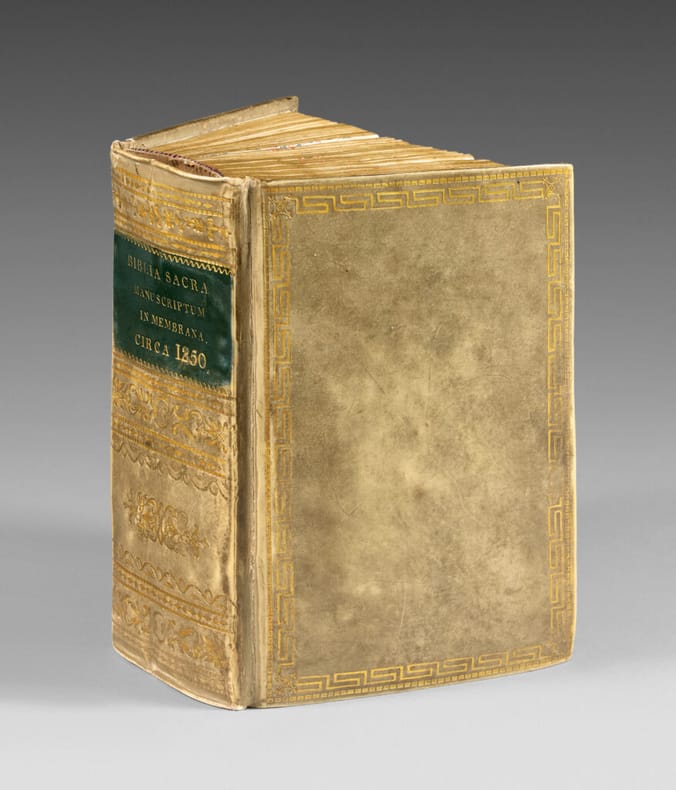
LCS-18358Un chef-d’œuvre de l’enluminure capétienne orné de 78 miniatures d’une finesse exquise réalisé sous le règne de Saint Louis. Bible en latin, avec le Prologue attribué à St Jérôme et l’interprétation des noms hébreux. Nord de la France, probablement Paris, 1230-1250. In-12 de 1 + 658 ff.: 1-1524, 1620, 17-2224, 2310, 24-2524, 2617 (sans le f. blanc xviii), 2726, 2828, 295 (sans le f. blanc vi). Ainsi complet. Double colonne de 47 lignes écrites à l’encre brune dans une très fine écriture gothique. Justification: 92 x 60 mm. 78 initiales historiées. Cahiers numérotés en chiffres romains au pied des versos des derniers ff. et signatures au pied du coin inférieur du texte sur chaque recto de la première moitié d’un cahier, rubriques en rouge, initiales en rouge, lettres des titres courants et numéros des chapitres alternativement en rouge ou bleu, initiales des chapitres sur 2 lignes alternativement en rouge ou bleu avec un décor de la couleur opposée, initiales de 5 à 7 lignes au début des prologues du même type mais avec des décors des deux couleurs ouvrant les prologues, 78 initiales historiées, la plupart ornées de feuillage et de dragons, le prolongement de 29 d’entre elles formant des bordures décorant la marge, peintes en bleu, rose, orange-rouge et jaune (qq. trous de vers ds. le premier f., atteinte à qq. titres courants, dernier f. restauré ds. la marge extérieure). Vélin rigide du XIXe siècle, encadrement d’une roulette grecque dorée autour des plats, dos lisse orné, pièce de titre de maroquin vert, tranches dorées. 140 x 93 mm.
4to (150 x 195 mm). 440 ff. (quires: a-f16, g18, h-x16, y12, zA-D16, E10; recent pencil foliation). 55 lines, 2 columns (written space ca. 75 x 125 mm). Miniscule gothic bookhand in blank ink; emphases in red, page captions, chapter numbers, rubrication and Lombardic initials in red and blue, numerous red and blue initials with elaborate penwork in complementary colours. 16th century auburn morocco on four raised double bands, gilt spine ornaments, both covers with fleurons to corners, multiple rules along the edges, and gilt coat of arms (quarterly, a goat rampant and a sheaf of corn; inescutcheon a lion rampant; not in Olivier), dated "1587" on upper cover. 4 modern cloth ties. Stored in custom-made half morocco case. A beautiful, complete mediaeval Bible written in a miniscule bookhand on extremely delicate vellum, probably copied in England or commissioned from there. As is common, the Bible is prefaced with the epistle of St Jerome to Paulinus (53: "Frater Ambrosius [...] moriturum", fols. 1r-3r), followed by Jerome's prologue to the Pentateuch ("Desiderii mei [...] in latinum eos transferre sermonem. Amen"); the text of Genesis begins on fol. 4r. The Second Book of Kings is followed by the Book of Isaiah (139v) and the Prophets; on fol. 227r follow the Book of Job and the Poetic Books; 287v ff. contain the Books of Chronicles and the historical books to 2 Maccabees; the New Testament begins on fol. 351r. - Some page headings and penwork flourishes slightly trimmed, still an uncommonly wide-margined specimen. Occasional flaws in the vellum were carefully avoided by the scribes. The margins contain numerous contemporary and later annotations in what appear to be four different hands (a number of which are also very slightly trimmed), some exceedingly delicate: one 8-line annotation measures no more than 10 mm! The early marginalia would appear to be in a 15th century English hand; at least one (at the lower edge of fol. 41v) is an extract from the Psalm commentary of the Yorkshire mystic Richard Rolle (d. 1349). Furthermore, the plummet lines along many of the earliest marginalia, but also the order of the Old Testament Books, uncommon for a French Bible, suggest an English provenance. As the continental hands of the later annotations show, the Bible must have reached France or Germany in the later 15th century. - Professional repairs to spine-ends and one corner of the fine Renaissance binding. First and last quires a little browned and dust-stained, very slight worming to beginning, occasional, largely insignificant waterstains to margins, a few edge cuts and cut-out sections in the blank margins. An old edge repair to fol. 155, fols. 310-323 as well as a few others more strongly browned and wrinkled, but generally in fine state of preservation. - Provenance: Karl & Faber, sale 81 (1962), no. 3.
4to (220 x 155 mm). Decorated Latin manuscript on vellum. i + 168 + i ff. (collation: 1-38, 47 [of 8, lacking i], 58, 67 [of 8, lacking viii], 7-128, 136, 14-178, 186, 191, 204, 21-228), with modern foliation in pencil. Central column of 20 lines in a late Carolingian hand, surrounding and interlinear gloss on ff. 1-139 in a minute script; no gloss on ff. 139v-152v; gloss on ff. 153-168v in a mid-13th-century hand. Ruled space 156 x 65 mm, versal initials alternately red and blue, running headers and rubrics in red, spaces left for decorated initials, remains of a large decorated initial in characteristic Limoges style of interlaced celtic design including a dragon and two eagles’ heads on fol. 1. Modern Romanesque imitation binding of dark red goatskin over wooden boards. A superb example of Limoges Romanesque manuscript production of the first half of the 12th century, written by Petrus del Casta for the Augustinian Abbey of St-Jean-de-Côle, containing one of the earliest surviving texts of the Glossa Ordinaria. - Petrus del Casta is known from the colophon in a Homilies on Ezechiel (ex Phillipps no. 934/2708, then Chester Beatty W MS 18, sold at Sotheby’s, 3 Dec. 1968, lot 4, to Maggs; subsequently Abbey Sale, 20 June 1978, lot 2976) and has been associated with at least three other splendid manuscripts of the period: the spectacular Limoges Missal (Paris, BnF, Mss. Latin 9438); a Bible at the Bibliothèque Mazarine (lat. I and II); and the Bible of Saint-Yrieix (Bibliothèque municipale de Saint-Yrieix, Ms. 1). According to Danielle Gaborit-Chopin, he may also have been an illuminator (see D. Gaborit, "Deux bibles limousines du début du XII siècle", Bulletin de la Société nationale des Antiquaires de France, 1970, pp. 197f.). - The Glossa Ordinaria was one of the great achievements of the early 12th century: a combination of the scriptural text interwoven with patristic and mediaeval commentaries used by students and teachers until the end of the Middle Ages, originally compiled under the direction of Anselm of Laon (d. 1117) and his brother Ralph, but gradually augmented over the decades that followed. This is therefore one of the earliest witnesses to the Glossa, found here in its unfinished state, extending throughout the Pauline Epistles, with the Canonical Epistles glossed in a contemporary but probably different hand as far as f. 138v and then stopping. - Contents: Pauline Epistles, glossed, ff. 1-131v (Rom f. 1, 1 Cor f. 25 [lacking opening], 2 Cor f. 47 [lacking opening], Gal f. 62v, Eph f. 70, Phil f. 78, Col f. 83v, 1 Thess f. 89, 2 Thess f. 94, 1 Tim f. 97, 2 Tim f. 103v, Tit f. 108v, Philem f. 111v, Heb f. 113); Catholic Epistles ff. 132-152v (James f. 132, 1 Pet f. 138v [lacking end], 2 Pet f. 140 [lacking beginning], 1 John f. 142, 2 John f. 148v, 3 John f. 149v, Jude f. 150v]; Apocalypse ff. 153-169v (lacking end). - Condition: first leaf fragmentary and opening leaves gnawed at edges, lacking leaves after ff. 24 and 46 with the opening of 1 Cor and 2 Cor, a gathering after f. 139, and a number of leaves at the end. Some wormholes, occasional marginal staining and natural flaws to the vellum, lower margin of f. 116 cropped without affecting text, else in good condition. - Provenance: this is one of an important group of manuscripts written in Limoges mainly by the scribe and illuminator Petrus del Casta for the Augustinian Abbey of St-Jean-de-Côle in Perigord, founded ca. 1083 by Raynaud, Bishop of Perigueux (1081-99). Sold at Christie's, 17 Nov. 1976, lot 366; subsequently Quaritch, 2005. C. de Hamel, Glossed Books of the Bible and the Origins of the Paris Booktrade (1984), pp. 4 and 15, with ill. plate 2.
20 x 65 cm. 314 sheets of heavy, multi-layered paper stained in blue over the whole area, varnished on the writing space, surrounded by a frame, within which are written 8 lines of approximately 80 characters in Tibetan uchen (dbu-can) script using gold ink. Each leaf written on both sides. Upper cover from another manuscript, in black ink; beneath a flap are 2 lines of very large script with the words "in the language of India". The first leaves of the manuscript contain 4, 5, 6 and 7 lines of script. Text is complete. A canonical Buddhist sutra and the central text of the Mahayana Prajnaparamita school. The present text is a Tibetan translation from the original Sanskrit, of which there are also Chinese, Korean, and Japanese translations. The "Perfection of Wisdom" sutra exists in a range of shorter and longer recensions, of which that in 8,000 lines is regarded as having been the source, since according to Buddhist belief, its precursor, no longer extant, in Buddhist Prakrit, the vernacular language actually spoken by the Buddha, transmitted the actual spoken words of the Buddha. This Sanskrit text was then expanded into versions in 10,000, 18,000, 25,000, and 100,000 lines or verses, for the advanced adepts who could appreciate detailed commentary, and on the other hand abbreviated to versions in 2,500, 700, 500, 300, 150 and 25 lines for those of lesser understanding. Modern scholarship considers that the text was elaborated by a series of additions to a small original core, not identical to any of the later 'short' versions, over the period from 50 to 700 CE. - The first Tibetan translation was made in around 850 CE and the second in 1020 CE. By this time the text had achieved its canonical form. Further comparison with the Sanskrit original and with additional Sanskrit manuscripts led to revisions of the Tibetan translation in 1030, 1075 and 1500. The Tibetan translation achieves a high level of understanding and accuracy and has been useful to modern scholars occupied in establishing and analysing the Sanskrit text. The whole range of Tibetan versions of the sutra on the "Perfection of Wisdom" has been edited, translated and commented on by Edward Conze. - The sutra recounts a debate at Rajagriha, on the Vulture Peak, where 1,250 Buddhist monks gathered to hear the Buddha. The other main speakers are the Buddha's disciples Subhuti, who puts forward the Prajnaparamita principles, and Sariputra, who puts forward the conservative views of those monks who are unable to follow these new developments. - While there is no colophon, this manuscript was almost certainly donated or sponsored by a lay person who hoped to win merit by financing the copying of the text. This manuscript is a superb example of Tibetan uchen (dbu-can) calligraphy produced during the 13th and 14th centuries. The text shows a few archaistic orthographic characteristics, such as the presence of the da-drag (the letter 'da' as a secondary suffix for some syllables), which suggest an early date, probably 13th or 14th century. - Although the manuscript is not illustrated, it displays some of the best uchen calligraphy produced in Tibet. The gold letters are pleasingly spaced and very exactly executed on the lustrous blue ground, which represent "the clear empty space, the void from which all things arise". - Some damage to the outer corners of the upper and lower 10-20 leaves. With very early marginal patches over tears from frequent turning of the pages. - Provenance: McCarthy Collection, Hong Kong, 2010-18. Previously in a UK private collection, UK, acquired in 1999.
Small 8vo (100 x 148 mm). Calligraphic manuscript on vellum and paper. 112 ff. with various blackletter scripts in black, silver and gold, all with a full borders of knotwork, interlaced and geometric designs. Prefatory calligraphic and micrographic leaves, incorporating hymns, prayers and Biblical texts, with 5 pages of intricate micrographic text. 2 blank but bordered leaves at the front and 5 at the end, monogrammed "IKR" at end of index. Contemporary green velvet over wooden boards with silver clasps. A splendid calligraphic manuscript on vellum and paper created for the 28-year-old Juliana of Hesse-Darmstadt (1606-59), countess of East Frisia, later in the collection of Victoria, Princess Royal, the eldest daughter of Queen Victoria and Albert of Saxe-Coburg. The micrographic text includes the liturgical calendar for 1634, the Psalms in mirror writing, verses in a maze-like composition, and an orb-shaped device. - Johannes Kirchring, one of the greatest 17th-century calligraphers, had settled in Oldenburg as early as 1592; he is last recorded in 1630 living with his son and successor, the painter and calligrapher Johannes Kirchring the Younger. The Kirchrings were superb exponents of the calligraphic skills developed in Germany during the 16th century, stimulated rather than extinguished by the demands of type design for printed books. Their micrography probably drew on the rich Jewish tradition of Bible decoration that was especially strong in Germany. Although Lutherans were not forbidden religious images, they shared with Judaism a great concern about the dangers of idolatry as well as great scholarly respect for the written word. Elaborate calligraphy and intricate micrography in elegant combinations of gold, silver and black were a splendid yet appropriate way of honouring the Word of God. - Another Lutheran Psalter, handwritten by Johannes Kirchring the Elder, was sold at Sotheby’s in 1994 and subsequently commanded £151,250 at Christie's in 2010 (The Arcana Collection Sale II, lot 18) - the only example ever to have been offered at auction. Apart from this, only four specimens of Kirchring's craft are known to exist, all in public collections (Stockholm Royal Library; Oldenburg State Museum; Halle University Library; Lübeck Municipal Library). A hymnal likely penned by Kirchring the younger in 1637 is known to have been owned by the brothers Grimm. - Provenance: dedicated by the artist to Princess Juliana of Hesse-Darmstadt, wife of Count Ulrich II of East Frisia. The 19th century front flyleaf bears the ink signature of Princess Victoria Adelaide Mary Louisa (1840-1901). Victoria, the eldest daughter of Queen Victoria and created Princess Royal in 1841, was German Empress and Queen of Prussia by marriage to German Emperor Frederick III and mother of German Emperor Wilhelm II. - In perfect condition.
- s.l. (Londres, Paris, Toulon...) 1791-1832, 12 000 feuillets de divers formats, en feuilles. - The Complete Archives of Louis, Chevalier de Sade 1791-1832 | ca 12,000 leaves | various format Unpublished political, scientific and historical archives The complete manuscript unpublished papers of Louis, Chevalier de Sade (1753-1832), author of the Lexicon politique and cousin of the famous Marquis. The important geopolitical, historical, and scientific archives of a learned aristocrat, a privileged witness of the end of the Ancien Régime, the French Revolution, the Consulate, Empire, and Restoration. A unique fund of research on the implementation of a constitutional monarchy. Exceptional collection of the Chevalier Louis de Sade's personal archives, the cousin of the Marquis de Sade, representing 12,000 handwritten pages, including several thousand unpublished and written by his hand. The Chevalier shows a thought system that he describes as «holistic,» including historical, political and scientific reflections. Louis, Chevalier de SADE If we take the French Revolution as the birth of an experiment, both secular and political, the Chevalier de Sade was without doubt one of its early critics. Not only of the Revolution, which had many other detractors, but of its political ideology, which would go on profoundly to impact the two hundred years that followed. What he calls «positive politics» is «based on reasoning and experience». «The theory did have some attractions for me; I studied it with care, I savored its principles. Now, I see their value only in terms of the impact of their implementation, what we've seen them produce in the peoples of which history has given me knowledge. This is my method; I know that it is, all in all, the opposite of the methods utilized by the men who have governed us and written our constitutions to this very day without deviation. This continuous divergence between what has been done and what should never have been done increased my confidence in the path to be followed and at the same time fortified my determination to keep to the views I had adopted, of judging laws by the historic consequences they entail rather than by the lyrical, supposedly conclusive, metaphysical arguments with which these innovators continually, and still to this day, assault us.» The Chevalier de Sade, who saw the world in terms of his own time and place, could be nothing other than a Royalist. There were practically no examples of democracy in the history known to the Chevalier, apart from the Classical democracies of Greece and Rome which had been experiments only in very elitist forms of democracy. These were very well known to this political scientist, whose papers contain 7,000 pages dedicated to the history of the Classical world. The republic ushered in by the Revolution, was more than just a political system - it was the realization of a philosophical political ideal. And while most of those opposed to the new regime saw in it above all a threat to their personal situations, their religious beliefs or even more simply their habits, the writings of the Chevalier de Sade show no such dogmatic influence; or at least, he never uses dogma to justify his arguments. Louis de Sade, a gentleman without a fortune and without significant ties, was conservative through philosophical and historical conviction and not out of interest. It is with this perfect intellectual honesty that he studies the essays, memoirs and political or theoretical works of his contemporaries. Running counter to Enlightenment thought, the Chevalier's view of society owed very little to philosophy. Though he puts together a serious theoretical history of the development of Man from the condition of «savages» to the forging of various societies, he does not posit Man's ideal nature, as some of his contemporaries did. Rather, the Chevalier examines the gap between nature and the civilized being without passing moral or philosophical judgment
Small folio (210 x 277 mm). Title, (14) ff. of contents, 187 numbered ff. (a total of 202 ff.) with 60 coloured illustrations (mainly full-page, 7 on large folding sheets). Italian manuscript on paper (watermark: a bird on 3 hillocks, Briquet 12,250 [ca. 1566-1583]). 16th century red morocco (possibly German) with gilt-stamped border fillets, cornerpieces and centrepiece (dated "1581" on upper cover), lacking ties. All edges gilt. Stored in modern slipcase. An unusual and attractive Italian Renaissance manuscript on the art of war, lavishly illustrated in colour and in a sumptuous contemporary binding. The text comprises eight chapters dealing with the duties of the captain, making gunpowder, siege-breaking devices, the deployment through artillery of artificial fire, smoke and poisonous fumes, the use of cannons, ballistics and artillerymen, and the logistics and practice of moving artillery and cavalry. - The title of the first chapter accords with that in an earlier manuscript in the Biblioteca Riccardiana in Florence (Ms 2525), "Il primo capo tratta universalmente dell'uffitio del capitano dell' Arteglieria, con che ordine, modo et diligenza egli habbia à procedure, ad ogni cosa appartinenti alla munitione dell' Artegl[eri]a et all' ufficio suo", dated ca. 1529-30 (cf. Mariano D'Ayala, Bibliografia militare-italiana [1854], p. 159). The third chapter contains illustrations of siege devices similar to those in Franz Helm's "Armamentarium Principale oder Kriegsmunition und Artillerey-Buch" (1625), which was originally written around 1530. - Some paper (and text) loss through oxidation of the ink, restored and silked. Rebacked, retaining part of the old spine, by Joseph William Zaehnsdorf in 1919, according to old pencil note on flyleaf. - Provenance: from the collection of Thomas Fremantle, 3rd Baron Cottesloe (1862-1956), commander of the Territorial Army and president of the Society for Army History Research. On a note pasted to the flyleaf, Cottesloe writes: "This was in the library of Wistow Hall, Leicester, during the lifetime of Sir Henry St John Halford Bt (1828-97) but nothing is known as to how or when it came there" (dated Wistow, September 1945).
Oblong folio (390 x 252 mm). 118 numbered ff. (but 115: ff. 96, 106, and 112 skipped). Calligraphic preface by Hörmannsperger, 58 full-page textile designs by the same, mostly in red, blue, green, and gilt (including one folded, double-page sized specimen and 4 ff. with 2 designs each), 7 splendid gouache washes raised in gilt and silver; bound in between these are a total of 52 engravings on 48 plates, all in splendid contemporary colour raised in gilt and silver. Contemp. marbled boards. Unique, museum-quality document of late Baroque craftsmanship among the urban Third Estate: apart from 58 meticulously executed textile designs, the album contains seven large-format gouaches showing the self-assured author practising his trade in his workshop, advertising and selling his wares to customers, as well as playing music and even bowling, but also attending the general meeting of the Viennese blanket makers. The engravings which Hörmannsperger inserted between his own works all show mundane subjects (dwarves, soldiers, caricatures, etc.): thus, his autograph textile designs and gouaches are interleaved with some of the rarest and most charming pieces produced by the 1720's Augsburg school of engraving. - The album is introduced by a self-portrait of the 26-year-old Hörmannsperger in his workshop (with his compass and one of the later-included textile designs lying on the table); on the opposite page he offers a brief preface to the volume: "for true art speaks for the master: here is a book, all mine, with many drawings, as they will be seen, all drawn by me, though I say so myself, with much time, labour, and trouble [...] I, Johann Frantz Hörmansperger" (transl.). The captions to the splendid gouaches prove the author's humour (sometimes bawdy) as well as a trait of surprising self-confidence. Pitching his self-plaited blanket to a female customer, he addresses her: "My dear lady, here's a fine blanket for you - you may well stretch yourself under this: one and a half ells wide and two in length; perfect for flipping over with your husband underneath" (transl., f. 84). Another image shows him selling saddlecloths to military officers ("we'll have these and take them into battle", f. 86); yet another shows him bowling in a Baroque garden at the weekend ("All gay and jolly, for we are journeymen of the trade: and so the virgins may be; they will not be bored - here is red wine and white, so well we may make merry", f. 94) and dancing ("Be merry all. Musicians play! Thus do the blanket makers frolic and dance with pretty girls until their shoes may fall to pieces", f. 104). The final leaf shows an apprentice received into the society of blanket makers at their quarterly general assembly ("The blanket makers convene today to discuss what concerns the society: the young man must have learned his trade; he is not too tall nor too small. But he must put in his time, until he is made a journeyman", f. 118). Some of Hörmannsperger's ornamental designs, created with the use of a compass, include centerpieces showing armorial or figural motifs; one design (f. 113) is apparently a commission for Emperor Charles VI (bearing his monogram and Imperial insignia); according to the later caption, it was indeed executed for him. - Between his own works Hörmannsperger bound engravings by the great Augsburg masters of his age, all splendidly coloured and raised in gilt and silver: eight engravings from Elias Bäck's dwarf series (fencing school, drinking, gluttony, and tobacco addiction), a complete cycle of the seasons and the life stages of man by Martin Engelbrecht ("Der Menschen Jahr Veränderung"), a total of 19 of the famous engravings by Pfeffel, Schmidt, and Engelbrecht showing a soldier's life (two with movable parts), as well as a fine broadsheet by Albrecht Schmidt showing the seven Honest Swabians, and finally an untitled eight-page cycle showing the female tempers. - The Austrian and especially the Viennese bedclothes were known for their high quality throughout the continent. During their golden age in the 18th century they were exported to all European courts, as well as to Greece, Turkey, and many oriental countries. At the time this album was drawn up, there were ten masters of the profession in Vienna alone creating blankets and mattresses as well as backpacks and cuirasses. - Provenance: acquired in 1893 "from Mr Josef Lang's son-in-law" by the bedclothes merchant Josef Pauly, supplier to the Royal and Imperial court, and passed on by him to Mr. Junghofer, chairman of the bedclothes makers' cooperative, in 1896 (cf. Pauly's autograph dedication note on the flyleaf); last in an Austrian private collection. Boards imperceptibly restored at lower spine end; interior slightly fingerstained; slight tears to two leaves, but in excellent state of preservation altogether.
8vo (190 x 133 mm). Latin manuscript (lettre batarde) on vellum. 2 columns, 25 lines. 70 (instead of 74) ff., with 2 ff. of flyleaves at beginning and end each. Floral borders in colours and gilt; ornamental initials; 10 (instead of 14?) illuminated pages. 16th century calf with gilt double cover rules and central oval stamps (upper cover: crucifixion; lower cover: annunciation). Splendidly illuminated Northern French Book of Hours on vellum. The nearly full-page miniatures (ca. 110 x 80 mm) show extended landscapes as well as interiors, comprising: fol. 14r, Annunciation (at the beginning of the matin of the Office of Mary); fol. 20r, Visitation (Lauds); fol. 26r, Crucifixion (Hours of the Cross); fol. 27r, Pentecost (Hours of the Holy Spirit); fol. 31r, Adoration (Sext), fol. 33r, Presentation at the Temple (None); fol. 35r, Flight into Egypt (Vespers); fol. 38, Coronation of Mary (Compline); fol. 41v, King David in prayer (Penitential Psalms); fol. 50v, Job (Office of the Dead). Wants 4 leaves: before fol. 7 (Gospel lections), before fols. 28 & 30 (Prime and Terce in the Office of Mary), and before fol. 65 (beginning of a prayer to the Blessed Virgin). The finely gilt accents on the figures' clothing are typical of the French book illumination of the period. The borders (on all sides of the first calendar page and surrounding the miniatures, otherwise only to the outside of the text) show characteristically elongated, light brown and blue tendril leaves as well as blossoms and fruits (mainly strawberries and oblong red blossoms) within light brown compartments. The various prayers and lections have small coloured initials; final paragraph lines are completed with red and blue bars bearing gilt decoration. - The localisation of this Book of Hours is conclusively demonstrated by the original note on fol. 13r: "Hore beate Marie virginis secundum usum Rothomagansem" (i.e., Rouen in Normandy). Liturgically of high importance is the calendar (fols. 1r-6v), written in French: the entries are alternately in red and blue, feasts are emphasized in gilt. Names include St Martialis, bishop of Limoges, celebrated in Rouen on 3 July and also prominently mentioned in the litany; St Romanus, bishop of Rouen (23 October); and other bishops of Rouen, such as Ansbertus (9 February), Hugo (9 April), Mellonus (22 October), and numerous saints typical for the region, some of which reappear in the litany (fols. 47v-50r). - The localisation is supported by the art-historical evidence: the tendril forms were developed in Rouen around 1460 by the "maître de l’échevinage", and his highly productive workshop continued the tradition until the 16th century. The compositions and their arched top borders further support this attribution. The date is suggested by the lack of bars in the borders, such as are typical of workshop's ornamentation as late as in the third quarter of the 15th century, and on the other hand by the unadulterated Gothic character of the illumination, which in Rouen tends to give way to Renaissance motifs even in the late 15th century. - Provenance: 16th century old French entries on fol. 70v, concerning the birth of several children of the book's owner. The first entry mentions a fourth son, Pierre, born on 13 May 1563; by 1570 he is followed by four more children who were apparently entered immediately after their birth. While the family's name is not stated, it might be identified from the names of the godparents. An added prayer entered on fol. 13v appears nearly contemporary with these notes. - Occasional very insignificant paint smudges and offsetting to opposite pages with a few very minor stains. Altogether in fine state of preservation.
8vo (120 x 162 mm). Armenian manuscript on polished laid paper. 261 leaves, 25 lines of Armenian calligraphy in black ink, 2 columns, capitals in red. With a full-page colour frontispiece illustration of an evangelist, 3 finely illuminated chapter heads, and numerous marginal illuminations, some in the form of birds. Later foliation in pencil. Contemporary full leather binding over wooden boards, lacking the metal applications formerly applied to the covers. Well preserved, uncommonly pretty Armenian Gospel manuscript with Persian provenance. The charming illumination is directly comparable to that of a religious manuscript in the National Library of Armenia, dated 1740 (Matenadaran 101, cf. Stone/Kouymjian/Lehmann, pp. 468f.). Although the style emerges as early as the 14th century and finds its full expression between the 15th and the 17th century (cf. ibid., nos. 109, 121, 157 and 167), the colour palette, the details of the marginal palmettes and also the type of paper used place our manuscript in the early 18th century. - The numerous bird-shaped initials contribute to the complexity and luxurious effect of the illuminations. In the lower margin of the frontispiece showing an Evangelist, apparently St Matthew, an invocation inscribed in Persian ("in the name of the Father, the Son and the Holy Spirit") suggests that the manuscript belonged to an Armenian from Iran. A Gospel Book in the collections of the Armenian Patriarchate in Istanbul shows the same arrangement of a painting of St. Matthew illustrating the beginning of the text (APIP33). - A few edge tears, chips and other flaws with a few minor instances of loss (fols. 14, 82, etc.); occasional light stains. Binding rubbed; fore-edge flap preserved in fragments. A semé of holes in the upper cover (as well as few additional holes in the lower cover) give evidence of a once-elaborate decoration of metal bosses that has not survived. Cf. Michael E. Stone / Dickran Kouymjian / Henning Lehmann, Album of Armenian Paleography (Copenhagen, 2002), no. 176, pp. 468 ff.
179167693s. l. (Londres, Paris, Toulon...) 1791-1832 | 12000 feuillets de divers formats | en feuilles
Small folio (ca. 235 x 306 mm). Latin manuscript (bastarda in black ink) on paper. (4 blank), 365 numbered, (6 blank) ff. (fol. 37 vacat; contemporary ms. foliation continued 366-370). With 16 pretty four-line initials in colour and gilt and numerous red (and occasional blue) lombardic initials; partly rubricated and with red marginalia. Contemporary blindstamped pigskin over wooden boards, signed by the Vienna bookbinder Mathias, preserving 3 of the original 10 brass bosses, 7 of the 8 leading edge fittings, and both catch plates on the upper cover, as well as the original straps, ruled in blind. Crenellated spine-ends. Extensive collection of mostly late sermons by the versatile Austrian theologian Thomas Ebendorfer from Haselbach near Korneuburg, who is best remembered for his "Cronica Austrie" and who long served as professor as well as variously as dean and rector of the University of Vienna. All writings here present are also to be found (in a slightly different order) in the Vienna manuscript Cod. 4041, in the author's own hand. They comprise on the one hand the fairy widely copied "Sermones de confessione" (a series of eight sermons) in Ebendorfer's revised version from 1447, and on the other a set of 25 treatises collected under the title "Poenitentiale", which focuses on penitence and repentance, reparation, debt, usury, pledges, testaments, and related subjects (1456-1461). According to Lhotsky this latter collection does not appear to have been widely disseminated beyond the author's original manuscript: although we have been able to trace individual parts in other codices (Eichstätt University Library, Cod. st 761: Lhotsky 134, 110, 102, 111, 112, 132, 133; Vienna, Schottenstift, Cod. 387: Lhotsky 110, 102, 111), this series was obviously copied very rarely, and the only other known similarly complete transmission remains the autograph in the Austrian National Library. Contains individually: - 1r: Collationes de ieiunio (Lhotsky 134), nine sermons; followed by a poem (36vb) "Gloria, laus et honor ... Apicum hic scriptor quem Haselpach vexit ad ortum ut prece placatus sit deus ipse pius" (Lhotsky 136); the remainder of the column as well as the entire leaf 37 are left blank. - 38r: Tractatus de contritione (Lhotsky 110, inc. "Ait dominus per prophetam", but the painted initial "S" corrupts this to "Sit ..."); interrupted on 42va (with a marginal note "hic non est defectus") and continued on 43ra; an oblong 8vo leaf written on both sides in a different hand, bound before 72r, contains inserted text; expl. 82va "... suo pondere ad aliud trahit. Sic est finis huius primae partis". - 82rb: Collationes de confessione (Lhotsky 102), inc. "Ecce nunc tempus"; expl. 135va "Expliciunt collationes Mgri Thomae d'Haslpach De confessione". - 135vb: De satisfactione (Lhotsky 111), ten sermons; inc. "Reddite ergo omnes debita. Ita hortatur". - 180rb: Tractatus specialis de restitutione que est pars satisfactionis (Lhotsky 112), inc. "Reddite omnibus debita. Ita praecipit". - 185ra: Sermo secundus de restitutione (Lhotsky 113). - 190ra: De restitutione rapine (Lhotsky 114). - 196ra: De contractibus emptionis (Lhotsky 115). - 207rb: De mutuo faciendo (Lhotsky 116). - 212vb: De usura et iudeis (Lhotsky 117). - 218vb: De usura (Lhotsky 118). - 224rb: Collatio tertia de usuris (Lhotsky 119). - 232rb: Collatio de restitutione usuarum (Lhotsky 120). - 238ra: Collatio secunda de restitutione usure (Lhotsky 121). - 243rb: Collatio de restitutio pignorum (Lhotsky 122). - 247rb: Sermo de solutionibus debitorum (Lhotsky 123). - 251va: De restitutione vinctorum (Lhotsky 124). - 255va: De testamentis (Lhotsky 125). - 260va: De locatione et conductione (Lhotsky 126). - 264rb: De comodato (Lhotsky 127). - 266va: De custodiendo et servando deposito (Lhotsky 128). - 271ra: De restitutione dampnificancium in corpore proximum (Lhotsky 129). - 276rb: De restitutione dampnificatorum in bonis anime (Lhotsky 130). - 281va: Collatio de restitutione fame ablate (Lhotsky 131). - 286ra: Collationes de elemosina (Lhotsky 132), seven sermons. - 315ra: Collationes de oratione (Lhotsky 133), eleven sermons; dated "1460" in the margin of 329v; expl. 365rb: "Et sic est finis illarum collationum". - Of the 26 individual chapters, no fewer than 16 are decorated with small, but quite meticulous initials in colours and gilt, while the others have lombardic initials. Bound in an attractive, immediately contemporary Gothic pigskin binding by the Viennese bookbinder Mathias, exhibiting the typical features of his mature work. "Mathias is foremost among Vienna's bookbinders of the Gothic period; his name is known from the scroll stamp he used. He was active from about 1450 to 1474. It was he who created the classic Viennese binding style that was to be much imitated but never replicated [...] Several books bearing Mathias's stamps were bound for Emperor Frederick III [...] His craft reached its first peak around the year 1460" (cf. H. Kühnel, Ausstellung Gotik in Österreich, Krems 1967, p. 265). - Of the original five brass bosses to each of the covers, the present volume wants three on the upper and four on the lower cover, as well as the brass clasps. Insignificant worming to lower and tiny chafe marks to upper cover. Front hinge starting at top. Several additions and insertions in the margins and on extra leaf in a different contemporary hand; numerous manicules. Small traces of worming to the upper corner of fols. 217-229, occasionally just touching foliation. - Provenance: from the library of the Servite Order in Vienna's Rossau suburb with their 18th century engraved bookplate on the front pastedown and a smaller version thereof, as well as a faded stamp, on the first page; handwritten shelfmark "MS 73" (olim: 30); traces of an additional stamp on the front pastedown. A splendid Viennese codex containing writings by one of the great Viennese scholars of the late Middle Ages, in an original binding by the leading Viennese bookbinder of the Gothic period. A. Lhotsky, Thomas Ebendorfer: ein österreichischer Geschichtschreiber, Theologe und Diplomat des 15. Jahrhunderts (Stuttgart 1957), nos. 102, 110-134, 136. - For the binding: Kyriss K 51; Schunke, Schwenke-Slg. II, 283; Einbanddatenbank w000166; Mazal, Europ. Einbandkunst, no. 29.
Folio (240 x 355 mm). Italian and occasionally Latin manuscript by several hands, brown ink on paper. 198 numbered ff. With numerous, mostly full-page sketches, genealogical trees, and architectural drawings, some with touches of colour. Contemporary limp vellum with fore-edge flap, ruled in blind; handwritten title to spine and upper cover. Stored in modern half cloth box. Hitherto unknown, unpublished chronicle of the Gritti, a Venetian Doge family, containing a genealogy, account book, and lists of building projects from ca. 1566 to 1680. - The most famous representative of the family, which can be traced back as far as the 13th century, was probably Andrea Gritti (1455-1538), the 77th Doge of Venice. Their rise to fame and immense fortune is mostly due to the achievements of the ancestor of the very branch of the family commemorated here, namely Ludovico Alvise Gritti (1480-1534), who was closely involved in the fate of the city republic as a merchant, banker, and politician. Alvise Gritti had important trade connections throughout Ottoman Hungary and the Orient; as a minister under Sultan Suleyman I (1494-96) he worked in Istanbul, reporting directly to the Grand Vizier of the Ottoman Empire, Makbul Ibrahim Pascha (1493-1536). From 1530 to 1534 he served as Imperial Regent of Hungary. - The manuscript begins with an "arbor consanguinitatis" of the Gritti, starting in 1539 with Alvise's son Domenico Gritti di S. Marcuola and reaching as far as the fifth generation; additional descendants were pencilled in by later members of the family who inherited the volume and later consigned it to the trade. This is followed by numerous copies of relevant documents, often with a small sketch of the seal. Entries pertain to births and baptisms ("fede di Battesimo della Signora Sulpicia") with copies of the certificates, marriage documents ("copia del Sposalizio della Signora Orsetta Menegalla con il N. H. S. Antonio Gritti ... 3 Agosto 1623"), claims of ownership, purchases ("segue la nota dei beni", "divisione delli beni, et heredità ... dalla Signora Contessa Galeazzo"; "scriture per l'acquisto della casa in corte della calla"), gifts and bequests of moveables and immoveable properties as well as estates: "In Dei Eterni Nomine Amen. Anno ab Incarnatione D.N.J.C. 1675 in die xiii. die vero veneris 5. Aprilis. Patrone il S. H. E. Ottavian Gritti ... che qui sotto volerà esser referto de Sc[udi] 50 d'entrata annua perpetua sopra una casa posta in questa Città". Also mentions commissions for villas in Veneta awarded to important architects: "In Christi Nomine Amen. Anno 1543 12 Maji Gritti, Procurator d. Marei Ven., ... constitutus de D. ... Sansovino Architectus con sua fabbrica in Villa di Cessalto..., Villa Albarella...". Leaf 115v contains another family tree ("Vitturi") from Daniel to Domenico and Isabetta Gritti and onwards to the tenth generation. - Binding a little duststained, rubbed and bumped; vellum covers splitting along the edges. A large flaw to the upper cover as a result of the fastener for the flap's tie having been torn out. A unique survival.
8vo (157 x 105 mm). Decorated Latin and German manuscript on paper by two hands. (115) ff. (collation: 18 [of 10, i and x cancelled blanks], 27 [of 8, lacking ii], 37 [of 8, lacking ii], 46 [of 8, lacking ii and vi], 58 [of 10, lacking iii and x], 66 [of 8, lacking ii and vi], 76 [of 8, lacking ii and vi], 86 [of 8, lacking ii and vi], 96 [of 8, lacking ii and vi], 106 [of 8, lacking ii and vi], 116 [of 8, lacking iii and viii], 127 [of 8, lacking vi], 137 [of 8, lacking iv], 147 [of 8, lacking ii], 150-178, 186 [of 8, vii and viii cancelled blanks], with modern foliation in pencil (ff. 1-87): the earlier 16th century section ff. 1-86 with 17-20 lines of text, large initials and rubrics in red, capitals touched in red; the later German section with 18-19 lines of text, one full-page illustration for the Rosarium philosophorum. Contemporary blind-stamped calf. Worn and cracked, especially on spine. This fascinating alchemical miscellany, compiled by the Tyrolean alchemist and humanist Michael Cochem in 1529, includes the earliest dated manuscript witness to the famous Rosarium philosophorum, an alchemical florilegium that was falsely attributed to the mediaeval physician Arnaldus de Villanova (ca. 1240-1311). - The compendium comprises: Lapis philosophorum, or Lapis hic ph[ilosoph]orum vere, incipit: "Si felicitari desideras ut benediction[n]em ph[ilosoph]or[um] obtineas [...]" ff. 1-1v; Arnaldus de Villanova, Epi[isto]la Arnoldi de novavilla ad rege[m] Neapolitanu[m], incipit: "Scias o tu rex q[uod] sapie[n]tes posueru[n]t" ff. 2-7; blanks ff. 8-9; Pseudo-Arnaldus de Villanova, Rosarium philosophorum, here "Rosella Philosophorum", incipit: "Qui desidera[n]t artis phi[losophi]ce scie[ntie] maioris cognition[n]em" ff. 10-83v; blanks ff. 84-86. - The later German manuscript is an alchemical treatise with chapters on the preparation of the Philosophers' Stone from antimony (f. 87), on the calcination of lead (91v), the extraction of Cypriot sugar (f. 92), its purification (f. 93) and fixation (f. 96v), incineration (f. 104v), trituration (the reduction of substances to a powder) and projection (in which the stone or elixir is tossed upon the molten base metal, here lead or tin, to transmute it). - The text of the Rosarium in the present manuscript matches the famous florilegium traditionally attributed to Arnaldus de Villanova (cf. an unillustrated copy in the National Library of Israel, Ms. Ed. 13, dated to the first half of the 16th century). Describing the preparation of the Philosophers' Stone, the text would provide the foundation for the hugely influential 1550 Frankfurt publication of the Rosarium Philosophorum in "De Alchimia Opuscula complura veterum philosophorum". The canonical illustrations of the Rosarium that are best known in the form of 20 woodcuts from the 1550 edition appeared in various alchemical works throughout the 15th and 16th centuries. The only surviving illustration in the present manuscript on f. 13 is an exquisite example of the alchemical fountain, the first illustration of the Rosarium. Framed by the the six-pointed star, the Sun and Moon, and the two-headed dragon, the fountain pours forth the three substances that supposedly flow from the centre of the soul: "Lac Virginis" (the Virgin's milk), "Acetum fontis" (the spring of vinegar,) and "Aqua Vitae" (the water of life). The confluence of these liquids that symbolize the male and female, solar and lunar forces, in the fountain's basin creates the water of Mercury that is central to all further stages of the alchemical process described in the text. - Provenance: 1) Michael Cochem, 16th century humanist and alchemist, his autograph colophon on f. 83v: "Explicit libello Rosella ph[ilosoph]orum i[n]titulata. Et unum per me Michaele[m] Coche[m] collectus atque appositus. Et scripta anno salute hu[m]ane 1529 Lucie virginis. De quo sit b[e]n[e]dicta s[an]cta dei t[ri]nitas. Amen. Amen". Little is known about Cochem, but a small number of alchemical texts datable from 1522-33 written and owned by him can be found in St Gallen (Kantonsbibliothek Vadiana, MSS 403 and 430), and it is from one of those manuscripts that we know he was from Schwaz, Austrian Tyrol; 2) B. Magnus Fässle of the Benedictine Abbey of Monte Maria (Marienberg), near Malles, in Val Venosta, Italy, with his ownership inscription on f. 1: "Possessor B. Magnus Fässle Profess[us] Marie Montensis in Tyroli Ord. S. Benedicti, 1600". For Cochem cf. U. Gantenbein, Das Kunstbuch des Michael Cochem [Ms. Vadiana 407] aus dem Jahr 1522. Seine Bedeutung für die medizinische Alchemie, in: Mitteilungen der Fachgruppe Geschichte der Chemie der Gesellschaft Deutscher Chemiker 15 (2000), pp. 32-61.
18701029131870] 1 vol. relié in-8, plein maroquin vert sombre, dos à nerfs, doubles filets à froid en encadrement des caissons et des plats, portrait émaillé en médaillon par Claudius Poleplin encastré dans le plat supérieur, dentelle intérieure à froid, tranches dorées (Lortic Frères). Emouvant reliquaire établi en hommage à Jules de Goncourt, avec cette note autographe signée d'Edmond en exergue : "Cette nécrologie de mon frère contient les lettres qui m’ont été adressées après sa mort : les lettres de Victor Hugo, de Michelet, de George Sand, de Flaubert, de Berthelot, de Renan, de Taine, de Banville, de Zola, etc, de Seymour Haden, le grand aquafortiste anglais qui appréciait et vantait les eaux-fortes de mon frère. Et ces lettres sont accompagnées de tous les articles de quelque importance qui ont été publiés dans les journaux français." A l'encre rouge, il précise que l'émail de Claudius Popelin qui décore la reliure porte au dos "à mon ami Ed. de Goncourt, j'ai fait l'image de son frère Jules, en témoignage de vive affection". En regard de la page de titre écrite à la plume, est contrecollé un portrait gravé de Jules par Rajon. Viennent ensuite, montées sur onglet, les 14 lettres autographes signées des auteurs cités au titre, chacune précédée d'un feuillet de légende sur lequel Edmond a écrit à l'encre rouge le nom de l'expéditeur et la date. Edmond a enrichi ses courriers de nombreux articles de journaux de Théophile Gautier, Yriarte, Théodore de Banville, Charles Monselet, Philippe Burty, Ernest d’Hervilly, Jules Claretie, Zola, Asselineau, etc., tous contrecollés sur feuillets à la suite des lettres.Cet exemplaire unique que mentionne le journal en date du 16 novembre 1874 et du 14 décembre 1894 est décrit dans la plupart des ouvrages consacrés aux Goncourt, et notamment par Christian Galantaris (Deux cents portraits des Goncourt, n°102) qui précise son cheminement, de libraires en amateurs, depuis la vente publique de 1897.Ces témoignages d'affection débordent d'empathie à l'égard du frère survivant : — "Une cordiale et douloureuse poignée de main, mon pauvre enfant ! Aurez-vous du courage ? Oui, si votre vie est la continuation des travaux entrepris avec lui, aimés et désirés par lui." (George Sand). — "Mon cher Edmond, envoyez-moi à Croisset de vos nouvelles. Je pense plus souvent à vous que vous ne le croyez peut-être, & je vous plains comme je vous aime, c’est-à-dire profondément." (Flaubert). — "Quelle affreuse chose que la mort et quelle triste chose que la vie ! Je ne vous propose rien ; mais sachez que vous pouvez regarder ma maison comme la vôtre." (princesse Mathilde). La lettre de Victor Hugo, qui s'adresse à son "cher confrère", est particulièrement émouvante. "Pourquoi vous écrire ? Pour vous dire qu’on souffre avec vous. Car au-delà de ce partage de la douleur, il n’y a rien de possible, et toute consolation échoue. Vous avez perdu votre compagnon dans la vie, votre soutien dans cette charge pesante à porter, la renommée, votre ami au milieu des ennemis, une moitié de votre âme ! (...) Plus d’une fois parmi les grandes et belles pensées qui vous viennent, vous reconnaîtrez un rayon de lui, et vous lui direz : merci". Quant à Zola, en pleine rédaction du premier roman du cycle des Rougon-Macquart qui le sacrera chantre du naturalisme, il rend un hommage d'admiration vibrant au frère disparu. "Je tiens encore à vous dire combien votre frère avait des amis inconnus, et je serais allé vous le dire de vive voix, si je n’avais la religion de la souffrance. Il est mort, n’est-ce pas ? beaucoup de l’indifférence du public, du silence qui accueillait ses oeuvres les plus vécues. L’art l’a tué. Quand je lus Madame Gervaisais, je sentis bien qu’il y avait comme un râle de mourant dans cette histoire ardente et mystique ; et quand je vis l’attitude étonnée et effrayée du public en face du livre, je me dis que l’artiste en mourrait. Il était de ceux-là que la sottise frappe au cœur. Et bien! s'il s'en est allé découragé, doutant de lui, je voudrais pouvoir lui crier maintenant que sa mort a désespéré toute une foule de jeunes intelligences"...Exceptionnelle reliure des frères Lortic rehaussée de l'émail de Claudius Popelin, ultime témoignage offert à Edmond. Le volume, conservé sous un étui de plexiglas, a figuré à la vente Goncourt de 1897 (n° 864) et porte leur ex-libris. Élève d’Alfred Meyer, Claudius Popelin (1825-1892) adapta l'art de l'émail à la reliure. Beraldi, dans La Reliure du XIXe siècle (II, pp. 170-172), signale une dizaine de reliures décorées d’émaux de cet artiste, ayant appartenu à Philippe Burty, la princesse Mathilde, etc.
4to (159 x 218 mm). Latin and Italian manuscript on vellum. 16 leaves, the first part containing notarial records of land ownership paginated 1-15; the second half with 14 pages of symbols, diagrams and cipher text, in red ink. Stored in custom-made morocco-backed clamshell case. An unusual and sophisticated alchemical manuscript showing a range of influences from Paracelsus to the Kabbalah. - Beginning in the middle of the single gathering, the manuscript contains a series of complex symbols and diagrams with cipher text, encoding alchemical processes. The illustrations start off with a symbol incorporating four watchtowers, a Star of David, and alchemical glyphs; later images include various furnaces, stills, and other apparatus, a seven stage ascent beginning with a flask and culminating in a throne (probably representing chemical processes), a fountain (similar to the opening image of the Rosarium Philosophorum), an alchemical rebis, a tree growing on a tomb with seven mountains in the background, a fruit bearing tree growing from a male figure impaled on a sword, a bird (apparently an owl) with an alembic on its head, and a distillatory furnace, many of the images partly composed of lines of cipher characters and incorporating various glyphs, also with diagrams of geometrical speculation, tables with Hebrew letters (perhaps showing permutations of solar and lunar qualities), and related material (ff. 9-15v). - Paracelsian influence is in evidence in the manuscript's list of the three essential ingredients of the Philosophers' Stone (Mercury, Sulphur, Salt), while the geometric representations of these tria prima resemble those found in the works of the Belgian alchemist Gerard Dorn (1530-84). Jewish elements include the use of Hebrew characters and the appearance of a Menorah in the rebis figure. The accompanying text is entirely in a cipher which resembles that of the Aiq Bekr or Kabbalah of the Nine Chambers. This manuscript reveals an alchemist whose work combines in a unique way many features found in contemporary practitioners such as, in England, John Dee. - Prefixed to the alchemical section is a series of notarial records including land transactions and a will, dating from 1537 to 1561 (providing the terminus post quem for the succeeding part) and localisable to northern Italy, specifically the Veneto (there is mention of a church of "Sancti Floriani de Rippa", or Riva, and of Venice itself). - Some staining, smudging to a few images and tears to outermost leaves. - Provenance: Sotheby's, 26 November 2008, lot 7.
320 x 170 mm. 1 blank, 29 ff., 1 blank, 25 ff., 1 blank, 3 ff., 1 blank f. Hindi manuscript on paper, illustrated with 159 miniatures. Black script with important words and headings in red; borders illuminated in red, green, yellow, blue and purple, leaves ruled in red. Indian blue floral print cotton with flap and binding cord. Magnificently illustrated manuscript of the foundational text of veterinary science in India, with a particular focus on the care and management of horses. Beautifully and prolifically decorated, including a depiction of Lord Ganesh on a lotus with mice and two chauri-bearers, the Goddess Sarasvati on a bird with a chauri-bearer and a priest with an oil lamp, a king attended by a prince, the seven-trunked spotless white elephant Airavata with a keeper, the seven-headed horse Uchchaihshravas with a chariot and enthroned Shiva, a king seeking blessing from a priest, a priest seeking blessing from a king with a chauri-bearer, a king on a horse, and 144 miniatures of thoroughbred horses, each carefully individualized by colour, stature, length of snout, and other features. - Shalihotra was a 3rd century BCE expert on animal rearing and healthcare. The "Shalihotra Samhita" is his most famous work, and extensively documents the treatment of diseases using medicinal plants. This knowledge was so important that it was traditionally believed to have been revealed to Shalihotra by Lord Brahma himself. - The principal subject matter of the Shalihotra Samhita is the care and management of horses. It describes equine and elephant anatomy and physiology alongside a laundry-list of diseases and preventive measures. It also details equine body structures, elaborates on breeds, and contains notes on the auspicious signs to watch for when buying a horse. Though Shalihotra composed other treatises on the care of horses, the Samhita remains the earliest known work on veterinary science in India. Subsequent veterinary works were largely based on the Shalihotra Samhita, which future authors either revised or built upon. - The welfare of animals was always important on the ancient subcontinent, and it was considered the duty of veterinary doctors to prevent infections in animals which might spread to human society. Medicines were administered in the form of powders, decoctions, and ointments. Although herbal plants were the main ingredients in medicines, animal-derived substances and minerals were also used. Several treatments and medicines mentioned by Shalihotra are still used to date, such as for digestive disorders, sprains and sores in cattle, sheep, horses and other domesticated species. - In an appealing, finely preserved Indian cotton binding with fore-edge flap and wrap-around cord. Some professional restoration to interior hinges, but tightly sewn and in excellent condition overall. A beautifully presented manuscript and a key piece of the history of veterinary medicine.
Small folio (235 x 314 mm). Latin ms. (gothic book cursive) on paper. 550 pp. (page numbers added in pencil, c. 1900, written on 547 pp.). Leaf size 210 x 295 mm, written area mainly 140 x 190 mm. 2 cols., mainly 30-31 lines (but final gathering: 41-43 lines), partly rubricated with red chapter headings and ends; numerous red Lombardic initials. Contemporary blindstamped Gothic calf binding over wooden boards. Wants the fittings and clasps. Fine late mediaeval manuscript, principally comprising sermons of St Augustine (pp. 1-410), but also containing four shorter treatises of his slightly older contemporary, Gregory of Nazianzus (pp. 411-523); dated "1448" at the end. Bound after this are 12 additional leaves, apparently penned slightly later by a different scribe, with theological writings of the early 15th century, namely two treatises by the French mystic Jean Gerson (pp. 527-540) and the treatise on the vice of dice by the Vienna canon Johann Geuss (pp. 541-550). - Contents: A) St Augustine. 1-121: Sermones de verbis domini secundum Mattheum (with a table of contents, followed by "Evangelium audivimus ... agite penitentiam"); 122-181: Sermones de verbis domini secundum Lucam (inc. "Petite et dabitur"); 182-344: Sermones de verbis domini secundum Johannem (inc. "Capitulum Evangelii quod lectum est"); 345-347: Sermo de verbis domini evangelio secundum Lucam de verbis apostoli, omnes nos manifestari oporte ante tribunal Christi (inc. "Omnium Christianorum spes"); 348-410: Liber de spiritu et anima (inc. "Quoniam dictum est mihi", expl. "quem cernere finis est doloris"). - B) Gregory of Nazianzus. 411-470: De urbana vita [ad Pronianum; tr. Rufinus] (inc. "Proficiscenti mihi ex urbe magnopere iniungebas Aproniane fili"); 470-487: De nativitate domini [oratio XXXVIII] (inc. "Christus nascitur"); 487-506: De luminibus et secundis epiphaniis [oratio XXXIX] (inc. "Iterum Jesus meus et iterum"); 506-523: De pentecoste [oratio XLI] (inc. "De sollemnitate huius diei pauca dicenda sunt"; expl. "et potestas in spiritu sancto in secula seculorum. Amen"); followed by date: "et finitus est liber anno etc. 1448"; 524-526 vacant. C) Johannes Gerson: 527-537: Tractatus de trepidantibus accedere ad celebrationem misse post pollutionem in sompniis habitum (inc. "Dubitandum est aput me"); 537-540: De duplicii stuatu in dei ecclesia, curatorum et privilegiatorum (inc. "Pax quam omnibus"; expl. "inveniri. Deo gratias. Deo gratias"). D) [Johannes Geuss]. 541-550 [Sermo de ludo alearum] (inc. "Confundatur sorcium distributio scribitur Numeri ultimo. Hec verba possunt intellegi de sortilegio lusorum et confusione ipsorum"; expl. "unam libram et sic posset fieri recompensatio" (lacking the final four columns of text). - Occasional addenda and marginalia by a roughly contemporary hand in the wide blank margin throughout. The 12-leaf quire bound at the end (watermark: type Piccard V [libra], section V, no. 294 ["Vienna 1461"]) must originally have been followed by a now-lost final leaf of text. Binding rubbed and bumped; small crack to upper cover; traces of a pasted grey paper wrapper. Occasional slight browning to manuscript; insignificant waterstain near beginning. Slight tear to first 3 ff. (not touching text), loss of corner to first leaf (loss of page number and a 17th century monastic ownership "Conven[tus] C[...]").
Small folio (185 x 275 mm). Italian manuscript on paper. 154 leaves (including 19 blank leaves, 268 written pages), with one full-page drawing of an armillary sphere in red and black (signed "Jo[annes] Bap[tis]ta Bonsignorius"), 9 subject diagrams and 77 astronomical tables. Italian semi-cursive script in black ink, rubrics and astronomical symbols supplied in red, 24 lines to each page. Bound in 16th century limp vellum with manuscript title to spine ("Manoscritti di Astronomia"). Remains of ties. An intriguing, elegantly written and well illustrated handwritten manual about the "noble science of the movements of the planets", forming a detailed display of 16th century astronomical knowledge and all related information available, compiled by an otherwise unrecorded author. Joannes Bonsignorius, likely a member of the Sienese noble Bonsignori family noted for their important role in the history of banking, brings together all the information which a contemporary might need to read the planets and the stars. He begins with explanations of the Metonic cycle, leap years, and ascendants, proceeds to the calculation of new moons and moveable feasts, then expands on the qualities and characteristics of the signs of the zodiac, the influence of the ascendants on each, planetary aspects and their influence on 'air' and climate, lunar and solar eclipses, the planetary houses, triplicity rulers, friend and enemy planets, elaborates on the effects of the planets on the human body (perceived as pain in various body parts) and on the movement of the ascending lunar mode before finally enumerating which countries and cities of the world are ruled by which zodiacal sign (while England, for example, comes under the influence of Aries, Damascus is listed under Leo; Egypt, Babylon and Constantinople are under the sign of Cancer, and Alexandria is said to be ruled by Gemini). - Condition: written on paper assembled from various stocks, showing five different watermarks. While none of them can be positively identified with the specimens illustrated by Briquet, it is interesting to note that they all largely conform to types common among Swiss and Southern German papermills: three show the "Crosse de Bâle" (types: Briquet I, 1313, 1339 & 1357), one shows the griffin-head of Freiburg im Breisgau (type: Briquet I, 2216), and another shows an eagle with an F (type: Briquet I, 154), originating in Frankfurt am Main but used throughout the Rhine Valley and even in the Habsburg provinces. One leaf stained at foot; some light browning; the final leaves of index a bit brown-stained in the outer margins; overall in excellent condition, and in its original first binding. - Provenance: as stated on the first page in the author's own hand, the present manuscript was written in 1579 and dedicated by Bonsignorius to a member of his family named Nicolo. Later in an unidentified European collection (shelfmark "XXII" on front pastedown). Recently acquired from a U.S. private collection.