VOLTAIRE François-Marie Arouet de:Livre Rare Book
267 résultats
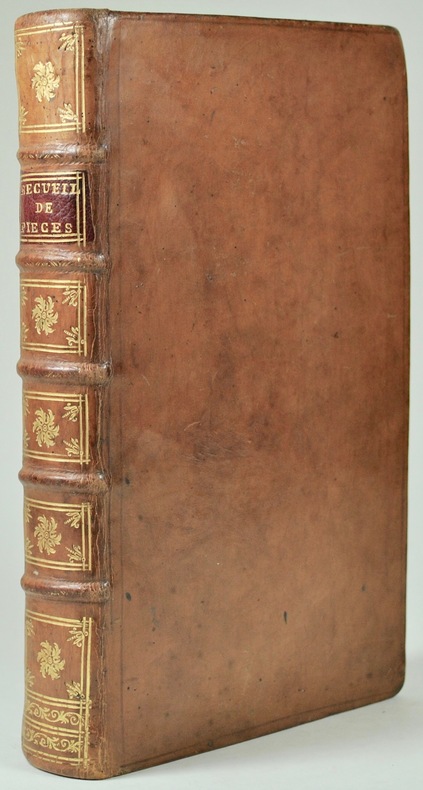
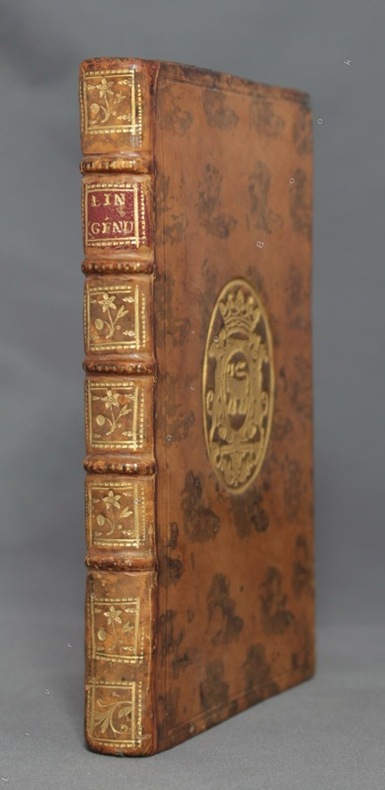
17678679Lausanne [pour Paris], sans nom, 1767. 2 tomes en un volume in-12 de [4]-118; [4]-120 pages, plein veau brun moucheté, dos à nerfs orné de filets et fleurons dorés, pièce de titre en maroquin rouge, plats frappés au centre des armes de Jean Bouhier, président du parlement de Bourgogne, membre de l'Académie française.
174015915, , 1740-1744. La Mérope française, avec quelques petites pièces de littérature. A Paris, chez Prault fils, 1744. In-8 de (4)-XXIV-(2)-115-(1) pp. Lettre à M. Norberg, chapelain du roi de Suède Charles XII, auteur de l'Histoire de ce monarque. A Londres [Paris, Prault], 1744. In-8 de (2)-16 pp. Mahomet, tragédie. Par M. de Voltaire. Représentée à Paris pour la première fois le jeudi 10 août 1742. (Paris), 1742. In-8 de (2)-89 pp. Conseils à M. Racine sur son poème de la religion par un amateur des belles-lettres. Sans lieu, (1742). In-8 de 14 pp. Recueil de pièces fugitives en prose et en vers. Par M. de V***. (Rouen), 1740. In-8 de (4)-IV-223 pp.5 pièces reliées en 1 vol. in-8, veau blond glacé, dos orné à nerfs, pièce de titre en maroquin rouge, tranches rouges (reliure de l'époque).
175116247Berlin: C F Henning. Very Good- with no dust jacket. 1751. First Edition; First Printing. Hardcover. Vellum darkened and with some surface cracking light extremity wear; light foxing. No half-title pages. Errata page for both volumes bound at end of Vol I. Two custom owners' bookplates in first volume. Solid hardcovers. ; French language. Half vellum binding with marbled boards. Two of two volumes complete. Bengesco I 1178. This work was the most researched and carefully prepared of Voltaire's works. He began work on this project in 1734 while at the Chateau Cirey put it aside in 1738 and resumed work on it in 1750. First Edition First Printing of Voltaire's pioneering historical study of the age of King Louis XIV published while Voltaire was resident at the court of King Frederick II of Prussia.; xii 488 2 errata; ii 466 in 2v pages . C F Henning hardcover
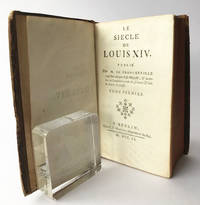
17512359The first edition of Voltaire's brilliant historical study of the age of King Louis XIV. Begun as early as 1732 Voltaire sent a manuscript version to Frederic II who was enthusiastic and encouraged its publication. In 1739 Voltaire published a 'Plan Raisonné' of the project including two finished chapters but this was condemned by the court and seized. In 1750 Voltaire left France for Frederic's court at Berlin where he set himself to complete the work. Failing to obtain the 'privilège royal' or even the non-written 'permission tacite' he decided to go ahead and publish the work in Berlin at his own expence. Voltaire continued to add to the work in subsequent editions most notably in the 1753 Berlin edition where he added a supplement in which he refuted the attacks made by La Beaumelle.<br /><br /><i>Two volumes in one 12mo 144 x 85mm pp. xiv 488 1 errata; ii 466 2 errata with the half-title to the first volume in contemporary calf rather worn spine gilt in compartments foot of spine chipped wormhole to the head of spine wanting the front endpaper red edges.</i><br /><br />BN Voltaire Catalogue 3361-3363. C.F. Henning
1795ILTPVOLT95Paris: Didot Le Jeune L'An Troisième 1795. 1795. 2 Volumes. 4to. pp. 211; 212. with half-titles. engraved frontis. portrait of Jeanne d'Arc by Gaucher & 21 engraved plates by engraved by A very tall fine crisp copy on thick paper deckle edge visible on some leaves bound in contemporary tree calf gilt backs all edges gilt some surface scarring to covers but still a very nice copy. First Edition with these Illustrations the frontispiece portrait of Jeanne d'Arc by Gaucher and the other twenty-one plates engraved by Bacquoy Choffard Delignon Delvaux Duhamel Dupréel Lemire Lingée Malbeste Patas Pauquet Ponce and Romanet after designs by Lebarbier Marillier Monnet and Monsiau. "Très belle édition." Cohen-De Ricci Cohen-De Ricci 1034. Brunet V 1362. Bengesco 513. F. Hardcover. Paris: Didot Le Jeune, L'An Troisième [1795]. Hardcover
177510567[Genève], [Cramer et Bardin], 1775. 40 vol. in-8, veau marbré, dos lisse orné, triple filet doré sur les plats, pièces de titre en maroquin rouge (reliure de l'époque).
1775044596Genève: Cramer et Bardin 1775. Edition encadrée" Complete set of all 40 volumes with the engraved frontispieces where issued all pages printed within the wood-engraved frames octavo format. Uniformly bound in mottled calf with gilt spine trim and lettering; some leather chipping mostly at the head of some spines. all edges marbled. Contents: t. 1 La Henriade divers autres poëmes et toutes les piéces relatives à l'épopée. t. 2-10 Ouvrages dramatiques précédés et suivis de toutes les piéce qui leur sont relatifs. t. 11 La Pucelle d'Orléans poëme suivie du Temple de Gout &c. t. 12-13 Mélanges de poësies &c. t. 14-17 Essai sur les moeurs et l'esprit des nations; et sur les principaux faits de l'histoire depuis Charlemagne jusqu'à Louis XIII. t. 18-20 Siècle de Louis XIV auquel on a joint un précis du siècle de Louis XV et un autre morceau d'histoire. t. 21 Histoire de Charles XII roi de Suède avec les pièces qui y sont relatives. t. 22 Histoire de l'Empire de Russie sous Pierre le Grand divisée en deux parties. t. 23-24 Annales de l'Empire depuis Charlemagne fragmens sur quelques revolutions dans l'Inde fragmens sur l'histoire générale et divers autres morceaux historiques. t. 25-30 Questions sur l'Encyclopédie par des amateurs. t. 31-32 Romans philosophiques élémens de Newton précédés et suivis de divers morceaux intéressans. t. 33-37 Mélanges de littérature d'histoire et de philosophie. t. 38-40 Piéces détachées attribuées à divers hommes célèbres. Cramer et Bardin unknown books
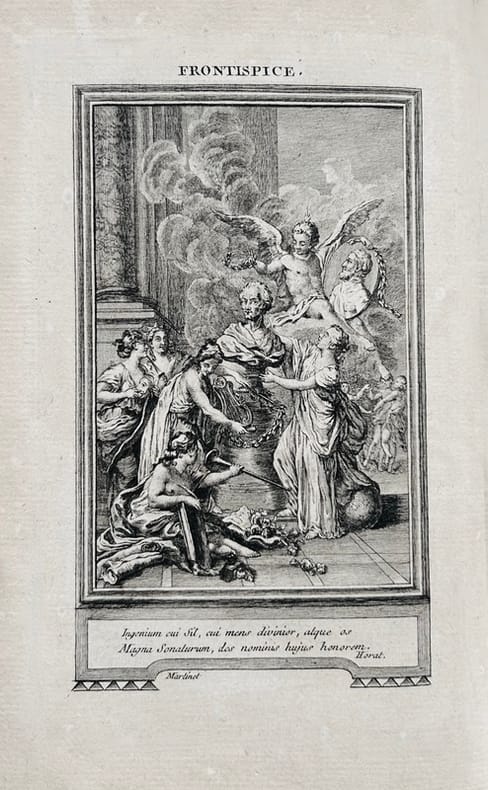
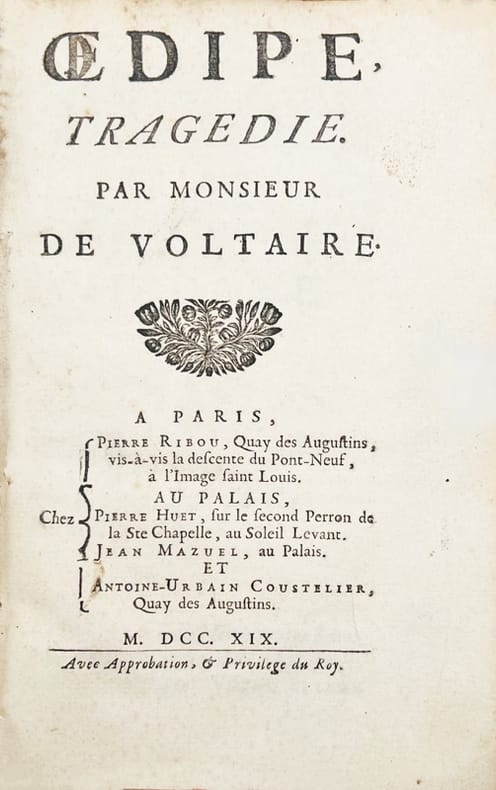
171944635A Paris, chez Pierre Ribou, Pierre Huet, Jean Mazuel, Antoine-Urbain Coustelier, 1719. In-8 de (8)-131 pp.12 pièces en un volume in-8, veau granité, dos orné, tranches rouges (reliure de l'époque).
175310636, , 1753-1767. 13 pièces reliées en 1 vol. in-12, veau havane marbré, dos orné à nerfs, pièces de titre en maroquin rouge, tranches rouges (reliure de l'époque).
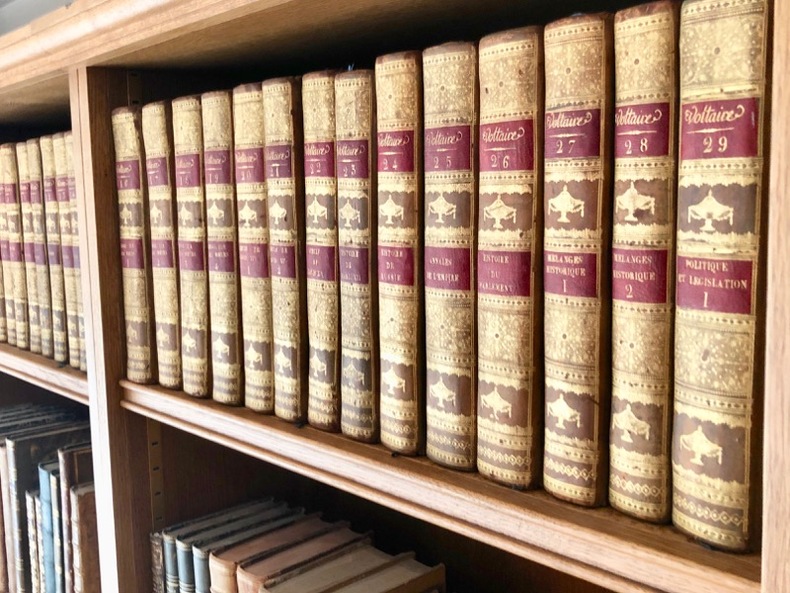
17689785Genève, [Cramer], 1768-1777. 29 volumes grand in-4, demi-veau blond à coins, dos à 5 nerfs ornés de filets, roulettes, titre, sous-titre et paniers de fleurs surmontés d'un joli chapeau, le tout doré. 23 volumes avec étiquettes de titre rouges et de sous-titre et tomaison caramel, 6 volumes avec étiquettes de titre caramel et de sous-titre et tomaison vertes, plats de joli papier marbré. Non rognés.
1789000012023Paris: La Société Littéraire-Typographique 1789. First edition. Hardcover. Very Good. 70 vol. 8vo. Please inquire if you require any pagination information. Contemporary full calf spines in six and a half compartments each with a red and a green morocco label lettered in gilt; several edges decoratively stained yellow. With 104 of the 122 recorded plates Cohen-DeRicci calls for 122 plates volume one is missing the tableau the folding plate and the dedication plate. Due to the vagaries of hand-press-era binding and to the large size of the set it is difficult to determine which of the other 16 plates are the ones missing. The plates present depict Voltaire scenes from his plays and several fascinating figures from European History including of course Enlightenment-era figures. All other half-titles present see condition statement. Bengesco 2142. Brunet 681. Cohen-DeRicci 1042-1047. This edition is the set most lauded for its completeness and beautiful typography. Baskerville's type was purchased to produce this sizeable set of Voltaire's writings. The later editions of Voltaire's works are said to be based on this edition. Voltaire's career was nothing short of prolific as demonstrated by these 70 volumes. With a biting wit and a clever pen the philosophe lampooned Leibniz wrote countless plays and historical dramas and corresponded with his fellow Enlightenment-era intellectuals. He walked the line of philosopher and literary figure and made great contributions to science in his translation of Newton's writings into French. He was a champion not only of the natural sciences but of liberty and of personal pleasure. Voltaire dreamed that European society would and could move forward away from tyrannical monarchies towards a more sophisticated and benevolent system of governance. He stands out as one of the most popular and influential figures of the Enlightenment era. Volume 37 lacks its free front endpaper a few leaves in the volumes have an occasional dampspot volume 43 lacks leaf CC8 and its half-title. La Société Littéraire-Typographique hardcover
17385783A Amsterdam, chez Etienne Ledet & Compagnie, 1738. In-8 de 1 frontispice gravé, 2 portraits, (6)-XII-(2)-399-(1)-(400 à) 410-(6) pp., veau brun, dos orné à nerfs, pièce de titre en maroquin rouge (reliure de l'époque).
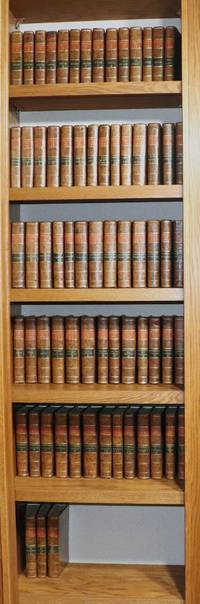
178439990Kehl, De l'Imprimerie de la Société littéraire-typographique, 1784-1789. 70 volumes in-8, demi-veau vert, dos lisses très ornés de fleurons, palmes et palettes, pièces de titre et de tomaison en maroquin rouge (reliure de l'époque).
173360085London C. Davis and A. Lyon 1733. 8vo. Lovely contemporary full Cambridge-style binding with five raised bands to spine and blindstamped ornamental borders to boards. . Double gilt line-borders to boards. All edges of boards with gilt borders. Gilt title to spine. Hinges neatly and professionally re-inforced. Internally very nice clean and fresh. A lovely crisp and large copy with good margins printed on heavy fine paper. 16 -including preface contents advertisements 253 1 18 -Index pp. <br/><br/><em>The important actual first edition of this highly celebrated key work of the Enlightenment in which the anecdote of how Newton discovered gravity the story about Newton and the falling apple appeared for the first time together with the description of the difference between the physical world view of the English and the French the "plenum" and the "vacuum". This seminal work in which Voltaire famously depicts British philosophy science society and culture in comparison to French can be viewed as the Enlightenment equivalent to Tocqueville's "Democracy in America". This series of essays which is based on Voltaire's experiences when living in England was actually written by Voltaire mostly in English which he mastered to perfection. It has often been presumed that the first edition of the work was that published in French in 1734 but actually the present English edition constitutes the actual first appearance of the work as well as the version that is closest to Voltaire's intention as the French language version is the re-written one and the English version the original. Curiously almost all modern English versions are translations into English of the French edition instead of the original English version making this edition of the utmost importance.After the original English edition of 1733 two French editions soon followed the first in 1734. Unlike the British the French resented the book and already in 1734 the French Parliament issued an order for the author's arrest and condemned the work causing the impact of it in France to be delayed. The book was burned for being "dangerous to religion and civil order". At the same time the work became a bestseller in Britain and as much as 14 editions of the work were published in the eighteenth century. "Inspired by Voltaire's two-year stay in England 1726-8 this is one of the key works of the Enlightenment. Exactly contemporary with Gulliver's Travels and The Beggar's Opera Voltaire's controversial pronouncements on politics philosophy religion and literature have placed the Letters among the great Augustan satires. Voltaire wrote most of the book in English in which he was fluent and witty and it fast became a bestseller in Britain. He re-wrote it in French as the Lettres philosophiques and current editions in English translate his French." Nicholas Cronk Introduction to the Oxford's Classics edition from 1999.The great French philosopher Voltaire was greatly impressed by the philosophical and scientific achievements of the English especially those of Newton Locke and Bacon. As a disseminator of scientific knowledge Voltaire came to play a great rôle in the popularization of Newtonian science and its discoveries the present work being a prime example. Although the work was condemned by the French authorities it still came to play a great rôle in the spreading of Newtonian ideas in France. The present work generally came to play a dominant rôle in Enlightenment accounts of the history of science and philosophy. The work focuses on British science and thought and uses the accounts of these to emphasize what is lacking in French society and French thought. The work is generally very critical towards the French "ancient régime" and when Voltaire here discusses the emergence of empiricism it is viewed as an English tradition that stands in opposition to the French rationalist tradition with Descartes as the prime example. This view is taken over by the following Enlightenment historians of science and philosophy e.g. d'Alembert see for instance his "Preliminary Discourse" of 1751. Some of the most influential passages of the work are probably those on Bacon who Voltaire sees as the founder of modern experimental science Newton and Descartes. Letters XIV on Descartes and Newton XV on attraction and XVI on Newton's Optics from 1704 are among the most influential essays of the work. In XVI Voltaire reflects upon Newton's "Optics" and the way that he rejected Descartes' theory and set out his own account of the properties of light. In XV he presents the first account of Newton and the falling apple: "As he was walking one Day in his Garden and saw some Fruits fall from a Tree he fell into profound Meditation on that Gravity the Cause of which had so long been sought but in vain by all the Philosophers whilst the Vulgar think there is nothing mysterious in it. He said to himself that from what height soever in our Hemisphere those Bodies might descend their Fall wou'd certainly be in the Progression discover'd by Galileo; and the Spaces they run thro' would be as the Square of the Times. Why may not this Power which causes heavy Bodies to descend and is the fame without any sensible Diminution at the remotest Distance from the Center of the Earth or on the Summits of the highest Mountains; Why said Sir Isaac may not this Power extend as high as the Moon." pp. 127-28.But perhaps the most famous passage in the volume is the opening of Letter XIV: "A Frenchman who arrives in London will find Philosophy like every Thing else very much chang'd there. He had left the World a "plenum" and he now finds it a "vacuum". At Paris the Universe is seen compos'd of Vortices of subtile Matter; but nothing like it is seen in London. In France 'tis the Pressure of the Moon that causes the Tides; but in England 'tis the Sea that gravitates towards the Moon; so that when you think that the Moon should make it Flood with us those Gentlemen fancy it should be Ebb which very unluckily cannot be prov'd." pp. 109-10. </em> hardcover
178588781785 [Kehl], de limprimerie de la Société Typographique, 1785 1789. 70 volumes grand in-8° (175 x 270 mm). Exemplaire dexception sur très grand papier vélin de la fameuse édition de Voltaire financée par Beaumarchais, comportant dune part lillustration destinée aux tirages de luxe de cette édition (soit 93 planches de Jean-Michel Moreau le jeune, 12 portraits, 14 planches de physique, 1 plan, 1tableau des oeuvres de Voltaire), plus un large supplément dillustrations destinées à lédition Renouard des Oeuvres de Voltaire en 66 volumes in-8° publiée entre 1819 et 1825. Louvrage contient ainsi un total de 196 planches hors texte, soit : 113 figures de Moreau le jeune (44 pour le Théâtre, volumes 1 9; 10 pour la Henriade, volume 10; 21 pour la Pucelle dOrléans, volume 11; 6 pour les Contes en vers, volume 14; 2 pour le Siècle de Louis XIV, volumes 20 et 21; 1 pour le Siècle de Louis XV, volume 22; 1 pour lHistoire de Charles XII, volume 23; 1 pour lHistoire de Russie, volume 24; 27 pour les Romans et Contes, volumes 44 et 45); 67 portraits (33 gravés par Augustin de Saint-Aubin et 34 de graveurs divers dont Renouard possédait les cuivres); 14 planches de physique (volume 31) ; 1 plan («Camp des Tartares», volume 24 ); 1 tableau dépliant des oeuvres de Voltaire, volume 70). Impressionnantes reliures en demi-basane maroquinée bordeaux à coins, plats de papier rouge, dos lisse ornés, tranches ébarbées. Datant des environs de 1825 1830, elles sont signées (au dos du volume I): «Rel[ié] p[ar] les Dl[l]es Cotty». On ignore tout de ces personnes, dont on peut seulement supposer quelles étaient apparentées à Jean-Etienne Cotty, relieur actif à Paris de 1776 à 1820, que «Lesné [...] place parmi les bons relieurs de second ordre de son temps» (Thoinan, Les Relieurs français, page 234). Bas de la charnière inférieure du volume 11 fendu sur la moitié de sa longueur, quelques coiffes frottées, coins çà et là un peu émoussés, mais dans lensemble la collection est dans un état absolument désirable. Etiquettes collées aux premiers contreplats: «Louvard, libraire, rue du Bac, no 78»; ex-libris illustré: «André Gutzwiller» (1922 2014), banquier et bibliophile bâlois.
175908228Geneva: Gabriel Cramer 1759. First Edition. Full Leather. Fine. The third of the first four editions according to Bengesco 1436 and the fourth edition according to Wade see Voltaire and Candide 1959 p. 201 dated 1759 with 299 pages clandestinely printed and published by Cramer in Geneva and preceeding the other 16 different editions published throughout Europe in 1759. The present copy conforms to Bengesco 1436 in every respect which is "page by page line for line like the first edition" except for the "que ce ce fut" error on page 103 an error which was introduced by Cramer into the early printings then doubtless not "fixed" as it was correct in the first place. Note that the fleurons agree exactly with Bengesco 1436 as follows: p. 134 is a basket of fruits; p. 228 shows two horns 'a plenty; the fleuron at p. 115 is repeated on pages 179 and 193; fleuron on page 213 is signed N. C. and is repeated on page 279; page 277 is paginated 177. The present copy also agrees with Wade see Voltaire and Candide 1959 p. 201 in every respect including that page 17 is numbered 15. Both the above references to Bengesco and Wade show signatures A-N3 meaning they are bound without the Table of Chapters; the present copy like 7 of the 10 known copies of the first edition shows signatures A-N6 without the final leaves N7 a blank and without N8 instructions to the binder concerning the cancellation of two pairs of leaves B4 B9 and D6 D7. In addition to the above let us state the textual points in the present copy: page 31 B4 an unnecessary paragraph break was eliminated. The words "mais il y a une raison." do NOT start a new paragraph; page 41 B9 several short sentences about the Lisbon earthquake were rewritten as "car dit-il tout ceci est."; page 84 D6 D7 reads "Nos filles se trouverent."; page 103 reads "que ce fut." as explained above was correct to begin with then discovered by Cramer and was not "fixed"; page 125 reads "mais ils se leverent precisement."; page 242 the paragraph beginning "Candide etait afflige."; has been removed by Voltaire while the book was being printed as it was critical of German poets. Pages 121 - 168 signatures F and G are a larger type than the rest of the book. In summation the present copy agrees with the first edition except that the "que ce ce fut." error was discovered and not inserted and the fleurons differ but are by Cramer who printed the first four editions. This a wide margined copy is larger than other copies we have seen at 165 mm x 95 mm; beautifully bound in late 19th Century full tan leather with raised bands and gilt decoration on spine with a brown leather lettering piece marbled end papers all edges gilt; printed on laid paper. The text is remarkably clean and bright; a fine copy. PMM204. <br/><br/> Gabriel Cramer hardcover books
1759752Genève Geneva: Cramer 1759. First Edition. 3 vols. in one 12mo 164 x 100mm pp. 2 291 1; 133 1 35 1. First printing of the great 18th century philosophical narrative with all the points correct. Including the 3 usual cancels the right title page ornament repeated pages 193 and 266 the misprints of “que ce ce fut†page 103 line 4 and “précisément†page 125 line 4 the correction removing a paragraph break page 31 the rewritten lines about the Lisbon earthquake page 41 etc. Contemporary full calf red calf label rebacked with the original spine saved and laid down recornered marbled endpapers gilt rubbed inner paper hinges strengthened old ink signatures on the endpaper and front blank tiny signature on the title page one tissue strengthened tear at the bottom of A2 touching the last 3 lines of text without any loss otherwise internally quite nice clean and very good. Bound without N7 a blank and N8 a notice to the binder as is usual agreeing in all respects to what you would have received if you had purchased a copy in sheets on publication day then bought the sequels and then handed them over to the most local Swiss bindery. Ref: PMM 204. There were 18 editions of Candide in 1759. It took 221 years for a clear and convincing bibliography to first sort them out and then got accepted and once accepted our real 1st edition was confirmed as rare. In the last 15 years however that bibliographical data has been more widely circulated and several 1st editions that weren’t on the original 22–copy census have come into market. It is still scarce more so in a contemporary binding.<br /> <br /> Candide bides as the epitomic philosophical fable of the French Enlightenment and the genotype of irony without exaggeration and though it’s laced with more salt than the postwar streets of Carthage it repeatedly tolls a reminder that light hearts live long. Most importantly Candide remains remarkably relevant when examined through contemporary frameworks functioning as an incisive proto-postcolonial text that anticipates modern discourse on global inequality systems of oppression and the limitations of Enlightenment rationality. The novel's scathing portrayal of slavery conquest and religious persecution resonates with intersectional analyses that recognize how power structures interlock across racial gender and economic dimensions. The savage irony throughout the text dismantles not just philosophical optimism but also European exceptionalism exposing the hypocrisy of colonial enterprises and religious institutions alike. The narrative's episodic structure—with its global movements between Europe South America and the Ottoman Empire—invites discussions of transnationalism and diasporic experience while Candide's concluding retreat to cultivate his garden has been reinterpreted by ecocritical scholars as both an acknowledgment of environmental interdependence and a potentially problematic withdrawal from systems-level political engagement.<br /> <br /> “Do you believe†said Candide “that men have always massacred each other as they do to-day that they have always been liars cheats traitors ingrates brigands idiots thieves scoundrels gluttons drunkards misers envious ambitious bloody–minded calumniators debauchees fanatics hypocrites and fools†“Do you believe†said Martin “that hawks have always eaten pigeons when they have found them†<br /> –Voltaire Candide. Cramer unknown