Quinault, ( Philippe )Biblio.com

130 résultats
1824006561Paris: Crapelet Imprimeur-Libraire 1824. Book. Near Fine. Leather and Marbled Boards. First Thus. 8vo - over 7¾" - 9¾" tall. In handsome red leather and marbled boards end pages marbled top edges gilt gilt titles and decorations 4 raised band Near Fine slight rubbing to leather at tips slight foxing and toning scattered throughout. Philippe Quinault 1635-1688 was a French dramatist best known for his 14 opera librettos which he wrote for Lully. Crapelet, Imprimeur-Libraire Hardcover
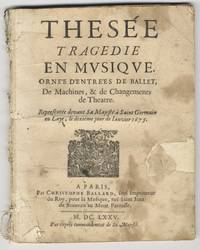
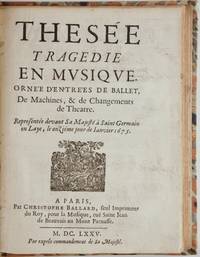
167539713Paris: Christophe Ballard seul Inprimeur du Roy pour la Musique ruë Saint Jean de Beauvais au Mont Parnasse . Par exprés commandement de Sa Majesté 1675. Quarto. Disbound. 1f. recto title verso blank 1f. "Acteurs du Prologue" 3ff. "Prologue" 1f. "Acteurs de la Tragedie" 70 pp. With woodcut device to title including Apollo with lyre figures in Greco-Roman dress with harp and lute and a pegasus; woodcut headpieces to each act; decorative woodcut initials and tailpieces throughout.<br /> <br /> Full named cast lists for the "Acteurs du Prologue" and the "Acteurs de la Tragedie."<br /> <br /> Somewhat worn browned foxed soiled and stained a bit heavier to title; some worming especially to lower inner margins; stub of front free endpaper and blank preliminary leaf preceding title; first signature detached; loss to blank outer margin of title repaired with contemporary paper; blank outer margin of all leaves of "Prologue" repaired with contemporary paper; numerous additional leaves with contemporary paper reinforcements to inner margins; other minor defects. Lacking first leaf of Prologue pp. 65-66 and pp. 71-76. First Edition first issue all other issues with a date of first performance as 11 January 1675. This issue not in Sonneck Librettos. Schmidt LLC3-1. <br /> <br /> Thesée a tragédie en musique in a prologue and five acts to a libretto by Quinault after Ovid's Metamorphoses was first performed at St Germain-en-Laye on 11 January 1675.<br /> <br /> "The orchestra and chorus are used with brilliant effect in several divertissements but especially in the evocation of battle throughout Act 1. Medea's role like that of Lully's final lovesick sorceress Armide is replete with expressive monologue airs: 'Doux repos' 'Dépit mortel' 'Sortez Ombres' and 'Ah! faut-il me venger'. Thésée was part of the standard repertory at the Paris Opéra from 1675 until 1767; in addition it was selected to represent Lully when in 1779 the Opéra presented an historical survey of French operatic styles. Lully's score was substantially modernized by editors for productions from 1754 onwards." Lois Rosow in Grove Music Online. Christophe Ballard, seul Inprimeur du Roy, pour la Musique, ruë Saint Jean de Beauvais au Mont Parnasse ... Par exprés command unknown
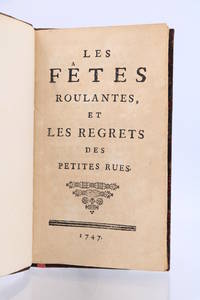
174791802n. l.: s. n. 1747. Fine. s. n. n. l. 1747 10 x 16.8 cm Relié First edition of this work published by the Société du Bout-du-Banc the celebrated literary salon presided over by Mademoiselle Jeanne-Françoise Quinault and the Comte de Caylus. This intimate circle originally comprising eight members would gather on Mondays at dinner to exchange ideas and to write; at the close of each meal every distinguished guest was required to set down a few lines whether in the coarse poissard style or in a more refined vein on paper. It was in this context that Les Fêtes roulantes ou les regrets des petites rues came into being in the wake of the celebrations held in Paris in honour of the Dauphin's second marriage to Marie-Josèphe de Saxe. Pastiche binding in plum half-shagreen spine with five raised bands framed by gilt dotted fillets and six compartments decorated with gilt fillets and fleurons marbled paper boards gilt top edge pastedowns and endpapers in shell-pattern marbled paper. Some minor rubbing to the paper of the lower board corners slightly bumped. ""In his youth the Comte de Caylus had paid considerable tribute to the literature of fairy tales which the translations from Arabic and Persian by Galland and Pétis de la Croix had brought into fashion; one does not find him again in these artificial creations to which he returned when he was nearly seventy. But in the intervening years his character as a writer emerged and declared itself in accordance with his manners and tastes and in how propitious a milieu! The Société du bout du banc that academy of Gallic ribaldry presided over by Mademoiselle Quinault; those suppers at which an inkwell served as centrepiece and which La Chaussée d'Armenonville Voisenon Moncrif the Grand Prior of Vendôme Duclos Salley and Crébillon fils enlivened with their bawdy and bantering wit. All men of letters with little taste for philosophy all content to let the world go its own way and finding it perfectly satisfactory as it was all of that sacred flock of Epicurus somewhat transformed by Circe in which each member is satisfied or very nearly with what their presiding lady declared sufficient for Duclos the least fastidious among them. The popular literature of the eighteenth century that is to say literature which took the common people as the subject of its observations and tableaux was born within this company of mirth and folly and the Comte de Caylus was its natural father and its foster father; it took its first lively flights in those ""Écosseuses"" 1739 those ""Étrennes de la Saint-Jean"" 1742 those ""Mémoires de l'Académie des colporteurs"" those ""Avantures des bals des Bois"" those ""Fêtes roulantes"" 1748 a veritable magic lantern of Parisian popular life ."" Avertissement ""Mémoires et réflexions du comte de Caylus"" 1874 s. n. hardcover
167539689Paris: Christophe Ballard seul Imprimeur du Roy pour la Musique ruë Saint Jean de Beauvais au Mont Parnasse . Par exprés commandement de Sa Majesté 1675. Small quarto. Modern marbled boards with paper title label to upper and spine. 1f. recto title verso blank 1f. "Acteurs du Prologue" 4ff. "Prologue" 1f. "Acteurs de la Tragedie" 76 pp. With woodcut device to title including Apollo with lyre figures in Greco-Roman dress with harp and lute and a pegasus; exceptionally fine woodcut headpiece to Prologue and additional headpieces to each act; decorative woodcut initials and tailpieces throughout.<br /> <br /> Full named cast lists for the "Acteurs du Prologue" and the "Acteurs de la Tragedie."<br /> <br /> Small holes to blank inner margins from previous sewing; slightly worn; very occasional minor foxing soiling and stains; minor loss to blank upper outer corner of pp. 31/32. First Edition fourth issue. Sonneck Librettos p. 1069. Schmidt LLC3-2.3. <br /> <br /> Thesée a tragédie en musique in a prologue and five acts to a libretto by Quinault after Ovid's Metamorphoses was first performed at St Germain-en-Laye on 11 January 1675.<br /> <br /> "The orchestra and chorus are used with brilliant effect in several divertissements but especially in the evocation of battle throughout Act 1. Medea's role like that of Lully's final lovesick sorceress Armide is replete with expressive monologue airs: 'Doux repos' 'Dépit mortel' 'Sortez Ombres' and 'Ah! faut-il me venger'. Thésée was part of the standard repertory at the Paris Opéra from 1675 until 1767; in addition it was selected to represent Lully when in 1779 the Opéra presented an historical survey of French operatic styles. Lully's score was substantially modernized by editors for productions from 1754 onwards." Lois Rosow in Grove Music Online. Christophe Ballard, seul Imprimeur du Roy, pour la Musique, ruë Saint Jean de Beauvais au Mont Parnasse ... Par exprés command unknown
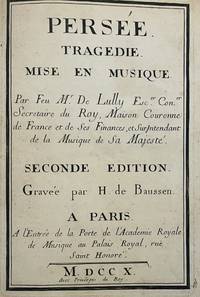
17102811Paris: A l’Entrée de la Porte de l'Academie Royale de Musique …: Henry de Baussen 1710. The first illustrated and the first edition engraved full score of Lully’s Persée. Engraved music. Folio. In somewhat later green half maroquin. Spine and front panel gilt. Supra ex-libris: M.me Adolp. de Lanneau - Partitions. With six engravings by Scotin and Deplaces after Duplessis. Binding rubbed at the extremities. Water stain to the lower edge of the first and last leaves. Sporadic foxing pages toned due to aging. Otherwise in fine condition. The first illustrated and the first edition engraved full score of Lully’s Persée. Engraved music. Folio. In somewhat later green half maroquin. Spine and front panel gilt. Supra ex-libris: M.me Adolp. de Lanneau - Partitions. With six engravings by Scotin and Deplaces after Duplessis. 4 229 1 p. The first illustrated and the first edition engraved full score of Lully’s Persée.<br /> Full score of Lully’s tragédie en musique with Philippe Quinault libretto. The opera premiered on 7 April 1682. This is the Persée’s first engraved edition adorned with six engravings illustrating scenes from the opera the first for the prologue and one for each of the five acts.<br /> Provenance: Madame Adolphe de Lanneau wife of A. de Lanneau 1796–1881 a French school director and politician to whom George Onslow dedicated his Violin Sonata No. 6 Opus 31.<br /> RISM L 2993. A l’Entrée de la Porte de l'Academie Royale de Musique […]: [Henry de Baussen] unknown