307 résultats
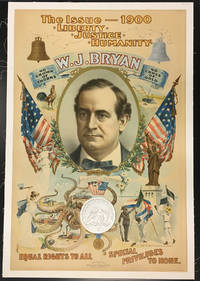
190024250<p><b><i>"No Crown of Thorns / No Cross of Gold / Equal Rights to All / Special Privileges to None"</i></b></p><p>William Jennings Bryan tried for the White House in 1896 1900 and 1908. The leading supporter of "free silver" against the gold standard and a champion of the "little guy" against moneyed Eastern businessmen and bankers Bryan came closest to victory in 1896.</p> <b>WILLIAMS JENNING BRYAN.</b><i>"The Issue--1900: Liberty Justice Humanity."</i> Columbus Ohio Neville Williams 1900. Chromolithograph printed by the Strobridge Lithograph Company Cincinnati Ohio. 20 x 30 in; edges slightly trimmed very faint mat toning; laid down on canvas.<p>Surrounding the central vignette of the candidate flanked by American flags nearly every theme of Bryan's long political career is represented in fantastic graphics. Quotes from his 1896 "Cross of Gold" speech on monetary policy and the free coinage of silver surround his name; a rooster and plow reveal his appeal to the nation's long-suffering Midwestern farmers; and "Blind Justice" looks longingly at Bryan's portrait. A bronze liberty bell dated 1776 juxtaposes a silver one labeled "1900 No Imperialism."</p><p>Below a white-clad Lady Democracy fashioned as a Jael-style avenger prepares to destroy monopolistic trusts by hacking the tentacles off an octopus that protects large American industries such as the U.S. Biscuit Company American Tobacco the American Steel Trust and perennial progressive punching bag Standard Oil. An octopus representing monopolies dates to the early 1880s but gained traction in the early years of the 1900s notably in <i>Puck</i> magazine's famous 1904 cartoon of Standard Oil's tentacles surrounding the U.S. Capitol building.</p><p>The anti-imperialist plank is shown by figures representing Cuba Mexico and probably the Philippines appealing to the Statue of Liberty shouting "give us liberty or give us death" paraphrasing Patrick Henry's famous line. The print itself boldly proclaims "Equal Rights to All Special Privileges to None."</p><p><b>William Jennings Bryan</b> 1860-1925 of Nebraska was a powerful orator and prominent populist who failed in bids for the presidency in 1896 1900 and 1908. His support for farmers and laborers led him to oppose trusts and seek monetary trade tariff and railroad rate regulation. After his third presidential bid he became Woodrow Wilson's Secretary of State in 1913. A pacifist in 1915 Bryan resigned after Wilson began to move towards fighting Germany in WWI after the sinking of the <i>Lusitania</i>. Bryan supported Prohibition and was an ardent anti-Darwinist. He died in 1925 five days after the conclusion of the Scopes Monkey Trial where he defended Tennessee's anti-evolutionary position.</p> books
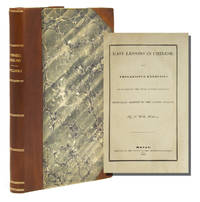
1842260298Macao: Printed at the Office of the Chinese Repository 1842. First edition. Frontispiece and folding plate. Text in English and Chinese. ix i 287 1 pp. 8vo. Rebacked and recorned in three quarters calf preserving early marbled boards new endpapers. Horizontal tear across frontispiece neatly repaired. Bookplate of Library of the American Board of Commissioners for Foreign Missions. First edition. Frontispiece and folding plate. Text in English and Chinese. ix i 287 1 pp. 8vo. First edition of this early manual on the Chinese language for English speakers issued as Chinese trade was opening to the West. It is the first book on China by the missionary and sinologist Samuel Wells Williams 1812-1884 who argues that the beginning student of Chinese should first learn to write the 214 radicals that comprise the various characters. With the bookplate of the American Board of Commissioners for Foreign Missions who in 1833 hired Williams to run its printing press in Guangdong. Cordier 1685; Lust 1067; Trübner Catalogue of Dictionaries and Grammars of the Principal Languages p. 37 Printed at the Office of the Chinese Repository unknown books
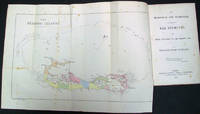
1848WRCAM41959London: Thomas Cautley Newby 1848. xii346pp. Folding colored frontispiece map. Contemporary three-quarter calf and marbled boards gilt label. Small tear in upper fore- edge of a few pages. Small closed tear repaired on verso of map. Map and titlepage slightly foxed else quite clean and neat. A very good copy. Williams a resident of Hamilton Bermuda drew largely on the heretofore unexamined material in the Public Records Office of the Colony. His work constitutes the first thorough history of Bermuda from discovery and initial settlement through the mid-19th century. There is a heavy emphasis on the political history of the island and also information on geology climate agriculture commerce churches etc. A lengthy appendix reprints many documents important in the history of the island. A scarce book; we can find only one copy appearing at auction in the last thirty years. Thomas Cautley Newby hardcover books
18162474Boston: Tileston and Weld 1816. Second Edition. Full leather. Good. From the personal library of President James Buchanan Reports Of Cases Argued and Determined by the Supreme Judicial Court of Massachusetts. Octavo xii 564pp. The second edition Volume I. Full period calf title on red morocco label affixed to spine. Considerable wear to spine repairs along top edge. Dampstain to outer edge some intermittent foxing. Signed by President James Buchanan on the title page. This law book is from the personal library of President James Buchanan. His library was primarily held at his home in Lancaster PA called Wheatland. The majority of his presidential papers correspondence and books went to Dickinson college his alma mater. After graduating with honors in 1809 James Buchanan moved to Lancaster and became a legal apprentice to James Hopkins. He was admitted to the Pennsylvania Bar in 1812. Buchanan would go on to serve in the House of Representatives from 1821-1831 United States Senator 1834-1845 then as the 17th Secretary of State under President James K. Polk. He was elected President of the United States in 1856 serving one term. He predicted in retirement that "history would vindicate my memory" but his inability to stop the succession of the southern states has sealed his legacy as one of the least successful presidents in history. Tileston and Weld unknown books
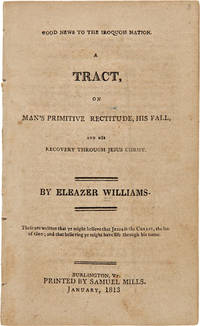
1813WRCAM45597Burlington Vt.: Samuel Mills 1813. 12pp. Dbd. Minor foxing and toning. Very good. "Grandson of Indian captive Eunice Williams who married an Indian chief of Caughnawaga Eleazar Williams d. 1858 served as an American scout in northern New York during the War of 1812. Desiring afterwards to work as a missionary he published in 1813 this 'gospel' for the Iroquois Nation. Although a devout spiritual leader for many years Williams later fell into the delusional fantasy that he was the Dauphin of France" - Siebert. The Siebert copy was in quite poor condition. SHAW & SHOEMAKER 30540. SIEBERT SALE 487. PILLING IROQUOIAN p.167. AYER INDIAN LINGUISTICS IROQUOIAN 15. FIELD 1667. Samuel Mills unknown books
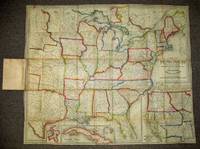
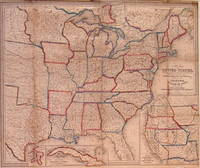
185136812Philadelphia: Lippincott Grambo & Co 1851. 1st edition Clark III 434; Graff 4687; New Howes W-487. Original publisher's wallet-style purple leather binding with gilt title stamping to one side. Leather faded to dark tan. Old paper repair to top of rear hinge. Map with some age-toning along the two center horizontal fold-lines. Overall a respectable VG copy. iv 5 - 216 20 pp. Publisher catalogue last 20 pages. Fold-out map 24-3/4" x 29-1/2" at rear entitled "A New Map of the United States © 1851 upon which are Delineated its Vast Works of Internal Communication Routes across the Continent &c. Showing also Canada and the Island of Cuba." Map hand-colored in outline. Scale: ~ 65 mi = 1". 4 insets including one depicting California & Oregon. 12mo. 5-9/16" x 3-1/2" <br/><br/>While Howes categorizes this work as a derivative of Williams' earlier Appleton publications the author in his prefatory "To the Public" goes to great pains to reassure the reader this a new work in which an "entirely new plan has been adopted." a stance to which Clark & Graff agree. Further research suggests this the first Williams' publication to address California. This 1851 map not recorded by Wheat TRANSMISSIPPI though see entry 769 for the 1852 version. Wheat tells us the map "is largely based on Fremont but which carries much up-to-date information .". Somewhat uncommon on the commercial market with last copy to auction in 1999. Lippincott Grambo & Co hardcover books
1853202739Philadelphia: Lippincott Grambo & Co 1853. unbound. very good. Case map. Engraving with original hand coloring. Image measures 24" x 29.25".<br/><br/> Wellington Williams was a 19th century engraver publisher geographer and draughtsman from Philadelphia. Map includes the Gold Region of California Utah covers Nevada and part of Colorado the remainder of which is consumed by Nebraska. Washington and Oregon both extend eastward to the Rockies beyond which is North-West Territory. New Mexico includes present day Arizona. Booklet missing. Map is expertly repaired.<br/><br/> Lippincott, Grambo & Co unknown books
186961320Mercer PA 1869. Pen-and-ink drawing on paper 16 1/2 x 20 inches probably for a newspaper or periodical advertisement depicting a slain 12-point buck lying on the ground in a mountainous terrain trees in the background vegetation in the foreground a sad- looking hound curled up beside the deer; in the left foreground is a cluster of overlapping 3 x 1 3/4 inch business cards one for the artist "Mercer Gun Shop / J.R. Williams. / Manufacturer and / Dealer / in / Rifles / Shot Guns / . / Repairing / of all kind / Done on / The / Shortest / Notice" and four others for local Mercer businesses a bank a restaurant a hotel and an inn. The illustration and ads are enclosed within a thin black rule. Jesse R. Williams 1830-1914 a Civil War veteran lived in Mercer county most of his life and worked as a farmer river boat pilot gunsmith hotel owner and ferry operator. Some browning but very good and a wonderful evocation of mid-19th century deer hunting. One abrasion causing a short crack in the image. #8475. <br/><br/> unknown books
18554504Hertford: Stephen Austin 1855. First printing. First printing. Bound handsomely by John Leighton signed Leighton Brewer Si i.e. "Brewer Street on verso of front fly in full crimson morocco with rich gold tooling consisting of floral ornaments navy morocco circular inlays on all four corners on both covers spine with similar design tooling and inlays gilt dentelles marbled endsheets. The rare first edition of this classic with pictorial title text illustrations ornaments and page borders in oriental style in colors and gold. Corners somewhat bumped slight scratch on rear cover near fine. A nice example of Leighton's work. <br/><br/> Stephen Austin unknown books
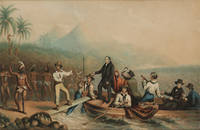
1841WRCAM41732London: George Baxter 1841. Two oil-colored "Baxter prints" 8 x 12 inches each visible dimensions within the mat. Matted and in contemporary burnished wood frames. A bit of light spotting mostly in the sky of the second print else in fine condition. A remarkable pair of rare and interesting prints depicting the mission to the South Seas by the Rev. John Williams and his murder at the hands of natives on the island of Erromango. The prints were produced through an unusual oil-colored process invented by pioneering British print-maker George Baxter who was a close friend of Rev. Williams and who created these prints as a memorial to his friend and as a way of raising funds for Williams' family. <br> <br> Rev. John Williams 1796-1839 was a member of the London Missionary Society and was in the third group of missionaries to visit Tahiti arriving there in 1817. He then went on to Australia where he helped conduct the first Evangelical service in Van Diemen's Land. He also preached in Raiatea in French Polynesia. In 1838 Williams sailed aboard the missionary ship Camden for the South Seas visiting the island of Erromango in what is now a southern province of Vanuatu in late 1839. He was initially greeted warmly but shortly after his arrival the natives of the island turned on him and his colleagues killing Williams and one other. Those events are shown in these two prints. The first image shows Williams and his cohorts coming ashore in a small boat and being greeted - with a welcoming curiosity - by the natives. A chief of the natives urges his people to welcome the visitors while Williams stands at the front of the small boat and another missionary displays colored cloths and a looking glass. The faint outline of the Camden and a few other small landing boats can be seen in the right side of the image though it seems that Baxter never fully colored them in this copy of the print. The second print is a scene of violent mayhem as the Rev. Williams waist deep in the surf is clubbed to death by natives. Dozens of natives are shown running from the shore into the water in an effort to kill Williams and his colleagues who attempt their escape by boat. Mr. Harris is seen on shore being speared and clubbed to death. <br> <br> George Baxter who produced these prints was among the most innovative of British print-makers and a close friend of the Rev. Williams. Much of Baxter's output in the early 1840s was devoted to illustrations of missionary activities abroad and Courtney Lewis says that "this period includes Baxter's best and most original work." Baxter 1804-67 is credited with creating a method of using woodblocks to produce color prints thereby making color prints commercially viable for the first time in Great Britain. Later he pioneered a printing method using colored oils which is the method used to produce this pair of prints. Baxter produced a portrait print of Rev. Williams in 1837 and others followed and the two men became good friends. Lewis notes that when Williams left the Thames aboard the Camden Baxter was one of the last people to see him off. When Baxter heard the news of Williams' death he produced these prints and donated the proceeds to the missionary's family. Baxter drew the scenes based on the testimony of Mr. Leary one of the survivors of the mission. He offered the prints as a pair as they are here or as a "book" accompanied by seven pages of descriptive text and called TWO SPECIMENS OF PRINTING IN OIL COLOURS. The prints could be purchased in sepia or fully colored as here. The DNB says that Baxter produced some of his most powerful work for the missionary societies and calls the print of the massacre of Rev. Williams "his most celebrated print in this context." <br> <br> OCLC locates only five copies of this pair of prints at the National Library of Australia State Library of New South Wales National Library of New Zealand University of Toronto Victoria University and University of Hawaii at Manoa. Rare and fascinating images of a little-known event in the missionary history of the South Pacific. Lewis GEORGE BAXTER COLOUR PRINTER HIS LIFE AND WORK 82a 82b p.93. OCLC 154637564 16336100. AUSTRALIAN DICTIONARY OF BIOGRAPHY online Vol. 2 pp.599-600. George Baxter hardcover books
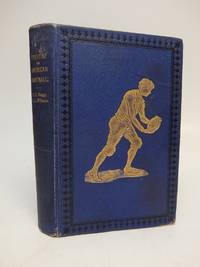
1893280411Hartford: The Case Lockwood & Brainard 1893. First. hardcover. very good. Illustrated with diagrams and explanations for 69 plays. 12mo 274 pages gilt decorated blue cloth lightly rubbed at the extremities and minimal buckling on cloth. Hartford: The Case Lockwood & Brainard 1893. Very good . Scarce.<br/><br/> Stagg and Williams' book was the first to include diagrams and explanations of plays for coaches and teams and is considered one of the Founding Documents of the American game. Amos Alonzo Stagg played football at Yale and was later inducted into the College Football Hall of Fame. Stagg and Williams' Treatise on American Football is perhaps the most important book in the history of football in the United States.<br/><br/> The Case, Lockwood & Brainard unknown books
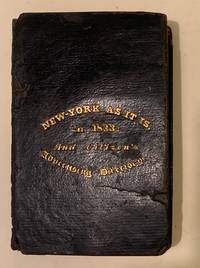
1833296434J. Disturnell 1833. Small 8vo. 4 7/8 x 3 3/8. Fine folding engraved map "of the City of New-York" by David H. Burr expressly for this guidebook engraved by S. Stiles & Co. Original black leather stamped in gilt spine repaired and map toned.<br/><br/> Contains the important folding map of New York which includes lower Manhattan up to West 34th Street Brooklyn Heights and Williamsburg.<br/><br/> J. Disturnell unknown books
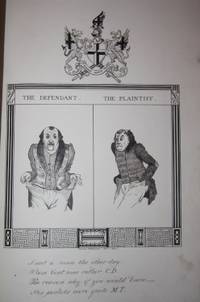
1845004565England 1845. Quarter Calf. Cloth Boards. Very Good. Eleven leaves of precise and incisive pen and ink caricatures of those involved in the courts and in medicine with sixteen original caricatures in all. Folio 37 by 27 cm. Also lovely bird butterfly and foliate vignettes ornamenting the three first pages without caricatures. The court characters include the judge the barrister the crier of the court the attorney the plaintiff the defendant witnesses for each the bailiff's follower and the sheriff. The medical cast is comprised of the apothecary the physician the quack doctor the patient the medical student and the surgeon. The writing is by a calligraphic hand and this is applied both to the flowery dedicatory and introductory pages and the sharp captioned text. <br/><br/> hardcover books
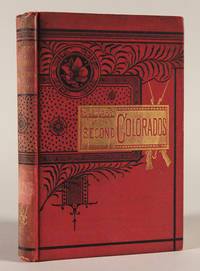
1885WRCAM51658New York: Published for the Author by Fowler & Wells Company 1885. 4178pp. Original red cloth stamped in black and gilt. Spine lightly faded and soiled extremities lightly worn. Bookplate on front pastedown. Final forty pages bound out of order but all present. Very good. A quite rare privately printed personal account by the wife of a bugler about the Civil War campaigns on the Plains and in the Rockies New Mexico Kansas Missouri and Arkansas including a unit roster for the Second Colorado Cavalry on pages 161-176. Many of the men of the Second Colorado had been miners before the war. Mrs. Williams gives an interesting view of the little-known southwestern campaigns. DORNBUSCH Colorado 166. EBERSTADT 138:171. HOWES W452 "aa." GRAFF 4676. Published for the Author by Fowler & Wells Company hardcover books
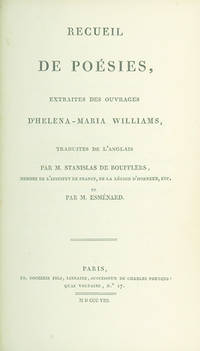
180828308Paris: Fr. Cocheris Fils Libraire 1808 1808. First and only edition. Jackson Romantic Poetry by Women Williams 8c; OCLC records 15 copies. Edges a little rubbed; fine copy. 8vo contemporary French red straight-grain morocco blue watered silk doublures with gilt-decorated borders boards spine and inner dentelles gilt lettering a.e.g. Errata. A French translation of more than 30 poems by Helen Maria Williams including ones on her real and imaginary travels: "Sonnet sur la ligne équinoxiale"; "Sonnet sur l'oiseau du tropique"; "Les glaciers des Alpes"; "Hymne composé au milieu des Alpes"; and "Nouvelle Américaine." French scholar writer and friend of Williams Charles Pougens 1755-1833 arranged the translations specifically for this sole edition; the majority of the poems were not published in English until 1823. <br/><br/> Paris: Fr. Cocheris Fils, Libraire, 1808 unknown books
1900C0416ii232 pages with diagrams index and tables. Quarto 10 1/2" x 6 3/4" bound in three quarter leather with gilt lettered spine label and original vignette affixed to front cover. Annotations by Leopold Hoffer. Provenance Galsgow Chess Club Betts: 7-36 Limited to 500 copies. First edition.<br /><br />The London 1899 chess tournament was without a doubt one of the very strongest tournaments ever held on British soil. Almost every great master of the day was present including the past and reigning world champions. It proved to be the swan song of the old champion Wilhelm Steinitz but for Emanuel Lasker it was a glittering success which propelled him way beyond the other grandmasters of the time. All important players were invited. Many of these players were the champions of the country that they represented. Refusals came from Siegbert Tarrasch and Rudolf Charousek illness. The businessman Amos Burn had to withdraw at the opening's day. Fifteen participants played double rounds from 30 May to 10 July 1899 except for Richard Teichmann. He withdrew after round 4 due to an eye disease. His remaining games in the first cycle were declared as lost. Rounds were played in St. Stephen's Hall. The time limit was fifteen moves in one hour. Participants were entertained by the City of London chess club at Crystal Palace and the Star and Garter Hotel in Richmond. A banquet took place in the International Hall of the Café Monico on 29 June. Lasker finished a whopping 4.5 points ahead of the group finished tied for second Janowski Maroczy Pillsbury. This is easily one of the more dominating personal performances in a tournament ever played. London 1899 goes down in history as one of the great Lasker victories along with St. Petersburg 1896 Paris 1900 St. Petersburg 1914 and New York 1924. There was a second section in the tournament won by Frank James Marshall with 8.5 out of 11. Georg Marco and Jacques Mieses were the most experienced opponents and the tournament was not all that strong.<br /><br />Condition:<br /><br />Glasgow Chess Club stamp liberally used through out date received and released on front end paper with secretary's initials. Some soiling through out. Rebound in attractive three quarter leather with the original vignette laid on front cover. A good to very good copy of a scarce tournament title. <br /> Longmans, Green & Co hardcover books
1819718231819. An Interesting Murder and Piracy Trial Joseph Story Presided Trial. Williams John Primary Defendant. The Trial of John Williams Francis Frederick John P. Rog Nils Peterson and Nathaniel White On an Indictment for Murder on the High Seas: Before the Circuit Court of the United States Holden for the District of Massachusetts At Boston On the 29th of December 1818. Boston: Printed by Russell and Gardner 1819. 92 pp. Octavo 9-1/2" x 5-1/2". Stab-stitched pamphlet in plain wrappers untrimmed edges. Moderate edgewear a few small tears and chips to wrappers spine abraded wrappers partially detached but secure faint inscription in pencil to head of front wrapper. Moderate toning and light foxing to text faint dampstaining to a few leaves soiling to p.92 and title page which has a chip to its lower inside corner. $1500. Only edition. Tried before Joseph Story in his capacity as the Judge of the U.S. Circuit Court for the District of Massachusetts this trial involved murders committed on the merchant schooner Plattsburgh bound from Baltimore to Smyrna. Led by Williams the accused murdered the captain and took the ship to Norway. All the defendants except White were found guilty of murder and piracy and hanged. Cohen Bibliography of Early American Law 13248. McDade The Annals of Murder 1103. unknown books
183325845New York: C.S. Williams 1833. Engraved folding pocket map period hand-colouring in outline statistical table in lower left corner. Folding index sheet. Folds into publisher's cloth-backed paper boards titled on upper cover "Williams' Travellers' Directory.". Boards worn some repaired separations at folds. Scarce map depicting the U.S. as far west as the Rockies.<br/> <br/>This small "Travellers Directory" as it is titled on the upper cover was evidently issued in competition to Mitchell's similar guide of the same year. The two guides are quite similar in terms of format folding sheets of tables facing a folding map but the map in the present guide extends significantly farther west i.e. to present-day Arizona in the southwest with the Gila River named and present-day Idaho in the northwest with Lake Wayton i.e. Lake Coeur d'Alene named. Longs and James Peaks are both named as well as the apocryphal River Buenaventura. Texas is shown as Mexico although is named as the area along the Gulf Coast of eastern Mexico from Galveston to the Sabine River. The map is generally similar in appearance to Melish's 1822 map of the U.S. but with significant differences in nomenclature. Williams would later jointly publish the maps of Texas and Mexico in Mitchell's New Universal Atlas of 1846.<br/> <br/>Streeter Sale 3847. Not in Wheat Mapping the Transmississippi West. C.S. Williams unknown books
1859WRCAM51021London 1859. xii3111pp. plus engraved frontis. Original blue cloth gilt. Minor wear to extremities else fine. Untrimmed and completely unopened. In a blue cloth slipcase. A scarce account of world travel. Williams sailed to India by way of Rio de Janeiro the Straits of Magellan Callao the Sandwich Islands Honolulu and China. He then records military operations during the Indian Mutiny in the north of India. Not in Hill. An exceptional copy of a scarce travel narrative. FORBES 2349. hardcover books
186657789Pittsburgh PA: W.S. Haven 1866. First edition. 12mo. 182 pp. "In form the society was a communistic theocracy with Rapp the actual dictator. His religious teachings were those of Lutheran pietism heavily overlaid with a millenarianism derived from Bengal and Jung-Stilling a fantastic interpretation of Swedenborg various minor features of Boehme and other mystics and the practice of celibacy . one of the most successful American communistic societies" DAB. Inscribed on the front endpaper "John B. Peebles Esq. / with sincere regards / of the Author." Howes W-445: "Includes a chapter on this Society's earlier establishment in Indiana." Adams Radical Literature in America p. 40: "It is the best account available of one of the most successful communistic societies in America." Streeter sale 4278 $325. Very good. Original gilt- stamped black cloth spine ends a little chipped. #6191. <br/><br/> W.S. Haven hardcover books
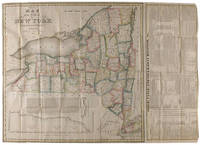
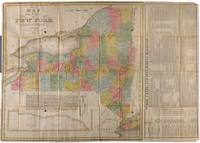
1828WRCAM29282AUtica: Published by William Williams 1828. Folding pocket map 19 3/4 x 20 1/4 inches with period outline color on a 19 3/4 x 28 1/4-inch sheet with nine columns of text entitled "Stage Canal and Steam-Boat Register" at right plus three columns of descriptive text entitled "Erie Canal." "Engraved by V. Balch & Stiles." Bound into contemporary 16mo. tan morocco wrappers stamped in gilt. Fine condition. Second edition with changes to the text from the first edition of 1827. With two insets: "Profile of the Grand Erie Canal" and "Profile of the Champlain Canal." PHILLIPS p.510. RUMSEY 4970. Published by William Williams unknown books
1828WRCAM29282Utica: Published by William Williams 1828. Folding pocket map 19 3/4 x 20 1/2 inches with period outline color on a 19 3/4 x 28 1/4-inch sheet with nine columns of text entitled "Stage Canal and Steam-Boat Register" at right and three columns of descriptive text entitled "Erie Canal" at bottom. Bound into 16mo. gilt-stamped brown leather boards. Very good. "Engraved by V. Balch & Stiles." Second edition with changes to the text from the first edition of 1827. With two insets: "Profile of the Grand Erie Canal" and "Profile of the Champlain Canal." PHILLIPS MAPS p.510. RUMSEY 4970. Published by William Williams hardcover books
18283266Utica: William Williams 1828. Engraved by V. Balch & Stiles." Period outline color 19 3/4 x 20 1/2 inches on a 19 3/4 x 28 1/4-inch sheet with nine columns of text entitled "Stage Canal and Steam-Boat Register" at right. Folding into gilt-stamped brown leather covers. Three columns of descriptive text entitled "Erie Canal." Fine condition. Second edition with changes to the text from the first edition of 1827. With two insets: "Profile of the Grand Erie Canal" and "Profile of the Champlain Canal."<br/> <br/>Phillips p.510. Rumsey 4970. William Williams unknown books
180923067.02<p>As Commander of the Corps of Engineers Jonathan Williams planned and supervised the construction of New York Harbor's defenses. In this letter to the commander of Fort Columbus on Governors Island Williams gives a detailed report on the state of the fortifications and their capacity for additional artillery.</p> <b>JONATHAN WILLIAMS.</b>Autograph Letter Signed to Richard Whiley December 1 1809 New York. 2 pp. 7¾ x 10 in.<p><b><br /></b></p><p><b>Excerpts:</b></p><p> "<i>In compliance with your verball request I sit down to give you information respecting the Artillery that may be mounted on the different Works in this City & Harbour.</i>"</p><p> "<i>The Platform at <b>Ellis Island</b> has long been ready to receive twenty Pieces of the heaviest metal on Carriages similar to those at Fort Columbus.</i></p><p> "<i>The mortar Battery on Bedlows Island is finished in part & might be ready to receive mortars of any Caliber in a short notice nothing but the removal of Earth & the platform being necessary; but the work itself is not far enough advanced to receive any Guns.</i></p><p> "<i>The Castle on the point of Governors Island has eleven french 36s mounted & Fifteen more have long been expected to arrive from the Columbian Foundery. These 26 may be ready for action as soon as they can be mounted. Although it would be prudent to avoid putting Guns on the second tier until the arches are dry yet upon an emergency 16 thirty two pounders might</i> <2> <i>be placed there immediately. The Force of this Castle when completed may be considered at least 52 heavy Guns under a Bombproof cover & 48 on the terrasse above making 100 Guns. if it were necessary 26 more might be put in the 3d tier of embrazures intended to serve as Windows to the Barracks under the arches.</i></p><p> "<i>Fort Columbus is a finished work and capable of receiving without delay one hundred and four guns of the heaviest metal although about one third of the number commanding the read of the Island need not be of greater caliber than eighteen or twenty four pounders.</i></p><p> "<i>When Bedlows Island shall be finished & the Battery off the City Battery shall be completed the first will mount about forty & the last thirty Guns. From this View you will see that the ordnance of this Harbour may be actually taken to be one hundred and sixty six Guns so far as the Fortifications are ready. And the ordnance that may be mounted when finished will be three hundred and four Guns and ten mortars without taking into acct the State Works at the narrows which are now ready to receive upward of eighty Guns.</i>"</p><p><b>Jonathan Williams</b> 1750-1815 born in Boston was the grandnephew of Benjamin Franklin. He attended Harvard College and spent most of the time from 1770 to 1785 in England and France where he inspected shipments of ammunition and supplies. In February 1801 President John Adams appointed Williams as a major in the Corps of Artillerists and Engineers. President Thomas Jefferson made Williams the Army's Inspector of Fortifications and in December 1801 appointed him the first Superintendent of the United States Military Academy at West Point. In 1802 Jefferson appointed Williams to concurrent command of the new Army Corps of Engineers.</p><p>In 1803 he left his position at West Point but was reappointed in 1805. From 1807 to 1811 he designed and oversaw construction of Castle Williams the East Battery and Castle Clinton the West Battery in New York Harbor. When Secretary of War William Eustis refused to give him command of Castle Williams he resigned in July 1812.</p><p>Right before the start of what became known as the War of 1812 New York state placed him in charge of construction of additional fortifications for New York City. He later moved to Philadelphia and helped build fortifications around that city. In 1814 he was elected to the U.S. House of Representatives but died before Congress assembled.</p><p>In 1802 investor Richard Woodhull named his acre tract in north Brooklyn Williamsburg after Williams who had surveyed the land. A member of the American Philosophical Society Williams also founded the U.S. Military Philosophical Society and gave it its motto "Science in War is the Guarantee of Peace."</p><p><b>Richard Whiley</b> 1767-1847 was born in London and came to the United States in the 1780s. He served under General Anthony Wayne in the Northwest Indian War 1785-1795 and received a commission as a lieutenant of artillery in 1796. By 1803 he was a captain of artillery and he commanded Fort Jay on Governors Island in New York Harbor from 1804 to 1806 when it was demolished. He was the commander of Fort Columbus on Governors Island from 1807 to 1809. He resigned from the military in June 1811 and lived for several years on the Hudson River near Poughkeepsie. He served as president of the North River Insurance Company for many years.</p> books
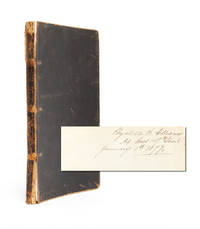
18992984New York 1899. Soft-bound sheep over card with rubbing to extremities and some loss to spine. Ownership signature to third blank: "Elizabeth B. Williams. 34 West 17th Street. January 1st 1877." Comprised of 32 handwritten pages providing a glimpse into the bohemian life of an educated woman living in New York at the turn of the century. <br/><br/>By the time of this notebook's use New York's Greenwich Village had gained a reputation as a haven for artists writers and musicians to live and gather. Boarding houses and bachelor flats like the well-known Benedick Building made the Village an affordable place even for single people to find housing that was safe and affordable. The brownstone building that Elizabeth lists as hers in the ownership signature in fact still exists allowing us to image the space in which this manuscript was used. While we've been unable to locate information on Elizabeth's history the pages here reveal her to be a woman interested in history reading and music. 13 pages focus on a range of historical facts -- including historical timelines of the Hebrews lists of British monarchs and American presidents notes on the genres of authors from the Renaissance to Romantic period and the history of landmarks in London. 4 pages with her hand notably sloppier as if writing while working make notes on musical scales and techniques for effective fingering while playing. And 9 pages reveal that for a number of years Elizabeth was involved in a Book Club as she keeps track of her reading lists for meetings by month and year including Harriet Beecher Stowe Annie Fields and Edna Lyall as well as books on Victorian Literature Social Life in Old Virginia and histories of England and Korea -- 64 titles in all.<br/><br/>Elizabeth's life was not confined to New York however. She dedicates 2 pages for example to a packing list for a voyage detailing the clothes she'll need in her trunk. Another 3 pages list addresses for friends in New York New Jersey Ohio and Illinois to whom she'll send letters while away.<br/><br/>Within these pages exist opportunities for researchers to explore genealogy practices of self-education through reading book clubs and reading habits lifestyles of women living in New York at the turn of the century musical practice and paleography. unknown books