((Williams, Edwin)Biblio.com
1 339 résultats
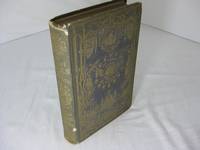
185010970New York: Edward Walker 1850. 1st Edition. Cloth. Very Good. 8vo - over 7¾ - 9¾" tall. 1st ed. A Very Good copy. Publisher's cloth with elaborate patriotic gilt decoration all edges gilt. 8vo. 364 4 pp 3 color plates plus elaborate color printed title page 12 engraved presidential portraits. Slight wear at the head and heel and tips of the cloth the cloth is gray which seems as issued as the gilt is bright. Very Good tight contents Fine. Edward Walker unknown
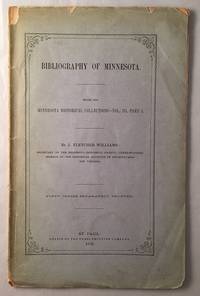
1870175St. Paul: Office of the Press Printing Company 1870. First Edition. Original wraps. Very Good. 6 1/8 X 9 1/2 Inches. 65 Pages. In original blue wraps! One of only fifty copies. Very scarce! Corners and edges are worn a bit. Spine is chipped at head and foot. Slight foxing. 100% complete. Office of the Press Printing Company unknown
1872251727Toronto: Adam Stevenson 1872. hardcover. good. 12mo original blue cloth cloth lightly soiled spine ends and edges of corners worn corners bumped. Toronto: Adam Stevenson 1872. First Canadian Edition<br/> <br/> A poem.<br/> <br/> Adam, Stevenson unknown
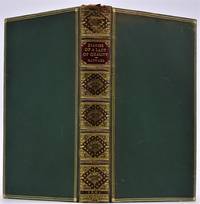
1864008184London: Longman Green Longman Roberts & Green 1864. Book. Near Fine. Hardcover. First Edition. 8vo - over 7¾" - 9¾" tall. Finely bound in contemporary green polished calf gilt back gilt top maroon end papers with wide gilt dentelles signed by Riviere & Son. Near Fine rubs to calf at spine ends. A lovely copy and RARE in First Edition. OCLC locates one copy at the British Library. Longman, Green, Longman, Roberts & Green Hardcover
1840673Philadelphia Pa. 1840. Calling Card printed one side only. 40 x 75 mm. 1 ½ x 3 inches. Painter's name scratched out and "Miss Louise Bradley West Springfield" is penciled in Engraved border pinholes. James W. Williams was a miniature portrait painter. He also experimented with early photographic processes to produce his portraits. He was born in England about 1787 and set up shop in Philadelphia. The Smithsonian holds two of his works; a Talbotype paper print with applied color of Edward Robinson Squibb and an ivory type of two girls untitled. Ivory types were positive photographic prints resembling a hand-painted ivory miniature and were first produced in the mid-1850s. As the term suggests some of these images were made on thin sheets of actual ivory or artificial ivory made of pigmented and hardened gelatin. Louise Bradley 1818-aft 1880 of West Springfield Massachusetts acquired Williams's calling card and used it as her own in this instance since she crossed out his name and penciled in her own. She married a farmer Charles White and lived and died in West Springfield. Portrait miniatures began to flourish in 16th century Europe and the art was practiced during the 17th century and 18th century but the development of photography contributed to the decline in the popularity of miniatures. . unknown
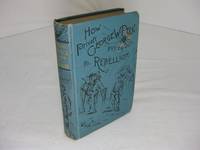
1887003452Chicago and New York: Belford Clarke & Co 1887. 1st Edition. Cloth. Very Good . True Williams. 8vo - over 7¾ - 9¾" tall. 1st edition. A Very Good copy. 8vo. x 11-316 4 pp. illustrated with a frontispiece and 15 b&w plates and 4 pages of ads. Light blue decorated cloth. Very mild soiling to the cloth. Lower tips bumped. Hinges secure. Internally clean. A Very Good copy. George Wilbur Peck 1840- 1916 was an American author and politician from Wisconsin. He served as the 17th Governor of Wisconsin and the 9th Mayor of Milwaukee. He served in the Union Army and wrote stories of his time in the army with an audience of teenagers and young adults. . Belford, Clarke & Co unknown
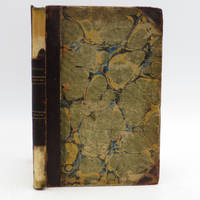
1838C218239Paris: A. and W. Galignani and Co. 1838. Hardcover Hardcover. Very Good. Octavo. 484pp. Contemporary half leather over marbled boards with gilt spine titles. Slight rubbing to covers otherwise very good indeed. Bookplate to pastedown. A. and W. Galignani and Co., hardcover
185275654Caernarvon: H. Humphries 1852. Second edition revised. Octavo 11. 1 ads pp. plus the large folding panorama bound in at the beginning. Publisher's blue printed wrappers. Spine starting minor dust soiling. Very good.The panorama is formed of twelve panels and each notable location in the Eyri Hills is described underneath. Although protected as the Eyri National Park in Wales the area is still redolent with history. A few examples of historical and mythological sites in the Eyri Hills;Yr Wyddfa's name likely comes from the word 'Gwyddfa' another word for 'grave' or 'burial-ground'. The summit of Yr Wyddfa is said to be where the medieval Welsh king Rhita Gawr was buried after a fierce battle with King Arthur. The medieval masterpiece the Mabinogi is one of Britain's earliest examples of prose. Some of the best-known stories of the Four Branches of the Mabinogi are set within the National Park's boundaries including 'Branwen ferch Llyr' and 'Math fab Mathonwy'. One of our favorite legends is that of the woman made of flowers; "One of the Mabinogi’s most iconic characters is Blodeuwedd. The Mabinogi is a collection of mythical Welsh tales divided into four parts or ‘branches’. Blodeuwedd’s story is told in the fourth branch of the Mabinogi ‘Math fab Mathonwy’ Math son of Mathonwy. A woman named Arianrhod places a ‘tynged’ fate on her son Lleu Llaw Gyffes. The fate meant that Lleu could never marry a human woman. But Lleu had an uncle named Gwydion a legendary wizard. Upon hearing Lleu’s fate Gwydion created him a wife made of flowers and named her Blodeuwedd. She was created from the flowers of the oak the flowers of the broom and the flowers of the meadowsweet. Blodeuwedd and Lleu got married but trouble was soon on the horizon. Blodeuwedd had fallen in love with Gronw Pebr a warrior and hunter from Penllyn. To solve their dilemma Blodeuwedd and Gronw decided to murder Lleu so that they could live happily together. But killing Lleu was no easy task. Lleu could only be killed in certain circumstances. He had to have one foot on a bath and one on a goat. He would then have to be stabbed with a spear—but not any old spear. It had to be a spear created over a year during Mass. Faced with such conditions Blodeuwedd and Gronw were almost hopeless—until Blodeuwedd had an idea. She asked Lleu to show her exactly how he had to stand in order to be killed. Lleu would have no suspicions about Blodeuwedd’s plan—after all he and Blodeuwedd were happily married and in love. As he stepped to stand on the bath and placed his other foot on a goat Gronw appeared from nowhere and stabbed him. Suddenly Lleu transformed into an Eagle and flew off into the night. Blodeuwedd and Gronw lived happily for a while after Lleu’s departure. But soon revenge was had on the insidious couple. Lleu and his wizard friend Gwydion returned and killed Gronw Pebr. Blodeuwedd was turned into an owl thus never being able to show her face in the light of day ever again" Snowdonia National Park Authority You need legends like these to inspire Welsh bands like Catatonia shameless plug. H. Humphries unknown
1888322644New York 1888. 72 cabinet card portraits. Full morocco gilt with metal hinge and clap gilt edges. Well worn with front joint cracked many of the "slots" for the cabinet cards empty or broken. Provenance: Edwin Johnson Gillette name in gilt on upper cover. 72 cabinet card portraits. unknown
1827044229London: Stewart Wheatley & Adlard 1827. Edition Unstated. Hardcover. Fair Condition/No Dust Jacket. 8vo. In 1/2 leather edges worn back strip partly gone hinges breaking. Top corners of pages browned & gone fire but text unaffected. Little foxing & some stains on tops of pages. Prices realized and buyers identified in ink throughout with some corrections of listings all in a contemporary hand. Size: 8vo. 197 pages. Full refund if not satisfied. Stewart, Wheatley, & Adlard hardcover
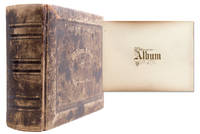
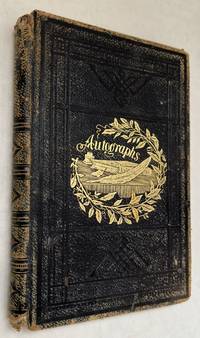
1868102470San Francisco: NP 1868. Pages clean; sturdy binding; edgewear to boards and chipping to spine; a sturdy very good - copy. Only a few pages inscribed. Leatherbound boards with raised bands embossed patterns and gilt stamping on spine and front cover; gilded edges; sewn; approx. 150 pages. The autograph book of Sarah E Williams in San Francisco dated 1868. Intricate embossing and craftsmanship a one-of-a-kind object. Features beautifully penned poems and messages from a handful of friends amidst mostly blank pages. Intricate embossing on the cover and gilded edges still gleaming. A touching and personal document of friendships in San Francisco and Stockton. [NP] unknown
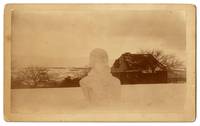
18884126531888. Unbound. Very Good. Approximately 8.5" x 5.5". Albumen photograph on card mount. Modest fading very good or better. Image depicts a snow sculpture of the bearded Corson with a large house in the background. One the verso is a contemporary note: "This is a snow bust of Prof. Hiram Corson professor of Eng. Literature. The bust was made by Mr. Harvey Williams instructor in mechanical drawing. The bust was about eight feet high." Corson was professor of rhetoric and oratory at Cornell University where he was professor of English literature at Cornell University from 1872-1903. We could find less about Harvey Williams but did learn that he was taught mechanical drawing at Cornell around 1890 when he received a promotion. Boudoir-size cards were most popular in the 1880s. unknown
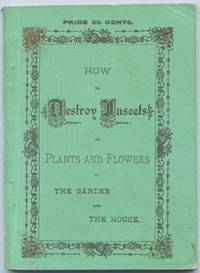
1878541096New York: Henry T. Williams 1878. Softcover. Near Fine. First edition. 24mo. 99 iii pp. Printed green glazed wrappers. Label of D.M. Farmer of Detroit over the publisher's information on titlepage contemporary name from Burlingame California on the titlepage slight wear on wrappers a handsome near fine copy. Henry T. Williams unknown
1815BOOKS036583ILondon: John Murray. Very good set in full leather. 1815. 1st. leather. 8vo 869 pp. Edited by John Eagles with his introduction and his dedication of the work to artist Benjamin West Bound in full brown leather with spines in six blindstamped panels and contrasting leather labels for the title and volume number of each; three of these labels are missing; front & rear boards with double gilt rules and and inner blindstamped rule & corner decorations; marbled endpapers and gilt-decorated board edges; hinges tight and contents clean . John Murray hardcover
1870E12968BNew York: Robert M. De Witt 1870. First edition. Hardcover. Very Good. First editon. Octavo in darl brown cloth hardcoverslettred and decorated with the figure of an orator in gilt; spine lettering gilt. 192 pp. with appendix explaining each of the 15 figure engravings in the text. Lessons in elocution and presentation using examples from the classics Shhakespeare and more contemporary workd. A tight very good example front gilt bright spine lettering a touch less so some minor spotting and wear to the cloth ornate owner's name and address of the period on the firts blank. <br/><br/> Robert M. De Witt hardcover
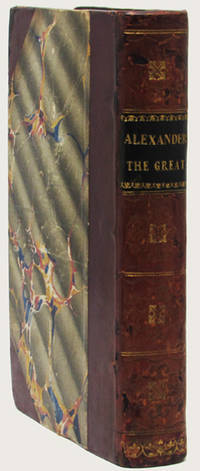
182934651London: John Murray Albemarle Street 1829. First Edition. Illustrated with a large folding map showing the campaigns of Alexander. Small 8vo handsomely bound in contemporary three-quarter calf over marbled paper covered boards the spine ruled in gilt and with a black morocco lettering label gilt. vi 402 pp. A well preserved copy handsome and in good order the binding tight and strong the text-block clean and fresh the map also in fine state. FIRST EDITION OF THIS VERY READABLE HISTORY AND BIOGRAPHY OF ALEXANDER THE GREAT. Alexander III of Macedon Ancient Greek: Aléxandros most commonly known as Alexander the Great was king of the ancient Greek kingdom of Macedon. He succeeded his father Philip II to the throne in 336 BC at the age of 20 and spent most of his reign conducting a lengthy military campaign throughout Asia and Egypt. By the age of 30 he had created one of the largest empires in history stretching from Greece to northwestern India. He was undefeated in battle and is widely considered to be one of history's greatest and most successful military commanders.<br> Born in Pella Macedon Alexander was tutored by philosopher and polymath Aristotle until the age of 16. In 335 BC shortly after assuming the throne of Macedon he launched a campaign in the Balkans and reasserted control over Thrace and parts of Illyria before marching on the city of Thebes which was subsequently destroyed. Alexander then assumed leadership of the League of Corinth created by his father.<br> With this authority over all Greeks he launched a pan-Hellenic invasion of the Persian Achaemenid Empire in 334 BC and with it began a series of campaigns which lasted for ten years. Following his conquest of Asia Minor and a series of decisive battles particularly at Issus and Gaugamela the power of the Achaemenid Empire was broken. He subsequently overthrew Darius III and conquered the Achaemenid Empire in its entirety. After the fall of Persia the Macedonian Empire held a vast swath of territory between the Adriatic Sea and the Indus River. Alexander endeavored to reach the "ends of the world and the Great Outer Sea" and invaded India in 326 BC achieving an important victory over Porus an ancient Indian king of present-day Punjab at the Battle of the Hydaspes. Facing mutiny from troops he was eventually forced to turn back at the Beas River and later died in 323 BC in Babylon Mesopotamia the city which he had planned to make the capital of his empire while on his return to Greece. Alexander's death put an end to his planned invasion of Arabia. John Murray, Albemarle Street hardcover
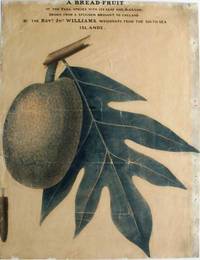
183012572London: Published by John Snow 1830. Good overall. Very rare separately published image of the bread fruit probably one of the few fruits in history to figure in a mutiny. William Bligh's mishandling of his crew who were sent to Tahiti to secure the breadfruit to feed slaves in the West Indies in the 1790s lead to the infamous Mutiny of the Bounty. John Williams traveled for the London Missionary Society in 1816 and brought back a bread fruit when he returned to England in 1834. This image derives from the William's period.<br /> <br /> Large colored lithograph with the leaf and fruit occupying most of the image. Many rubbed spots with number of small tears and one 9" closed tear into sheet. Backed on tissue paper to strengthen cracks. Some lighter discoloration on the right edge. Printed area 39.5 X 50.5 cms. Trove Libraries Australia ID 9131025 at the National Library of Australia. Published by John Snow unknown
1850List1929California 1850. With thirteen letters most multi-page written from Monterey in 1850 a 7 pp facsimile transcription of a 1834 Mexican land grant on cloth measuring 11 x 14 inches and and eleven page document on paper in Spanish relating to a Monterey land grant transcribing an 1841 document. Letters heavily worn with some loss at margins but mostly legible land grant in good to very good condition transcribed document in Spanish in fair condition with water damage to margins. Fair. An interesting archive of 1850s-era material relating to the life and career of the surveyor Edward Williams which recently surfaced in the central mother lode region. The group includes his personal letters from the California Gold Rush as well as well two interesting documents form his work for the Surveyor General J.W. Mandeville in 1858 where he transcribed two Mexican land grants. <br /> <br /> Lt. Edward Williams was a member of Company E New York Volunteers under Capt. Nelson Taylor. He came to California around 1847 and found employment as a deputy surveyor later working for the Office of the Surveyor General of the Unites States for California. In 1858 Surveyor General J.W. Mandeville commissioned a report on Mexican-era California Land Grants. Mandeville had Williams copy the original documents exactly - inclusive of an ink copy on linen that is an "exact tracing" of the original documents starting with 1834 up through about 1840. These "copies" were submitted to the Surveyor General in 1858 for use in the report. Williams continued the title work by copying other documents from about 1841 though this time not as a tracing but hand copied on the usual blue paper of the 1850s.<br /> <br /> The documents illustrate the length officials went to while they investigated Mexican Land Grant titles to California properties in the 1850s. The process was difficult and involved two distinctly separate cultures and legal systems that clearly conflicted. The Mexican Government granted rights for these large land parcels in California to various people but clearly stated they could not sell parts of the property. The wording was used many times in litigation of the period in both defense of the land grants and in opposition to how the land grants were handled. The issues were actually quite simple in that the Mexican legal standards for land grants was far different from those in the United States and the two differing forms of written land ownership and use clashed. <br /> <br /> These documents reflect a parcel of land granted to Francisco Mesa at "Corral de Tierra" a large parcel in Monterrey County California. Mesa had requested land for "his personal use and that of his family." In the Grant the title papers reflect "while the land is under Francisco's possession it cannot be divided mortgaged or a levy placed on it nor handed down." These original documents help illustrate the complex story of Mexican Land Grants in California. <br /> <br /> Also included are thirteen letters from Ed aka "Ned" to various family members primarily his mother and sister Alice and vice versa. About half are from Ed the other half are written to him. The dates of the letters are; 1850: February 10th April 15th April 16th April 28th June 10th July 30th October 11th and November 17th and 1851: September 9th. One undated letter with heavy loss is written from Panama. The letters are generally readable but the condition far from perfect with water stains throughout and chips abundant along edges and significant textual loss. The letters are generally at least two pages sometimes four or more inclusive of writing in the crossed line custom to save paper. Most are datelined at Monterrey where he discusses the people the customs setting and more. <br /> <br /> Despite the condition flaws there is much to be gleaned from his correspondence. In his April 15 1850 letter . he describes his trip to San Juan Bautista from Monterrey in detail while he was on his way to San Francisco. Williams writes of his great pleasure on tasting cooked beef by the Indians that he found was the best he ever tasted as they camped on the way to San Jose with the ultimate goal Mission Dolores in San Francisco: “this the beef they put on the embers of the fire and broiled it - I never tasted anything like it before so tender so juicy…†One of his first notes on San Francisco: "There are regular streets filled with all kinds of sorts of stores… The shipping covers the water as far as you can see. And those nearest the shore are converted into store houses the rigging being taken down and the and holes cut in the sides for doors.The best houses in town are occupied by gamblers . a large saloon filled with tables on which are played all kinds of games of chance - at some of the tables are displayed immense amounts of coin and gold in lumps worth from 1 to 5000 dollars which some poor infatuated fool of a miner has at some time lost to them."<br /> In his letter of April 16th he discusses both his difficulties with women in California and his lack of fitting in back east: “The Spanish Girls are very nice and all that sort of thing but the trouble is to find one that is educated. I can’t bear an uneducated wom an and I think I shall have to come to N.Y. and bring one out here… I know one or two in N.Y. but I don’t believe they would have such an uncouth specimen of an ‘hombre’ as me…†In his next letter he describes Carmel in detail. He states: “I haven’t been to the mines nor have I any inclination to go†though he intends to settle in California permanently. In his next letter he discusses the people he’s met and how he detests the anglophone community there: “How do I like the People Those of Spanish whom I call my friends I love with all my soul - there is not much society except among them… the Eng. and Am. population I detest from the bottom of my heart. This may sound strange but you will know the por que when you arrive.†He then praises the climate and scenery of Monterey. One letter written from Panama which has unfortunately sustained heavy losses at margins offers some details of the trip on the Chagres River. The replies to Williams from his family offer details on life in New York and are similarly compromised in condition but overall there is enough to glean from the group to provide a detailed example of family correspondence from the period. <br /> <br /> Overall a very interesting and unusual archive of a young professional who moved to California during the Gold Rush period and rejected the Anglophone mining community with particular interest to historians of Monterey and of the systems of land grants that shaped Mexican and American land policy in the nineteenth century. unknown
182942139Philadelphia: Pub. for the Proprietors by R.H. Hobson. Chesnut St. 1829. Hand-colored broadside oblong "Sketches of Character. No. 1." 9-1/4" x 13-1/2." Some light wear and wrinkling. Blank verso with extraction remnants. Good plus. <br /> <br /> "Originally from Philadelphia and later New York City Edward Clay remains an enigmatic figure. He created highly provocative racial social and political satire until late in his life. His 1829 engraving The Nation's Bulwark a Well-Disciplined Militia LC shows a lineup of bored undisciplined soldiers smoking pipes chatting barely awake confronted by a plump officer with a bottle bulging from his pocket. The slogans on the tent banners in the background 'Hurrah for Old Hickory' and 'Jackson Forever' indicate the unit's loyalty to Jacksonian principles of democracy" Recent Acquisition: Fantastical Militias at the Clements Library web site 27 October 2014.<br /> Excellent description from the Fleischer's Auction House April 2026 lot 37: "A satirical depiction of a Philadelphia militia company by the American cartoonist Edward Williams Clay 1799 - 1857. The scene portrays a motley assemblage of militiamen gathered under the command of an officer dressed in a frock coat with epaulettes and a plumed hat. In contrast to their commander's martial bearing most of the men appear in civilian clothing and stand at varying and often comically imperfect degrees of attention. Their mismatched attire and relaxed posture lend the group a distinctly humorous quality suggesting a volunteer militia whose enthusiasm exceeds its discipline. <br /> "This print was intended as the first number in Clay's proposed series Sketches of Character in which he caricatured recognizable types and personalities from contemporary Philadelphia society. Although conceived as a continuing series this appears to have been the only number issued. The figures represented are believed to be caricatures of well-known Philadelphians of the period rendered with Clay's characteristic wit and observational sharpness.<br /> "Clay was among the earliest American artists to produce sustained series of political and social caricatures in lithographic form helping to establish a distinctly American tradition of satirical printmaking in the decades before the Civil War. Prints such as the present example not only lampooned local personalities and civic institutions but also reflected the vibrant political culture of the early republic when militia companies public gatherings and partisan politics formed a visible part of urban life.<br /> "As both a humorous social commentary and an early example of American political caricature the print offers a vivid glimpse into the intersection of militia culture local identity and Jacksonian politics in nineteenth-century Philadelphia."<br /> Weitenkamp 215. Reilly 1829-1. OCLC 299947406 2- LCP DLC as of June 2026. The Clements Library and Brown University also own copies. AAS and Penn do not own it according to their web sites. Pub. for the Proprietors by R.H. Hobson. Chesnut St. unknown
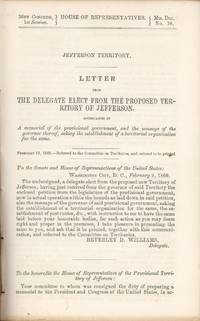
186037664Washington D.C.: n.p. 1860. First edition. Modern stitched paper wrappers. A very good copy clean and unmarked stitched in plain paper wrapper with paper label. 15 pp. 8vo. 36th Congress 1st Session. House of Representatives. Mis. Doc. No. 10.<br /> <br /> Including most of present day Colorado the territory of Jefferson as a briefly lived unrecognized political entity caused by the need for governnance due to the population explosion caused by the Pike's Peak Gold Rush commencing in 1858. Includes a detailed descritpion of the gold rush as well as the other mineral resources of the territory and also a census of the newly created towns whose combined population reached 8000: Denver 1100 Auraria 1000 Golden City 900 Arrappahoe 400 Colorado at the foot of Pike's Peak 300 and "Mountain City in the mining region" 800. n.p. unknown
181841562<p><strong>1818 US NAVY Rules Regulations Crowninshield USS PEACOCK Provenance Pirates WOW</strong></p><p>Exceptionally rare the "<em>Rules Regulations and Instructions for the Naval Service of the United States</em>" is a formal guidebook created under the authority of Benjamin Williams Crowninshield the Secretary of the Navy 1815-1818 to streamline and standardize practices across the naval forces of the United States. <strong>First published by Edward De Krafft in Washington 1818</strong> the book was a response to an Act of Congress from February 7 1815 during James Madison's presidency which called for the establishment of the Board of Commissioners to oversee the Navy Department. This text served to guide the transition of the Navy into a peacetime force after the War of 1812 laying out detailed instructions for various ranks and positions from yard personnel and warrant officers to high-ranking officials. It covers a wide array of topics including ship maintenance naval ceremonies discipline and provisions as well as specific instructions for surgeons pursers marines and midshipmen. The regulations also provided for the handling of convoys and established <strong>clear guidelines for salutes military honors and other ceremonies. This text played a crucial role</strong> in shaping the growth structure and discipline of the U.S. Navy during the early 19th century especially during the presidencies of James Monroe John Quincy Adams and Andrew Jackson.</p><p><strong>This particular copy belonged to the famous USS Peacock a sloop-of-war that played a significant role in the U.S. Navy during the early 19th century!</strong> Commissioned during the War of 1812 it was part of various naval operations including suppressing piracy in the Caribbean and patrolling South American waters during regional independence movements. After decommissioning in 1827 it was rebuilt for exploration and participated in the United States Exploring Expedition in 1838 eventually meeting its end on the Columbia Bar in 1841. The ship also took part in diplomatic missions such as conveying Francis Baylies to Argentina and engaging in treaty negotiations in Asia. Throughout its service the Peacock navigated various challenges including severe weather conditions and health crises among the crew. The fascinating post-war exploits of the USS Peacock's diplomatic and explorational missions are recorded in American diplomat Edmund Robert's notes that were published in 1837 under the title "<em>Embassy to the Eastern Courts of Cochin-China Siam and Muscat in the U.S. Sloop-of-war Peacock</em>".</p><p>Item number: #41562</p><p>Price: $2500</p><p>CROWNINSHIELD Benjamin Williams; BOARD OF NAVY COMMSIONERS OF THE UNITED STATES</p><p><strong><em>Rules Regulations and Instructions for the Naval Service of the United States: Prepared by the Board of Navy Commissioners of the United States with the Consent of the Honorable the Secretary of the Navy; In Obedience to an Act of Congress Passed Seventh February 1815 Entitled "An Act to Alter and Amend the Several Acts for Establishing a Navy Department by Adding Thereto a Board of Commissioners."</em></strong></p><p>Washington: E. De Krafft 1818. First Edition.</p><p><u>Details</u>:</p><p><!-- if !supportLists-->· <!--endif-->Collation: Complete</p><p><!-- if !supportLists-->o <!--endif-->75 26 ii</p><p><!-- if !supportLists-->· <!--endif-->Provenance: <strong>Handwritten – U.S. Sloop-of-War Peacock</strong></p><p><!-- if !supportLists-->o <!--endif-->"<em>For the use of the U.S. Sloop of War. Peacock - It is to be observed that the attendences or additions in pencil or in writing are not a part of the regulation to be observed but should all be erased. -Morris 2 March 1832</em>"</p><p><!-- if !supportLists-->o <!--endif-->The USS Peacock was a sloop-of-war warship with a single gun deck in the United States Navy during the War of 1812.</p><p> <!--endif-->The Peacock was authorized by an act of Congress March 3 1813 laid down July 9 1813 by Adam and Noah Brown at the New York Navy Yard and launched on September 19 1813. Peacock served in the War of 1812 capturing twenty ships. Subsequently the ship <strong>served in the Mediterranean Squadron and in the "Mosquito Fleet" which fought to suppress Caribbean piracy. She patrolled the South American coast during the colonial wars of independence.</strong></p><p> <!--endif-->The Peacock was decommissioned in 1827 and broken up in 1828 to be rebuilt as USS Peacock intended as an exploration ship. She sailed as part of the <strong>United States Exploring Expedition in 1838</strong>. Peacock ran aground and broke apart on the Columbia Bar without loss of life in 1841.</p><p> <!--endif-->The fascinating post-war exploits of the USS Peacock's diplomatic and explorational missions are recorded in American diplomat Edmund Robert's notes that were published in 1837 under the title "<em>Embassy to the Eastern Courts of Cochin-China Siam and Muscat in the U.S. Sloop-of-war Peacock</em>".</p><p><!-- if !supportLists-->· <!--endif-->References: Sabin 74115</p><p><!-- if !supportLists-->o <!--endif-->Provenance: Edmund Roberts <em>Embassy to the Eastern Courts… 1837 – </em>Forbes 1123; Sabin 71884</p><p><!-- if !supportLists-->· <!--endif-->Language: English</p><p><!-- if !supportLists-->· <!--endif-->Binding: Leather secure</p><p><!-- if !supportLists-->· <!--endif-->Exceedingly rare and desirable!</p><p>Our Guarantee:</p><p>Very Fast. Very Safe. Free Shipping Worldwide.</p><p>Customer satisfaction is our priority! Notify us with 7 days of receiving and we will offer a full refund without reservation!</p><p>41562</p><p>Photos available upon request.</p> E. De Krafft hardcover
189856525Denver CO: The Chamber of Commerce Printed by the Carson-Harper Co. 1898. Oblong 4to. 9.75 x 8.25 in. 43 5 pp. Photo frontisp. decorated title photo & text illustrations throughout. Beige printed softcovers gilt lettering on front cover punch sewn at spine w/ red silk braid yapp edges couple minor closed tears very minor sunning still VG copy. First edition of this very scarce and lavishly illustrated land promotion work for Denver sent to the national Encampment of the Grand Army of the Republic meeting in Cincinnati OH in Sept. 1898 to pitch the Rocky Mountain capital for the 34th Encampment in 1899. The boosters have included information on the climate and medical advantages to visiting Denver mining and agricultural resources typical Denver homes the Country Club live stock industry and more. Unfortunately Denver was unable to secure the required 1¢ a mile rate required by the Encampment Committee so it was awarded to Philadelphia. Worldcat locates 1 copy Denver Public. The Chamber of Commerce, Printed by the Carson-Harper Co., paperback
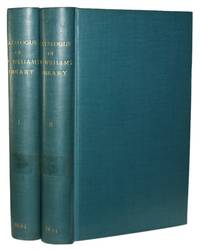
1841AQ14661London: Printed and Sold by Richard and John E. Taylor 1841. In two volumes. viii 420; 2 438pp. Recent green cloth lettered in gilt. Extremities a trifle marked. Internally clean and crisp but for light marginal damp-staining and browning to first three gatherings of Vol. II. An inventory of the printed material housed within the theological research library founded in 1729 with proceeds originating from the estate of Presbyterian minister Daniel Williams c.1643-1716 a supplement not present here was issued in 1870. The collections which aside from theological holdings include works of philosophy history and literature were greatly enlarged over the years with a plethora of significant donations; Williams's original benefaction of approximately 7600 books now forms only a small part of the modern library. After several moves the trustees acquired University Hall in Gordon Square London where the library opened in 1890 and remains today. The catalogue includes mention of the library's copy of Shakespeare's First Folio sold at Sotheby's in 2006 for £2.8 million. . First edition. 8vo. Printed and Sold by Richard and John E. Taylor hardcover
18396351Baudry's European Library 1839. 1st edition. Hardback. Cloth VG. 415pp lacks endpaper but with half title foxed throughotu but readable a fair copy cloth rubbed & worn. A fictional account of the formative years of Shakespeare. Volume CCXL in the Collection of Ancient & Modern British Authors. Baudry's European Library hardcover
182471004h<p>London: G. and W. B. Whittaker 1824. Book. Very Good. Hardcover. 12mo - over 6¾ - 7¾" tall. Contemporary full gilt green calf with marbled edges and endpapers. Expertly rebacked retaining original gilt spine and titling. With a hidden fore-edge paining of a marine scene of a sailing skiff and village in distance. Light scuffing and soiling to covers; edges toned. Old bookseller's label and previous owners' bookplates inside front cover. Otherwise clean tight and unmarked. Very neat -- a sound and handsome copy. .</p> G. and W. B. Whittaker hardcover