69 444 résultats
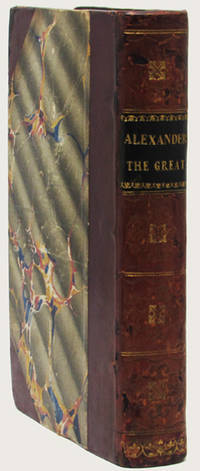
182934651London: John Murray Albemarle Street 1829. First Edition. Illustrated with a large folding map showing the campaigns of Alexander. Small 8vo handsomely bound in contemporary three-quarter calf over marbled paper covered boards the spine ruled in gilt and with a black morocco lettering label gilt. vi 402 pp. A well preserved copy handsome and in good order the binding tight and strong the text-block clean and fresh the map also in fine state. FIRST EDITION OF THIS VERY READABLE HISTORY AND BIOGRAPHY OF ALEXANDER THE GREAT. Alexander III of Macedon Ancient Greek: Aléxandros most commonly known as Alexander the Great was king of the ancient Greek kingdom of Macedon. He succeeded his father Philip II to the throne in 336 BC at the age of 20 and spent most of his reign conducting a lengthy military campaign throughout Asia and Egypt. By the age of 30 he had created one of the largest empires in history stretching from Greece to northwestern India. He was undefeated in battle and is widely considered to be one of history's greatest and most successful military commanders.<br> Born in Pella Macedon Alexander was tutored by philosopher and polymath Aristotle until the age of 16. In 335 BC shortly after assuming the throne of Macedon he launched a campaign in the Balkans and reasserted control over Thrace and parts of Illyria before marching on the city of Thebes which was subsequently destroyed. Alexander then assumed leadership of the League of Corinth created by his father.<br> With this authority over all Greeks he launched a pan-Hellenic invasion of the Persian Achaemenid Empire in 334 BC and with it began a series of campaigns which lasted for ten years. Following his conquest of Asia Minor and a series of decisive battles particularly at Issus and Gaugamela the power of the Achaemenid Empire was broken. He subsequently overthrew Darius III and conquered the Achaemenid Empire in its entirety. After the fall of Persia the Macedonian Empire held a vast swath of territory between the Adriatic Sea and the Indus River. Alexander endeavored to reach the "ends of the world and the Great Outer Sea" and invaded India in 326 BC achieving an important victory over Porus an ancient Indian king of present-day Punjab at the Battle of the Hydaspes. Facing mutiny from troops he was eventually forced to turn back at the Beas River and later died in 323 BC in Babylon Mesopotamia the city which he had planned to make the capital of his empire while on his return to Greece. Alexander's death put an end to his planned invasion of Arabia. John Murray, Albemarle Street hardcover
1970143281Chicago: Alligator Records 1970. Archive of seven vintage promotional photographs for Alligator Records recording artists circa 1970s. <br /> <br /> Founded in 1970 independent blues label Alligator Records continues to release music to this day. Included are images of Ed Williams Lonnie Brooks Maurice John <br /> Vaughn and Lil Ed and the Blues Imperials. <br /> <br /> 8 x 10 inches. Fine. Alligator Records unknown
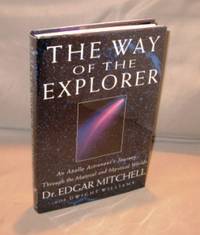
199625653New York:: Putnam 1996. First Printing of the First Edition. A Fine copy in a Fine unclipped dust jacket. Inscribed by astronaut Mitchell on the half-title page. Apollo 14 astronaut Mitchell offers a vision in which technology and intuition are harmonized in pursuit of a more advanced consciousness. When Mitchell was hurtling back to earth after walking on the moon in 1971 he had a profound sense that all things are interconnected and that the universe is an intelligent process with which we need to link up. We hear how Mitchell began a career as a fighter pilot in the years following WW II switched to NASA with the hope of being part of the new space program and came to know the legendary Wernher von Braun whom he believes was a true visionary rather than a Nazi opportunist. Mitchell tells how while returning to earth he carried out a private ESP experiment that seemed to yield positive results. Subsequently he founded the Institute of Noetic Sciences in order to test paranormal phenomena scientifically. He offers us a tour of Western thought from Aristotle to Newton arguing that intuition and science were divorced until the advent of Einstein and quantum physics. We hear a lot about synchronicity left and right brain and the concept that psychic events are quantum exchanges in the brain that link us with the larger world. From "Kirkus". Putnam, unknown
195562224Salem OR: Traffic Engineering Division Planning Survey Section Oregon State Highway Commission June 1955. Oblong folio. 15.5 x 11 in. 151 1 pp. With maps colour maps diagrams 5 colour mylar overlays civil highway engineering elevation drawings tables charts. Original tan softcovers plastic-comb binding as issued wear bumping creasing to text block some soiling & tidemark to back cover edgewear front cover retained and affixed w/ paper tape repair still a good reference copy from the library of A. Rodney Eckerson 1930-2024 former purchasing agent for the Port of Portland. First edition of this groundbreaking highway engineering urban planning and “blight†redevelopment plan released the year before funding began flowing to underwrite 90% of the eventual 42500 mile interstate freeway “Expressway†system. Oregon leaders had contracted with New York urban planner Robert Moses†in 1943 to develop a public works program and highway building plan for the state which included a series of core recommendations reflected in this later 1955 Traffic Engineering Technical Report prepared by Baldock & Williams who pitched in the report that Portland be carved up by a series of freeways and cleared of blighted urban neighborhoods. The Banfield Freeway which later became I-84 through East Portland was completed first in 1958 and largely was built over the remnants of a vast shanty town in Sullivan Gulch but the construction of I-5 through North Portland began in earnest in 1962 directly demolishing 300 homes and bisecting the African-American Lower Albina neighborhood which at the time was the heart of the city’s only majority black neighborhood. The original colour mylar overlays depict the projected growth of the city and the increasing demand for roads as the interurban and electric railway system was either decommissioned or condemned and automobiles were the focus of transport into and around the city. Also included here is the proposed route for the Mount Hood Freeway which was to run through East Portland all the way to Mt. Hood and by 1969 had received the necessary funding but by then considerable residential backlash had built primarily due to the fact that the proposed Stadium Freeway I-405 ended up bisecting and leveling the former neighborhoods North & West of downtown Portland near Goose Hollow increasing removal of houses in North Portland along the I-5 construction was particularly bitter and the introduction of the early plans for I-205 set off a revolt in Lake Oswego that would have as planned divided the community separating the schools from their community. Eventually after the election of Mayor Neil Goldschmidt the Mount Hood Freeway project would finally be canceled and the Federal money poured into mass transit projects. Although 11 copies are located in Worldcat privately owned copies for sale in the trade are quite scarce; See: Val Ballestrem “In the Shadow of a Concrete Forest:†Transportation Politics in Portland Oregon and the Revolt Against the Mount Hood Freeway 1955-1976 2009; Cortright How a Freeway Destroyed a Neighborhood and May Again 2019; Raymond Mohl The Interstates and the Cities: Highways Housing and the Freeway Revolt 2002. Traffic Engineering Division, Planning Survey Section, Oregon State Highway Commission, paperback
196062419Gallup NM & Detroit MI: Navajo Motors Inc. General Motors Corp. Chevrolet Motor Division ca. 1960. 4to. 16 pp unpaginated. thick card stock and mylar sleeves w/ 16 silver gelatin photographs slipped-in sized 7.5 x 9.5 in. Contemporary 1950’s padded brown album post-binder screw-posts at gutter margin black marker title on spine minor edgewear very minor starting to outer lower hinges still VG bright exemplar w/ pencil MS annotations on ffep. A sleek Mid-20th-Century souvenir presentation album capturing the heyday of a 1958 Chevy dealership at the height of their business. The album opens with crisp clear photos of the signage and exterior of the dealership showroom followed by interior views capturing the Bel-Air Sport Sedan 4-door hardtop two-tone in the fore-ground setting next to the Chevy Delray with the Biscayne and 4-door Chevy Nomad station wagon in the backgrounds featuring signage and sales literature on racks at the back of the showroom. Of particular interest are images of the 1958 Chevrolet showroom album on stand in the sales office seated on the counter. Other photos show the parts department accessories service bays with 1950’s Chevy trucks and autos in the bays and one featuring the reat ends of 1957 Chevy Suburban and 1957 Chevy Bel Air 2-door being serviced. Also featured are shots of the Navajo “OK Cars†used Chevy car lot filled with assorted 1950’s Chevy autos pickups and stave commercial trucks. The company was originally founded in 1927 by James M. Williams 1886-1978 who had moved to McKinley New Mexico on the Zuni Reservation from North Carolina in 1910 to set up a trading post with the Zuni and learned several of the Native American languages as well as contributed significantly to local tribal charities. Later in 1927 first opened a dealership in Gallup NM selling Chevrolet automobiles which continued to grow and thrive through World War II into the post-War era taken over by his son Charles Williams 1915-1996 who was a huge Good Roads Movement proponent sat on the New Mexico Highway Commission and was also breeder of Appaloosa Horses. Navajo Motors Inc., General Motors Corp., Chevrolet Motor Division, unknown
191658155Boston & New York: Houghton Mifflin Co. 1916. 8vo. 2 61 1 pp. Illustrations in silhouette on calendar pages charts diagrams. Quarter-blue cloth over beige-illustrated boards minor dustsoiling to fore-edges minor shelfwear w/o ffep. w/ d.j. cover art by Gluyas Williams minor chipping head & foot of spine small tear upper fore-edge front cover still G/VG- copy. First edition of this humorous take on the impact of automobiles and automobile travel in the early 20th Century and was the first illustrated book by Williams while he was working for The Youth’s Companion children’s magazine. The work incorporates short humor stories of the Brass Era motorist previously published in the magazine and Williams’ silhouette illustrations outlined and filled in with black were similar in appearance to models used in Chinese shadow theatre. Williams 1888-1982 would later become well known for developing Michelin tire’s advertising campaigns during the Roaring 20’s featuring his cartoon character “Bibendum†often advising consumers on the advantages of Michelin tires. See: Pau. Medrano-Bigas Gluyas Williams Humorous and Cartoon Illustrator in: The Forgotten Years of Bibendum. Michelin’s American Period in Milltown: Design Illustration and Advertising by Pioneer Tire Companies 1900-1930 2015 pp. 1706-1707. Houghton Mifflin Co., hardcover
192964033Indianapolis IN: Marmon Motor Car Company 1929. 4to. 8 pp unpaginated. leporello accordion-style colour lithographed throughout by the Dayton OH Reynolds & Reynolds Co. self-printed colour-illustrated lithograph softcovers Roosevelt emblem badge on front cover former salesman markings of Jerry Parmeuter on front cover & w/ pricing info inside in ink MS still a VG- copy. First edition of this very rare original dealership brochure for the very popular Marmon automobile The Roosevelt whose line-up included a 5-passenger sedan a Victoria Coupe and a Collapsible Coupe with rumble seat and was not only the most reasonable 8-cylinder automobile marketed at the end of the Roaring 20’s but the first to come stock with a car radio. Although a hit under Williams with sales of nearly 24000 automobiles Marmon collapsed under the impact of the Great Depression and by 1933 had been sold off including their final dream car of the Marmon Sixteen of which fewer than 400 were ever built. No copies in Worldcat. Marmon Motor Car Company, paperback
201216538Paris, Les classiques illustrés - editions Williams , 1974 ; petit in-4, 48 pp., br. BROCHÉ très bon état - collection les classiques illustrés n°10 - illustrations de A. Alex Blum.
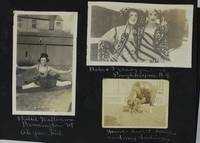
19205819Various locations 1920. Very good. 51 leaves illustrated with 205 sepia-toned photographs in mounting corners and another handful loose in the album or stored behind other images about a third captioned in white pencil on the album leaves. Oblong quarto. Contemporary black cloth. Moderate soiling and edge wear. Minor occasional wear to photographs. Manuscript inscription on inside front cover reads "Miss Peggy Williams. Bates Bro. Musical Follies." A personal vernacular photograph album kept by Miss Peggy Williams of the Bates Brothers Musical Follies a popular touring circus in the first half of the 20th century. Williams performed as a clown for the Bates Brothers some of which she documents in the present album. Williams likely worked mainly in the 1920s although the range of time represented by the present album runs from roughly 1920 to the late 1960s. The album captures Williams and other members of the Bates Brothers Musical Follies otherwise known as the Bates Brothers Musical Comedy Company while on tour through Nova Scotia and New England with stops in Halifax and Truro as well as Keen New Hampshire; Poughkeepsie New York; Bennington Vermont; Orchard Beach Maine; and other locations. <br /> <br /> The photographs depict the company taking to the road standing beside advertisements dressed in circus attire with white face paint practicing splits and forming human pyramids in their down time. The images capture the troupe largely during recreation times with no images of the performances themselves. Some of the images are studio portraits of the performers. Much of the album captures Williams in slightly later times largely in a domestic capacity. These images include family portraits casual family settings Williams' mother her dog her husband school portraits of unidentified children and other images of babies and friends.<br /> <br /> A pasted advertising sign visible in the background of a few photos touts the Bates company as "A jingling laugh show of mirth melody and dance." These signs indicate the main performers as Kimmie Evans and Dora Davis which should help researchers more accurately date the pictures here. Peggy Williams must have acted in a supporting role as she does not appear to be featured on the company's posters at the time of these photos. Bill Bates is pictured and named as the manager of the eponymous Bates Brothers Musical Follies in which Miss Williams got her start. Two pages refer to the set of the film Arctic City in which Williams played a small role. This set was located in Port Henry New York. A wonderful primary source record of one woman's work as a clown during the Roaring Twenties. unknown
201907737Paris, Editions RST collection caravelle , 1964 ; in-4, 152 pp., cartonnage de l'éditeur. Editions RST collection caravelle.
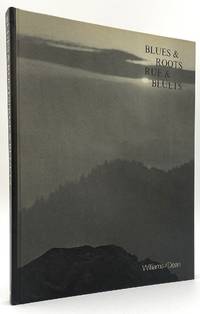
2738Boards sunned and bowed; offsetting to endleaves; dust wrapper creased and toned. Very good. <p>Jonathan Williams and Nicholas Dean. Blues & Roots Rue & Bluets: A Garland for the Appalachians. New York: Grossman Publishers 1971. First edition. <br /> With Bill Wittliff ink ownership stamp and signature. <br /> Quarto. Unpaginated. Illustrated with b/w photos by Nicholas Dean. Publisher's hardcover illustrated boards original glassine dust wrapper. <br /> From the collection of Bill Wittliff highly regarded book designer typographer photographer and screenwriter from Austin Texas founder of the Encino Press.<br /> </p> . unknown
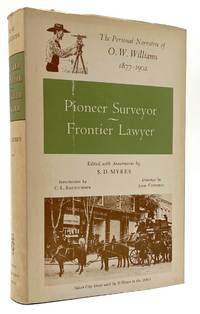
2710Spine rubbed and worn; light toning and wear to slipcase else fine. O. W. Williams. S. D. Myres editor. C. L. Sonnichsen introduction. José Cisneros illustrator. Pioneer Surveyor - Frontier Lawyer: The Personal Narrative of O. W. Williams 1877 - 1902. El Paso TX: Texas Western College Press 1966. Limited edition No. 121 of 150 numbered copies. <br /> Signed by S. D. Myres C. L. Sonnichsen José Cisneros Clayton W. Williams and Carl Hertzog. <br /> Octavo. 350pp. Illustrated with b/w photos; maps and sketches by José Cisneros. Green quarter cloth over brown cloth-covered boards spine lettered in blind yellow top-stain marbled endleaves publisher's slipcase printed prospectus laid-in. With bookplate of William W. Wittliff his copy. <br /> <br /> <p>From the collection of Bill Wittliff highly regarded book designer typographer photographer and screenwriter from Austin Texas founder of the Encino Press. </p> . unknown
2779Minor toning and wear to boards; light foxing to textblock edges; small stain to title page; jacket lightly creased and toned. Very good. <p>O. W. Williams. S. D. Myres editor. C. L. Sonnischen introduction. José Cisneros Illustrator. Pioneer Surveyor - Frontier Lawyer: The Personal narrative of O. V. Williams 1877 - 1902. El Paso TX: Texas Western College Press 1966. First edition. <br /> Octavo. 350pp. Illustrated with b/w photos; maps and sketches by José Cisneros. Brown quarter over green cloth-covered boards spine lettered in black front cover decorated in brown green top-stain endleaves in brown original unclipped dust jacket.<br /> From the collection of Bill Wittliff highly regarded book designer typographer photographer and screenwriter from Austin Texas founder of the Encino Press. </p> . unknown
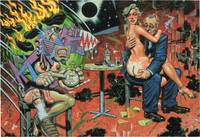
1992168353New York: Jive Records 1992. Vintage postcard promoting the 1992 release of the album "Sex and Violence" featuring Robert Williams' painting used for the album art on the recto with the quote printed on the verso over a Boogie Down Productions BDP logo "Ya can't see there is no intelligence ya can't see there is no common sense when you think of entertainment as sex and violence. Peace KRS One / Metaphysician" and a label for "Downtowm sic Music Gallery" New York and a "Feb 25 '92" postmark on the verso.<br /> <br /> 8 x 5.5 inches. Light toning to the extremities of the verso else Near Fine. Jive Records unknown
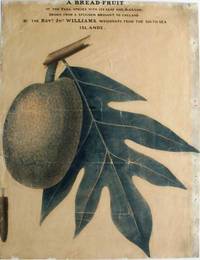
183012572London: Published by John Snow 1830. Good overall. Very rare separately published image of the bread fruit probably one of the few fruits in history to figure in a mutiny. William Bligh's mishandling of his crew who were sent to Tahiti to secure the breadfruit to feed slaves in the West Indies in the 1790s lead to the infamous Mutiny of the Bounty. John Williams traveled for the London Missionary Society in 1816 and brought back a bread fruit when he returned to England in 1834. This image derives from the William's period.<br /> <br /> Large colored lithograph with the leaf and fruit occupying most of the image. Many rubbed spots with number of small tears and one 9" closed tear into sheet. Backed on tissue paper to strengthen cracks. Some lighter discoloration on the right edge. Printed area 39.5 X 50.5 cms. Trove Libraries Australia ID 9131025 at the National Library of Australia. Published by John Snow unknown
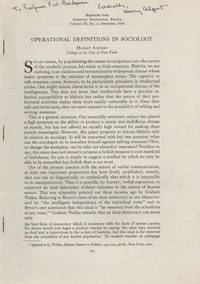
193829926AB1938. New York American Sociological Review 1938. Octavo. 8 pages. Original Offprint / Stapled. Very good condition with some minor signs of wear only. From the library of Nobel Laureate Percy Bridgman. Reprinted from American Sociological Review - Volume III No.6 December 1938. Harry Alpert 1912 1977 was an American sociologist best known for his directorship of the National Science Foundation's NSF social science program in the 1950s. During his time at the NSF 1953-1958 Alpert guided the development of the U.S. NSF's earliest efforts to provide funding to the social sciences and helped to establish the agency's basic policy framework for funding social science research and fellowships. In his short five-year term as director Alpert was able to establish a viable policy framework for NSF funding that would help to demonstrate both the value and scientific legitimacy of social science research. Born to a Jewish family in New York City Alpert completed his undergraduate studies at the City College of New York in 1932 before enrolling in Columbia University's graduate program in sociology the following year. Alpert's strong interest in French sociology took him to the French universities of Paris and Bordeaux from the period of 1932-1933. After completing his master's degree in 1935 and his doctoral degree in 1938 Alpert took up a postdoctoral fellowship at the University of Chicago from the period of 1940-1941. Although Alpert was interested in a range of foundational issues regarding the social sciences Alpert's doctoral dissertation as well as a number of his early publications focused on the famous French sociologist Emile Durkheim. In an attempt to promote Durkheim's social theories to American academic audiences many of Alpert's early studies as well as his highly influential book Emile Durkheim and His Sociology aimed to clarify how Durkheim understood the ontology of the social word social science methodology relations between the social and natural sciences and the social relevance of social science. After Alpert received his Ph.D. in 1938 he worked as an assistant professor of sociology at the City College of New York. Wikipedia Percy Williams Bridgman April 21 1882 August 20 1961 was an American physicist who received the 1946 Nobel Prize in Physics for his work on the physics of high pressures. He also wrote extensively on the scientific method and on other aspects of the philosophy of science. The Bridgman effect the BridgmanStockbarger technique and the high-pressure mineral bridgmanite are named after him. Wikipedia unknown
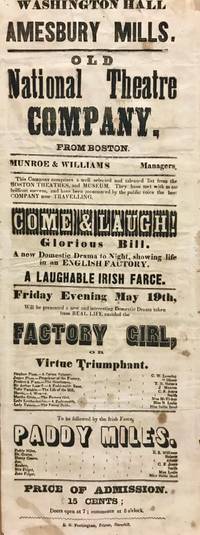
35626Boston Amesbury: E. G. Frothingham Printer Haverhill n.d. Broadside. Fair. Broadside approx. 17" x 6". Broadside is pasted down on old peach colored thin cardboard. Some light corner and edge chipping to the board and paper. Light toning to the paper. No date provided. The National Theatre was in existence in Boston from 1836-1863. These plays were held at Amesbury Mills a prosperous industrial location north of Boston. Printed under the top heading of the broadside - "This Company comprises a well selected and talented list from the BOSTON THEATRES and MUSEUM. They have met with most brilliant success and have been pronounced by the public voice the best COMPANY now TRAVELLING." The plays performed on Friday Evening May 19th include:<br /> <br /> Come and Laugh! Glorious Bill. A new Domestic Drama to Night showing life in an ENGLISH FACTORY. A LAUGHABLE IRISH FARCE.<br /> <br /> FAC-TORY GIRL or VIRTUE TRIUMPHANT<br /> <br /> PADDY MILES an Irish Farce. The National Theatre in Boston was founded in Boston and was active from 1836-1863. From wikipedia: The National Theatre 1836-1863 was a theatre in the West End of Boston Massachusetts in the mid-19th century.12 William Pelby established the enterprise in 1836 and presented productions of "original pieces and the efforts of a well selected stock company which with few exceptions have been American. The scenery is of the highest order and the business of the stage well directed. Mr C.A. Eaton made his debut at this theatre and here Mr. F.S. Hill's early labors were eminently successful. Mr. J.S. Jones has written and produced on this stage thirty pieces embracing every department except tragedy."3 William Washburn designed the building erected on the site of the former Warren Theatre. Performers at the National included Edwin Adams Marietta Zanfretta Jean Margaret Davenport4 Julia Dean Jonathan Harrington W.H. Smith5 Mary Ann Vincent and Billy Whitlock. In 1852 the theatre burnt down and was rebuilt.6 In 1863 the building was again destroyed by fire.7 E.B. Williams was listed as a manager for the company but there is no mention of Munroe. <br /> <br /> The Amesbury and Salisbury Mills Village Historic District is a historic district on Market Sq. roughly bounded by Boardman Water Main and Pond Streets in Amesbury Massachusetts. It was the site of significant industrial development between 1800 and 1875 during which time the town developed a significant textile processing industry. Among the buildings in the district is the Salisbury Mill #4 a four-story brick Greek Revival building which features dentil decorations on its eaves and towers.2 The district was listed on the National Register of Historic Places in 1985.1 wikipedia<br /> <br /> The printer Edward Gilman Frothingham 1811-1875 was a writer and owner of the Haverhill Gazette from 1843-1869. From the OCLC site most of the publications listed in World Cat by Frothingham spanned years 1858-60. Some publications were done in 1866. No listing for this broadside has been found. Also used source: Genealogical and Personal Memoirs: Relating to the Families of Boston.By William Richard Cutter. E. G. Frothingham, Printer, Haverhill unknown
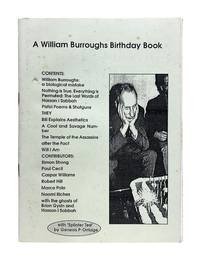
1994WB053Brighton England: Temple Press Limited 1994 First edition. Publisher's pale green stapled wrappers printed in black. Very good with light spotting to spine light spotting to wrappers and a small puncture to front wrapper. Overall a wonderful tribute to the great experimental American author and Beat guru. In editor Paul Cecil's note at the beginning of the book he writes "The pieces that make up this book were prepared for the 'Burroughsday' celebrations that took place at the Phoenix Gallery Brighton on 5th February 1994 the occasion of the 80th birthday of William S. Burroughs. The event itself in many ways mirrored Burroughs' own approach to literature and art being a random coming together of discrete connections that were collaged into a 'whole'. Alongside video and soundbites numerous artists writers and performers presented their work some of which is included here." The book's contributors include Burroughs himself Paul Cecil Robert Hill Catherine Lupton Genesis P-Orridge Naomi Riches Simon Strong and Caspar Williams. . First Edition. Original Wrappers. Very Good. [Brighton, England]: Temple Press Limited paperback
1850List1929California 1850. With thirteen letters most multi-page written from Monterey in 1850 a 7 pp facsimile transcription of a 1834 Mexican land grant on cloth measuring 11 x 14 inches and and eleven page document on paper in Spanish relating to a Monterey land grant transcribing an 1841 document. Letters heavily worn with some loss at margins but mostly legible land grant in good to very good condition transcribed document in Spanish in fair condition with water damage to margins. Fair. An interesting archive of 1850s-era material relating to the life and career of the surveyor Edward Williams which recently surfaced in the central mother lode region. The group includes his personal letters from the California Gold Rush as well as well two interesting documents form his work for the Surveyor General J.W. Mandeville in 1858 where he transcribed two Mexican land grants. <br /> <br /> Lt. Edward Williams was a member of Company E New York Volunteers under Capt. Nelson Taylor. He came to California around 1847 and found employment as a deputy surveyor later working for the Office of the Surveyor General of the Unites States for California. In 1858 Surveyor General J.W. Mandeville commissioned a report on Mexican-era California Land Grants. Mandeville had Williams copy the original documents exactly - inclusive of an ink copy on linen that is an "exact tracing" of the original documents starting with 1834 up through about 1840. These "copies" were submitted to the Surveyor General in 1858 for use in the report. Williams continued the title work by copying other documents from about 1841 though this time not as a tracing but hand copied on the usual blue paper of the 1850s.<br /> <br /> The documents illustrate the length officials went to while they investigated Mexican Land Grant titles to California properties in the 1850s. The process was difficult and involved two distinctly separate cultures and legal systems that clearly conflicted. The Mexican Government granted rights for these large land parcels in California to various people but clearly stated they could not sell parts of the property. The wording was used many times in litigation of the period in both defense of the land grants and in opposition to how the land grants were handled. The issues were actually quite simple in that the Mexican legal standards for land grants was far different from those in the United States and the two differing forms of written land ownership and use clashed. <br /> <br /> These documents reflect a parcel of land granted to Francisco Mesa at "Corral de Tierra" a large parcel in Monterrey County California. Mesa had requested land for "his personal use and that of his family." In the Grant the title papers reflect "while the land is under Francisco's possession it cannot be divided mortgaged or a levy placed on it nor handed down." These original documents help illustrate the complex story of Mexican Land Grants in California. <br /> <br /> Also included are thirteen letters from Ed aka "Ned" to various family members primarily his mother and sister Alice and vice versa. About half are from Ed the other half are written to him. The dates of the letters are; 1850: February 10th April 15th April 16th April 28th June 10th July 30th October 11th and November 17th and 1851: September 9th. One undated letter with heavy loss is written from Panama. The letters are generally readable but the condition far from perfect with water stains throughout and chips abundant along edges and significant textual loss. The letters are generally at least two pages sometimes four or more inclusive of writing in the crossed line custom to save paper. Most are datelined at Monterrey where he discusses the people the customs setting and more. <br /> <br /> Despite the condition flaws there is much to be gleaned from his correspondence. In his April 15 1850 letter . he describes his trip to San Juan Bautista from Monterrey in detail while he was on his way to San Francisco. Williams writes of his great pleasure on tasting cooked beef by the Indians that he found was the best he ever tasted as they camped on the way to San Jose with the ultimate goal Mission Dolores in San Francisco: “this the beef they put on the embers of the fire and broiled it - I never tasted anything like it before so tender so juicy…†One of his first notes on San Francisco: "There are regular streets filled with all kinds of sorts of stores… The shipping covers the water as far as you can see. And those nearest the shore are converted into store houses the rigging being taken down and the and holes cut in the sides for doors.The best houses in town are occupied by gamblers . a large saloon filled with tables on which are played all kinds of games of chance - at some of the tables are displayed immense amounts of coin and gold in lumps worth from 1 to 5000 dollars which some poor infatuated fool of a miner has at some time lost to them."<br /> In his letter of April 16th he discusses both his difficulties with women in California and his lack of fitting in back east: “The Spanish Girls are very nice and all that sort of thing but the trouble is to find one that is educated. I can’t bear an uneducated wom an and I think I shall have to come to N.Y. and bring one out here… I know one or two in N.Y. but I don’t believe they would have such an uncouth specimen of an ‘hombre’ as me…†In his next letter he describes Carmel in detail. He states: “I haven’t been to the mines nor have I any inclination to go†though he intends to settle in California permanently. In his next letter he discusses the people he’s met and how he detests the anglophone community there: “How do I like the People Those of Spanish whom I call my friends I love with all my soul - there is not much society except among them… the Eng. and Am. population I detest from the bottom of my heart. This may sound strange but you will know the por que when you arrive.†He then praises the climate and scenery of Monterey. One letter written from Panama which has unfortunately sustained heavy losses at margins offers some details of the trip on the Chagres River. The replies to Williams from his family offer details on life in New York and are similarly compromised in condition but overall there is enough to glean from the group to provide a detailed example of family correspondence from the period. <br /> <br /> Overall a very interesting and unusual archive of a young professional who moved to California during the Gold Rush period and rejected the Anglophone mining community with particular interest to historians of Monterey and of the systems of land grants that shaped Mexican and American land policy in the nineteenth century. unknown
19801649864Matrix Publications 1980. First Edition. hardcover. Used-Very Good. Cloth no dj. as issued. Slipcased. Signed. Slight shelf-wear to boards and slipcase. Sunning to spine and some discoloration to front of slipcase. Otherwise good clean copy. Matrix Publications unknown
201111646Paris, Librairie arthème fayard - collection savoir, 1947 ; in-8, 377 pp., br. Comme neuf - broché -.
19089180New York: Frederick Stokes 1908. First edition. Pictorial Cloth over Boards. Very Good; pasting has been carefully done resulting in fine illustrations. Oblong Quarto pp. 18 richly illustrated w/ color drawings cut-out and paste book with cutouts expertly done. Scarce and better than average copy with lovely early drawings of railroads Frederick Stokes hardcover
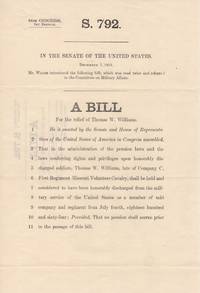
1922List2720Butte Montana 1922. Approximately 113 pieces: fifty-one letters to Thomas Williams; thirteen to various politicians mainly members of Congress; and twenty to Williams’ advocates mostly from Congresspeople; fifteen miscellaneous items including Grand Army of the Republic materials and Williams’ citizenship document; and fourteen empty envelopes. Materials date from between 1911 and 1922. Near fine with normal wear. Thomas W. Williams 1845–1931 was born outside of Swansea Wales and died in a Soldier’s Home in Los Angeles California. According to his obituary he came to the United States in about 1857 as a very young boy briefly left to learn blacksmithing in Toronto Canada and then returned stateside. He enlisted with the Union army at the outbreak of the Civil War shortly before he turned 16 and served in the 1st Missouri Cavalry of Volunteers Company C. After the war he was a resident of Butte Montana to or from which many of these letters are written.<br /> <br /> Offered here is a large lot of materials relating to Williams’ efforts late in life to secure a veteran’s pension for his service – or at least to have his 1864 dishonorable discharge expunged from his record. Williams enlists a number of people to help him with this task including fellow 1st Cavalry veteran Abraham Brokaw several local attorneys and the mayor of Butte. Their letters on Williams’ behalf are mainly addressed to congressmen mostly from Montana whose replies start out with polite deferrals—they would of course love to do anything in their power to help but these matters are difficult and now is simply not the right time—but devolve into accusations and firm denials.<br /> <br /> According to Williams he had served with Company C until his honorable discharge in May of 1864 at which point he immediately reenlisted. He received a thirty-day furlough on reenlistment and decided to visit his uncle in Hamilton Ontario as he had no other family on the continent. On attempting to return to his post:<br /> <br /> “As I was not of age my uncle held me and prevented me from returning to my command. I tried to get away so as to get back ran away twice but was recaptured twice my uncle having a letter from my mother instructing him to hold me as I would only be 19 on Sept 15 1864. I was branded as a deserter when I applied for a copy of my discharge.†December 11 1919<br /> <br /> His record prior to this he claims had been stellar as he lays out in an eleven-page notarized statement as part of his appeal May 3 1922. He describes being sent as a member of General Frémont’s bodyguard into the First Battle of Springfield:<br /> <br /> “we were sent to lexington to drive Price and the Rebels out of Mo. we camp about 20 miles away in a viliage before we reached Springfield and General Freemont called the Body guard out at 2 oclock in the morning for volenteers we came out . we did not know where we were going. after we had gone a few miles we had a fight with the Rebels pickets and whiped and drove them away and we went two or three miles towards Springfield . we made the charge and drove the rebels out there were 2200 of them. we laid out in the prairies all night without Hat Coat or Blanket to keep us warm and Held our Horses by the Bridel all nightâ€.<br /> <br /> The men “formed a camp near Springfield and you can see cut in a large rock the name of Camp Bliss which I cut and the dait of the year.†When Frémont was ordered back to Washington he ordered a dispatch sent from Springfield to Sedalia which Williams carried<br /> <br /> “132 miles from 8 oclock in the morning on our same Horses. and only one drink of water for our selves our Horses from the time we left camp that night untill 11 oclock when we arrived in Seidailia we then returned to Springfield with General Hunters comand escorted General fremont to Rollaâ€.<br /> <br /> The men go on “to Levenworth Kansas and the Bushwackers fought us all the wayâ€. They winter in Leavenworth and are then sent to “Independence Mo to drive Quantrell and his gang out of North Mo†– that is William Quantrill and his Raiders an infamous pro-Confederate guerilla group. Williams writes:<br /> <br /> “We left the Sargent of Co E. in Kansas City to get our mail and a citizen and his son was with him Quantrell gang captured them and striped the both and placed them in a fence corner and killed them Both and placed fence rail over them and Burned them up and left the Boy see them do this he came to our Captain Miles Kehoe who sent us out in squads on all the roads and we captured 9 of the Rebles Captain line them up and told the Boy to pick out the man that killed his father . they coart Marcheled him and Hanged him the next morning at 8 oclock Capt Kehoe let the others go and told them if they were caught in any thing But a fair fight he would Hang them tooâ€.<br /> <br /> Quantrill’s men heed Keogh’s warning and go much easier on six of the company’s men who are captured while searching for more feed for the horses:<br /> <br /> “Quantrals gang caught them after disarming took them to a farm house gave them supper and sent some of his men around and collected all the young ladies they could get and an old Mo fidler they danced all night and then Quantral gave them Brekfast and sent them to there camps this was the last trouble we had with him and his gangâ€.<br /> <br /> At this point Williams does admit to running into some trouble himself: another soldier “started to curse queen Victoria and I hit him . my Welch Blood could not stand to hear himâ€. Williams asks the soldier what he “would do to a man if he damned presedent Lincoln†and the soldier<br /> <br /> “went and swore I damned the president and I was Coart Marceled and sent to Alton then a Military Prison and at the Cort Marshal they did not alow me to say one word to protect myself when I arrived at Alton I explained the whole afair to the officer who had charge of this prison he advised me to write to president Lincolnâ€.<br /> <br /> Williams is shortly released from prison and sent back to his post at Little Rock; in later tellings of the story by Williams’ advocates including in a resolution of the Grand Army of the Republic Lincoln personally ordered Williams released. Willliams’ company fights in the Battle of Prairie D'Ane and then camps with “a comand of Jenensons coulered troopsâ€â€”probably Colonel Charles Jennison—who were “attacked by the rebles†and “shot at them and then went at them with Bainets and drove them for miles it was a Sight to see the dead rebles how they were Killedâ€. Shortly before his initial discharge Williams’ company goes on to Camden where:<br /> <br /> “some of our troops were on picket and those not on guard were asleep around a fire and the rebles made a charge and shot the Boys around the fire after that the Boys took logs and put Hats and overcoats on the logs and the Rebles tryed the same game But was caught in a trapâ€.<br /> <br /> Finally Williams is discharged reenlists and is furloughed and heads to Canada where his troubles begin.<br /> <br /> He first appeals to fellow 1st Missourian Abraham Brokaw since Brokaw could act as a witness to his claims. In their correspondence Brokaw sometimes recalls interesting anecdotes from the war including the “dirty irishman thief and libertine†Kelley “who the boys you will call to mind was going to hang at Little Rock for steeling our postals†April 18 1912 and a “band of gurillas from Ark. that had captured and was holding the little town†of Ozark Missouri who “had got word of our coming and left for parts unknown a few hours before our coming†January 26 1915.<br /> <br /> The letters to Williams and his advocates are frustrating – what he’s told is inconsistent and he makes little progress. First he has to get confirmation of his first honorable discharge which he seems to receive around September of 1916. Then he applies for a pension; however the office of the Bureau of Pensions writes to him the following year that his pension “claim was rejected November 13 1916 on the ground that you were never honorably discharged from the only contract of service you entered into during the Civil War†August 31 1917. A month later the Missouri Adjutant General writes a certificate of his service which “clears your record both here and in Washington†and congratulates him “on receiving at last your just due as a Veteran so richly merited†September 20 1917. By the end of the year though he is still trying to clear the desertion charge and has now resorted to trying to pass a bill in congress to do so. Montana Senator Thomas Walsh writes that “I have tried very hard to secure a favorable report . but have been unable to induce the Military Committee to take action thereon†December 11 1917.<br /> <br /> The congressmen to whom he appeals—including Senators Walsh Tom Stout and Henry Myers and Representatives Frank W Mondell Carl W Riddick and Henry Z Osborne—are less than helpful. They often claim that there is insufficient time remaining in the current congressional session remind him that such bills are difficult to pass even in favorable circumstances and ask him to furnish them with the same information he has already provided. After years of this Senator Myers suddenly tells Charles Juttner one of Williams’ advocates a very different story about Williams’ service:<br /> <br /> “The report of the War Department shows that in March 1863 Mr. Williams was tried by court-martial on a long list of serious charges and that he was found guilty on all of them; that he was sentenced to imprisonment at hard labor for the duration of the war or at least until his term of enlistment should expire and that other penalties were assessed against him one of which was that at the expiration of his term of imprisonment he should be dishonorably discharged from the Army. It appears however that after having been imprisoned nearly a year the remainder of his sentence was remitted and that he was allowed to rejoin his company and that he did rejoin it in February 1864. The records of the War Department however show that July 4 1864 at St. Louis while on furlough Mr. Williams deserted and never rejoined the army.†July 18 1921<br /> <br /> A letter from the War Department Adjutant General adds the details that he “was found guilty . of conduct prejudicial to good order and military discipline and of disobedience to orders†and that his sentence had included “a ball and chain weighing twelve pounds attached to his leg†and the forfeiture of all present and future pay and allowances January 16 1922.<br /> <br /> It is difficult to say which account is true. Myers however had given some telling further reason that Williams’ bill might have been rejected:<br /> <br /> “There is an intense prejudice in Congress against such bills. . The senators and representatives seem to think that such a bill is merely a prelude to an application for a pension and the expenses of the government are now so enormous and the expenses of providing for the veterans of the World War are so great . that there seems to be a general disposition in Congress not to increase the Civil War pension list any more by a single dollar.â€<br /> <br /> Overall a record of one veteran’s experience dealing with the federal government. Of interest to scholars of the American Civil War and postbellum civilian life both for its firsthand accounts of engagements in the trans-Mississippi theater and for the look it offers at the treatment of veterans. unknown
201607058Geneve, Edito services sa, 1973 ; in-12, 270 pp., cartonnage de l'éditeur.
182942139Philadelphia: Pub. for the Proprietors by R.H. Hobson. Chesnut St. 1829. Hand-colored broadside oblong "Sketches of Character. No. 1." 9-1/4" x 13-1/2." Some light wear and wrinkling. Blank verso with extraction remnants. Good plus. <br /> <br /> "Originally from Philadelphia and later New York City Edward Clay remains an enigmatic figure. He created highly provocative racial social and political satire until late in his life. His 1829 engraving The Nation's Bulwark a Well-Disciplined Militia LC shows a lineup of bored undisciplined soldiers smoking pipes chatting barely awake confronted by a plump officer with a bottle bulging from his pocket. The slogans on the tent banners in the background 'Hurrah for Old Hickory' and 'Jackson Forever' indicate the unit's loyalty to Jacksonian principles of democracy" Recent Acquisition: Fantastical Militias at the Clements Library web site 27 October 2014.<br /> Excellent description from the Fleischer's Auction House April 2026 lot 37: "A satirical depiction of a Philadelphia militia company by the American cartoonist Edward Williams Clay 1799 - 1857. The scene portrays a motley assemblage of militiamen gathered under the command of an officer dressed in a frock coat with epaulettes and a plumed hat. In contrast to their commander's martial bearing most of the men appear in civilian clothing and stand at varying and often comically imperfect degrees of attention. Their mismatched attire and relaxed posture lend the group a distinctly humorous quality suggesting a volunteer militia whose enthusiasm exceeds its discipline. <br /> "This print was intended as the first number in Clay's proposed series Sketches of Character in which he caricatured recognizable types and personalities from contemporary Philadelphia society. Although conceived as a continuing series this appears to have been the only number issued. The figures represented are believed to be caricatures of well-known Philadelphians of the period rendered with Clay's characteristic wit and observational sharpness.<br /> "Clay was among the earliest American artists to produce sustained series of political and social caricatures in lithographic form helping to establish a distinctly American tradition of satirical printmaking in the decades before the Civil War. Prints such as the present example not only lampooned local personalities and civic institutions but also reflected the vibrant political culture of the early republic when militia companies public gatherings and partisan politics formed a visible part of urban life.<br /> "As both a humorous social commentary and an early example of American political caricature the print offers a vivid glimpse into the intersection of militia culture local identity and Jacksonian politics in nineteenth-century Philadelphia."<br /> Weitenkamp 215. Reilly 1829-1. OCLC 299947406 2- LCP DLC as of June 2026. The Clements Library and Brown University also own copies. AAS and Penn do not own it according to their web sites. Pub. for the Proprietors by R.H. Hobson. Chesnut St. unknown