Le Duc, Philippe fl 1664-5Biblio.com
96 résultats
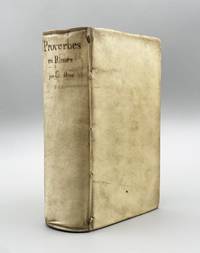
166512246Paris: G. Quinet 1665. Contemporary vellum over stiff boards scuffed light soiling flat spine with manuscript title. <p>       Only Edition of this collection of some 6000 proverbs on marriage fortune lust doctors lawyers confessors wine women food and household management. For this Le Duc put many common sayings into rhyming couplets including numerous misogynistic maxims with which Le Duc claims in his preface not to agree with. A poem on personal hygiene diet exercise and sleep closes the book. In good condition some spots inscription “4 7bris 1689 Amsterdam†on verso of final flyleaf bookplate of the Belgian book and art collector Anselme Van Den Bogaerde 1766-1866; Catalogue 1866 3923.<br /> ¶Viollet-le-Duc Catalogue des livres composant la bibliothèque poétique 523-4 “rareâ€; Cioranescu 41567.</p> G. Quinet unknown
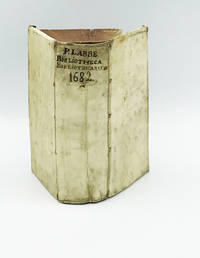
1682008911Leipzig: Joh. Christ. Wohlfahrt 1682 In-12 engraved title 37 ff 671 1 pp 38 pp. Cont. yapp vellum edges painted red manuscript title on spine biding rubbed corners bumped spine slightly creased both titles somewhat brittle some pages toned as the book seems to be used at some point as a herbarium. Forth edition of the first bibliography of bibliographies first edition Paris 1664 Compiled by French Jesuit scholar Philippe Labbe 1607-1667 the book quickly became an indispensable guide in the rapidly expanding field. "It's basically an alphabetical list arranged by author's first names followed by eight intricate subject indices among them one of publisher's and bookseller's catalogues." Breslauer & Folter. "In addition to Labbe's work this edition features with a separate title and pagination a concise guide to numismatics titled 'Bibliotheca nummaria' authored by the English jurist and scholar John Selden 1584-1654. VD17 12:154454C Joh. Christ. Wohlfahrt hardcover
166441105Paris: Gaspar Meturas Père & Fils 1664. 12mo 15x85 cm. Contemporary calf spine gilt with ribbons a few sl. imerf. to hinges and corners. xxiv420 pp. with small woodcut on title. Pp. 1-66 'La petite méthode' and pp. 67-420 'La grande méthode . tirez . de l'Alliance Chronologique'. - Good copy Gaspar Meturas, Père & Fils unknown
166682624Parisiis: Simonem Benard 1666. First Edition . Hardcover. Good/No Jacket Issued. 8vo - over 7¾" - 9¾" tall. hardcover with original leather spine and rear cover and later leather front cover xvi 1-626 pp plus 44 index pages binding chipped and rubbed internally a very good clean and complete copy. scarce. <br/> <br/> Simonem Benard hardcover
1667010880Lyon: Les Libraires de la compagnie 1667. Book. Good. Full-Leather. 24mo - over 5 - 5¾" tall. Derniere edition revenue & augmentee de plus de la troisieme partie en plusieurs endroits. 4 separate publications bound in one volume. 14 690; 4 41; 32; 63 pages. Lacks pieces at the top and bottom of the spine old writing on front and rear endpapers. . Les Libraires de la compagnie Hardcover
164400211635Molinis/Moulins Petrus Vernoy 1644. Softcover. Fair. Vellum; 64 unnumbered pages followed by 272 numbered pages; This geographical dictionary contains the research of the historian and chronologist Philippe Labbé 1607-1667 on the names of cities and places of France appearing in ancient geographical texts. Each name studied has its version in French. This book was criticized by the geographer Sanson. Please also check all the pictures.; Traces of use; pages 233/234 and 235/236 in wrong order; few notes on page 236; traces of use Molinis/Moulins, Petrus Vernoy paperback
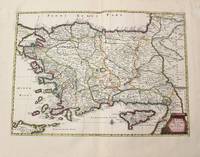
1700M10229Amsterdam: Jean Covens & Corneille Mortier 1700. Very Good. Notes: Detailed map of Turkey showing Cyprus. Size : 381x530 mm 15.00x20.87 Inches Coloring: Original Hand Coloring Category: Maps Asia Near East Turkey; Maps Mediterranean Islands; Jean Covens & Corneille Mortier unknown
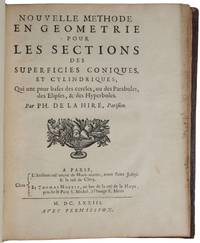
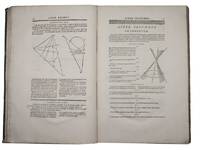
16766349Paris; Paris: chez l'autheur et Thomas Moette; n.p. 1676. First edition. <p>First edition extremely rare of these two works of which the Nouvelle Méthode is the first substantial treatment of projective geometry explicating the Brouillon Projet of Girard Desargues 1591-1661. "The BrouillonProjet 1639 was published in an edition of only 50 copies and won very little support . Projective geometry secured a place in mathematics only with the publication of a book by Philippe de Hire 1673" Stillwell Mathematics and its History.</p>. PROJECTIVE GEOMETRY SECURES A PLACE IN MATHEMATICS. <p>First edition extremely rare of these two works of which the Nouvelle Méthode is the first substantial treatment of projective geometry explicating the Brouillon Projet of Girard Desargues 1591-1661. "The BrouillonProjet 1639 was published in an edition of only 50 copies and won very little support. In fact its reception was generally hostile and Desargues was engaged in a pamphleteering battle for years with his detractors. At first his only supporters were Pascal most of whose work on projective geometry is also lost and the engraver Abraham Bosse. Desargues became discouraged by the attacks on his work and left the dissemination of his ideas up to Bosse who was not really mathematically equipped for the task. Projective geometry secured a place in mathematics only with the publication of a book by Philippe de Hire 1673. It seems quite likely that La Hire's book influenced Newton see below" Stillwell p. 153. Michel Chasles writing in 1837 noted that La Hire's work is "extrêmement rare" Chasles p. 128. "The treatise of 1673 is where De La Hire shows himself to be truly original and innovative and which leads us to regard him as one of the founders of modern geometry" translated from ibid. "La Hire certainly read the Rough Draft on Conics Brouillon Projet thoroughly; for a long time the only known copy of the work was one made by La Hire himself in 1679. Possibly he made his own handwritten copy of the Rough Draft on Conics from a printed copy belonging to his father the painter Laurent de la Hire 1606-1656 a pupil of Desargues and a friend and colleague of Abraham Bosse at the Académie. Philippe de la Hire had by then written his first book on geometry his Nouvelle Méthode en Géométrie . It too has become extremely rare and he was later to write that his new method had been found difficult because it involved planes and solids" Field & Gray p. 37. La Hire's point of view in his Nouvelle Methode was entirely projective. He regarded all conics as projections of circles and used the harmonic division of four points which he showed was projectively invariant to obtain theorems about poles and polars. The work is in two parts. In the first pp. 1-72 La Hire treats conics as sections of the cone which are then projected onto the plane of the base of the cone; this approach was later expanded in his Sectiones conicae 1685. In the second Les Planiconiques pp. 73-94 he treats conics by entirely planar methods; Chasles notes that this part which Chasles regards as the more original "offered the first sufficiently general method for transforming figures of one kind into other figures of the same kind". The Planiconiques was published one year after the Nouvelle Méthode and was not added to all copies the Lyon and Marburg copies of the Nouvelle Méthode end at p. 72. The second work in the present volume De Cycloid Lemma is even rarer than the Nouvelle Méthode. It presents a geometrical construction of the tangent at any point of the cycloid - the method was discovered by Descartes and Fermat but they did not publish it. OCLC lists 12 copies of the Nouvelle Méthode worldwide Columbia only in US and 6 copies of De Cycloide Lemma of which three are bound with the Nouvelle Méthode including Columbia and three are bound separately BL Erfurt & Lyon the first two of which hold the Nouvelle Méthode. It is unclear how many of the copies of the cycloid pamphlet are complete as several lack the plate e.g. the BNF copy. RBH lists only the Macclesfield copy of the Nouvelle Méthode since 1961 bound with De Cycloide Lemma but lacking its plate and no other copy of the cycloid pamphlet.</p> <br /> <p>"When Desargues circulated fifty copies of his Brouillon Project d'une Atteinte aux Événemens des Rencontres du Cone avec un Plan Rough Draft of an Essay on the results of taking plane sections of a cone in 1639 he was contributing to a lively contemporary study of geometry. Descartes's novel algebraic methods had been published two years before and in 1639 Mydorge published a more classical treatment of the conic sections. The classical authors themselves were increasingly well studied. Desargues had available Commandino's Latin edition of Euclid's Elements published in 1572 as well as his Latin edition of the first four books of Apollonius' Conics published in 1566 with extensive commentaries by Eutocius Pappus and Commandino himself. The last four books of the Conics were unknown in Desargues' time" Field & Gray p. 1.</p> <br /> <p>"The Brouillon Projet on conics of which he published fifty copies in 1639 is a daring projective presentation of the theory of conic sections; although considered at first in three-dimensional space as plane sections of a cone of revolution these curves are in fact studied as plane perspective figures by means of involution a transformation that holds a place of distinction in the series of demonstrations. But the use of an original vocabulary and the refusal to resort to Cartesian symbolism make the reading of this essay rather difficult and partially explain its meager success.</p> <br /> <p>"Although he praised the unitary conception that inspired Desargues Descartes doubted that the use of geometry alone could yield results as good as those that a recourse to algebra would provide. As for Fermat he reserved his judgment and the only geometer who really comprehended the originality and breadth of Desargues's views was the young Blaise Pascal who in 1640 published the brief Essay pour les Coniques inspired directly by the Brouillon Projet. But since the great Traité des Coniques that Pascal later wrote has been lost Desargues's example survived only in certain of the youthful works of Philippe de La Hire and perhaps in a few essays of the young Newton" DSB.</p> <br /> <p>"Philippe de la Hire 1640-1718 published three treatises on conics in 1673 in 1679 and in 1685. From the point of view of modern geometry the treatise of 1673 is by far the most original. Unfortunately because of its rarity it did not have a very wide circulation and today too many historians of science pass over it in silence concentrating instead on the Latin treatise of 1685 which is merely a development of the first part of the treatise of 1673. Although La Hire in a note attached to his copy of the Brouillon Projet of Desargues claims not to have known the treatise of Desargues until after 1673 and not to have been inspired by it it seems to us on the contrary that this inspiration is manifest. A first reason is that La Hire's father the king's painter was a diligent student of Desargues's oral lectures so it would be very surprising if he were unaware of the existence of this treatise and were unable to make its content known to his son. The second and most important reason is drawn from the study of the text. It seems that La Hire knowing at least the spirit of Desargues's treatise has tried to derive from it a work using the same principles but avoiding the faults that were the source of the violent criticisms by Desargues's adversaries.</p> <br /> <p>"Indeed La Hire seems to want to make a synthesis of the theories of Desargues while giving them a classical gloss . His method . amounts to deducing the projective properties of an arbitrary conic in space situated on a cone with a horizontal circular base from the properties of the base circle via the intermediary of the projection of the conic section onto the plane of the base. He uses in fact the properties of cylindrical projection for the passage from the curve in space to its projection and of homology for the passage from the conic to the projection of the base circle.</p> <br /> <p>"The method for studying the properties of conic sections 'in the cone' led quite logically to another procedure for studying them which consists in deducing directly - in the plane - every conic from a circle by a homology. This is the object of the second part of La Hire's small treatise titled Les Planiconiques. This very ingenious method is applied with the aid of several lemmas on the elementary properties of homology. So here apparently we have a treatise which although inspired by the ideas of Desargues is not afraid to develop them further" translated from Taton pp. 204-205.</p> <br /> <p>Chasles pp. 128-9 describes the method of the Planiconiques as follows. "Suppose that we have in a plane two straight lines parallel to each other which the author calls the formatrice and directrice and a point called the pole.Through each point M of a given curve in the plane one draws in an arbitrary direction a transversal; it meets the directrix at a point which one joins to the pole by a line;and the former at a second point through which we draw a parallel to this line.This parallel meets the straight line which goes from the point M to the pole in a point M' which is said to be formed by the point M.Each point of the proposed curve will thus form a corresponding point of a second curve. The points of a straight line form points belonging to a second straight line and these two straight lines will intersect on the formatrice.Finally the points of a circle will form the points of a conic section. Such is the method by which De La Hire studied in the plane without the need for any solid nor any other plane than that of the figure the sections of a cone.This is what he called reducing the cone and its sections to a plane."</p> <br /> <p>"Whiteside has pointed out Mathematical Papers of Isaac Newton VI 271 n.70 that the Nouvelle Méthode received a favourable review probably from CoIlins in 1676 and that Newton may have read it for Hooke wrote to him mentioning it in 1679. There are certainly similarities between ingenious projective transformations described by both men . In Book I of his Principia Newton showed how to solve all of the six different problems of the form: find the conic through k points and tangent to m lines k m = 5. In the course of accomplishing this feat he introduced a projective transformation capable as he remarked of transforming any conic to a circle . It is strikingly similar to the one given by La Hire in his Planiconiques which was printed in the same volume as his Nouvelle Méthode" Field & Gray p. 37. The Nouvelle Méthode also influenced Leibniz. "The ideas of Desargues and Pascal led Leibniz to a 'dynamical' vision of geometry. In the years 1672-76 Leibniz was in Paris where he greatly increased his mathematical knowledge. In 1673 he was informed on Desargues' perspective through La Hire's Nouvelle Méthodeen Géométrie ." Del Centini & Fiocca.</p> <br /> <p>Determining the properties of the cycloid the curve traced out by a point on the circumference of a circle as it rolls along a straight line served as a test bed for the techniques of seventeenth century mathematics. The earliest significant work on the cycloid is due to Gilles Personne de Roberval 1602-75 who obtained many of its properties before 1636 although he kept his results secret and they remained unpublished until 1693. Roberval in particular gave a construction of the tangent at a point on the cycloid using his method of 'composition of movements' a precursor of the differential calculus. This problem was also solved by Pierre de Fermat and René Descartes although they also did not publish their work. It was instead first published by La Hire in the first part of his De Cycloide Lemma pp. 1-4. The remainder of this little pamphlet is devoted to a problem relating to conics which is perhaps why it is often although not always found bound together with the Nouvelle Méthode.</p> <br /> <p>Chasles AperVu historique des Méthodes en Géométrie 1837. Del Centini & Fiocca 'Boscovich's geometrical principle of continuity and the 'msyteies of infinity' Historia Mathematica 45 2018 pp. 131-175. Field & Gray The Geometrical Work of Girard Desargues 1987. Stillwell Mathematics and its History 3rd edition 2010. Taton Le Prehistoire de la 'Geometrie moderne' Revue d'Histoire des Sciences et de leurs Applications 2 1949 pp. 197-224.</p> <br/> <br/> 4to 201 x 162 mm. Nouvelle Méthode: pp. viii 94 with 25 folding engraved plates 10 bound before title page 15 at end of volume the last 2 referring to Les Planiconiques woodcut vignette on title woodcut initials head- and tail-pieces. De Cycloide Lemma: pp. 6 with 13 figures on one plate cut up with each figure tipped in at the appropriate place in the text. chez l'autheur et Thomas Moette; [n.p.] unknown
16766181Paris; Paris: chez l'autheur et Thomas Moette; np 1676. First edition. <p>First edition extremely rare of these two works of which the Nouvelle Méthode is the first substantial treatment of projective geometry explicating the Brouillon Projet of Girard Desargues 1591-1661. "The BrouillonProjet 1639 was published in an edition of only 50 copies and won very little support . Projective geometry secured a place in mathematics only with the publication of a book by Philippe de Hire 1673" Stillwell Mathematics and its History.</p>. PROJECTIVE GEOMETRY SECURES A PLACE IN MATHEMATICS. <p>First edition extremely rare of these two works of which the Nouvelle Méthode is the first substantial treatment of projective geometry explicating the Brouillon Projet of Girard Desargues 1591-1661. "The BrouillonProjet 1639 was published in an edition of only 50 copies and won very little support. In fact its reception was generally hostile and Desargues was engaged in a pamphleteering battle for years with his detractors. At first his only supporters were Pascal most of whose work on projective geometry is also lost and the engraver Abraham Bosse. Desargues became discouraged by the attacks on his work and left the dissemination of his ideas up to Bosse who was not really mathematically equipped for the task. Projective geometry secured a place in mathematics only with the publication of a book by Philippe de Hire 1673. It seems quite likely that La Hire's book influenced Newton see below" Stillwell p. 153. Michel Chasles writing in 1837 noted that La Hire's work is "extrêmement rare" Chasles p. 128. "The treatise of 1673 is where De La Hire shows himself to be truly original and innovative and which leads us to regard him as one of the founders of modern geometry" translated from ibid. "La Hire certainly read the Rough Draft on Conics Brouillon Projet thoroughly; for a long time the only known copy of the work was one made by La Hire himself in 1679. Possibly he made his own handwritten copy of the Rough Draft on Conics from a printed copy belonging to his father the painter Laurent de la Hire 1606-1656 a pupil of Desargues and a friend and colleague of Abraham Bosse at the Académie. Philippe de la Hire had by then written his first book on geometry his Nouvelle Méthode en Géométrie . It too has become extremely rare and he was later to write that his new method had been found difficult because it involved planes and solids" Field & Gray p. 37. La Hire's point of view in his Nouvelle Methode was entirely projective. He regarded all conics as projections of circles and used the harmonic division of four points which he showed was projectively invariant to obtain theorems about poles and polars. The work is in two parts. In the first pp. 1-72 La Hire treats conics as sections of the cone which are then projected onto the plane of the base of the cone; this approach was later expanded in his Sectiones conicae 1685. In the second Les Planiconiques pp. 73-94 he treats conics by entirely planar methods; Chasles notes that this part which Chasles regards as the more original "offered the first sufficiently general method for transforming figures of one kind into other figures of the same kind". The Planiconiques was published one year after the Nouvelle Méthode and was not added to all copies the Lyon and Marburg copies of the Nouvelle Méthode end at p. 72. The second work in the present volume De Cycloid Lemma is even rarer than the Nouvelle Méthode. It presents a geometrical construction of the tangent at any point of the cycloid - the method was discovered by Descartes and Fermat but they did not publish it. OCLC list 12 copies of the Nouvelle Méthode worldwide Columbia only in US and 6 copies of De Cycloide Lemma of which three are bound with the Nouvelle Méthode including Columbia and three are bound separately BL Erfurt & Lyon the first two of which hold the Nouvelle Méthode. It is unclear how many of the copies of the cycloid pamphlet are complete as several lack the plate e.g. the BNF copy. RBH lists only the Macclesfield copy of the Nouvelle Méthode since 1961 bound with De Cycloide Lemma but lacking its plate and no other copy of the cycloid pamphlet.</p> <br /> <p>"When Desargues circulated fifty copies of his Brouillon Project d'une Atteinte aux Événemens des Rencontres du Cone avec un Plan Rough Draft of an Essay on the results of taking plane sections of a cone in 1639 he was contributing to a lively contemporary study of geometry. Descartes's novel algebraic methods had been published two years before and in 1639 Mydorge published a more classical treatment of the conic sections. The classical authors themselves were increasingly well studied. Desargues had available Commandino's Latin edition of Euclid's Elements published in 1572 as well as his Latin edition of the first four books of Apollonius' Conics published in 1566 with extensive commentaries by Eutocius Pappus and Commandino himself. The last four books of the Conics were unknown in Desargues' time" Field & Gray p. 1.</p> <br /> <p>"The Brouillon Projet on conics of which he published fifty copies in 1639 is a daring projective presentation of the theory of conic sections; although considered at first in three-dimensional space as plane sections of a cone of revolution these curves are in fact studied as plane perspective figures by means of involution a transformation that holds a place of distinction in the series of demonstrations. But the use of an original vocabulary and the refusal to resort to Cartesian symbolism make the reading of this essay rather difficult and partially explain its meager success.</p> <br /> <p>"Although he praised the unitary conception that inspired Desargues Descartes doubted that the use of geometry alone could yield results as good as those that a recourse to algebra would provide. As for Fermat he reserved his judgment and the only geometer who really comprehended the originality and breadth of Desargues's views was the young Blaise Pascal who in 1640 published the brief Essay pour les Coniques inspired directly by the Brouillon Projet. But since the great Traité des Coniques that Pascal later wrote has been lost Desargues's example survived only in certain of the youthful works of Philippe de La Hire and perhaps in a few essays of the young Newton" DSB.</p> <br /> <p>"Philippe de la Hire 1640-1718 published three treatises on conics in 1673 in 1679 and in 1685. From the point of view of modern geometry the treatise of 1673 is by far the most original. Unfortunately because of its rarity it did not have a very wide circulation and today too many historians of science pass over it in silence concentrating instead on the Latin treatise of 1685 which is merely a development of the first part of the treatise of 1673. Although La Hire in a note attached to his copy of the Brouillon Projet of Desargues claims not to have known the treatise of Desargues until after 1673 and not to have been inspired by it it seems to us on the contrary that this inspiration is manifest. A first reason is that La Hire's father the king's painter was a diligent student of Desargues's oral lectures so it would be very surprising if he were unaware of the existence of this treatise and were unable to make its content known to his son. The second and most important reason is drawn from the study of the text. It seems that La Hire knowing at least the spirit of Desargues's treatise has tried to derive from it a work using the same principles but avoiding the faults that were the source of the violent criticisms by Desargues's adversaries.</p> <br /> <p>"Indeed La Hire seems to want to make a synthesis of the theories of Desargues while giving them a classical gloss . His method . amounts to deducing the projective properties of an arbitrary conic in space situated on a cone with a horizontal circular base from the properties of the base circle via the intermediary of the projection of the conic section onto the plane of the base. He uses in fact the properties of cylindrical projection for the passage from the curve in space to its projection and of homology for the passage from the conic to the projection of the base circle.</p> <br /> <p>"The method for studying the properties of conic sections 'in the cone' led quite logically to another procedure for studying them which consists in deducing directly - in the plane - every conic from a circle by a homology. This is the object of the second part of La Hire's small treatise titled Les Planiconiques. This very ingenious method is applied with the aid of several lemmas on the elementary properties of homology. So here apparently we have a treatise which although inspired by the ideas of Desargues is not afraid to develop them further" translated from Taton pp. 204-205.</p> <br /> <p>Chasles pp. 128-9 describes the method of the Planiconiques as follows. "Suppose that we have in a plane two straight lines parallel to each other which the author calls the formatrice and directrice and a point called the pole.Through each point M of a given curve in the plane one draws in an arbitrary direction a transversal; it meets the directrix at a point which one joins to the pole by a line;and the former at a second point through which we draw a parallel to this line.This parallel meets the straight line which goes from the point M to the pole in a point M' which is said to be formed by the point M.Each point of the proposed curve will thus form a corresponding point of a second curve. The points of a straight line form points belonging to a second straight line and these two straight lines will intersect on the formatrice.Finally the points of a circle will form the points of a conic section. Such is the method by which De La Hire studied in the plane without the need for any solid nor any other plane than that of the figure the sections of a cone.This is what he called reducing the cone and its sections to a plane."</p> <br /> <p>"Whiteside has pointed out Mathematical Papers of Isaac Newton VI 271 n.70 that the Nouvelle Méthode received a favourable review probably from CoIlins in 1676 and that Newton may have read it for Hooke wrote to him mentioning it in 1679. There are certainly similarities between ingenious projective transformations described by both men . In Book I of his Principia Newton showed how to solve all of the six different problems of the form: find the conic through k points and tangent to m lines k m = 5. In the course of accomplishing this feat he introduced a projective transformation capable as he remarked of transforming any conic to a circle . It is strikingly similar to the one given by La Hire in his Planiconiques which was printed in the same volume as his Nouvelle Méthode" Field & Gray p. 37. The Nouvelle Méthode also influenced Leibniz. "The ideas of Desargues and Pascal led Leibniz to a 'dynamical' vision of geometry. In the years 1672-76 Leibniz was in Paris where he greatly increased his mathematical knowledge. In 1673 he was informed on Desargues' perspective through La Hire's Nouvelle Méthodeen Géométrie ." Del Centini & Fiocca.</p> <br /> <p>Determining the properties of the cycloid the curve traced out by a point on the circumference of a circle as it rolls along a straight line served as a test bed for the techniques of seventeenth century mathematics. The earliest significant work on the cycloid is due to Gilles Personne de Roberval 1602-75 who obtained many of its properties before 1636 although he kept his results secret and they remained unpublished until 1693. Roberval in particular gave a construction of the tangent at a point on the cycloid using his method of 'composition of movements' a precursor of the differential calculus. This problem was also solved by Pierre de Fermat and René Descartes although they also did not publish their work. It was instead first published by La Hire in the first part of his De Cycloide Lemma pp. 1-4. The remainder of this little pamphlet is devoted to a problem relating to conics which is perhaps why it is often although not always found bound together with the Nouvelle Méthode.</p> <br /> <p>Chasles AperVu historique des Méthodes en Géométrie 1837. Del Centini & Fiocca 'Boscovich's geometrical principle of continuity and the 'msyteies of infinity' Historia Mathematica 45 2018 pp. 131-175. Field & Gray The Geometrical Work of Girard Desargues 1987. Stillwell Mathematics and its History 3rd edition 2010. Taton Le Prehistoire de la 'Geometrie moderne' Revue d'Histoire des Sciences et de leurs Applications 2 1949 pp. 197-224.</p> <br/> <br/> 4to 201 x 162 mm. Nouvelle Méthode: pp. viii 94 with 25 folding engraved plates 10 bound before title page 15 at end of volume the last 2 referring to Les Planiconiques woodcut vignette on title woodcut initials head- and tail-pieces. De Cycloide Lemma: pp. 6 with 13 figures on one plate cut up with each figure tipped in at the appropriate place in the text. chez l'autheur et Thomas Moette; [np] unknown
16854671Paris: Etienne Michallet 1685. 19th-century boards ca. 1820 covered with blue paste-paper sewn on 4 cords with gold-tooled red vellum spine-label. Large folio 38 x 26 cm. With a charming woodcut headpiece at the beginning of the main text with a perspective drawing of sliced cones and double cones in a decorative border hundreds of woodcut diagrams in the text woodcut tailpieces one repeated on the title-page 2 woodcut decorated initials 2 series and numerous decorations built up from cast fleurons. First and only early edition in Latin of a comprehensive and influential text book on conic sections discussing the standard classical Greek work of Apollonius the projective methods of Desargues and the application of Cartesian analytical geometry by the artist mathematician and astronomer Philippe de La Hire "among the best of the followers of Desargues and Descartes" DSB. It "seemed to be the last word on the subject" and La Hire's "pre-eminence in this field" was still acknowledged in 1738 Kemp p. 121. La Hire here provides the clearest and most fully developed presentation of the projective principles pioneered by Desargues whose work became generally known through La Hire's further development and improved presentation of his ideas. With a few leaves slightly browned 2 severely or foxed the last leaf extensively but otherwise in very good condition and largely untrimmed with many deckles intact and large margins. Binding rubbed and spine damaged.l Honeyman coll. 1886; Kemp The science of art pp. 221-222 & passim; for La Hire: DSB VII pp. 576-579. Etienne Michallet, hardcover
168457732à Paris: Chez Etienne Michalet 1684. Fine. Chez Etienne Michalet à Paris 1684 9 x 16 cm relié Rare first edition illustrated with several diagrams in the text and 3 plates of leveling instruments invented by Picard for the leveling of the château de Versailles. Edition produced by Philippe de la Hire after Jean Picard's death and from manuscripts found at his residence. Contemporary full speckled brown sheep binding. Decorated spine with raised bands. Brown calf title label. 3 corners slightly bumped. Rubbing. Good copy. The work is divided into distinct chapters the first being a theory of leveling in relation to the earth's surface those that follow being an application of this theory and practical examples of leveling. One finds there for example the way to bring water to Versailles through measurements despite differences in terrain. The last part concerns the measurement of the earth. Picard had been charged by the Académie des sciences to measure one degree of meridian. The result found by Picard was the most accurate found at that time and allowed science and notably Newton to pursue his work on universal gravitation whereas he had been hindered by imprecise and faulty measurements. Chez Etienne Michalet hardcover
1692019576Amstelodami Amsterdam: Peter Le Clert 1692. Book. Very good condition. Hardcover. Early edition. Octavo 8vo. Book I: xxxiv 372 pages of text viii pages of index. Book II: xxiv 274 pages. Book III; 275-638 pages followed by vi pages of index. In book III pages 451-537 are mis-numbered 551-637. Original full vellum binding with minor shelfwear moderate soiling hand-lettered spine and a small paper label. Gilt heraldic device stamped on the front cover. Measures 196mm x 157mm. Illustrated with a frontisportrait of the author and complete with two 2-page tables and a large fold-out table. Title printed in red and black. Previous owner's bookplate affixed to the inside of the front cover over a remnant of another bookplate: Bruno Kisch Pragensis. Previous owner's markings on the front endpaper and stamped on the back of the title page. There is a small amount of minor damp-staining and rippling to the bottom corner of the final half of the text. The final two endpapers have a small crease. Numismatics. Early printing. Peter Le Clert Hardcover
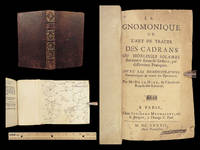
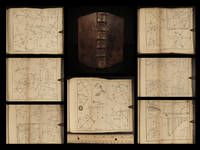
168227137<p><strong>1682 Gnomonics 1ed Art of SUNDIALS Horology Navigation Astronomy Clocks Science</strong></p><p>Philippe de La Hire was a French scholar who best-known for his works in mathematics mechanics and astronomy. Though perhaps his best work was a conglomeration of all his studies – '<em>Gnomonics – Universal Methods of Sundials</em>'.</p><p>While studying astronomy at the French Academy of Sciences Hire took a fascination in the movements and phases of the Sun Moon and other celestial bodies. He took an interest in the processes in making sundials and published his book on the subject in 1682. This first edition of Hire's "<em>Gnomonics</em>" includes folding engravings and full-page charts and tables.</p><p>Item number: #27137</p><p>Price: $750</p><p>HIRE Philippe de la</p><p><strong><em>La gnomonique ou MeÌthodes universelles pour tracer des horloges solaires ou cadrans sur toutes sortes de surfaces</em></strong></p><p>A Paris : chez Estienne Michallet 1682. First edition.</p><p><u>Details</u>:</p><p><!-- if !supportLists-->· <!--endif-->Collation: Complete with all pages</p><p><!-- if !supportLists-->o <!--endif-->194 i.e. 184 54</p><p><!--endif-->Pagination errors expected</p><p><!-- if !supportLists-->o <!--endif-->Filled with tables and 6 folding plates</p><p><!-- if !supportLists-->· <!--endif-->Language: French</p><p><!-- if !supportLists-->· <!--endif-->Binding: Leather; tight and secure</p><p><!-- if !supportLists-->· <!--endif-->Size: ~6.25in X 3.75in 15.5cm x 9.5cm</p><p>Our Guarantee:</p><p>Very Fast. Very Safe. Free Shipping Worldwide.</p><p>Customer satisfaction is our priority! Notify us with 7 days of receiving and we will offer a full refund without reservation!</p><p><u>Photos available upon request. </u></p> Estienne Michallet hardcover
169817746<p><b>1698 Gnomonics Art of SUNDIALS Horology Navigation Astronomy Clocks Science Hire</b></p><p>Philippe de La Hire was a French scholar who best-known for his works in mathematics mechanics and astronomy. Though perhaps his best work was a conglomeration of all his studies – '<i>Gnomonics – Universal Methods of Sundials</i>'. While studying astronomy at the French Academy of Sciences Hire took a fascination in the movements and phases of the Sun Moon and other celestial bodies. He took an interest in the processes in making sundials and published his book on the subject in 1682. This 1698 edition of Hire's "<i>Gnomonics</i>" includes folding engravings and full-page charts and tables.</p><p>Item number: #17746</p><p>Price: $599</p><p>HIRE Philippe de la</p><p><b><i>La gnomonique ou MeÌthodes universelles pour tracer des horloges solaires ou cadrans sur toutes sortes de surfaces</i></b></p><p>A Paris : Chez Thomas Moette 1698.</p><p><br /></p><p><u>Details</u>: </p><p>· Collation: Complete with all pages </p><p>o 24 275</p><p>o 8 engravings </p><p>· Provenance: Handwritten – <i>Richard Touly</i> </p><p>· Language: French </p><p>· Binding: Leather; tight and secure</p><p>· Size: ~5.75in X 3.25in 15cm x 8.5cm</p><p>Our Guarantee:</p><p>Very Fast. Very Safe. Free Shipping Worldwide.</p><p>Customer satisfaction is our priority! Notify us with 7 days of receiving and we will offer a full refund without reservation!</p><p>17746</p><p>Photos available upon request. </p> Thomas Moette hardcover
16311711240004Antverpiae : Officina Plantiniana 1631. Acceptable. Folio. 7 double page engraving 6 single page plates 2 in text gravings. Lacking engraved title piece. 163 pp 15. Lacking final leaf. Contemporary limp vellum. Vellum soiled. Damp staining to margins scattered spotting. This is the French translation made on the original Latin Hugo Obsidio Bredana 1626 . See Maurice Cockle 110 for the English edition and 817 for several other editions. Cockle acknowledges that this is the best contribution made in the 17th century to the seat of Breda both militarily and politically. The siege of Breda lasted 11 months and cost the lives of 5000 inhabitants of the city. The capitulation of the city on June 2 1625 was immortalized by the painting of Velasquez "Las Lanzas o The rendition of Breda". Antverpiae : Officina Plantiniana hardcover
164810243CB1648. wohl die 3. Auflage bei Elzevier EA: 1637 2. Auflage: 1641 Leiden Elzevier Lugduni Batavorum - Ex officina Elseviriorum 1648 8° S. 17 bis 239 vierspaltig gesetzt Text viersprachig: Latein Französisch Italienisch und Deutsch Lederband der Zeit mit vier Rückenbünden und vornehmer Deckel- und Rückenverzierung sowie mit goldener Rückenbeschriftung Einbandecken leicht bestoßen und etwas beschabt der Band beginnt mit Seite 17 ist also ohne Titelseite und die ersten Seiten davor nur eine Vorsatzseite mit Vermerk 'Ex Libris Alexandri .' insg. ein altersgemäß schönes sauberes Exemplar Dieser sehr frühe Sprachführer gliedert sich in vier Bereiche: Das I. Gespräch: Vom Spazieren gehen' / Das II. Gespräch: Weg-Reyß in Franckreich / Das III. Gespräch: Von der Herberg / Das IV. Gespräch: Von dem Ballen Spiel. Da die Titelseite fehlt haben wir die bibliographischen Angaben dem KVK entnommen. Wir konnten das Buch nur in wenigen europäischen Bibliotheken nachweisen. Der Band ist komplett digitalisiert. Die fehlenden Seiten können daher unter https://digital.slub-dresden.de/werkansicht/dlf/8026/4/0/ als pdf angesehen oder auch herunterleladen werden. Abholung im Ladengeschäft in Frankfurt am Main Nordend ggü. Musterschule möglich. Das spart die Portokosten. Pickup at the store in Frankfurt am Main Nordend close to Musterschule is possible. It saves the shipping costs. unknown
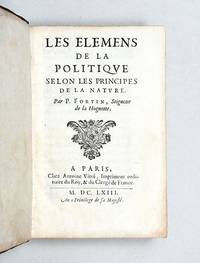
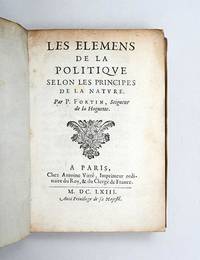
1663144254Paris: Chez Antoine Vitré 1663. Government and society in the reign of Louis XIV First edition of the final major work by the soldier and philosopher. Fortin's work of political theory yokes together the public and the private relating the development of government to the control of four essential vices: murder theft false witness and adultery. The book mirrors contemporary attitudes towards marriage and sexuality and it has been read as by Leslie Tuttle as reflecting the social imperialism imposed on France's new North American colonies in the 1660s p.79. Philippe Fortin de la Hoguette 1585-1668 fought in the French Wars of Religion and was present at the siege of La Rochelle in 1627. In his spare time he wrote several works of Catholic fideism corresponded extensively with the Dupuy brothers and smuggled many of Francis Bacon's manuscripts out of England after his death in 1626. Octavo 172 x 112 mm. Woodcut vignette to title page headpiece and initial. Contemporary mottled calf spine lettered panelled and decorated in gilt raised bands edges sprinkled red and brown. Ink manuscript "Elem: Pol:" to upper edge. Remnants of shelf label to lower spine end. Light wear loss to lower spine end front joint cracked but holding firm minor browning and foxing to endpapers and contents: a very good copy. Leslie Tuttle Conceiving the Old Regime: Pronatalism and the Politics of Reproduction in Early Modern France 2010. hardcover
1663144980Paris: Chez Antoine Vitré 1663. Government and society in the reign of Louis XIV First edition of the final major work by the soldier and philosopher. Fortin's work of political theory yokes together the public and the private relating the development of government to the control of four essential vices: murder theft false witness and adultery. The book mirrors contemporary attitudes towards marriage and sexuality and it has been read as by Leslie Tuttle as reflecting the social imperialism imposed on France's new North American colonies in the 1660s p.79. As a soldier Philippe Fortin de la Hoguette 1585-1668 fought in the French Wars of Religion and was present at the siege of La Rochelle in 1627. As a philosopher he wrote several works of Catholic fideism corresponded extensively with the Dupuy brothers and smuggled many of Francis Bacon's manuscripts out of England after his death in 1626. Octavo 166 x 113 mm Contemporary vellum spine lettered in manuscript edges sprinkled in red and green. Woodcut vignette to title page headpiece and initial. Lightly toned and with some natural creasing front pastedown free rear pastedown starting to free minor browning to endpapers and content margins occasional small mark: a very good copy in an attractive contemporary binding. Leslie Tuttle Conceiving the Old Regime: Pronatalism and the Politics of Reproduction in Early Modern France 2010. hardcover
1685262811Lyons: Girin 1685. hardcover. very good. 3 full page copperplate engravings and 4 engraved chapter headings. Thick 12mo 22 445 5 pages rubricated title and edges full calf gilt spine chipped and worn. Lyons: Jean Girin & B. Riviere 1685. Scarce. Very good .<br/> <br/> Sabin 21146; Wellcome II p. 494; Bitting 134.<br/> <br/> Girin unknown
168560607La Haye Moetjens 1685. 12mo. In contemporary full vellum. Light soiling to extremities. Worm-tract in margin of pp. 359-401 not affecting text otherwise a nice copy. 1-14 15-404 5 pp. 3 plates. <br/><br/><em>This third edition of one of the first works to deal with the gastronomic and healing qualities of coffee tea and chocolate and the first work in any language to describe the three new beverages of the seventeenth century. This is the only edition having the appendix consisting of a dialogue about the medical properties between a physician an Indian and a civilist. Vicaire p. 293-94. </em> hardcover
16855021242050<p>"Traitez Nouveaux & Curieux du Café du Thé et du Chocolat. Ouvrage Également Nécessaire aux Medecins & à Tous Ceux qui Aiment Leur Santé." by Philippe Sylvestre Dufour Jean Girin & B. Riviere 1685. First Edition. French language. 20 445 5 pp. Added engraved title page with 3 frontispiece engravings one each for treatise: on coffee tea and chocolate. 12mo 16x8.5 cm 6¼x3½" period calf raised bands spine lettered in gilt. Moderate binding wear with cracked joints and some worming; title page with several holes possibly burn marks engraved title with short tear to fore-edge affecting image throughout light foxing some toning overall still Very Good.</p><p>This book is one of the first comprehensive European treatises on coffee tea and chocolate detailing their origins preparation medicinal properties and cultural importance. It helped introduce and popularize these beverages in Europe during the late 17th century a time when they were still considered novelties.</p> Jean Girin & B. Riviere hardcover
1685743Lyon: Jean Girin & Barthélemy Rivière 1685. First edition. <br /> <br /> A landmark in the cultural and scientific history of coffee tea and chocolate — the three “new beverages†of early modern Europe. Written by Philippe Sylvestre Dufour 1622–1687 a Lyon apothecary physician and merchant this 1685 first edition is among the earliest treatises devoted to the preparation medicinal properties and social virtues of these drinks. Dufour discusses the origin of coffee in the Ottoman Empire tea in China and cacao in the Americas blending pharmacological observation with moral reflection on their consumption. The work marks an important moment in the spread of global trade and early modern dietary theory illustrating how exotic imports became staples of European life and medicine.<br /> <br /> Illustrated with three full-page engravings and an engraved frontispiece including a striking depiction of an Ottoman coffee drinker a Chinese tea ceremony and a native American holding a chocolate vessel. These plates helped define the visual iconography of coffee and chocolate in the 17th century. Dufour’s Traitez became the foundational French-language reference on these drinks influencing subsequent European authors. This copy shows early marginal notes and the presence of all plates noted for the true first edition confirming its completeness and authenticity.<br /> <br /> Condition & Binding: Contemporary full mottled calf spine gilt in compartments with floral ornaments and gilt title “TRAITÉ DU CAFÉ.†Light rubbing and edge wear; some cracking along joints but binding remains solid and entirely original. Mild staining and toning to a few leaves; scattered foxing consistent with age. Engravings crisp and well-inked showing excellent impression quality. Early manuscript notes on title and endpaper likely from an 18th-century hand. Overall- good. Jean Girin & Barthélemy Rivière unknown
169328644A la Haye Adrian Moetjens 1693. 12mo. Cont. full calf. Gilt back and gilt titlelabels. Edges worn especially lacking outer part of backcover. Engraved title showing an Arab a Chinese and an Indian drinking their products and printed title. 1-1415-4044 pp. and 3 engraved plates depicting the appropriate plants together with their cultivators. Somewhat brownspotted. Plates shaved traces of use. <br/><br/><em>This third edition is the only edition having the appendix consisting in a dialogue about the medical properties between a physician an Indian and a civilist. - Vicaire p. 293-94. </em> unknown