STENGEL, CarlAntiquariat.de

172 résultats
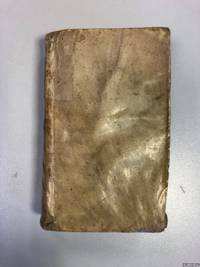
16231724-22(Augsburg, 1623). Nunc primum latine publici iuris factae. 12°. Kupfertitel, 11 Bll., 428 S., 2 Bll. Pergament-Manuskripteinband. Etwas berieben, Deckel leicht fleckig. Erste Ss. mittig mit kleinem dezenten Löchlein (ohne Textverlust). EA. [2 Warenabbildungen]
16521710030055Amsterdam: Louys Elzevier 1652. Hardcover. Good. Bound in full contemporary calf. Spine hinges cracked but solid at ties. Thick 4to 24 cm. Volume 1 only: 8 1207 i.e. 1197 15 p. p. 389 misnumbered 189; p. numbers 1070-1079 omitted in sequence. No pages are missing but the pagination is in error for all copies. <br> Suite des lettres et memoires de Messire Philippe de Mornay. Philippe de Mornay was a French Protestant writer and member of the anti-monarchist Monarchomaques. Mornay was instrumental in the drafting of the Edict of Nantes and an important figure in France's internal struggle between Huguenot and Catholic forces ca. 1562-1598. A continuation of the 2 previous volumes compiled from the memoirs of Charlotte Arbaleste wife of Philippe de Mornay by David de Liques and Valentin Conrart; edited by Jean Daille and printed by Jean Bureau at La Foret in 1624 and 1625. This edition by Elzevier continues the work of Jean Bureau's 1624 La Foret printing. <br> Refs: Copinger H.B. Elzevier Press 3243; Willems A. Elzevier 1149; Rahir E. Elzevier 1171; Hauser H. XVIe s. III 1612. <br> This is an oversized or heavy book that requires additional postage for international delivery outside the US. Louys Elzevier hardcover
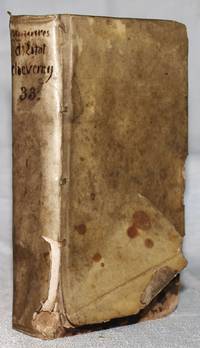
16691407030014La Haye Steucker 1669-01-01. Hardcover. Good. 16mo. Bound in contemporary full vellum. Contemporary pen spine label. Good binding and cover. Shelfwear. Chipping and loss to bottom edge of vellum to boards. Clean unmarked pages with tanning. Owner's stamp on 2nd blank page. Ships daily. La Haye Steucker hardcover
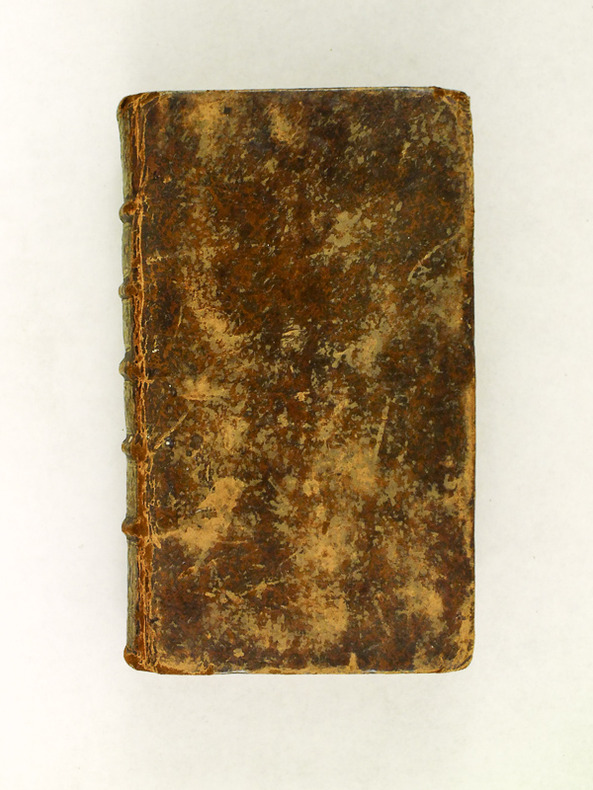
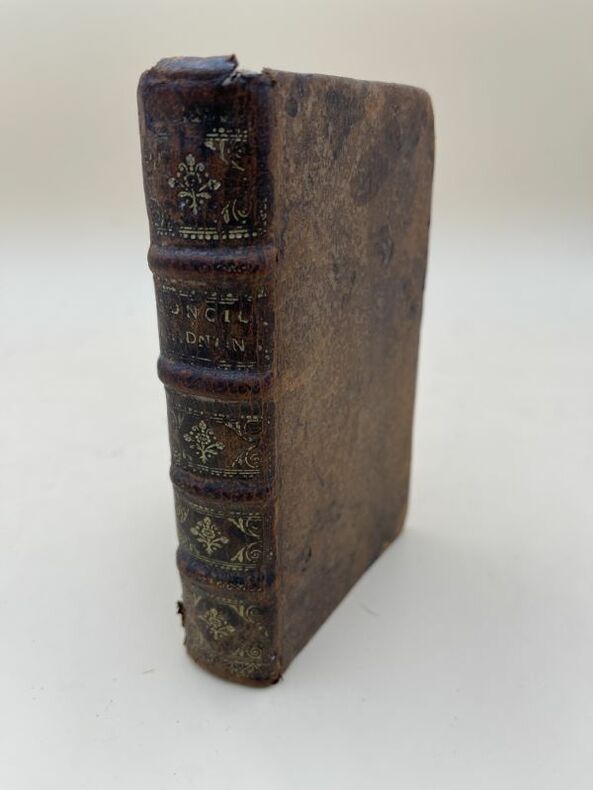
1664444391 vol. in-12 reliure de l'époque pleine basane marron, dos à 5 nerfs orné, Chez François Mauger, Paris, 1664, 4 ff. n. ch., 551 pp. (paginé 561).
169412584Paris, de l'Imprimerie Royale, 1694. In-4 de [8]- 202 (chiffrées 302)- [2] pages, pleine basane brune, dos à nerfs orné de filets et fleurons dorés, reliure légèrement frottée, quelques rousseurs. Tampon de possesseur sur la page de garde.
165241659Amsterdam, Louys Elzevier, 1652-1651. 2 vol. in-4 de (8)-1207-(15) pp. ; 903-(11) pp. 275-(3) pp., vélin rigide, pièce de titre en maroquin rouge (reliure de l'époque).
1649138960Paris: Imprimerie Royale Sébastien Cramoisy 1649. full calfskin-covered boards seven raised bands gilt ornamentation on spine title in second compartment. folio 265 x 375 mm. full calfskin-covered boards seven raised bands gilt ornamentation on spine title in second compartment. 56-572 11 pages with two large genealogical tables printed on double-pages. Revues & corrigez sur divers manuscrits & anciennes impressions. Augmentez de plusieurs traistez contracts testaments autres actes & de diverses observations. Par Denys Godefroy Conseiller et Historiographe ordinaire du Roy. The Denys Godefroy edition with this copy being a somewhat larger paper copy 375 mm tall as opposed to the commonly found 350 mm tall. Small bookplate on front pastedown. Ownership name in ink on recto front free endpaper and ownership notes in ink on the verso of the front free endpaper. Front hinge cracked but firm. Loss of the leather spine in third compartment. Spine age-darkened. Rubbing to extremities. Minor foxing throughout. Dampstaining to title page. Philipe de Comines was a Statesman and one of the most interesting of the old French historians of the Middle Ages. Dibdin says that "no English Historical Collection can be complete without P. de Comines."<BR> <br /> <BR> <br /> A great visionary Comines 1447 - 1511 noticed and regretted the permanent antagonism between the European nations and aspired to a Europe united by Christianity. He advocated free trade the reform of the currency and the system of weights and measures as well as the consultation of the States General in order to avoid any despotism. After the first edition was produced by Denis Sauvage in 1552 which marked a notable progress this edition of 1649 produced by Théodore and Denis Godefroy was a great step forward. They printed at the prestigious Imprimerie Royale installed in the Louvre. In addition to the beautiful typographical quality it was established on two manuscripts and on the Sauvage edition. Many new lessons appear here for the first time and the editors attach to the text a valuable compendium of supporting material. this edition of 1649. Imprimerie Royale (Sébastien Cramoisy) unknown
1626elala975cLe Forest-sur-Sèvre: 1626-28. 1626. 2 Volumes. 4to. pp. 4 p.l. 978 16contents & index; 2 p.l. 640. woodcut ornaments & initials. contemporary mottled calf spines partly restored spine labels wanting scattered light foxing & browning some marginal dampstaining scattered stains small hole in last leaf costing several letters. Second Edition of the memoirs of one of the most eminent members of the French protestant party at the end of the sixteenth century. These memoirs begin with his narrow escape from the Massacre of St. Bartholomew in 1572 and his taking up arms for the Huguenots in 1575. Shortly thereafter he entered the service of Henri of Navarre who employed him in important negotiations. One of his most significant achievements was the role which he played in the reconciliation of Henri III and the King of Navarre in 1589 for which he was rewarded with the government of Saumur. He became a member of Henri IV's council and retained the monarch's favour after the latter had abjured his religion. Two further volumes of memoirs covering the period 1600-1623 were published by Elzevier at Amsterdam in 1651-52. Brunet III 1912. cfGoldsmith BM STC French M1495. [cLe Forest-sur-Sèvre]: 1626-28. unknown
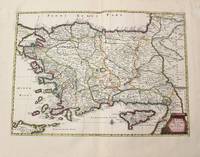
1700M10229Amsterdam: Jean Covens & Corneille Mortier 1700. Very Good. Notes: Detailed map of Turkey showing Cyprus. Size : 381x530 mm 15.00x20.87 Inches Coloring: Original Hand Coloring Category: Maps Asia Near East Turkey; Maps Mediterranean Islands; Jean Covens & Corneille Mortier unknown
1700B7152Nuremberg: Jean Zieger & George Lehmann. 1700. Some leaves with repairs otherwise text and plates are clean and crisp. . Binding: Original vellum boards rebacked. Spine with red morocco label. Top and front edges speckled red. Notes: Dual Language Edition; text in German and French Size: Folio 340 x 220mm Illustration: Near fine example of this important work on horsemanship. Illustrated with 73 large fine copperplates including engraved title and the armorial plate on the verso of the French title all double-page and/or folding. Translation of the original English edition. Text printed in two columns German in Gothic font on the left French on the right. Some inconsistencies in plate numbering; includes one duplicate plate. Pagination jumps from 290 to 293 text continuous. Lacking the German title in red and black. <br><br> Provenance: Ex-Libris; ownership stamp plus bookplate of Dodgson Hamilton Madden on front pastedown. References: Brunet I 1700; Graesse II 93; Huth 23; Lowndes 1663; Mennessier de la Lance II p. 250; Nissen ZBI 848 Pages: P Double-page engraved title. 4 double-page plates. Dedication. Blank. French Title. Large armorial engraving. German dedication. Publisher’s preface 3. Solleysel’s advertisement 5. Notice to the reader 5. Table of names 3. Contents 7. Pp. 1-301. Category: Book Natural History; Jean Zieger & George Lehmann. hardcover
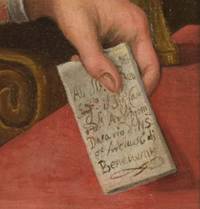
1613773Venice: Domenico Usci 1613. Softcover. Fair. This early 17th century edition of Commines important work on the inner-workings of the French government includes one of the more interesting provenance marks I've researched not for the person but for the unique way it's likely verified: ""Pompeo Arrigoni"" signed the flyleaf and title page twice. Searching this name quickly brought me to the Italian Roman Catholic Cardinal and Archbishop Pompeo Arrigoni. At his Italian Wikipedia page is a 1596 painting of him. I zoomed in on a note he's holding and there is his last name written in what appears to me the same hand as the one that inscribed my book. The painting is ""commons"" which means I'm free to use the photo so I've attached a copy of the note. I have to say most times I have to infer that someone signed a book context time period etc.; this is the first time I've ever found a picture of my subject holding their written name as though saying ""Yeah it was me that wrote in that book"". About the Author and Work - Philippe de Commines 1447 1511 was a writer and diplomat in the courts of Burgundy and France. He has been called ""the first truly modern writer"" Charles Augustin Sainte-Beuve and ""the first critical and philosophical historian since classical times"" Oxford Companion to English Literature. The Mémoires are divided into ""books"" the first six of which were written between 1488 and 1494 and relate the course of events from the beginning of Commines' career 1464 up to the death of King Louis. The remaining two books were written between 1497 and 1501 printed in 1528 and deal with the Italian wars ending in the death of King Charles VIII of France. Commines' scepticism is summed up in his own words: Car ceux qui gagnent en ont toujours l'honneur ""For the honours always go to the winners"". Bibliographic Details - Universal Short Title Catalogue number 4026765; 14 copies in the world's libraries. Only two copies outside Italy none in the Americas. Physical Attributes - Measures approx. 16.5 x 10.5 x 3.5 cm. Gatherings of eight 8vo. Vellum binding over pasteboard boards. Title in old hand on spine. Printers mark on title page. Several headers and decorated initials. Pages xxiv 1-683 1 Collation a8 b4 A-Z8 Aa-Tt8 Vv4 Someone fat-fingered the USTC entry because my gatherings are correct but they wrote ""11"" as the post-numbering number of pages. I can verify it is 1 since my gatherings are correct. Condition - See pictures. Some nibbling around edges and joints of vellum binding. Boards with some rust marks. Turn-ins lifted Im sure to check for manuscript there isnt. Text block edges a little darkened from dust. Ex libris and bookseller marks to pastedown and flyleaf. Pompeo wrote his name on the title page several times bottom one has bled through. Text block with a little toning and occasional thumbing dog-eared pages fox spot page-edge/corner chip etc. a2 with a 1 cm hole in the fore-edge margin. Bottom margin moisture mark intermittent. Bottom corner E5 chipped away no text affected. I5 torn at gutter from top 3 just barely touches start of text. L3 with a tear in bottom margin. V to Z gatherings with a moisture mark at top corner. Candle ember mark to Aa6. Oo7 bottom corner chipped. Two small wormholes in bottom margin of last gathering Vv. Domenico Usci
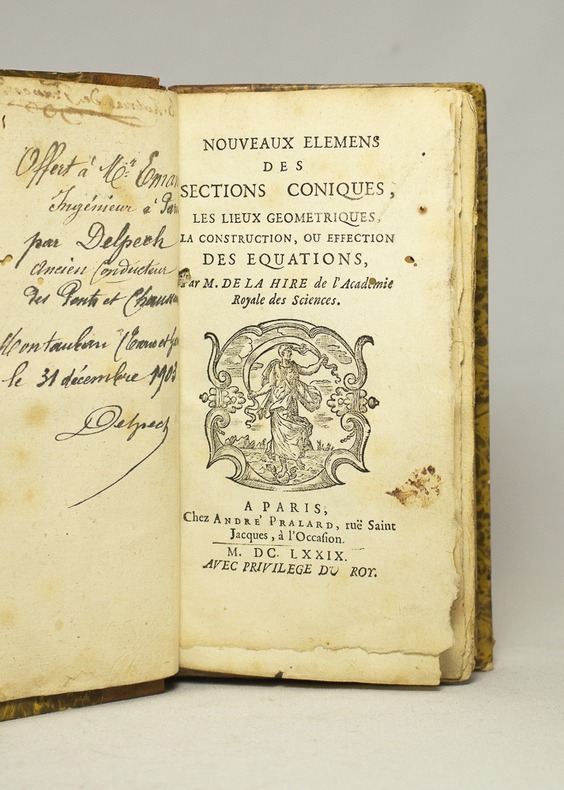
167916026Paris, André Pralard, 1679. In-12 de [12]-452 pages non rognées, demi-basane brune moderne, dos lisse orné de filets et fleurons dorés.
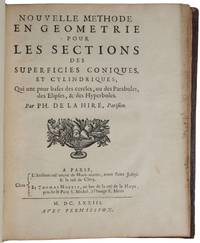
16766349Paris; Paris: chez l'autheur et Thomas Moette; n.p. 1676. First edition. <p>First edition extremely rare of these two works of which the Nouvelle Méthode is the first substantial treatment of projective geometry explicating the Brouillon Projet of Girard Desargues 1591-1661. "The BrouillonProjet 1639 was published in an edition of only 50 copies and won very little support . Projective geometry secured a place in mathematics only with the publication of a book by Philippe de Hire 1673" Stillwell Mathematics and its History.</p>. PROJECTIVE GEOMETRY SECURES A PLACE IN MATHEMATICS. <p>First edition extremely rare of these two works of which the Nouvelle Méthode is the first substantial treatment of projective geometry explicating the Brouillon Projet of Girard Desargues 1591-1661. "The BrouillonProjet 1639 was published in an edition of only 50 copies and won very little support. In fact its reception was generally hostile and Desargues was engaged in a pamphleteering battle for years with his detractors. At first his only supporters were Pascal most of whose work on projective geometry is also lost and the engraver Abraham Bosse. Desargues became discouraged by the attacks on his work and left the dissemination of his ideas up to Bosse who was not really mathematically equipped for the task. Projective geometry secured a place in mathematics only with the publication of a book by Philippe de Hire 1673. It seems quite likely that La Hire's book influenced Newton see below" Stillwell p. 153. Michel Chasles writing in 1837 noted that La Hire's work is "extrêmement rare" Chasles p. 128. "The treatise of 1673 is where De La Hire shows himself to be truly original and innovative and which leads us to regard him as one of the founders of modern geometry" translated from ibid. "La Hire certainly read the Rough Draft on Conics Brouillon Projet thoroughly; for a long time the only known copy of the work was one made by La Hire himself in 1679. Possibly he made his own handwritten copy of the Rough Draft on Conics from a printed copy belonging to his father the painter Laurent de la Hire 1606-1656 a pupil of Desargues and a friend and colleague of Abraham Bosse at the Académie. Philippe de la Hire had by then written his first book on geometry his Nouvelle Méthode en Géométrie . It too has become extremely rare and he was later to write that his new method had been found difficult because it involved planes and solids" Field & Gray p. 37. La Hire's point of view in his Nouvelle Methode was entirely projective. He regarded all conics as projections of circles and used the harmonic division of four points which he showed was projectively invariant to obtain theorems about poles and polars. The work is in two parts. In the first pp. 1-72 La Hire treats conics as sections of the cone which are then projected onto the plane of the base of the cone; this approach was later expanded in his Sectiones conicae 1685. In the second Les Planiconiques pp. 73-94 he treats conics by entirely planar methods; Chasles notes that this part which Chasles regards as the more original "offered the first sufficiently general method for transforming figures of one kind into other figures of the same kind". The Planiconiques was published one year after the Nouvelle Méthode and was not added to all copies the Lyon and Marburg copies of the Nouvelle Méthode end at p. 72. The second work in the present volume De Cycloid Lemma is even rarer than the Nouvelle Méthode. It presents a geometrical construction of the tangent at any point of the cycloid - the method was discovered by Descartes and Fermat but they did not publish it. OCLC lists 12 copies of the Nouvelle Méthode worldwide Columbia only in US and 6 copies of De Cycloide Lemma of which three are bound with the Nouvelle Méthode including Columbia and three are bound separately BL Erfurt & Lyon the first two of which hold the Nouvelle Méthode. It is unclear how many of the copies of the cycloid pamphlet are complete as several lack the plate e.g. the BNF copy. RBH lists only the Macclesfield copy of the Nouvelle Méthode since 1961 bound with De Cycloide Lemma but lacking its plate and no other copy of the cycloid pamphlet.</p> <br /> <p>"When Desargues circulated fifty copies of his Brouillon Project d'une Atteinte aux Événemens des Rencontres du Cone avec un Plan Rough Draft of an Essay on the results of taking plane sections of a cone in 1639 he was contributing to a lively contemporary study of geometry. Descartes's novel algebraic methods had been published two years before and in 1639 Mydorge published a more classical treatment of the conic sections. The classical authors themselves were increasingly well studied. Desargues had available Commandino's Latin edition of Euclid's Elements published in 1572 as well as his Latin edition of the first four books of Apollonius' Conics published in 1566 with extensive commentaries by Eutocius Pappus and Commandino himself. The last four books of the Conics were unknown in Desargues' time" Field & Gray p. 1.</p> <br /> <p>"The Brouillon Projet on conics of which he published fifty copies in 1639 is a daring projective presentation of the theory of conic sections; although considered at first in three-dimensional space as plane sections of a cone of revolution these curves are in fact studied as plane perspective figures by means of involution a transformation that holds a place of distinction in the series of demonstrations. But the use of an original vocabulary and the refusal to resort to Cartesian symbolism make the reading of this essay rather difficult and partially explain its meager success.</p> <br /> <p>"Although he praised the unitary conception that inspired Desargues Descartes doubted that the use of geometry alone could yield results as good as those that a recourse to algebra would provide. As for Fermat he reserved his judgment and the only geometer who really comprehended the originality and breadth of Desargues's views was the young Blaise Pascal who in 1640 published the brief Essay pour les Coniques inspired directly by the Brouillon Projet. But since the great Traité des Coniques that Pascal later wrote has been lost Desargues's example survived only in certain of the youthful works of Philippe de La Hire and perhaps in a few essays of the young Newton" DSB.</p> <br /> <p>"Philippe de la Hire 1640-1718 published three treatises on conics in 1673 in 1679 and in 1685. From the point of view of modern geometry the treatise of 1673 is by far the most original. Unfortunately because of its rarity it did not have a very wide circulation and today too many historians of science pass over it in silence concentrating instead on the Latin treatise of 1685 which is merely a development of the first part of the treatise of 1673. Although La Hire in a note attached to his copy of the Brouillon Projet of Desargues claims not to have known the treatise of Desargues until after 1673 and not to have been inspired by it it seems to us on the contrary that this inspiration is manifest. A first reason is that La Hire's father the king's painter was a diligent student of Desargues's oral lectures so it would be very surprising if he were unaware of the existence of this treatise and were unable to make its content known to his son. The second and most important reason is drawn from the study of the text. It seems that La Hire knowing at least the spirit of Desargues's treatise has tried to derive from it a work using the same principles but avoiding the faults that were the source of the violent criticisms by Desargues's adversaries.</p> <br /> <p>"Indeed La Hire seems to want to make a synthesis of the theories of Desargues while giving them a classical gloss . His method . amounts to deducing the projective properties of an arbitrary conic in space situated on a cone with a horizontal circular base from the properties of the base circle via the intermediary of the projection of the conic section onto the plane of the base. He uses in fact the properties of cylindrical projection for the passage from the curve in space to its projection and of homology for the passage from the conic to the projection of the base circle.</p> <br /> <p>"The method for studying the properties of conic sections 'in the cone' led quite logically to another procedure for studying them which consists in deducing directly - in the plane - every conic from a circle by a homology. This is the object of the second part of La Hire's small treatise titled Les Planiconiques. This very ingenious method is applied with the aid of several lemmas on the elementary properties of homology. So here apparently we have a treatise which although inspired by the ideas of Desargues is not afraid to develop them further" translated from Taton pp. 204-205.</p> <br /> <p>Chasles pp. 128-9 describes the method of the Planiconiques as follows. "Suppose that we have in a plane two straight lines parallel to each other which the author calls the formatrice and directrice and a point called the pole.Through each point M of a given curve in the plane one draws in an arbitrary direction a transversal; it meets the directrix at a point which one joins to the pole by a line;and the former at a second point through which we draw a parallel to this line.This parallel meets the straight line which goes from the point M to the pole in a point M' which is said to be formed by the point M.Each point of the proposed curve will thus form a corresponding point of a second curve. The points of a straight line form points belonging to a second straight line and these two straight lines will intersect on the formatrice.Finally the points of a circle will form the points of a conic section. Such is the method by which De La Hire studied in the plane without the need for any solid nor any other plane than that of the figure the sections of a cone.This is what he called reducing the cone and its sections to a plane."</p> <br /> <p>"Whiteside has pointed out Mathematical Papers of Isaac Newton VI 271 n.70 that the Nouvelle Méthode received a favourable review probably from CoIlins in 1676 and that Newton may have read it for Hooke wrote to him mentioning it in 1679. There are certainly similarities between ingenious projective transformations described by both men . In Book I of his Principia Newton showed how to solve all of the six different problems of the form: find the conic through k points and tangent to m lines k m = 5. In the course of accomplishing this feat he introduced a projective transformation capable as he remarked of transforming any conic to a circle . It is strikingly similar to the one given by La Hire in his Planiconiques which was printed in the same volume as his Nouvelle Méthode" Field & Gray p. 37. The Nouvelle Méthode also influenced Leibniz. "The ideas of Desargues and Pascal led Leibniz to a 'dynamical' vision of geometry. In the years 1672-76 Leibniz was in Paris where he greatly increased his mathematical knowledge. In 1673 he was informed on Desargues' perspective through La Hire's Nouvelle Méthodeen Géométrie ." Del Centini & Fiocca.</p> <br /> <p>Determining the properties of the cycloid the curve traced out by a point on the circumference of a circle as it rolls along a straight line served as a test bed for the techniques of seventeenth century mathematics. The earliest significant work on the cycloid is due to Gilles Personne de Roberval 1602-75 who obtained many of its properties before 1636 although he kept his results secret and they remained unpublished until 1693. Roberval in particular gave a construction of the tangent at a point on the cycloid using his method of 'composition of movements' a precursor of the differential calculus. This problem was also solved by Pierre de Fermat and René Descartes although they also did not publish their work. It was instead first published by La Hire in the first part of his De Cycloide Lemma pp. 1-4. The remainder of this little pamphlet is devoted to a problem relating to conics which is perhaps why it is often although not always found bound together with the Nouvelle Méthode.</p> <br /> <p>Chasles AperVu historique des Méthodes en Géométrie 1837. Del Centini & Fiocca 'Boscovich's geometrical principle of continuity and the 'msyteies of infinity' Historia Mathematica 45 2018 pp. 131-175. Field & Gray The Geometrical Work of Girard Desargues 1987. Stillwell Mathematics and its History 3rd edition 2010. Taton Le Prehistoire de la 'Geometrie moderne' Revue d'Histoire des Sciences et de leurs Applications 2 1949 pp. 197-224.</p> <br/> <br/> 4to 201 x 162 mm. Nouvelle Méthode: pp. viii 94 with 25 folding engraved plates 10 bound before title page 15 at end of volume the last 2 referring to Les Planiconiques woodcut vignette on title woodcut initials head- and tail-pieces. De Cycloide Lemma: pp. 6 with 13 figures on one plate cut up with each figure tipped in at the appropriate place in the text. chez l'autheur et Thomas Moette; [n.p.] unknown
16766181Paris; Paris: chez l'autheur et Thomas Moette; np 1676. First edition. <p>First edition extremely rare of these two works of which the Nouvelle Méthode is the first substantial treatment of projective geometry explicating the Brouillon Projet of Girard Desargues 1591-1661. "The BrouillonProjet 1639 was published in an edition of only 50 copies and won very little support . Projective geometry secured a place in mathematics only with the publication of a book by Philippe de Hire 1673" Stillwell Mathematics and its History.</p>. PROJECTIVE GEOMETRY SECURES A PLACE IN MATHEMATICS. <p>First edition extremely rare of these two works of which the Nouvelle Méthode is the first substantial treatment of projective geometry explicating the Brouillon Projet of Girard Desargues 1591-1661. "The BrouillonProjet 1639 was published in an edition of only 50 copies and won very little support. In fact its reception was generally hostile and Desargues was engaged in a pamphleteering battle for years with his detractors. At first his only supporters were Pascal most of whose work on projective geometry is also lost and the engraver Abraham Bosse. Desargues became discouraged by the attacks on his work and left the dissemination of his ideas up to Bosse who was not really mathematically equipped for the task. Projective geometry secured a place in mathematics only with the publication of a book by Philippe de Hire 1673. It seems quite likely that La Hire's book influenced Newton see below" Stillwell p. 153. Michel Chasles writing in 1837 noted that La Hire's work is "extrêmement rare" Chasles p. 128. "The treatise of 1673 is where De La Hire shows himself to be truly original and innovative and which leads us to regard him as one of the founders of modern geometry" translated from ibid. "La Hire certainly read the Rough Draft on Conics Brouillon Projet thoroughly; for a long time the only known copy of the work was one made by La Hire himself in 1679. Possibly he made his own handwritten copy of the Rough Draft on Conics from a printed copy belonging to his father the painter Laurent de la Hire 1606-1656 a pupil of Desargues and a friend and colleague of Abraham Bosse at the Académie. Philippe de la Hire had by then written his first book on geometry his Nouvelle Méthode en Géométrie . It too has become extremely rare and he was later to write that his new method had been found difficult because it involved planes and solids" Field & Gray p. 37. La Hire's point of view in his Nouvelle Methode was entirely projective. He regarded all conics as projections of circles and used the harmonic division of four points which he showed was projectively invariant to obtain theorems about poles and polars. The work is in two parts. In the first pp. 1-72 La Hire treats conics as sections of the cone which are then projected onto the plane of the base of the cone; this approach was later expanded in his Sectiones conicae 1685. In the second Les Planiconiques pp. 73-94 he treats conics by entirely planar methods; Chasles notes that this part which Chasles regards as the more original "offered the first sufficiently general method for transforming figures of one kind into other figures of the same kind". The Planiconiques was published one year after the Nouvelle Méthode and was not added to all copies the Lyon and Marburg copies of the Nouvelle Méthode end at p. 72. The second work in the present volume De Cycloid Lemma is even rarer than the Nouvelle Méthode. It presents a geometrical construction of the tangent at any point of the cycloid - the method was discovered by Descartes and Fermat but they did not publish it. OCLC list 12 copies of the Nouvelle Méthode worldwide Columbia only in US and 6 copies of De Cycloide Lemma of which three are bound with the Nouvelle Méthode including Columbia and three are bound separately BL Erfurt & Lyon the first two of which hold the Nouvelle Méthode. It is unclear how many of the copies of the cycloid pamphlet are complete as several lack the plate e.g. the BNF copy. RBH lists only the Macclesfield copy of the Nouvelle Méthode since 1961 bound with De Cycloide Lemma but lacking its plate and no other copy of the cycloid pamphlet.</p> <br /> <p>"When Desargues circulated fifty copies of his Brouillon Project d'une Atteinte aux Événemens des Rencontres du Cone avec un Plan Rough Draft of an Essay on the results of taking plane sections of a cone in 1639 he was contributing to a lively contemporary study of geometry. Descartes's novel algebraic methods had been published two years before and in 1639 Mydorge published a more classical treatment of the conic sections. The classical authors themselves were increasingly well studied. Desargues had available Commandino's Latin edition of Euclid's Elements published in 1572 as well as his Latin edition of the first four books of Apollonius' Conics published in 1566 with extensive commentaries by Eutocius Pappus and Commandino himself. The last four books of the Conics were unknown in Desargues' time" Field & Gray p. 1.</p> <br /> <p>"The Brouillon Projet on conics of which he published fifty copies in 1639 is a daring projective presentation of the theory of conic sections; although considered at first in three-dimensional space as plane sections of a cone of revolution these curves are in fact studied as plane perspective figures by means of involution a transformation that holds a place of distinction in the series of demonstrations. But the use of an original vocabulary and the refusal to resort to Cartesian symbolism make the reading of this essay rather difficult and partially explain its meager success.</p> <br /> <p>"Although he praised the unitary conception that inspired Desargues Descartes doubted that the use of geometry alone could yield results as good as those that a recourse to algebra would provide. As for Fermat he reserved his judgment and the only geometer who really comprehended the originality and breadth of Desargues's views was the young Blaise Pascal who in 1640 published the brief Essay pour les Coniques inspired directly by the Brouillon Projet. But since the great Traité des Coniques that Pascal later wrote has been lost Desargues's example survived only in certain of the youthful works of Philippe de La Hire and perhaps in a few essays of the young Newton" DSB.</p> <br /> <p>"Philippe de la Hire 1640-1718 published three treatises on conics in 1673 in 1679 and in 1685. From the point of view of modern geometry the treatise of 1673 is by far the most original. Unfortunately because of its rarity it did not have a very wide circulation and today too many historians of science pass over it in silence concentrating instead on the Latin treatise of 1685 which is merely a development of the first part of the treatise of 1673. Although La Hire in a note attached to his copy of the Brouillon Projet of Desargues claims not to have known the treatise of Desargues until after 1673 and not to have been inspired by it it seems to us on the contrary that this inspiration is manifest. A first reason is that La Hire's father the king's painter was a diligent student of Desargues's oral lectures so it would be very surprising if he were unaware of the existence of this treatise and were unable to make its content known to his son. The second and most important reason is drawn from the study of the text. It seems that La Hire knowing at least the spirit of Desargues's treatise has tried to derive from it a work using the same principles but avoiding the faults that were the source of the violent criticisms by Desargues's adversaries.</p> <br /> <p>"Indeed La Hire seems to want to make a synthesis of the theories of Desargues while giving them a classical gloss . His method . amounts to deducing the projective properties of an arbitrary conic in space situated on a cone with a horizontal circular base from the properties of the base circle via the intermediary of the projection of the conic section onto the plane of the base. He uses in fact the properties of cylindrical projection for the passage from the curve in space to its projection and of homology for the passage from the conic to the projection of the base circle.</p> <br /> <p>"The method for studying the properties of conic sections 'in the cone' led quite logically to another procedure for studying them which consists in deducing directly - in the plane - every conic from a circle by a homology. This is the object of the second part of La Hire's small treatise titled Les Planiconiques. This very ingenious method is applied with the aid of several lemmas on the elementary properties of homology. So here apparently we have a treatise which although inspired by the ideas of Desargues is not afraid to develop them further" translated from Taton pp. 204-205.</p> <br /> <p>Chasles pp. 128-9 describes the method of the Planiconiques as follows. "Suppose that we have in a plane two straight lines parallel to each other which the author calls the formatrice and directrice and a point called the pole.Through each point M of a given curve in the plane one draws in an arbitrary direction a transversal; it meets the directrix at a point which one joins to the pole by a line;and the former at a second point through which we draw a parallel to this line.This parallel meets the straight line which goes from the point M to the pole in a point M' which is said to be formed by the point M.Each point of the proposed curve will thus form a corresponding point of a second curve. The points of a straight line form points belonging to a second straight line and these two straight lines will intersect on the formatrice.Finally the points of a circle will form the points of a conic section. Such is the method by which De La Hire studied in the plane without the need for any solid nor any other plane than that of the figure the sections of a cone.This is what he called reducing the cone and its sections to a plane."</p> <br /> <p>"Whiteside has pointed out Mathematical Papers of Isaac Newton VI 271 n.70 that the Nouvelle Méthode received a favourable review probably from CoIlins in 1676 and that Newton may have read it for Hooke wrote to him mentioning it in 1679. There are certainly similarities between ingenious projective transformations described by both men . In Book I of his Principia Newton showed how to solve all of the six different problems of the form: find the conic through k points and tangent to m lines k m = 5. In the course of accomplishing this feat he introduced a projective transformation capable as he remarked of transforming any conic to a circle . It is strikingly similar to the one given by La Hire in his Planiconiques which was printed in the same volume as his Nouvelle Méthode" Field & Gray p. 37. The Nouvelle Méthode also influenced Leibniz. "The ideas of Desargues and Pascal led Leibniz to a 'dynamical' vision of geometry. In the years 1672-76 Leibniz was in Paris where he greatly increased his mathematical knowledge. In 1673 he was informed on Desargues' perspective through La Hire's Nouvelle Méthodeen Géométrie ." Del Centini & Fiocca.</p> <br /> <p>Determining the properties of the cycloid the curve traced out by a point on the circumference of a circle as it rolls along a straight line served as a test bed for the techniques of seventeenth century mathematics. The earliest significant work on the cycloid is due to Gilles Personne de Roberval 1602-75 who obtained many of its properties before 1636 although he kept his results secret and they remained unpublished until 1693. Roberval in particular gave a construction of the tangent at a point on the cycloid using his method of 'composition of movements' a precursor of the differential calculus. This problem was also solved by Pierre de Fermat and René Descartes although they also did not publish their work. It was instead first published by La Hire in the first part of his De Cycloide Lemma pp. 1-4. The remainder of this little pamphlet is devoted to a problem relating to conics which is perhaps why it is often although not always found bound together with the Nouvelle Méthode.</p> <br /> <p>Chasles AperVu historique des Méthodes en Géométrie 1837. Del Centini & Fiocca 'Boscovich's geometrical principle of continuity and the 'msyteies of infinity' Historia Mathematica 45 2018 pp. 131-175. Field & Gray The Geometrical Work of Girard Desargues 1987. Stillwell Mathematics and its History 3rd edition 2010. Taton Le Prehistoire de la 'Geometrie moderne' Revue d'Histoire des Sciences et de leurs Applications 2 1949 pp. 197-224.</p> <br/> <br/> 4to 201 x 162 mm. Nouvelle Méthode: pp. viii 94 with 25 folding engraved plates 10 bound before title page 15 at end of volume the last 2 referring to Les Planiconiques woodcut vignette on title woodcut initials head- and tail-pieces. De Cycloide Lemma: pp. 6 with 13 figures on one plate cut up with each figure tipped in at the appropriate place in the text. chez l'autheur et Thomas Moette; [np] unknown
164433195Ex officina Petri Vernoy | Molinis (Moulins) 1644 | 7.50 x 13 cm | relié
164400211635Molinis/Moulins Petrus Vernoy 1644. Softcover. Fair. Vellum; 64 unnumbered pages followed by 272 numbered pages; This geographical dictionary contains the research of the historian and chronologist Philippe Labbé 1607-1667 on the names of cities and places of France appearing in ancient geographical texts. Each name studied has its version in French. This book was criticized by the geographer Sanson. Please also check all the pictures.; Traces of use; pages 233/234 and 235/236 in wrong order; few notes on page 236; traces of use Molinis/Moulins, Petrus Vernoy paperback
164433195Molinis Moulins Moulins: Ex officina Petri Vernoy 1644. Fine. Ex officina Petri Vernoy Molinis Moulins Moulins 1644 7.50 x 13 cm relié First edition rare impression from Moulins. Contemporary full sheep binding. Ornate spine with raised bands. Good copy. Geographical dictionary of place names and cities of France in the texts of ancient geographers and their correspondences in modern French. Some articles are extensively detailed such as those on the Rhine or the Rhone. The work presents the research and studies of chronologist and historian Philippe Labbé 1607-1667. Ex officina Petri Vernoy hardcover
167415322Venetia, apud Pezzana, 1674. In-24 de 465-[11] pages, plein vélin, dos à nerfs, étiquette de titre orange.
169711811697 Amsterdam [Amstelaedami], Jean Wolters [Joannem Wolters], 1697. 24 x 18 cm (R), in-4, 1 f. bl. - titre frontispice entièrement gravé - 11 ff. n. ch. (dont titre, dédicace, adresse au lecteur, epistolae, table et privilège) - 565 pp. - 31 ff. n. ch. d'index - 2 ff. bl. - 2 planches, 3 tableaux et 41 (sur 43) cartes gravées hors texte, dont 40 sont dépliantes ou à double page, reliure hollandaise de l'époque en plein vélin doré, plats estampés à froid de motifs des Pays Bas espagnols dans un double encadrement de filets avec fleurons d'angle, dos estampé de filets et fleurons, titre manuscrit à l'époque, traces de lacets. (sig. *3, **4, ***4, A-Z4, Aa-Zz4, Aaa-Zzz4, Aaaa-Kkkk4)
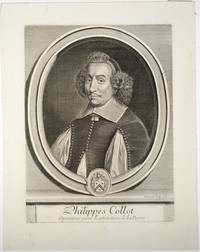
1700537731700. Les Hommes Illustre 2. - Ed. Charles Peraullt. - Paris 1700 264 x 184 auf 305 x 240 mm. Philippe Collot 1593-1656 Lithotomist at hte Hôtel Dieu Paris. Portr. Wellcome Inst. Hist. Med. Nr.650.1; Mortzfeld A 3892; Drugulin Ä. 1008; Singer 16165; Robert-Dumesnil 7 244 Nr.173; IFF XVIIs 453 Nr.223. unknown
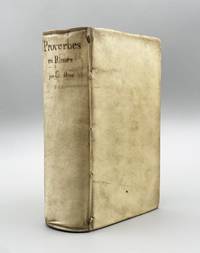
166512246Paris: G. Quinet 1665. Contemporary vellum over stiff boards scuffed light soiling flat spine with manuscript title. <p>       Only Edition of this collection of some 6000 proverbs on marriage fortune lust doctors lawyers confessors wine women food and household management. For this Le Duc put many common sayings into rhyming couplets including numerous misogynistic maxims with which Le Duc claims in his preface not to agree with. A poem on personal hygiene diet exercise and sleep closes the book. In good condition some spots inscription “4 7bris 1689 Amsterdam†on verso of final flyleaf bookplate of the Belgian book and art collector Anselme Van Den Bogaerde 1766-1866; Catalogue 1866 3923.<br /> ¶Viollet-le-Duc Catalogue des livres composant la bibliothèque poétique 523-4 “rareâ€; Cioranescu 41567.</p> G. Quinet unknown
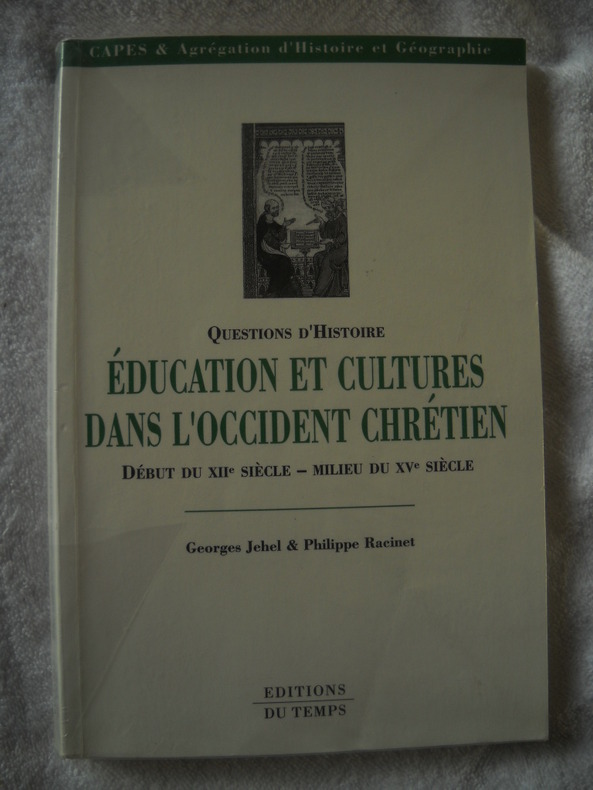
1624179521624 broché - 16x24 - 255pp- éditions du temps - 1998
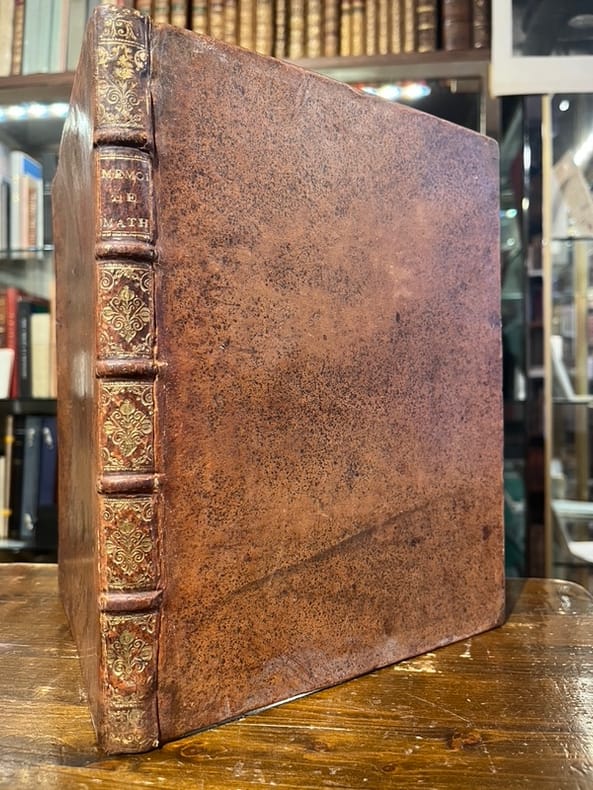
169386928Paris, Imprimerie Royale, 1693 [1679-1693], in-folio, 9 parties, [4]-43 pp. ; [2]-71 pp. ; [2]-92 pp, 1 carte de l'île de île de Ven. et 1 carte depl. de la France ; 20 pp. ; 74-[1] pp. ; 68 pp. ; 64 pp. ; [2]-52-106-[1] pp, Basane havane de l'époque, dos à nerfs fleuronné refait à l'imitation, fer central sur les plats [armes de France], 5 vignettes de titre gravées sur cuivre, gravées par Le Clerc, l'une représentant des observatoires, les 4 autres l'astronome au travail. Lettrines sur cuivre. Première édition de ce rare ensemble de mémoires imprimés à différentes dates et mis en recueil en 1693. Lalande ne compte que 12 mémoires ; notre recueil en contient 13, avec les Observations faites à Brest et à Nantes pendant l'année 1679 par Picard et de la Hire. On y trouve les principales publications de Giovanni Domenico (Jean Dominique) Cassini (1625-1712), le premier astronome de l'illustre famille, postérieures à son arrivée en France ; soit sept traités d'astronomie qui sont largement basés sur les observations faites par Jean Richer à Cayenne, qui sont jointes au recueil. La collection se termine par les célèbres tables des satellites de Jupiter, plus exactes que celles de 1668, et auxquelles les navigateurs se fiaient fréquemment. Les pièces sont placées dans l'ordre suivant : CASSINI, De l'origine et du progrès de l'astronomie. RICHER, Observations astronomiques et physique faites en l'isle de Caïenne. PICARD, Voyage d'Uranibourg, ou observations astronomiques faites en Dannemarck. Id. Observations astronomiques faites en divers endroits du royaume. PICARD et DE LA HIRE, Observations faites à Brest et à Nantes pendant l'année 1679. Id, Observations faites à Bayonne, Bordeaux et Royan pendant l'année 1680. Id, Observations astronomiques faites aux costes septentrionales de France pendant l'année 1681. LA HIRE, Observations faites en Provence et à Lyon sur la fin de l'année 1682. CASSINI, Observations astronomiques faites en divers endroits du royaume pendant l'année 1672. Id, Les éléments de l'astronomie vérifiés par Monsieur Cassini par le rapport des ses Tables aux observations de M. Richer faites en l'île de Caïenne. Avec les observations de MM. Varin, Des Hayes et de Glos faites en afrique & en Amérique. Id, Découverte de la lumière céleste qui paroist dans le zodiaque. Id, Règles de l'astronomie indienne pour calculer les mouvements du soleil et de la lune. Id, Les hypothèses et les tables des satellites de Jupiter, réformées sur de nouvelles observations. Id. Tabulae mutuum primi [secundi, tertii, quarti] satellitus Jovis. Ex-libris de l'astronome Toulousain Augustin Darquier de Pellepoix (1718-1802). Bel exemplaire, reliure restaurée. Les feuillets sont d'une belle fraîcheur ; seuls quelques rares sont brunis. Réparation dans l'angle inférieur droit des 70 derniers feuillets, sans atteinte au texte. DSB III p. 104. Lalande pp. 326-327. Sabin 71110 (pour les Observations de Richer). Couverture rigide
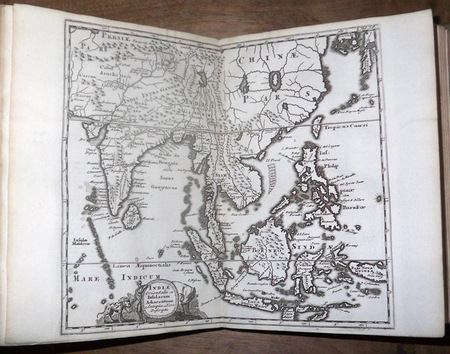
165815988Paris: Chez Pierre Mariette rue S.t Iacques a l'Esperance 1658. 457 by 572mm. 18 by 22.5 inches. Hand-coloured engraved map. The second state of the plate published separately and extensively corrected with the addition of: the four cardinal points added midway along the graticule scale around the map; 'ou Saycock a io 10 Roy.mes' and'ou Tokoesi a 4. R.'; and additional titles for the 'kingdoms' throughout the map. Hubbard points out that this is "an enormous number of corrections for the engraver Somer to make" although many other errors remain. Briet 1601-1668 came from the same town Abbeville as Nicolas Sanson I and examples of this map have been found in composite atlases largely made up of maps by Sanson. Sanson and Mariette who published this map also had a business relationship that eventually ended badly. The engraver Jan van Somer worked for Sanson in Paris. A Jesuit from 1619 Briet was also a teacher of humanities and rhetoric. He wrote literature as well as history and historical geography. He published his 'Paralella Geographica' in 1648 and 1649 with 144 maps of Europe. He had intended further volumes of maps of the other continents but only managed a manuscript for the Asia volume which was never published. Many of the maps from the original work were republished in his 'Theatre Geographique de L'Europe' and 'Theatrum Geographicum Europae Veteris' in 1653. Hubbard 31.2. Chez Pierre Mariette, rue S.t Iacques a l'Esperance, unknown
167799913890Lugduni Sumptibus Petri Guillimin Lugduni Sumptibus Petri Guillimin 1677, In-12 plein veau de l'époque, dos à nerfs trés orné. 442 pages + tables et index. Quid in hac edicione praestium sit, sequens hilippi CHIFFLETII, Abbatis Balernensis et Ecclesiae Vesontinae Canonici et Vicarii Generalis Praefatio indicabit. Page de titre dans un bel encadrement gravé. 2 gravures dans le texte. Reliure un peu frottée néanmoins bon exemplaire.