Albert CAMUSBiblio.com
3 806 résultats
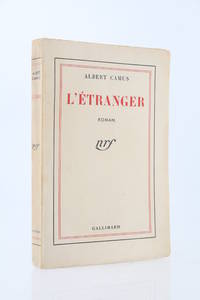
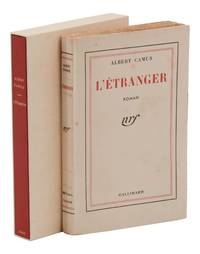
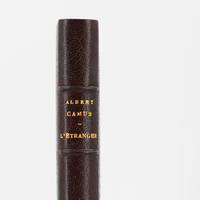
194288495Paris: Gallimard 1942. Fine. ""Nobody nobody had the right to cry over her"" Gallimard Paris 1942 11.8 x 18.8 cm Relié First edition no copies on deluxe paper issued. Half light brown morocco binding flat spine with author stamped in gilt and title stamped in gilt lengthwise gilt date at foot brown stingray boards framed in morocco brown suede endpapers and pastedowns original covers and spine preserved top edge gilt elegant binding signed Thomas Boichot. Manuscript ex-libris in black ink and a slight restoration to the upper right corner of the first endpaper. Since March 1942 the Vichy government had restricted paper stocks available to publishers which drastically reduced their print run and deluxe issues. 4400 copies of the first edition of LÉtranger were printed on 21 April 1942 and divided into eight editions of 550 copies each. As a result most copies bear on the back cover a false statement of second to eighth edition. Paper was scarce in 1942 and as Albert Camus was then an unknown author Gallimard did not print any copies on deluxe paper. Only press copies and first issue copies do not feature a statement of edition. The exigencies of wartime paper production resulted in stock of markedly inferior quality; copies are almost invariably browned with age save for a handful of rare exceptions. Copies without any statement of edition are particularly sought after. A major piece of book collecting housed in an outstanding binding signed by Thomas Boichot. Gallimard hardcover
194697850New York: Alfred A. Knopf 1946. First American edition of Camus' first novel and masterpiece. Octavo original beige cloth. Presentation copy inscribed by the author on the half-title page "A Vincent Sheean pour le remercier de savoir si bien parler de Stendhal Sympathiquement Albert Camus." The recipient Vincent Sheean was an American journalist and novelist. Sheean's most famous work was Personal History which won one of the inaugural National Book Awards: the Most Distinguished Biography of 1935. Film producer Walter Wanger acquired the political memoir and made it the basis for his 1940 film production Foreign Correspondent directed by Alfred Hitchcock. Sheean wrote the narration for the feature-length documentary Crisis 1939 directed by Alexander Hammid and Herbert Kline. He translated Eve Curie's biography of her mother Madame Curie 1939 into English. Sheean wrote Oscar Hammerstein I: Life and Exploits of an Impresario 1955 as well as a controversial biography of Dorothy Thompson and Sinclair Lewis Dorothy and Red 1963. He studied at the University of Chicago becoming part of a literary circle which included Glenway Wescott Yvor Winters Elizabeth Madox Roberts and Janet Lewis while he was there. Near fine in a near fine dust jacket. Jacket design by Warren Chappell. Translated by Stuart Gilbert. Housed in a custom half morocco clamshell box. Presentation copies of The Stranger are rare with only one appearing at auction in the past 70 years. Exceedingly scarce and desirable. Through the story of an ordinary man unwittingly drawn into a senseless murder on an Algerian beach Camus explored what he termed "the nakedness of man faced with the absurd." With the publication of this first novel L'Etranger The Stranger Camus introduced his lifelong attempt to reconcile a philosophy of heroic nihilism with "the ideal of human fraternity" Encyclopedia of Philosophy. It remains one of the classic works of the twentieth century. Alfred A. Knopf hardcover books
194697850New York: Alfred A. Knopf 1946. First American edition of Camus' first novel and masterpiece. Octavo original beige cloth. Presentation copy inscribed by the author on the half-title page "A Vincent Sheean pour le remercier de savoir si bien parler de Stendhal Sympathiquement Albert Camus." The recipient Vincent Sheean was an American journalist and novelist. Sheean's most famous work was Personal History which won one of the inaugural National Book Awards: the Most Distinguished Biography of 1935. Film producer Walter Wanger acquired the political memoir and made it the basis for his 1940 film production Foreign Correspondent directed by Alfred Hitchcock. Sheean wrote the narration for the feature-length documentary Crisis 1939 directed by Alexander Hammid and Herbert Kline. He translated Ève Curie's biography of her mother Madame Curie 1939 into English. Sheean wrote Oscar Hammerstein I: Life and Exploits of an Impresario 1955 as well as a controversial biography of Dorothy Thompson and Sinclair Lewis Dorothy and Red 1963. He studied at the University of Chicago becoming part of a literary circle which included Glenway Wescott Yvor Winters Elizabeth Madox Roberts and Janet Lewis while he was there. Near fine in a near fine dust jacket. Jacket design by Warren Chappell. Translated by Stuart Gilbert. Housed in a custom half morocco clamshell box. Presentation copies of The Stranger are rare with only one appearing at auction in the past 70 years. Exceedingly scarce and desirable. Through the story of an ordinary man unwittingly drawn into a senseless murder on an Algerian beach Camus explored what he termed "the nakedness of man faced with the absurd." With the publication of this first novel L’Etranger The Stranger Camus introduced his lifelong attempt to reconcile a philosophy of heroic nihilism with “the ideal of human fraternity†Encyclopedia of Philosophy. It remains one of the classic works of the twentieth century. Alfred A. Knopf hardcover
194288495Gallimard | Paris 1942 | 11.8 x 18.8 cm | Relié
5221ALBERT CAMUS 1913-1960. Camus was a Nobel Prize-winning French author best known for his absurdism and works like The Stranger and The Plague. AM. 5pgs. N.d. 1946. N.p. An autograph manuscript draft of Albert Camus’s famous “The Crisis of Man†or “The Human Crisis†speech. Camus delivered this landmark speech at Columbia University on March 28 1946 during his only trip to the United States. Asked to talk about the French sensibility Camus delivered a compelling meditation about the Second World War and the crisis facing all humanity. The tone is both stirring and thought-provoking. Camus had been a resistance fighter during the war and his experiences obviously color his speech particularly in his descriptions of atrocities committed during the war. In 2016 Columbia held an event to commemorate the 70th anniversary of Camus’s speech. There actor Viggo Mortensen read Camus’s speech to a sold-out crowd in the Miller Theatre – the same venue where Camus had spoken. Even three-quarters of a century after its debut “The Crisis of Man†remains relevant and timely and people continue to reflect on it today. This manuscript is Camus’s draft of the speech. As such it differs in some places from the version he actually delivered. The manuscript is written in French. The English translation is as follows: “When it was suggested to me to do lectures at the EUDA the United States I felt scruples and hesitated. I am not of the age to give lectures and It was in the reflex as well as the categorical affirmation since I don’t show myself in person at what is generally held to be the truth. Having taken notice of my scruples they gave the very polite response that the important thing was not that I have a personal opinion. What was important was that I would in a way bring to France the various elements of information that would permit my audience to form an opinion. As to what about it was proposed that I tell my listeners about the current state of French theater literature and even philosophy. I responded that it might be at least as interesting to speak about the extraordinarily hard work of the French railroad workers and the…of which the miners from the North seem to work. I was told patiently that you should never force your talent and that it was good that the specialists were treated by those who were suspicious of them and that since I had been interested in literary questions for a long time and thus certainly knew nothing about railroad switches it was only natural that I would be asked to speak about literature rather than the railroad. I understood right away. And I agreed in short to speak of what I knew and to give an idea of France. That is precisely why I chose to speak neither of literature nor of the theater. Because literature theater philosophy and maybe even the hard work of railroad workers and mail carriers intellectual research and the hard work of an entire people are only the reflections of a fundamental questioning of a struggle for life and for man reflections that for us make up the entire problem of the time. The French feel that man is quite threatened and that he cannot go on believing a certain idea of man who is not…And that is why out of loyalty to my country I chose to speak of my…And even if it were a matter of speaking about what I knew I did not believe I could do better than retrace as clearly as possible the spiritual experience of people of my generation because that experience has had the whole…of the world crisis and because it may bring a faint shimmer and faith to the destiny of the railroad workers and an aspect of today’s French sensibility. How did that happen In this world that is deprived of value in this desert of the heart where we live what did this revolt mean It made men who say no out of us. But at the same time we were men who say yes. We said no to this world to its essential absurdity to the abstractions that threatened us to the culture of death that was being prepared for us. By saying no we affirmed that things had been like that for long enough that there was a limit that could not be passed. But at the same time we affirmed everything that was beyond that limit; we affirmed that there was something in us that defended the scandal and that was impossible to humiliate too long. And of course that was a contradiction but one that had to make us reflect. We thought that this world was and would continue to be without any real value. But then again there we were fighting against Germany. The men of the Resistance whom I met and who read Montaigne on the trains where they carried their tracts showed at least to us that one could not understand the skeptics while having a notion of honor. But consequently through the simple fact of living of hoping and of fighting we affirmed something. But some thing had a general value – did it extend beyond the thoughts of the individual – did it seem to serve as a rule of conduct The answer is simple. The men I am talking about accepted their death at the start of their revolt. And that death proved that they were sacrificing themselves for the good of a pay-off that went beyond their personal existence and thus their individual destiny. What these revolutionaries defended against an enemy destine was a value that is shared by all men. – When the men were tortured in front of their concierge when the nights were purposefully chopped up when mothers saw themselves forced to condemn their children to death and when the just were buried like hogs these revolutionaries decided that something inside of them was being denied to them that did not belong to them alone but was a common bond where the men found their solidarity all ready. Yes that was the big lesson of these terrible years when the wrong done to a student in Prague would touch a blue-collar worker in a suburb of Paris and when the blood spilled on the banks of a central-European river would bring a Texas farmer to spill his on the soil of the Ardennes that he had never seen before. And that in itself was absurd and crazy impossible almost anyway to imagine. But that absurdity at the same time carried in it the lesson that we were all in a collective tragedy and what was at stake was our common dignity a feeling of communion with each other that was crucial to defend and to maintain. Aside from that we knew how to act and we learned how the individual in the most absolute moral denouement again can find enough values to rule his conduct. For if that communication between individuals in the mutual recognition of their dignity was the truth then it was that communication that had to be helped. And in order to maintain that communication it meant people had to be free because there is nothing in common between a master and a slave and you cannot talk and communicate with someone who is subservient. Yes servitude is a form of silence the most terrible of all. And in order to maintain that communication we had to make sure that injustice would disappear because there is no contact between one who is oppressed and one who profits from it. Envy too is in the domain of silence. And in order to maintain that communication we had to banish lying and violence for someone who lies closes himself off from other people and someone who tortures and uses force imposes the ultimate silence. Aside from the negation of the simple movement of our revolt we also drew moral strength from liberty and sincerity. 2 This crisis then is based on the impossibility of persuasion. People live and can do so only because of the notion that they have something in common where they can always meet. You always believe that by speaking humanely to a person you can get a humane reaction. Yet we have also discovered this: there are people you cannot persuade. It was impossible for a victim in concentration camps to even begin to explain to the SS who were beating her that they shouldn’t do it. The Greek mother whom I have mentioned could not persuade the German officer that the terrible choice he put her in was just impossible. It’s because the SS or the German officer didn’t represent a person anymore or persons but an instinct that had been elevated to an idea or a theory. Passion even if murderous would have been preferable. Because passion has an end and another passion another scream from the heart or flesh can convince it. But a person who is capable of caring sincerely about the ears that he himself has previously torn that man is not impassioned he is mathematical and no one can stop or convince him. 3This crisis is also about the replacement of natural objects with print that is to say the increase of bureaucracy. Contemporary man more and more puts an abstract and complicated machine between himself and nature which throws him back into solitude. When there is no more bread tickets appear. The French have only 1200 calories of nutrition a day but they have at least six different pieces of paper all stamped a hundred times. And it is like that all over the world where bureaucracy has not ceased to multiply. To come to America from France I used a lot of paper in both countries. So much paper that I suspect I could have printed this lecture on some of it and have it copied here without even having to show up. With the help of paper offices and functionaries we are creating a world where human warmth disappears where nobody can touch anybody else unless it is through the maze of what is called formalities. The German officer who flattered my comrade about his wounded ears thought he could do so because he had torn them and it was part of his job as a functionary so consequently that couldn’t be bad. To summarize one only dies or loves or kills anymore by permit. That is what you call at least I think so a good organization. 4 The crisis is also about the replacement of the real person with the political person. Individual passions are no longer possible only collective passions meaning abstract passions. We are all introduced to politics by agreeing or by force. What counts is not that you respect or spare the suffering of a mother but that a doctrine triumphs. And human pain is no longer a scandal but only a numeral in an addition whose terrible sum total cannot be calculated yet. 5 It is clear that all these symptoms are replicated in one single one which is at once the cult of effectiveness and that of abstraction. This is why today’s European knows only solitude and silence. And that is because he cannot join others with their values that they have in common. Since he is no longer defended by human respect based on his values the only alternative open to him from now on is to be victim or else executioner.†This highly-significant manuscript is in fine condition overall. It has some crossouts red pencil underlining light toning a couple of folded corners horizontal folds on every page and a small stain on the third page. unknown books
1946116373New York: Alfred A. Knopf 1946. First American edition of Camus' first novel and masterpiece. Octavo original beige cloth. Presentation copy inscribed by the author on the half-title page "A Muriel Sutman nous ne sommes pas des etrangers <span class="match">Albert</span> <span class="match">Camus.</span>" Near fine in a near fine dust jacket. Jacket design by Warren Chappell. Translated by Stuart Gilbert. Housed in a custom half morocco clamshell box. Presentation copies of The Stranger are rare with only one appearing at auction in the past 70 years. Through the story of an ordinary man unwittingly drawn into a senseless murder on an Algerian beach Camus explored what he termed "the nakedness of man faced with the absurd." With the publication of this first novel L'Etranger The Stranger Camus introduced his lifelong attempt to reconcile a philosophy of heroic nihilism with "the ideal of human fraternity" Encyclopedia of Philosophy. It remains one of the classic works of the twentieth century. Alfred A. Knopf hardcover books
195192185Gallimard | Paris 1951 | 12 x 19 cm | Relié sous étui
194280260Paris: Gallimard 1942. Fine. Precious Advance Copy as Issued Gallimard Paris 1942 12 x 19 cm broché sous chemise et étui First edition first issue for which no grand papier deluxe copies were printed one of the rare service de presse advance copies. Some very discreet restorations to spine paper browned some discreet traces folds at the bottom of some leaves. A handsome copy as issued. The book is housed in a slipcase signed by Julie Nadot reproducing the original design of the cover and spine. This first edition of L'Étranger was printed on 21 April 1942 with a run of 4400 copies: 400 advance copies service de presse 500 copies without statement and 3500 copies with false statements from the second to eighth edition. The advance copies not intended for sale do not include the indication of price 25 francs on the back of the cover. Paper was rare in 1942 and Albert Camus being then an unknown author Gallimard did not print any deluxe grands papiers copies as was often the case. The advance copies or copies without false statements are particularly sought after. Precious and rare unsophisticated copy under an elegant slipcase by Julie Nadot. Gallimard unknown
5222ALBERT CAMUS 1913-1960. Camus was a Nobel Prize-winning French author best known for his absurdism and works like The Stranger and The Plague. TMS. 5pgs. 1945. N.p. A lengthy typescript in French by Albert Camus. It concerns the Spanish Civil War 1936 to 1939. This manuscript was Camus’s preface to the book L’Espagne Libre Paris: Calman-Lévy 1946. Writing just after World War II in which he took an active role in the resistance against the Nazis Camus muses back on the Spanish Civil War often called a “dress rehearsal for World War IIâ€. Camus felt personally connected to the Spanish Civil War since his mother was Spanish. The English translation of his writing is as follows: “It has been nine years now that the men of my generation have carried Spain in their thoughts. Nine years that they carry like a serious wound. That experience has given them their first taste of defeat and the insight really a surprise from which they have barely recovered that you could be in the right and yet be beaten that force could suppress the spirit and that there were times where courage was not rewarded. No doubt that explains why to so many men all over the world the Spanish drama felt like a personal tragedy some realizing that this was the first battle in a war for which neither qualities nor flaws had prepared us. But those very same ones who did not don the mantle of prophecy came to feel with anguish that this war was theirs to the degree that it was a war of liberty. For it was in fact that a war of liberty. We found out about it in the papers even if it was a badly intentioned paper. There are things that today one doesn’t speak about anymore but that back then were fresh and bloody history. And we at least have not forgotten that the Spanish Civil War started out as a general’s rebellion against the democratic institutions that a people had just given themselves liberally. We have not forgotten that this general sent Moorish troops against the people of his country in the name of Christ and German-Italian legions invoking the Holy Spain. In the indignation that overcame us in 1931 despite the warning signs there was the feeling that an injustice had just been committed that had to disappear as quickly as possible if one didn’t want it to remain on Europe’s flank like a sore that was going to fester and grow wider. But the injustice still was to receive its reward that this world always reserves for it. Agencies published the Italian legions’ victorious communiques at the same time as the non-intervention ones. The Spanish Republic firm in its rightfulness teetered in its power and at first with rage then with pain that filled us all started to give birth to anguished amazement that has not left us all these years at the spectacle of an injustice that gradually took on an immense scale of history and that found itself sanctioned both by the defeat of a people and by the cowardice of the world. This world nevertheless perseveres in calling legal what has been established while we continue in vain to call legal what has been given consent. Of all the reasons that the Spanish war has continued to haunt us many undoubtedly have vanished today. The cruelty of that struggle seems to us almost natural after five years of indescribable violence. But you can see what remains: the passion of a people and the spectacle of injustice that was never repaired. The hostilities have been suspended the darkness of the dictatorship has dissipated and so we continue to carry Spain in our thoughts. At the other end of the continent a patch of night yet reminds us of the reasons for this war and of the fact that we were wrong believing it to be finished just as we were wrong nine years ago not believing that it had started. But vanquished courage and injustice consecrated by history are commonplace in this world. And maybe as far as Spain is concerned our indignation would be less strong if we had a better conscience. How would it be when we cannot forget that France is not the only one to respond to some of the assassinations that shook what was left of the European conscience. The death of Frederic Garcia Lopez thus seems to us less tolerable than others. We had entered a period where every free man could reasonably expect that he would one day stand facing guns of execution. We are still in that period and it is natural that a free man justifiably prepares himself or at least takes this likelihood into account when he calculates his chances and his convictions. Lorca’s death was in the order of things in the dirty order in which we have since lived. And the Granada execution put men on alert that they had entered serious times meaning times where poets could be shot by those whom their existence contradicted. At least some of us have seen it that way and are preparing ourselves instead of complaining. But we have to believe that we were not yet prepared enough. For we needed to go further yet do our part of the assassinations and see Antonio Machade die as he was leaving a democratic concentration camp. Some years later and Companys was liberated by a French Marechal to be executed at leisure. How will we be able to forget All of this has colored in red and in black a face that of Spain that we already carry in ourselves but that we can no longer heal. That is why since Barcelona was taken there is an absence in us an emptiness a sense of waiting. In this world that we call liberated there is a country from which we obstinately avert our gaze for it speaks to us of injustice and remorse. We would like peace but it won’t let us have it. Yet would our heart be as anxious if this subjugated land was not at the same time the land of great passion and grandeur No doubt I have my personal reasons of choice. Based on blood Spain is my second home. And in this greedy Europe in this mechanized world where passion is met with derision half my blood has been pondering its exile for seven years and wants to find the only land again where I feel at ease the only land where people know how to unite to a higher degree of necessity the love of living and the desperation of living. But it is not just a personal reaction that rules the hope for a free Spain. All of Europe’s intelligent minds also turn to Spain as if they felt that this sad country held some of the royal secrets that Europe is desperately trying to figure out right through a long list of wars revolutions eras of mechanics and spiritual adventures. In fact what would prestigious Europe be without poor Spain What more staggering has it invented than this powerful and magnificent Spanish summer light where extremes are wed where passion can be indulgent as well as ascetic where death is a reason to live where you bring seriousness to dance and lightheartedness to sacrifice where nobody can tell the border between life and dreams between comedy and truth. While the Western world tears itself up to discover syntheses and formulas Spain offers them up freely. But it can only furnish them in the effort of insurrections the terrible breathing of its liberty. Homeland of revolutionaries the only country where anarchy has been able to establish itself as a powerful organized party its greatest works are calls toward the impossible. In each one the world is accused yet at the same time glorified. Europe and the world for what they now need to find can really no longer do without Spain. But Europe and the world do and in such a natural way that it is hard to believe. But that is the way it is and nothing apparently is of any use but the testimony of the free man. The indignation will last through the ages we know that now. For the last twelve years many Ubu Fathers rose up and we at first laughed about them but they put irresistible mechanisms in the service of their mediocre follies. And these Ubu Fathers were masters long enough that at their defeat men were still blind. You have to believe it at least since we let the latter continue their parade in what was the country of Cervantes. For the past seven years the grotesque has been the only Spanish product to manifest itself there. And we who know the value of the grotesque when it has a police we support that it continue gagging the people of the revolution and that above Spain the windmills of stupidity and cruelty keep turning. And not only do we support the grotesque but we also sign treatise with them. The democrats are hungry and honor does noy count for much when you can have some oranges. The lasting smell of those oranges will mingle with the memory of Machade and Companys. Too bad if in the end we have a change of heart. Why get upset The realists say that this does not concern us that you have to leave people to take care of their own business and that finally we didn’t fight for Spain but against Germany. Democracy from all it seemed means not to worry about others. But we learned that democracy means no borders. Misunderstood in one place it is threatened altogether. And we know better than the realists why we fought. We fought so that free men could look at each other without shame and so that each man would be in charge of his own happiness and would judge himself without carrying the constricting weight of others’ humiliation. That man today can feel himself or actually be free as long as this land of liberty stays entrusted to an arbiter. Every time a man somewhere in the world is weighed down with chains we are at the same time bound. Freedom must be for all or for no one. That is the only formula of democracy that is worth the sacrifice. Here at least in the following pages the testimony of some men who feel they are still not quite free. It is the work of those who have not signed commercial treatise and who will continue to make do without oranges. And there is no doubt their testimony is symbolic. It has to be. But in this world without memory it is good that some believe in faithfulness. They perhaps will help one day to forgive what in the rage in their hearts they could not prevent. Albert Camus 1945â€. This weighty and heartfelt piece was published as Camus’s preface to the book L’Espagne Libre Paris: Calman-Lévy 1946 which also included contributions by Jean Cassou Jean Camp and others. It has been much quoted over the years even inspiring the title of a recent book on the Spanish Civil War. One page is yellowed and there are corrections and cross-outs one quite large throughout in Camus’s handwriting. unknown books
194280260Gallimard | Paris 1942 | 12 x 19 cm | broché sous chemise et étui
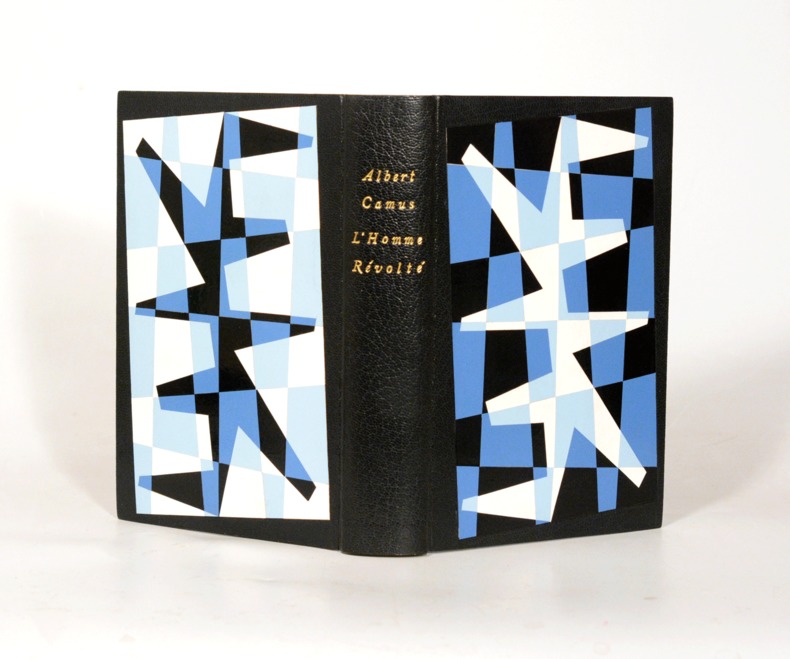
19510001341951 Paris, Gallimard, 1951. In-12 (127 X 190 mm) maroquin noir entièrement décoré sur les plats d'une mosaïque de motifs géométriques en box bleu ciel, bleu azur, noir et blanc, dos lisse, auteur et titre dorés, tête dorée, couverture conservée, chemise à petits rabats, étui (Pierre-Lucien Martin, 1959).
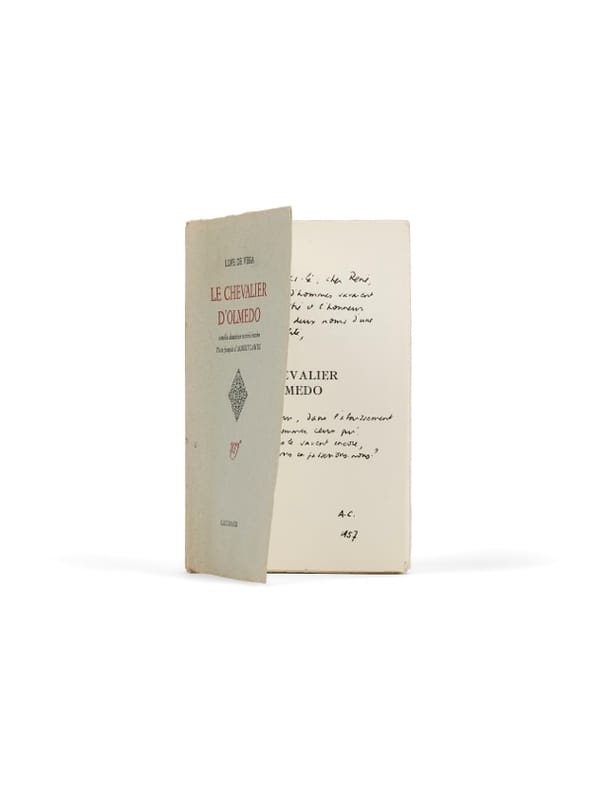
195732047Exemplaire René Char avec envoi : la plus longue des dédicaces faites Paris, Gallimard, (17 juin) 1957. 1 vol. (110 x 170 mm) de 203 p. et [2] f. Broché. Édition originale de l'adaptation d'Albert Camus. Un des exemplaires numérotés sur alfa. Envoi signé : «En ce temps-là, cher René, beaucoup d'hommes savaient que l'amitié et l'honneur étaient les deux noms d'une même fidélité ; aujourd'hui, dans l'abaissement où nous sommes, ceux qui comme vous le savent encore, comment nous en passerions-nous ? A. C. 1957».
32047Paris Gallimard 17 juin 1957. 1 vol. 110 x 170 mm de 203 p. et 2 f. Broché. . Édition originale de l'adaptation d'Albert Camus. Un des exemplaires numérotés sur alfa. Envoi signé : « En ce temps-là cher René beaucoup d'hommes savaient que l'amitié et l'honneur étaient les deux noms d'une même fidélité ; aujourd'hui dans l'abaissement où nous sommes ceux qui comme vous le savent encore comment nous en passerions-nous A. C. 1957 ». . Cette dédicace au coeur de l'année du Nobel résume évidemment l'amitié mais surtout l'alliance d'éthique et d'esthétique qui gouverne la période : Camus dramaturge metteur en scène et traducteur ancre son travail dans une fidélité d'amitié d'histoire et de théâtre. Dès ses débuts algérois Camus rêve de plein air d'une scène populaire où la parole « marche vers sa fin » ; l'Espagne l'accompagne très tôt de Révolte dans les Asturies à La Célestine montée avec l'Équipe avant qu'une première collaboration décisive n'ait lieu en 1953 : Marcel Herrand lui commande l'adaptation de Calderón La Dévotion à la croix coup d'envoi d'un cycle hispanique qui culminera avec Lope de Vega en 1957 et ce Chevalier d'Olmedo. À Angers Camus est la figure centrale de la 6e édition du Festival 21-30 juin 1957 : il y remanie et met en scène Caligula pour la première fois et dirige sa propre adaptation du Chevalier d'Olmedo. La « première » demeure de manière légendaire datée au 21 juin mais un orage d'une violence rare arrache décors et inonde plateau et gradins au moment d'allumer les remparts : la représentation est annulée si bien que le festival s'ouvrira in fine le 22 par Caligula et la vraie première d'Olmedo a lieu le 23 juin puis les 26 et 29. Sans en « oublier le côté populaire » écrit-il en marge de ses brouillons sur la pièce. Car Olmedo vient nourrir le projet d'une tragédie moderne où « un seul sentiment marche sans arrêt vers sa fin » et préfigure le répertoire que Camus à la fin de 1959 cerne pour la direction de théâtre qu'on s'apprête à lui confier : Lope encore Calderón Tirso de Molina. Robert Kemp dans sa critique de la pièce donnée dans Le Monde saluera le rythme la fraîcheur et l'innocence du texte de Lope servis par « la plume solide aiguë » de Camus - la même qui vient d'écrire sur la peine de mort des pages fortes et saisissantes qui ne convaincront pas les mainteneurs de la guillotine mais exalteront les abolitionnistes. Rien d'anecdotique : Camus note que le dernier mot de la pièce - teatro - signifie aussi échafaud ; les tréteaux sont un gibet. « Il vaudrait mieux que l'exécution fût publique. Le comédien qui est en chaque homme pourrait alors venir au secours de l'animal épouvanté et l'aider à faire figure même à ses propres yeux » écrit-il dans Réflexions sur la guillotine dont la rédaction est strictement contemporaine. Ainsi la fin de l'adaptation d'Angers n'est pas sans rappeler un motif qui parcourt l'oeuvre entière de Camus du dernier voeu de Meursault au pied de l'échafaud dans L'Étranger jusqu'au rêve d'exécution publique dont parle Clamence à la fin de La Chute publiée l'année précédente. Magnifique provenance. Cet envoi est l'une des 43 connus à René Char l'ami le frère : cette dédicace est de loin la plus longue des 43 référencées. Paris, Gallimard, (17 juin) 1957. 1 vol. (110 x 170 mm) de 203 p. et [2] f. Broché. unknown
13594Paris, De l'Imprimerie de la République, Régent et Bernard, Bachelier, Mallet-Bachelier, Gauthier-Villars, An III (1794) - 1881. 48 tomes (1 à 8 et 10 à 49) in-4 reliés en 27 volumes, 160 planches hors-texte, quelques figures dans le texte, reliure demi-basane ou veau à coins (reliure frottée, manques à quelques coiffes, quelques mors fendillés, manque la moitié du dos au tome 11, dos du tome 20 tabîmé, mors supérieur du tome 1 fendu, rousseurs éparses). Tampons humides ("Bibliothèque de l'Université de France", "Echange autorisé", "Dons n° 12961", "Ecole Polytechnique") et ex-libris : Citoyen Messier (manuscrit), Lefebure de Fourcy 1869 (impr.) et "Monsieur Lefebvre" (manuscrit), Paul Serret (d'après un certificat de la Librairie scientifique A. Hermann, daté 1884 et signé par le libraire, qui confirme qu'il s'agit d'une collection ayant fait l'objet d'un échange autorisé avec la Bibliothèque de l'Université - cf. cachets, et par exemple l'ex-dono manuscrit suivant, répété : "à Mr. Lefebvre, Elève de l 'Ecole Polytechnique, De la part du Conseil de la dite Ecole").
1946BAWDENED001717Hamish Hamilton London. 1946. First UK edition. Octavo. pp ii 104. Translated from the French by Stuart Gilbert. Five-page Introduction by Cyril Connolly who also included the book in his 100 Key Books of the Modern Movement.WITH: Edward Bawden's original artwork for the front panel and spine of the dustwrapper. This measures approximately 11.5 x 9 cm and is painted in three colours with watercolour. The pencilled gridlines for scaling up to the published size are discernible beneath the image and the phrase ''Introduction by Cyril Connolly'' is not present. Mounted framed and glazed together with the front panel and spine of the printed dustwrapper. The frame which measures 36.5 x 31 cm was made by Bawden's usual framers in Essex and has their inkstamp on the rear. His pencilled signature can be seen on the backing board below the artwork. The printed version shows some details have been added to the face and that the lettering designed by Bawden has been tidied up a bit. In their 2008 book on Bawden Caroline Bacon and James McGregor state that the dustwrapper design uses linocut and collage whereas this early preparatory drawing clearly uses neither. It is possible that the frame was made for the 1988 exhibition at the V&A which celebrated Bawden's 85th birthday. He had worked as an official war artist in Iraq and Saudi Arabia which may have influenced his decision to depict the about-to-be-murdered Arab rather than the book's central character Meursault.Book: small patch of fading to head of spine; very small bumps to corners of covers; very good indeed in very good dustwrapper with some chipping and closed tears repaired on the reverse. Artwork: fine. Hamish Hamilton, London. unknown
195392226Gallimard | Paris 1953 | 12 x 19 cm | Broché
1942140947843Paris: Gallimard 1942. First Edition. Near Fine. First edition first printing with false mention of seventh edition imprint. 159 pp text in French printed on wartime speckled paper. Bound in publisher's cream wraps printed in red and black. Prelims unopened. Near Fine with slight lean to spine and light wear soiling and foxing to covers. Contents toned. Housed in a custom chemise slipcase with very light wear marble-printed paper over boards red leather spine titled in gilt on chemise.<br /> <br /> <p>An excellent copy of Camus' first novel published in a limited run of 4400 copies due to paper restrictions under German occupation. The publishers printed different copies with "Second Edition" "Fifth Edition" and so on as a marketing ploy to attract customers. This copy has "septieme edition" printed on the title page and rear wrap. Gallimard unknown
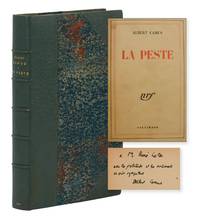
1947140946928Paris: Gallimard 1947. First Edition. Near Fine. First edition of the The Plague in the original French; a press service copy. An association copy signed by Albert Camus and inscribed on the half title page to teacher and literary critic "a M. Rene Lalou avec la gratitude et les sentiments de vive sympathie." Bound in half green morocco over marbled boards stamp-signed by Mercher 1967; in matching green lined slipcase lightly worn. Near Fine with small small stain to fore edge tanning to pages pencil marking throughout mostly confined to the margins. One of Camus' best known works. Gallimard unknown
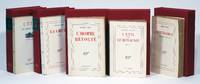
19572921<p>Paris: Gallimard 1957. First edition. original wrappers. Fine. FIVE PRESENTATION COPIES ALL SIGNED AND INSCRIBED BY CAMUS TO ALAIN GHEERBRANT. Alain Gheerbrant 1920-2013 was an influential French writer publisher and explorer. As the founder of the avant-garde publishing house K Éditeur Gheerbrant was highly influential in French literary circles in the 1940s publishing works by among others Antonin Artaud Benjamin Péret and Georges Bataille. He later became famous as an explorer - traveling along the Amazon river and being the first Westerner to make contact with several indigenous groups. These volumes – all inscribed by Camus to Gheerbrant – link Camus to an important contemporary of the French literary avant-garde.<br /><br />The collection consists of:<br /><br />–L'Homme Révolté. The Rebel. Inscribed on the half-title "á M. Gheerbrandt / en cordial hommage. Albert Camus."<br /><br />Camus's major philosophical statement a continuation of the ideas introduced in The Myth of Sisyphus and fictionalized in La Peste. First edition – with "l'edition originale" statement but later issue with "17e édition" on title page. The publisher Gallimard was famous for adding fictitious later edition statements on the title page to imply the book was selling well. Paris: Gallimard 1951. Original wrappers glassine with wear custom box. A fine copy.<br /><br />–L'Exil et Le Royaume. Exile and the Kingdom. Inscribed on the half-title "á M. Gheerbrant / en cordial hommage. Albert Camus."<br /><br />Camus's masterful collection of six short stories exploring the absurd including his most celebrated story "The Guest". First edition service de presse issue "S.P." – sent to potential reviewers and members of the literary world – generally preceding the regular issue. Paris: Gallimard 1957. Octavo original wrappers glassine with wear custom box. A fine copy.<br /><br />–Actuelles II. Chroniques 1948-1953. Current Chronicles. Inscribed on the half-title "à Monsieur Gheerbrant en bien cordial hommage. Albert Camus". <br /><br />Camus second collection of journalistic essays promoting his characteristic themes of the need for justice and the avoidance of violence. First edition advance service de presse issue "S.P." Paris: Gallimard 1953. Octavo original wrappers glassine with wear custom box. A fine copy.<br /><br />–La Chute. The Fall. Inscribed on the half-title "à Monsieur Gheerbrant en cordial hommage. Albert Camus". <br /><br />Camus's last novel a searing exploration of the narrator's attempt to deal with his existential despair in the wake of the Second World War and the Holocaust. First edition with "l'edition originale" statement but later issue with "Onzième édition" on title page. Paris: Gallimard 1956. Octavo original wrappers glassine with wear custom box. A fine copy.<br /><br />–L'Été. Summer. Inscribed on the half-title "à Monsieur Gheerbrant en bien cordiale pensée. Albert Camus." <br /><br />Camus's post-war collection of essays including his much-reproduced "La Minotaure" and "Retour a Tipasa". First edition advance service de presse issue "S.P." Paris: Gallimard 1954. Octavo original wrappers glassine with wear custom box. A fine copy.<br /><br />Please note: There is some toning and chipping to the glassine on the copies but the copies themselves are strikingly clean and fine.</p> Gallimard
194543878Paris: Gallimard 1945. Fine. Gallimard Paris 1945 12 x 19 cm broché First edition one of 25 numbered copies on ""pur-fil"" paper most limited issue. The book Camus dedicated to his friend René Leynaud. Rare and handsome copy. Gallimard unknown
195757978Paris Gallimard 1957. Bound uncut and with the original printed wrappers aslo the backstrip in a magnificent full black morocco binding with more than 100 calf onlays in seven different tones of red/orange forming three hypnotizing circles on each board. Gilt title to spine all edges gilt and bright red suede end-papers within cream calf borders. Housed in a matching black morocco chemise with gilt title and red and grey paper covers with suede on the inside and a slipcase of the same paper and with black morocco edges. The binding is signed J.P. Miguet and dated 2003. One of the morocco onlays on the back board towards the spine has a tiny tear at the edge. Otherwise the binding is in splendid condition. Also internally the copy is near mint. Apart from the backstrip which has been mounted and slightly restored it is completely clean fresh and crisp. Elengant blindstamped super-exlibris to inside of front board. <br/><br/><em>Nr. 35 out of merely 45 numbered copies on Hollande van Gelder - first paper premier papier followed by another 1.145 numbered copies on other kinds of paper - of Camus' great collection of stories which are considered among the best of his works. Together these stoires cover the entire variety of existentialism - or absurdism. There is general consensus that the clearest manifestation of the ideals of Camus can be found in the present work. </em> unknown
19793856Fata Morgana, sl., 1979. Petit in-folio (340 x 270 mm), 34 pages en ff., couverture illustrée rempliée, sous chemise illustrée et étui toilés bleu. Édition originale illustrée très rare en tirage de tête. 34 LITHOGRAPHIES ORIGINALES EN COULEURS à chaque page par Pierre Alechinsky, dont 2 pour la couverture. Tirage : 200 ex. sur vélin d'Arches, signés par l'auteur et l'artiste au justificatif. Celui-ci l'un des 30 numérotés de 1 à 30 du tirage de luxe (n°17), AVEC LA SUITE COMPLÈTE DES 32 LITHOGRAPHIES SUR DOUBLES FEUILLETS (16), chacune rehaussée d'aquarelle au pochoir, chacune signée et numérotée 17/30. Note bibliographique : Cioran avait peu de goût pour la peinture, et n'avait jamais fait de livres illustrés. En 1979, persuadé par son éditeur, il tente l'aventure avec Pierre Alechinsky et lui propose une trentaine de pages d'aphorismes. Le peintre y répondit par 32 lithographies en couleurs. Poussé par le challenge, il réalise alors l'une de ses très grandes réussites éditoriale.
194543878Gallimard | Paris 1945 | 12 x 19 cm | broché
195043780Paris: Charlot 1950. Fine. Charlot Paris 1950 16 x 25.50 cm relié First edition in part one of 17 numbered copies on China paper tirage de tête. Half maroon morocco Bradel binding by Devauchelle over Japan paper the spine with two mosaiced lozenges of cream-colored morocco date and publisher at foot of spine top edge gilt an elegant binding. Provenance : the library of Raoul Simonson with his ex libris pasted in. A fine copy in a lovely binding. Charlot unknown
1946184881Paris: Calmann-Lévy Éditeurs 1946. They discovered with a surprise from which they have barely recovered that one could be right and be defeated A hand-corrected typescript by Camus of his preface to the special Spanish issue of Actualité along with a copy of the journal. L'Espagne Libre was edited by George Bataille and devoted exclusively to Spanish politics economy art and culture. The typescript shows several significant differences to the published version including the deletion of a large paragraph that is present in L'Espagne Libre suggesting that Camus returned to and revised this text or changed his mind and made further edits prior to publication. In the preface written shortly after the Second World War Camus considers the damage and horror of the Spanish Civil War: "For nine years now the men of my generation have had Spain in their hearts. it was through it that they first experienced the taste of defeat that they discovered with a surprise from which they have barely recovered that one could be right and be defeated that force could subdue the spirit and that there were cases where courage had no reward" our translation. The journal contains many significant pieces including articles by Jean Camp Maurice Blanchot a translated version of a chapter of Ernest Hemingway's For Whom the Bell Tolls to which they gave the title "L'Odeur de la Mort" and the short puppet play Retablillo de don Cristóbal written by Federico García Lorca. Typescript: 5 leaves 280 x 217 mm typed one side only in French paper hole punched. Actualité: L'Espagne Libre: cream wrappers spine lettered in black front cover lettered and decorate in black and yellow. Typescript: occasional chips to inner edge hole-punched toned horizontal crease where folded. Actualité: toned a little brittle chips at edges minor loss to paper on spine rear joint repaired: a good copy. unknown