CAMUS (Albert)Biblio.com

3 905 résultats
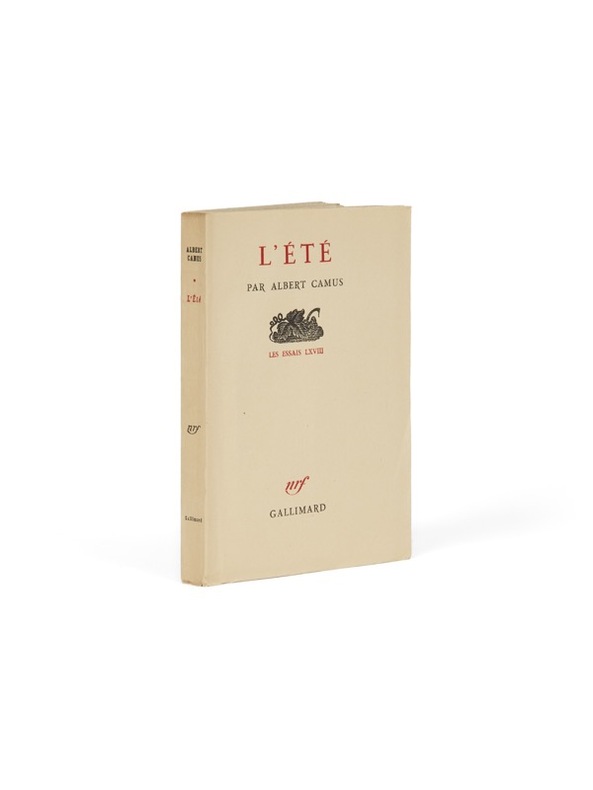
26841Paris Gallimard coll. « Les Essais » février 1954. 1 vol. 125 x 190 mm de 188 p. et 2 f. Broché non coupé sous chemise et étui. . Édition originale. Un des 25 premiers exemplaires sur vélin de Hollande n° 18. . Après les querelles idéologiques que ses adversaires ont infligées à L'Homme révolté Albert Camus se tourne vers un travail plus littéraire en composant ce recueil. Les récits qui le composent ont été écrits entre 1939 et 1953 au rythme des lieux visités ou habités : Oran dont la nouvelle « Le Minotaure » dresse un fabuleux portrait ; Alger ville de sa jeunesse. Les textes notamment le célèbre « Retour à Tipasa » sont parcourus par un lyrisme qui les place dans la continuité de Noces. Signalons qu'il s'agit d'un des plus petits tirage en grands papiers pour une oeuvre de Camus : il suit par le nombre les 13 exemplaires du Malentendu et des Justes les 14 de L'État de siège les 15 du Mythe de Sisyphe et les 21 du Minotaure ou la halte d'Oran - lequel sera justement repris dans L'Été. Signalons néanmoins que 10 exemplaires d'auteurs ont été tirés hors commerce sur alfa mousse. Tel que paru. Paris, Gallimard, coll. « Les Essais », (février) 1954. 1 vol. (125 x 190 mm) de 188 p. et [2] f. Broché, non coupé, sous unknown
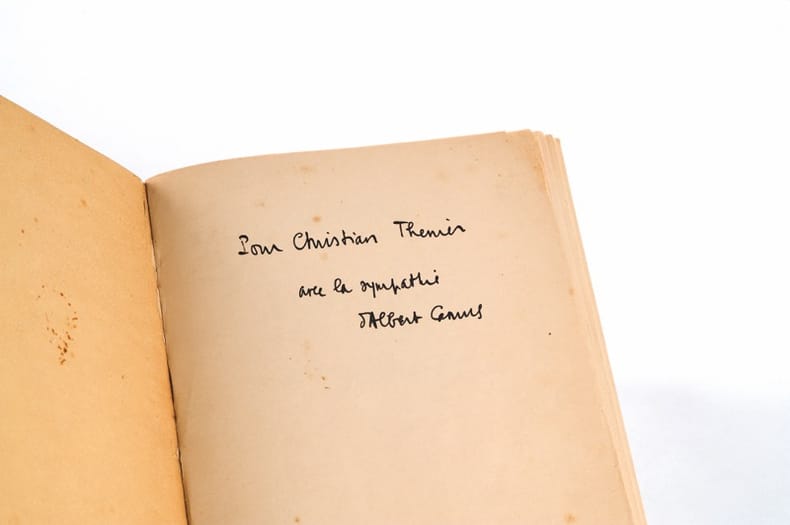
193731882Premier livre de Camus. Envoi signé de la rue de Tanger Alger, Éditions Edmond Charlot, coll. «Méditerranéennes», (10 mai) 1937 1 vol. (205 x 156) de 66 p. et 1 f.n.ch. Broché. Édition originale. Tirage limité à 385 exemplaires. Un des 325 exemplaires sur Hélio (n° 261). Envoi signé : « à Christian Thenier, avec la sympathie d'Albert Camus». Montée en tête, la rare carte de visite « hommage de l'éditeur» d'Edmond Charlot.
195426841Tirage de tête sur hollande Paris, Gallimard, coll. «Les Essais», (février) 1954. 1 vol. (125 x 190 mm) de 188 p. et [2] f. Broché, non coupé, sous chemise et étui. Édition originale. Un des 25 premiers exemplaires sur vélin de Hollande (n° 18).
195253361Paris: Falaize 1952. Fine. Falaize Paris 1952 11.50 x 17.50 cm broché La Ballade de la geôle de Reading. L'Artiste en prison The Ballad of Reading GaolFalaize Paris 1952 11.5 x 17.5 cm original wrappers New edition of the French translation by Jacques Bour and the first edition of Albert Camus' famous preface. One of 50 numbered copies on Madagascar paper tirage de tête. A fine autograph inscription from Albert Camus: à Michel Simon grand artiste avec les voeux chaleureux d'un de ses vieux admirateurs For Michel Simon a great artist with warmest wishes from an old fan and an autograph inscription from the translator Jacques Bour: à Michel Simon qui ferait crouler tous les murs! For Michel Simon who raised all the roofs! A rare and very good copy. Falaize unknown
195043780Charlot | Paris 1950 | 16 x 25.50 cm | relié
194585204Sous boitier avec dos en demi-maroquin violet, signe? Carine Vilaine. Couverture souple. Non rogne?.
195253361Falaize | Paris 1952 | 11.50 x 17.50 cm | broché
19422886<p>Paris: Gallimard 1942. First edition. Very Good. FIRST EDITION OF ONE OF THE DEFINING NOVELS OF THE TWENTIETH CENTURY. "From its cold opening lines 'Mother died today. Or maybe yesterday; I can't be sure' to its bleak concluding image of a public execution set to take place beneath the 'benign indifference of the universe' Camus's first and most famous novel takes the form of a terse flat first-person narrative by its main character Meursault a very ordinary young man of unremarkable habits and unemotional affect who inexplicably and in an almost absent-minded way kills an Arab and then is arrested tried convicted and sentenced to death. The neutral style of the novel-typical of what the critic Roland Barthes called 'writing degree zero'-serves as a perfect vehicle for the descriptions and commentary of its anti-hero narrator the ultimate 'outsider' and a person who seems to observe everything including his own life with almost pathological detachment" David Simpson. <br /><br />Note: With the fictitious "Quatrième édition" on the title page and rear wrapper. The 4400 copies of the first printing were issued on the same day. There were eight different title pages and rear wrappers however used as a marketing ploy implying falsely that there were eight different editions.<br /><br />The Nobel Prize in Literature 1957 was awarded to Albert Camus "for his important literary production which with clear-sighted earnestness illuminates the problems of the human conscience in our times".<br /><br />Paris: Gallimard 1942. Original wrappers; glassine probably not original glassine; housed in custom half-morocco box with chemise. Some soiling to wrappers particularly on the spine spine also with edgewear; small tear at bottom right front wrapper and chipping at bottom right edge. A very good copy rare in original wrappers.</p> Gallimard
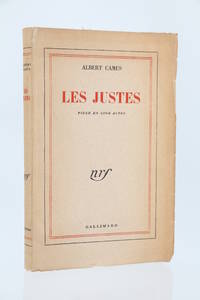
195082804Paris: Gallimard 1950. Fine. Gallimard Paris 1950 12 x 19 cm broché First edition one of 70 numbered copies on pur fil paper the deluxe issue after 2 reimposed on pur fil vergé hors commerce reserved for Jacques Hébertot and 13 on holland paper. A handsome and rare copy of this response by Albert Camus to Jean-Paul Sartre's ""Les mains sales"". Gallimard unknown
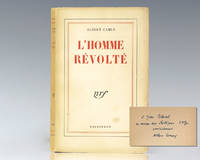
1951137305Paris: Gallimard 1951. First edition review copy marked "S.P." on title-page and lower wrappers of one of Camus' most notable works. Octavo original wrappers as issued. Presentation copy inscribed by the author on the half-title page "A Yvon Belaval en souvenir des Portiques d'Alger amicalement Albert Camus." The recipient French philosopher and literary scholar Yvon Belaval was a specialist in 18th century French philosopher Denis Diderot and edited an important edition of Diderot's works with fellow philosopher Jean Grenier one of Camus' most influential mentors to whom he dedicated the present volume. Camus became a student of Grenier's in Algiers and was strongly influenced by his work Les Îles published in 1933. He dedicated his first book to Grenier: L'envers et l'endroit published in Algeria by Edmond Charlot. L'homme révolté was also dedicated to Grenier and Camus provided the preface to the second edition of Les Îles in 1959. In near fine condition. A unique association copy. One of Camus' most important philosophical texts The Rebel examines both the metaphysical and historical development of rebellion and revolution in societies particularly in Western Europe. Examining both rebellion and revolt which may be seen as the same phenomenon in personal and social frames Camus examines several' countercultural' figures and movements from the history of Western thought and art noting the importance of each in the overall development of revolutionary thought and philosophy. Gallimard unknown
195082804Gallimard | Paris 1950 | 12 x 19 cm | broché
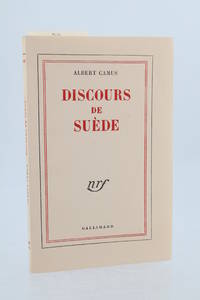
195882402Paris: Gallimard 1958. Fine. Gallimard Paris 1958 12 x 19 cm broché First edition one of 56 numbered copies on Holland paper deluxe copy. Additionally 210 copies were printed on pure thread paper and hors commerce 50 copies on Madagascar paper. A very handsome copy of Camus's finest text on commitment and the responsibility of new generations facing the challenges of the world to come. Gallimard unknown
195086112Paris: Gallimard 1950. Fine. Gallimard Paris 1950 12 x 19 cm broché First edition one of 70 numbered copies on pure thread paper ours being one of 15 hors commerce copies lettered under Ingres covers deluxe copies after 2 reimposed on pure thread laid paper hors commerce reserved for Jacques Hébertot and 13 holland paper copies. Minor marginal tears of no consequence to the covers. Handsome and rare copy of this response by Albert Camus to Jean-Paul Sartre's ""Les mains sales"". Gallimard unknown
1816ST15737Lyon: Chez Rusand 1816. 208 x 122 mm. 8 1/4 x 5". 2 p.l. xlviii 572 pp. <br/> ESPECIALLY FINE CONTEMPORARY EMERALD GREEN SHAGREEN BY DUPLANIL signed at foot of spine "DUPLANIL RELIr. DE S. A. R. MADAME" covers with simple gilt rule frame spine with raised bands flanked by gilt fillets and decorated with a dotted line compartments with very pretty centered ornament of a flower with four pointillé petals set against a gilt square background head and tail of spine with multiple decorative gilt rules board edges gilt with Greek key roll elegant gilt inner dentelles of urns and palmettes pink endpapers gilt edges. In a fine later fleece-lined burgundy morocco and marbled paper chemise and slightly worn matching slipcase. With woodcut vignette. Front end papers with morocco bookplates of Mortimer L. Schiff and John Roland Abbey. For the binding: De Ricci-Schiff III 277 this copy. ◆A breath of chafing to covers two leaves with slight paper flaws at fore margin otherwise A BEAUTIFULLY BOUND BOOK IN VIRTUALLY PERFECT CONDITION.<br/> <br/> This is an outstanding example of a French Restoration binding with illustrious provenance. The Duplanils were a distinguished family of Parisian binders active from the last part of the 18th until the middle of the 19th century. The signature at the foot of the spine here is that of Pierre Duplanil known as Duplanil fils the most notable member of the family; as this item indicates he was the self-styled binder to "S. A. R. Her Royal Highness Madame" i.e Madame Royale the title borne by Marie-Thérèse Charlotte of France 1778-1851 the eldest--and only surviving--child of Louis XVI and Marie Antoinette. Although she had married her cousin the duc d'Angoulême son of the future Charles X she retained the royal title accorded her as the daughter of the king. She later became "la Dauphine" when her father-in-law ascended the throne. Because of his client's changing appellations we can confidently date the present binding as being done between 1816 and 1824. Madame Royale's books which numbered about 1800 were kept together for 20 years after her death then sold at two auctions in Paris in the 1870s. Our volume is distinguished by its inclusion in Seymour De Ricci's impressive 1935 illustrated catalogue of Schiff's library of signed French bindings part of what Dickinson calls an "unrivaled collection of decorative bindings." This item is one of six Duplanil bindings in the Schiff catalogue. The presence of the bookplate of J. R. Abbey 1894-1969 the most ambitious English book collector of his time adds further luster to this item's provenance. Although Abbey's renowned library included world-class collections of private press books illuminated manuscripts and color plate books bindings were his most ardent interest and the various fine and important catalogues they spawned comprise perhaps the most enduring legacy of his collecting. During his most active period of binding acquisition Abbey bought many items and no doubt the present one in the Schiff sale in 1938; this book in turn was lot #1740 in part III of the Abbey sale purchased at Sotheby's on 19 June 1967 by B. W. Simpson for £32. First published in 1639 the present biography of the bishop and devotional writer St. Francis de Sales the author's friend and teacher is among the most memorable of the 200 or so books produced by the diligent churchman Camus bishop of Belley 1582-1652. Chez Rusand unknown
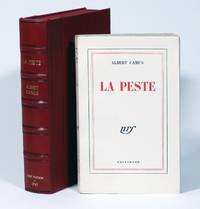
19472915Paris: Gallimard 1947. First edition. Original wrappers. Fine. FIRST EDITION; A MAGNIFICENT COPY. "The longest and most ambitious of his fictions Albert Camus's novel The Plague is widely regarded as his masterpiece. It is certainly an artistic tour de force: a vividly realistic account of a harrowing imaginary event" Murray Sachs. “When The Plague was first published in 1947 the majority of French critics greeted it as an allegorical presentation not only of la condition humaine in general but also of the particular experience of the German occupation. Yet it would be an extremely limiting interpretation to see in The Plague only the description of a single historical experience. The struggle against plague and occupation are part of a wider struggle not only against the physical evil inherent in the world but also against the evil which men by their blindness and indifference as well as by their cruelty do to one another†Philip Thody. <br /> <br /> One of 215 copies this one numbered 199 on “vélin our film des Papeteries Lafuma-Navarre†with the paper thicker and much brighter than the more common issue which tends to have browned pages. Note: before the number the limitation page says "Exemplaire de Alfa Navarre" but this is an error printed on all the "Lafuma-Navarre" copies. <br /> <br /> CAMUS ALBERT. La Peste. Paris: Gallimard 1947. First edition. Octavo original wrappers with almost certainly original glassine; custom half-red morocco box. A beautiful fine copy; without question the nicest we've handled. Gallimard unknown
1950422752Paris: Charlot 1950. Softcover. Near Fine/Near Fine. First edition limited issue. Tall octavo. Small chip at the spine crown very good in printed wrappers and unprinted glassine dust jacket. One of 120 copies reserved for the use of the author of a total edition of 1343 copies. This is copy number 848 on Rives paper. The copies numbered between 801 to 920 were the author's copies. Inscribed by the author: "a Nicole et Jean Marie/ avec la fidele affection/ de leur vieux camarade/ Albert Camus." "To Nicole and Jean Marie/ with the faithful affection/of their old comrade/ Albert Camus.".<br /> <br /> The recipients were almost certainly Nicole and Jean-Marie Domenach French intellectuals and friends of Camus albeit with some philosophical differences. Jean-Marie was a noted left wing Catholic thinker and while he and Camus were both vocal in protesting such activities as the French use of torture during the Algerian Civil War Domenach had considerably more sympathy for the socialist and communist governments of the time which Camus found repugnant. It is interesting to note the comma in the inscription as though the inclusion of Jean-Marie in the presentation was an afterthought or perhaps a necessity of politesse. Long after Camus had died Jean-Marie Domenach provided a preface to a book of his thinking Albert Camus and Christianity. Hope on Trial.<br /> <br /> The deluxe editions of this title turn up at auction with some regularity but we were unable to find any instance of one of the author's copies in the market and very few copies of this limited edition have ever turned up signed. A rarity and a notable association copy. Charlot unknown
195048392Paris: Gallimard 1950. Fine. Gallimard Paris 1950 12 x 19 cm broché sous chemise et étui First edition one of 23 numbered copies on Hollande paper the tirage de tête A fine unsophisticated copy. Gallimard unknown
195051282Paris: Gallimard 1950. Fine. Gallimard Paris 1950 12 x 19 cm broché First edition one of 23 numbered copies on Hollande paper the tirage de tête A fine copy. Gallimard unknown
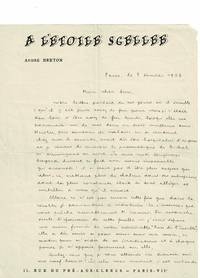
195375729Paris 1953. Fine. Paris 8 janvier 1953 21 x 27 cm 1 pages et quelques lignes sur un feuillet Unpublished handwritten signed letter from André Breton addressed to critic Charles Estienne; one page and a few lines in black ink on a paper from the à l'étoile scellée gallery. Two transverse folds from having been sent a small corner missing in the upper right margin. Very beautiful letter giving an account of the death of one of André Breton's dearest friends and of his quarrel with Albert Camus. Breton tells his friend about the death of the Surrealist Czech artist Jindich Heisler: Your letter spoke of those days where it seemed that there was only just enough fire to live: on Monday there was far from enough fire when it reached me: one of my two or three best friends Heisler taken suddenly unwell on his way to mine on Saturday had to be hospitalised urgently and I had just received the pneumatic from Bichat telling me of his death. The event no less inconceivable than accomplished left me distraught for a long time: there was no-one more exquisite than he putting more warmth into everything he did the most constant of which was to lighten and embellish those whom he loved. The two poets were indeed very close: Heisler participated alongside Breton in the launch of Néon in 1948 and supported him during a period of depression accompanying him with other friends to the Île de Sein. The beginning of 1953 was overshadowed by the death of Jindich Heisler 4 January. Loyal among the faithful he lived entirely for Surrealism according to Breton who pays tribute to his activity as a leader: This is how he was between 1948 and 1950 the soul of Néon and until his last moments the greatest bearer of projects that as if by magic his talent gave him the means to achieve. Henri Béhar André Breton In this letter laden with pain Breton suddenly makes reference to L'Homme révolté by Albert Camus published two years earlier: Come on it is not yet the time in the rebellion that I will succeed in introducing the measure that M. Camus kindly preaches to us. The two writers met in New York at the end of March 1946 when Camus was invited to the United States for a conference tour as a representative of Combat. The two agree on the best way to preserve the testimony of certain men free from ideological distortions. They dream of a kind of pact by which people of their calibre would commit to not join any political party to fight against the death penalty to never claim any credit whatsoever. ibid. With other intellectuals they founded the Rassemblement démocratique révolutionnaire RDR in 1948; but the idyll ended a couple of years later in the autumn of 1951 when Camus published Lautréamont et la banalité an extract from his Homme révolté which was published later. Breton was extremely hurt and responded to him in an article entitled Sucre jaune in Arts: This article . testifies to the part of Camus for the first time for an indefensible moral and intellectual position. . He only wants to see a guilty adolescent in Lautréamont whom he - in his capacity as an adult - must discipline. He goes as far as to find him in the second part of his work: Poésies a deserved punishment. According to Camus Poésies would be but a mass of laborious banalities . It could still be worse if the destitution of these views did not intend to promote the most suspect thesis in the world which is that absolute revolt can generate only the taste for intellectual enslavement. This is a completely gratuitous ultra-defeatist statement which must incur even more contempt than its false demonstration. Thus two years later Breton still holds out against Camus' crime of lese-majesty towards that which Breton constructed as the father of surrealism but even more this allusion to Camus' pacifist philosophy bearing witness to the incompatibility between a thought of moderation and a poetry of revol unknown
194752557Paris Gallimard 1947 In-12, broch, couverture imprime.Edition originale. Un des 215 exemplaires numrots sur vlin pur fil. Neuf, non coup.
1945185956Paris: Gallimard 1945. A rare inscribed copy First edition inscribed by the author on the half title "à M. L. D. Hirsch avec la cordial sympathie Albert Camus". This work consists of four texts in the form of letters written by a Frenchman to a former German friend who has embraced Nazism. The first three were published in clandestine newspapers during the occupation. The recipient Louis-Daniel Hirsch was the marketing director of Gallimard from 1922. He later became the general secretary to Gaston Gallimard and was head of the Reading Committee. This is from a limited edition of 2265 copies of which this is Number 2213 of the 2000 numbered trade copies on alfa Navarre. Small octavo. Original cream wrappers spine lettered in gilt covers lettered and with borders to covers in black and dark brown. With original wraparound band loosely inserted; in a later glassine jacket. A few faint marks to covers else a fine and unopened copy. unknown
19792606240056Easton Press 1979. Hardcover. Like New. 50 volume Great Books of the 20th century set Hardcover. Bound in full leather. Stamped with 22kt gold gilt design on cover front back and spine. All edges gold. Silk moire fabric end papers. Satin ribbon place holder. Fine binding and cover. Clean unmarked pages. Some volumes still in publisher's shrink wrap. For more than 30 years the Easton Press has been the standard for finely bound profusely gilt classic leather bindings. <br>Now out of print the Easton Press Library of 20th Century Classics featured the emblematic works of the 20th century in collector's edition gilt leather bindings.<br>This is an oversized or heavy book which WILL require additional postage for Priority Mail or International delivery outside the US.<br> Contains the following volumes: Baldwin James - Go Tell it on the Mountain; Borges Jorge Luis - Ficciones; Bradbury Ray - Fahrenheit 451; Burgess Anthony - A Clockwork Orange; Camus Albert - The Stranger; Capote Truman - In Cold Blood; Cather Willa - Death Comes for the Archbishop; Ellison Ralph - Invisible Man; Faulkner William - Light in August; Fitzgerald F. Scott - The Great Gatsby; Forster E.M. - A Passage to India; Greene Graham - The Power and the Glory; Heller Joseph - Catch-22; Hemingway Ernest - The Sun Also Rises; Huxley Aldous - Brave New World; James Henry - The Ambassadors; Joyce James - Ulysses Illustrated by Henri Matisse; Kafka Franz - The Trial; Kerouac Jack - On the Road; Kesey Ken - One Flew Over the Cuckoo's Nest; Koestler Arthur - Darkness at Noon; Lawrence D.H. - Women in Love; Lee Harper - To Kill a Mockingbird; Lewis Sinclair - Babbitt; London Jack - The Call of the Wild; Mann Thomas - The Magic Mountain; Márquez Gabriel García - One Hundred Years of Solitude; Maugham Somerset - Of Human Bondage; McCullers Carson - The Heart is a Lonely Hunter; Mitchell Margaret - Gone with the Wind; Morrison Toni - Beloved; Nabokov Vladmir - Lolita; Orwell George - Nineteen Eighty-Four; Pasternak Boris - Dr. Zhivago; Plath Sylvia - The Bell Jar; Proust Marcel - Swann's Way; Rand Ayn - The Fountainhead; Remarque Erich Maria - All Quiet on the Western Front; Roth Philip - Portnoy's Complaint; Solzhenitsyn Aleksandr - One Day in the Life of Ivan Denisovich; Steinbeck John - The Grapes of Wrath; Updike John - Rabbit Run; Vonnegut Kurt - Slaughterhouse-Five; Walker Alice - The Color Purple; Warren Robert Penn - All the King's Men; Waugh Evelyn - Brideshead Revisited; Wharton Edith - The Age of Innocence; Wiesel Elie - Night; Woolf Virginia - To the Lighthouse; Wright Richard - Native Son. Easton Press hardcover
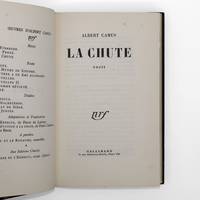
1956374898Paris: Gallimard 1956. First edition one of 235 numbered copies on vélin pur fil Lafuma-Navarre after 35 on Hollande. 169 pp. 1 vols. 12mo. Full chestnut morocco spine titled in gilt suede doublures preserving the original wrappers edges gilt on the rough by Alix. Book label. Fine binding in perfect condition in matching slipcase. First edition one of 235 numbered copies on vélin pur fil Lafuma-Navarre after 35 on Hollande. 169 pp. 1 vols. 12mo. La Chute is the masterful final novel by Albert Camus 1913-1960 whose other works include L'Etranger 1942 and Le mythe de Sisyphe. Camus was awarded the Nobel prize in literature the year after publication of La Chute which Sartre called his most beautiful and least understood. In his eulogy Sartre recalled how Camus provisionally chosen silence after receiving the honor but his autobiography in progress Le premier homme was published posthumously.<br /> <br /> This copy on fine paper has been bound in a sober dazzling binding from the French designer bindery Alix. Gallimard unknown
195882402Gallimard | Paris 1958 | 12 x 19 cm | broché
195086112Gallimard | Paris 1950 | 12 x 19 cm | broché