Andre BRETON - (Albert CAMUS)Biblio.com
1 673 résultats
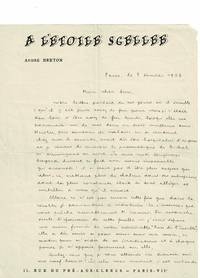
195375729Paris 1953. Fine. Paris 8 janvier 1953 21 x 27 cm 1 pages et quelques lignes sur un feuillet Unpublished handwritten signed letter from André Breton addressed to critic Charles Estienne; one page and a few lines in black ink on a paper from the à l'étoile scellée gallery. Two transverse folds from having been sent a small corner missing in the upper right margin. Very beautiful letter giving an account of the death of one of André Breton's dearest friends and of his quarrel with Albert Camus. Breton tells his friend about the death of the Surrealist Czech artist Jindich Heisler: Your letter spoke of those days where it seemed that there was only just enough fire to live: on Monday there was far from enough fire when it reached me: one of my two or three best friends Heisler taken suddenly unwell on his way to mine on Saturday had to be hospitalised urgently and I had just received the pneumatic from Bichat telling me of his death. The event no less inconceivable than accomplished left me distraught for a long time: there was no-one more exquisite than he putting more warmth into everything he did the most constant of which was to lighten and embellish those whom he loved. The two poets were indeed very close: Heisler participated alongside Breton in the launch of Néon in 1948 and supported him during a period of depression accompanying him with other friends to the Île de Sein. The beginning of 1953 was overshadowed by the death of Jindich Heisler 4 January. Loyal among the faithful he lived entirely for Surrealism according to Breton who pays tribute to his activity as a leader: This is how he was between 1948 and 1950 the soul of Néon and until his last moments the greatest bearer of projects that as if by magic his talent gave him the means to achieve. Henri Béhar André Breton In this letter laden with pain Breton suddenly makes reference to L'Homme révolté by Albert Camus published two years earlier: Come on it is not yet the time in the rebellion that I will succeed in introducing the measure that M. Camus kindly preaches to us. The two writers met in New York at the end of March 1946 when Camus was invited to the United States for a conference tour as a representative of Combat. The two agree on the best way to preserve the testimony of certain men free from ideological distortions. They dream of a kind of pact by which people of their calibre would commit to not join any political party to fight against the death penalty to never claim any credit whatsoever. ibid. With other intellectuals they founded the Rassemblement démocratique révolutionnaire RDR in 1948; but the idyll ended a couple of years later in the autumn of 1951 when Camus published Lautréamont et la banalité an extract from his Homme révolté which was published later. Breton was extremely hurt and responded to him in an article entitled Sucre jaune in Arts: This article . testifies to the part of Camus for the first time for an indefensible moral and intellectual position. . He only wants to see a guilty adolescent in Lautréamont whom he - in his capacity as an adult - must discipline. He goes as far as to find him in the second part of his work: Poésies a deserved punishment. According to Camus Poésies would be but a mass of laborious banalities . It could still be worse if the destitution of these views did not intend to promote the most suspect thesis in the world which is that absolute revolt can generate only the taste for intellectual enslavement. This is a completely gratuitous ultra-defeatist statement which must incur even more contempt than its false demonstration. Thus two years later Breton still holds out against Camus' crime of lese-majesty towards that which Breton constructed as the father of surrealism but even more this allusion to Camus' pacifist philosophy bearing witness to the incompatibility between a thought of moderation and a poetry of revol unknown
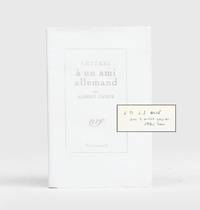
1945185956Paris: Gallimard 1945. A rare inscribed copy First edition inscribed by the author on the half title "à M. L. D. Hirsch avec la cordial sympathie Albert Camus". This work consists of four texts in the form of letters written by a Frenchman to a former German friend who has embraced Nazism. The first three were published in clandestine newspapers during the occupation. The recipient Louis-Daniel Hirsch was the marketing director of Gallimard from 1922. He later became the general secretary to Gaston Gallimard and was head of the Reading Committee. This is from a limited edition of 2265 copies of which this is Number 2213 of the 2000 numbered trade copies on alfa Navarre. Small octavo. Original cream wrappers spine lettered in gilt covers lettered and with borders to covers in black and dark brown. With original wraparound band loosely inserted; in a later glassine jacket. A few faint marks to covers else a fine and unopened copy. unknown
19792606240056Easton Press 1979. Hardcover. Like New. 50 volume Great Books of the 20th century set Hardcover. Bound in full leather. Stamped with 22kt gold gilt design on cover front back and spine. All edges gold. Silk moire fabric end papers. Satin ribbon place holder. Fine binding and cover. Clean unmarked pages. Some volumes still in publisher's shrink wrap. For more than 30 years the Easton Press has been the standard for finely bound profusely gilt classic leather bindings. <br>Now out of print the Easton Press Library of 20th Century Classics featured the emblematic works of the 20th century in collector's edition gilt leather bindings.<br>This is an oversized or heavy book which WILL require additional postage for Priority Mail or International delivery outside the US.<br> Contains the following volumes: Baldwin James - Go Tell it on the Mountain; Borges Jorge Luis - Ficciones; Bradbury Ray - Fahrenheit 451; Burgess Anthony - A Clockwork Orange; Camus Albert - The Stranger; Capote Truman - In Cold Blood; Cather Willa - Death Comes for the Archbishop; Ellison Ralph - Invisible Man; Faulkner William - Light in August; Fitzgerald F. Scott - The Great Gatsby; Forster E.M. - A Passage to India; Greene Graham - The Power and the Glory; Heller Joseph - Catch-22; Hemingway Ernest - The Sun Also Rises; Huxley Aldous - Brave New World; James Henry - The Ambassadors; Joyce James - Ulysses Illustrated by Henri Matisse; Kafka Franz - The Trial; Kerouac Jack - On the Road; Kesey Ken - One Flew Over the Cuckoo's Nest; Koestler Arthur - Darkness at Noon; Lawrence D.H. - Women in Love; Lee Harper - To Kill a Mockingbird; Lewis Sinclair - Babbitt; London Jack - The Call of the Wild; Mann Thomas - The Magic Mountain; Márquez Gabriel García - One Hundred Years of Solitude; Maugham Somerset - Of Human Bondage; McCullers Carson - The Heart is a Lonely Hunter; Mitchell Margaret - Gone with the Wind; Morrison Toni - Beloved; Nabokov Vladmir - Lolita; Orwell George - Nineteen Eighty-Four; Pasternak Boris - Dr. Zhivago; Plath Sylvia - The Bell Jar; Proust Marcel - Swann's Way; Rand Ayn - The Fountainhead; Remarque Erich Maria - All Quiet on the Western Front; Roth Philip - Portnoy's Complaint; Solzhenitsyn Aleksandr - One Day in the Life of Ivan Denisovich; Steinbeck John - The Grapes of Wrath; Updike John - Rabbit Run; Vonnegut Kurt - Slaughterhouse-Five; Walker Alice - The Color Purple; Warren Robert Penn - All the King's Men; Waugh Evelyn - Brideshead Revisited; Wharton Edith - The Age of Innocence; Wiesel Elie - Night; Woolf Virginia - To the Lighthouse; Wright Richard - Native Son. Easton Press hardcover
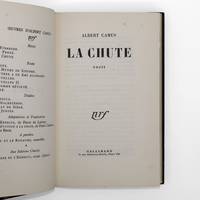
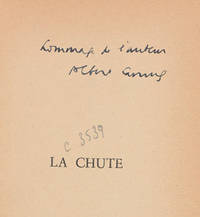
1956374898Paris: Gallimard 1956. First edition one of 235 numbered copies on vélin pur fil Lafuma-Navarre after 35 on Hollande. 169 pp. 1 vols. 12mo. Full chestnut morocco spine titled in gilt suede doublures preserving the original wrappers edges gilt on the rough by Alix. Book label. Fine binding in perfect condition in matching slipcase. First edition one of 235 numbered copies on vélin pur fil Lafuma-Navarre after 35 on Hollande. 169 pp. 1 vols. 12mo. La Chute is the masterful final novel by Albert Camus 1913-1960 whose other works include L'Etranger 1942 and Le mythe de Sisyphe. Camus was awarded the Nobel prize in literature the year after publication of La Chute which Sartre called his most beautiful and least understood. In his eulogy Sartre recalled how Camus provisionally chosen silence after receiving the honor but his autobiography in progress Le premier homme was published posthumously.<br /> <br /> This copy on fine paper has been bound in a sober dazzling binding from the French designer bindery Alix. Gallimard unknown
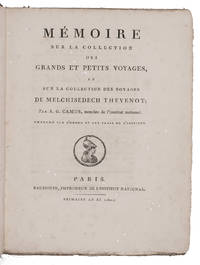
1802K2SBMCLI5XNFParis 1802. 4to. Baudouin Contemporary boards rebacked with cloth. 8 "401"=405 3 pp. First edition of an important bibliographical study of De Bry's Grand and Petit voyages and Thévenot's Relations des divers voyages curieux. Two of the most famous collections of voyages ever published. Sabin calls it "an excellent specimen of bibliographical analysis" and it remains the standard bibliographical reference for both works. It notes the sources for all travels included and gives historical commentary.Armand Gaston Camus 1740-1804 a French Revolutionary was restored to his function as archivist to the Commission des archives of the Assembly in 1796.Some foxing and with restored wormholes throughout a good copy wholly untrimmed.l Sabin 10328. hardcover
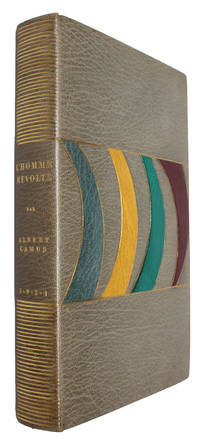
195158821Paris Gallimard 1951. 8vo. Bound uncut and with the original printed wrappers also the spine in a wonderful grey full morocco binding with splendid line-gilding and gilt lettering to spine and onlays of coloured morocco eight different colours in a weve-like pattern with gilt outline to boards. top-edge gilt. Binding by Henning Jensen gilding by Leif Hagel Olsen and design by Jens Bork. Gilt super ex-libris to inside of front board. A very nice and clean copy. 382 2 pp. <br/><br/><em>First edition review-copy Service de Presse-copy - "S. P." to bottom of title-page and on back wrapper of "The Rebel" one of Camus' greatest works with signed presentation-inscription to front free end-paper to the famous critic of literature and drama the writer Guy Dumur 1921-1991.The younger Guy Dumur was a close friend of Camus who hired him to work on "Combat" with him. It is reported that he had a great talent for discovering new talent. Since childhood he was extremely passionate about the theatre and came to work with all the great dramatic figures in Paris at the time. He is also famous for a number of well respected novels.Famous for it's opening lines "What is a rebel A man who says no: but whose refusal does not imply a renunciation. He is also a man who says yes as soon as he begins to think for himself. A slave who has taken orders all his life suddenly decides that he cannot obey some new command. What does he mean by saying 'no'" the novel addresses themes that have never lost their relevance like terrorism rebellion art etc. and counts as one of the great literary productions of the 20th century. </em> hardcover
195458192Paris Gallimard 1954. Uncut in the original printed wrappers. Excellent copy. <br/><br/><em>First edition Service de presse-copy i.e. review-copy "S.P" to bottom of title-page and to verso of back wrapper with an excellent presentation-inscription of Camus' magnificent and highly influential collection of essays entitled "Summer". The copy is inscribed to Camus' close friend and ally in numerous respects Jean Paulhan: "a Jean Paulhan/ en affectueuse pensée/ Albert Camus" on half-title. The famous French writer literary critic and publisher Jean Paulhan 1884-1964 shared many things with Camus with whom he grew very close. Not only did he participate actively in the publication of Camus' first books by Gallimard was one of the first to see the true value of Camus' "The Stranger" he was also a confidante of Camus who considered Paulhan one of the main reasons that he became a proper author. In a letter to Paulhan dated September 17 1952 at the moment of break with Sartre Camus writes: "Ever since I thanks to you became what is called an author I have not ceased to be astonished by my brethren. Sometimes it is true in the sense of admiration. Today it is in another sense." Depuis que je suis devenu en peu grâce à vous ce qu'on apelle écrivain je n'ai pas cessé d'être étonné par mes confrères. Parfois dans le sens de l'admiration il est vrai. Aujourd'hui c'est dans un autre sens.Paulhan was an early and active member of the French Resistance director of the literary magazine Nouvelle Revue Française NRF from 1925 to 1940 and again from 1946 to 1968 and a great translator of Malagasy poetry which attracted the interest of the likes of Guillaume Apollinaire and Paul Éluard. He also wrote numerous works of literary criticism "The Flowers of Tarbes or Terror in Literature" 1941 probably being the most famous and he wrote several autobiographical short stories. After the war Paulhan he founded "Cahiers de la Pléiade" and in 1953 he re-launched NRF.Interestingly especially in connection with Camus' famous essays in "L'été" which are devoted entirely to his beloved Algiers Paulhan was loudly against independence for Algeria. He caused great controversy by opposing independence and supporting the French military during the Algerian War. This not only caused public problems for him it also cost him on the personal front as for instance Maurice Blanchot denounced him. The essays in "L'été" are devoted to Algiers and represent a very personal side of Camus who provides a marvelous poetic and humorous picture of the provincial simplicities of Oran and Algiers. For many Camus-devotees "L'Été" constitutes one of the most beloved works as it gives the feel of a certain intimacy with the author that few of his other works does. "In "Return to Tipasa" perhaps the most confessional essay in "Summer" which dates from a long trip to Algeria in December 1952 Camus issues his now famous testimony of survival - "In the depths of winter I finally learned that within me lay an invincible summer" Hawes: Camus A Romance 2009 pp. 181-82. </em> unknown
195852286Paris: Gallimard 1958. Fine. Gallimard Paris 1958 13 x 20 cm relié First edition one of 25 numbered copies on Hollande this one of 5 lettered hors commerce the tirage de tête. Half red morocco over marbled paper boards by Goy & Vilaine spine in six compartments endpapers and pastedowns of red paper covers and spine preserved top edge gil . A very good coop well-margined in a nice binding. Gallimard hardcover
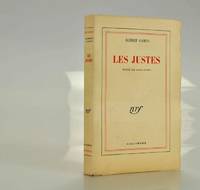
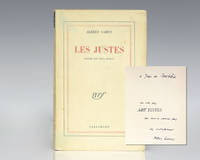
1950300420181614Albert Camus – Les Justes – 1950<br /><br />First edition copy numbered No. 79/200 on Alpha Mousse Navarre<br /><br />182 Pages<br /><br />Very good condition uncut small stains and marks of wear on the cover including very slightly marked folds see photos.<br /><br />Éditions Gallimard<br /><br />19 x 12cm Gallimard Nrf blanche paperback
28520Paris Gallimard 6 février 1958. 1 vol. 115 x 185 mm de 69 p. et 3 f. Maroquin rouge dos lisse titre doré date en pied tranches dorées sur témoins doublures et gardes de chèvre velours havane couvertures et dos conservés étui bordé Alix. . Édition originale. Un des 56 exemplaires sur vélin de Hollande n° 32. . Les Discours de Suède sont un ensemble de deux allocutions prononcées par l'écrivain à la suite de l'obtention du prix Nobel de littérature : celui du 10 décembre 1957 prononcé à Stockholm pour la remise du prix et celui du 14 décembre 1957 prononcé à l'université d'Upsala intitulée L'artiste et son temps - un texte rédigé en 1953 en guise de préface au texte de Wilde La Ballade de de la gêole de Reading. Une postface clôt l'ouvrage où il est question des deux totalitarismes de l'art pour l'art du réalisme socialiste et du fameux « engagement » de l'intellectuel - en des termes qui n'ont rien perdu de leur acuité. Qu'on en juge : « C'est ainsi que beaucoup de nos artistes aspirent à être maudits ont mauvaise conscience à ne pas l'être et souhaitent en même temps l'applaudissement et le sifflet » ; ou encore : « L'académisme de droite ignore une misère que l'académisme de gauche utilise ». Le texte est imprimé sur les presses de l'Imprimerie Moderne à Montrouge le 6 février 1958. Il est dédié à Louis Germain à qui Camus avait écrit dès novembre : « Ma première pensée après ma mère a été pour vous. Sans vous sans cette main affectueuse que vous avez tendue au petit enfant pauvre que j'étais sans votre enseignement et votre exemple rien de tout cela ne serait arrivé. Je ne me fais pas un monde de cette sorte d'honneur. Mais celui-là est du moins une occasion pour vous dire ce que vous avez été et êtes toujours pour moi et pour vous assurer que vos efforts votre travail et le coeur généreux que vous y mettiez sont toujours vivants chez un de vos petits écoliers qui malgré l'âge n'a pas cessé d'être votre reconnaissant élève. » Bel exemplaire en pleine reliure d'Alix. Paris, Gallimard, (6 février) 1958. 1 vol. (115 x 185 mm) de 69 p. et [3] f. Maroquin rouge, dos lisse, titre doré, date en p unknown
51-4757Paris: Gallimard 1956. 8vo. 10.5 x 17.5 cm. Contemporary blue cloth with leather titled label on spine. The first edition and the 9th printing from May 1956 the same month as the first printing.Likely a Presentation copy to Adolf Herckenrath. Accompanied by a publicity photo of Albert Camus by Lennart Green 27 x 21 cm. . See provenance below.First published in 1956 it is his last complete work of fiction.Provenance:From the archives of the celebrated bookstore and literary salon Herckenrath on Veldstraat in Ghent Gand Belgium. Founded by the writer Adolf Herckenrath 1879-1958 in 1909; continued by his son Walter Herckenrath 1907- 1989 and by Walter’s children Guy and Helga Herckenrath until around 2000….Poète dramaturge libraire et éditeur. Adolf Herckenrath est entré dans l' histoire en tant qu'ami d'enfance pour lequel Karel van de Woestijne a écrit son Laethemsche Brieven sur Lente 1901… À partir de novembre 1909 Herckenrath résida dans la Veldstraat où il conserva la librairie Adolf Hoste et une fois l'université devenue bilingue principalement consacré à la littérature francophone. Entre les deux guerres mondiales Herckenrath était toujours actif en tant que professeur et membre du conseil d'administration de l'académie de théâtre de Gand pour laquelle un magazine De Tooneelschool 1937-1940 avait également été fondé. Il aida à fonder Pan le cercle de la littérature flamande orientale en 1938… En 1935 Herckenrath s'installa dans la villa 't Kersouwken sur l'Eikeldreef à Sint-Martens-Latem. Pendant la Seconde Guerre mondiale il y résidera officiellement pendant quelques mois de mai à novembre 1944. Il est ensuite retourné dans sa librairie de la Veldstraat où il vivrait au moins officiellement jusqu'à sa mort. Après la guerre sa librairie a été reconstruite par le célèbre architecte Geo Henderick. Grâce à la continuation de son fils Walter et de ses petits-enfants Guy et Helga le nom Herckenrath a également survécu jusqu'à la fermeture de l'entreprise à la mi-2000. 175 x 105 cm 171 pp mention de 'neuvième édition' sur la page de titre. achevé d'imprimer en mai 1956. Imprimé très peu de temps après l'édition originale. Exemplaire SIGNÉ envoi AUTOGRAPHE de l'auteur. Reliure privée en toile bleue. Paris: Gallimard, 1956 hardcover
1955140945412London: Hamish Hamilton 1955. First British Edition. Near Fine/Near Fine. First British edition and the first English language edition. Bound in publisher's original blue cloth with spine lettered in silver. Near Fine with very slight lean to spine slight fading and wear to spine ends offsetting to endsheets and contents lightly tanned. In a Near Fine unclipped dust jacket with light tanning and a small indentation to the spine panel light wear. A beautiful copy of a book that does not normally turn up in such nice condition. Hamish Hamilton unknown
195363678Paris: Gallimard 1953. Fine. Gallimard Paris 1953 12 x 19 cm relié First edition an advance service de presse copy. A few reading notes in the margin. Bradel binding in half morocco covers preserved top edge gilt binding signed by P. Goy & C. Vilaine. Autograph inscription signed by Albert Camus to Gilbert Sigaux : ""AVec l'affectueuse pensée de son vieux camarade."" Gallimard unknown
195347737Paris: Gallimard 1953. Fine. Gallimard Paris 1953 12 x 19 cm broché First edition on ordinary paper. Handsome fine autograph inscription signed by Albert Camus : ""à Albert Béguin qui trouvera ici les raisons de mes désaccords avec Esprit avec mon bien cordial souvenir.to Albert Bégiun who will find here the reasons for my disagreements with the Spirit in friendly remembrance "" A little light spotting primarily to upper cover and ffep. Retaining its advertising notice entitled ""Lettres sur la révolte"". Gallimard unknown
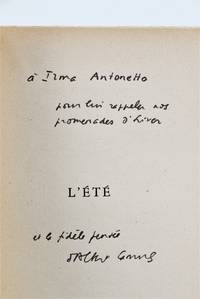
195482990Paris: Gallimard 1954. Fine. Gallimard Paris 1954 12 x 18.50 cm broché Edition from the same year as the first edition. Minor restorations to the spine. Beautiful autograph inscription signed by Albert Camus to Irma Antonetto: "". pour lui rappeler nos promenades d'hiver et la fidèle pensée d'Albert Camus."" "". to remind her of our winter walks and the faithful thoughts of Albert Camus."" Irma Antonetto was the founder and director of the Associazione Culturale Italiana. During her forty-six years at the head of the Association she invited nearly 400 intellectuals and numerous Nobel Prize winners to give readings in Italy. In 1964 she was named Knight of Merit of the Italian Republic before being honored twenty years later by France for her tireless work in favor of culture. Gallimard unknown
195354039Paris: Gallimard 1953. Fine. Gallimard Paris 1953 10.50 x 16.50 cm relié First edition of the French version translated and adapted by Albert Camus a numbered copy on alfa paper. Half green shagreen by Goy & Vilaine spine in six compartments gilt date to foot cover and spine sunned preserved top edge gilt. Autograph inscription signed by Albert Camus to Jean Gillibert. A good copy in an elegant binding Gallimard unknown
194764501Paris: Gallimard 1947. Fine. Gallimard Paris 1947 12 x 18.50 cm broché First edition one of 13 numbered copies on pur fil paper this copy one of 3 lettered hors commerce the only grand papier deluxe copies. Preface by Albert Camus. Endpapers slightly and partially shaded. Rare and nice copy with a photographic portrait of the author as frontispiece. Gallimard unknown
1950137191Paris: Gallimard 1950. First edition early printing of Camus' classic examination of the moral issues associated with murder and terrorism. Octavo original wrappers. Presentation copy inscribed by the author on the half-title page "A Jean de Bosschère crossing through "Les" an nom des que vous no sommes sens tes cordialement Albert Camus." The recipient Jean de Bosschère lived for most of the 20th century between London and France and illustrated his own works as well as the works of Oscar Wilde Charles Baudelaire and the classical works of Aristophanes Ovid Strato and Apuleius. He published his own works of poetry and in 1952 was awarded the Prix de la Méditerranée and in November the Mandat des Poètes. In near fine condition. Camus separated his work into three cycles. Each cycle consisted of a novel an essay and a play. The first was the cycle of the absurd consisting of L'Étranger Le Mythe de Sysiphe and Caligula. The second was the cycle of the revolt which included La Peste The Plague L'Homme révolté The Rebel and Les Justes The Just Assassins. The third the cycle of the love consisted of Nemesis. Each cycle was an examination of a theme with the use of a pagan myth and including biblical motifs. Camus began his work on the second cycle while he was in Algeria in the last months of 1942 just as the Germans were reaching North Africa. Based on the true story of a group of Russian Socialist-Revolutionaries who assassinated the Grand Duke Sergei Alexandrovich The Just Assassins explores the moral issues associated with murder and terrorism. Gallimard unknown
1946150923New York: Alfred A. Knopf 1946. First American edition of Camus' first novel and masterpiece. Octavo original beige cloth. Fine in a fine dust jacket with a single closed tear. Jacket design by Warren Chappell. Translated by Stuart Gilbert. The nicest example we have ever seen. Through the story of an ordinary man unwittingly drawn into a senseless murder on an Algerian beach Camus explored what he termed "the nakedness of man faced with the absurd." With the publication of this first novel L’Etranger The Stranger Camus introduced his lifelong attempt to reconcile a philosophy of heroic nihilism with “the ideal of human fraternity†Encyclopedia of Philosophy. It remains one of the classic works of the twentieth century. Alfred A. Knopf hardcover
196244658Paris: Gallimard 1962. Fine. Gallimard Paris 1962 12.50 x 19.50 cm relié First edition one of 90 numbered copies on Hollande paper the tirage de tête. Elegant half red morocco binding over marbled paper boards by P. Goy & C. Vilaine spine in six compartments marbled endpapers and pastedowns covers and spine preserved top edge gilt. A very good well-margined copy in a handsome binding. Gallimard hardcover
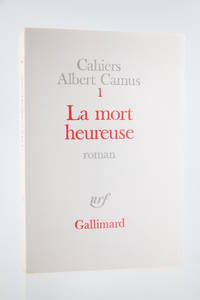
197178115Paris: Gallimard 1971. Fine. Gallimard Paris 1971 14.50 x 21.50 cm broché First edition one of 106 numbered copies on Holland the tirage de tête. A beautiful copy of this important text in the work of Albert Camus: although published posthumously it is indeed his first novel which is considered a first draft of L'Etranger. Gallimard unknown
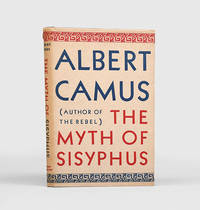
1955192704London: Hamish Hamilton 1955. One must imagine Sisyphus happy First edition in English including a new preface by Camus and collecting the title essay alongside "Summer in Algiers" "The Minotaur or The Stop in Oran" "Helen's Exile" "Return to Tipasa" and "The Artist and His Time". Camus's absurdist treatise on the philosophical problem of suicide was first published as Le Mythe de Sisyphe in 1942. Addressing his English readers Camus comments that "written fifteen years ago in 1940 amidst the French and European disaster this book declares that even within the limits of nihilism it is possible to find the means to proceed beyond nihilism. This book is in a certain sense the most personal of those I have published in English". It acts as a non-fictional companion to his novel L'Étranger 1942. The translator Justin O'Brien 1906-1968 was a professor of French at Columbia University who translated many works by Camus and certain works by Jean-Paul Sartre and André Gide including Gide's collected journals. Octavo. Original blue boards spine lettered in silver. With dust jacket. Spine ends bumped a few spots to edges; jacket unclipped spine lightly toned closed tear to spine head couple of nicks and creases: a very good copy in like jacket. hardcover
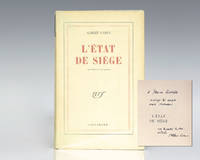
1948137545Paris: Gallimard 1948. First edition early printing of Camus' fourth play a political allegory about resistance to the plague of authoritarian rule. Octavo original wrappers. Presentation copy inscribed by the author on the half-title page "A Jean de Bosschère assiege sure anso mars insoumais L'Etat de Siege are Esperes a plus cordials Albert Camus." The recipient Jean de Bosschère lived for most of the 20th century between London and France and illustrated his own works as well as the works of Oscar Wilde Charles Baudelaire and the classical works of Aristophanes Ovid Strato and Apuleius. He published his own works of poetry and in 1952 was awarded the Prix de la Méditerranée and in November the Mandat des Poètes. In near fine condition. Written in 1948 The State of Siege—the original sense is closer to state of emergency—is a play in three acts presenting the arrival of plague personified by a young opportunist in sleepy Cadiz and the subsequent creation of a totalitarian regime through the manipulation of fear. In a piece written in 1948 in reply to criticisms from Gabriel Marcel Camus defended his decision to set the play in Spain and not in Eastern Europe citing the ongoing oppression in Spain France's collusion in it and the Catholic Church's abandonment of Spanish Christians. The piece was first performed in October 1948 and was initially received poorly by critics and public who had eagerly awaited the work but expected a dramatization of Camus's novel The Plague. While the two share a common background the treatments are entirely different in tone. The work has remained almost constantly in print in French and since 1958 in an English translation by Stuart Gilbert—in Caligula and Three Other Plays—with a foreword by Camus. Gallimard unknown
1955122226London: Hamish Hamilton Pub.;.TRINITY PRESS. Very Good in Very Good dust jacket. 1955 VERSO. first editionUK. HARDCOVER. 6x8". VERY GOOD CONDITION IN VERY GOOD UNCLIPT15s. ne t DUST JACKET. Includes old newspaper page 778 from "THE TIMES LITERARY SUPPLEMENT FRIDAY DECEMBER 23 1955" review by Translator for this edition.JUSTIN O'BRIENstated pr ice was 15s. confirms this is first ed DUST JACKET .Has left light tan area on inner ep from being laid in since purchase.now in its own plastic protector. book look new I do not describe any book above VG/VG.but it has no defects beside effect oof newspaper review. ; BOOK APPEARS WITH SILVER SPINE TITLES ON DARK BLUE TEXTURED HARD COVERS.Tan paper dust jacket has black & red titles. with red and black border designs. Back pane describes revies for THE PLAGUE. ; 169pgg pages; Hamish Hamilton. States "First published Year" or "First published in Great Britain in Year" on copyright page; notes subsequent printings.this copy meets that standard no subs. printing noted to proper statement verso. . Hamish Hamilton Pub.;.TRINITY PRESS hardcover
1955212314Hamish Hamilton 1955. First English Translation first printing. Hardcover in dust jacket. Inked in ownership along inside edge of ffep light rippling to inside edge of front paste down from binding some acid browning from laid in Times supplement now in mylar sleeve. Text block is extremely clean crisp and tight very near fine in near fine to fine dust jacket with a shade of toning to spine and just a touch of wear to spine head NOT price-clipped in mylar cover. It's difficult to find a more beautiful copy of this monumental absurdist text. <br /> <br /> Originally written in 1942 The Myth of Sisyphus is in many ways the literary companion to The Stranger––published that same year. <br /> <br /> As an introduction to his absurdist philosophy this work addresses what is in Camus' estimation the only truly serious philosophical problem"––suicide. In Camus' own words: "This book declares that even within the limits of nihilism it is possible to find the means to proceed beyond nihilism. The Myth of Sisyphus sums itself up for me as a lucid invitation to live and to create in the very midst of the desert." <br /> <br /> Translated from the French by Justin O'Brien. <br /> <br /> Includes the Times literary supplement from Friday Jan. 8 1960 discussing Camus' influence. Hamish Hamilton hardcover