433 résultats
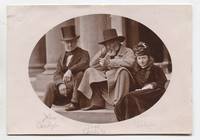
18855374631885. Unbound. Very Good. Collodion photograph of John Carlyle half-brother of Thomas Thomas Carlyle and Mrs. Alex Carlyle sister-in-law of Thomas seated on the steps of a building. Oval image measures approximately 4.5" x 3.25" at its widest points; 5.5" x 5" at the margins. The subjects are identified lightly in pencil in the margins below the image. Removed from an album the paper is skinned on the verso but which doesn't affect the image which is otherwise clear bright and about fine. Thomas Carlyle smokes a pipe on the steps of a pillared grand public building. unknown
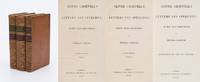
1827008736Edinburgh: William Tait 1827. Book. Very Good. Hardcover. First Edition. 8vo - over 7¾" - 9¾" tall. SCARCE. Four volumes rebound in later 19th c. quarter calf over marbled boards a Very Good set calf worn at corners boards a bit rubbed lacking half titles and added engraved title pages p.145 in Vol. IV misnumbered 149. From the personal library of noted medievalist Charle W. Jones his signature FEP each volume. Thomas Carlyle's 3rd book appearance to which he contributed a preface to the whole work and biographical and critical introductions for the authors here included. The last volume comprises the first English edition of Goethe's "Wilhelm Meister's Travels". William Tait Hardcover
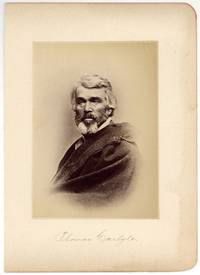
1880519552No Place: No Photographer 1880. Unbound. Near Fine. Albumen print photographic portrait measuring 4" x 5.5" depicts Thomas Carlyle wearing a dark overcoat from the chest up facing the camera over his left shoulder. The photograph is mounted on octavo sheet of contemporary heavy stock paper. Identified beneath the image in contemporary ink holograph in an unknown hand: "Thomas Carlyle No Photographer unknown
1845D19665London: Chapman & Hall 1845. Hardcover. Very Good. Second Edition." With a presentation inscription from Carlyle on the front free endpaper: "To Samuel Rogers Esq. with many kind regards T.C. Chelsea 13 July 1845." Backstrip restored; hinges repaired. In a morocco-backed folding case. Another of the younger generation who met Rogers about 1838 was Thomas Carlyle; and the gruff Scotsman's impressions hackneyed as they are must be quoted: "Old Rogers with his pale head white bare and cold as snow. those large blue eyes cruel sorrowful and that sardonic shelf chin." It is evident that Carlyle rebel as he was was impressed with the "grim old dilettante full of sardonic sense"; and when we remember how unresponsive was Carlyle to mere reputations and how hopelessly unfair even to greatness that did not agree with him his tribute is remarkable. There must have been a force of character trained and controlled to make this wild prophet of a new age write so definitely of an old poet to the fellow-prophet in America Ralph Waldo Emerson. <br/><br/> Chapman & Hall hardcover
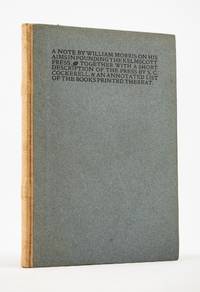
1898ST20842Hammersmith: Kelmscott Press 1898. ONE OF 525 COPIES on paper and 12 on vellum. 210 x 150 mm. 8 1/4 x 5 3/4". 4 p.l. including two blanks 70 pp. 1 leaf colophon. <br/> Original holland-backed blue paper boards. WOODCUT ILLUSTRATION BY EDWARD BURNE-JONES of "Pysche Borne off by Zephyrus" ENGRAVED BY WILLIAM MORRIS elaborate borders around this and first page of text designed and cut by Morris large decorative woodcut initials device on last page of text and one full-page woodcut of ornaments used in the Kelmscott edition of "Love is Enough." Printed in red and black in Golden Troy and Chaucer types. With errata slip laid in at title page. Front pastedown with Arts & Crafts-style bookplate of Edmund Bulkley dated 1893; a list of the Kelmscott books in E. W. Buckley's collection listed by the number assigned to them in this book recorded in pencil on a translucent piece of paper laid in here. Morris & Cockerell 53; Peterson A-53; Ransom 53; Tomkinson p. 121. Some wear to lower corners just a hint of soil to covers otherwise a very fine copy--exceptionally fresh clean and bright internally.<br/> <br/> Owned by two collectors with a special interest in Morris this is a very pleasing copy of one of the key Kelmscott Press books and the last one to be issued by the press. Morris tells us here about his admiration for 15th century printed books saying that "they were always beautiful by force of the mere typography even without the added ornament with which many of them are so lavishly supplied." And he says that "it was the essence of his undertaking to produce books which it would be a pleasure to look upon as pieces of printing and arrangement of type." This is the most important contemporaneous source of comment on the founding operation and publications of the Kelmscott Press. Peterson quotes Newdigate who says that this is "one of the three books that every student of English book-production ought to read." The original owner here was American private press collector Edmund Bulkley who according to the list laid in at the rear of this volume owned 42 Kelmscott books. Evidently prepared after Bulkley's death the list also marks with a "0" the books sold before 1950 and notes at the end the books including this volume that remained in the possession of "M A B B." this might refer to a relation possibly art collector M. A. B. Bulkley who bequeathed a Pre-Raphaelite-style painting to the Fitzwilliam Museum in 1996. Bulkley's distinctive bookplate perhaps created by one of the private presses is found in a number of press books which when listed at auction are in notably fine condition. In 1883 Morris & Company took out a full-page ad in the Official Catalogue of the Boston Foreign Exhibition announcing the appointment of Elliott & Bulkley of 42 East 14th Street New York City as U.S. agents for the sale of Morris & Co. "Decorative Manufactures" including wallpaper fabrics and "the celebrated Hammersmith carpets made only by Morris & Company." It is tempting to speculate that Edmund Bulkley was associated with this firm and became aware of the Kelmscott Press via this connection with Morris & Company. Although without additional signs of ownership our book was later sold as part of the library of Clive Wilmer 1945-2025 English poet and scholar of John Ruskin and William Morris. He wrote and lectured extensively on both men and from 2009 to 2019 served as Master of The Guild of St. George a charity for arts crafts and the rural economy founded by Ruskin in 1871. The Ruskin Society of North America presented him with a Lifetime Achievement Award in 2023. Copies of this work appear with some regularity in the marketplace but specimens in attractive condition are becoming increasingly difficult to find. Kelmscott Press unknown
182527701London: Taylor and Hessey 1825. First Edition. With frontis portrait of Schiller engraved by Bull after Graff. 8vo in the scarce original textured cloth paper label on the spine printed in black. vi 352pp. A near fine copy of the author's first book some offsetting to the title from the frontis portrait light edge wear light wear to the spine label not affecting lettering. A VERY EARLY WORK BY ONE THE GREATEST SOCIAL COMMENTATORS OF HIS TIME. Carlyle's thinking was heavily influenced by German idealism and he established himself as an expert on German literature. He was well suited to craft this fine biography of the famous German poet philosopher physician historian and playwright. Taylor and Hessey hardcover
182532857London: Taylor and Hessey 1825. First Edition. With frontispiece portrait of Schiller engraved by Bull after Graff. 8vo bound in three quarter polished calf over marbled paper covered boards the spine with raised bands gilt decorated the compartments of the spine gilt tooled one compartment with lettering label gilt. vi 352pp. A good copy of the author's first book some light offsetting to the title from the frontispiece portrait some rubbing and light edge wear to the binding rear board tender and nearly detached. FIRST EDITION AND A VERY EARLY WORK BY ONE THE GREATEST SOCIAL COMMENTATORS OF HIS TIME. Carlyle's thinking was heavily influenced by German idealism and he established himself as an expert on German literature. He was well suited to craft this fine biography of the famous German poet philosopher physician historian and playwright. As both an historian and essayist Thomas Carlyle was a pivotal thinker in nineteenth century Britain. He became the center of a circle of intellectuals in London that included John Stuart Mill Charles Dickens and George Eliot. Taylor and Hessey hardcover
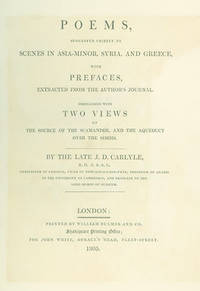
180528304London: Printed by William Bulmer and Co. Shakespeare Printing Office; for John White 1805 1805. First and only edition. See Colbert Women Travel Writers 1780-1840. Original paper spine skillfully repaired; spine label almost gone; boards a little rubbed; but a fine copy in original state enclosed in a cloth clamshell case. 4to original tan paper spine and blue paper boards printed paper label untrimmed. Two aquatint engravings by R. Pollard. Eight page list of subscribers. Topographically inspired poetry about Turkey Syria and Greece by Joseph Dacre Carlyle 1759-1804 posthumously edited by his sister Susanna Maria Carlyle 1752-1833 handsomely printed by William Bulmer and illustrated with two fine aquatints by the artist and engraver Robert Pollard 1755-1838. Susanna Maria Carlyle's role in this publication was essential and hence Benjamin Colbert recognizes her contribution in his bibliography of Women's Travel Writing. Small book labels of Ruari McLean and J. O. Edwards on the front paste-down. London: Printed by William Bulmer and Co., Shakespeare Printing Office; for John White, 1805 unknown
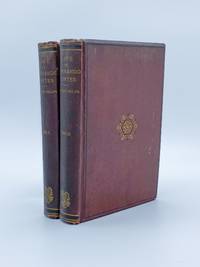
1871409153London: Bell and Daldy Printed at the Chiswick Press 1871. From the Bart Auerbach Collection. Spines a touch darkened some very slight wear. Small hole in the front free endpaper of vol. 2 probably the result of moving Carlyle's bookplate from that spot where it was mistakenly placed to the inside front cover; nevertheless an agreeable copy. 2 volumes 8vo. Original dark brown cloth blocked in black and gilt. First edition. The dedication copy to Carlyle with his bookplate in each volume and with an autograph letter signed from Helps to him in the original envelope which is tipped onto the front free endpaper of vol. 1. The letter 3 pages 8vo on Privy Council Office stationery Helps was Clerk dated 3 April 1871 reads: "My dear Carlyle I send herewith a copy of a book which I have taken the liberty of dedicating to you. You must therefore receive it very kindly and be blind or at least blind as you can to its many faults. If one cannot rely upon one's Dedicatee as a partial friend I hate your impartial people and do not believe in them whom can one rely upon Yours always Arthur Helps."<br /> <br /> The printed dedication is in the form of a 6 ½-page dedicatory letter: "Dedication. / My Dear Carlyle I dedicate this Life of Cortes to you. And I cannot content myself by making a simple dedication but must write a letter.I dedicate this work to you because I desire an occasion to record my gratitude for all your kindness to me in times past. I have also an author's as well as a friend's reasons for this dedication." Sir Arthur Helps 1813-1875 had been associated with Carlyle on the founding committee for the London Library. With Carlyle's bookplate. BA. Bell and Daldy [Printed at the Chiswick Press] unknown
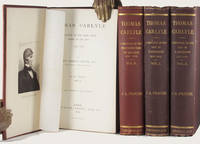
188233438London: Longmans Green and Co. 1882 and 1884. 4 volumes. First Edition of each set. Illustrated with portraits and etchings. Tall 8vo publisher's original sepia cloth the spines lettered and blocked in gilt the covers blocked in blind the two volumes of Carlyle's Life in London in brown cloth as issued by the publisher designed to marry the two volumes of Carlyle's First Forty Years. xviii 432 24 ads.; vi 495; viii 460 24 ads.; viii 486 2 ads. pp. A very good and pleasing set the hinges strong and in good order a bit of light rubbing to the bindings due to the composition of the cloth still a very bright and pleasing set with the gilt and bindings in good order and the text-blocks clean and well preserved. RARE FIRST EDITION OF ALL VOLUMES OF THIS FORMIDABLE BIOGRAPHY OF THOMAS CARLYLE. 'Thomas Carlyle 1795-1881 the British essayist historian and philosopher from the Scottish Lowlands was a leading writer of the Victorian era he exerted a profound influence on 19th-century art literature and philosophy.<br> Born in Ecclefechan Dumfriesshire Scotland Carlyle attended the University of Edinburgh where he excelled in mathematics inventing the Carlyle circle. After finishing the arts course he prepared to become a minister in the Burgher Church while working as a schoolmaster. He quit these and several other endeavours before settling on literature writing for the Edinburgh Encyclopćdia and working as a translator. He found initial success as a disseminator of German literature then little-known to English readers through his translations his Life of Friedrich Schiller 1825 and his review essays for various journals. His first major work was a novel entitled Sartor Resartus 1833–34. After relocating to London he became famous with his French Revolution 1837 which prompted the collection and reissue of his essays as Miscellanies. Each of his subsequent works including On Heroes 1841 Past and Present 1843 Cromwell's Letters 1845 Latter-Day Pamphlets 1850 and History of Frederick the Great 1858–65 were highly regarded throughout Europe and North America. He founded the London Library contributed significantly to the creation of the National Portrait Galleries in London and Scotland was elected Lord Rector of Edinburgh University in 1865 and received the Pour le Mérite in 1874 among other honours.<br> Carlyle occupied a central position in Victorian culture being considered not only in the words of Ralph Waldo Emerson the "undoubted head of English letters" but a "secular prophet". Carlyle is now recognised as "one of the enduring monuments of our literature who quite simply cannot be spared."<br> Carlyle was a renowned conversationalist. Ralph Waldo Emerson described him as "an immense talker as extraordinary in his conversation as in his writing—I think even more so." Charles Darwin considered him "the most worth listening to of any man I know." William Lecky noted his "singularly musical voice" which "quite took away anything grotesque in the very strong Scotch accent" and "gave it a softening or charm". Henry Fielding Dickens recollected that he was "gifted with a high sense of humour and when he laughed he did so heartily throwing his head back and letting himself go." Thomas Wentworth Higginson remembered his "broad honest human laugh" one that "cleared the air like thunder and left the atmosphere sweet." Lady Eastlake called it "the best laugh I ever heard".<br> Charles Eliot Norton wrote that Carlyle's "essential nature was solitary in its strength its sincerity its tenderness its nobility. He was nearer Dante than any other man." Frederic Harrison similarly observed that "Carlyle walked about London like Dante in the streets of Verona gnawing his own heart and dreaming dreams of Inferno. To both the passers-by might have said See! there goes the man who has seen hell". Higginson rather felt that Jean Paul's humorous character Siebenkäs "came nearer to the actual Carlyle than most of the grave portraitures yet executed" for like Siebenkäs Carlyle was "a satirical improvisatore". Emerson saw Carlyle as "not mainly a scholar" but "a practical Scotchman such as you would find in any saddler's or iron-dealer's shop and then only accidentally and by a surprising addition the admirable scholar and writer he is."<br> Carlyle's two most important followers were Emerson and Ruskin. In the 19th century Emerson was often thought of as "the American Carlyle" and he described himself in 1870 as "Lieutenant" to Carlyle's "General in Chief". Ruskin publicly acknowledged that Carlyle was the author to whom he "owed more than to any other living writer" and would frequently refer to him as his "master" writing after Carlyle's death that he was "throwing myself now into the mere fulfilment of Carlyle's work".' wiki Longmans, Green and Co. hardcover
1842005217London: Chapman and Hall 1842. Three volumes complete - Volume One - 5 vi-xix 4 2-324pp; Volume Two - 5 4-377pp 1; Volume Three - 5 iv-xxxi 6 38-290pp. Contemporary half morocco and marbled paper over boards raised bands spines in six panels title lettered directly in gilt to second panel translator and volume number to fourth panel with place and date to foot t.e.g. marbled endpapers. Spines slightly faded very minor rubbing to extremities internally occasional pencil lines to margins a few instances of light foxing but generally fairly bright and clean. Armorial book plate of Robert Balloch to front pastedowns. A revised edition first published in English translation in 1824. Dyer page 262; Morgan 'German Literature in English Translation' 3001; Tarr A.2.3.I-III.b. Reprint. Hardback. Good. 12mo. Chapman and Hall Hardcover
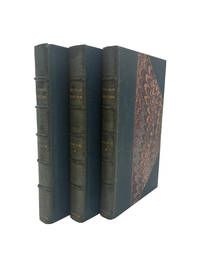
184531228AB1845. First Edition. Three Volumes complete set with the Supplement in Second Edition. London Chapman and Hall 1845 - 1846. Octavo 145 cm x 22 cm. Volume I: Frontispiece-Portrait of Cromwell engraved by Francis Holl with Cromwell's facsimile - signature XII 522 pages / Volume II: XIV 692 pages / Volume III Supplement to the First Edition: XVIII 224 pages plus c. 230 empty pages for annotations and notes which were left empty by the 19th century owner. Hardcover / Stunning original 18th century full calf with gilt lettering and original spine-labels. Marbled Endpapers matched with marbled edges all around. Strengthened and restored bindings in splendid and firm condition. Minor repaired tear to titlepage of Volume I only. The text in excellent very clean condition which is unusual for this set. Very Rare in this condition ! Volume I: Anti-Dryasdust / Of the Biographies of Oliver / Of the Cromwell Kindred / Events in Oliver's Biography / Of Oliver's Letters and Speeches / Oliver Cromwell's Letters and Speeches including Letters during the Campaign in Ireland 1649 / Letters by Cromwell to Presdient Bradshaw Dublin 1649 To Governor Taaf Ross 1649 / Accont of Gaining of Ross / To Hon. W. Lenthall 1649 about Proceedings in Munster: Cork Youghal Baltimore Castlehaven etc. including a letter from 14th November 1649 in which i talk about Colonel Townsend aboard having been a very active instrument for the return of both Cork and Youghal to their obedience" Volume II: Letters regarding: War with Scotland / Battle of Dunbar / The Little Parliament 1651-1653 / First Protectorate Parliament 1654 / The Major Generals 1655-1656 / Jamaica / The Disaffected in Ireland / Can sell Newhall / Dangers in Ireland Second Protectorate Parliament 1657-1658 / Kingship / Case of James Nayler / Conference with the Committee of Ninety-nine in regard to the Title of the King / Perils of the Nation / Perils of the Protestant Interest in Europe at large / Death of the Protector / Index Supplement: The Supplement is a first edition but also includes a "Preface to the Second Edition". This supplement-volume adds Letters to Volume I and II including Letters about: Surrender of Berwick and Carlisle/ Essex in Cornwall / Summons to Dundak / Capture of Wexford / To Lord Wharton Cork 1649 about Wharton's Doubts / Letter to Hon. T.Scott Ross 1649 about "The Vote of Lands to Lieut.-Gen. Jones - Lord Broghill" / Summons to Cahir / Summons to Kilkenny / Fatherly Advices: Raleigh's History / Inchgarvie surrendered / Letter to Lieut.-Gen. Fleetwood about "Difference between Love and Fear in matters of Religion" / Letter to Downhall / At Ely / Letter to Cambridge with "Protestation" and "Preamble" / Gainsborough Fight Letter to Fairfax on the Action at Islip-Bridge and Bletchington / Battle of Naseby - Two Letters concerning Ely / Letter on behalf of Young Cholmely / Correspondence with the Mayor of Waterford / Exchange of Prisoners - Renegado Wogan / Vowel's Plot / Penruddock's Plot / New-England / Last Royalist Plot etc. Thomas Carlyle 4 December 1795 5 February 1881 was a Scottish essayist historian and philosopher. A leading writer of the Victorian era he exerted a profound influence on 19th-century art literature and philosophy. Born of peasant parents in Ecclefechan Dumfriesshire Carlyle attended the University of Edinburgh where he excelled in mathematics inventing the Carlyle circle. After finishing the arts course he prepared to become a minister in the Burgher Church while working as a schoolmaster. He quit these and several other endeavours before settling on literature writing for the Edinburgh Encyclopædia and working as a translator. He found initial success as a disseminator of German literature then little-known to English readers through his translations his Life of Friedrich Schiller 1825 and his review essays for various journals. His first major work was a novel entitled Sartor Resartus 183334. After relocating to London he became famous with his French Revolution 1837 which prompted the collection and reissue of his essays as Miscellanies. Each of his subsequent works from On Heroes 1841 to History of Frederick the Great 185865 and beyond were highly regarded throughout Europe and North America. He founded the London Library contributed significantly to the creation of the National Portrait Galleries in London and Scotland was elected Lord Rector of Edinburgh University in 1865 and received the Pour le Mérite in 1874 among other honours. Carlyle's corpus spans the genres of history the critical essay social commentary biography fiction and poetry. His innovative writing style known as Carlylese greatly influenced Victorian literature and anticipated techniques of postmodern literature. While not adhering to any formal religion he asserted the importance of belief and developed his own philosophy of religion. He preached "Natural Supernaturalism" the idea that all things are "Clothes" which at once reveal and conceal the divine that "a mystic bond of brotherhood makes all men one" and that duty work and silence are essential. He postulated the Great Man theory a philosophy of history which contends that history is shaped by exceptional individuals. He viewed history as a "Prophetic Manuscript" that progresses on a cyclical basis analogous to the phoenix and the seasons. Raising the "Condition-of-England Question" to address the impact of the Industrial Revolution his political philosophy is characterised by medievalism advocating a "noble Chivalry of Work" led by "Captains of Industry". He attacked utilitarianism as mere atheism and egoism criticised laissez-faire political economy as the "Dismal Science" and rebuked "big black Democracy" while championing "Heroarchy Government of Heroes". Carlyle occupied a central position in Victorian culture being considered not only in the words of Ralph Waldo Emerson the "undoubted head of English letters" but a secular prophet. Posthumously his reputation suffered as publications by his friend and disciple James Anthony Froude provoked controversy about Carlyle's personal life particularly his marriage to Jane Welsh Carlyle. His reputation further declined in the 20th century as the onsets of World War I and World War II brought forth accusations that he was a progenitor of both Prussianism and fascism. Since the 1950s extensive scholarship in the field of Carlyle Studies has improved his standing and he is now recognized as "one of the enduring monuments of our literature who quite simply cannot be spared." Wikipedia hardcover
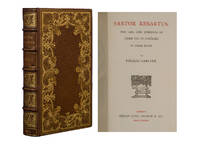
18896403London: Kegan Paul Trench & Co 1889. Fine. Sixteenmo 6 3/16 x 3 5/8 inches; 157 x 93 mm. vi 306 1 imprint 5 blank pp. Portrait frontispiece with tissue guard. Title-page printed in red and black. Bound ca. 1920 by Rivière & Son stamp signed in gilt on lower turn-in. Full antelope crushed levant morocco covers decoratively ruled in gilt surrounding a very elaborate floral design in pointillé spine with five raised bands similarly decorated and lettered in gilt in compartments gilt-ruled board edges full dark blue morocco liners elaborately decorated in gilt blue watered silk end-leaves top edge gilt. A wonderful example of the art of 'pointillé'.<br /> <br /> The Scottish author critic and thinker Thomas Carlyle 1795-1881 was a major influence on Victorian society. His novel Sartor Resartus translated as The Tailor Re-tailored among other variations is a satirical look at the work of a fictional philosopher Diogenes Teufelsdröckh. Intriguing in its form the book is structured from the prospective of a skeptical English reviewer consumed by Teufelsdröckh's book Clothes Their Origin and Influence. In crafting Sartor Resartus Carlyle drew on a range of literary influences: Goethe Hegel Sterne and Switft. Carlyle's complicated text not only critiques academic writing and materialism but offers meditations on the meanings of symbols and the search for truth. Although first started as an essay the project eventually developed into a novel which was first published serially in Fraser's Magazine 1833-34. Fine. Kegan Paul, Trench & Co unknown
188036866London c.1880. IN THREE BOOKS. 8vo. iv235pp. Engraved frontispiece. FROM THE LIBRARY OF AGNES NICHOLS GRACE wife of W.G. Grace WITH HER SIGNATURE OF OWNERSHIP on the front endpaper. W.G. Grace and Agnes Nichols Day were married on 9th October 1873. unknown
182527957London: Taylor and Hessey 1825. First Edition. With an engraved portrait frontispiece of Schiller. 8vo publisher's original cloth over boards the spine with a printed title label. viii 352 pp. A good copy in the original cloth. Some edge wear and a bit of chipping to the spine label the text-block loose between the covers. FIRST EDITION OF THOMAS CARLYLE'S FIRST ORIGINAL BOOK PUBLICATION. Taylor and Hessey hardcover
1825BOOKS075267ILondon: Printed for Taylor & Hessey 1825. HC. good 3/4 leather hardcover light edgewear light foxing. B&W frontis. Ligh edgewear to leather including top/bottom of spine. Light foxing on a few pages Marbled edges of book block and endpapers. Clean and tight copy. 352pp. Printed for Taylor & Hessey unknown
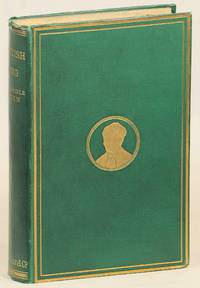
1874000016571London: Macmillan and Co 1874. First edition. Hardcover. Very Good. 12mo. 7 vi-viii 2 1-308 4 pages of publisher's advertisements pp. Green publisher's cloth with two gold borders and a bust in gold on the front board gold lettering and gold rules on the spine. Coated green endpapers and pastedowns. With a small portrait of the author on the title page. The crown and foot of the spine worn a sticker ghost on the free front endpaper a few leaves roughly opened at their top edge. Macmillan and Co hardcover
187740799Boston: James R. Osgood and Company Late Ticknor & Fields 1877. 1st edition thus Tarr A24.3.a. Green cloth binding black and gilt stamping to front board black lettering to spine. Printed endpapers. Moderate wear to binding some rubbing to edges light soiling puffing to cloth binding. A VG example. 94 pp. A couple small woodcut engravings in text. 4-7/8" x 3-3/8" <br/><br/>Only 6 institutional holdings recorded on OCLC Buffalo & Erie Public Notre Dame UMich UWash U of Waterloo & the British Library. This edition rare in the trade. James R. Osgood and Company, Late Ticknor & Fields hardcover books
1861RO60071498Ticknor & Fields, Boston. 1861. In-8. Relié. Etat d'usage, Couv. convenable, Dos abîmé, Intérieur acceptable. 471 pages. Gravure en noir et blanc en frontispice (portrait). Ex-libris illustré en noir et blanc (Armoiries, Arthur William Patrick Buchanan, Montreal) encollé au dos du 1er plat. Mors fendus et manques sur les coiffes. Dos légèrement taché. Quelques cahiers se détachant.. . . . Classification Dewey : 420-Langue anglaise. Anglo-saxon
1872RO60069383Chapman and Hall. 1872. In-12. Relié. Bon état, Couv. convenable, Dos satisfaisant, Intérieur frais. 300 pages. Reliure d'éditeur rouge à motifs noirs, et titre doré sur le dos.. . . . Classification Dewey : 420-Langue anglaise. Anglo-saxon
1857RO60070265Chapman and Hall. 1857. In-8. Relié. Etat passable, Plats abîmés, Dos abîmé, Mouillures. 395 pages. Dos manquant. Plats et pages de garde détachés.. . . . Classification Dewey : 420-Langue anglaise. Anglo-saxon
1897RO60067846Chapman and Hall. 1897. In-12. Relié. Etat d'usage, Couv. légèrement passée, Dos satisfaisant, Intérieur acceptable. 235 pages. Annotations en page de garde. Page de titre découpée, avec manque sur son bord supérieur.. . . . Classification Dewey : 420-Langue anglaise. Anglo-saxon
1888R200104078Henry-Gautier / Librairie Bleriot. 1888. In-8. Broché. Etat d'usage, Tâchée, Dos satisfaisant, Papier jauni. 32 pages. Quelques rousseurs et pliures.. . . . Classification Dewey : 70.49-Presse illustrée, magazines, revues
1881RO60060264LONGMANS, Green and Co. 1881. In-8. Broché. Bon état, Couv. convenable, Dos satisfaisant, Intérieur frais. 341 pages. Inscriptions au stylo sur le dos, 2ème et 3ème de couverture. Quelques rousseurs.. . . . Classification Dewey : 420-Langue anglaise. Anglo-saxon
1895R100065546Chapman and Halle. 1895. In-12. Relié. Etat d'usage, Tâchée, Coiffe en tête abîmée, Papier jauni. 375+308 pages - frontispice en noir et blanc - livre en anglais - coins frottés - coiffes frottées.. . . . Classification Dewey : 420-Langue anglaise. Anglo-saxon