Jean COCTEAUBiblio.com
3 895 résultats
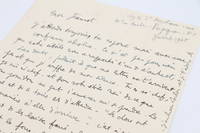
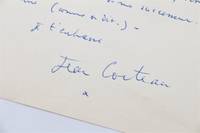
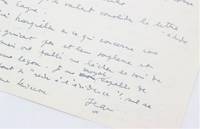
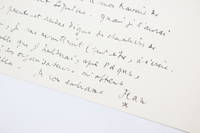
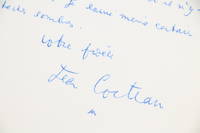
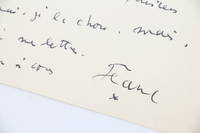
195185222Milly-la-Forêt 1951. Fine. Milly-la-Forêt 7 Février 1951 21 x 27 cm une page Autograph letter signed by Jean Cocteau addressed from his house in Milly-la-Forêt 15 lines in black ink to Olivier Quéant. Traces of folds inherent to postal mailing. ""Milly Février 1951 7 Très cher Quéant Pardonnez moi. Je traverse une crise très pénible de santé. L'opération a redéclenché les symptomes de mes supplices de la Belle et la Bête. Les médécins s'y perdent et je vais être tenu de changer de climat. Bref tout un ordre ou un désordre qui m'empêchent d'écrire surtout sur un tel sujet. Je sais que vous m'aimez bien et me comprendrez. S'il s'agissait de plusieurs mois peut-être tenterai-je la chose mais vous le voyez je forme à demi mes lettres. Tt coeur à vous. JeanC."" ""Milly February 1951 7 Very dear Quéant Forgive me. I am going through a very painful health crisis. The operation has triggered again the symptoms of my torments from Beauty and the Beast. The doctors are at a loss and I will have to change climate. In short a whole order or disorder that prevents me from writing especially on such a subject. I know that you care for me and will understand. If it were a matter of several months perhaps I would attempt the thing but as you can see I can barely form my letters. All my heart to you. JeanC."" unknown
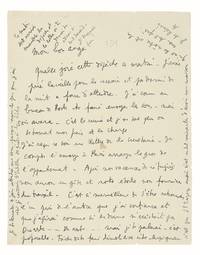
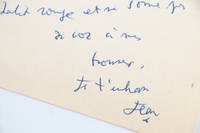
1940888411940. Fine. ""Its such a miracle to have a home that is truly ours and the sea so close by. I bless you."" s. d. juillet 1940 21 x 27 cm Une page sur un feuillet Autograph letter signed by Jean Cocteau marked with his famous star addressed to his great love the actor Jean Marais. One page penned in black ink on a single sheet.Traces of folds horizontal creases inherent to mailing two ink spots on the blank verso not affecting the text.A magnificent love letter from Cocteau to Marais who together formed one of the most iconic artistic couples of the 20th century. Set against the backdrop of turmoil and the German Occupation their unbreakable bond is embodied in this letter of the writer filled with desperate tones. Published in Letters à Jean Marais 1987 p. 159. Written by a love-stricken Cocteau while Jean Marais having been mobilised joined the front in May 1940. Cocteau had taken refuge in Perpignan where communication in those troubled times was difficult: ""Ce matin sont arrivées ensemble la dépêche et la lettre où tu donnais ton adresse à tout hasard. Je devenai sic fou! Mon bon ange Quelle joie cette dépêche ce matin. J'avais prié la veille pour la recevoir et pas dormi de la nuit à force d'attendre. J'ai couru au bureau de poste pour t'envoyer les sous - mais - sois avare - c'est la ruine et je ne sais plus où se trouvent mon frère et la charge. J'ai reçu ce soir une lettre de la secrétaire. Je compte l'envoyer à Paris arranger le gros de l'appartement. Après nos réfugiés nous aurons un gîte et notre étoile nous fournira du travail. C'est si merveilleux de s'être retrouvés l'un près de l'autre que j'ai confiance et que j'agirai comme si le drame n'existait pas. Du reste. du reste. mais je te parlerai c'est préférable. Tâche de te faire démobiliser vite. Perpignan n'est pas Saint-Tropez mais c'est un tel miracle d'avoir une maison qui est la nôtre et la mer tout près. Je te bénis. Je te demande de faire attention aux sous parce que avec le peu que j'ai ici je voudrais t'habiller des pieds à la tête ""This morning the telegram and the letter where you gave your address arrived together. I nearly lost my mind! My dear angel What joy your telegram brought this morning. I had prayed the night before to receive it and hardly slept from the wait. I ran to the post office to send you moneybut be thriftyI am broke and I no longer know where my brother and the charge are. This evening I received a letter from the secretary which I plan to send to Paris to sort out the main part of the apartment. After our refugees well have a home and our star will bring us work. Its so wonderful to have found each other again that I have confidence and will act as if the drama didnt exist. But. but. Ill tell you more in person its better that way. Try to get demobilised quickly. Perpignan is not Saint-Tropez but it is such a miracle to have a house that is ours and the sea close by I bless you.I ask you to be careful with money because with the little I have here I want to clothe you from head to toe.. The Cocteau-Marais pair would soon return to Paris and endure the harshness of the German Occupation which banned the revival of their scandalous 1939 hit play Les Parents terribles. hardcover
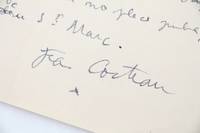
1946871451946. Fine. ""Ainsi les dieux grecs nous visitent encore et nous sentons autour de nous une tempête d'ailes un remous de merveilleux païen cette foule turbulente qui va de Zeus à Mercure et s'abat sur nos places publiques comme à Venise les pigeons de Saint-Marc"" Thus the Greek gods still visit us and we feel around us a storm of wings a stirring of pagan marvels this turbulent crowd that goes from Zeus to Mercury and swoops down on our public squares like the pigeons of Saint Mark's in Venice 1946 20.60 x 26.80 cm trois pages et une paperolle tapuscrite Autograph manuscript signed by Jean Cocteau entitled ""Le merveilleux païen"" 3 pages in black and blue ink on three leaves multiple rewritings and crossed-out passages. Accompanied by a typewritten bibliographical reference on paper. Pencil note by a previous bibliographer on the outer margin of the first leaf. Published in Plaisir de France no. 122 13th year December 1946 p. 18. Superb praise of ancient Greek culture and its theatrical pantheon of idols. Cocteau draws from his symbols to understand the modern world and compares Hollywood to the Olympus of old. Cocteau collaborates here in the issue of Plaisir de France devoted to ""Le Merveilleux dans l'Art et dans la Vie"" alongside Supervielle and Marcel Aymé. Fascinated from his beginnings by ancient mythology which floods his theatrical works Antigone Orphée La Machine Infernale. he writes a declaration of love to this blessed time when ""there existed a perpetual contact between human acts and their symbols"" when the marvellous was part of daily life. Numerous corrections mark the manuscript including the very title of the article which Cocteau had originally baptized ""L'Olympe"". Faithful to his mythological alter ego Orpheus who charms with his lyre and verses he will choose the shimmering tapestry ""Orphée et les Muses"" by Lucien Coutaud to illustrate this article. ""A cause du mécanisme moderne qui permet de reproduire le rare à d'innombrables exemplaires le rare se meurt et entre autres on fait du mot merveilleux un emploi abusif mot biffé. Le merveilleux cesse de l'être s'il se désingularise et l'on a une tendance à le confondre avec tout ce qui nous étonne encore : la radio la vitesse la bombe atomique. Or le merveilleux se trouve beaucoup plus en nous que dans les objets qui nous surprennent. Le véritable merveilleux c'est la faculté d'émerveillement qui s'émousse si vite chez l'homme. L'enfance le quitte. Il se blinde contre elle. Il juge il préjuge. Il repousse l'inconnu phrase biffée. S'il laisse agir en lui cette faculté atrophiée c'est pour fuir les fatigues qu'il s'impose. Il en use comme d'une drogue et se plonge pour quelques heures dans un livre ou dans un film. L'antiquité c'est l'enfance du monde. L'âge où l'enfance interroge et se meut dans un univers peuplé d'énigmes mot biffé. Les dieux grecs sont des oiseaux qui se posent sur leurs propres statues. Il y vivent à la mode des pigeons de nos squares. Il y observent les hommes qu'ils imitent ou qui agissent à leur exemple. Il existait donc un perpétuel contact entre les actes humains et leurs symboles qui se formaient tout de suite et devenaient des réalités. Deux mondes se superposent et se compénètrent. Phrase biffée Rien ne frappe en arrivant à Athènes comme cette familiarité d'une religion toujours pareille de siècle en siècle de peuple en peuple qui cette fois prenait un style de théâtre. Il fallait un décor où puissent jouer leurs drames et leurs comédies les acteurs aimés du public véritables vedettes de l'Olympe espèce d'Hollywood peuplé d'emplois divers de tragédiens de mimes de comiques et de belles filles plus ou moins mariées ensemble que la foule adore et auxquels on envoie des lettres et des cadeaux. Le moindre signe ""merveilleux"" du miracle grec relève d'un réalisme et c'est ce qui lui vaut un contact rapide. Et de même que passage biffé les yeux morts de la tête de Méduse unknown
1998R300268749Gallimard. 1998. In-12. Broché. Etat d'usage, Couv. convenable, Dos satisfaisant, Papier jauni. 320 pages. Quelques traces de mouillures.. . . . Classification Dewey : 792-Théâtre
194084633Perpignan 1940. Fine. Perpignan juillet 1940 21 x 27 cm deux pages sur un feuillet Autograph letter by Jean Cocteau signed with his famous star addressed to his great love the actor Jean Marais. Dated by the author July 1940. One and a half pages in black ink on a sheet. Two small marginal tears not affecting the text. Traces of transverse folds inherent to posting. Magnificent love letter from Cocteau to Marais who formed one of the most legendary artistic couples of the 20th century. Against the backdrop of defeat and German Occupation their unbreakable bond is embodied in this letter from the writer with its desperate accents. Published in the Lettres à Jean Marais 1987 p. 157. This missive from a love-stricken Cocteau was written shortly after the Armistice of June 22 1940 marking the end of the French defeat. Marais mobilized had joined the front in May 1940 while Cocteau had taken refuge in Perpignan. Communication in these troubled times proved difficult: ""Mon Jeannot j'attends toujours ta réponse mais avec une confiance absolue. Ce n'est pas pour rien que notre étoile nous a rapprochés l'un de l'autre et sans doute fallait-il que mes lettres ne t'arrivent pas et que je souffre de mon silence"" ""My Jeannot I am still waiting for your response but with absolute confidence. It is not for nothing that our star brought us closer to one another and no doubt it was necessary that my letters not reach you and that I suffer from my silence"" ""Tu es né chef je suis né chef. Et sous notre étoile rien de ce que nous . ne peut s'annexer ni se perdre. Le principal est de se taire et d'attendre. entre guillemets : les choses ont une manière à elles d'arriver."" C'est à nous de le savoir et de les laisser faire ."" ""You were born a leader I was born a leader. And under our star nothing of what we . can be annexed or lost. The main thing is to remain silent and wait. in quotation marks: things have their own way of happening."" It is up to us to know this and let them do so ."" The Cocteau - Marais partnership would soon return to Paris and endure the torments of the German occupation which would ban the revival of their scandalous play Les Parents terribles which had enjoyed great success in 1939. unknown
195483066s. l.: S. n. 1954. Fine. S. n. s. l. 27 avril 1954 21 x 27 cm une feuille Autograph letter signed by Jean Cocteau president of the jury of the 1954 Cannes festival which was held from March 25 to April 9 addressed to his friend Carlo Rim 17 lines in blue ink : ""cette étrange foire d'empoigne à laquelle j'essayai de donner quelque grâce"" ""this strange free-for-all to which I tried to give some grace"" Jean Cocteau further praises Carlo Rim's impartiality and clairvoyance: ""Je dois te dire ma reconnaissance pour ton oeil qui savait voir au dessus du lieu."" ""I must tell you my gratitude for your eye which knew how to see above the place."" and denounces the struggles of influence troubling and surrounding the awarding of prizes of which he bore the brunt : ""Le plus drôle c'est que ma dernière tentative de justice dérangeait encore de combinés - l'entourage de Clément ""The funniest thing is that my last attempt at justice still disturbed some schemes - Clément's entourage"" This refers to René Clément who was competing that year with Monsieur Ripois il n'y est pour rien espérant un scandale publicitaire annulé par le prix spécial. Les petits copains que tu connais dirent qu'on m'avait téléphoné de ordres sic."" ""he has nothing to do with it hoping for a publicity scandal cancelled by the special prize. The little friends you know said that I had been telephoned orders."" Satisfied to be rid of this cumbersome burden Jean Cocteau nonetheless advises his friend Carlo Rim jury member to be vigilant for the next edition of the festival: ""Le jeu n'étant pas la chandelle. L'année prochaine ouvre ""l'oeil"" sur le travail de mon successeur. il aura bonne mine comme on dit."" ""The game not being worth the candle. Next year keep an 'eye' on my successor's work. He will look good as they say."" In his letter Jean Cocteau mentions René Clément who was competing that year with ""Monsieur Ripois"" which thus obtained to the great joy and instigation of René Clément's entourage the grand jury prize ""Gate of Hell"" by Teinosuke Kinugasa winning the grand prize. Fold marks inherent to postal mailing. Provenance: from the Carlo Rim collection. Carlo Rim was a Provençal writer author notably of ""Ma belle Marseille"" a caricaturist a filmmaker: ""Justin de Marseille"" ""L'armoire volante"" ""La maison Bonnadieu"" and was notably the friend of Fernandel Raimu and Marcel Pagnol but also of Max Jacob and André Salmon whom he met in Sanary. S. n. unknown
62519Paris, Librairie Saint-Germain-des-Prés, 1969. 11 x 17, 127 pp., broché, bon état.
106.116Editions Dutilleul, 1955. 13 x 18, 106 pp., broché, non coupé, bon état.
lc_93666Editions du Tambourinaire., 1946
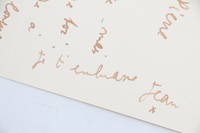
195083936s. l. 1950. Fine. s. l. 4 février 1950 21 x 27 cm une page sur un feuillet Autograph letter signed ""Jean"" and with a small star addressed to his English translator Marie Hoeck one page in blue ink on a sheet of fine white paper. Transverse folds inherent to posting. On the verso notes by the translator in ballpoint pen. Jean Cocteau is overworked by several projects: ""I have finished the mixtures of sounds and music for Orphée. I will probably finish the images for Les Enfants Terribles next week. . I do not speak to you of Léone because I look at her feel her steep myself in her - but alas my English allows me nothing more than to breathe in her light ink."" He shares with his translator his great fatigue: ""Then relaxation and fatigue - for fatigue only manifests itself in rest. . I am quite at ease concerning your springs. They do not creak and their flexibility is perfect. Mine nearly gave way on me the evening in Brussels. It is a lesson. I thought myself capable of the impossible. One must ""face the facts"" no one can do it."" unknown
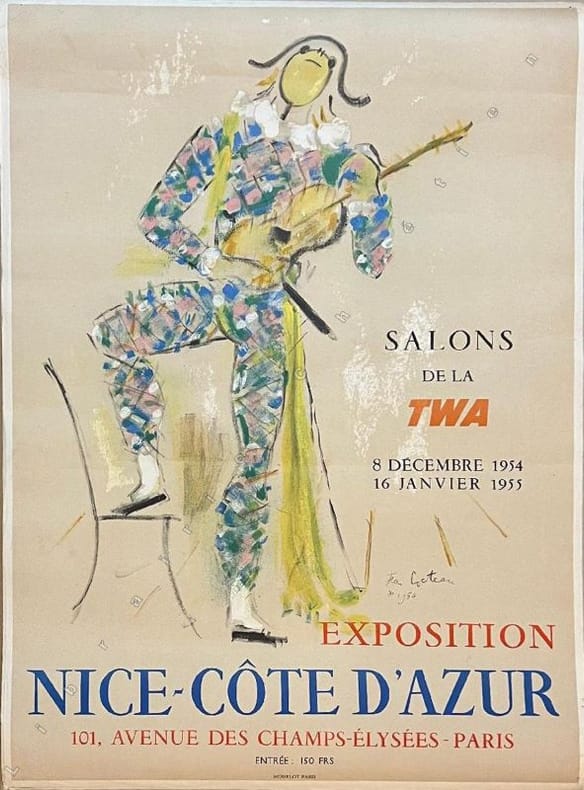
195425036Paris Mourlot 1954 Affiche lithographiée signée à droite dans la planche, Paris, Mourlot, 1954, 70 x 50 cm.
196386003Fréjus 1963. Fine. Fréjus 17 Avril 1963 21.50 x 27.50 cm une page Autograph letter dated and signed by Jean Cocteau 20 lines in black ink on letterhead of the committee for the edification of the chapel of Notre-Dame de Jérusalem de Fréjus. Fold marks inherent to postal dispatch one tear in left margin of the letter at the level of the fold. Jean Cocteau offers profuse apologies while acknowledging mitigating circumstances regarding the emotional burden overwhelming him: ""J'accepte vos reproches avec beaucoup de honte. Mais si je pouvais vous raconter la période que je traverse votre coeur me comprendrait et m'absoudrait."" ""I accept your reproaches with great shame. But if I could tell you about the period I am going through your heart would understand and absolve me."" due to a recently deceased friendship about which he does not wish to reveal more: ""N'en parlons plus et priez pour moi."" ""Let us speak no more of it and pray for me."" Jean Cocteau prefers to discuss his projects: ""Actuellement je me consacre à mon travail de la chapelle du Saint-Sépulcre. Quand je l'aurai construite peinte et rendue digne des chevaliers de Jérusalem je me remettrait sic peut-être à écrire."" ""Currently I am devoting myself to my work on the chapel of the Holy Sepulchre. When I have built it painted it and made it worthy of the knights of Jerusalem I will perhaps start writing again."" and the prospects that delight him: ""Il est probable que je resterais après Pâques à Fréjus où les organisateurs m'offrent une petite villa."" ""It is likely that I will remain after Easter in Fréjus where the organizers are offering me a small villa."" unknown
195486537Saint-Jean-Cap-Ferrat 1954. Fine. Saint-Jean-Cap-Ferrat 10 Mai 1954 13.50 x 21 cm une page Autograph letter dated and signed by Jean Cocteau 17 lines in black ink to a friend describing his Sevillian sojourn. Fold marks inherent to being placed in an envelope. Jean Cocteau explains his silence: his patron and very close friend Francine Weisweiller had been ill: ""Excuse ce long silence. mais on parle souvent de toi. Francine a été très très malade à Kitzbühel en Autriche et longue à reprendre des forces."" Excuse this long silence but we often speak of you. Francine was very very ill in Kitzbühel in Austria and slow to regain her strength. But to cut short his bad news he prefers to recount the enchantment of Seville: ""Nous revenons de Séville. Il pleuvait sur les calèches et les gitanes - mais dans le vieux Séville pareil à Pompéi les orangers embaument."" We are returning from Seville. It was raining on the carriages and the gypsies - but in old Seville like Pompeii the orange trees are fragrant. unknown
195687010Saint-Jean-Cap-Ferrat 31 Décembre 1956 | 21 x 27 cm | une page + une enveloppe
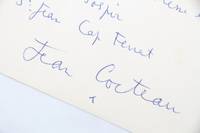
195388024Saint-Jean-Cap-Ferrat 1953. Fine. Saint-Jean-Cap-Ferrat 29 Août 1953 21 x 27 cm une page Autograph letter dated and signed by Jean Cocteau 26 lines in blue ink to Olivier Quéant editor of the magazine Plaisir de France sent from villa Santo-Sospir. Fold marks inherent to postal handling. Quéant journalist and notably editor of the magazine Plaisir de France maintained a fine friendly and literary correspondence with the writer. He notably delivered a glowing review of Antigone at its premiere in 1944: ""depuis Racine l'on avait rien écrit d'aussi beau d'aussi grand et d'aussi profondément humain"" since Racine nothing so beautiful so great and so profoundly human had been written L'Illustration. Jean Cocteau at the twilight of his life rebels and complains about his diminished and merely symbolic role in French theater of the 1950s. The second sentence of this letter will be taken up almost word for word in the famous verses of his longest poem Requiem 1962: ""Il est juste qu'on m'envisage / Après m'avoir dévisagé"" It is right that I should be considered / After having been stared at which will also serve as his epitaph. Despite official recognition Cocteau felt until his death ""méconnu inconnu invisible"" misunderstood unknown invisible Jean Cocteau sur le fil du siècle 2003 - a malaise masterfully expressed through these lines. ""Voilà plusieurs années que j'accepte d'être en secret mis à ma place et publiquement remis à ma place. Bref de n'être pas envisagé mais dévisagé. Il est beau de recevoir des lettres ""retournées"" où Anouilh me dit ""Sans vos pièces je n'aurais pas écrit une ligne des miennes"" et Giraudoux ""Rilke avait raison. Nos figures blanches à côté du hâle de tes séjours dans l'antiquité."" Il est beau d'être comme le Pisanelle - enterré sous les roses ."" For several years I have accepted being secretly put in my place and publicly put back in my place. In short not being considered but stared at. It is beautiful to receive ""returned"" letters where Anouilh tells me ""Without your plays I would not have written a line of mine"" and Giraudoux ""Rilke was right. Our pale faces beside the tan of your sojourns in antiquity."" It is beautiful to be like Pisanello - buried under roses . Interesting and touching missive from Cocteau with disordered and furious handwriting twisting and stretching in the manner of a calligram. unknown
195687010Saint-Jean-Cap-Ferrat 1956. Fine. Saint-Jean-Cap-Ferrat 31 Décembre 1956 21 x 27 cm une page une enveloppe Autograph letter dated and signed by Jean Cocteau 12 lines in blue ink to his friend Georges Bachelard. Fold marks inherent to mailing envelope included. Jean Cocteau is fully absorbed in decorating the Saint-Pierre chapel of Villefranche sur mer which he adorns out of friendship for the village fishermen to whom it belongs. He nevertheless wishes to make himself available for his friend ""Viendrez-vous sur notre côte Mon adresse est villa Santo Sospir St Jean Cap Ferrat."" ""Will you come to our coast My address is villa Santo Sospir St Jean Cap Ferrat."" unknown
196087393Saint-Jean-Cap-Ferrat 6 Janvier 1960 | 21 x 27 cm | une page + une enveloppe
195287645Saint-Jean-Cap-Ferrat 8 Novembre 1952 | 21 x 27 cm | une page
195287645Saint-Jean-Cap-Ferrat 1952. Fine. Saint-Jean-Cap-Ferrat 8 Novembre 1952 21 x 27 cm une page Autograph letter dated and signed by Jean Cocteau 15 lines in blue ink addressed to a friend from Saint-Jean-Cap-Ferrat about a painting he is about to complete. Fold marks inherent to postal delivery. Jean Cocteau questions his correspondent about the shipping arrangements for his work which he plans to finish the day after writing this letter: ""Should I bring it back to Paris or send it elsewhere if that suits you The best would be to remove the canvas from its frame and roll it. Please be so kind as to reply quickly so that I can prepare the packaging."" ; he briefly describes the work: "". will be 92 cm in height and 1 m 26 wide. It appears as if it were in flat tints and there is not a single flat surface. I even leave some sunken areas that form dark patches."" unknown
196087393Saint-Jean-Cap-Ferrat 1960. Fine. Saint-Jean-Cap-Ferrat 6 Janvier 1960 21 x 27 cm une page une enveloppe Autograph letter dated and signed by Jean Cocteau 9 lines in black ink to his friend Georges Bachelard from his villa at Santo Sospir in Saint-Jean-Cap-Ferrat. Fold marks inherent to postal dispatch envelope included and extensively written by Jean Cocteau. Jean Cocteau extends all his wishes for success to his friend and thanks him for his last letter which comforted him in the path he is pursuing. unknown
1953R300314966Grasset. 1953. In-12. Broché. Etat d'usage, Couv. convenable, Dos satisfaisant, Non coupé. 234 pages.. . . . Classification Dewey : 94.4-Editions numérotées
1970RO20224248Albin Michel. 1970. In-4. Relié. Bon état, Couv. convenable, Dos satisfaisant, Intérieur frais. 200 pages environ. Nombreux dessins en noir et blanc, très peu de texte. Frontispice illustré en noir et blanc.. . . . Classification Dewey : 741-Dessin
RO20214236Flammarion. Non daté. In-8. Broché. Bon état, Couv. convenable, Dos satisfaisant, Intérieur frais. 63 pages. Texte sur deux colonnes.. . . . Classification Dewey : 840.091-XX ème siècle
1983RO30321396Rocher. 1983. In-4. Broché. Bon état, Couv. convenable, Dos satisfaisant, Intérieur frais. 145 pages illustrées en noir et blanc, dans le texte. Texte sur plusieurs colonnes. Nombreuses coupures de presse et cartes illustrées dont une destinée à Michel Suffran.. . . . Classification Dewey : 840-Littératures des langues romanes. Littérature française