CLAUDEL PaulLivre Rare Book

3 742 résultats
1851Chinchiocha, Tokyo 1923.Un volume (14 x 33 cm) en feuilles, dépliant à la japonaise serti de deux ais de bois, sous étui de tissu bleu à fermoir en ivoire, pièce de titre contrecollée au dos. Édition originale, un des 1000 exemplaires numérotés sur papier spécial dit "Hôcho", seul tirage avec 12 exemplaires de grand luxe et 6 hors commerce. Ouvrage illustré de 14 dessins dans le texte d'Audrey Parr gravés sur bois par Bonkotsu Igami, "d'après le procédé japonais", d'une composition en couleur de Keisen Tomita (au verso), gravée par Bonkotsu Igami, d'un poème autographe en fac-similé, de la page de titre dessinée par Noémi Pernessin.Chemise de percaline bleue en partie passée, avec une petite déchirure en haut du dos, mors papier intérieur de la chemise légèrement fendus, bords des pages salis. État moyen.
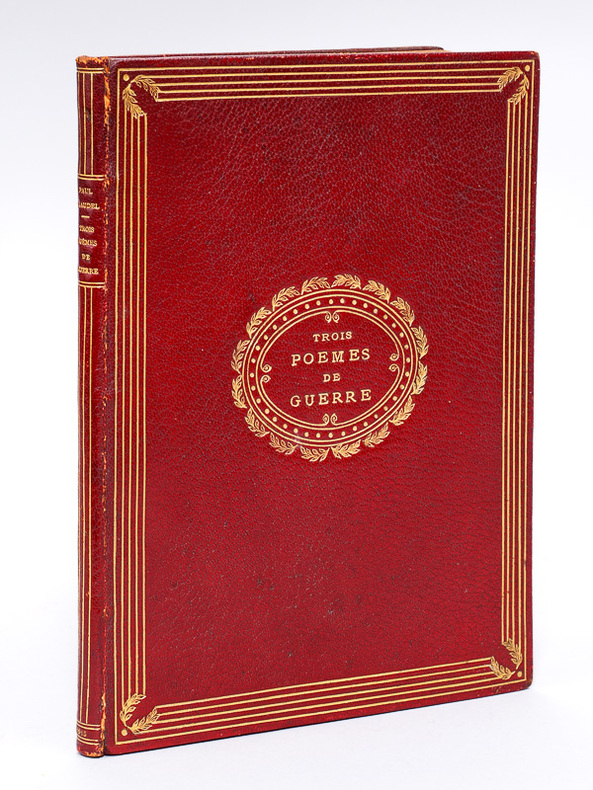
191558723Septième édition, 1 vol. grand n-8 reliure plein maroquin rouge, dos lisse orné en long, filets d'encadrement dorés en plats, couvertures conservées, tête dorée, reliure signée de J. E. Reymond, Editions de la Nouvelle Revue Française, 1915, 26 pp.
1914430261914 Paris. Georges Crès & Cie. 1914. 2 volumes in-8 en long brochés, imprimés d’un seul côté sur deux feuilles pliées, sous chemise de soie bleue de Pékin frottée et passée, cartonnage éditeur fermé par 2 tiges d’ivoire fixées au bout d’une lanière.
194983390Couverture souple imprimée. Préface et notes par Robert Mallet. 2 portraits-frontispice. Non coupé et non rogné. Petit accroc sur la couverture.
193683980Nrf | Paris 1936 | 12 x 19 cm | broché
198448501Gallimard | Paris 1984 | 15 x 22 cm | broché
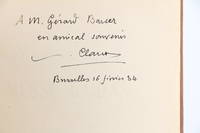
191979630Paris: Nrf 1919. Fine. Nrf Paris 1919 19.50 x 26.50 cm relié First edition on ordinary paper. Full brown cloth Bradel binding smooth spine gilt date at foot covers and spine preserved bookplates pasted on one pastedown contemporary binding signed in blind by Stroobants. Two light dampstains to upper right corner of first cover and upper left corner of second cover. Autograph inscription dated Brussels 1934 and signed by Paul Claudel to Gérard Bauër. Provenance: from the libraries of Gérard Bauër and Jean-François Lemaire with their bookplates pasted on one pastedown. Nrf hardcover
196682044Paris: Gallimard 1966. Fine. Gallimard Paris 1966 14.50 x 21.50 cm broché First edition one of 39 numbered copies on wove paper the only deluxe copies. Handsome copy. Gallimard unknown
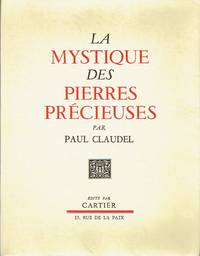
1938019799Paris: Cartier 1938. Limited edtion #414 of 1600. Fine. Fine condition; clean bright no foxing so signs of previous ownership. Slipcase worn soiled slightly cracked. Folio broché. <br/><br/> Cartier unknown
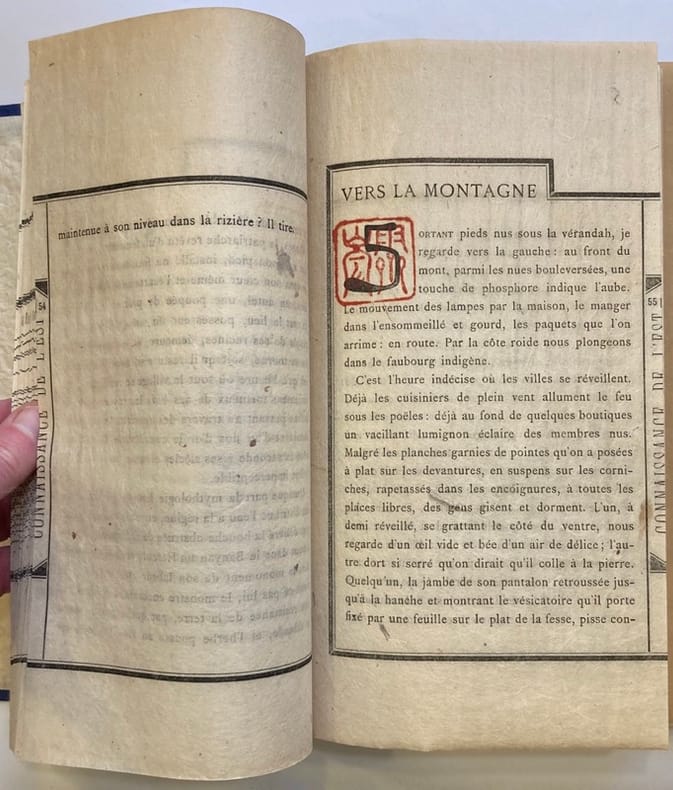
191475520Paris: Georges Cres Coll. coréenne composée sous la direction de Victor Segalen 1914. One of 750 numbered copies. Two octavo volumes paginated continuously. 226 pp. with text printed in two columns and with 61 large opening letters printed in red and black and meant to imitate a Chinese seal. Pages are all french-fold to simulate a Chinese book. String-tied wrappers. Housed in the original folding case with ivory clasps. A bit of wrinkling to the overlay leaf but the entire production by Victor Segalen is quite impressive.Connaissance de L'Est Knowledge of the East first published in 1900 is a collection of prose poems by Paul Claudel almost all composed in China between July 1895 and October 1899 when Claudel was appointed alternate consul in Shanghai. The poems in this collection are grouped into two unequal parts. Published in 1900 at the Mercure de France then in an expanded edition in 1907 the purpose of the book was to allow the newcomer to get to know this eastern country where he had just settled. Hence these texts on what we would today call Chinese culture: gardens theatre ideograms… Hence also the descriptions of exotic trees animals or landscapes. In August of 1913 Claudel gave Victor Segalen whom he had met in Beijing permission to republish his prose poems. The pages of this reissue were printed on one side folded in half and sewn in the oriental fashion. The two volumes were presented in a box covered with blue silk and equipped with tabs.Victor Segalen though largely forgotten today was a real force in his age. "French writer Victor Segalen was born in Brest on January 14 1878. After solid classical studies with the Jesuits he studied medicine in Brest Rennes and Bordeaux and became a naval doctor in 1902. His thesis entitled Les Cliniciens ès lettres in which he studied the medical documentation of certain naturalist writers. He detached a chapter from it: Les Synesthesias et l'école symboliste a vigorous plea in favor of the symbolists was published in the Mercure de France of April 1902.Meeting Joris-Karl Huysmans in 1899 and later Remy de Gourmont gave him access to the environment of the Mercure de France. His first post on the sloop "La Durance" in Tahiti from January 1903 convinced him from the outset that Polynesian civilization was threatened with death by European influence and by the carelessness of its peoples. Seeing the paintings and reading the writings of Paul Gauguin who had died recently in Hiva-Oa made him understand from the inside what the sensual and joyful life of the Polynesians had once been like. An article published in the Mercure de France in June 1904 Gauguin and much later a Tribute to Gauguin in 1918 testify to his admiration. Back in France in February 1905 he published Les Immémoriaux in 1907 under the pseudonym of Max-Anély. In this carefully documented book under a romantic and poetic fabrication Segalen showed how under political and religious pressure from Europe the Polynesians "the Immemorial" had come to forget their sacred words their gods their sensual search for happiness. It was Segalen's way of putting his ideas on exoticism into practice by letting Maori reciters speak pretending to adopt their values. In this he showed himself to be a precursor of modern ethnologists. The book moreover is the expression of his violent revolt against his rigorous moral and religious education. It had begun in Bordeaux but the Tahitian facilities the influence of Nietzsche and the example of Gauguin ranked among the "outlaws" with Rimbaud on whom he published a study Le Double Rimbaud had him singularly reinforced.His passion for music very much fostered by his family and his admiration for Debussy led him to meet the Master to whom he unsuccessfully offered the libretto of Siddhartha inspired by the tenets of Buddhism. However Debussy suggested that he write an Orpheus instead. They worked on it together but Orphée-Roi will only appeared in 1921 after the death of the musician and the poet. It is with China that Segalen according to Jouve quoting Rimbaud "finds the place and the formula". Appointed student interpreter for the navy he arrived in Beijing in June 1909 met Paul Claudel in Tien-Tsin for whom he felt more literary admiration than religious sympathy and undertook a great expedition to central China and Japan which lasted nine months. This lengthy stay in Asia gave rise the great works of Segalen as poet. Steles 1912 and 1914 a collection of forty-eight poems — sixty-four in the second edition — is externally and internally presented in Chinese style. But exoticism here only serves as an alibi. Neither translations nor adaptations these poems actually express the secret universe of the poet his opinions his feelings his travel experiences. By the detour of China by what he calls allegory they suggest notions too pure to fall under the cut of words. The unspeakable the invisible the unheard of haunt the stelae of the "Middle" in particular.With Paintings 1916 leaving behind the dense and concentrated style of lapidary inscriptions Victor Segalen opted to describe or recreate through spoken language Taoist paintings a long roll of silk portraits of decadent emperors. These are prose poems to be put on the same level as Rimbaud's Illuminations and Claudel's Conférence de l'Est. This poet was also a sinologist and an archaeologist. The official archaeological mission formed by Victor Segalen Gilbert de Voisins and Jean Lartigue discovered in 1914 the oldest Chinese monumental statue and identified the burial site of Emperor Ts'in Che-Houang whose exploration was to be sixty years later. the greatest discovery of the century. Georges Cres, Coll. coréenne composée sous la direction de Victor Segalen unknown
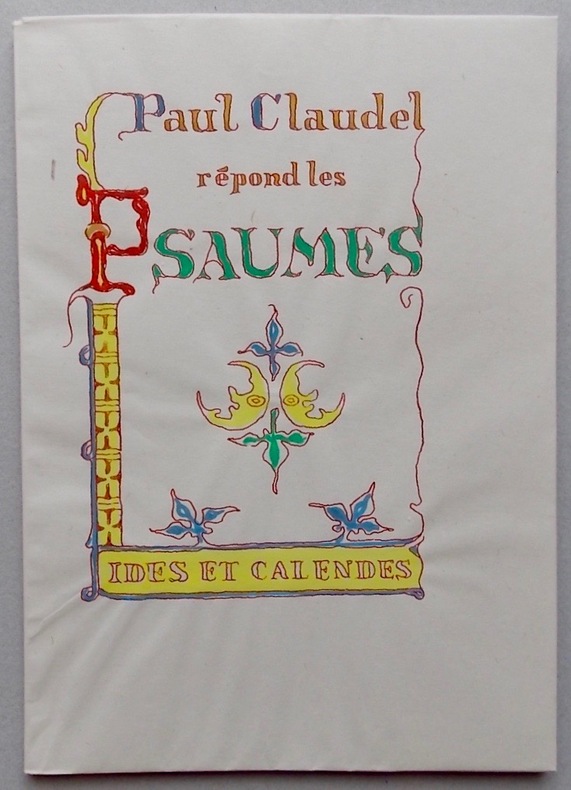
38261Neuchâtel, Ides et Calendes, 1948. Gr. in-8°, 75p. Broché, couverture illustrée rempliée.
19332092902140309984Ritsumeikan Publishing Department 1933. Soft Cover. Fine. Number of books: 1 Ritsumeikan Publishing Department paperback
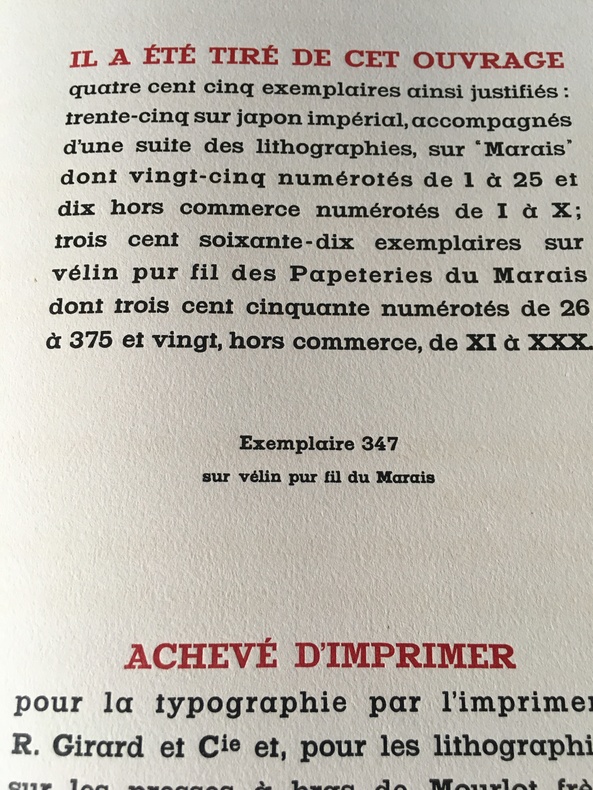
1946YRG-1In-folio en 21 feuillets in 4.40 pages illustrées de 12 lithographies en noir, blanc et marron, dans et hors texte. Feuillets souples, couverture rigide. Sous emboîtage ((28,5 X 39 cm). LIBRAIRIE GALLIMARD. 1946. Illustrations par LOSE MARIA SERT Y BADIA (1874-1945). EDITION ORIGINALE ET PREMIER TIRAGE, LIMITE A 405 EXEMPLAIRES NUMEROTES, DONT 30 HORS COMMERCE. UN DES 370 SUR VELIN PUR FIL DES PAPETERIES DU MARAIS.
This is a fine hardcover copy still in the shrinkwrap, with no wear at all. Completely clean. Text in French. This is the 3rd edition revised and enlarged. Illustrated in black & white and color. Bibliography. 11" high X 9" wide, 367 pages. A fine unopened copy. This book will be securely wrapped and packed in a sturdy box and shipped with tracking.
190963848Paris: Editions de la Nouvelle Revue Française 1909. Fine. Editions de la Nouvelle Revue Française Paris 1er décembre 1909 14.50 x 22.50 cm broché First edition one of the rare deluxe copies on Japan paper. Pre-original edition of Trois Hymnes by Paul Claudel. Other contributions by Henri de Régnier Paul Valery Francis Carco André Ruyters Eduard Ducoté and André Gide. A tiny tear without loss at the foot of the second cover otherwise a handsome copy. Extremely rare deluxe copy of one of the very first issues of the most celebrated French literary review of the twentieth century. Editions de la Nouvelle Revue Française unknown
1928430511928 Paris. Les Cent Une. Société de femmes bibliophiles. 1928. 1 volume in-8, en feuilles sous couverture rempliée, chemise légèrement frottée et étui.
1946WB16883Lausanne: Mermod 1946. Limited Edition. Hardcover. Fine. Copy 66 of a total edition of only 90 copies. 66/90. Exemplaires numérotés sur papier vergé de Rives. Lino original de Henri Laurens. Custom full red leather binding by Suzanne Schrag with pictorial black inlay. Original wrappers bound in. A beautiful book. <br/><br/> Mermod hardcover books
1946WB16883Lausanne: Mermod 1946. Limited Edition. Hardcover. Fine. Copy 66 of a total edition of only 90 copies. 66/90. Exemplaires numérotés sur papier vergé de Rives. Lino original de Henri Laurens. Custom full red leather binding by Suzanne Schrag with pictorial black inlay. Original wrappers bound in. A beautiful book. <br/><br/> Mermod hardcover
a71432Paris 1920 1st Editions de la Nouvelle Revue Francaise. Copy No. 6 of 390. Printed sur les Presses de Coulouma Argenteuil. In French. Hardcover. Sm.4to. about 100pp. half vellum with marbled boards. Lovely matching marbled end papers. VG light cover wear. Elegant book. In later removable protective glassine jacket. . hardcover
200414005Paris, Dunod, éditeur, librairie des corps des ponts et chaussées et des mines., 1877 ; in-8, 1857 pp., demi marocain vert à caissons. Les 2 volumes. Neuvième édition, revue et considérablement augmentée, rousseurs usuels.
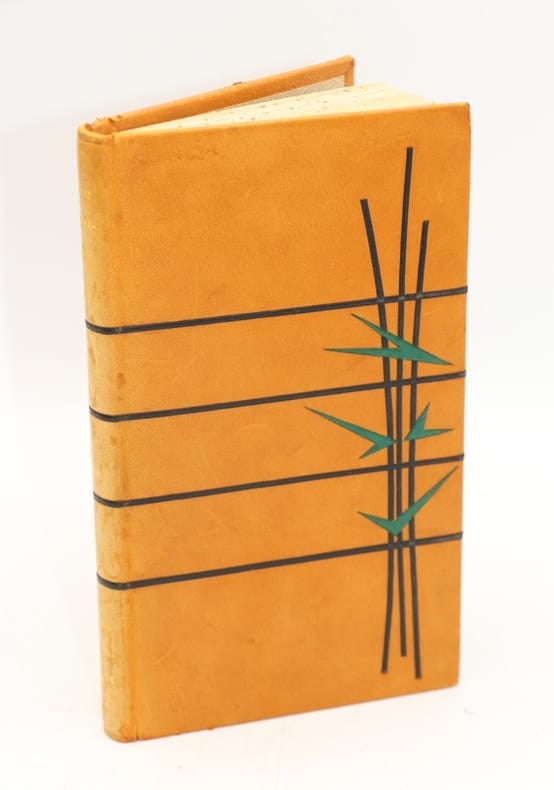
604835Paris, Gallimard, NRF, 1942. In-8 étroit, reliure décorative pleine-basane fauve (sign. Cladt), dos lisse, titre doré, décor de mosaïque noir et vert sur les plats, couvertures et dos conservés, non paginé, ex-dono ms sur la p. de garde. Recueil de cent soixante-douze haïkus composés par l'auteur entre juin 1926 et janvier 1927 lorsqu'il était ambassadeur de France à Tokyo ; il est illustré de caractères japonais calligraphiés par Ikuma Arishima.
1913022190Paris éditions de la Nouvelle Revue Française 1913 un volume in folio (255 x 325mm), 72 pp. Reliure de l'époque en pleine peau imitation vélin à la Bradel, premier plat orné du titre frappé en or, dos lisse muet, gardes cailloutée, tranches dorées (A. MERTENS REL.). (légers frottements à la reliure, très rares rousseurs dans les marges). Edition originale, tirée seulement à 323 exemplaires sur vergé d'Arches, un des trois cents numérotés en chiffres arabes (n° 147). Bel exemplaire sorti des presses de l'imprimerie Sainte-Catherine à Bruges.
7168Paris, NRF Gallimard, 1928. In-12, broché (couverture : dos bruni, petits défauts).
1910LIQ-4901P. Librairie d'Occident 1910. Grand in-4° broché sous couverture illustrée en couleurs.
24619P., Mercure de France, 1900, in-8, br., (158 p.), couv. gris vert imprimée. Edition originale. Tirage à très petit nombre sur alfa vergé (pas d'autre papier).