477 résultats
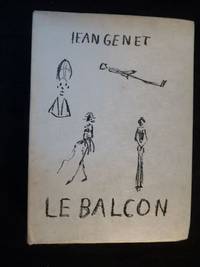
1960016031L'Arbalete 1960. Book. Very Good. Paperback. Inscribed and signed by Jean Genet: "a mon Amie/-le petit Phil.!/Jean Genet." Laid in is a note "From the Desk of Jean Vallier" in French dated 6 decembre 2008: "Mais qui est donc "le petit Phil." Un pote unclear a toi Pour le bon vieux temps a toi Jean." Jean Vallier is among other things Marguerite Duras' biographer. Text block is coming loose from the wrapper and has some uneven tanning to the front cover and spine but still a nice copy of the second edition with the lettered lithographed cover design by Alberto Giacometti. "Genet's biographer Edmund White wrote that with The Balcony along with The Blacks 1959 Genet re-invented modern theatre.5 The psychoanalyst Jacques Lacan described the play as the rebirth of the spirit of the classical Athenian comic playwright Aristophanes while the philosopher Lucien Goldmann argued that despite its "entirely different world view" it constitutes "the first great Brechtian play in French literature."6 Martin Esslin has called The Balcony "one of the masterpieces of our time."7" Though not noted this book is from the library of an NYC film critic. Trade editions of books signed by Genet are quite uncommon. L'Arbalete Paperback
194635093Lyon: L'Arbalète 1946. First edition number 256 of 475 copies "in-quarto coquille sur pur fil rives filigrané 'L'ABALETE.'. Printed in maroon and black. 1 vols. 4to 11 x 8-1/2 inches. Original white cloth. Fine copy of perhaps Genet's most famous work. First edition number 256 of 475 copies "in-quarto coquille sur pur fil rives filigrané 'L'ABALETE.'" Printed in maroon and black. 1 vols. 4to 11 x 8-1/2 inches. L'Arbalète unknown
1949558750New York: The Tiger's Eye 1949. Softcover. Very Good. Nos. 1-9 all published. Octavos. Illustrated in black and white and tipped-in color plates. Printed wrappers. Modest general wear with a couple of tiny tears at the spine most color plates neatly reattached first two volumes with hinges neatly strengthened Number 2 with a small foredge stain affecting the a small area of the margins of the second half of the text and Number 1 with a bit of cover erasure and a bit of loss at the spine a very good set. <br /> <br /> Text highlights include "The Night's Children" by Jean Genet translated by Bernard Frechtman; "Japanese Goblin Poems" translated by Lafcadio Hearn; "Forerunners of Modern Music" by John Cage; "Two Poems about Heaven and Earth" by Kenneth Patchen; "To Walter de la Mere" by T.S. Eliot; "The Gift of Understanding" and "The Landfall" by Thomas Merton; "The Furies" by Weldon Kees; "At the Edge of the Forest" by Raymond Queneau translated by Ralph Manheim; and "Demolition Proejct" by William Stafford among many others. <br /> <br /> In 2002 Yale's Beinecke Library organized an exhibition of Ruth and John Stephan's work with an emphasis on The Tiger's Eye. Reviewing the exhibition and accompanying catalog for The New York Times Roberta Smith wrote: "the magazine which took its title from William Blake was one of the few that 'took visual art as seriously as literature.' It was also an eccentric mom-and-pop operation put together with love sophistication and a fair amount of attitude as well as Ruth's money. Her family owned Walgreen's.'" A complete run of this important and nicely-produced mid-Century journal. The Tiger's Eye unknown
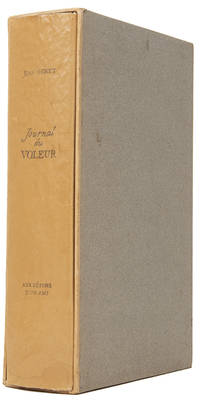
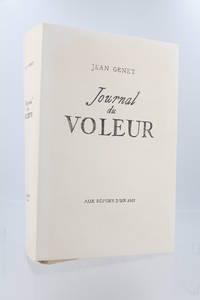
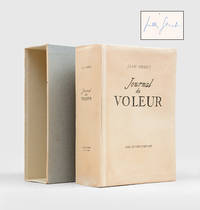
110561Geneva Aux Depens d'un Ami Albert Skira 1949. . First edition first printing. number 347 of 400 copies on vélin de Lana signed by the author from a total edition of 410; 4to; Signatures loose within publisher's cream wrappers printed in black. Contained in the original grey card slipcase. With the original glassine. A little toned but a very good copy in the marked and tanned box.<br /> One of the greatest autobiographical novels of the 20th century. Perhaps Genet's most lasting testament.<br /> [Geneva], Aux Depens d'un Ami [Albert Skira], 1949. unknown
194979693s. l. Genève Geneva: Aux dépens d'un ami 1949. Fine. Aux dépens d'un ami s. l. Genève Geneva s. d. circa 1949 19.50 x 29 cm en feuilles sous chemise et étui First edition reserved for subscribers only one of 400 numbered copies on handmade Lana laid paper the only issue along with 10 copies on Arches laid paper. Autograph signature of the author on the justification page. Handsome copy. Aux dépens d'un ami unknown
196659539Paris: Gallimard 1966. Fine. Gallimard Paris 1966 14 x 20.50 cm broché First edition an advance service de presse copy. Autograph inscription signed by Jean Genet to Margaret Bendy. Illustrations. Spine slightly sunned not serious. Gallimard unknown
196346927Paris: Marc Barbezat 1963. Third edition - the first theatre edition with the illustrations taken from Blin's original production. With the author's signed presentation inscription to the half title leaf "A Brion Souvenir amical de Jean Genet". The recipient was the artist Brion Gysin. Octavo. Photographic illustrations by Ernest Scheidegger. Original photographic wrappers. Edges lightly rubbed backstrip creased. Very good. unknown
1947NE23Paul Morihien 1947. Book. Very Good. No Binding. 1st Edition. n 1947 Paul Morihien published a clandestine edition of Querelle de Brest by Jean Genet featuring 29 very explicit erotic drawings by Cocteau. 28 of 29 lithographs by Cocteau only. 4to loose as issued portfolio; with original glassine Paris 1947 Approximately 10 by 12 a partial set of a suite of plates issued separately. SURPRESSED! . Paul Morihien unknown
194732852Paris: Les cinéastes bibliophiles 1947. Fine. Les cinéastes bibliophiles Paris 1947 13 x 19 cm broché First edition strictement hors commerce and of 60 numbered copies on Lana this one for the actress Simone Renant. Spine and covers slightly spotted and sunned in the margins. Les cinéastes bibliophiles unknown
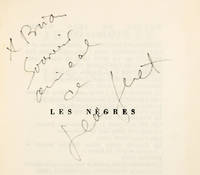
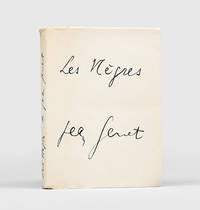
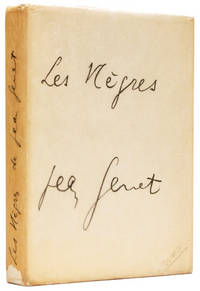
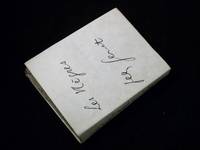
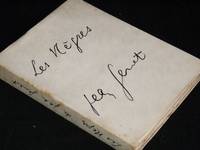
1958153103Décines: L'Arbalète 1958. May our friendship remain always so beautiful for you despite the torments of life First edition limited issue number 2150 of 3200 copies from a total edition of 3535 this copy warmly inscribed by the author on the dedication page "Décembre 64 A Henri Avec le plus profonde affection Jean Que notre amitié resté pour toi toujours si belle malgré les tourments de la vie". The inscription reads "To Henri with deepest affection Jean may our friendship remain always so beautiful for you despite the torments of life" our translation. On 12 October 1955 Le Figaro announced that the Belgian actor and director Raymond Rouleau had commissioned Genet to write a play for Black actors. The subsequent work was dedicated to Genet's lover the German-Algerian acrobat Abdallah Bentaga. Les Nègres opened under the direction of Roger Blin at the Théâtre de Lutèce on 28 October 1959 and was the longest-running off-Broadway play of the 1960s. It played to full houses every evening until its close on 4 April 1960 and won the Grand Prix de la Critique for 1959. The total edition comprised 3200 copies numbered 1 to 3200; 250 copies hors commerce marked "HC"; 50 copies on japon reserved for the author; 32 copies marked i to xxxii; and three copies hors commerce reserved for the publishers. Octavo. Original white wrappers lettered in black facsimile of the author's handwriting by Mourlot edges untrimmed many uncut. A few tiny spots of foxing to spine spine ends a little creased and rubbed with tiny chip to head else square and sharp. A near-fine copy. unknown
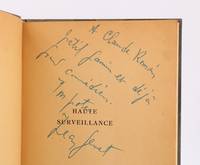
194992070Paris: Gallimard 1949. Fine. Gallimard Paris 1949 14 x 21 cm Relié First edition one of the press service copies.A faint waterstain affecting the centre of the final leaves.Bradel binding in patterned paper-covered boards smooth spine black oasis morocco lettering-piece wrappers and spine preserved.Precious presentation inscription signed by Jean Genet to Claude Romain who created the role of Maurice in this play: ""à Claude Romain petit gamin et déjà grand comédien. Ton pote Jean Genet.""High Surveillance was first performed in Paris at the Théâtre des Mathurins on 26 February 1949 directed by Jean Marchat with Tony Taffin Claude Romain Robert Hossein and Jean-Marc Lambert in the cast.Claude Romain also appeared in films by Marcel Carné including ""La Marie du port"" and by Robert Hamer notably ""Deux anglaises à Paris"" and ""Deux anglais à Paris"". Gallimard hardcover
195868103Paris: Marc Barbezat 1958. First edition first printing. From a total edition of 3535 copies this is one of just 32 printed on Japon nacre imperial and numbered in roman. The top paper issue. Rare. Octavo. Original wrappers printed in black. Fine copy. unknown
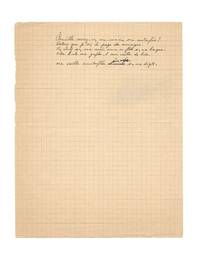
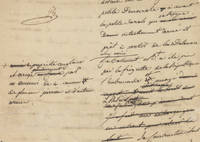
1943Genet3<p><b>GENET Jean 1910-1986</b></p><p>Fragment of an autograph poemN.p.n.d Paris prison de la Santé – 1943 1/4 p. in4°Slightly frayed left margin</p><p><b>Precious first draft fragment of a poem composed in Prison and attached to "La Parade" unpublished in its manuscript version</b></p><p><i>Canaille oserez-vous me mordre une autre fois </i><i>Retenez que je suis le page du Monarque.</i><i>Vous roulez sous ma main comme un flot sous ma barque.</i><i>Votre houle me gonfle ô ma caille des bois.</i></p><p><i>ma caille emmitouflée écrasée sous mes doigts.</i></p><p>Genet's versified work translates into six long pieces collected in a 1948 collection soberly titled <i>Poèmes</i>.</p><p>By far the most composite of the poems published in the volume and the last one that summons the prison universe "La Parade" whose title is also that of one of Rimbaud's most enigmatic <i>Illuminations</i> is composed of eight partially autonomous pieces almost all of which were probably written in 1943.</p><p>This fragment is composed of a rhyming quatrain embraced and a monostic. We immediately note the presence of a punctuation almost entirely absent only two commas and an end period remain in the collection published in 1948 and taken as it is in the edition of the Pleiade as well as a variant: "et morte" becomes "écrasée".Finally we note that the hyphenation at the hemstitch in the monostic does not show a comma unlike the published version.</p><p><u>Reference:</u>Jean Genet <i>Romans et poèmes</i> éd. Emmanuelle Lambert et Gilles Philippe Pléiade p. 1068</p>
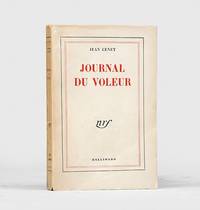
1949153061Paris: Gallimard 1949. A scarce inscribed copy of the author's autobiographical novel First trade edition warmly inscribed by the author on the half-title "à Jean Dutourd et à sa femme mes amitiés sincères. Toute ma gentille sympathie á fort de gentillesse. Mais c'est votre fillette qui est encore la plus adorable Jean Genet" "to Jean Dutourd and his wife my sincere friendship. All my kind sympathy to so much kindness. But it's your little girl who is still the most adorable Jean Genet". This recipient was the novelist and member of the Académie française Jean Dutourd 1920-2011 his wife Camille and their daughter Clara who was three years old at the time of publication. As a critic Dutourd had largely respected Genet as a writer with "a deep mind an original poetic gift and complete intrepidity in his writings" quoted in Jablonka our translation. However he was affronted by Genet's final play The Screens 1961 and wrote a particularly scathing review for France Soir. Comprising 17 individual scenes The Screens depicts an Arab insurrection against a buffoonish colonial power: a thinly veiled satire on French colonial power that references both the French conquest of Algeria in the 1840s and the then-ongoing Algerian War 1954-1962. An abridged version of The Screens premiered in Berlin in May 1961 and it was first performed in its entirety in Stockholm in 1964. Its French premier wasn't until April 1966 when it debuted at the Odéon theatre under the direction of Roger Blin. Dutourd joined a sea of critical animosity denouncing Genet as a once-great poet who had become "an official artist who like the others has made a career out of the uprising and has done well for it" quoted in Jablonka our translation. Journal du Voleur was first circulated earlier the same year in a limited edition of 410 copies for subscribers published anonymously by Albert Skira. The present edition was partially redacted by Genet to remove some of the more risqué elements. This semi-autobiographical novel follows its debauched criminal protagonist across Europe as he appropriates Christian language inverts virtues and vices and creates a religion of criminality in opposition to the society which has shaped him. Journal du voleur is dedicated to Jean-Paul Sartre and Simone de Beauvoir and prompted Sartre's 1952 essay "Saint Genet" an attempt to "prove that genius is not a gift but the way out that one invents in desperate cases" quoted in Gaitet p. 16. Octavo. Original white wrappers printed in red and black fore and lower edges untrimmed. Spine toned and a little creased with tiny chips to ends short closed tears to ends of rear joints lower corners lightly creased wrappers and lower edge a touch soiled contents toned. A very good copy indeed. Pascale Gaitet Queens and Revolutionaries New Readings of Jean Genet 2003; Ivan Jablonka Les Vérités inavouables de Jean Genet 2004. unknown
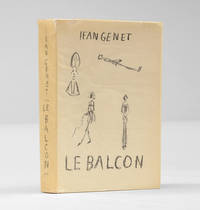
195688864Paris: Marc Barbezat 1956. One of the masterpieces of our time First edition first printing number XVII from a limited issue of 32 copies on japon nacre imperial from a total edition of 3233. The play mostly takes place outside of an upmarket brothel in a city during a revolutionary uprising. Critic Martin Esslin hailed it as "one of the masterpieces of our time" quoted in Savona. It exists in three distinct versions published in French in 1956 1960 and 1962. This first version was written between January and September 1955 and Genet took his initial inspiration from Franco's Spain. The Giacometti lithographs on the front wrapper depict a tall elegant Irma the Bishop made to resemble Gener and the General with his whip. Octavo. Original pictorial wrappers titles and lithographic illustrations by Giacometti to both wrappers and the backstrip in black edges uncut and partly unopened. With the original glassine jacket. Very light toning to edges of the otherwise exceptionally bright and fresh wrappers. An excellent copy in the lightly edge-chipped and partly toned glassine jacket. Jeannette Savona Jean Genet 1983. unknown
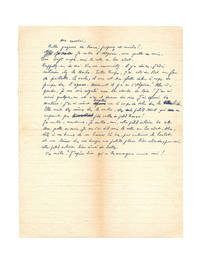
1955Genet4<p><strong>GENET Jean 1910-1986</strong></p><p>First draft manuscript<br />N.p.n.d c. 1955 3/4 p. in-4° in blue ink on lined paper<br />Numerous repentirs by the author</p><p><strong>Unpublished and provocative manuscript about the Algerian war</strong></p><p><strong><u>From the</u></strong><u> <strong>B. & R. Broca</strong> <strong>collection</strong></u></p><p><em>" Me revoici</em><br /><em>Belles gonzesses de France préparez vos miches !</em><br /><em>Je rentre d'Algérie une patte en moins trois doigts coupés mais le reste en bon état.</em><br /><em>Rappellez-vous</em> sic<em> de moi. Vous me reconnaîtrez : il y a dix ans j'étais milicien chez les Boches. Entre temps j'ai rôti du Viet au feu des paillottes. Les vaches ils nous ont tous foutu dehors à coup de pompes dans l'ognon. Heureusement il y a eu l'Algérie ! Alors là pardon je me suis régalé avec la viande de Bic ! J'en ai crevé quelques-uns et c'en est devenu du vice. J'ai défoncé des moukères : J'en ai même travaillé une à coup de talons dans le bide. Elle avait deux mômes dans le ventre deux sales petits Bicots qui ne ne couperont pas</em> les <em>jolies couilles de petit Français ! </em><br /><em>Je rentre mesdames je rentre moi votre petit milicien de 44. </em><br /><em>Une patte en moins je vous l'ai dit mais le reste en bon état. Alors dites à vos hommes de se barrer là bas pour continuer le boulot et me laisser dans vos draps une petite place bien chaude pour moi votre petit milicien bien aimé et boiteux. </em><br /><em>Vos mâles J'espère bien qu'on les arrangera comme moi ! "</em></p><p>Entirely unpublished this text seems to be linked to the play <em>Les Paravents</em> first performed on 16 April 1966 at the Théâtre de l'Odéon. Although the complete manuscript of the work as we know it was written in 1961 we nevertheless know that the first drafts were composed as early as 1955. Genet made profound changes and this sequence a monologue by a colonist was probably discarded.<br />The text deliberately provocative embodies here more than ever the moral intellectual and sexual transgression of its author. Strongly committed to anti-colonialism Genet expressed his position not only through his work but also through political combat. He thus took a violent stand against France during the Algerian War and pleaded more generally the cause of independence.</p><p><u>We would like to thank Albert Dichy for confirming the unpublished nature of this document</u></p>
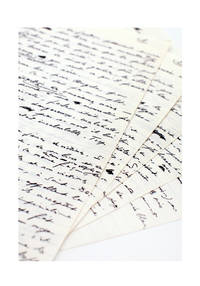
Genet2<p><strong>GENET Jean 1910-1986</strong></p><p>Autograph manuscript first draft<br />N.p.n.d 1971 4 p. 1/2 in-4°<br />Numerous corrections from the author</p><p><strong>A complete and first-draft manuscript written in reaction to the murder of George Jackson</strong></p><p><strong><u>A remarkable plea with revolutionary overtones taking a firm stand in support of the African-American community</u></strong></p><p><em>" Hier c'est-à-dire quand la vie de George Jackson paraissait encore possible j'ai parlé de son livre comme meurtre et je ne me doutais pas que le meurtrier serait descendu par la police américaine. <strong>Cet assassinat de Jackson par la police américaine quel que soit le niveau d'autorité qui l'a décidé c'est un coup monté : il a pu partir des salons de Reagan ou d'un bureau de simples gardiens la cible restait la même : un Nègre qui pense qui écrit ce qu'il pense dont le livre est l'annonce et la préparation d'une révolution noire.</strong><br /></em>… <strong><em>Les Blancs peuvent rire de sa naïveté Jackson était en effet naïf</em></strong><em> c'est-à-dire neuf c'est-à-dire nouveau c'est-à-dire dangereux. Maladroits <strong>les blancs l'ont tué</strong>. Ils ne l'ont pas grandi par sa mort ils lui ont enfin donné ses proportions exactes pourtant incalculables trop vastes. </em>…<em> Il n'y a jamais eu il n'y a pas il n'y aura jamais de victimes. <strong>Si Jackson est responsable de sa démarche révolutionnaire de son livre et de sa mort les policiers américains sont responsables de la même façon de l'assassinat de Jackson</strong>. Les Noirs américains sont responsables et non victimes quand ils acceptent de faire la guerre au Viêt-Nam à Saint-Domingue en Bolivie pour ce que les Américains blancs appellent la grandeur de l'Amérique. <strong>Ils sont responsables quand ils acceptent même la plus petite parcelle des bénéfices de l'impérialisme qui s'enrichit des dépouilles des peuples dévastés. L'Europe fait partie aussi de ce vampirisme. Il n'y a qu'un moyen de prouver sa liberté pour une liberté toujours plus grande c'est d'entrer dans la révolution</strong> </em>…<em> comme tout homme et toute femme qui refusent d'asservir et d'être asservi.</em> …<em><br />Jonathan et George Jackson Angela Davis les Panthères noires les mouvements révolutionnaires noirs ou blancs ont porté au plus haut degré ou la trahison ou le combat démasqué donc la conscience d'être responsable. </em>…<br /><strong><em>Qu'est-ce que la prison C'est l'immobilité. " Homme libre toujours tu chériras la mer ! " Baudelaire.</em></strong>…<em> Même s'il m'est difficile ici de dire comment le monde sera changé croyez bien qu'on y travaille. Nous ne négligerons rien. Cela nous gêne peut-être de dominer de moins en moins les Noirs mais c'est qu'ils ne l'acceptent plus. Ils comptent sur leur propre force non pour nous dominer mais pour nous regarder droit dans les yeux. Ils changent aussi le langage qui n'obéira plus à la définition des maîtres. </em>…<br /><em>Qu'était le corps de Jackson dans cette cellule. Ni plus ni moins qu'un autre dans cet espace</em> …<br /><strong><em>Il faut porter notre attention sur David Hilliard huit ans de prison sur Angela Davis accusée de complot et de tentative de meurtre et de tous les Noirs emprisonnés – dans la prison ou dans le ghetto – qui risquent à tout moment d'être assassinés comme George et Jonathan Jackson ou gâchés par le monde blanc. En fait il faut apprendre à trahir les Blancs que nous sommes</em></strong><em>. "</em></p><p>George Jackson died in San Quentin prison on August 21 1971. According to the official police account he was shot while allegedly threatening a guard with a revolver during an escape attempt having taken advantage of a riot to flee the prison yard — despite it being under heavy surveillance. However the official version of events does not align with the findings of an independent investigation conducted afterward. To this day the circumstances surrounding his death remain shrouded in mystery. Jackson's trial was scheduled to take place just two days later — a trial he had actively prepared for. In the end he and his two comrades were acquitted of a crime committed nearly two years earlier on January 13 1970.<br />This text is an essential complement to Genet's other writings on Jackson following in the wake of an article published shortly before. It was elaborated as part of a collective work in homage to the "Soledad Brothers" and more broadly to all Black political prisoners.</p><p>Genet's political commitment reached its full force beginning in 1970. On February 25 a representative of the Black Panther Party requested his support. Genet declined to sign petitions but offered instead to carry out advocacy campaigns on the ground in the United States for the Black Panthers. For two months he shared their daily life tirelessly crisscrossing the country with them giving countless lectures at universities and speaking to the press.</p><p>An admirable manuscript in which Genet's outrage bursts forth in solidarity with the African-American cause.</p><p><u>Bibliography:</u><br />Jean Genet <em>L'Ennemi déclaré</em> textes et entretiens Gallimard 1991 p. 105-108</p>
195640848Décines Décines-Charpieu: Marc Barbezat 1956. Fine. Marc Barbezat Décines Décines-Charpieu 1956 15 x 20.50 cm broché First edition one of 32 numbered copies on Japon nacré the tirage de tête. Illustrated covers with an original lithograph by Alberto Giacometti. Slight worming to spine. A good well-margined copy. Marc Barbezat unknown
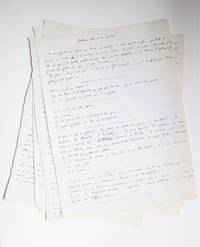
196872719s. l.: S. n. 1968. Fine. S. n. s. l. s. d. circa 1968 22 x 29 cm 6 feuillets 1/4 Unpublished autograph manuscript comprising 6 and a quarter leaves written in black ink containing around twenty notes and digressive reflections relating to the exercise of power. - ""Where does the law come from From power. The law is the voice and instrument of power. Power precedes the law and gives birth to it."" - ""The working masses are not about to accept nor to consider as political the rape of a little girl nor of a little boy. We live in such a moral climate that it first makes us pity the pain of the parents it makes us reject the cruelty of the act. The worker needs a certain respectability in order to stand equal here with the present bourgeois classes the aristocracy has disappeared. We must look ever more closely at what servile labor consists of and what it entails."" - ""Work as a virtue fostered a new morality and if it was all the more distant and disregarded by the aristocrat the people held to it. I am not speaking of what broke out in 1789 but of what was gradually formed as serfs escaped in one way or another from serfdom. In 1789 this new morality had reached its point and what had carried it word illegible to the extreme had become what was called the bourgeoisie. Bound to this new morality of work they also aspired to an 'imitation'but an imitation onlyand the morality was stronger than the still prestigious pretensions of the declining nobility."" - ""If there is an essence of power it remains hidden. But the manifestation of power even if not ostentatious seeks to be recognized and visible. For instinct one must accept the enigma."" - ""Rousseau a foundling abandons his children to public care: no one cares. It is probable that Dostoevsky raped a little girl: no one cares. The Brothers Karamazov is indeed a revolutionary book."" S. n. unknown
195838387Décines Décines-Charpieu: Marc Barbezat 1958. Fine. Marc Barbezat Décines Décines-Charpieu 1958 15.50 x 20.50 cm broché First edition one of 32 numbered copies on Japon nacre paper the tirage de tête. A fine copy. Marc Barbezat unknown
195841929Décines Décines-Charpieu: Marc Barbezat 1958. Fine. Marc Barbezat Décines Décines-Charpieu 1958 15 x 19.50 cm relié sous étui First edition one of 32 numbered copies on nacré Japon the tirage de tête. Bound in full embossed khaki leather smooth spine without lettering the title of the work and the author's name in gilt on the front cover reproducing the calligraphy of the original wrapper publishers name and place in gilt on the back cover likewise reproducing the calligraphy of the rear wrapper endpapers and pastedowns of wood-grain effect almond paper wrappers and spine preserved top edge gilt; slipcase covered with wood-grain effect almond paper echoing the binding and bearing on the covers the same features as the binding. A few small spots of foxing on the spine and upper edge slightly affecting the boards internally very clean. A rare copy spectacularly and perfectly presented. Marc Barbezat hardcover
17932495809/07/1793. <p>Following the execution of King Louis XVI and Marie Antoinette in January 1793 the French revolutionary government found itself at war with Spain the Netherlands and Great Britain. It dispatched Edmond Charles Genêt as minister to the United States for the purpose of enlisting American assistance to the fullest extent possible. Genêt arrived in Charleston South Carolina on April 8 1793 – calling himself “Citizen Genêt†to emphasize the revolutionary title. He received a warm welcome and immediately began to issue privateering commissions that authorized the bearers regardless of their country of origin to seize British merchant ships and their cargo for personal profit all with the approval and protection of the French Government. President Washington saw this as a dangerous attempt to draw the new United States into a European war and on April 22 issued his Proclamation of Neutrality declaring the U.S. a neutral nation in the conflict and threatening legal proceedings against any American providing assistance to the warring countries. Genet then proceeded to the capital at Philadelphia and was met with acclaim and jubilation everywhere he went as many Americans supported the French Revolution’s goals of liberty equality fraternity. He was officially received by Washington on the afternoon of May 18th but Secretary of State Thomas Jefferson soon informed him that the United States considered the outfitting of French privateers in American ports to be a violation of the U.S. policy of neutrality. Genet ignored this warning and in fact threatened to take his case directly to the American people bypassing official government opposition. Genêt was thus willing to challenge Washington and risk being seen as a foreign meddler in American domestic affairs.</p><p>Sometime in the spring of 1793 the French frigate Embuscade commandeered the British vessel Little Sarah and dragged it into Philadelphia. The ship was there outfitted as a French privateer and renamed La Petite Démocrate. On June 22nd the Washington administration began to investigate the disturbing claims coming from the nation's capitol. There was talk of sending an armed brigade from the state of Pennsylvania to confront Genet. Secretary of State Thomas Jefferson visited Genet in an attempt to secure his promise that the vessel would not leave Philadelphia before the President’s return. According to Jefferson’s account of the meeting Genet “said he should not be justified in detaining her. I told him it would be considered a very serious offence indeed if she should go away; that the government was determined on that point and thinking it was right would go through with it. After some hesitation he said he could not make any promise it would be out of his duty but that he was very happy in being able to inform me that the vessel was not in readiness and therefore could not sail that day.… And whenever I tried to fix it to the President’s return he gave the same answer that she would not be ready for some time but with the look and gesture which showed he meant I should understand she would not be gone before that time.""</p><p>On July 8 Washington Hamilton Jefferson and Knox met at Independence Hall. Note of the meeting read: ""The secretary of the Treasury and The secy of War are of opinion that it is expedient that immediate measures should be taken provisionally for establishing a battery on Mud Island under cover of a party of Militia with direction that if the Brig Sarah should attempt to depart before the pleasure of the President shall be known concerning her military coercion be employed to arrest and prevent her progress. The Secretary of State dissents from this opinion.""</p><p>Jefferson evidently then turned to Genet who was in Philadelphia to write his own rationale that he would send just 2 days later to Washington enclosing this note with a recommendation that armed conflict not be commenced as he had advocated at Independence Hall. He judged Genet's non-committal along with conciliatory language as promise enough that the action would not be taken prior to President Washington's return.</p><p><strong>Autograph memorandum signed</strong> Philadelphia July 9 1793 to Thomas Jefferson Genet's draft pages 1 and 2 signed in the margin. <em>""Note pertaining to la Petite Démocrate captured by frigate Embuscade heretofore la Petite Sarah that M. Genet has had armed on account of the Republic and to which the exit is being opposed.""</em></p><p><em>""You have asked me details about the Brigantine la Petite Démocrate heretofore la Petite Sarah found presently armed and ready to leave Delaware. This vessel Sir of English property armed by our enemies with 4 cannons and other arms has been taken by the Frigate of the French Republic l'ambuscade and sent to Philadelphia. The construction being light and strong her body lined with copper her molding superior her rigging and her masts in good shape I have judged to act on the Embuscade Captain's report and that provided by other sailors that the acquisition of this vessel was advantageous to the Republic and this consideration added to the wish I had to procure employment for a rather large amount of French sailors being there exposed to the danger which often comes by being idle and miserable made me determined to take her on behalf of the State.</em></p><p><em>""I had it repaired right away. I did so using cannons found on board 4 French vessels. I left the command to the Citizen Amiot officer of the Republic. I will have it sent out armed with a commission of the Executive Council along with my instructions as soon as possible. I have to confine Monsieur that relating these facts which are not susceptible for discussion from me and which should not present any difficulties to your government.""</em></p><p>On July 11 Jefferson wrote to Washington ""Papers requiring the President’s instant attention"" enclosing the final version of this very note.""</p> unknown
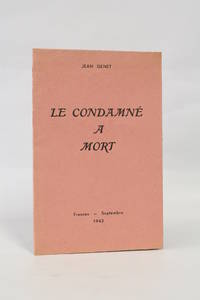
194263635Fresnes: S. n. 1942. Fine. S. n. Fresnes 1942 14 x 21.50 cm en feuilles sous couverture rose First edition of Jean Genet's debut work written at Fresnes printed in a few copies and published at the authors expense which appeared clandestinely while he was serving a prison sentence for book theft. The pamphlet thirteen pages unbound and unpaginated was printed on brown paper under a pink or white cover. Our copy is housed in a half old-rose box chemise boards of geometrically patterned paper slipcase trimmed in old-rose box the ensemble signed by Thomas Boichot. « J'ai dédié ce poème à la mémoire de mon ami Maurice Pilorge dont le corps et le visage radieux hantent mes nuits sans sommeil. ». Thus Jean Genet explained the genesis of this poem a tribute to « l'assassin de 20 ans » guillotined with whom he shared the last forty days. According to François Sentein biographer of Maurice Pilorge L'Assassin et son bourreau the two men never actually met and Jean Genet would make him into an imagined companion « mort avec l'insouciance d'un dandy » Edmund White Jean Genet. Jean Cocteau who would become both friend and guardian angel to Jean Genetsaving him from life imprisonment a few years laterwrote in his Journal: « Parfois il m'arrive un miracle. Par exemple Le Condamné à mort de Jean Genet. Je crois qu'il n'en existe que quatre exemplaires. Il a déchiré le reste. Ce long poème est une splendeur. Jean Genet sort de Fresnes la plaquette est datée de la prison « Fresnes septembre 1942 ». Poème érotique à la gloire de Maurice Pilorge assassin de vingt ans exécuté le 12 mars 1939 à Saint-Brieuc. L'érotisme de Genet ne choque jamais. Son obscénité n'est jamais obscène. Un grand mouvement magnifique domine tout. La prose qui débute est courte insolente hautaine. Style parfait. » Extremely rare and very attractive copy as published. S. n. hardcover
1949124273Geneva: aux dépens d'un ami 1949. The first numbered copy with Genet's birthday card to a friend Signed limited edition large paper issue the tirage de tête number 1 of 10 copies numbered in roman numerals signed by Genet and printed on Vélin d'Arches paper from a complete edition of 410. Laid in is an autograph note written by Genet slipped inside a rice-paper birthday card with mawkish hand-painted decorations. The first part of the inscription in a neat hand satirizes the sentimentality of the card with a string of asinine rhymes: "Cette carte se mange comme le pain des anges mon âme de la fange tirée par vous ô Lange qui êtes sans mélange sauf de fleurs et d'oranges votre âme dans ses langes purifierait le Gange. Dans le ciel des mésanges on hurle vos louanges" "This card can be eaten like angel's bread my soul of mire pulled by you oh swaddling sheets unadulterated except for flowers and oranges your swaddling soul would purify the Ganges. In the blue tits' sky they howl your praise". The second part in a much looser hand - "Eh bien ma petite mon ange je suis très simple très gentil et je ne vous souhaite en vous embrassant que du bonheur votre Plantagenet" "Well my sweet little thing my angel I am very simple very kind and as I kiss you I only want to wish you happiness your Plantagenet" - recalls the interrogation scene in Miracle de la Rose 1946 in which the narrator's name "Genet" is turned into "Plantagenet" by the interrogator. Loose quarto quires held in the original card chemise lithographed chemise titles half-title title and dedication page. With the original grey card slipcase. Housed in a black quarter morocco solander box by the Chelsea Bindery. Chemise faintly tanned tiny closed tear at head of spine light spotting to lower margins; slipcase a little rubbed at extremities and with one tiny stain. A bright and fresh copy in excellent condition. unknown
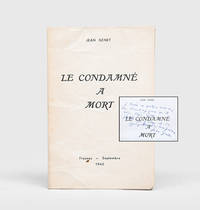
1942172551Fresnes: September 1942. Presentation copy of Genet's rare debut with his corrections First edition first printing presentation copy inscribed by the author on the title page to his friend Boris Kochno and with several authorial manuscript corrections. Genet wrote the poem while imprisoned in Fresnes for bibliolarceny. The manuscript was smuggled out and privately printed in a tiny edition. The inscription reads thus: "à Boris ces quelques mots mais bien davantage parce qu'il aime déjà Guy plutôt qu'à cause de sa sympathie par mon poème - Jean Genet" "These few words are for Boris but much more because he already likes Guy than because of his appreciation for my poem". Kochno 1904-1990 was celebrated for his work for the Ballets Russes and Les Ballets des Champs-Elysées which helped reinvigorate the art in France. Genet's biographer Edmund White credits a small circle of distinguished gay artists to whom Kochno belonged with inspiring Genet to write about homosexuality with such unprecedented frankness and power. The individual to whom the inscription refers is likely Lucien-Guy Noppé nicknamed Guy Genet's fellow inmate and lover. Noppé was a major inspiration for Miracle de la rose 1946 and Journal du voleur 1949 and was the subject of various poems penned by the author such as "Boxeur endormi" and "À Guy". On 21 July 1943 Genet sent the latter poem in manuscript to both Kochno and Kochno's lover Christian Bérard. The couple later designed the set for Genet's play Les Bonnes 1947. Variants in pink wrappers have been noted without priority. Octavo pp. 16. Original white wrappers printed in black pages loose within as issued. Housed in a custom black solander box. Faint foxing to lightly creased wrappers small burnt hole to front cover internally fresh. A well-preserved copy of this fragile publication. see Edmund White Jean Genet 1993 p. 226. unknown