389 résultats
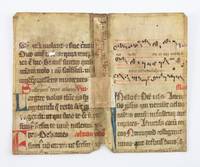
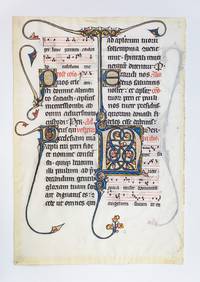
ST20214Northern France perhaps Beauvais or Amiens late 13th or early 14th century. 286 x 199 mm. 11 1/4 x 7 3/4". Double column containing a mixture of staves and text approximately 21 lines in an excellent formal gothic book hand. <br/> Attractively matted. Rubrics in red chant text containing black penwork initials with red and yellow geometric elaboration BEAUTIFULLY ILLUMINATED with five two-line initials painted blue or pink with white tracery on a ground in the contrasting color two of the initials filled with grotesques and swirling vines and two with the filler design traced out but never completed each initial with blue and pink extensions terminating in orange leaves or spiky shapes; the verso featuring AN IMPRESSIVE SIX-LINE "N" 58 x 50 mm. in the same style filled with an intricate knotwork design and orange leaves with long extensions including a horizontal extension across the upper margin. Margins with light offsetting of the designs from the facing leaf; remnants of mounting tape on recto corners and bottom edge; verso apparently with a barely visible Medieval "14" in lower margin. An area measuring 5 mm. at edges just faintly yellowed from mat burn but IN FINE CONDITION the vellum otherwise quite bright the paint rich and the gold brightly glittering.<br/> <br/> This sumptuously decorated leaf--which is beautifully preserved and contains a particularly large and handsome initial--comes from the last volume of a three-volume Missal presented to Beauvais Cathedral by Canon Robert de Hangest d. 1356. The Missal remained at the cathedral at least through the 17th century when it is noted in an inventory but was removed from the church at some point likely in the aftermath of the French Revolution. The parent volume eventually entered the collection of Henri-Auguste Brölemann 1775-1854 of Lyon who passed it to his grand-daughter Etienne Mallet who then sold it at Sotheby's in 1926. It was then acquired for the collection of William Hearst where it remained for the next 25 years. In 1941 it was again sold at auction and subsequently dismembered. Though long thought to have been the work of famed biblioclast Otto Ege recent scholarship suggests that it was actually Phillip Duschnes who was responsible for breaking up the book keeping some leaves for himself and selling others on to his colleague Ege for inclusion in his portfolios of "Fifty Original Leaves from Medieval Manuscripts." The Beauvais Missal has been a subject of interest for many notable scholars chief among them being Christopher de Hamel--see: "Otto Ege and the Beauvais Missal" in "Gilding the Lilly: A Hundred Medieval and Illuminated Manuscripts in the Lilly Library" and it is currently the focus of a major effort to "reconstruct" the manuscript digitally--a project spearheaded by Lisa Fagin Davis. Other leaves from the parent volume are in the collections of the Morgan Library the Metropolitan Museum of Art the Cleveland Museum of Art and the Houghton Library at Harvard among many others. Although there is some dispute among art historians the illumination has been tentatively attributed to the artist of the Hours of Yolande of Soissons produced in Amiens ca. 1280 and now held by the Morgan Library MS M.729. It is worth noting that the town of Hangest home to the original owner is only 10 miles from Amiens and is a likely place of origin for the Missal. The present leaf contains a text for a major feast day and thus contains a large and extravagantly decorated initial for its opening "'Nunc scio vere." It is not too much to say that the decoration here is masterful but curiously--and of special interest to us from a modern perspective--the illuminators seem to have forgotten to put the finishing touches on the two smaller initials above which still contain sketches of the preliminary design. unknown
ST19350-049Germany 14th century. 132 x 164 mm. 5 1/4 x 6 3/8". Double column 12 extant lines in a gothic book hand. <br/> Rubrics and four-line staves in red capitals touched in red four large initials in red or blue. Spine with two old paper labels one with ink titling. Vellum a bit soiled a couple small holes ink a little faded on verso paper remnants on verso obscuring a few lines but still a good specimen demonstrating use and reuse of Medieval manuscripts.<br/> <br/> From a noted Missal that had outlived its use this manuscript leaf was later repurposed as a cover for a 17th century printed book. The spine label indicates it was a copy of Jacob Bidermann's "Herodiados libri tres" a lengthy Latin poem relating the story of John the Baptist and Herod first published in 1622. unknown
8755Oxford: Printed At The University Press By Samuel Collingwood And Co. Printers to the University. Sold by E. Gardner G. B. Whittaker H. Mozley 1835 . 4to. 32.5cm x 25.5cm x 2.6cm. Printed title. Pages of the Holy Communion carefully strengthened with linen not obscuring text. A few pages slightly soiled due to regular use but not detracting from the overall appearence of the book. Inner gilt dentilles. Aegfaded in places . Contemporary full calf with gilt decoration and gilt title: "Parish Church "St. Johns" Weston-Super-Mare." Spine with 5 raised bands gilt decorated compartments and gilt title: "Altar Services". Edges slightly bumped. G Oxford: Printed At The University Press, By Samuel Collingwood And Co. Printers to the University. Sold by E. Gardner, G. B. Wh hardcover
1984mon0004026883Catholic Book Publishing Company 1/1/1984 12:00:00 AM. leather_bound. Good. . Catholic Book Publishing Company hardcover
1276555237.Gpaperback. Good. Access codes and supplements are not guaranteed with used items. May be an ex-library book. paperback
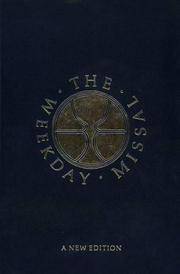
1966317165New York: Benziger Brothers 1966. New edition. Hardcover. Very Good in boards. 6 silk ribbon page markers. Spine cocked. Foxing on text block edges. Benziger Brothers hardcover
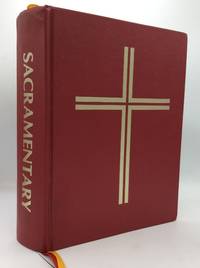
19851289428Collegeville MN: The Liturgical Press 1985. Leather. 1182p. Altar size. A large hardcover book bound in bonded red leather with a gilt cross on the front. Near-fine condition; unmarked save for a diocesan library stamp on title page and label on rear endpaper. Binding tight and cover in fine shape. An English sacramentary for the Novus Ordo form of the Catholic Mass. Measures approx. 11.25" x 8.5 The Liturgical Press unknown
1911mon0000072472Alexander Moring LtdThe De La M 1911-01-01. Hardcover. Acceptable. in x in x in. Ex-library book usual markings. Volume 2 only. Hardback with some discolouring and wear to book covers and to page edges due to age. Still very useable. Alexander Moring Ltd?The De La M hardcover
0005997259.Ghardcover. Good. Access codes and supplements are not guaranteed with used items. May be an ex-library book. hardcover
0007456328.Ghardcover. Good. Access codes and supplements are not guaranteed with used items. May be an ex-library book. hardcover
SONG0007456328HarperCollins 0000-00-00. hardcover. Used: Good. 4.84x6.10x6.97. Buy with confidence. Excellent Customer Service & Return policy. HarperCollins hardcover
DADAX0007456328HarperCollins 0000-00-00. hardcover. New. 4.84x6.10x6.97. Buy with confidence. Excellent Customer Service & Return policy. HarperCollins hardcover
1939769329.Gpaperback. Good. Access codes and supplements are not guaranteed with used items. May be an ex-library book. paperback
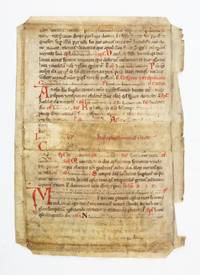
ST19350-013Germany early 13th century. 273 x 193 mm. 10 3/4 x 7 1/2". Single column 31 lines text in two sizes in a gothic hand. <br/> Rubrics in red several one- and two-line initials in red and two larger initials in red. A few lines with neumes later notations in the margins now quite faded. ◆Vellum a bit soiled and creased as expected fading to four or five lines where the spine was placed several notches along one edge other imperfections due to its reuse as binding scrap but still an excellent specimen that is almost entirely legible.<br/> <br/> Written in a neat and attractive hand this sizable leaf from a Missal remains mostly quite legible with all its rubrication intact despite having been used as part of a binding. A few lines also show musical notation from the earliest generation of neumes. They are described as "in campo aperto" which means literally "in an open field" because they and they alone occupy the space or "field" above the text. They are also described as adiastematic because they appear in a straight line whereas later diastematic neumes reflect changes in pitch by being placed in a higher or lower vertical position above the text. At the time the present leaf was written out the neumes here simply served as an "aide memoire" to the singer who had already learned the melody orally. unknown