[Ohne Autor]Antiquariat.de

389 résultats
189811027Regensburg, Friedrich Pustet, 1898. 14. Auflage 12° (15-18,5 cm). CXIV S., 1 Bl., 716, 292, 23 SS. Halbleder der Zeit mit goldgeprägtem Rückentitel und Ganzkopfrotschnitt
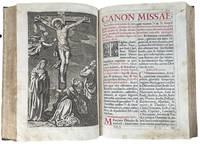
16002945Paris: the Associated Booksellers to the Church apud Societatem Typographicam Librorum Officii Ecclesiastici 1600. Folio 362 x 245 mm. Collation: ã6 ê6 î4 i4 blank õ6 ũ6 ãã6 êê4; A-Z Aa-Yy6. 38 228 42 leaves. Double column printed in red and black double rule page-borders throughout. 57 pages with printed music staves red-printed. Woodcut title illustration of Saints Peter and Paul seven full-page woodcuts the first in two blocks: a woodcut border and small Annunciation cut five small woodcut vignettes including two repeats and approximately 368 historiated initials in various sizes and from various series. Small tear to corner of title-leaf occasional foxing very occasional offsetting of red ink small stains in gutters in quire O finger-soiling in Canon quire X small rust-hole in f. 212 NN2 affecting 3 letters last few leaves with narrow marginal dampstain and slight creasing to upper fore-corners. Bound in contemporary French gold-tooled and -stamped light brown goatskin covers paneled with double fillets inner panel with fleurons at outer corners inner corners with large stamp of leafy branches emerging from a small medallion with winged cherub's head large central oval medallion of the Crucifixion on upper cover and Annunciation on lower cover smooth spine with recessed cords decorated with overall double fillet panel with tiny fleurons at corners gilt edges plain endpapers remains of numerous fore-edge tabs in paper pale green or pink silk and black silk for the Mass for the Dead. Corners bumped slight wear front cover slightly rubbed a few small holes to lower cover foxing to endpapers. Provenance: contemporary inscription in French on front flyleaf listing "Messes pour tous les iours de la sepmaine" Masses for every day of the week; loosely inserted armorial papercut unidentified arms lion rampant on a chief three roses.An imposing post-Tridentine Missal an unrecorded issue in a fine Parisian gold-tooled binding. The illustrations of this copy differ from the other known copies of this edition. The binding tools appear on other books published by the same publishing consortium and have been associated with religious lay confraternities founded by Henri III in the 1580s.In 1570 with the papal bull "Quo primum" Pope Pius V imposed uniformity on the rites of Mass previously a hodge-podge of different local traditions. That bull was printed in all subsequent missals; it is accompanied here by papal and royal privileges which supply crucial information concerning the publishing history of this edition. Jacques Kerver was the first French libraire to obtain a privilege for the publication of liturgical works. When he died in 1583 the privilege passed to his widow who ceded it to a consortium of booksellers: Sebastian Nivelle Guillaume Chaudière Guillaume de la Noue Michel Sonnius and Thomas Brumen cf. Renouard Imprimeurs et libraires parisiens du XVIe siècle IV 22. That privilege expired on 22 December 1595. This edition includes Papal and Royal renewals of the Kerver privilege for the printing of "sacred books" Missals Breviaries and Offices of the Virgin granted respectively by Clement VIII and Henri IV both on 4 April 1596. For Thomas Brumen who had died in 1588 the Royal privilege substitutes his son-in-law and heir Jean Corbon II and adds the names of Claude Chapelet identified as bookseller to the Academy and Jamet Mettayer and Pierre L'Huillier respectively Royal printer and Royal bookseller Mettayer was also the official printer for the Royal confraternities.The preliminary matter further includes the reformed Gregorian Paschal calendar for the years 1582 to 1700 a table of moveable feasts for 1589 to 1621 the Rubricae generalis missae the Ritus servandus in celebratione Missae and an index of Saints' names. The second part of the Missal separately paginated contains the Commune Sanctorum. The subjects of the full-page illustrations are: the Annunciation: a small cut within an historiated woodcut border in twelve compartments showing four scenes from the life of the Virgin alternating with angels and the four Evangelists fol. êê4v; the Nativity B4v Crucifixion T6v opening the Canon Resurrection X4v Pentecost AA1v Last Supper BB3r and Last Judgment PP2v. These monumental woodcuts influenced by Italian and Flemish mannerism derive from various engraved sources including at least one engraving the Resurrection used by Jamet Mettayer in an Office of the Virgin published in 1586.The five smaller woodcuts printed from three blocks include a Crucifixion showing Longinus piercing the side of Jesus repeated twice the Last Supper and a smaller primitive Crucifixion cut. Noteworthy are the many historiated initials. Ruth Mortimer describing an edition by Kerver from 1574 noted that the elaborate historiated initials containing "figures of the saints the Evangelists and . New Testament scenes may be attributed to the same artists who worked on the illustrations. The blocks are so detailed as to give the impression of additional illustrations rather than initials." As in previous editions the initials were chosen carefully here to match the text: for example the four Rs opening the word Requiem in the Mass for the Dead ff. XX5 ff. incorporate a skeleton and funeral scenes.The full-page woodcuts had appeared previously in the Kerver-consortium's 1588 edition cf. an illuminated copy offered by Breslauer in 1981 cat. 104/II no. 192. Only a few copies of these repeatedly printed Paris post-Tridentine Missals survive in public collections and precise descriptions are few. The most thorough description is that by Ruth Mortimer of the Harvard copy of the 1574 Kerver edition. Both that edition and the 1583 edition of which there is a copy at the Newberry Library are illustrated with only two full-page woodcuts including the canon cut of the Crucifixion used here and numerous smaller woodcuts. The title of the 1574 edition bears the same Peter and Paul cut while the 1583 edition has Kerver's device.The present copy represents a previously unrecorded variant issue of the 1600 edition of which the two other copies located at the Austrian National Library digitized and with Sokol Books catalogue 65/64 are illustrated with engravings all but one of which differ iconographically from the present woodcuts. The exception is the aforementioned Resurrection woodcut which is copied in reverse from the engraving. The typesetting other than the title appears to be identical but rather than a letterpress title-page and woodcut full-page illustrations the other copies have an engraved title and seven full-page engravings. Another variant setting occurs in quires M and N: both issues have the small Longinus woodcut on M1v but the spaces here filled by 3 small woodcuts one used twice are left blank in the cited copies.The existence of multiple editions of these post-Tridentine Paris Missals has been documented; Mortimer for example noted that in 1574 Kerver printed two folio editions as well as quarto and octavo editions. From the early 1570s to the end of the century these liturgical books now rare were churned off the presses to meet the needs of priests and clerics throughout France and beyond several copies of the Kerver or Kerver-consortium editions survive in Spanish and Italian libraries. Under these circumstances the existence of multiple editions and variant issues is not surprising.The attractive Parisian binding shows signs of hasty finishing: the cornerpieces using a popular cherub's head and leafy branch motif are single stamps and those on the upper cover are unevenly placed so that three of them overlap the double fillet panel. It is however a luxury binding of high-quality goatskin and its decoration is charged with meaning which remains to be completely teased out. Several variants of the Crucifixion and Annunciation medallions were used on the bindings of a number of devotional books published by the present publishing consortium or by its individual members. A few of those bindings bear a motto Spes mea Deus used by members of the Confraternity of Penitents of the Annunciation founded by Henri III in 1583. Possibly by extension the Crucifixion stamp itself has been associated with the confraternity and with the three other "congregations" established by that devout monarch in 1583-85. The same large Crucifixion and Annunciation medallion stamps were used in a similar center- and cornerpiece design on the aforementioned Breslauer copy of the 1588 edition of this Missal and in a dated binding from 1599 covering a 1508 Verard book of hours in the British Library shelfmark c29f16 reproduced in the BL Database of Bookbindings. In both cases the corner feuillage stamps are different but the central medallions appear to be identical to those on this binding.Similar but not identical stamps besides those cited in the sources below are found on: a copy of Mettayer's 1586 Pseaultier de David recently offered by the Paris booksellers Laurent Coulet and Ariane Adeline in their catalogue "1586: Jamet Mettayer et les Confréries de Pénitents"; an Officium beatae Mariae Virginis Paris: apud Societatem Typographicum 1586 using both the Annunciation and Crucifixion medallions set within a fanfare design Bibliothèque Sainte Geneviève Réserve 8 Z 6685 INV 9940; and an Office de La Vierge published by Mettayer in 1586 BnF Réserve B. 1654 Lacombe 486. A book of hours for the use of Amiens Paris: for Guillaume de La Noue 1589 bound with several devotional tracts BnF Réserve B-27949; Lacombe 492 has a different Annunciation stamp but apparently the same Crucifixion stamp. Coulet and Adeline established a typology of 9 different Crucifixion stamps or 8 stamps and one variant the one used here being no. 8. Given these facts the possibility cannot be excluded that the publishers were involved in commissioning the bindings of this copy and of the other "Crucifixion medallion" bindings found on their imprints.This exceptional copy is of interest for the history of publishing printing illustration and binding; it raises questions about the very concept of an edition about the transmission of images and about the relations between printer-publishers bookbinders and book buyers in the hand-press period. USTC 137500 Austrian National Library only variant issue - not in their OPAC. Cf. Harvard/Mortimer French 378 8 June 1574 edition. Not in Weale-Bohatta or Amiet. On the binding cf. Hobson & Culot Italian and French 16th-century Bookbindings 1991 62; Claude La Charité "Henri III Le miroir des religieux 1585 de Louis de Blois et `la troisiesme couronne à frere Henri de Valois'" Revue de Bibliothèques et Archives du Québec no. 2 2010 online; Needham Twelve Centuries of Bookbindings 1979 82. the Associated Booksellers to the Church (apud Societatem Typographicam Librorum Officii Ecclesiastici) unknown books
1853246031853 P. J. Hanicq, Mechliniae [Malines Mechelen, Flanders, Belgium], 1853,IN FOLIO reliure plein chagrin rouge (posterieure),plats decorés (cartonnage fers dorés,monogramme MM ,2e plat)),tranches dorées,dos à caissons dorés,signets tissus multicolores à fleurs de lys,11 planches gravées ht (bois et litho) - Title vignette; illustrated initials; printed in red and black; text in double columns.[40], 484, cxxxvj,+ [1]-[1-1bl]-2-2-2-20-[1-1bl-2] p.,pages datées posterieures : , 11 unnumbered leaves of plates : illustrations, music ; 36 x 26 cm, RELIURE ANIMEE plaques romantique, bon état .Missale Romanum is a highly important text in the Roman Catholic Church and contains within it the texts and rubrics relating to the Catholic Rite of Mass, considered an essential part of Catholic doctrine. This particular version of the Roman Missal contains the changes made by Pope Clement VIII in 1604 which include corrections to the previous standard edition created by Pope Pius V and the further corrections made by Pop Urban VIII in 1634. The work is an unusual edition of a highly important and still widely recognised part of Catholic Dogma,with last corrections.
1763LD15791Venice: Apud Nicolaum Pezzana 1763. Hardcover. Very Good. 18th-century Italian tan morocco gilt-stamped to both covers with central armorial device: a double-headed crowned eagle after Rome and over three sets of seven balls after De Medici all surmounted by crown and with four gilt foliate cornerpieces spine gilt in six compartments enclosing acorn device green and pink silk headbands red speckled pastedowns two blue silk index tabs all edges gilt; circular stain - not too bad - on front cover remnants of silk index tabs some light edgewear. 4to 245 x 165mm. 632 pp. cxci. Sold as a binding. <br/><br/> Apud Nicolaum Pezzana hardcover books
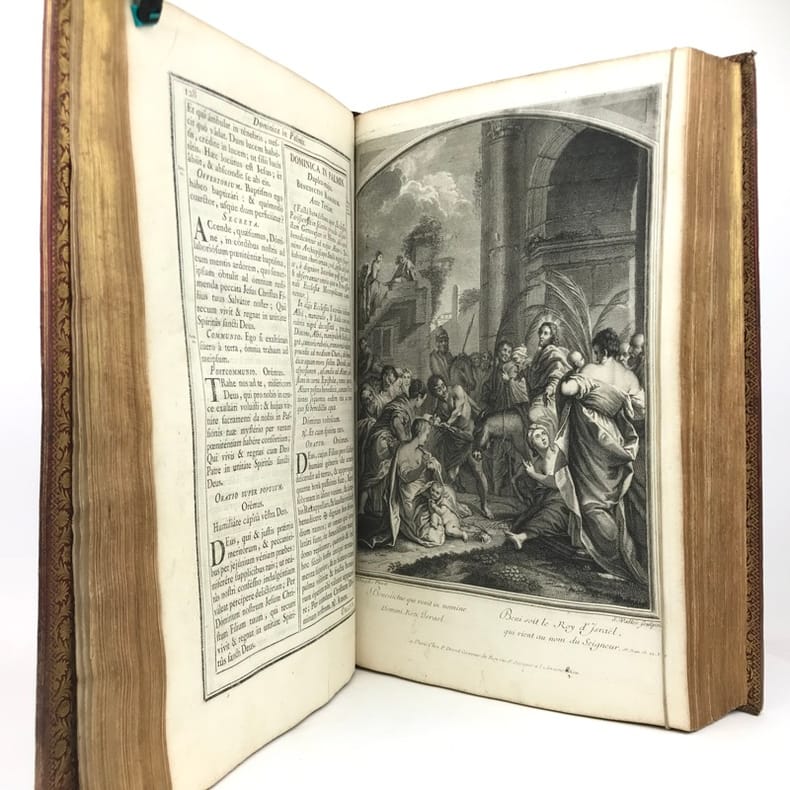
15862Paris, Jean-Baptiste Coignard, 1724, 1 pleine basane, plats et dos frottés, coins émoussés. in-12, titre, 39 ff.n.c., 612-CXXII-4-2 pp., texte sur 2 colonnes imprimé en rouge et noir, gravures hors-texte ;
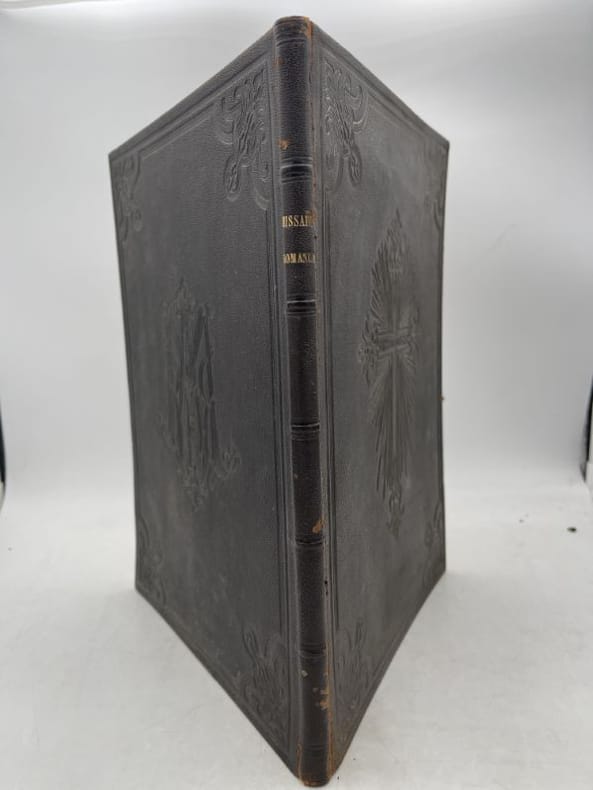
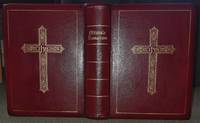
RATISBONAE, ROMAE et NEO EBORACI, Sumptibus, chartis et typis Friderici Pustet - 1890 - In-4 - Reliure Pleine Percaline de l'époque - Dos à nerfs, à caissons dorés et ornés - 1 er Plat orné d'un crucifix au centre, entouré d'écoinçons dorés avec une croix dans chaque coin - 4 è plat identique à l'exception d'un coeur remplassant le crucifix - Toutes tranches dorées - Filets dorés sur les coupes - Gardes ornées avec lisérés ornés dorés - Frontispice en couleurs - Bandeaux (couleurs ou NB), Lettrines en couleurs, Bandeaux - Texte en N ou rouge encadré d'un filet rouge - Musique - (42)-572 pages + Commune Sanctorum 216 pages + Suppementum : Ex. Piteux Fratres, 1892 : 61 pages - Bel exemplairze
1890244991890 RATISBONAE, ROMAE et NEO EBORACI, Sumptibus, chartis et typis Friderici Pustet - 1890 - In-4 - Reliure Pleine Percaline de l'époque - Dos à nerfs, à caissons dorés et ornés - 1 er Plat orné d'un crucifix au centre, entouré d'écoinçons dorés avec une croix dans chaque coin - 4 è plat identique à l'exception d'un coeur remplassant le crucifix - Toutes tranches dorées - Filets dorés sur les coupes - Gardes ornées avec lisérés ornés dorés - Frontispice en couleurs - Bandeaux (couleurs ou NB), Lettrines en couleurs, Bandeaux - Texte en N ou rouge encadré d'un filet rouge - Musique - (42)-572 pages + Commune Sanctorum 216 pages + Suppementum :Ex. Piteux Fratres, 1892 : 61 pages - Bel exemplairze
1892183796Mame Turonibus, A Mame, 1892. In-4 relié plein chagrin nour, dos à feux nerfs, ornés, plat estampés à froid. Tranches dorées. Frontispice, titre, paginé 33 - 168 + Missae Propriae sanctorum quae in hispana celebrantur. 1888 de 38 pages + Addenda proprio missarum quae in Hispana Celebrantur de 8 pages.
a29572Rome 1794 Exudebant Joachim et Michael Puccinelli Fratres. Restitutum Sancti PII V. Pontificis Maximi Jussu editum Clementis VIII. et Urbani VIII actoritate recogniutm; nunc denuo sub auspiciis Sancitissimi Domini nostri PII Sexti Pont. Max. Folio 26x38x4 cm. Hardcover. Title in red and black with 1/4 page vignette. Text in double columns. Two fullpage engravings. About 20 pages have lower blank corner cut off and cloth tabs have been added to 6 pages 2 tabs have since worn off. Rebound in early or mid 20thc to brown paper-covered boards with green cloth spine. Includes much black block letter music scoring. One text page has lower corner torn off just into text loss of about 4 lines of words and one bottom line of music is torn off on another page. Occasional spotting and foxing throughout. Binding very secure. near Good. . hardcover
2A8599Ex officina typographica Everardi Kints & Clementis Plomteux Lüttich 1767. 30 Blatt 652 CXXXVI S. 3 Blatt 4 S. 3 Blatt mit 5 Leder-Registerbändchen versehen Ledereinband der Zeit auf 5 Schmuckbünden mit goldgeprägtem Rückentitel sowie farbigem Schnitt quart teils etwas fleckig/kleinere Wasserränder/Buchblock mittig etwas verzogen/Einband bestoßen/Kapitale eingerissen/Schließer fehlen. - Messbuch der römisch-katholischen Kirche auf Latein / Beigebunden: Parvum Missale Coloniense Romano Substructum Et unà cum hoc Juxta Ritum Coloniensem Aequé ac Romano-Coloniensem Commodè utendum 1749 96 S. / Missae Propriae Dioecesis Paderbornensis. Accedunt Missae Novissime per Summos Pontifices Concessae. Auctoritate et Jussu Reverendissimi Ordinariatus 1835 44 S. - unknown
162351006Paris Lutetiae Parisiorum: Associated Booksellers to the Church Apud Societatum Typographicam Librorum Officij Ecclesiastici 1623. Hardcover. 12mo. Rebound in full brown velour over heavy boards likely late 19th century. 94pp 735pp 1p i-cxxxvj. Small title page engraving and single full-page engraving unnumbered p. 94. Overall very good. Binding a bit edgeworn and rubbed with a few spots but strong; text block tightly cropped as is typical but tight and quite nice with corner or edge chips on title page not affecting text unnumbered p. 33-34 slightly affecting several words and pp. 367-72 not affecting text; cloth fore-edge tabs marking leaf 363-64 and 365-66; old but neat archival paper gutter reinforcements to inner hinges; 19th c. bookplate on inner flyleaf of Wisconsin religious academy couple of pencilled 19th c. ownership signatures on facing leaf and miniscule Wisconsin convent inkstamp at bottom of title page and one text page. Fairly attractive quite handleable later printing of the Council of Trent's 1570 official issue as authorized by Pope Pius V and corrected by Pope Clement VIII in 1604 but preceding the further revisions authorized by Pope Urban VIII in 1634. The Roman Missal contains in two-column large typeface format with extensive varying-sized historiated initials numerous texts for the celebration of the most common liturgy and Mass of the Catholic Church with numerous hymns scattered throughout. Many portions throughout printed in red. Interestingly on display at Moseley Old Hall in Wolverhampton in central England is a copy of this same Paris 1623 prayer book believed to be the edition that a Father Huddleston possibly used to convert Charles II to Catholicism on his deathbed when the King summoned the Benedictine priest to his bedside at Whitehall Palace in London in 1685. Associated Booksellers to the Church [Apud Societatum Typographicam Librorum Officij Ecclesiastici] hardcover
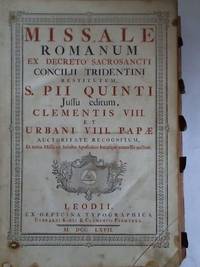
1673134<p>Extremely Rare Venetian Missal in a fine contemporary leather binding.</p><p>No copy of this edition recorded on WorldCat</p><p>Roman Church.<em> Missale Romanum ex Decreto Sacrosancti Concilii Tridentini Restitutum Pii V Pontificis Maximi Iussu Editum Clementis VIII Urbani VIII Alexandri VII Clementis IX et SS D.N. Clemente Papa X Novissime Suis Locis. </em>Venetiis Venezia apud Cieras MDCLXXIII 1673.</p><p>Folio 384 x 258 mm full black leather binding single ruler with floral decoration on boards charming metal plaque in the centre of the front board depicting two winged cherubs; spine with seven raised bands pp. 40 422 4 423-527 1 CXX 6 CXXI-CXXIII i.e. CIII 1. Original clasps preserved. Title page in red and black ink with a beautiful engraved vignette at f. a¹ <em>Commune sanctorum</em>. Signature: ¹Ⱐ2⸠3² A-2K⸠a-e⸠f-gâ¶</p><p>1 full-page engravings: Annunciation signed by the Sienese Engraver Giovanni Maria Ferri and four by Giacomo Piccini father of Sister Isabella. Several historiated initials. Pages of music engraved within the text in red ink.</p><p>Apparently the only existing copy of this edition of the Missale Romanum.</p><p>After the Council of Trent 1545-1563 liturgical norms underwent significant changes with the aim of unifying and strengthening the practice of the Catholic faith in response to the divisive tendencies of the Protestant Reformation.</p><p>Among the key reforms was a revision of sacred texts particularly the <em>Roman Missal</em> which was standardized and promulgated by Pope Pius V in 1570 through the bull <em>Quo Primum Tempore</em>. This new missal known as the <em>Tridentine Missal</em> standardized liturgical rites across the Latin Church eliminating local variations that had developed over the centuries except those with at least 200 years of tradition. Latin was retained as the official liturgical language and the gestures prayers and readings were clearly defined establishing a strict canon.</p><p>This liturgical reform endured for centuries until a new wave of changes introduced by the Second Vatican Council in 1962 which led to the creation of an updated Roman Missal with greater openness to vernacular languages and more active participation of the faithful.</p><p>Imprimatur: "We Brother Bassanus Galliciolus of Brescia of the Order of Preachers Master of Sacred Theology and General Inquisitor against heretical depravity in the City of Venice and throughout its Most Serene Dominion specially delegated by the Holy Apostolic Office.</p><p>We have compared the Roman Missal recently printed by Mr. Bonifacio Ciera with another already duly approved and since it is found to agree with it in all respects as well as with the Decrees of the Sacred Congregation of Rites and of the Supreme Pontiffs we therefore grant permission for it to be published.</p><p>And in testimony thereof etc.</p><p>Given at Venice from the offices of the Holy Inquisition on the 1st of January 1673.</p><p>Thus it is Brother Bassanus as above by his own hand."</p><p>Conditions: Few small wormholes along the text light marks of use. Overall a good copy.</p><p>Provenance: Paper <em>Ex libris</em> " Luigi Carpaneto " on front pastedown.</p><p>Wider description and more images:</p><p>https://tinyurl.com/1673Missal-PDF</p> apud Cieras
1587ABC_48453Antwerp: Christoffel Plantin 1587. Contemporary elaborately blind-tooled pigskin over bevelled wooden boards sewn on 4 double supports with the corresponding raised bands on the spine the manuscript title in the first compartment and the original manuscript shelf mark label "H.36" of the Monastery of Buxheim in the fifth compartment both boards with an ornamental roll and a roll with the portraits of Salvater sic! Maria S. Bruno and S. Johannes in a panel design two original brass clasps and catches ornamented with a small star leather tabs and six original bookmarkers plaited into a big knot. 8vo. With a woodcut vignette with Peter and Paul by Peeter van der Borcht on the title page 6 full-page woodcuts ca. 112 x 75 mm by Antoon van Leest after Peeter van der Borcht 6 half-page square woodcuts 55 x 55 mm in border one signed by Antoon van Leest one woodcut 90 x 76 mm by Antoon van Leest after Peeter van der Borcht and 2 smaller oval woodcuts. The work is printed in red and black. Plantin edition of the revised Roman Missal following the directives of the Council of Trent first published in Rome in 1570 by order of pope Pius V 1504-1572 and later approved by Clemens VIII 1536-1605 and Urbanus VIII 1568-1644. The work was quite popular as Plantin published a new missal nearly every year from 1571 onwards. All editions were printed in different sizes and in two issues one with woodcut illustrations and one with engravings. The present copy is the octavo edition with woodcut illustrations and comes from the library of the famous Carthusian monastery of Buxheim Maria Saal near Memmingen Bavaria.The monstery of Buxheim was founded in 1402 and dissolved after the secularisation in 1803. The rich library was auctioned in 1883 by Förster and in 1884 by Ludwig Rosenthal in Munich. The Museum of the Charterhouse Buxheim today is actively studying the history of the library and the present location of its books and manuscripts. The present copy is bound in contemporary pigskin which was likely bound for the monastery itself as the rolls depict Saint Bruno who was the founder of the Carthusian order. The Missal is therefore probably bound in a South-German bindery in the surroundings of the monastery.With an ownership annotation on the title page "Cartusiae Buxheim". The binding is somewhat rubbed and soiled. The leaves are lightly browned some of the leaves are slightly stained especially around the leather tabs. Otherwise in good condition.l Belg. Typ. 6335; Imhof Plantins 1574 Missale Romanum in octavo in: De Gulden Passer 73 1995 pp. 67-82; Nagler I 1459; USTC 406791; Voet 1701 A; Weale-Bohatta no. 1269; not in Haebler. Christoffel Plantin, hardcover
1784AQ14409Olispone i.e. Lisbon: Typographia regia et privilegio 1784. 30 672pp cxlvi 10 58. Several engraved devotional images within pagination. Contemporary red morocco richly gilt marbled endpapers and gilt gauffered edges yellow metal clasps. Rubbed small incision to lower joint paper label to upper board. Tears to FFEP occasional marginal loss/tearing some occasional marking. A handsomely bound Portuguese-printed Roman missal which despite later confusion in an inscription to a blank fly-leaf earlier manuscript letters inserted suggest that this was seized from the flagship of the usurper Dom Miguel the 80-gun Don Juan during the 1833 Battle of Cape St. Vincent passing through the hands of several clergymen before being presented to Grayfriar's Oxford. . Folio. Typographia regia, et privilegio unknown
1896AQ28784Mechliniae i.s. Mechelen: H. Dessain 1896. xli 502 60 24pp 2. With a half tile. Printed in red and black. Elaborately bound in contemporary richly gilt-tooled red morocco device of seated christ proffering book with Greek letters alpha and omega within ornate border to both boards A.E.G. with eight divisional red moire cloth tabs one partially perished gilt dentelles decorated endpapers. Slightest of rubbing to extremities. Internally immaculate. An exquisitely bound late nineteenth-century Continental edition of the Roman Missal. The Roman Missal with origins in the high middle ages is the liturgical book from which the text and rubrics for the celebration of Catholic Mass with both prayers and music. One of the major advances of the Council of Trent the Catholic counter to the Protestant Reformation was to standardise the Missal. Pope Pius V acting on the concilliar deciion formalised this in his Quo Primum on 14 July 1570 - insisting that the standard form of the Missal was used throughout the Church except where a local missal could be proved to be of two centuries antiquity. Perhaps one of the most controversial Counter-Reformation decisions made at Trent the use of a standard Missal prevented the celebration of the Mass in vernacular languages and signified a further strengthening of Papal authority: particularly as all printed editions were prefaced by the Pope's order of standardisation. The Missal of Pius V was further edited by Clement VIII in 1604 and later by Urban VIII in 1634. . Large 8vo. H. Dessain hardcover
1737ABC_50448Antwerp: ex architypographia Plantiniana = Joannes Jacobus Moretus 1737. Contemporary elaborately gold-tooled red morocco with remnants of brass catch and anchorplates along the fore edge gilt and gauffered edges with intricately made tabs along the fore edge gold-tooled board edges marbled endpapers. Folio. With 20 full-page engraved plates by Cornelius Galle 10 engraved frames surrounding the text and vocal music printed on pp. 153-155 196-197 199-207 220-233 235-237 240-272 286-288 290-292 and xvii. The text is printed in red and black with historiated initials hand-coloured in red an engraved vignette on the title page of each work and several woodcut tailpieces throughout of which 3 printed in red. 2 works in 1 volume. With: 2 SPANISH MISSAL. Missae propriae sanctorum Hispanorum qui generaliter in Hispania celebrantur. ex apostolica concessione & auctoritate S. Pii V. Gregorii XIII. Sixti. V. Clementis VIII. & Urbani. VIII. aliorumque summorum pontificum. Antwerp ex architypographia Plantiniana = Joannes Jacobus Moretus 1737. Plantin edition of the revised Roman Missal produced in line with the Council of Trents directives. This imposing folio exemplifies the Tridentine tradition established after the council 1545-1563 when the Roman Church responding to the Reformation sought to standardise the liturgy. In 1570 Pope Pius V 1504-1572 promulgated the reformed Missale Romanum establishing the text and ceremonial form of the Mass that would govern the Latin Church for centuries. Subsequent revisions under Clemens VIII 1536-1605 and Urban VIII 1568-1644 refined but did not alter its essential structure.From 1571 until the mid-18th century the press founded by Christophe Plantin 1520-1589 held a significant monopoly on the production and sale of authorised liturgical work for the Spanish Netherlands and effectively much of the Spanish Empire. The present Missale Romanum has been bound together with the Missae propriae sanctorum Hispanorum 1737 a collection of masses for Spanish saints. It contains the specific texts and music intended for the celebration of these saints reflecting its use in Iberian or Spanish-influenced territories. The beautiful red morocco binding richly gilt in the rococo manner was also most likely bound in Spain or Portugal.The front joint is slightly weakened but the structural integrity of the work is still intact a hole at the head and foot of the spine the edges and corners of the boards are slightly scuffed the boards are somewhat stained lacking the clasps. The leaves are somewhat browned with occasional foxing a few pages retaining traces of yellow wax. Otherwise in good condition.l Imhof Plantins 1574 Missale Romanum in octavo in: De Gulden Passer 73 1995 pp. 67-82; STCV 12923535; Ad 2; WorldCat 804759478 0 copies; not in STCV. ex architypographia Plantiniana [= Joannes Jacobus Moretus], unknown
16454529Antuerpiae Ex Officina Plantiniana Balthasaris Moreti 1645. 1645 8vo. 48 752 cxlvii 9 p. Ten engraved plates titlepage printed in red and black with an engraved vignette. Musical notation. Text in red and black throughout printed in double columns. Modern vellum over boards. Old stains to fore edge from the original clasps and thongs othewise a very good crisp copy. Antuerpiae, Ex Officina Plantiniana Balthasaris Moreti, hardcover
1726311716Venice 1726. Printed in red & black; Engravings including initial letters & title page vignette depicting St Peters and a papal crown by Sister Isabella Piccini. Short thick folio red velvet worn over boards With silver escutcheons & corner pieces on back & front covers. Venetiis: Typographia Balleoniana 1726<br/> <br/> unknown
16002945Paris: the Associated Booksellers to the Church 1600. <p>Folio 362 x 245 mm. Collation: ã6 ê6 î4 i4 blank õ6 Å©6 ãã6 êê4; A-Z Aa-Yy6. 38 228 42 leaves. Double column printed in red and black double rule page-borders throughout. 57 pages with printed music staves red-printed. Woodcut title illustration of Saints Peter and Paul seven full-page woodcuts the first in two blocks: a woodcut border and small Annunciation cut five small woodcut vignettes including two repeats and approximately 368 historiated initials in various sizes and from various series. Small tear to corner of title-leaf occasional foxing very occasional offsetting of red ink small stains in gutters in quire O finger-soiling in Canon quire X small rust-hole in f. 212 NN2 affecting 3 letters last few leaves with narrow marginal dampstain and slight creasing to upper fore-corners. Bound in contemporary French gold-tooled and -stamped light brown goatskin covers paneled with double fillets inner panel with fleurons at outer corners inner corners with large stamp of leafy branches emerging from a small medallion with winged cherub’s head large central oval medallion of the Crucifixion on upper cover and Annunciation on lower cover smooth spine with recessed cords decorated with overall double fillet panel with tiny fleurons at corners gilt edges plain endpapers remains of numerous fore-edge tabs in paper pale green or pink silk and black silk for the Mass for the Dead. Corners bumped slight wear front cover slightly rubbed a few small holes to lower cover foxing to endpapers. Provenance: contemporary inscription in French on front flyleaf listing “Messes pour tous les iours de la sepmaine†Masses for every day of the week; loosely inserted armorial papercut unidentified arms lion rampant on a chief three roses.<br /> <br /> Unrecorded issue of an imposing post-Tridentine Missal in a fine Parisian gold-tooled binding. The woodcut illustrations of this copy differ from the other known copies of this edition which are illustrated with engravings. The binding tools appear on other books published by the same publishing consortium and have been associated with religious lay confraternities founded by Henri III in the 1580s.<br /> <br /> This exceptional copy is of interest for the history of publishing printing illustration and binding; it raises questions about the very concept of an edition about the transmission of images and about the relations between printer-publishers bookbinders and book buyers in the hand-press period. <br /> <br /> In 1570 with the papal bull “Quo primum†Pope Pius V imposed uniformity on the rites of Mass previously a hodge-podge of different local traditions. That bull was printed in all subsequent missals; it is accompanied here by papal and royal privileges which supply crucial information concerning the publishing history of this edition. Jacques Kerver was the first French libraire to obtain a privilege for the publication of liturgical works. When he died in 1583 the privilege passed to his widow who ceded it to a consortium of booksellers: Sebastian Nivelle Guillaume Chaudière Guillaume de la Noue Michel Sonnius and Thomas Brumen cf. Renouard Imprimeurs et libraires parisiens du XVIe siècle IV 22. That privilege expired on 22 December 1595. This edition includes Papal and Royal renewals of the Kerver privilege for the printing of “sacred books†Missals Breviaries and Offices of the Virgin granted respectively by Clement VIII and Henri IV both on 4 April 1596. For Thomas Brumen who had died in 1588 the Royal privilege substitutes his son-in-law and heir Jean Corbon II and adds the names of Claude Chapelet identified as bookseller to the Academy and Jamet Mettayer and Pierre L’Huillier respectively Royal printer and Royal bookseller Mettayer was also the official printer for the Royal confraternities.<br /> <br /> The preliminary matter further includes the reformed Gregorian Paschal calendar for the years 1582 to 1700 a table of moveable feasts for 1589 to 1621 the Rubricae generalis missae the Ritus servandus in celebratione Missae and an index of Saints’ names. The second part of the Missal separately paginated contains the Commune Sanctorum. The subjects of the full-page illustrations are: the Annunciation: a small cut within an historiated woodcut border in twelve compartments showing four scenes from the life of the Virgin alternating with angels and the four Evangelists fol. êê4v; the Nativity B4v Crucifixion T6v opening the Canon Resurrection X4v Pentecost AA1v Last Supper BB3r and Last Judgment PP2v. These monumental woodcuts influenced by Italian and Flemish mannerism derive from various engraved sources including at least one engraving the Resurrection used by Jamet Mettayer in an Office of the Virgin published in 1586.<br /> <br /> The five smaller woodcuts printed from three blocks include a Crucifixion showing Longinus piercing the side of Jesus repeated twice the Last Supper and a smaller primitive Crucifixion cut. Noteworthy are the many historiated initials. Ruth Mortimer describing an edition by Kerver from 1574 noted that the elaborate historiated initials containing “figures of the saints the Evangelists and . New Testament scenes may be attributed to the same artists who worked on the illustrations. The blocks are so detailed as to give the impression of additional illustrations rather than initials.†As in previous editions the initials were chosen carefully here to match the text: for example the four Rs opening the word Requiem in the Mass for the Dead incorporate a skeleton and funeral scenes.<br /> <br /> The full-page woodcuts had appeared previously in the Kerver-consortium’s 1588 edition cf. an illuminated copy offered by Breslauer in 1981 cat. 104/II no. 192. Only a few copies of these repeatedly printed Paris post-Tridentine Missals survive in public collections and precise descriptions are few. The most thorough description is that by Ruth Mortimer of the Harvard copy of the 1574 Kerver edition. Both that edition and the 1583 edition of which there is a copy at the Newberry Library are illustrated with only two full-page woodcuts including the canon cut of the Crucifixion used here and numerous smaller woodcuts. The title of the 1574 edition bears the same Peter and Paul cut while the 1583 edition has Kerver’s device.<br /> <br /> The present copy represents a previously unrecorded variant issue of the 1600 edition. I have located two other copies of the edition at the Austrian National Library digitized and with Sokol Books catalogue 65/64; they are illustrated with engravings instead of woodcuts all but one of which differ iconographically from the woodcuts in our copy. The exception is the aforementioned Resurrection woodcut which is copied in reverse from the engraving. The typesetting other than the title appears to be identical but rather than a letterpress title-page and seven woodcut full-page illustrations the other copies have an engraved title and seven full-page engravings. Another variant setting occurs in quires M and N: both issues have the small Longinus woodcut on M1v but the spaces here filled by 3 small woodcuts one used twice are left blank in those copies.<br /> <br /> The existence of multiple editions of these post-Tridentine Paris Missals has been documented; Mortimer for example noted that in 1574 Kerver printed two folio editions as well as quarto and octavo editions. From the early 1570s to the end of the century these liturgical books now rare were churned off the presses to meet the needs of priests and clerics throughout France and beyond several copies of the Kerver or Kerver-consortium editions survive in Spanish and Italian libraries. Under these circumstances the existence of multiple editions and variant issues is not surprising though the outright replacement of engravings with woodcuts or vice-versa seems unusual.  <br /> <br /> The attractive Parisian binding shows signs of hasty finishing: the cornerpieces using a popular cherub’s head and leafy branch motif are single stamps and those on the upper cover are unevenly placed so that three of them overlap the double fillet panel. It is however a luxury binding of high-quality goatskin and its decoration is charged with meaning which remains to be completely teased out. Several variants of the Crucifixion and Annunciation medallions were used on the bindings of a number of devotional books published by the present publishing consortium or by its individual members. A few of those bindings bear a motto Spes mea Deus used by members of the Confraternity of Penitents of the Annunciation founded by Henri III in 1583. Possibly by extension the Crucifixion stamp itself has been associated with the confraternity and with the three other “congregations†established by that devout monarch in 1583-85. The same large Crucifixion and Annunciation medallion stamps were used in a similar center- and cornerpiece design on the aforementioned Breslauer copy of the 1588 edition of this Missal and in a dated binding from 1599 covering a 1508 Verard book of hours in the British Library shelfmark c29f16 reproduced in the BL Database of Bookbindings. In both cases the corner feuillage stamps are different but the central medallions appear to be identical to those on this binding.<br /> <br /> Similar but not identical stamps besides those cited in the sources below are found on: a copy of Mettayer’s 1586 Pseaultier de David recently offered by the Paris booksellers Laurent Coulet and Ariane Adeline in their catalogue “1586: Jamet Mettayer et les Confréries de Pénitentsâ€; an Officium beatae Mariae Virginis Paris: apud Societatem Typographicum 1586 using both the Annunciation and Crucifixion medallions set within a fanfare design Bibliothèque Sainte Geneviève Réserve 8 Z 6685 INV 9940; and an Office de La Vierge published by Mettayer in 1586 BnF Réserve B. 1654 Lacombe 486. A book of hours for the use of Amiens Paris: for Guillaume de La Noue 1589 bound with several devotional tracts BnF Réserve B-27949; Lacombe 492 has a different Annunciation stamp but apparently the same Crucifixion stamp. Coulet and Adeline established a typology of 9 different Crucifixion stamps or 8 stamps and one variant the one used here being no. 8. <br /> <br /> Given these facts the possibility cannot be excluded that the publishers were involved in commissioning the bindings of this copy and of the other “Crucifixion medallion†bindings found on their imprints.<br /> <br /> USTC 137500 Austrian National Library only variant issue - not in their OPAC. Cf. Harvard/Mortimer French 378 8 June 1574 edition. Not in Weale-Bohatta or Amiet. On the binding cf. Hobson & Culot Italian and French 16th-century Bookbindings 1991 62; Claude La Charité “Henri III Le miroir des religieux 1585 de Louis de Blois et `la troisiesme couronne à frere Henri de Valois’†Revue de Bibliothèques et Archives du Québec no. 2 2010 online; Needham Twelve Centuries of Bookbindings 1979 82.</p> the Associated Booksellers to the Church unknown
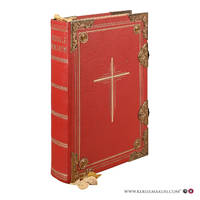
48760Romae - Tornaci : Typis Societatis S. Joannis Evangelistae. Desclee et Socii S. Sedis Apost. et S. Rituum Congreg. Typograph. C. 1921 . A very good full leather binding. 8vo. 30.0cm x 23.5cm x 6.5cm . Red calf over thick boads. Gilt cross to both boards. Corners and hinges carefully strengthened. Smooth spine with gilt banding and gilt title: "Missale Romanum". Rubbed gilt page edges with 11 silk tabs firmly attached. Inner gilt dentelles. Coloured endpapers lightly foxed and soiled. Free-endpapers blank but creased. Title-page and Dedicatory also creased. No date on the title-page but Dedicatory dated 1921. Clear Latin text in red and black with some written notes and numerous illustrations within text. Many pages strengthened along the edges due to wear. Pagination: pp.xlvi/4pp./pp.262/pp.273-656/pp.200/pp2./pp.2/pp.4/pp.72/pp.89-96 11 blank leaves at the end. Romae - Tornaci : Typis Societatis S. Joannis Evangelistae., Desclee et Socii, S. Sedis Apost. et S. Rituum Congreg. Typograph. hardcover
193782951Ratisbonae: Friderici Pustet 1937. 36 x 26 cm red leather hardcover metal clasps and fittings 4 blanc pages frontispiece in colour title page in red and black 4 2 5-50 2 748 2004 36 2 18 2 pages. minor wear few gift notes in ink on endpaper few pages with some spots although in very good condition see pictures. Weight is 5.4 kg! Roman Catholic liturgical missal according to the Tridentine rite revised and issued following the Council of Trent and later papal updates. Printed in red and black with musical notation for chant and decorative metal bindings. Metal ornaments and claps by 'Hamers Edelsmidse'. Friderici Pustet hardcover
176584155Antverpiae: Ex Architypographia Plantiniana 1765. 36 x 24.5 cm contemporary leather binding over boards with raised bands on spine ruled border blind-stamped on covers marbled endpapers title page in red and black 66 624 cxxviii 4 8 2 1 pages printed in red and black throughout engraved frontispiece and full-page engraved illustrations text in Latin. Binding lightly worn with rubbing and scuffing to covers and corners interior pages age-toned browned but clean and complete overall still in very good condition see picture. Issued by the famous Plantin-Moretus press in Antwerp one of the most celebrated printing houses in European history. This edition of the Roman Missal conforms to the Tridentine rite as mandated by the Council of Trent and subsequently revised under Popes Pius V Clement VIII and Urban VIII. Includes Proper of the Time Proper of Saints Common of Saints and chant notation; notable for its fine 9 engraved illustrations. Ex Architypographia Plantiniana hardcover
17771501777 Parisiis, sumptibus Bibliopolarum, 1777.
1777180481777 un volume, reliure plein maroquin rouge in-folio ( binding full morocco in-folio) (26 x 39,5 cm), RELIURE D'EPOQUE, dos à nerfs (spine with raised band), décoration or (gilt decoration) à filets, roulettes, entrelacs et rinceaux or (gilt lines and fillets), entre nerfs à compartiments à fleurons dans un encadrement à filets et roulettes " chainette" or, titre frappé or (gilt title), plats décorés d'un triple filet et roulettes "or" en encadrement (cover with triple gilt lines) avec un fleuron or à chaque angles, dos et plats légèrement épidermés, roulette or sur les coupes (gilt fillet on the cuts) et et dentelle sur les chasses (lace-like decoration on the turn-ins), toutes tranches lisses dorées (all edges gilt), pages de garde en papier peigné bleu (endpapers with white painting paper), etiquette Ex-Libris : "SEMINARIUM MOLINENSE" (Séminaire de Moulins), sans illustrations (no illustration) excepté une vignette gravée sur bois en noir "aux armes de l'Archevèque Charles-Gaspar-Guillaume de Vintimille" en bas de la page de titre (title page decorated with a vignette of title) et orné de bandeaux et de culs-de-lampe (illuminated of headpieces and tailpieces), (684 + CLIV) Pages, 1777 Parisiis : sumptibus bibliopolarum usuum parisiensium Editeur,
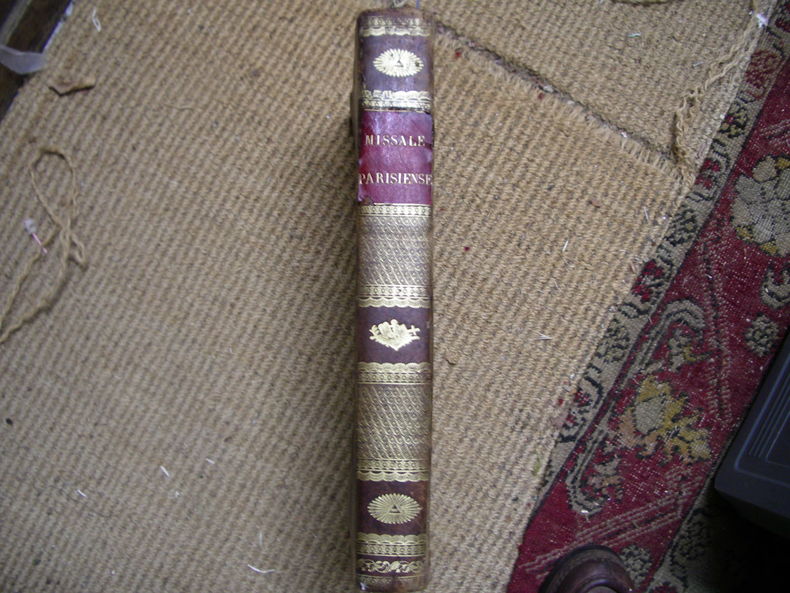
1774157141774 basane Restauration, dos lisse (traces de mouillures marginales aux premiers ff.). in-folio, 522pp. et CXIIpp. (Commune Sanctorum et divers), Paris 1774