Vicky Alvear ShecterMareMagnum

7 773 résultats
Salani Editore, maggio 2012. Traduzione di Raffaella Belletti. Rilegato con copertina rigida e sovraccoperta. Prima edizione. Spedizioni tracciabili con raccomandata entro 24 ore dall'ordine. First edition. Hardback cover with dust jacket in fine conditions, no price clipped, no inscriptions or markings inside. Worldwide delivery.
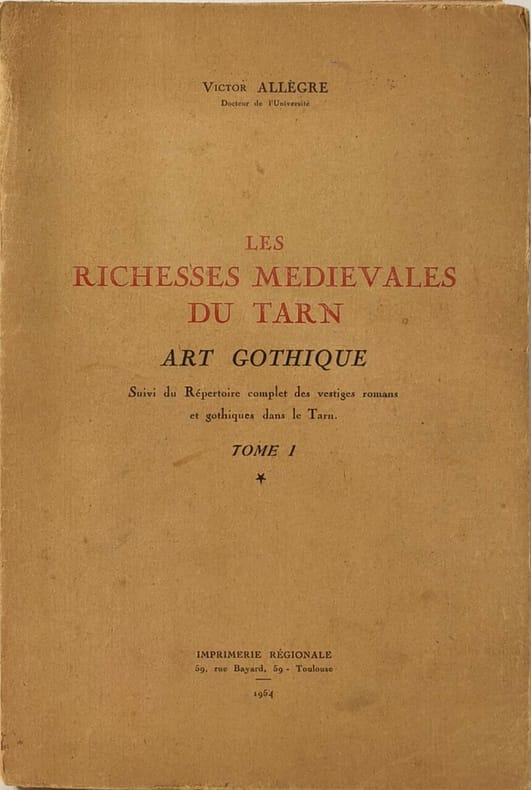
19543726Imprimerie Régionale 1954 399 pages in8. 1954. broché. 399 pages. Ouvrage de référence en deux tomes de Victor Allègre publié en 1954 consacré à l'inventaire et à l'étude de l'art gothique dans le département du Tarn. Il comprend un répertoire complet des vestiges architecturaux romans et gothiques de la région accompagné d'un volume d'illustrations (cartes planches photographies)
3364Chez l'auteur 1884
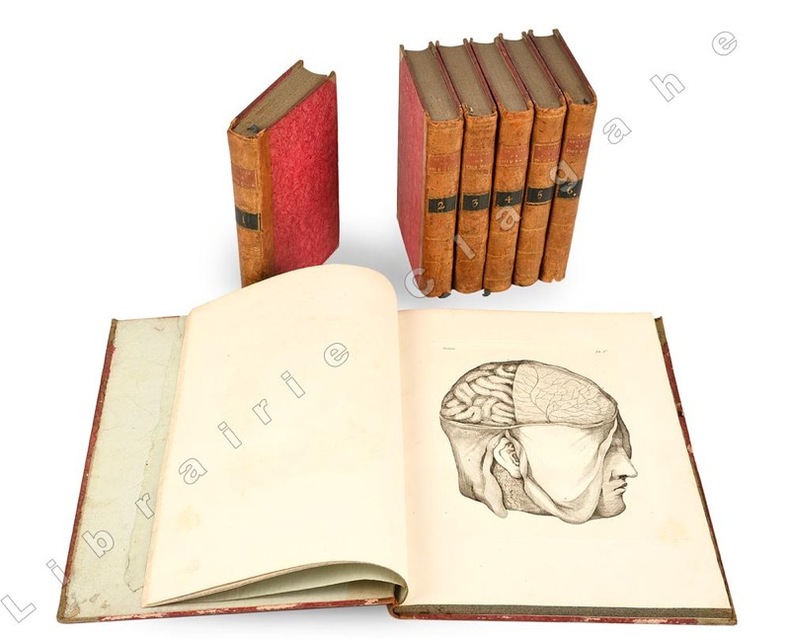
180521362Paris, L. Duprat-Duverger, imprimerie de Baudouin, an XIII-1805 ; 6 tomes in-8 et Atlas grand in-4° (338 mm), demi-veau fauve et petits coins de vélin, pièces de titre décorées rouge-orangé et de tomaison décorées vert-empire, plat de papier rouge à l’époque, tranches mouchetées (reliure de l’époque); XI, 88, 332 pp., frontispice de Girodet, gravé par Robert De Launay, [1] f. serpente imprimée de l’explication de l’estampe ; [2] ff. (Table et Errata) ; 446 pp., [1] f. (Errata) ; 444 ; 410 ; 372 ; 372; 360 pp. ; Atlas : [1] f. Titre, IV pl. pour les Mémoires ; 35 planches sur le cerveau (XXXII et II bis, V bis et XXIIbis), dont 8 doubles.
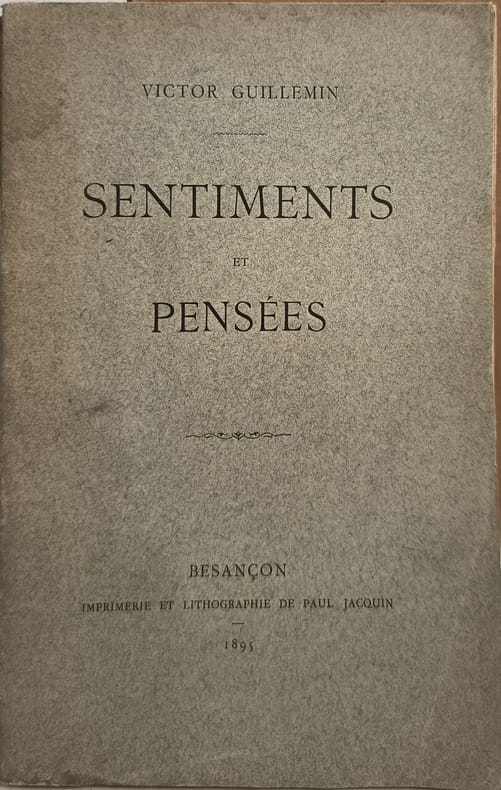
18957199Imprimerie et Lithographie de Paul Jacquin 1895 280 pages in8. 1895. broché. 280 pages. Ouvrage intitulé 'Sentiments et pensées' publié en 1895 à Besançon par l'imprimerie de P. Jacquin. Il s'agit d'un livre ancien de poésie de 280 pages
Folio (319 x 456 mm). 355 leaves and two folding sheets. Roman and italic types, occasional use of Greek and Hebrew types, printed shoulder notes. Woodcut pictorial title, author portrait, and printer’s device; 7 large, 186 mid-sized, and 22 small woodcut initials; more than 200 woodcut illustrations, including 3 full-page skeletons, 14 full-page muscle men, 5 large diagrams of veins and nerves, 10 mid-sized views of the abdomen, 2 mid-sized views of the thorax, 13 mid-sized views of the skull and brain, and numerous smaller views of bones, organs and anatomical parts. All woodcuts and initials up to page 165 in full contemporary hand colour. Contemporary blindstamped leather over wooden boards with bevelled edges, on five raised double bands, with two clasps. In custom-made solander box. A truly outstanding copy of one of the greatest and most appealing books in the history of science. Preserved in its original binding with the blindstamped initials of its first owner, the German physician Caspar Neefe (1514-79), and with his handwritten annotations throughout, the present copy is partly coloured by a contemporary artist (including the iconic woodcut used as title-page and all anatomical illustrations up to page 165). Caspar Neefe, who later served as personal physician to Duke Albert I of Saxony, acquired the precious volume only a year after its publication and obviously consulted it extensively throughout his career as a medical practitioner. - With the publication of "De humani corporis fabrica" (when he was only twenty-eight) Vesalius revolutionized both the science of anatomy and how it was taught. In his preface he describes his disappointing experiences as a student in Paris and Louvain, stating his intention to reform the teaching of anatomy by giving in this book a complete description of the structure of the human body, thereby drawing attention "to the falsity of Galen’s pronouncements". Vesalius also broke with tradition by performing dissections himself instead of leaving this task to assistants: the striking and dramatic title illustration shows him conducting such a dissection, his hand plunged into a female cadaver (striking in itself, as only the cadavers of executed criminals could be dissected legally and female criminals were rarely executed), surrounded by a seething mass of students. - The "Fabrica" is also revolutionary for "its unprecedented blending of scientific exposition, art and typography" (Norman). The woodcuts by artists of the school of Titian are both iconographically and artistically important. The series of fourteen muscle men show landscapes that, when assembled in reverse order, form a panorama of the Euganean Hills near Padua, a scenery well known to Vesalius while he was at work on the Fabrica. - Of the few copies of the first edition to have come to the market in recent decades, only two were in a contemporary binding. Apart from Vesalius's dedication copy to Emperor Charles V (Christie's New York, 18 March 1998, lot 213: $1,652,500), only a single other partly coloured copy was previously known, a list to which ours must now be added as the third known copy in contemporary colour. - Acquired in 2017; previously in a Tyrolean private medical collection, where the book rested for three generations (erased circular library stamp in the blank lower margin of the title-page). An outstanding copy hitherto unknown to scholarship (cf. the recent census published by Dániel Margócsy, University of Cambridge, below; further relevant correpondence with Dr Margócsy is available upon request). Occasional waterstaining to margins, the splendid binding a little rubbed and bumped, but altogether a wonderfully crisp, wide-margined copy of the first edition. Unquestionably the most desirable copy of a milestone in the history of science still in private hands, and likely the most important medical book obtainable for decades to come. PMM 71. VD 16, V 910. Durling 4577. Cushing VI.A.1. Eimas 281. Norman 2137. Wellcome 6560. Graesse VI.2, 289. Cf. D. Margócsy, M. Somos, S. N. Joffe: "Vesalius' Fabrica: A Report on the Worldwide Census of the 1543 and 1555 Editions", in: Social History of Medicine Vol. 30, No. 1, pp. 201–223. For Neefe cf. A. Lesser, Die albertinischen Leibärzte (Petersberg 2015), p. 71-74.
4to, xiv,205pp., text in Dutch and English, illustrs., orig. cloth, gilt. From the library of Pierre Ber?s.
Folio (277 x 207 mm). 163 (statt 164, fehlt Titelbl.) Bll. (a8-1, b8, c6, d-f8, g-h6, i-l8, m-o6, p8, q6, r-y6.8, z8). Gotische Type, zweispaltig zu 44 Zeilen (Komm. 54-55 Z.), Spatien für einzumalende Initialen. Diagramme auf Bl. b7v und f2r. Blindgeprägter Kalbslederband des frühen 16. Jhs. über Holzdeckeln auf vier Bünden, zweifach gerahmt, beide Deckel außen mit Bordüre, vorn im Mittelfeld Muster aus rhombischen Herzstempeln mit Krone und Blattwerkstempeln; hinten im inneren Rahmen außen quadratische aneinandergereihte Stempel mit Ast und blütenbesetztem Zweig; 1 gepunzter Schließbeschlag (v. 2). Die Innendeckel bezogen mit Fragment aus Conrad Tocklers astronomischer Vorhersage "Judicium Lipsense", Leipzig 1503 oder 1508. Zweite bei Quentel gedruckte Ausgabe dieses Kommentars zu den "Summulae logicales" des Petrus Hispanus (Papst Johannes XXI.), mit dem Text dieses für die mittelalterliche scholastische Logik wohl wirkmächtigsten und verbreitetsten Werks. Darin werden "die Formen der dialektischen Disputation vorgeführt [...], anschließend die logica modernorum entwickelt und eine semantische Analyse der aristotelischen Begriffslogik [...] entfaltet" (LexMA V, 544). Die Illustrationen auf Bl. b7v und d4r zeigen jeweils ein logisches Quadrat, die auf Bl. f2r die "arbor porphyriana". Auf Bl. n2v das bekannte Merkgedicht für die Schlussmodi. - Der französische Dominikaner Johannes Versoris (gest. wohl zwischen 1482 und 1485) gilt als einer der bedeutendsten Aristoteleskommentatoren der thomistischen Schule. "Seine Bücher [...] erschienen [...] in den letzten 20 Jahren des 15. bis in den Anfang des 16. Jahrhunderts, nicht selten ohne Jahr und Druckort, vielfach auch gedruckt bei Heinrich Quentel in Köln, der eifrig thomistische Werke verlegte; sie müssen viel gebraucht worden sein, da von einer Anzahl mehrere Auflagen rasch hintereinander gedruckt worden sind" (ADB 39, 637). - Einband berieben und stellenweise mit Bezugsdefekten; Schließen verloren. Die Innengelenke etwas gelockert; erste vorhandene Seite mit angeklebtem Falz des Vorsatzblattes und minimalem Eckdefekt (kein Textverlust); die letzten Blätter mit kleinen Wurmlöchern. Unterschiedlich gebräunt, zu Anfang auch gering wasserrandig. Einige zeitgenössische Tintenmarginalien (teils bei der Bindung etwas angeschnitten). Über ISTC nur in 18 Bibliotheken nachweisbar, sämtlich in Europa. H 16036. GW, M50203. BSB-Ink V-154. Ohly-Sack 2909. ISTC iv00238300. Voulliéme Köln 1241. Nicht bei Goff.
4to, 178,[1]pp., one of 300 copies, 76 facsimiles (some folding), orig. printed wrappers detached, spine broken.
161242773Béziers, Jean Pech, 1612. Béziers, Jean Pech, 1612. In-12 sur deux colonnes de (18)-268-(1) pp. 1 f.bl. (12) pp. de table, caractères romains et italiques, basane marbrée, dos orné à nerfs, pièce de titre en maroquin rouge, tranches jaspées (reliure du XVIIIe siècle).
64489, Brepols, 2023 Hardback, 516 pages, Size:156 x 234 mm, Illustrations:14 b/w, Language: English. ISBN 9782503585154.
Poul Steen Larsen, ed., wIn Pristine Condition. unknown
1998ABE-3657879159Harper Collins UK 1998 Collectable first printing world first edition hardcover. This highly intelligent and sympathetic study is essential for the Heaney scholar. An as new copy bought direct from the publisher and stored in a low light book room ever since. Unread and perfect and in a protected perfect jacket. Language: eng Language: eng 0.0 Language: eng 0.0 Language: eng 0.0 Language: eng. 1st Edition. Hardcover. As New/As New. Harper Collins UK hardcover
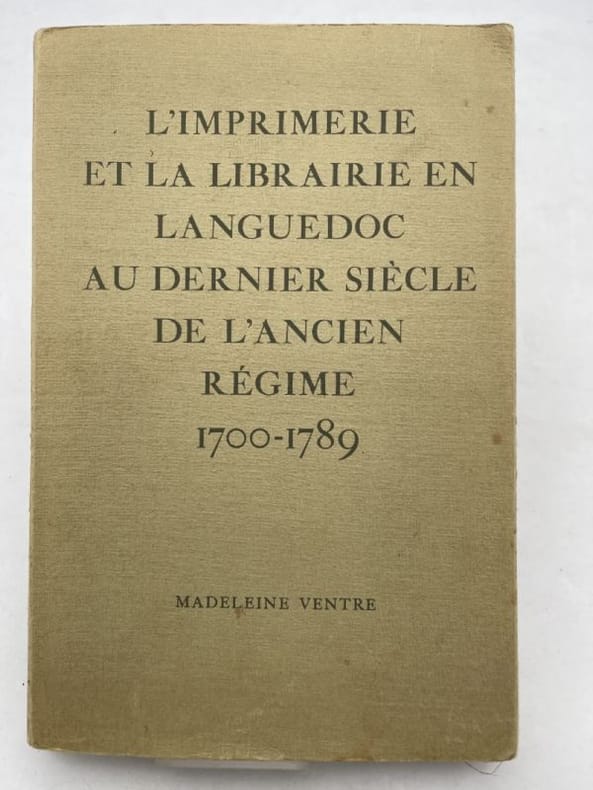
057130Montpellier Université de Montpellier. Faculté de Droit et de Sciences Economiques 1955 in 8 (24x16) 1 volume broché, couverture à rabats, XI et 288 pages [1]. Edition originale de cette thèse présentée le 29 juin 1955 devant la Faculté de Droit de Montpellier. Bel exemplaire ( Photographies sur demande / We can send pictures of this book on simple request )
1958188558Mouton Mouton, 1958. In-8 broché, covuerture à rabats deXI + 287 pages; Bon état
243543Collection Livres et Sociétés, IParis, La Haye, Mouton & Co., 1958, in-8, XI-288 pp., broché.
4320Mouton et Cie, 1958, in-8 broché, 288 pages. Bel exemplaire.
Folio (217 x 297 mm). 36 (instead of 40) ff. [a-d10], wanting the first and final blanks (as common) and leaves [a]5-6, missing text supplied in near-contemporary manuscript (but omitting initials). 38 lines, 2 columns, 3- and 4-line Lombardic initials supplied in red, red initial strokes and paraphs. 19th century unsophisticated boards. One of the earliest editions of Vegetius's famous military manual. The book gives an account of the Roman military institutions, organization and science, and includes a discussion of naval warfare. Writing under Emperor Theodosius the Great around 400 AD, Vegetius aimed to counter what he perceived as a progressive decay of the Roman military strength. "The printing of this edition is not clean and somewhat rough in general. Exceedingly rare" (cf. Schweiger). Ebert and Schweiger both date this to "between 1474 and 1478". - Annotated throughout in a contemporary hand. The two missing leaves of text have been supplied in different handwriting, no later than the early sixteenth century (watermark of inserted leaves: couronne à diadème, 138 mm high, not identified but similar to Briquet 4900ff., 4950ff., Piccard I.VI, 27-29: various locations, but mainly 1490s to 1520s). Blanks lacking (as from the Bodleian copy); the BSB copy wants the final two leaves (including [d]9, the last leaf of text). Only 19 copies listed in public collections; no sale records for this edition. Provenance: 1) William O'Brien (1832-99), Irish bibliophile and judge who presided over the 1882 "Phoenix Park Murders" (his handwritten pencil acquisition date "6 March 1868" on pastedown); 2) bequeathed as part of his enormous collection, which included 100 incunabula, to Milltown Park Jesuit Library (Dublin) in 1899 (their bookplates, with bequest plate). Hain 15911. Goff V-106. GW M49487. Proctor 1126. BSB-Ink V-61. Bod-inc V-050. Grosjean & O'Connell 117. Schweiger II.2, 1121. Ebert 23435.
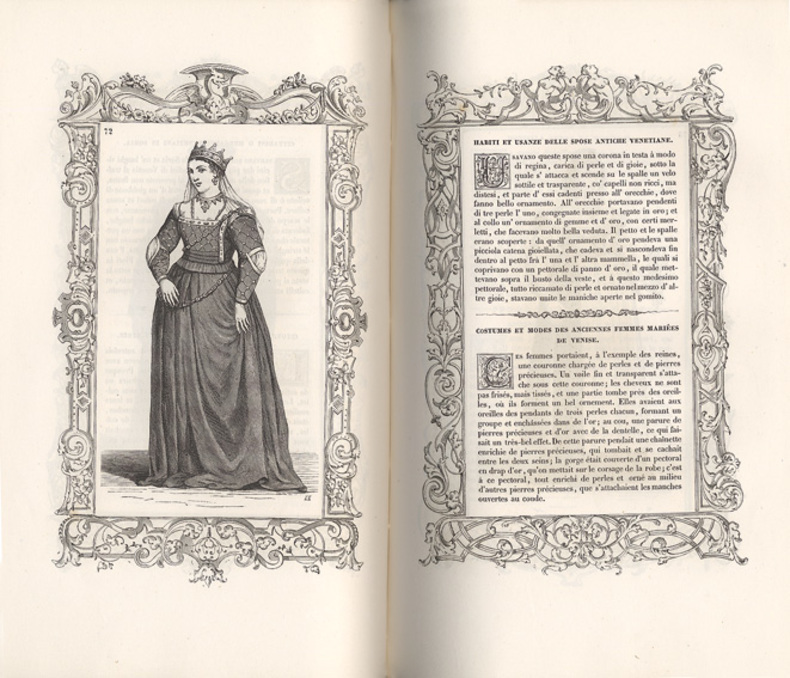
87331860. Relié avant : Essai typographique et bibliographique sur l'histoire de la gravure sur bois par Ambroise Firmin Didot. 1863. Paris, Typographie de Firmin Didot Frères Fils ; trois tomes reliés en deux volumes ; demi-chagrin maroquiné bordeaux, dos à quatre nerfs encadrant l'auteur et le titre dorés, date en queue, les couvertures illustrées et les dos, jaune paille, ont été conservés (reliure postérieure) ; XIV col., (1) p. bl., 316 col., (1) f. bl. ; 9 pp., (1 bl.), (1) p. faux-titre, (234 au tome 1er), 513 planches en tout : les planches de costumes, gravées sur bois, sont présentées sur la page de gauche et le texte qui les accompagne, en italien et en français, en face sur la page de droite, costumes et texte sont dans de grands encadrements décoratifs gravés sur bois ; 18 et 19 pp. de table des matières finissent les tomes 1 et 2.
83819Bourg-en-Bresse, L. Gandin, Libraire-Editeur/Francisque Martin-Bottier, Imprimerie de Comte-Millet/Imprimerie du Courrier de l'Ain, 1874-1877-1903, 3 parties reliées en 1 volume de 145x220 mm environ, 14-53-87 pages, demi chagrin marron, dos à nerfs portant titres dorés, gardes marbrées. Premier fascicule numéroté (N° 9) tiré à 25 exemplaires, un envoi sur la couverture du deuxième fascicule. Couverture do'origine conservées. Légers frottements sur les coins, infimes et très rares rousseurs, bon état.
1957GITj260Marseille Sérigraphie Romefort 1957. In-4 50 feuillets on chiffrés (soit 100pp) y compris le justificatif de tirage, le titre et l'achevé d'imprimer. Cartonnage de l'éditeur, do de toile beigne avec le titre en rouge et en long, plats de papier écru avec le titre en rouge et 1 vignette en couleurs sur le 1er. Reproduction en couleurs en sérigraphie d'environ 70 dessins ou aquarelles de T.P Grieg dont 10 à pleine page et 1 sur double page centrale. Légère usure de la toile du dos en tête et en queue. Intérieur très frais et complet. Edition originale, 1 des 900 exemplaires numérotés sur papier "carte" Renage. 1er ouvrage à reproduire des illustrations par le procédé de la sérigraphie, procédé d'impression des couleurs au pochoir, par couches successives, inspiré des techniques japonaises anciennes.
387pp. + illustrations out of text + loosely inserted: large folding plate, 25cm., softcover, good condition, B102782
8vo. (8), 127 ff. (wanting final blank f.). Half vellum using a leaf from an antiphonary. Second edition; the first was published the previous year by Garaldi in Pavia. "Early in the 14th century Varignana wrote a remarkable treatise which he entitled 'Secreta medicinae' [...] The plan on which the book is constructed is simple and convenient for rapid consultation. The author begins at the head, and goes through all the diseases in detail right down to the feet" (Ferguson II, Suppl. 2, S. 18). The physician and philosopher Guglielmo da Varignana (1270-1339) was the brother of the municipal physician of Bologna, Bartolomeo da Varignana, known for having performed the first forensic dissection there. - Slight waterstaining throughout; trimmed rather closely. Several marginalia by a contemporary hand. Edit 16, CNCE 34074. Wellcome 6495. Durling 2198. Hirsch/Hübotter V, 708. Ferguson (Bibliogr. Notes, Index) 317. Not in BM-STC Italian, Adams or Waller.
in-8°,, 171 pages, illustrations et figures en noir et en couleurs, broche, couv. Bel exemplaire. [NV-16]
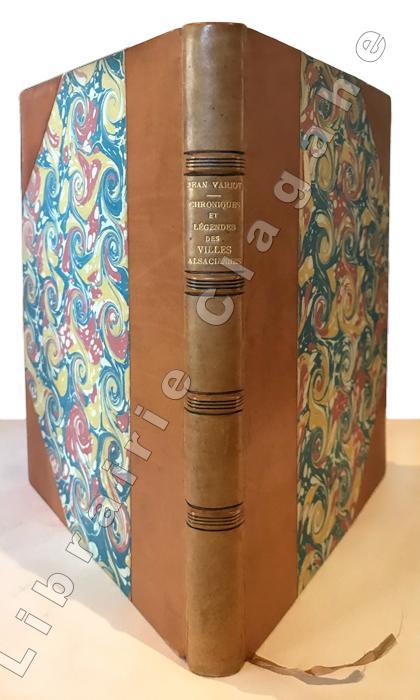
192721568Strasbourg, Collection de la vie en Alsace, 1927 ; in-8 (242 mm), demi-veau fauve à coins, dos à larges nerfs soulignés de filets à froid, titre diré, couverture illustrée et dos conservés, non rogné (Madelain) ; XII, 166, [2] pp., nombreuses gravures en noir et blanc.