7 770 résultats
2092902140600633Army Supplies Headquarters N.A. Soft Cover. Fine. The book is in fine condition. Army Supplies Headquarters paperback
200244159BBKöln, Bibliophilen-Gesellschaft Köln, 2002. 4°. 30 cm 154 Seiten. Original-Pappband.
1954158083(Berlin, 1954). M. mehr. Ill. 78 S. OHldr. Einbd. angeschmutzt. Kanten bestoßen.
198945229ABLeipzig, Selbstverlag, 1989. 4°. 30 x 21,5 cm. 304 Seiten. Original-Pappband. Original-Schutzumschlag.
1927142963Leipzig, Kantate, 1927. 62 S. OPp.
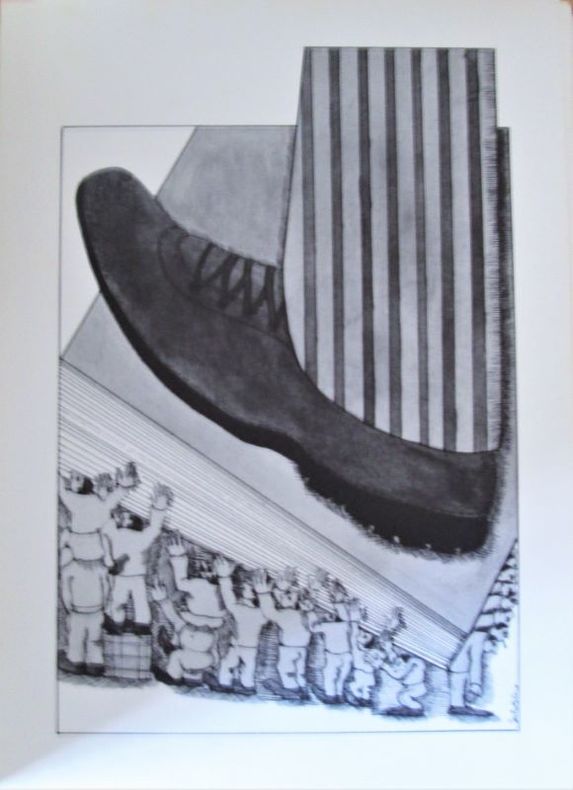
197729626Chaix (imprimé par les travailleurs de Chaix), 1977, in-4 sous chemise illustrée (20,7 x 29,7 cm), 76 dessins en feuilles + un dessin de couverture réalisé par Alain Leterrier. C900g. Corps frais (très discrètes réparations à l'adhésif transparent à l'intérieur des plis de la chemise). ALVARO - BARRIGUE - BELLANGER - BISSIERES - BOCAJ - CAMORS - CHENEZ - COINTET - COUDERT - COUREUIL - CSS - DAULLE - DERAN - GUILLOTIN - GOURMELIN - HIN - HONORE - KERLEROUX - KIRAS - LEGENDRE - LETERRIER - LYNCH - NORMAND - OTTO - PIEM - PLANTU - PYM - SARFATI - SAVINO - SCHATZBERG - SIROT - SIGG - SOLO - TESSIER - VALAT.- 830g.- Très bon état.
105 pages. One of 2,500 copies from the first printing. Author is managing editor of Publishers Weekly. "...exhibits the ferocity of his range: polemics worthy of Pope; quick delights that ignite in wit; ad dazzling, luminous poems that mix the language and geography of upstate New York with history, faith, autobiography, and poetic inheritance." - Susan Wheeler. Light rubbing to glossy covers. Two inch crease to upper corner of front cover. Unmarked. Book
First edition, 8vo (205 x 130 mm), [4], vi, 158pp., portrait frontispiece, some light water-staining to a few margins, recent marbled boards, morocco title label to spine. "A sketch of the life of Gutenberg, with a eulogium of his invention."?Bigmore & Wyman. Bigmore & Wyman II, p. 70.
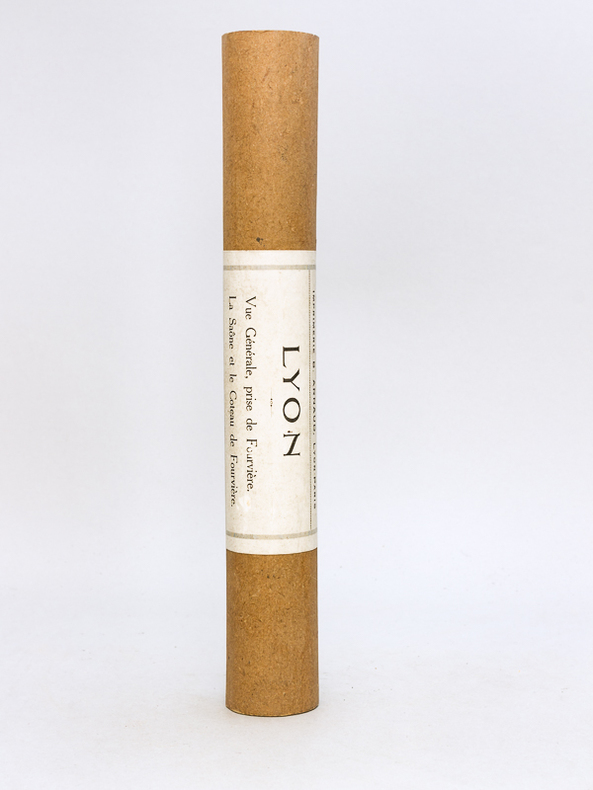
1914538592 vues dépliantes en couleurs enroulées sous tube, format 29,5 x 91.5 cm, s.d. (circa 1914), Imprimerie B. Arnaud, Lyon-Paris
Very Good Turkish, Ottoman (1500-1928) Contemporary quarter dark burgundy leather bdg. Grey cloth boards. Four compartments at spine. Cr. 8vo. (20 x 14 cm). In Ottoman script (Old Turkish with Arabic letters). 96 p. [48 leaves]. 19 lines on each page. Printed on paper with European watermarks. A small tear up to the last page with no loss of text. Overall a fine copy. The 9th incunable of the Islamic world, written by Ibrahim Müteferrika and printed in his legendary Basmahane. Known as the most significant work by Müteferrika, this incunable is a political and state-theoretical treatise composed in order to improve the Ottoman government. In his book, Ibrahim Müteferrika used the sources written in Latin in the Europe of his period, and he presented it to Sultan Mahmud I right after the Patrona Halil Revolt (1730). Müteferrika divided the state forms of government in Europe into three groups with the titles "monarkiya" [i.e. monarchy], "aristokrasiya" [i.e. aristocracy], and "demokrasiya] [i.e. democracy]. In the work, the importance of the sciences (physics, astronomy, and geography) in the state administration was emphasized, and it was stated that a solid-state order could not be established in a country where these sciences were not developed. In addition to this, he used the term "Nizâm-i Cedîd" [i.e. The New Order] for the first time and stated that the Ottoman Empire should definitely adopt and implement the new military orders of the 18th century Europe. In addition, this work is one of the earliest in which the "democracy" term is used in the Islamic world. The book was published in French in Vienna and Paris in 1769 (Traite de la tactique ou méthode artificielle pour l'ordonnance des troupes, Vienne, 1769. Translated by Karl Emerich Alexander von Reviczky von Revisnye [Baron Reviczki]), and was translated from French into Russian in 1777. One of only 500 copies. The volume appeared in 1732, about one and a half years after the uprising of Patrona Halil Revolt which had overthrown the system of Sultan Ahmed III and Grand Vizier Damad Ibrahim. The writing, recalling the characteristics of Ottoman siyâsetnâme [i.e. the book of politics], calls the attention of the Ottoman leaders to the results of the state and military development and to the reasons for the strategic superiority of the rival European powers, while strongly condemning the several centuries long disinterest of the Ottomans to the external world. An important feature of the work is to break with the hitherto prevailing nostalgic attitude to bygone golden ages. Although observes the stylistic conventions in as much he speaks contemptuously about the Christian nations, in the content, already turns away from the indifference referring to the superiority of Islam. It announces in a list organized by items the reasons for the state's weakness and the conditions of rising. In harmony with the main aspects of contemporary Ottoman reforms, the work mainly focuses on the necessity of the reorganization of the army. It also offers a broader historical background by describing after the Greek philosophers the various types of states (6v-7v), or by treating the origins and reasons for the success of the foundations of European culture, the Roman Empire (19v-20v). The concept "Nizâm-I Cedîd" (i.e. the New Order), which would be used for the newly organized military formations of Sultan Selîm III (1789-1807), appears here for the first time referring to the modernized European army (17v-18r). "The utopistic optimism of Risâle-i Islâmîye may have had some rational basis, if one takes into account the Karlovci Treaty (1699) which was a rather positive correction in contrast to the previous series of Turkish failures in the Balkans, the European 'internal wars' of the first decade of the 18th century, and the experiences of the reform and peace years of the Tulip Period. However, the Usûl ül-hikem. was already inspired by the atmosphere after the Pozarevac Treaty (1718) which was a further stro
152742528Basileae (Bâle), Johann Froben, 1527. Petit in-4 (154 x 204 mm) de (8)-434-(2) pp. (sign. a-z4 A-Z4 Aa-Hh4 Ii6), titre avec encadrement gravé, demi-basane blonde à petits coins, dos lisse orné de roulettes et palettes dorées, pièce de titre verte, tranches mouchetées (reliure du XIXe siècle).
4to. (8), 434, (2) pp. With woodcut title border by Hans Holbein. - (Bound with) II: The same. [Dikduk de-lishan arami. In hakhasda'ah] Chaldaica grammatica [...]. Ibid., 1527. (8), 212, (4) pp. Both works have woodcut printer's devices at the end. Contemporary blindstamped browns calf with 2 clasps. Sammelband containing two rare works by Münster: the first grammar of Aramaic written in Germany, a principal work, and the first German-produced Aramaic dictionary. "His dictionary [was] adapted from Pagninus's excerpt of Nathan Ben Yehiel's Arukh [...] Münster's most important work [...] was his Aramaic grammar, the first of its kind. The 'Chaldean' element in the Bible has of course long since been recognised, and people like Aurogallus and Fagius had treated the subject earlier in connection with their Hebrew studies. But just as Sanctes Pagninus was the first to exclude deliberately the Aramaic vocabulary from his Hebrew dictionary (1529), so Münster was the first to publish both a grammar and a dictionary devoted solely to Aramaic [...] A special feature of this grammar is the lexicographical introduction to the rabbinical Bible commentaries, with various Latin-Hebrew wordlists of technical terms. Münster also gives examples of the Sephardi and Ashkenazi rabbinical script in woodcut [...] The author compares the Aramaic with Arabic (called by him Saracenica lingua) which he quotes in transcription" (Smitskamp). - Binding restored; endpapers replaced. Obliterated contemp. ownership to t. p.; a few contemp. marginalia near the beginning of the grammar. I: VD 16, M 6657. Burmeister 23. BM-STC German 633. Adams M 1920. Steinschneider 2014, 6. Hieronymus 236 (note). Smitskamp 8d (note). BNHCat M 841. OCLC 13588558. - II: VD 16, M 6648. Burmeister 3 (& p. 11). BM-STC German 632. Adams M 1903. Steinschneider 6591, 6. Smitskamp 8. Leslau 398. BNHCat M 827. OCLC 20468455.
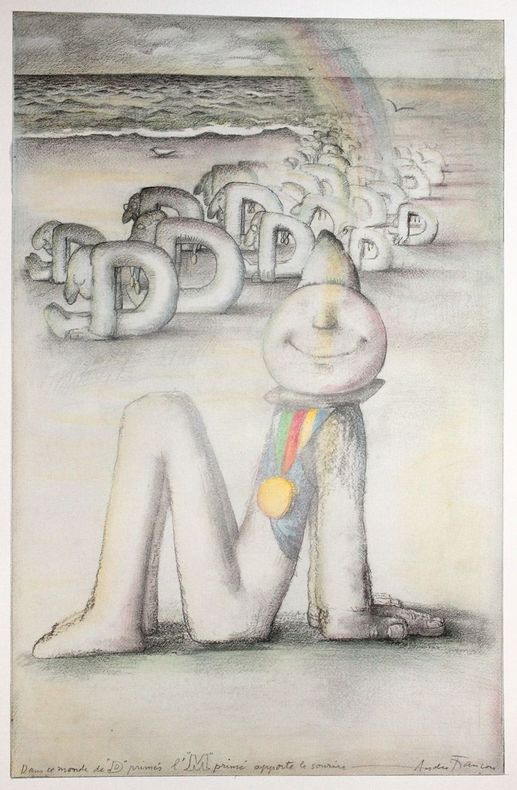
19772914Paris Fédération française de l'imprimerie et de l'industrie graphique 1977 aucune reliure [Paris], Fédération française de l'imprimerie et de l'industrie graphique, sd [1977]. 72 x 52 cm (feuille), 62,5 x 40,5 cm (image).
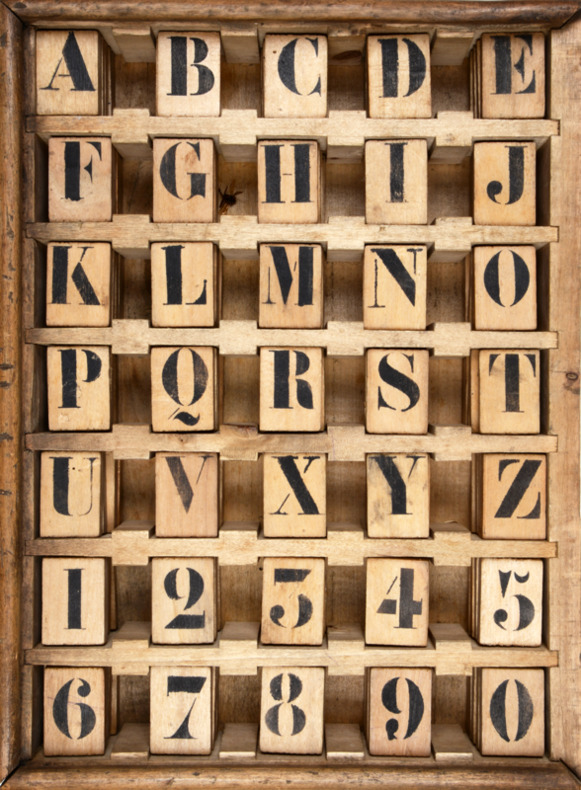
185941414Vitry-le-François, , 1859. Casier en bois blanc (36 x 26,5 cm) de 35 compartiments contenant chacun 5 planchettes mobiles en bois (4 x 2,8 cm) peintes en noir au pochoir recto verso (lettres et chiffres), couvercle.
Small 8vo. (16), 644, (4) pp. With woodcut printer's device to verso of final leaf. Modern full mottled calf with giltstamped title label to gilt spine. All edges red. A fine pocket-sized humanist edition from Basel: the Greek text, with Latin translation, printed in two columns, of this collection of works by Hippocrates of Kos, the founder of medicine as a science. Includes Galen's "Ars medicinalis" (the translation is by Nicolò Leoniceno, whose version of the Aphorisms is also the one here printed). - Occasional attractive humanist ink annotations in Greek and Latin in the margins, more extensive on front pastedown (recovered from the contemporary binding), both flyleaves, and final page. 17th century ownership of the lawyer Vincent Monsigot to front flyleaf and last page; additional early ownership of Claude Fournel at the top of the title-page. 20th century drystamped library stamp of Nitza and Robert Rousseau to flyleaf. Adams H 578. Bruni Celli 4102. Hoffmann II, 273. Not in Schweiger, Wellcome or Durling. NLM 233.
Einblattdruck. 1 S. Qu.-Folio (404:307 mm). Mit papiergedecktem Siegel über rotem Wachs. Gefaltet. Aufruf an alle Untertanen, "sonderlich aber allen an der Thonaw, so wol andern nechst geseßnen Flecken", für die Verproviantierung der "anzall Italianisch Kriegßvolck" zu sorgen, welche "die Babstlich Heiligkeit [...] herauß verordnet" habe: "Also haben wir hierinn nachfolgende maaß, ordnung und Tax, Euch [...] setzen unnd benennen wöllen, Alß neblich, daß man gedachtem herab ziehenden Kriegßvolck in ihren nachtleger die notturfft, Profiant, von Brot, Wein, Bier, alt und jungem Fleisch, Käß, Ayr, Schmaltz, Habern und dergleichen, umb bezalung und volgende Tax zufüern [...], und volgender gestalt, alß drey Brott weissen gebäch, deren jedes neün Lot wigt, per ein Kreutzer, ein Maß Wein per vier Kreutzer, ein Pfunt Behaimbischen Käß, per drey Kreutzer, den besseren Käß, so man in Osterreich macht, werden unsere Commissarien nach der güet Taxiern [...]". Mit der Schlacht bei Sissek am 22. Juni 1593 war der Lange Türkenkrieg ausgebrochen, der bis 1606 währen sollte. - Dorsalvermerke des 17. Jhs. zum Inhalt sowie zeitgenöss. Vermerk "Asentirt den 30. Juni Ao. 97". Unter dem Urkundentext rechts: "Commissio domini electi imperatoris in consilio". Links mit eigenh. Zeichnung des niederösterreichischen Statthalters Wolfgang v. Hofkirchen und des Kanzlers Christoph Pirckheimer, rechts des Hans Wilhelm Frhr. von Schönkirchen ("Hanns Wilhelmb Herr von Schennkhirchen d. Ä.") und des Dr. Paul Kraus. Nicht bei Starzer.
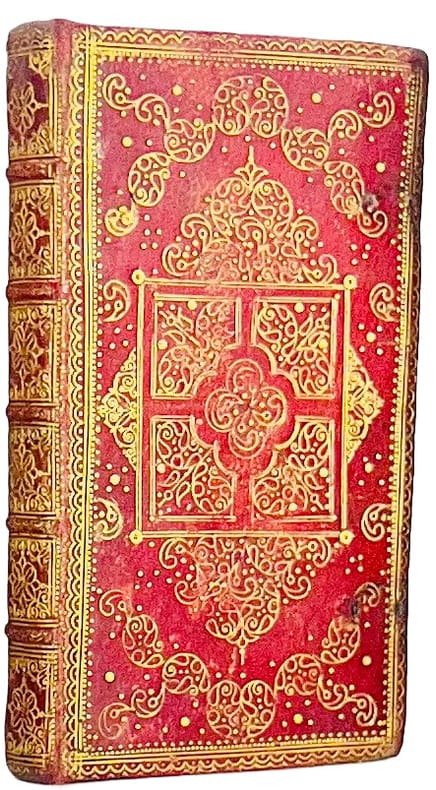
165343711Parisiis, , Typographia Regia, 1653. In-4 à deux colonnes de (64)-884-(58) pp., frontispice, maroquin rouge, dos orné à la grotesque, double encadrement doré à la Du Seuil sur les plats avec fleurons dorés dans les angles, coupes décorées, tranches dorées sur marbrure (reliure de l'époque).
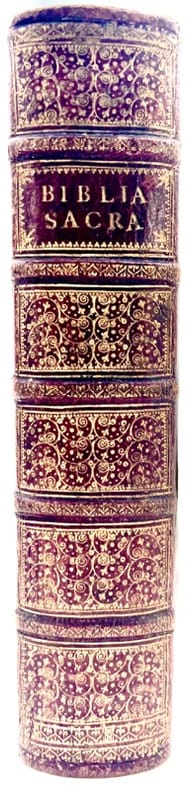
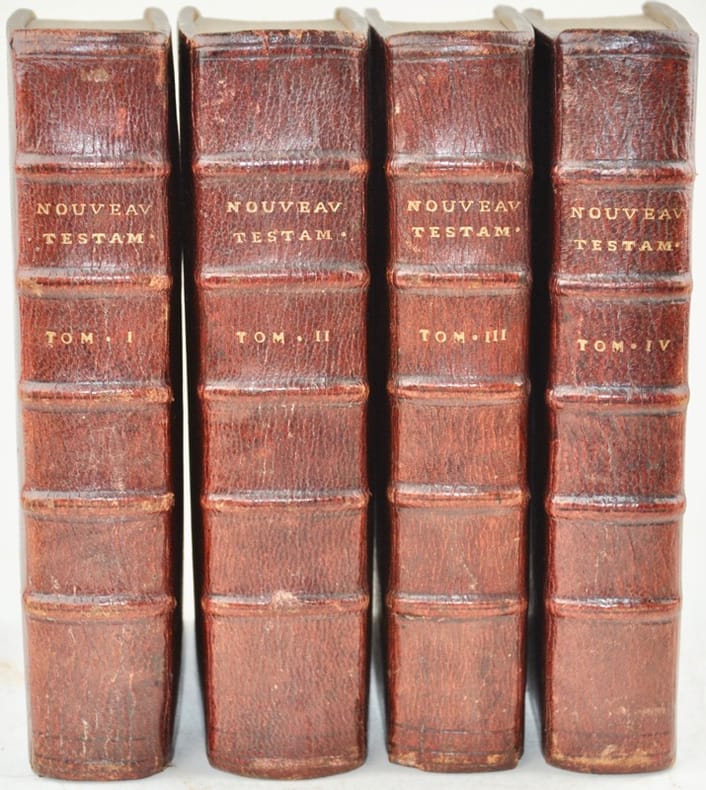
169242505Paris, André Pralard, 1692. 4 vol. in-8 de (48)-638-(58) pp. ; (8)-470-(8) pp. ; p. 471-892-(19) ; (40)-676 ; (20)-664 (i.e. 660) pp., maroquin rouge janséniste, dos à nerfs, tranches dorées (reliure de l'époque).
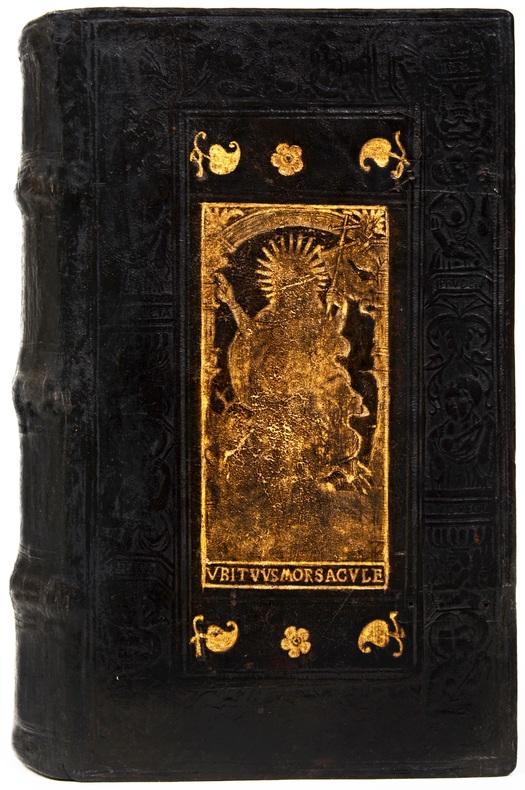
153815643Bâle, Thomas Platter, 1538. In-8 grec (170 x 100 cm) de (8)-382-(2) ff., maroquin noir estampé, dos à trois nerfs (reliure de l'époque).
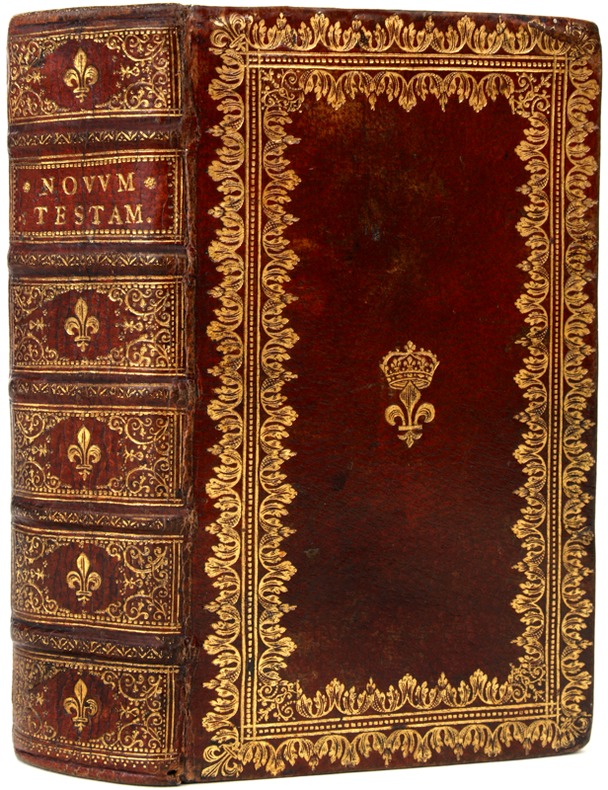
164940322Parisiis, , Typographia Regia, 1649. In-12 réglé de 1 f.bl., frontispice, (32)-324-100-316-(59) pp. 1 p.bl., maroquin rouge, dos fleurdelisé à nerfs, guirlande, filets et roulette dorés d’encadrement sur les plats, fleur de lis surmontée d'une couronne royale au centre des plats, tranches dorées (reliure de l’époque).
165644519Charenton, Antoine Cellier, 1656-1659. 2 parties en 1 vol. in-12 à deux colonnes de (156) ff., frontispice, (104) ff., musique notée, maroquin rouge, décor doré à petits fers sur les plats dans un encadrement de filets et roulettes, traces de fermoirs, dos orné à nerfs, tranches dorées (reliure de l'époque).
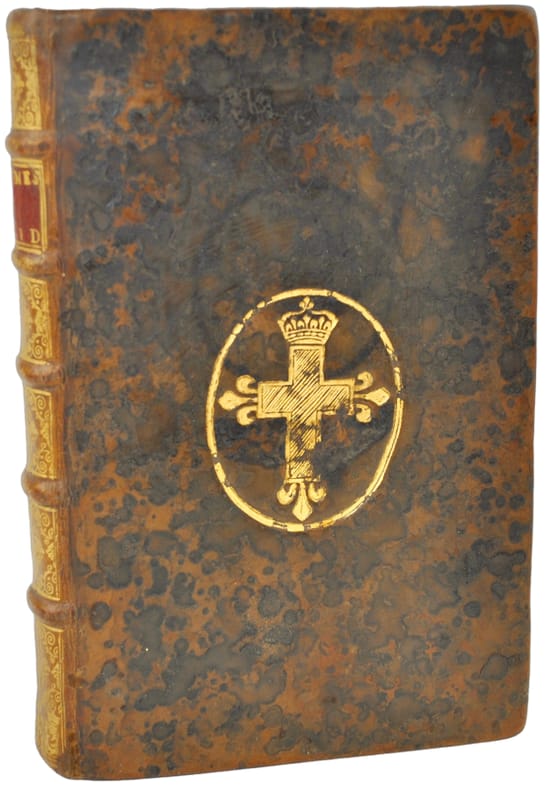
168642484Paris, André Pralard, 1686. In-8 à trois colonnes de (24)-530-(22) pp., tables, veau brun granité, dos orné à nerfs, pièce de titre en maroquin rouge, armorié en son centre de la croix de Saint-Cyr (reliure de l'époque).
169844493Paris, Élie Josset, 1698. In-12 à trois colonnes de (6)-497-(11) pp., frontispice, tables, maroquin rouge, fine roulette dentelée dorée encadrant les plats, dos à nerfs ornés de caissons frappés des initiales M et H alternées, doublure de maroquin rouge encadrée d'une large roulette dentelée dorée, chiffre couronné au centre, gardes de papier dominoté, tranches dorées sur marbrure (reliure de l'époque).
166444641La Haye, Chez Jean & Daniel Steucker, 1664. In-12 de (2)-252-(104) pp., galuchat, fermoirs et coins en argent (reliure de l'époque).
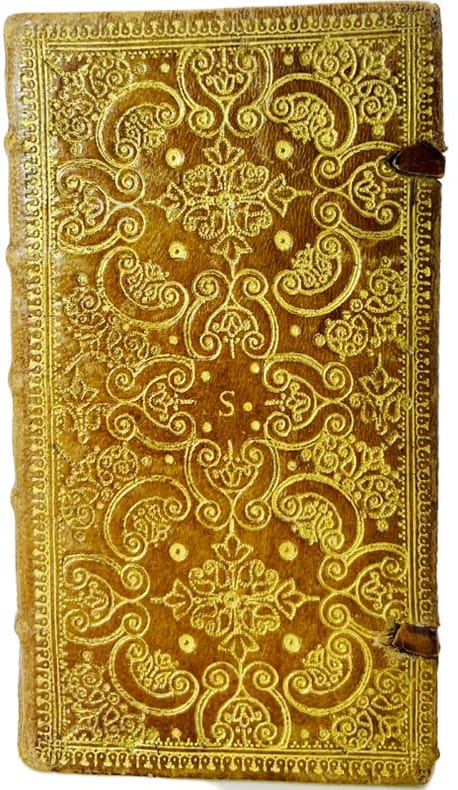
166444706Charenton, Antoine Cellier, 1664. In-12 de (116-26) ff. (sig. A-T6 V2 a6 B-C6 D-E4 F2), musique notée, veau blond décoré à petits fers, dos à nerfs orné de fleurons, filets et roulette dorés d'encadrement sur les plats ornés d'un riche décor, tranches dorées, traces de fermoirs (reliure de l'époque).