JACQUES DE VORAGINE.Livre Rare Book

7 774 résultats
150441988Lyon, Claude Davost, Étienne Gueynard, 1504. In-4 gothique à deux colonnes de (12)-217 ff. mal chiffré 215 (sign. aa bb a-z π-ƒ A9), index, veau marbré, dos orné à nerfs, pièce de titre en maroquin rouge, tranches rouges (reliure XVIIIe).
4to. [287] ff. (B-C6, D-E8, F28 [!], G8, H6, J8, K4, L-N8, O6, P-Q8, R6, S-V8, X6, Y-Z8, a8, b4, c7 [6+1: includes "c medium" between c2 and c3], d-e8, f6, g-h8, i4, k-l8, m6, n-p8; published thus without a gathering A, agreeing with ÖNB copy). With title woodcut, 8 pp. of musical notes, and numerous (32 large, 12 almost full-page, and hundreds of small) woodcuts in the text (wanting the woodcut map and the folding plate on musical theory). Contemp. wooden boards with blindstamped pigskin spine and one central brass clasp. The first encyclopedic work in modern European history. The first Strasbourg edition, a revision of the Freiburg first edition published the previous year. In the manner of a dialogue between teacher and student, the book discusses the sciences and liberal arts, including music (with notes), medicine, geometry, surveying, etc. Grüninger modified several woodcuts from the first edition and added others; he also incorporated a brief Hebrew grammar by Conrad Pellicanus, making this the first Strasbourg-printed book to include Hebrew type (cf. Schmidt). - Among the illustrations are a map of the world on f. c6r and many charming miniature woodcuts in the margins. Occasionally, details of the initials (F11r) and woodcuts (e.g., F18v, c2v [salamander], and c3v [dragon]) have been coloured in red. Several contemporary underlinings and marginalia, including a lengthy note on earthquakes that supplements the printed text by additional sources, such as the Arabian astronomer Abu Ma'shar: "Erdbebung bedeute straff Gottes. Naturliche Ursachen nemlich die Hitz und würckung etlicher Planeten, mit der Sonnen, als Martis, Iovis, Saturni, und sönderlich sagt Albumasar vom Saturno. Bedeuten stets künfftig Unglück, wie auch Plinius danen saget, das kein Erdbidem zu Rom geschehen sey one Bedeutung künfftiger ding [...]" (c5v). Some browning and fingerstaining; quires S and e misbound; several small edge defects (larger in d5, k6); paper defects to D4 and (almost touching text) d6. Some worming near beginning and end of volume, also concerning the binding; some damage to spine-ends. VD 16, R 1034. BM-STC 731. Proctor 9891. Schmidt (Grüninger) 66. Ritter 1984. Muller 24, 26. Smith, Rara, 82. Sabin 69123. Ferguson (Reisch) 201f. Alden/L. 504/2. Zinner 849. Eitner VIII, 183. Not in Adams.
Folio. (416) ff. Hebrew type, 4 cols. With woodcut printer's device on title page. 17th century calf with gilt spine and cover rules; gilt Jesuit device to cover. Edges tinted yellow. Rare second Venetian edition of the first Hebrew Bible concordance (first published by Bomberg in 1523), with a new Latin dedication to Maggio Parentini. Words are arranged etymologically by roots and stems; the order of the books follows that of the Vulgate. The Arles-born Rabbi Isaac Nathan ben Kalonimus (fl. 1400-48) compiled the work commonly referred to as "Meir Nativ" ("Light of the Way") between 1437 and 1447 with the twofold aim to facilitate the study of Biblical exegesis and to keep Jews who had converted to Christianity from misquoting the Bible in religious controversies (cf. Jewish Encyclopaedia). Nathan himself moved in Christian scholarly circles and participated in theological disputations with his Christian colleagues. Notably, he based his present concordance on a work compiled by the Franciscan Arlotto de Prato. Occasionally (as here) the book is falsely attributed to Isaac's nephew Mordechai Nathan. - Text ruled in red throughout; the edges' yellow paint has seeped into the margins in places. Title page somewhat brownstained; a few corner defects early on, otherwise very clean and largely unbrowned. Ms. ownership of the Jesuit college at Chambéry (Savoy), dated 1585, on title (and repeated on last leaf but one); old stamp and long bibliographical note in French (c. 1900). Binding somewhat rubbed; spine professionally repaired. No copy in U.S. libraries. Adams B 1953. BM-STC Italian 104. Steinschneider 5399.3. Fürst III, 22. OCLC 257608293. Not in Edit 16.
(8), 290, (2 [statt 30]) SS. Mit großer Holzschnittdruckermarke am letzten Bl. verso. Neurer brauner Pappband. 4to. In maßgefertigter Leinenkassette. Die zweite Ausgabe dieser berühmten Grammatik, erstmals 1542 erschienen. "Der Brief des Baillivius ist weggefallen. Ebenso ist das - nunmehr undatierte - Vorwort nicht mehr an diesen, sondern allgemein, wie üblich, an die Hebraicae Linguae Studiosi gerichtet. Gleichzeitig sind infolgedessen die persönlich gehaltenen Stellen am Anfang und Schluß in Wegfall gekommen. Jene sind ersetzt durch einen Hinweis auf des Verfassers Leistungen für das Studium der hebräischen und chaldäischen Sprache während eines Zeitraums von über 20 Jahren" (Prijs). "[E]nthält die Summe des grammatischen Wissens Münsters, die Summe einer 30jährigen Arbeit, die er mit diesem Werk zum Abschluß brachte. Aber das Werk enthält nicht nur das eigene Wissen Münsters, sondern berücksichtigt fast die gesamte Forschung seit Reuchlin, sowohl die christliche als auch die jüdische, die deutsche und die ausländische [...] Nach bewährtem Beispiel wurde wieder ein Übungstext angehängt, und zwar das apokryphe Buch Tobias [...] Münster sah diese Grammatik als endgültig an und arbeitete fortan keine neue mehr aus [...] Das Opus grammaticum consummatum erwies sich auch tatsächlich als eine perfektionierte Arbeit, die zahlreiche Auflagen erlebte" (Burmeister, Biogr. Gesamtbild, S. 69). "Als Hebraist nimmt [Münster] in Deutschland nach Reuchlin eine der ersten Stellen ein" (ADB XXIII, S. 30). - Etwas gebräunt und wasserrandig; die Seitenränder teils leicht unregelmäßig bzw. alt hinterlegt. Einige wenige Marginalien der Zeit zu Beginn. Am letzten Textblatt Lochstempelung der Philadelphia Divinity School. Ohne die letzten 14 Blätter Anhang. Sehr selten; zuletzt 1971 im Handel; über VD 16 nur drei Standortnachweise (Leipzig, Wien, Wolfenbüttel). VD 16, ZV 11220. Burmeister 12. Adams M 1937. Steinschneider 2015, 21. Prijs 68. Fürst II, 407. OCLC 48902972. Nicht im BM-STC.
8vo. (132) ff. With 2 different woodcut devices. - (Bound with) II: [Melekhet ha-dikduk]. Institutiones grammaticae in Hebraeam linguam [...]. (144) ff. With several musical notes and two woodcut devices. Modern vellum, in custom-made cloth case. I: Second edition of Münster's "Proverbs", previously published in 1520, together with his first own work ever, an introduction to Hebrew grammar. Numerous contemporary Hebrew and Latin marginalia. - II: Only edition of Münster's second publication, a foundation stone of modern Hebrew studies. Includes (fol. r1 ff.) the co-called Jonas polyglot in Hebrew, Chaldaic, Greek, and Latin, with other matter. Contemp. ownership obliterated from t. p.; lower corner defective (remargined professionally; losses supplied in pencil). Numerous contemp. marginalia, mostly in Latin. Both works are very rare; the former has not been seen at auctions since 1950. I: VD 16, B 3564. Burmeister 137. Hantzsch 234.2-4. Adams B 1536. Steinschneider (Bodl.) 11.51. Panzer VI, 244, 540. Vinograd Mem 1256. OCLC 71515193. Not in BM-STC. - II: VD 16, M 6685. Burmeister 2. Hantzsch 220.2. Adams M 1931. BM-STC German 633. Steinschneider (Hdb.) 1374. Panzer VI, 245, 541. Wolfheim I, 865. Graesse IV, 623. OCLC 22612604.
5 Bde. und Index in 2 Bdn. Mit 6 wdh. Druckermarken. Blindgepr. Schweinslederbände der Zeit. Reste von Schließen. Folio (265 x 375 mm). Schöner, sehr seltener Pariser Nachdruck der lateinischen Gesamtausgabe, die 1530 bei Froben in Basel erschien, erstmals von Philipp Montanus besorgt. - Mit 3 Blattweisern (ein vierter verloren). Einige Wurmgänge (auch im Text); durchgehend gleichmäßig schwach gebräunt. Die Schweinslederbände etwas berieben, hübsch blindgeprägt mit drei verschiedenen Rollenstempeln. Exemplar aus der Bibliothek der Ingolstädter Franziskaner mit deren hs. Besitzvermerk des frühen 18. Jhs. sowie Stempel an Titel und Vorsatz. Hoffmann II, 412. BM-STC French 244 (nur Bd. 1). Diese Ausgabe nicht bei Adams.
163440475Leyde, Abraham et Bonaventure Elzevier, 1634. Petit in-12 (126 x 67 mm) de (20) pp. dont 1 titre-frontispice et 1 figure gravée, 786-(30) pp. (sig.*10 A-Z12 Aa-Ll12), maroquin bleu, dos lisse orné, roulette dorée d'encadrement sur les plats, frise intérieure dorée, gardes de tabis rose, tranches dorées (reliure du XVIIIe siècle).
4to (142 x 196 mm). 119 ff. (of 122, without initial blank and two final blanks). 38 lines, single column, roman type. With 38 woodcut illustrations in the text showing constellations. Modern full calf with double blind rules to covers, spine on five raised bands with gilt title "Aratus". All edges red. First edition of Avienus's translation of this influential astronomical poem, rarely found complete, pre-dating the editio princeps of the Greek text by 11 years. Based on Eudoxus of Cnidus, Aratus's didactic poem about celestical phenomena (written soon after 276 BC, probably at the Macedonian court) enjoyed immense success and was frequently translated in Roman times - an interest occasioned by the increasing degree to which men viewed their fates tied to astrology and the stars. Avienus's 4th-century Latin text, informed by the Neoplatonic tradition, is expanded considerably from the original. The volume includes additional translations of Aratus by Cicero and by Germanicus Caesar, who offer earlier viewpoints. The latter version is accompanied by 38 zodiacal woodcuts, almost all of which were designed and executed for this volume and thus are present in brilliant early proofs. Four beautiful cuts in the Venetian manner are especially remarkable (cf. Essling, 431). - The "Ora maritima", on the other hand, is a short poetic account of early sea routes used by Greek and Carthaginian traders along the coasts of the Mediterranean, Caspian, and Black Seas. A few scholars have speculated that one of Avienus's sources for his work was the now-lost Massiliote Periplus, a conjectural sailing guide from the 6th century BC, although this idea is controversial. The final text in the volume constitutes the first dated edition of the most popular Roman medical work (by Serenus Samonicus), likewise couched as a didactic poem. The collective volume is thus of the greatest interest for the history of science. The editor, Vettore Pisani, was a pupil of Giorgio Valla. - Folio a4 remargined at foot and p6 (the final leaf present) repaired at head (both barely touching text). A few contemporary manicules. A very clean copy (entirely complete save for 3 blank leaves) of an edition usually encountered only in parts or even fragments, even in institutional collections. - Provenance: from the library of the surgeon, meteorologist, and antiquarian Charles Leeson Prince (1821-99) of Crowborough, Sussex, with his large bookplate (dated 1882) to front pastedown. Later in the collection of the meteorologist George James Symons (1838-1900); bequeathed to the Royal Meteorological Society with the Symons bequest bookplate (dated 1900) on lower pastedown. HC 2224* (= H 2223). Goff A-1432. GW 3131. Proctor 4593. Klebs 137.1. Sander 718. Essling 431. Pellechet 1673. Bod-inc A-639. Sheppard 3709-3711. BMC V 294. BSB-Ink A-969. Stillwell A 1277. ISTC ia01432000.
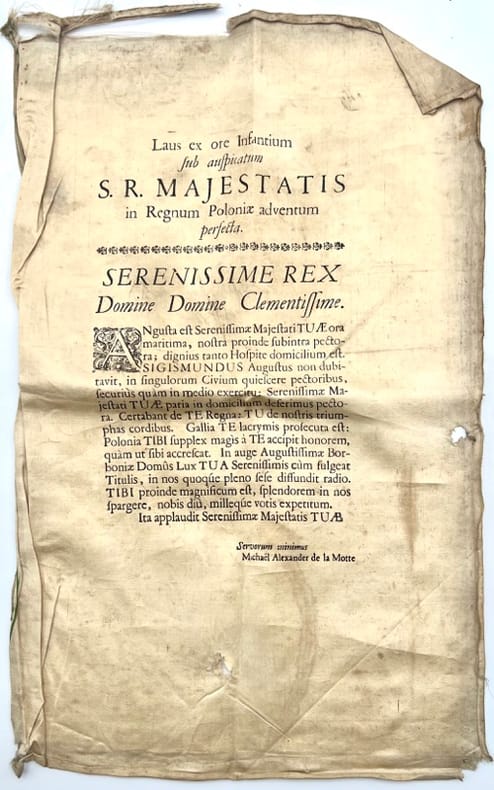
171444331S.l.n.d., , 1714-1734. Placard in-quarto sur soie (39 x 25 cm).
163644365[Rome, Typis Sacra Congregatio de Propaganda Fide, 1636 ?]. (4) ff.2 alphabets reliés en un vol. petit in-8 (105 x 155 mm), vélin souple muet (reliure de l'époque).
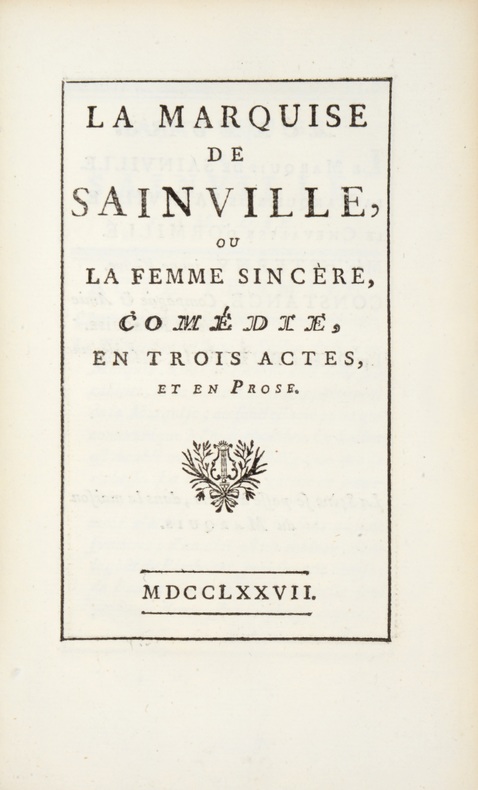
177215319[], [], 1772-1777. 4 pièces en 2 volumes in-8, texte encadré, veau marbré, dos lisse orné à la grotesque, pièces de titre en maroquin rouge et de tomaison en maroquin noir, tranches rouges (reliure de l'époque).
24x16cm. 42 pages. Softcover. Cover slightly water-stained. Ex-libris stamp on front whitepage. Else in good condition.
114727Série de cinq volumes in-12 de 90 x 150 mm environ comportant 40 textes. Demi-chagrin bleu, dos à quatre nerfs portant titres et tomaisons dorés, gardes marbrées. Intérieur frais et ensemble en bon état malgré les défauts à signaler : un dos insolé, de discrets frottements sur les coins et les coiffes.
1372883London: The Studio, 1926 in-4, pp.145-192 + xii pages d'annonces, illustrations dans le texte et 4 planches hors texte en couleurs. Broché, couv. défraichie, dos cassé, avec manques. Sommaire: HAMILTON: F. Gordon Crosby a draughtsman of cars. Jiro HARADA: Modern Japanese posters. Wilhelm LOTZ: German industry, training the designer. J.M. BOWLES: The Ovington campaign. Aspects of the selling art. The Royal Society of Arts exhibition. Horace TAYLOR: The Cloister Press, a bold venture. Gerald REITLINGER: Machine production, a warning and a panagyric. R. P. GOSSOP: Holiday posters.
1913012924Paris Les Soirées de Paris. Directeurs: André Billy. 1913 In-8 Broché
1912012926Paris Les Soirées de Paris. Directeurs: Guillaume Apollinaire, André Billy, René Dalize, Charles Perrès, André Tudesq. 1912 In-8 Broché
1912012927Paris Les Soirées de Paris. Directeurs: Guillaume Apollinaire, André Billy, René Dalize, Charles Perrès, André Tudesq. 1912 In-8 Broché
1914011213Paris Les Soirées de Paris. Directeurs: Guiaume Apollinaire et jean Cerusse. Gérant Jean Mollet. [Imprimerie Union]. 1914 In-8 Agrafé
1913012925Paris Les Soirées de Paris. Directeurs: André Billy. 1913 In-8 Broché
4to. (82) ff. (A-T4, V6). 29 lines, text partly surrounded by commentary. Later half vellum. Latin edition of this famous medical manual, arranged at Salerno in the 12th century and published in various incunabular editions. This instructional poem and the commentary that accompanies it, often attributed to the 13th-century Montpellier alchemist Arnoldus de Villanova (cf. E. Wickersheimer, in: Comptes rendus du XIIIe Congrès international d'histoire de la médecine, 1954, p. 226-234 [Aquilon 570]), preserved its exceptional influence in Western Europe well into the 19th century. - Quire Q misbound but complete; some browning and fingerstaining; margins show some wrinkling. Several old marginalia and underlinings; later ms. note to title page: "Arnoldinus in Scholam Salernitanam". Very rare; a single record in ABPC (Swann, 24 Jan. 1980, lot 1792). CR 5053. Goff R-77. GW M37397. BSB-Ink R-50. Klebs 830.12. Sander 6391. Pellechet 1289. BMC V, 598. Edit 16, CNCE 60481. Cf. Essling 609f.
4to., First Edition, with fine coloured frontispiece and 18 fine full-page coloured facsimiles in the text; original printed wrappers, a fine copy. The Parsons fragment of the Leiden Christi [c.1462-63?] is unique. It is the only known example of the FIRST BOOK PRINTED IN ITALY, as well as being the FIRST BOOK PRINTED IN ITALIAN, and employing a UNIQUE TYPE FOUNT.
154143462Paris, Charlotte Guillard, 1541. Petit in-8 réglé de (8)-216 ff. (sign. aa8 a-z8 A-D8), index, vélin doré à recouvrement, dos lisse titré orné de filets et fleurons, double filet en encadrement, armoiries avec légende dans un médaillon au centre des plats, tranches dorées, traces de fermoir (reliure de l'époque).
Royal folio (273 x 398 mm). Gothic type. 248 ff. (incl. final blank). 49 lines. 2 columns. Contemporary south German decoration: each of 4 books opening with an illuminated initial with extensions; rubricated throughout in red and blue. Modern calf, early index tabs. Editio princeps. Magnificent copy of the rare first edition of one of St. Thomas Aquinas's two masterpieces which systematized Latin theology. The printer is commonly referred to as "the printer of Henricus Ariminensis"; the ISTC suggests the Eichstädt printer Georg Reyser (active until 1503; cf. ADB 28, 368f.) known for his characteristic type, or, following Pellechet, Heinrich Eggestein. - "The combination of theology and philosophy which was the basis of scholasticism found its finest expression in [St. Thomas's] writings. Aquinas held that knowledge came from two sources: the truths of Christian faith and the truths of human reason. Each is a distinct source, but the revelation which comes from faith is the greater of the two, and its chief characteristic is that it consists of mysteries to be believed rather than understood" (PMM 30 for the editio princeps of the 'Summa Theologiae' published in 1485). The 'Summa de veritate catholicae fidei contra gentiles' (Treatise on the Truth of the Catholic Faith, against Unbelievers), written in Rome, 1261-64, was composed at the request of St. Raymond of Pennafort, who desired to have a philosophical exposition and defence of the Christian Faith, to be used against the Jews and Moors in Spain. It is a perfect model of patient and sound apologetics, showing that no demonstrated truth (science) is opposed to revealed truth (faith). It is worthy of remark that the Fathers of the Vatican Council, treating the necessity of revelation (Coast. "Dei Filius", c. 2), employed almost the very words used by St. Thomas in treating that subject in this work (I, cc. iv, V). - First leaf a little defective and repaired, minor marginal repairs in first 4 leaves, small stain at a few extreme upper margins, decoration just shaved. A stamp erased from fol. 4/10r. Hain 1385*. Goff T-190. GW M46563. BMC I 77. ISTC it00190000. CIBN T-162. Collijn, Uppsala 1420. IBP 5291. IDL 4382. IGI 9568. Madsen 3951. Aquilon 644. Michelitsch, Thomasschriften 60. Ohly (Gutenberg-Jahrbuch 1956) 6. Ohly-Sack 2729. Pellechet 986. Polain, Belgique 4761. Proctor 322. Rhodes, Oxford Colleges 1697. Sack, Freiburg 3437. Sajó-Soltész 3256. Schüling 816. Sheppard 233. Voulliéme, Berlin 2179. Walsh S-110B.
Very Good Turkish, Ottoman (1500-1928) Original dark brown handsome full leather bdg. with a traditional flap. Folio. (32 x 22 cm). In Ottoman script (Old Turkish with Arabic letters). [2], [6], 238 leaves. The size of the text block in red borders: 25.5 x 14.5 cm. 33 lines on each page. Printed on paper with European watermarks. The size of the text block in red borders: 25 x 14.5 cm. 33 lines on each page. Printed on paper with European watermarks. Handwritten title on the bottom edge. A fine copy. The 19th incunable of the Islamic world, printed by Ibrahim Müteferrika's legendary Basmahane. The publication of Ottoman chronicles which began in 1734 with the edition of Naimâ's history, continued after a long break in 1783. This volume, containing the works of three court chroniclers who followed each other in rapid succession, is a chronological continuation of Mehmed Râsid's history, published by Müteferrika. Arpaemînizâde Mustafa Sâmî (deceased 1734) was the court's historian from 1730 to 1733, Sâkir Hüseyin (died 1742) in 1733, and Subhî Mehmed (ca. 1711-1769) from 1739 to 1745. The work of the three chroniclers is known as one coherent historiography, which presents the events of Ottoman history from 1730 to 1744. This work is a particularly valuable source on the Habsburg-Ottoman war between 1736 and 1739, in which Subhî participated in person. The prestige of the work, which offers detailed data on the administrative events (appointments, dismissals, and other biographical communications) is further increased by the fact that Subhî in many cases used original documents. This chronicle includes the events between the years 1730-1743. Contents: Ahd-i Humâyûn [i.e. Imperial constitutional declaration]., Zikr-i tecdîd-i san'at-i tab' [i.e. Preface on the Muteferrika Press of Vasif Efendi]., Fihrist-i târîh-i Sami ve Sakir ve Subhi [i.e. Contents of the work]., Text., History of Subhi. The workshop of Müteferrika began its historical mission in 1728. They published 17 works in 22 volumes. The printing house served as a means to the long-term goal of Müteferrika, his efforts to broaden the horizon and modernize the knowledge of Ottoman society and Islamic civilization. This is evidenced by the subjects of the books selected for publishing, the motivations put forth in the publisher's introductions, as well as by the documents illuminating the background of the publication of each book, also published in print. In 1742, with the publication of the Persian dictionary of Hasan Suûrî, a chapter of Ottoman book printing came to an end. With the death of Müteferrika, the printing of Turkish books was temporarily interrupted. The first generation of Ottoman-Turkish prints was soon followed by a new series when in 1756 Ahmed and Ibrâhîm Efendi (the latter perhaps the founder's son, according to speculative sources) made an attempt to resurrect the legacy of Müteferrika through the possession of a decree obtained from the Sultan. However, this experiment did not prove to be lasting, as it did not last longer than the new edition of the first Turkish printed book, the Lugat-i Vankûlî. After this, for several decades there was no continuation to the Turkish book printing established by Müteferrika, until in 1783 the workshop was put in operation again for the publication of six more works. The subjects of these late 18th century works were dominated by history and military technology, thus Müteferrika's strategy of book distribution made its way hand in hand with the efforts of modernization of the Ottoman state. The second edition of Lugat-i Vankûlî followed the principles of the first edition, and its introduction was composed on the model of the introductory pages of the two last books published under Müteferrika's supervision. The works published after 1783 display a noticeable development in typography not only as to its somewhat refined visual impression but also in its structure. For example, the d+h and r+h ligatures, (For more info please visit our website)
Very Good Turkish, Ottoman (1500-1928) Original dark brown handsome full leather bdg. with a traditional flap. Folio. (32 x 22 cm). In Ottoman script (Old Turkish with Arabic letters). [9], 288 leaves. The size of the text block in red borders: 25 x 14.5 cm. 33 lines on each page. Printed on paper with European watermarks. Handwritten title on bottom edge. Marginal cutting on the first page. Overall a very good copy. The 20th incunable of the Islamic world, printed by Ibrahim Müteferrika's legendary Basmahane. Süleymân Izzî succeeded Mehmed Subhî Efendi (ca. 1711 - 1769) in 1745 as an official court historian (vaka'nüvis) and held this office until 1753, and is known as one of the three chroniclers for coherent historiography, representing the events in the Ottoman history from 1730 to 1744 and is a particularly valuable source on the Habsburg-Ottoman War between 1736 and 1739, as proven by his chronicle titled "Tevârîh-i Sâmî ve Sâkir ve Subhî", published in 1784. During this time, he recorded the contemporary events taking place between 1744 and 1753 in the Ottoman Empire. This work was the last item in a series of chronicles published by the printing house founded by Müteferrika. Franz Babinger writes that some parts of the book have been translated into German. Hammer translated one of the parts in question into German. All published, Izzi has planned the third part of his work, but this third part was never published. Contents: "Ahd-i Hümâyûn".; "Zikr-i iâde-i fenn-i tiba'at" [i.e. On the book pressing and publishing with a preface by Ahmed Vâsif Efendi].; "Fihrist-i Târîh-i Izzî" [i.e. Content of Izzi's history].; Izzî tarihinin birinci bölümü [i.e. The first chapter].; Izzî tarihinin ikinci bölümü [The second chapter]. The workshop of Müteferrika began its historical mission in 1728. They published 17 works in 22 volumes. The printing house served as a means to the long-term goal of Müteferrika, his efforts to broaden the horizon and modernize the knowledge of Ottoman society and Islamic civilization. This is evidenced by the subjects of the books selected for publishing, the motivations put forth in the publisher's introductions, as well as by the documents illuminating the background of the publication of each book, also published in print. In 1742, with the publication of the Persian dictionary of Hasan Suûrî, a chapter of Ottoman book printing came to an end. With the death of Müteferrika, the printing of Turkish books was temporarily interrupted. The first generation of Ottoman-Turkish prints was soon followed by a new series, when in 1756 Ahmed and Ibrâhîm Efendi (the latter perhaps the founder's son, according to speculative sources) made an attempt to resurrect the legacy of Müteferrika through the possession of a decree obtained from the Sultan. However, this experiment did not prove to be lasting, as it did not last longer than the new edition of the first Turkish printed book, the Lugat-i Vankûlî. After this for several decades there was no continuation to the Turkish book printing established by Müteferrika, until in 1783 the workshop was put in operation again for the publication of six more works. The subjects of these late 18th century works were dominated by history and military technology, thus Müteferrika's strategy of book distribution made its way hand in hand with the efforts of modernization of the Ottoman state. The second edition of Lugat-i Vankûlî followed the principles of the first edition, and its introduction was composed on the model of the introductory pages of the two last books published under Müteferrika's supervision. The works published after 1783 display a noticeable development in typography not only as to its somewhat refined visual impression, but also in its structure. For example, the d+h and r+h ligatures, characteristic of the first generation of Müteferrika's printed books, are replaced by separate letters. This extremely rare presented book is from the seven publications of this late period of the