[IMAGERIE D'EPINAL] PELLERIN.Livre Rare Book

7 770 résultats
16917Epinal, Pellerin, s.d. (fin XIXe), signée Georgin.. Gravure originale sur bois de fil coloriée au pochoir sur papier fin ( 64 x 42 cm, Image: 54;5 cm x 32 cm).Très bon état.
16904Epinal, Pellerin, s.d. (fin XIXe). Gravure originale sur bois de fil coloriée au pochoir sur papier fin ( 64 x 42 cm, Image : 52 cm x 31,5 cm).Très bon état.
152715642Parisiis, Apud Simonem Colinaeum, 1527. In-8 (160 x 100 mm) de 235-(9) ff. (sig. a-z, &, A-E8, F4, G8), caractères romains, initiales sur bois à fond criblé, veau brun, dos à quatre nerfs et plats estampés à froid, traces de lacets (reliure de l'époque).
Very Good Turkish, Ottoman (1500-1928) Original full leather bdg. with its miklep (traditional flap), embossed shamsa (mystical sun) on boards. Roy. 8vo. (24 x 17 cm). In Ottoman script. [8], 263 p. Sarlavla page decorated with traditional ornaments. First edition of this extremely rare and the first translation of the Anabasis of Alexander in the Ottoman / Turkish literature. One of 1010 copies. The Anabasis of Alexander was composed by Arrian of Nicomedia in the second century AD, most probably during the reign of Hadrian. The Anabasis (which survives complete in seven books) is a history of the campaigns of Alexander the Great, specifically his conquest of the Persian Empire between 336 and 323 BC. Both the unusual title "Anabasis" (literally "a journey up-country from the sea") and the work's seven-book structure reflect Arrian's emulation (in structure, style, and content) of the Greek historian Xenophon, whose own Anabasis in seven books concerned the earlier campaign "up-country" of Cyrus the Younger in 401 BC. The Anabasis is by far the fullest surviving account of Alexander's conquest of the Persian Empire. It primarily revolves around the military history, reflecting the content of Arrian's model, Xenophon's Anabasis; the work begins with Alexander's accession to the Macedonian throne in 336 BC and has nothing to say about Alexander's early life (in contrast, say, to Plutarch's Life of Alexander). Nor does Arrian aim to provide a complete history of the Greek-speaking world during Alexander's reign. Arrian's chief sources for his writing of the Anabasis were the lost contemporary histories of the campaign by Ptolemy and Aristobulus and, for his later books, Nearchus. One of Arrian's main aims in writing this work on history seems to have been to correct the standard "Vulgate" narrative of Alexander's reign that was dominant in his own day, primarily associated with the lost writings of the historian Cleitarchus. The Anabasis gives a broadly chronological account of the reign of Alexander the Great of Macedonia (336-323 BC), with a particular focus on military matters. George Rhasis (Yorgaki Razi) translated Anabasis Alexandrou = "History of Alexander the son of Philip" the work of Xenophon under the title "Târîh-i Iskender bin Filipos". This is the first translation of an ancient Greek historian into Turkish. Georgios Rhasis, who was one of the first writers of the French-Turkish dictionary in the early period, was an Ottoman intellectual who worked as an instructor and translator in Ottoman and French languages. He also taught at the Eastern Languages School in Paris and continued her studies in Corfu and Paris. In 1821 he came to be in Istanbul as a famous orientalist. Rhasis left the city and the homeland he lived in to settle in Tsarist Russia due to concerns during the Greek Revolution in 1821. The Bulaq or El-Amiriya Press is the first official and governmental printing press to be established in Egypt, and functions according to industrial printing basis, causing not just a qualitative but also a quantitative and knowledgeable leap in science throughout the Arab region. It's established in 1820 by Muhammad Ali Pasha of Egypt and Sudan (1769-1849) and it was part of Muhammad Ali's inclusive development plans for the modernization of Egypt. Library of Congress, Karl Süssheim Collection, no. 129. (OCLC: 966315151). Only 6 copies in OCLC: 27236333.; Alex II 25.; BM e15.; Cairo FKT 166.; IstUKT 802.; Bianchi CD 155.; Bulaq IF 8:21.; Bulaq FK 7:8.; Ridwan 162.; Özege 19837 (No author and no translator in Özege record).
153542543Lyon, Denys de Harsy, 1535-1536. In-4 gothique de CXXV-(11) ff. (sign. A-R8), 4 feuillets liminaires manuscrits, maroquin brun janséniste, dos à nerfs, frise dorée intérieure, tranches dorées sur marbrure (Chambolle-Duru).
4to ; 1st edition thus. 18th Century Full Leather, 4to, 4 parts in 1 volume: [148] + [112] + [119] + [128] leaves, with four sectional woodcut title pages within elaborately decorated architectural framework, their first appearance. Steinschneider, M. Cat. librorum hebraeorum, 47, 277; Cowley, 83; VD 16; ZV 17573. The Pentateuch with the Early and Later Prophets and Hagiographa. Pointed Hebrew with cantillation. Title and further information on colophon. Some opening words have woodcut decorated frames. The title page designs were so impressive that they were used again in later editions such as the Frankfurt am Oder Hebrew Bible of 1595. With extensive scholarly notations in Latin in a 17th Century hand to margins and blank rectos of well over 400 pages. Signatures in Arabic and Roman numerals: Pts. 1-2. 1-654 (334 blank, 654 verso blank) -- pt. 3. 1-304 (303 verso blank, 304 blank) -- pt. 4. 1-324 (11 verso blank, 324 verso blank). Haftarot and Pesukim are recorded in the margins. Place of printing from colophon, which is on verso of last leaf: "Nidpas be-mitsvat Yohanan u-Khonrad Ruihl ha-ahim." SUBJECT(S): Bible. Hebrew -- Versions. Haftarot. OCLC: 123017672. OCLC-Worldcat lists copies worldwide (HUC, Yale, Cambridge, Edinburgh Univ, Oxford, British Lib, NLI, Bar Ilan), with only two in the US. Eight leaves missing (91-104). In the final volume, Ketuvim, four leaves show a touch of outer margin loss, with an additional seven leaves showing substantial margin loss but touching only a letter or two of text. Thirteen leaves show enough margin loss that text is affected though never more than the outer portion of the top six lines of any leaf. Three leaves with margin notes are affected. Margin notes predate the 18th century binding and in many cases appear to have suffered some loss with trimming and rebinding in the 18th Century. 16th Century rag paper and internal binding remain very nice. Beautiful 18th Century British binding with leather spine label and armorial bookplate on front pastedown remain outstanding. Very Good Condition thus. No copies appearing at auction in the last 25 years. Rare and important, with significant period marginalia. (KH-10-7)
42926Paris, Thielman Kerver, 1498. In-8 gothique sur peau de vélin (115 x 175 mm) de (112) ff. (sig. A-O8), 25 lignes à la page, veau brun sur ais à large décor estampé à froid, dos orné à nerfs, tranches dorées, fermoirs (reliure de l’époque).
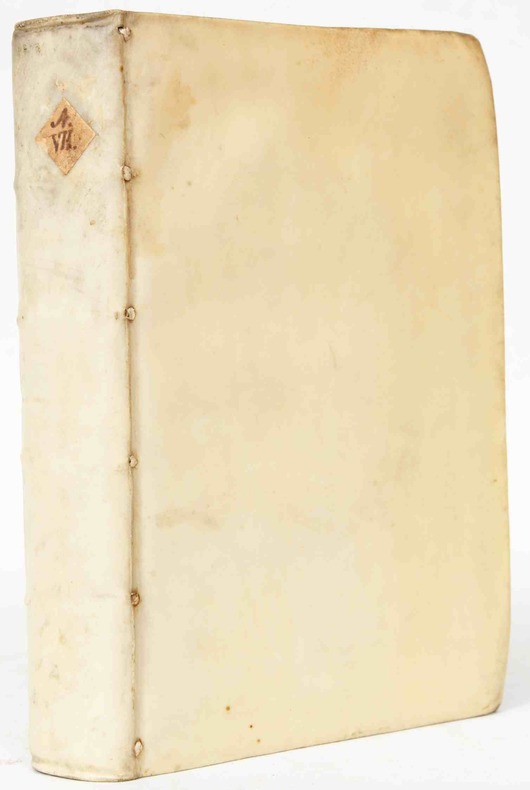
154414383Parisiis, Ex officina Rob. Stephani, 1544. In-8 de 394-(14) pp. (sign. aa-zz, AA, BB8, CC4), vélin ivoire, étiquette ancienne sur le dos (reliure de l'époque).
174942104Paris, Vaneck, 1749. Titre et 20 gravures sur cuivre (12 x 7,5 cm) frappées par 4 ou 5 sur 5 feuilles (24 x 38 cm).[CHEVILLARD (Jacques)]. Methode facile pour apprandre le blason, ou l'on joint les armes accollees, des Princes, et Princesses Ducs, et Duchesses, et celles des Maisons des plus considerables de France, avec les Explications des ornements exterieurs. Paris, Vanheck, 1749. 71 gravures sur cuivre (12 x 7,5 cm) frappées par 3 ou 4 sur 18 feuilles (24 x 38 cm).Ensemble 2 suites reliées en 1 vol. in-folio, demi-chagrin prune à coins, dos fleurdelisé à nerfs, double filet doré d'encadrement sur les plats (reliure du XIXe siècle).
15691Paris, Enguilbert I, Jean I et Geoffroy I de Marnef (impr Philippe Pigouchet), 1491. In-8 gothique (143 x 100 mm) de (96) ff. (sig. a-m8), maroquin brun, dos à 5 nerfs, quadruple filet d'encadrement et fleurons aux angles à froid sur les plats, tranches dorées (reliure du XIXe siècle).
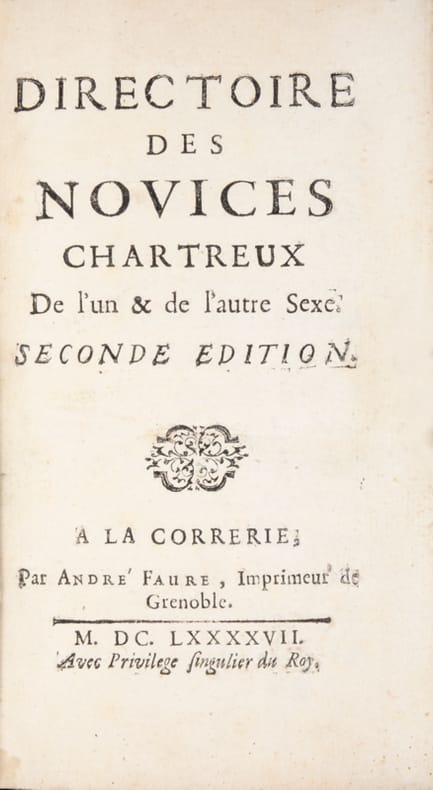
169042054La Correrie, Claude Faure, 1690. 2 parties en 1 vol. in-8 de (12) pp. (lettre-préface et table) 343-(3) pp., veau brun orné à froid, dos à nerfs, double encadrement et fleurons sur les plats, tranches rouges (reliure de l'époque).
168314992La Correrie, Laurens Gilibert, 1683. 3 parties en 1 vol. in-8 de (8)-191-(5) pp. 93 pp. 95-(1) pp., tables, veau brun, dos à nerfs, triple filet d'encadrement sur les plats, tranches rouges (reliure de l'époque).
178341804Paris, Imprimerie Royale, 1783. In-8 (199 x 120 mm) de (4)-49 pp., maroquin rouge, titre en long sur le dos «ÉPREUVE DE LA NOUVELLE PRESSE DE L’IMPR. ROYALE» encadré d’un double filet doré, triple filet doré d’encadrement sur les plats armes royales serties de la mention « Imprimerie royale », roulette dorée sur les coupes, dentelle intérieure, doublures et gardes de moire bleue, tranches dorées (reliure de l’époque).
8vo (105 x 159 mm). (3), 69 (but: 68), (1) ff. With two different woodcut devices to title-page and colophon; several pretty woodcut initials. Contemporary Italian carta rustica binding. Rare first Italian edition of these Fables of Bidpai. Reprinted in 1610 and again in 1872. First translated from the Pehlevi version into Arabic under the title "Kalilah wa-dimnah" by Ibn al-Muqaffa and subsequently into Greek by Simeon Seth, whose version is known under the title of "Stephanites kai Ichnelates". From this version the present Italian one is derived. - The ancient Sanskrit Panchatantra fables, a classic of the genre, are thought to have been assembled ca. 200 BC out of stories from an even older oral tradition. The stories became known in Europe through Hebrew translations of Arabic versions under the name Bidpai. Featuring animals as a mirror for human behaviour, the fables were intended to educate people, especially young rulers. - Binding a little stained. Interior shows occasional browning and very minor staining; old ink annotations to pastedown and flyleaf. An appealing copy. Chauvin II, p. 24, no. 38A. BM-STC Italian 309. Edit 16, CNCE 35122. OCLC 22606298. Not in Adams.
2 rad. Tafeln (ca. 556 x 328 mm und 546 x 290 mm). Folio. Die beiden berühmten, nach Volcher Coiters Biographen Robert Herrlinger "vollends originell[en] und wegweisend[en]" Kinderskelett-Tafeln aus den "Externarum et internarum principalium humani corporis partium tabulae" (Nürnberg, 1572). Nachdem der jungverstorbene Mediziner Coiter (1534-76), ein in Nürnberg wirkender Friese, nach seiner Zeit in Italien an keiner Universität mehr lehrte, hatte das Werk zunächst nur einen sehr eingeschränkten Leserkreis, und seine "Auflage kann nicht groß gewesen sein" (Herrlinger, 57). Bei den hier vorliegenden Tafeln handelt es sich um "die ältesten bisher bekannten [Abbildungen] aus dem Gebiet der Embyrologie und Kinderanatomie. Es handelt sich um zwei große Falttafeln von über einem halben Meter Höhe [...] Die erste zeigt das Skelett eines halbjährigen Kindes von schräg vorne, die zweite von schräg hinten; auf dieser ist als 'Abb. 3' ein kleines Skelett einer dreimonatigen Fehlgeburt hinzugefügt [...] Alle Abbildungstafeln sind wie immer mit V.C.D. signiert. Wenn sie auch nicht völlig korrekt sind, so ist vor allem an den beiden großen Kinderskeletten bemerkenswert, wie Coiter versucht, in reiner Schwarz-Weiß-Technik Knorpel und Knochen als zwei verschiedene Materialien zu kennzeichnen: er punktiert den Knorpel und läßt den Knochen weiß. Noch heute ist diese Art der Knorpeldarstellung üblich [...] Coiters Kinderskelette haben Schule gemacht. Felix Platter bringt in seinem anatomischen Lehrbuch von 1583 ebenfalls, als zweiter, Kinderskelette, die ohne Coiter kaum denkbar sind [...] Wirklich neue, bessere Abbildungen vom foetalen und vom kindlichen Skelett gab erst Thomas Kerckring (1670). Coiters Abbildungen waren ein ganzes Jahrhundert lang maßgebend gewesen" (ebd., S. 80). - Etwas braunfleckig; kl. Einrisse alt hinterlegt. VD 16, ZV 3754. R. Herrlinger, Volcher Coiter (Nürnberg, 1952), S. 79ff. (mit Abb.).
8vo. (8), 247, (1) ff. With woodcut printer's device on title-page, repeated on recto of final leaf. Contemporary limp vellum with traces of ties and remannts of a handwritten spine title. The twelve books on medicine by Alexander of Tralles, the first parasitologist in medical history (and the younger brother of Anthemius, architect of the Hagia Sophia), issued together with al-Razi's classic treatise on smallpox and measles ("Kitab fi al-Jadari wa al-Hasaba"): the first book ever published on smallpox, also known as "Peri loimikes" or "De pestilentia". - Indeed, Al-Razi was the first physician in the history of medicine to distinguish between smallpox and measles, and consider them as two different diseases. The influence of his diagnostic concepts on Muslim medicine was very clear, especially on Ibn Sina. This work gained great popularity in Europe and was also translated into French, English and German; Brockelmann states it saw some 40 Latin editions between 1498 and 1866. - Al-Razi (also known as Rhazes; 850-923 or 932) is considered the greatest mediaeval physician next to Avicenna; he also conducted alchemical experiments. According to his biographer al-Gildaki, he was blinded for refusing to share his secrets of chemistry. - Binding professionally repaired along the edges. Occasional browning and staining, some waterstaining near the end. 18th century ink ownership "A. Gonnella" to title-page. Rare; a single copy in auction records (Swann, 1 March 1979, Sale 1132: Distinguished Collection of Historic Medicine, lot 9). Edit 16, CNCE 1120. Wellcome I, 212. Durling 152. Cf. GAL S I, 419, no. 3. M. H. Fikri, Treasures from the Arab Scientific Legacy in Europe, No. 44 (Venice 1555 ed.). Not in Adams or BM-STC Italian.
8vo. 62, (2) ff. With wodcut printer's device on title page. Contemporary limp vellum with later giltstamped orange spine label and ms. spine title. Very rare Italian edition of the "Kitab al-Jawami", an Arabic work on the interpretation of dreams by an "Achmet, son of Seirim" - almost certainly identical with the 8th century Muslim mystic Abu Bakr Muhammad ibn Sirin. The work survived in a Greek translation ("Biblion oneirokritikon") prepared in the 12th century. "The author Ahmed served as interpreter of dreams to Caliph Al-Mamun around 820 [...] The mediaeval conflation of medicine with astrology originated with the Arabs. Through the Salernitanian school, which had many Arabic works translated, the notion reached Europe in the 11th century, where it remained predominant as late as the 17th and 18th century [...] In 1577 J. Loewenklau published a Latin translation of the Oneirokritiká of Ahmed, whom he calls Apomasar" (cf. Schöll). - Slight waterstaining and old ink ownerships and annotations to title page. BM-STC Italian 338. Edit 16, CNCE 40443 (title misspelt: "insonnii"). OCLC 1002786023. Not in Adams. Cf. GAL I, 66. Schöll, Geschichte der griechischen Literatur III, 487. Graesse, Bibl. mag. et pneum. 97.
Very Good French Original wrappers. Demy 8vo. (22 x 14 cm). In French. 33, [1] p., tables, and plates. First and only edition of this extremely rare treatise on How Kufic script is applied to print, a brief history of Kufic script, its use in ancient and modern times, examples of writing accompanied by illustrations, typesetting on the keyboard for linotype printing, its use on typewriters, its use in telegraphy (with Arab and international typesettings), etc. Ali Kenan (?-1962), married Emine Nemika Sultan (1888-1969) in 191 and became a groom to the Ottoman palace and the royal family. Only one copy can be traced in OCLC 1065045158, in The British Library, St. Pancras.
168142869La Correrie, per Laurentium Gilibert, typographum juratum apud Gratianopolim, 1681. In-4 de 348 pp. et (48) pp. d'index (sign. A-Z-Aa-Zz-Aaa-Ccc4, Ddd2), demi-veau havane, dos orné (reliure du XIXe siècle).
168143386Correriae, Per Laurentium Gilibert, typographum Juratum apud Gratianopolim, 1681. Petit in-8 de 339-(41) pp. 48 pp. (8)-91-(1) pp., index, errata (signatures: A-Aa dernier blanc, A-C a-f ), veau granité, dos orné à nerfs (reliure de l'époque).
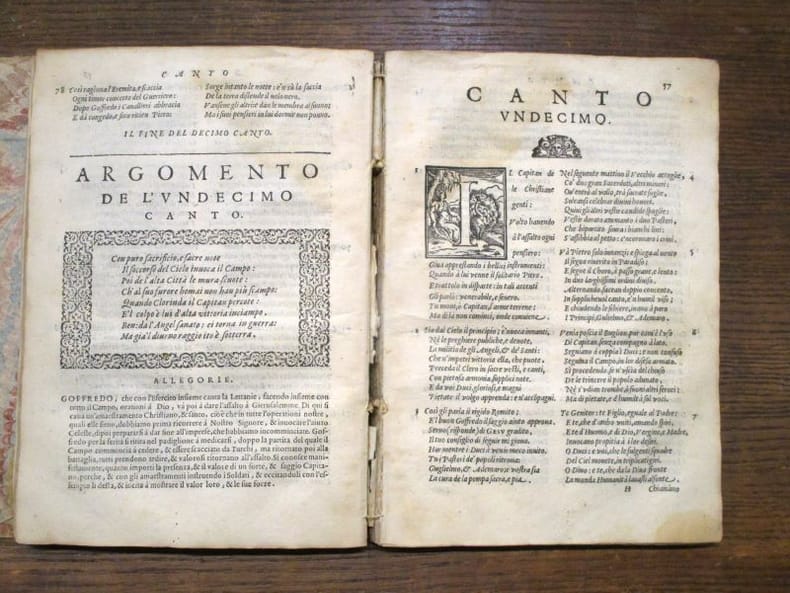
1581117826venise perchacino 1581 in-8 In Venetia [Venise], appresso Gratioso Perchacino [Grazioso Percacino], 1581, 1 volume grand in-8 de 150x210 mm environ, [10] ff., 112 pages, [11] ff. (table), incomplet : il manque 2 feuillets à la table des noms propres et le dernier feuillet de la table finale. Reliure cartonnée d'attente muette, plats recouverts de papier marbré. Exemplaire en partie dérelié, bas de la page de titre découpé (sans atteinte au texte), une déchirure en marge de la page 22, des traces importantes de mouillures, des sauts-erreurs-décalage de pagination, état d'usage.
158215603Paris, Imprimé Par Jean Le Blanc pour Julien Duval, 1582. Petit in-8 gothique de (108) ff. [aaaa8-oooo8]. 2 grand bois portent les initiales JLB (pour Julien Le Blanc) et 30 petites vignettes sur bois la plupart signées JLB. Imprimé en rouge et noir. Nombreuses initiales ornées. Les Quinze Effusions du tres precieux sang de nostre sauveur et redempteur Jésus-Christ. S.l.n.d. [Paris, Jean Leblanc, 1585]. Petit in-8 gothique de (8) ff. [A8]. 9 grands bois in texte portant les initiales JLB. Initiales ornées. La Vie de Madame Sainte Marguerite, vierge et martyre avec son oraison. Imprimé à Paris par Jean Leblanc, 1585. Petit in-8 gothique de (8) ff. [A8]. Vignette sur bois au titre. Les 3 pièces reliées en 1 vol. petit in-8 (11 x 7 cm), maroquin rouge, triple filet doré en encadrement sur les plats, dos lisse orné, pièces de titre en maroquin vert, dentelle dorée sur les tranches et filet doré sur les coupes, signet de soie bleue, tranches dorées (reliure du XVIIIe siècle).
4to. 165, (3) pp. With woodcut printer's device to title-page. Contemporary vellum. A very rare oriental grammar, unknown to Vater and Jülg: the first true grammar of Aramaic produced in France, expanded from Mercier's similarly titled "Tabulae in Chaldaeam grammaticen" published in 1550 (a slight work of a mere 18 leaves). The French oriental scholar Jean Mercier (ca. 1510-70) studied under François Vatable, whom he succeeded as professor of Hebrew at the Collège Royal. Created Lecteur du Roi in 1546, Mercier later was forced to flee to Venice because of his Protestant sympathies but returned to France and there died of the plague. "L'hébraïsant J. Mercier, auteur de la première grammaire araméenne parue en France, estime que la connaissance des langues maternelles des 'adversaires de la foi' permettra de les battre avec leurs propres armes sans leur laisser la moindre échappatoire" (S. Kessler-Mesguich, Hébraïsant-Chrétiens des XVIe et XVIIe siècles, p. 91). - Rare; USTC locates only 7 copies in libraries internationally, of which only one is in America (Houghton Library). - Lower corner of final leaf remargined; modern endpapers, using old paper. An attractive, tightly bound specimen. Adams M 1310. French Vernacular Books 79777. OCLC 457680439 (BnF copy). Not in Vater/Jülg.
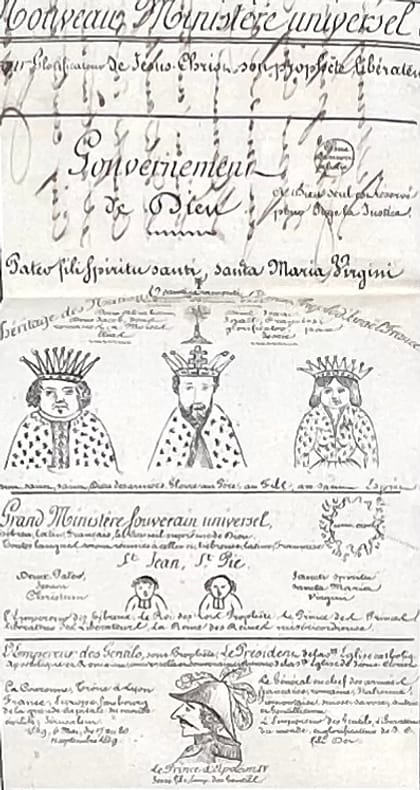
184943873(Lyon), Jacques-Nicolas Senocq, 1849. Placard autographié (560 x 440mm).
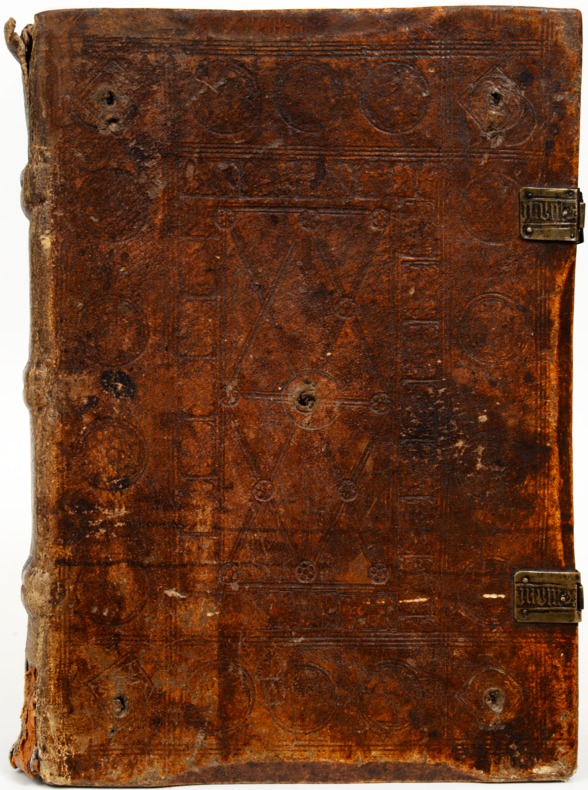
16006Ulm, Johann Zainer, [1478 ca]. Petit in-folio gothique (20 x 29 cm) de (418) ff. à 40 lignes par page, sans foliotation, réclames ni signatures dont 2 feuillets blancs (1er et 371e), peau de truie sur ais de bois biseautés, dos à trois nerfs, décor géométrique estampé à froid dans un encadrement de médaillons, titre manuscrit en noir sur le dos, fermoirs, traces de cabochons (reliure de l'époque).